THE RHYTHM SECTION (2020)

January 30, 2020

 Greetings again from the darkness. Kicking off a successful franchise that can sustain multiple sequels is the dream of most actors, writers, directors, and producers. When it clicks, a movie franchise can be a cash cow for many years. Unfortunately, it’s just not that easy to create characters that viewers will invest in, or story lines that will keep those viewers interested. Author Mark Burnell has already published four books in his Stephanie Patrick series, and director Reed Morano brings the first one to the big screen. By the time the end credits roll, we have little doubt that “franchise” was the goal.

An opening scene finds Stephanie Patrick (Blake Lively) pointing a gun at the head of a man who is unaware of her presence. A freeze frame shifts us to “8 months earlier.” Stephanie is a mess. She is supporting her heroin addiction through prostitution, all with the objective of numbing her pain. Three years earlier, her family was killed in a plane crash. It’s the kind of tragedy followed by a grief so devastating that Stephanie has basically given up on life.

Stephanie is jolted back to life when a journalist informs her that it was a bomb planted by a terrorist that brought down the plane her family was on. Now, Stephanie has a reason to exist … revenge. Clearly some suspension of disbelief is in order here. Actually everything about this story is a stretch from reality or even believability. Quick, name all of the heroin addicts who become world class assassins in 8 months. OK, that’s probably not a fair question since you likely don’t know many heroin addicts, and you hopefully don’t know many assassins. But you get the point.

The film plays like a brochure for a travel agent, as the story and Stephanie have stops in Tangier, England, Ireland, Madrid, New York, and Marseilles. Each stop is pretty brief – merely long enough for some killing. Of course most of the stops occur after former MI6 agent Ian Boyd (Jude Law) trains her on the finer points of being a contract killer. The training includes jogging uphill, a frigid lake swim, how to fight in the kitchen, how to get run off the road while driving, and the invaluable advice to shoot your victim twice (but your teacher only once). Oh yes, and she has to impersonate a presumed-dead assassin. Fortunately, Stephanie was top of her class at Oxford, so she is smart enough to make sense of all these things that make no sense to us.

And another thing … why do all these people have such perfect and complete files on their targets?  Photographs by Glamour Shots, map coordinates to hideouts, and an alphabetical list of known accomplices are all quite helpful when former MI6 and former CIA agents (Sterling K Brown) are trying to get a heroin addict to do their dirty work. Brown’s CIA agent turned ‘information broker’ is the oddest of many odd characters here. He lives in a stunning ultra-modern home and has no qualms about hitting on hot assassins that he knows only by reputation. Thanks to all those marvelously complete files, the only unknown here is the mysterious U17. Well, U17 seems to be mysterious to everyone except those watching the movie.

Blake Lively is a talented actress as evidenced by her work in THE TOWN, THE SHALLOWS, and A SIMPLE FAVOR. She is simply miscast here. Despite the “training” her Stephanie received from Ian, we never once believe she is ready to kill all the bad guys. This contributes heavily to the lack of believability presented by the film. It’s a serious story that is ultimately impossible to take seriously as a viewer.

There is a difference in believable and stylish, and director Reed Morano certainly serves up style. She is known mostly for her work as a cinematographer, though she did direct the first 3 episodes of “The Handmaid’s Tale.” Ms. Morano and cinematographer Sean Bobbitt hit us with some jarring camera work, and the musical inserts are just a tad too cutesy and obvious at their given time: “I’m Sorry”, “It’s Now or Never”, and “Where Did You Sleep Last Night?” (a cover by Sleigh Bells).

Having author Mark Burnell adapt his own novel may have been a mistake, as there are far too many plot holes and ridiculous moments for this to work as any type of thriller. Here are three examples: we never know why Stephanie didn’t get on the flight with her family; it makes little sense that the journalist tracked her down; and is that supposed to be a twist or not? Given the inclusion of Bond producers (and half-siblings) Barbara Broccoli and Michael G Wilson (stepson of Cubby Broccoli), we can safely assume that the vision was to turn Mr. Burnell’s books into a franchise along the lines of James Bond and Jason Bourne – right down to the fight scenes and international settings. This film certainly sets things up for round two, and if that happens, let’s hope more attention is paid to the script … a crucial element if viewers are expected to buy in.

watch the trailer:


MAKING APES: THE ARTISTS WHO CHANGED FILM (doc, 2020)

January 30, 2020

 Greetings again from the darkness. Movie make-up can be obvious and crucial to the character. Think about John Hurt in THE ELEPHANT MAN (1980) and Eric Stoltz in MASK (1985). It can also be subtle with quiet influence – think Grace Kelly in REAR WINDOW (1954), Julia Roberts in PRETTY WOMAN (1990), and Anne Hathaway in THE DEVIL WEARS PRADA (2006). Director William Conlin steps out of the world of Reality TV (“Animal Zone”) and into the world of make-up artists, whose job often consists of making the unreal look real. The power of movie make-up is described as magic.

As the title implies, the focus here is on director Franklin J Schaffner’s ground-breaking 1968 film PLANET OF THE APES. It is deservedly considered a turning point in movie make-up, as it proved if believable talking simians could be created, nothing was impossible. A “turning point” also means there was a ‘previous’ and a ‘since’, and Conlin’s documentary suffers from a lack of direction in those two segments. In his defense, a complete timeline of movie make-up would require much more than 90 minutes. Furthermore, additional time devoted to either the early years or the more recent years, and the importance of PLANET OF THE APES (POTA) would get lost. As you would expect, the doc is at its best when it focuses on the POTA make-up team and their process for those ‘darn’ dirty apes.

WWII Secret Agent Pierre Boulle’s 1963 science-fiction novel “La Planete des singes” (known as “Monkey Planet” in the UK) serves as the source material for the 1968 screenplay written by two legends: Rod Serling (“The Twilight Zone”) and 2 time Oscar winner Michael Wilson. Boulle also wrote the 1952 novel “The Bridge over the River Kwai”, which was renamed THE BRIDGE ON THE RIVER KWAI for the Oscar-winning film from director David Lean in 1957. 20th Century Fox was having financial troubles in the 1960’s, and it was acclaimed Oscar-winning actor Charleston Heston (BEN-HUR, 1959) who pushed to get a green light from the studio.

John Chambers had made a name for himself in both TV and movie make-up when he was hired for POTA. Chambers put together quite a staff, including Thomas R Burman, who spends a great deal of time on camera here recollecting Chambers and the backroom struggles and challenges faced by the crew. For the film to work, the apes needed not just to talk, but to emote; and even today … more than 50 years later … the make-up still looks great on screen. Mr. Chambers was awarded an Honorary Oscar for his work on POTA, as make-up did not become an official category until 1981.

Director Conlin opens the film with a history lesson – a lesson that actually feels too brief and incomplete. We hear about the work Lon Chaney and Jack P Pierce (FRANKENSTEIN, 1931) in those early Universal Studios monster movies, as well as the legendary Cecil Holland, who was behind the make-up on THE LOST WORLD (1925) and THE WIZARD OF OZ (1939). These early artists are held up as the inspirations for those who chose make-up as a career. Seven-time Oscar winner Rick Baker (AN AMERICAN WEREWOLF IN LONDON, 1982), four-time Oscar winner Greg Cannom (THE CURIOUS CASE OF BENJAMIN BUTTON, 2008), and four-time Oscar winner (now deceased) Stan Winston (TERMINATOR 2: JUDGMENT DAY, 1991) each speak highly (in recorded interviews) of their predecessors, and we also hear from directors who were inspired by their work: Guillermo del Toro (PAN’S LABRYNTH), Joe Dante (GREMLINS), Richard Donner (SUPERMAN), and John Landis (THE BLUES BROTHERS).

The modern day discussions address how the new generation is moving towards CGI and digital visual effects. Vincent Van Dyke speaks to today’s movie-making and how some of John Chambers’ early work is still used, and how digital effects are now commonplace not just in cinema, but also in TV work. He links the early POTA with the new generation of apes introduced in Tim Burton’s 2001 reboot, as well as the new Ape films that followed. Respect for the early masters is evident, but it’s easy to see how digital effects and traditional make-up are often at odds … leading us to believe a future documentary is likely to focus on this contrast.

PLANET OF THE APES premiered on March 28, 1968 and the backstories of those involved are quite entertaining. John Chambers is worshipped in the industry as both an artist (BLADE RUNNER, 1982) and as a crew leader with a temper. Conlin spends very little time (not enough in fact) on Chambers role with the CIA in the story told by the Oscar winning film ARGO. POTA director Franklin J Schaffner won an Oscar for directing PATTON (1970), and his resume also includes NICHOLAS AND ALEXANDRA (1971), PAPILLON (1973) and THE BOYS FROM BRAZIL (1978). He was also the TV adviser to John Kennedy during his campaign and presidency, and was the director of “A Tour of the White House with Mrs John F Kennedy” – a 1962 TV special broadcast to 80 million users. We also have actor Lou Wagner, who played Lucius in the original. Mr. Wagner and Mr. Burman (INVASION OF THE BODY SNATCHERS, 1978) are still regular speakers at the festivals and special screenings of their movie … the cult still thrives all these years later.

Despite the documentary sprinting through some important and interesting times, we walk away with a better understanding of how the artistry of make-up not only inspires actors, it can also help define the character for viewers. Make-up artists form a close-knit community, although one that may be fading due to digital effects. Standing as a legacy we have the 1968 PLANET OF THE APES, followed by its many sequels, TV series, and animated series. And you’ll just have to watch the documentary to find out how the great Edward G. Robinson played a role in the success of ‘Apes.’

watch the trailer:


INCITEMENT (Israel, 2019)

January 30, 2020

 Greetings again from the darkness. Since November 4, 1995, the day that Yigal Amir shot and killed Israel Prime Minister Yitzhak Rabin, speculation has existed that there could have been peace in the Middle East – if only the assassination had not occurred. The film opens on the first Oslo Peace Accord in 1994. Why was there a segment of the population concerned about possible peace? They were angry at the idea of surrendering their “promised land” to Palestinians and the Chairman of the PLO, Yasser Arafat.

Writer-director Yaron Zilberman and co-writers Yair Hizmi and Ron Leshem aren’t focused on what an end to the hostilities might look like today. Instead they offer up a psychological study of Yigal Amir (played by a forceful Yehuda Nahari Halevi) and what drove him to take the fateful action that changed the course of history. The film is presented as a slow-build thriller, and it mainly takes us through Yigal’s transformation from activist to assassin … a giant and significant step.

Yigal is a Law student at Bar-Ilan, and the college campus is filled with protests and tables dispensing information on all sides. Soon enough, Yigal is seeking counsel from rabbis who seem to be on board with revenge. When someone becomes obsessed, it’s not uncommon for them to ‘hear what they want to hear.’ Yigal sees Rabin fitting into the Jewish law of “pursuer/Rodif and Informer”, and he believes himself to be guided by Talmud and rabbis. The film is not about Yigal’s glory, but rather WHY he did it.

Alternatingly charming and frightening, intelligent and foolish, Yigal organizes a rebel movement for what he sees as a coming war. To him, there is no line between religion and politics. With archival footage of Netanyahu speaking out against Rabin and the peace project, it just pushes Yigal that much closer to action. There are three women who cross paths with Yigal and have varying impacts on him. His mother convinces him he is due for greatness (again, he interprets in his own way); Nava (Daniela Kertesz) is attracted to him, but can’t come to grips with his beliefs; and Margalit (Sivan Mast), who respects Yigal and understands how to lead him deeper down his chosen path.

There is a terrific scene between Yigal and his father, where the parent is emphasizing to the son he knows he’s losing that only the hand of God should determine Rabin’s fate … not an idealistic young man. The Oslo II accord from 1995 leads Yigal to conclude that Rabin is a traitor, and that it’s God’s will for Yigal to “let him go out like a tyrant.” This is all chilling to watch, and it helps us comprehend the vicious cycle of violence that plagues the Middle East. The film was Israel’s official submission for Academy Award consideration.

watch the trailer:


THE GENTLEMEN (2020)

January 23, 2020

 Greetings again from the darkness. Let’s get this out of the way upfront. Filmmaker Guy Ritchie’s return to London crime-comedy is most assuredly a bit too far removed from today’s acceptable Politically Correct line. It features mostly male characters and far too many stereotypes to count. It’s also ridiculously funny. Mr. Ritchie doesn’t take his story or characters too seriously, but he proves yet again that he’s serious about entertainment.

The film begins with Matthew McConaughey ordering “a pint and a pickled egg”, a jolt to the senses, and a very cool opening credits sequence (think James Bond). We then find Fletcher, a sleazy private detective, making a surprise appearance at Ray’s (Charlie Hunnam) house. Fletcher is played by a deliciously smarmy Hugh Grant. He is trying to extort 20 million from Ray by offering up the details he has uncovered about Ray and his boss, marijuana kingpin Mickey Pearson (McConaughey). Conveniently, Fletcher has turned the story into a screenplay, which he has generously agreed to include for the 20 million.

It’s tricky business trying to make drug dealers likable, and Ritchie steers clear of this despite the presence of a few. In addition to Mickey, we have Matthew Berger (Jeremy Strong) who is trying to buy Mickey’s business; Lord George (Tom Wu), who controls the Chinese syndicate; and Dry Eye (Henry Golding), an ambitious underling of Lord George who is anxious to make his own way, by any means necessary. Other players here include Mickey’s wife Rosalind (Michele Dockery, “Downton Abbey”, “Godless”) who runs a “safe space” garage for exotic cars owned by women; Coach (Colin Farrell) who runs a boxing gym for troubled young adults; and Big Dave (Eddie Marsan), a tabloid editor seeking revenge for a dinner party where he felt Mickey disrespected him.

As if all of those characters don’t provide enough humorous crime fodder, we also have a Russian Oligarch, street gangs, heritage estate owners in need of cash, YouTube fight porn, and the plight of Laura Pressfield (Eliot Sumner, Sting’s daughter) in a heroin haven. Fletcher’s ongoing narrative for Ray provides the framework for the film, and each scene is filled to the rim with clever and wise-cracking dialogue – often delivered with flair by one of our colorful characters. Mr. Grant and Mr. Farrell are exceptionally fun to watch, and Ms. Dockery leaves us wishing her Rosalind was more prominently featured.

For some reason he’s never been a critical favorite, though Guy Ritchie garnered a cult following with his early frenetic crime flicks LOCK, STOCK and TWO SMOKING BARRELS (1998) and SNATCH (2000). Lately he’s been focusing on big budget films like SHERLOCK HOLMES (2009), SHERLOCK HOLMES: A GAME OF SHADOWS (2011), THE MAN FROM U.N.C.L.E. (2015) and ALADDIN (2019). He’s back to his roots here, and is joined by many actors and crew members he’s worked with before. Ritchie co-wrote the screenplay with Ivan Atkinson and Marne Davies. His cinematographer is Alan Stewart (ALADDIN) and his film editor in charge of those signature smash-cuts is frequent collaborator James Herbert.

Quick listening pays off in some deadpan one-liners that might otherwise sneak by, although most of them can’t be repeated here. The “c-word” most frequently used in the film is not ‘cash’, and is rarely a term of affection. There is even a Miramax gag. Too soon? Only you can decide. It’s rare for McConaughey to play the heavy, and he seems to relish the opportunity. But then most of the actors seem to really enjoy delivering these lines and wearing these clothes … well except for Colin Farrell’s track suits and spectacles! Certainly this one isn’t for the masses, and undoubtedly people will be offended. This is what happens when you make Guy Ritchie play nicely for a decade.

watch the trailer:


QUEZON’S GAME (2020)

January 23, 2020

 Greetings again from the darkness. I’ve stated it many times before, and it’s proven true again here … WWII continues to be a source for stories big and small. Stories of heroes, and stories of victims. Some of these stories are very personal, and some have historical significance – even if we may only know fragments of the full events. The first feature film from Matthew Rosen combines these elements as he brings to the screen the fascinating role of Philippines President Manuel Quezon in providing asylum to Jewish refugees.

The film is bookended with an ailing President Quezon (played by Raymond Bagatsing) watching a Holocaust newsreel with his wife Aurora (Rachel Alejandro) as he convalesces at Saranac Cove Cottage in 1944. He turns to her and asks, “Could I have done more?” We then flashback six years to 1938. The screen explodes with vibrant colors as we land in Manila, the Capital city of The Philippines.

Jewish-American Ambassador Alex Frieder (Billy Ray Gallion) receives a telegram warning from Germany, and what follows is a glimpse at the behind-the-scenes political maneuverings, rather than a direct focus on the atrocities of concentration camps. President Quezon (and his wife) are presented as compassionate and empathetic towards the plight of the Jews in Germany. They are committed to helping even if it’s not a prudent political approach and it goes against their advisors. Someone does mention that Germany is “technically not our enemy” … “no matter how much we hate the SOBs.”

It’s especially interesting (and probably unknown to the majority of Americans) that U.S. High Commissioner to the Philippines, Paul McNutt (James Paoeli), played a key role in what basically amounted to going against the orders of the U.S. Government in arranging safe passage for the Jewish refugees. McNutt had seen himself as a successor to FDR as President of the United States – a dream that ended when FDR ran for a third and fourth term. Also playing a key role was Dwight Eisenhower (David Bianco), who was a military adviser, and even offered the position of Philippines Chief of Police by Quezon. Of course, after the war, Eisenhower went on to serve two terms as President of the United States.

Co-writers Janice Y Perez and Dean Rosen, along with director Rosen, have uncovered a terrific piece of history, and with the steady stream of white suits, fat cigars, and clinking cocktail glasses, the film has the right look for a historical drama. It’s really the dialogue and execution that come up short. We never quite believe these situations are anything but staged, which results in a negative impact on the drama and tension. The Philippines were under U.S. control from 1898-1946, and Quezon was fighting for his country’s independence at the same time he faced other challenges internal to the country, his own health issues (tuberculosis), and possible ramifications for defying the U.S. The obvious comparison here is to SCHINDLER’S LIST, and while not at that level, Quezon’s actions provided asylum for 1200 Jews and make for a story that deserves to be told. The closing credits are filled with clips of survivors telling their stories … the perfect ending.

watch the trailer:


ELSEWHERE (2020)

January 23, 2020

 Greetings again from the darkness. One of the best things about movies is that there are no rules. Most any story can be told by most any filmmaker in any way they see fit. Some people watch movies for escapism and purely for entertainment purposes, while others are looking for mental and creative stimulation. A separate category of movies would be what I call Lifetime Channel movies, which have been described by a friend as ‘melting brain cells faster than open bar night in Baton Rouge.’

Now to clarify, not all ‘Lifetime Channel movies’ are shown on that particular network. No, it’s more of a sub-genre that, when mentioned, is immediately recognizable to most movie lovers. As an example, take this synopsis: A handsome architect builds a seaside cottage for his beloved wife. She dies from a terminal disease, and the man goes into an emotional funk treating the house as a memorial to his wife. After two years, his wealthy in-laws evict him from the house. A spirited divorcee buys the house, and after their initial conflicts, the widower and divorcee hit it off. She brings the house and the widower back to life.  All of that is in the trailer, so I haven’t spoiled anything.

Heck, I wish there was something to spoil here, but writer-director-editor Hernan Jimenez knows what his audience wants and never leaves the path. He bookends the movie with the husband holding the urn containing the ashes of his deceased wife. We note he is surrounded by the wonder of nature: a forest of majestic trees, a gorgeous waterfall, and the picturesque coastline (filmed in Canada). Bruno is played by Aden Young, and it’s clear he has an unhealthy attachment to the house he designed and built on land owned by his wife’s parents. They give him two weeks to vacate, and Bruno moves in with his quite supportive parents (Beau Bridges, Jackie Weaver), while his loyal friend played by Ken Jeong is often close by.

Things pick up when Marie (Parker Posey) buys the cottage and hires Bruno as a contractor to bring her visions for the house to life. Of course, Bruno doesn’t tell her about his connection to the house, and somehow in this dinky little town where everybody knows everybody, no one else tells her either. As the two develop a relationship, Bruno never loses sight of his goal to get the house back. Marie is a charming and spirited woman who is writing a book on the link between moss and our lives. It’s really Marie’s outlook on life that makes the movie watchable at all, and in fact, focusing on her character likely would have provided more interesting options for the filmmaker. An even better scenario finds us crossing paths at that Baton Rouge open bar night.

watch the trailer:


BAD BOYS FOR LIFE (2020)

January 16, 2020

 Greetings again from the darkness. “Whatcha gonna do when they come for you?” In this third entry of the franchise, those song lyrics are what we are asking cocky and aging Miami detective Mike Lowery (Will Smith). An old case comes back to haunt him and a scorned lover comes back to hunt him, and he may or may not have his old reliable partner Marcus Burnett (Martin Lawrence) by his side.

It’s been 25 years since director Michael Bay introduced us to ‘Bayhem’ with his first feature film, BAD BOYS. It took another 8 years for the sequel BAD BOYS II, and now 17 years later, we get this long-anticipated third film. Only instead of Michael Bay (who is listed as a producer and makes a cameo), Belgian directors (and former film school buddies) Adil El Arbi and Billal Fallah are directing. Fans of the franchise need not be worried, as the two expected and necessary elements are present: partner banter and Bayhem action.

Detective Mike Lowery (Smith) is an old school bull with a badge, and Detective Marcus Burnett (Lawrence) is simply ready to ride off into the sunset of retirement as Pop-Pop with family, including his new grandbaby. Also back for his third run with the bad boys is stressed out Captain Howard played by Joe Pantoliano and the ever-present Pepto Bismol.

Isabel Aretas (Kate del Castillo) is sprung from jail in Mexico by her son Armando (Jacob Scipio). Mother and son have two missions: take back their drug cartel, and take revenge on those responsible for her arrest and the death of Isabel’s husband. Oh yeah, Isabel is part-witch and a former lover of rookie cop Mike Lowery. What a tangled web … and that’s without including another surprise twist. Their revenge checklist includes many Miami dignitaries … and a vow to make Lowery the last to die.

There is another surprise near the beginning of the film, and that motivates Lowery to get involved to help solve the string of murders – not yet aware that he’s on the list. Of course Detective Burnett is drawn out of retirement and they are forced to work with a new Special Forces team called AMMO. Surprisingly, neither of the ‘Ms” stand for Millennial, and instead it’s Advanced Miami Metro Operations. The team is led by Rita (Paolo Nunez), another former Lowery lover, and includes badass Kelly (Vanessa Hudgens), hulky computer whiz Dom (Alexander Ludwig), and wise-cracking Rafe (Charles Melton) as a verbal sparring partner for Lowery.

What follows is car chases, shootouts, fancy weapons, drones, and helicopters. And lots of one-liners at stressful moments. Lawrence is especially effective with the banter, and fans will be happiest when he and Smith are jabbing back and forth. This time, much of their grief towards each other focuses on mortality and growing old. The partners are close, but their life philosophies vary greatly. Of course we do get the fiery finale, and this one involves a helicopter and a stunning hotel that’s been left in ruins.

Chris Bremner, Peter Craig, and Joe Carnahan (originally slated to direct) wrote the script, and for the most part stays true to what the fans want – banter and action – while making note of the 17 years that have passed for these bad boys, “Ride together. Die together” always seemed like an absurd phrase for two cops, but the partner dynamics are in full force here, even though this movie (as well as the other two) are closer to live action cartoons than an actual police thriller. The end credits scene sets us up for BB4, and if they wait another 17 years, I calculate Will Smith will be 68 years old. Instead of a Porsche, he’ll be driving a Buick.

watch the trailer:


FILM SCHOOL AFRICA (doc, 2019)

January 16, 2020

 Greetings again from the darkness. The reason for the delayed release is unknown to me (it was filmed in 2017), and has no bearing on the inspirational message and story provided by Nathan Pfaff’s film. In this era of divisiveness and distasteful comments and judgments, it’s a true pleasure to watch folks dedicating themselves to a cause that changes the lives of those less fortunate.

Between 1941 and 1991 Apartheid racially divided the country of South Africa. The line between rich and poor was almost exclusively black and white, and even 30 years later, many of the impoverished citizens have been unable to improve their standard of living. When hope is lost, all is lost. And hope is what Hollywood casting director Katie Taylor was offering when she founded Film School Africa (FSA). For those raised in poverty, filmmaking was never considered a viable career option – it was for “them” not “us”.

Ms. Taylor changed that in 2008 by offering eager youngsters the opportunity to learn filmmaking techniques. Her classes covered how to hold a camera, how to shoot a scene, editing techniques, how to effectively use music and sound, and the details of structuring a 3-act story. All of this was new to the first class of students, but the enthusiasm was infectious. It was clear, the class had made a difference for these students.

Eight years later, with a blossoming career in film, Ms. Taylor decided to leave it all behind and return to South Africa – making FSA her life’s work. She sensed that “Art Therapy” could not only turn the personal lives of these students into fascinating film projects, but more importantly the skills she was teaching could offer the students a path out of poverty. These personal lives included abuse, alcoholism, poor nutrition, and overall challenging family dynamics.

We also meet Marie, a professional film editor and native to South Africa. Her work with FSA began as something temporary where she was helping out, but evolved into her being someone the students and Katie depend on. The enthusiasm and energy of these students makes us excited for them. We look forward to seeing clips of their work, and mostly we enjoy watching as they take on new skills and learn the value of collaboration and teamwork.

When asked what they want to accomplish with filmmaking, the students’ answers include “be awesome” and “change the world.” They get it. They know film gives them a shot they never dared dream of. It’s easy to see that Katie Taylor has found her life’s calling, and the students show her the ultimate respect by giving her the title “sisKatie”. She is a mentor, yet so much more. One of the students describes her as becoming a mother to the black community. It’s people like Katie Taylor who give us hope that the racial divide may one day vanish.

watch the trailer:


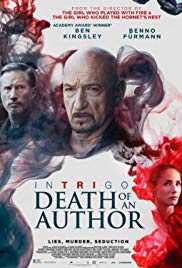
INTRIGO: DEATH OF AN AUTHOR (2019)

January 16, 2020

 Greetings again from the darkness. Daniel Alfredson directed two of the three films in the original “Millenium” trilogy by fellow Swede, the late Stieg Larsson. He handled THE GIRL WHO PLAYED WITH FIRE and THE GIRL WHO KICKED THE HORNET’S NEST. Alfredson has now signed on to direct a trilogy of films based on Hakan Nesser’s “Intrigo” novellas. This is the first in the series, with “Dear Agnes” and “Samaria” coming soon (each with completely different casts).

Nesser’s stories have been adapted for the screen by Alfredson and Brigitta Bongenheim, and they face the challenge of all crime stories making the move to movies … how to create an equal level of suspense. Benno Furmann (JOYEUX NOEL, 2005) stars as David, a translator by profession who has written his first novel. We first see David on vacation with his wife Eva (Tuva Novotny, ANNIHILATION, 2018), who spoils his plans by telling him she is leaving him for her therapist. We next see him planning or imagining her death.

Flash forward three years and David has arranged a meeting with successful writer Alex Henderson (Sir Ben Kingsley, Oscar winner for GANDHI, 1982) in hopes of receiving advice on his debut novel. Their meeting takes place at Henderson’s isolated island retreat, which serves as his primary residence away from ‘people’, the lot of whom he readily admits he doesn’t much care for. Henderson agrees to let David read passages of his novel, and the ‘cat and mouse’ game is afoot.

David has been contracted to translate the final book of Austrian writer Germund Rein, who recently committed suicide (mysteriously) while at sea. As the twists and turns unfold, David begins to wonder if there is a connection between Rein and his own story. A simple cough heard while listening to a radio concert sends David on the road. He discovers a code within Rein’s manuscript, and the film bounces between the multiple stories and layers.

When David’s fiction crosses over with his own reality, it’s our job as viewers to keep up and distinguish between the two. It’s not always easy as the structure seems designed to confuse. On the other hand, some of the aforementioned twists and turns might as well have neon signs explaining what is about to happen, why it happens and how it is related to what has already happened. Because of this, the film lacks the tension suspense and conflict necessary for this type of story. Storytelling is the focus, but it’s that storytelling that is the film’s downfall. While it’s always fun to watch Kingsley tear into a role, and some of the scenery is drop-dead gorgeous, we do hope the next two chapters of Nesser’s books transfer better to the screen.

watch the trailer:


THE HOST (2020)

January 16, 2020

 Greetings again from the darkness. The success of Ryan Murphy’s “American Horror Story” has inspired many writers and filmmakers to dive headfirst into the genre. The results have been mixed – some really creative works, and some ho-hum copycats. What has been interesting to watch is the genre-bending (or stretching) when what traditionally would have been a suspenseful drama or thriller, has elements of horror added to spice things up. That’s my best lead-in for director Andy Newbery’s film based on a story by Laurence Lamers, and adapted for the screen by Lamers, Finola Geraghty, Brenda Bishop, and Zachary Weckstein.

Sixty years ago this would have fit right in as an episode on “Alfred Hitchcock Presents”, even down to the bookend therapy sessions led by the fine British actor Derek Jacobi as Dr. Hobson. He tells his patient (whose face we don’t see) that his is “an unusual and disturbing case.” We then ‘see’ the story unfold … or maybe unravel is a better description. Robert Atkinson (played by Mike Beckingham, younger brother of Simon Pegg) is a bank employee enjoying a lunch break tryst with a beautiful woman. Sarah (Margo Stilley, 9 SONGS) just so happens to be married to Robert’s boss, and she clearly has only one use for Robert since he has no money and his life is a mess.

It’s not long before we discover Robert has many vices: gambling, smoking, drinking, and of course, romping with married women. In a moment that can be attributed to a desperate attempt to legitimize his existence, Robert nabs a 50,000 pound cash deposit from a new bank customer and promptly heads over to his favorite gambling hall. Things don’t go well, and dumb-as-a-rock Robert is soon cutting a deal with Chinese cartel leader Lau (played by the always reliable Togo Igawa).

Robert’s deal sends him to Amsterdam, a city where many things can go wrong – and often do. Local resident Vera Tribbe (Maryam Houssouni) offers Robert a room in her mansion, and, as we expected, things don’t go well for him. Both the cartel and Robert’s brother Steve (musician Dougie Poynter) are on the trail to find out what happened to Robert. DEA Agent Herbert Summers (played by Nigel Barber and his silky voice) is also involved, and what we find is a whole bunch of ‘nothing good’ thanks to the creepy rich Tribbe family,

Familiar faces pop up throughout the film, yet it’s difficult to buy into the sense of dread when most of the characters are making the kind of dumb decisions that Geico riffed in their commercial about ‘the running car’ and hiding behind the chainsaws. The lessons are pretty simple. Don’t steal money. Don’t sleep with your boss’ spouse. Don’t agree to run an errand for the Chinese cartel … or any other cartel flavor. Only if you can overlook the cluelessness of the characters will you find some entertainment value here.

watch the trailer: