#NOJOKE (doc, 2019)

October 24, 2019

 Greetings again from the darkness. Bullying generates insecurity, hatred, and fear. The definition of bullying can range from calling someone a derogatory name, verbally abusing them, physically intimidating them, or causing actual physical pain. It’s an abuse of power that can happen at any age and in any environment. Los Angeles-based Canadian musician Andrew Cole set out a few years ago to create an all-star anti-bullying song … something similar to what “We are the World” did for the starving people in Africa in 1985.

Mr. Cole spends much of the film’s run time on camera, and he explains his motivation for starting the project. He attended approximately 20 schools and was often the “weird” kid or “newbie”, and he believes that made him an easy target. Part of his project involves trying to track down Paul Blades, a particularly evil bully he recalls. Cole also explains how his own Dad could flip a switch from being a great guy to a terrifying presence. He refers to these memories as scar tissue. It’s at this point when we begin to question whether Cole’s project is for the greater good, or simply for his own therapy.

Some time is spent on his efforts to convince celebrities and famous musicians to jump on board. Mr. Cole mostly seems to be winging it during the early phases, almost like he expects people to jump at the chance to work with an unknown musician with no foundation or charity backing him. Cole even goes so far as to label this as a form of bullying … celebs using their power to shut down the little guy with a dream. Doors do begin to open, once Jeff Goldblum agrees to play piano on the song.

Documentarian Manfred Becker is charged with turning years of footage into something coherent for viewers. Unfortunately, rather than focusing on the topic, there are segments included that appear to be there for no reason other than Cole’s ego. Specifically, a stunt at the front gate of Chateau Marmont and a ride-along with the paparazzi as they chase Harrison Ford down the street. The big news is apparently that Harrison Ford is caught texting while driving. The film is at its best when Cole is not talking, but rather letting others have their say. Watching Jane Lynch, Patrick Stewart and Michael Biehn admit to having been bullies in their younger years is powerful. Visiting Columbine High School and “the world’s worst parent”, Lenore Skenazy, is fascinating and insightful.

We are informed that 50% of youth suicides are related to bullying. Of course bullying has been a topic for generations, and it’s a topic that needs to remain in the forefront. Unfortunately, having a great idea, a great cause, or even a great song doesn’t ensure a great documentary. More research into the mentioned connection between bullying-hate crime- genocide could have elevated this look at the complex issue of the psychology of bullying. “Hurt people hurt people” (spoken by Russell Simmons) provides more insight than clips of Slash strumming a guitar. Hate, guilt, and forgiveness all play a role here and deserve more than a quick mention. Hopefully the film and Cole’s song, “Do You Think I’m a Joke?” can make a difference for the Center for Abuse Awareness.

watch the trailer:


THE LIGHTHOUSE (2019)

October 17, 2019

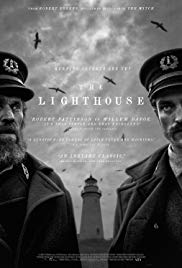
 Greetings again from the darkness. The opening sequence plays like something from 1920’s era cinema. The chug-chug-chug of a boat slamming against the waves of an angry sea while birds flap and chirp alongside. We hear the wind and “feel” the severe ocean spray. Several minutes elapse before any word is spoken. Immediately noticeable is the nearly square aspect ratio … the rarely (these days) seen 1.19:1 frame, making the black and white images appear both surreal and ominous.

All of the above makes perfect sense when we realize this is writer-director Robert Eggers’ first feature film since his 2015 indie horror gem THE WITCH won dozens of festival awards. Mr. Eggers obviously has his own vision for projects, and his approach borders on experimental, eschewing conventional. He co-wrote this script with his brother Max, and evidently much was drawn from the actual journals of lighthouse keepers … something that is evident in the vocabulary and the effects of solitude.

4-time Oscar nominee Willem Dafoe stars alongside Robert Pattinson as the two men charged with a 4 week assignment of tending to a lighthouse. The film is set in 1890, and Dafoe plays Thomas Wake, the epitome of a salty old sea dog, replete with bad leg, hardcore Atlantic accent, and upside down pipe. Pattinson is Ephraim Winslow, the assistant Wickie, who faces non-stop demands from Wake, and initially maintains a quietness as he goes about his duties … what Wake calls the ‘doldrums.’ We learn little about either man’s past. For Wake, other than knowing his previous assistant went mad, the clue is when he mentions “13 Christmases spent at sea” costing him a family. For Ephraim, when Wake asks, “Tell me what’s a timberman want with being a Wickie?” we get some insight into Ephraim’s desired future.

Eggers has delivered the anti-buddy movie. It’s a bleak, slow-motion race to insanity caused by being isolated with only one other person … a person you aren’t fond of. Only this is not a director or a film content with showing two men stuck on a storm-battered rock, as they slip towards insanity. No, we viewers are forced to experience some of these same feelings – how much of what we see is actually happening? It’s mesmerizing and hypnotic, and the above-mentioned narrow screen aspect purposefully emphasizes the sense of confinement and claustrophobia.

With no color and only a couple of characters … OK, 3 if you count the mermaid …OK, 4 if you count the seagull … the film still manages to pound us with sensory overload. We can barely process all we are seeing, despite relatively minimal ‘typical’ action. The black and white images are mostly just various shades of gray, and sunshine is non-existent.  Cinematographer Jarin Blaschke (THE WITCH) embraces the dreariness by allowing the fog, lanterns, candles, wind, rain, and harsh elements to become characters unto themselves. However, nothing is in sync with our two leads. Composer Mark Korven fills the many lapses in dialogue with sounds and tones we haven’t heard before, yet they fit perfectly here. This is also quite likely the first film to utilize farts and foghorns in harmony.

Director Eggers filmed this on Cape Forchu in Nova Scotia, and the extreme weather and less-than-welcoming terrain create quite the visuals – as do the faces of our two lead actors. Dafoe may never have chewed scenery so delightfully as he does here, and Pattinson starts slowly before delivering his best work – including a ferocious rant that is fascinating to watch and contrast to his character’s first meal with Dafoe. Is this a horror film? A fantasy? Macabre comedy? There is simply no way to describe this other than bizarre. It’s truly miserable cinema, and I loved every minute of it.

watch the trailer:


PAIN & GLORY (2019)

October 17, 2019

 Greetings again from the darkness. This marks the 13th Pedro Almodovar movie I’ve seen over the last 33 years. There is no logical explanation for why I feel connected to his movies. It seems obvious I have very little in common with the provocative filmmaker from Spain who won an Oscar for his extraordinary 2002 film HABLA CON ELLA (TALK TO HER). Yet, his movies invariably strike an emotional chord with me – and none more so than his latest.

As with many of his previous films (and more than most), this one has a strong semi-autobiographical feel to it. Antonio Banderas stars as aging filmmaker Salvador Mallo. No other actor could have been cast in the role. This is, by my count, the eighth collaboration between actor and director … no actor has a better feel for Almodovar over the past three decades. It must be noted that Banderas does not stoop to impersonation or mimicry. OK, he has similar spiked hair, beard, fancy clothes and a museum-quality house … but the performance is all Banderas, and it’s a thing of beauty. Salvador is an aged man who looks defeated despite numerous career achievements. His physical pains are many – chronic back pain, migraines, sporadic choking – but it’s his emotional isolation and solitude that stands out. Salvador is a lonely man with signs of depression.

The film bounces between two time periods: Salvador as an older man with the above listed struggles, and young Salvador (Asier Flores) growing up in poverty with his mother Jacinta (Penelope Cruz) and dreaming of a better life. The elder Salvador is reflecting on the life journey that brought him to this point, while the younger Salvador is filled with youthful hope for the future, even as his core being is taking shape.

Cinemateque has remastered Salvador’s first big movie “Sabor” and have invited him to attend the screening and participate in the Q&A. He sees this as a chance to re-connect with the film’s star (and his long ago friend) Alberto Crespo (played by Asier Etxeandia). The two haven’t spoken in over 30 years due to bad blood and artistic differences during the filming of “Sabor”. Now understanding Alberto’s approach to the role, Salvador is told by an actress that ‘the movie hasn’t changed, but the eyes you see it through have’. Salvador visits Alberto and soon the actor is sharing his heroin stash with his director. Salvador continues “chasing the dragon” as a form of relief from his physical pain, and as an escape from his solitude. It seems to work much better than his cocktail of prescription drugs.

Rather than a film of drug addiction, this is a film of reflection. Fellini’s 81/2 (1963) is surely the most famous and iconic of the autobiographical films by a director, and though Fellini may have the advantage of esoteric artistry, Almodovar’s signature style is ever-present through primary colors (especially red) and memorable sets. Deserving of special mention are frequent Almodovar collaborators Antxion Gomez (Production Design), Maria Clara Notari (Art Direction), Paola Torres (Costume Design), and cinematographer Jose Luis Alcaine. The music is provided by 3-time Oscar nominee Alberto Iglesias.

There are some intimate and touching scenes in the film, as well as a couple of lines of dialogue that hit pretty hard. Circumstances are such that Salvador reunites with Federico (Leonardo Sbaraglia), the love of his life. It’s a tender reunion that lasts only a short time, but allows for needed closure for both men. There is also a sequence where Salvador is having a heartfelt and intimate conversation with his elderly mother (Julieta Serrano). She tells him he was not a good son. This conversation between adult son and mother is an example of things that should be said, but rarely are. Ms. Serrano previously played Mr. Banderas’ mother in WOMEN ON THE VERGE OF A NERVOUS BREAKDOWN and MATADOR.

Almodovar’s movie premiered at Cannes, and it examines our expectations for life and how they contrast to our later recollections. The two timelines show one looking forward as the stage is set, and the other looking back at both the good times and bad. For an artist, it’s the life that molds their influences for their art/craft. Salvador’s memories even play like short movies. There may be no real plot to the film, and instead it focuses on reflection, introspection and perspective. “Love can’t cure the ones we love” is a gut-punch of a line, and one that can’t be comprehended until late in life. For an Almodovar film, this one is restrained and tempered – even tender at times. And yet despite this, it will stick with me for awhile.

watch the trailer:


SERENDIPITY (2019)

October 17, 2019

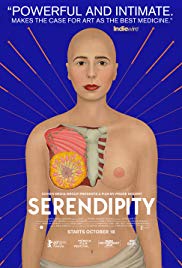
 Greetings again from the darkness. 31 years old. It’s an age that can feel old while in fact, it’s so young. Certainly too young for a diagnosis of breast cancer – not that there is ever a right age for such news. New York City-based French artist Prune Nourry was 31 when she was hit with the breast cancer diagnosis, and she turned her journey into a book, published in 2017, and subsequently this blend of art film and personal video journal.

The film opens with the camera on a hospital gurney as it is wheeled through various hallways and into examination rooms. It’s Ms. Nourry’s way of having us join her on her trip through the medical maze. One of the unique aspects of the film is how she connects her current situation to some of her past works. When she learns that she must freeze her eggs for future use before her chemotherapy sessions begin, she ties that into her 2009 art project entitled “The Procreation Dinner”, where the steps of In vitro fertilization are presented in food form … through birth and finishing with a flan breast feeding dessert. It’s at this time where she shows us her eggs magnified under the microscope lens. We now better understand the artist and her way of dealing.

With a mastectomy as first step, Ms. Nourry meets up with Oscar nominated French director Agnes Varda (FACES PLACES, 2017). Ms. Varda passed away earlier this year, but here she assists Ms. Nourry with cutting off 15-18 inches of her beautiful and braided hair so that it can be donated prior to her chemo. The film takes us through the treatment process, which includes the psychological impact of having one’s body altered so drastically. Is the challenge more physical or mental? We can only know that each person reacts in their own way.

Known as a sculptor, much of Ms. Nourry’s work can be considered performance, or even participatory. With work often related to the female body and female rights, other pieces of her work included here are “Sperm Bank” (2011), “Holy Daughters” (2010-11), “Holy River” (2011-12), “Imbalance” (2014, also a short film), “Terra Cotta Daughters” (to be unearthed in 2030), and “The Amazon” (2018).

Executive Producers of the film include Angelina Jolie and Darren Aronofsky, and while shaving her own head, Prune Nourry shares her philosophy of life that “everything is connected.” With the film documenting much of her art work, she emphasizes that this life philosophy focuses on Health, Life, and Art … just like her film.

watch the trailer:


FANTASTIC FUNGI (doc, 2019)

October 14, 2019

 Greetings again from the darkness. Why did the mushroom get invited to the party? Because he’s a fun guy (fungi)! That joke works better when spoken rather than read, but it made me laugh as a kid, even though it wasn’t enough to keep me (and half my classmates) awake during those dull science films in junior high. Documentarian Louie Schwartzberg obviously stayed awake in class, and now he’s showing us how those films should be made … interesting, informative and entertaining.

“We brought life to Earth. You can’t see us. We are mushrooms!” Narrator Brie Larson (yes, Captain Marvel herself) introduces fungus, or more accurately, fungi … since we are told there are 1.5 million species – 20,000 of which produce mushrooms. Despite the presence of Ms. Larson, this isn’t a superhero movie. No, it’s much more important. In fact, the real star of the documentary – other than fungi – is an amateur mycologist named Paul Stamets. That’s right, this informative project devotes much of its time to some guy who just likes science (oh my, does he like it); specifically, the study of fungus and mushrooms. He even tells us some of his personal story, allowing us to connect with a guy who is proud to be known as a mushroom nerd.

Director Schwartzberg is an accomplished documentarian, and noted time-lapse photographer and visual artist. He even uses impressive digital animation periodically to guide us along. He’s also smart enough to complement Mr. Stamets’ observations with input from real life scientists, as well as authors and researchers. Admittedly, it’s not really fair to classify Stamets as an amateur. He has written books and his research has been invaluable to some of the world’s foremost experts.

You may wonder why you should care about fungi. Heck, it’s described as something between vegetable and animal. We hear that it’s been around since the beginning, and that it plays a role in rebirth, reincarnation, and regeneration. This is shown via a memorable time-lapse segment, and with the bold proclamation that Mycelium is “the mother of us all.” We learn how fungi is such a vital part of our existence through medical research, penicillin (and chees), antibiotics, bio-terrorism, psychedelics, and now even the treatment of depression and cancer. Fungi can feed you (it’s good on pizza), heal you, and even kill you. The film is quite a fascinating and educational treat … and a lesson in biological resilience. And I never once fell asleep – my junior high teacher wouldn’t believe it.

watch the trailer:


GEMINI MAN (2019)

October 10, 2019

 Greetings again from the darkness. Usually after watching a movie, I spend some time thinking about the story, the performances, the visual effects, the music, the sets, the costumes, and any other piece of the puzzle that makes up that particular movie going experience. However, Oscar winning director Ang Lee’s (BROKEBACK MOUNTAIN, LIFE OF PI) new film creates a challenge. In addition to those previously mentioned factors, the ground-breaking new technology must also be addressed – both separately and in conjunction with how it works in the movie.

If you’ve seen the trailer, or even the poster, you know that there is an “old” Will Smith and a “young” Will Smith. The basic story is that Henry Brogan (old Will Smith) is a retiring DIA (Defense Intelligence Agency) assassin who is being hunted by his own government. The one doing the hunting is Junior, a “young” clone of Henry Brogan. What you may not know is that this is not accomplished through the typical de-aging process that has become so popular in Hollywood. Nope, this Junior is actually digital animation from Weta Digital in New Zealand. It’s not even really Will Smith – it’s a digital creation that looks almost identical to the Will Smith from “The Fresh Prince of Bel-Air” (1990-96), minus the wide grin and funky clothes. It’s very impressive technology, but not yet to the point where it can replace living, breathing, emoting actors. However, it’s pretty obvious that day is coming.

What’s also obvious is that this script is a mess, and despite the new generation of technology, this film seems dated … well at least the story seems that way. Darren Lemke (SHAZAM!) first published the screenplay in the mid-1990’s and it has “almost” made it to production on a few occasions. Writers David Benioff (THE KITE RUNNER) and Billy Ray (CAPTAIN PHILLIPS) are credited on this final, mostly disappointing version. The dialogue is lame and character development is non-existent. We are never provided a reason to give a hoot about old Henry. Junior is never more than a video game creation. And DIA Agent Danny Zakarweski (Mary Elizabeth Winstead) seems to be an afterthought when someone realized the film needed a female presence. Clive Owen plays Clay Verris, the mastermind/mad scientist with little more than a scowl, though Benedict Wong brings a jolt of life to his Baron role as a pilot friend of Henry.

We do get to see some of the world. The initial sequence takes us on Henry’s final mission. It’s his 72nd kill, and it occurs from a grassy knoll in Belgium through a window on a bullet train going 228 mph. Henry heads back to his isolated lake cabin in Buttermilk Sound, Georgia where his peaceful retirement lasts about 3 scenes. Soon, we are headed to Columbia for a crazy motorcycle chase, and then on to the catacombs in Budapest – an idea that provides a welcome dose of inspiration.

High-speed parkour, blurry close-up fight scenes, rooftop shootouts, and a hyper motorcycle chase through town all have an air of familiarity, which is something this type of film should strive to avoid. Rian Johnson’s LOOPER toyed with us using a young and old version of the same character, and though that was time travel and not cloning, the ideas are too similar for this one to come across as unique. Oscar winning cinematographer Dion Beebe (MEMORIES OF A GEISHA) delivers the shots – down to the crystal clear logos on beer and soda – but we never really experience the thrill that new technology should deliver. It should also be noted that no theatre in America is equipped to show this in the way Ang Lee filmed it: 4K 3D 120fps HFR format … leaving us wondering, what’s the point?

watch the trailer:


LUCY IN THE SKY (2019)

October 10, 2019

 Greetings again from the darkness. ‘Space – the final frontier.’ Well, that wasn’t the case for real life astronaut Lisa Nowak. In 2007, Nowak made the national news for her cross-country, diaper-wearing road trip that ended with her being arrested in Orlando for attempted kidnapping. Nowak had been a Navy pilot and conducted spacewalks as an astronaut. She had been married and divorced from a NASA contractor, and the purpose of her long drive to Orlando was to kidnap the astronaut she had an affair with and the astronaut that she had been dumped for by that astronaut (the other one she was kidnapping). Noah Hawley’s feature film directorial debut is “inspired by true events”, and about the only thing missing is those diapers.

OK, that’s not the only thing. Also missing are a coherent story, believable dialogue, a realistic Texas accent, a competent psychologist, and an inspiring story of girl power. Natalie Portman plays Lucy Cola, and the film opens with her being filled with awe during a spacewalk that will forever make life on Earth seem small … even while her dreadful accent (with San Angelo gun joke) tortures the ears of every viewer. Jon Hamm co-stars as astronaut Mark Goodwin, the “action-figure” prize in the eyes of Lucy. This despite Lucy’s cheery, stable and very grounded husband Drew (Dan Stevens), who works in NASA Public Relations. Playing the 4th wheel in what should have been two separate two-wheelers is astronaut Erin Eccles (an underutilized Zazie Beetz). Thankfully, Ellen Burstyn is around to inject some raunchy old woman humor and life lessons as Lucy’s Nana. For no apparent reason, other than possibly in hopes of attracting a younger audience, Pearl Amanda Dixon plays Iris, Lucy’s teenage niece. Iris spends most of the movie casting confused looks at her famous aunt, wondering why Nana told her to take any advice from Lucy.

Noah Hawley is best known for his excellent TV work with “Fargo”, and here is credited as co-writer with Brian C Brown and Elliott DiGuiseppi. It’s the first feature film for all three and it shows. There are some interesting ideas and approaches, but most of the stylistic attempts are just too much: the non-stop shifting of aspect ratios, the by design blurring (out of focus) images, and the Malick-type edits early on, are all more distracting than artistic.

There are some intriguing bits to Lucy’s character. She’s a woman in a field dominated by Type A men, and she matches or exceeds all in determination, grit and expertise. It’s only after she is “star struck” that she begins her descent into mental and emotional instability. As she loses herself, there is a scene where Hamm’s Goodwin is watching the Space Shuttle Challenger tragedy over and over. That scene probably offers more insight into being an astronaut than most anything we see from Lucy. As for the finale, it’s a rain-soaked mess, and perhaps drives home the point that the filmmakers were handcuffed by a true life story that was simply too bizarre to work as a movie … especially since they left out the diapers.

watch the trailer:


THE LAUNDROMAT (2019)

October 10, 2019

North Texas Film Festival (NTXFF) 2019

 Greetings again from the darkness. The meek may inherit the earth, but if this Steven Soderbergh movie based on Jake Bernstein’s book (screenplay by Scott Z Burns) is correct, they aren’t likely to get the money too. To put it more bluntly, the first of the film’s 5 rules of creating and protecting wealth is, “the meek are screwed.” In order to follow this film that is “based on true secrets”, it helps to have a basic knowledge of the Panama Papers … a 2016 anonymous leak of more than 11 million documents exposing how the rich skirt the laws when it comes to protecting their money. Offshore entities had previously been a mainstream punchline, but these documents from Mossack Fonseca, a law firm in Panama, clearly outlined just how widespread the practice had become.

Rather than traditional narrative form, the information is presented through multiple vignettes featuring an impressive roster of well-known actors: Meryl Streep, Jeffrey Wright, Sharon Stone, Melissa Rauch, David Schwimmer, James Cromwell, Matthias Schoenaerts, Robert Patrick, Nonso Anozie, and Rosalind Chao, plus a few others you’ll recognize. In the role of tongue-in-cheek emcees are Gary Oldman and Antonio Banderas, as Jurgen Mossack and Ramon Fonseca, respectively. Their coordinating flamboyant outfits correspond to these caricatures of the real men behind this web of fraudulent activity. They are meant to add humor to the situation, but also tell “their side of the story.”

We are caught off-guard when Meryl Streep’s story and her character are not the main focus. Her slow unraveling of insurance fraud after her husband’s death is but one segment of the lesson that will likely confuse most people. The easy comparison is Adam McKay’s THE BIG SHORT (2015), which used some of this style in explaining the mortgage backed securities market. Whereas Mr. McKay won an Oscar for his screenplay, that’s highly unlikely for this one. Scott Z Burns is a talented writer, but this was simply too complex of a subject to tackle in 95 minutes. Mr. Soderbergh, as is tendency, not only directs the film, but is also the cinematographer, editor and producer.

This is a Netflix production that I caught at the inaugural North Texas Film Festival, and thanks to the presence of Ms. Streep, will likely have at least a limited theatrical release. Unfortunately, neither big screen nor small will solve the inherent issues here. There are some nuggets such as Delaware, despite its population of less than one million, being king of corporation filings (thanks to its business-friendly tax laws). Understanding shell companies, tax evasion, and other illicit financial activities among the world’s ultra-rich requires more than a talented cast, but perhaps there is enough here to motivate some to dig a little deeper with their own research. That is, if the film’s finale – a lecture on reform – doesn’t turn you off completely. Many of us appreciate being informed, but rebel against the preaching.

watch the trailer:


DOLEMITE IS MY NAME (2019)

October 7, 2019

North Texas Film Festival 2019

 Greetings again from the darkness. The old flea market adage is “one person’s trash is another’s treasure”, and the same can be said for comedy. What you find obtuse and humorless may be the funniest thing your neighbor has ever seen or heard. No scientist can explain this phenomenon, and it’s never been better exemplified than with a scene in director Craig Brewer’s (BLACK SNAKE MOAN, HUSTLE & FLOW) latest film. Rudy Ray Moore and his group of friends are in a theatre watching Billy Wilder’s comedy THE FRONT PAGE (1974), starring Walther Matthau and Jack Lemmon. The befuddled looks on the faces of Moore and his cohorts can’t mask their confusion over the raucous laughter in the theatre and what they are viewing on screen. It’s a turning point for Rudy Ray Moore and his next career step.

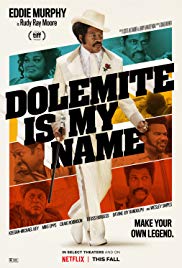
Eddie Murphy stars as Rudy Ray Moore, and though it’s not necessary, having some knowledge of the career of the real Mr. Moore will likely enhance your viewing experience during this exceedingly entertaining, and sometimes riotous biopic. Ruby Ray Moore was a hustler who dreamed of making it big in show business – first as a singer, then as a stand-up comedian, and finally as movie star. His ambition and dreams kept him going, even after others wrote him off. We first meet Rudy as an assistant manager at Dolphin’s of Hollywood record store. He’s trying to smooth-talk the store DJ (Snoop Dogg) into playing Rudy’s R&B records … one of which is “The Ring-A-Ling-Dong” song. The DJ tells him the time for that music has passed, but the next light bulb soon goes off Rudy. A local panhandler (a terrific Ron Cephus Jones cameo) regales those in the store with tall tales from the ‘hood. Rudy decides to fine-tune those tales and turn it into a comedy act.

Add some clothes and attitude and that’s how Dolemite was born … Rudy Ray Moore’s onstage alter ego – part pimp, part rapping philosopher. His memorable catchphrase is repeated a few times throughout the film, and I’ll do my best to present a PG version: “Dolemite is my name, and ‘effing’ up mother-‘effers’ is my game.” Yep, now you have a better feel for Rudy and Dolemite. However, co-writers Scott Alexander and Larry Karaszewsi (also co-writers on Tim Burton’s ED WOOD, 1994), and especially Eddie Murphy, dig much deeper and provide a look at the man, his friends, and his career pursuits.

It’s pretty interesting to see a guy, without much going for him, figure out a strategy that ends up working. Part of his wisdom was in ‘knowing his audience’. His own preferences, and those of his friends, played right into what went on stage, on vinyl, and on screen. When a producer tells him his act will only be funny to the 5 blocks in Rudy’s neighborhood, Rudy brilliantly responds, “Yeah, but every city in America has these same 5 blocks.” It’s that kind of instinct, along with his generosity, and understanding his own shortcomings, that allowed him to reach a level of success. The scene where he cuts a deal with uppity actor D’Urville Martin (a superbly funny Wesley Snipes) portrays Rudy’s keen sense of persuasion … he played to the ego.

Eddie Murphy reminds us of his immense comedic talents and how he became such a mega-superstar in the first place. Here, he’s not really impersonating or mimicking Moore, but rather capturing his spirit and paying tribute to a man he so clearly respects. The supporting cast is also outstanding. In addition to Mr. Snipes, who we wish had more scenes with Mr. Murphy, Craig Robinson is hilarious as singer Ben Taylor, Keegan-Michael Key is socially-conscious playwright Jerry Jones, Titus Burgess is wide-eyed co-worker Theodore Toney, Mike Epps plays Moore’s pal Jimmy Lynch, and Kodi Smit-McPhee (THE ROAD) plays the student-DP. In addition, we get a couple of other cameos from Chris Rock as DJ Daddy Fatts, and Bob Odenkirk plays a film distributor with dollar signs in his eyes. Deserving of special mention is Da’Vine Joy Randolph (“On Becoming a God in Central Florida”) as Lady Reed, Rudy’s muse and discovery. She is funny and ferocious in this role that should lead to much more work.

The film is produced by Netflix and it screened at the inaugural North Texas Film Festival. The music (Scott Bomar) and especially the costume design (Ruth Carter) are top notch, and contribute to the story and film. Rudy Ray Moore became a Blaxploitation icon at a time when the comedy of Richard Pryor, Red Foxx, and Moms Mabley were popular – so hopefully that gives you some indication of the type of humor the film delivers. Raunchy humor with Kung-Fu action and plenty of skin – that’s the formula for the three Dolemite movies, as well as Moore’s comedy albums (and their covers). This was a time when dropping Fred Williamson’s name garnered instant respect. Some may compare this to James Franco’s THE DISASTER ARTIST, but instead I recall Mario van Peebles’ BAADASSSS!, a tribute to his filmmaking father Melvin. Hopefully your sense of humor will allow you to find the many laughs in this one, because Dolemite is dynamite … and that’ a WRAP!

watch the trailer (LANGUAGE WARNING):


JOKER (2019)

October 3, 2019

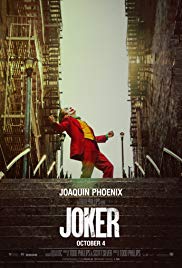
 Greetings again from the darkness. The first thing to know is that this is not a Superhero movie. In fact, there are no heroes in the movie – unless you would like to apply the label to a single mom who lives down the hall from Arthur Fleck. Mr. Fleck lives at home with his invalid mother in a grungy, run-down apartment. He works as a clown-for-hire, dreams of becoming a stand-up comedian, and depends on social services to supply the 7 medications he takes since being released from Arkham State Hospital. It’s a bleak existence at a bleak time in a bleak city. Gotham is in the midst of a garbage workers’ strike (only the ‘super rats’ are happy), political upheaval, and a growing chasm between the classes. And then it gets worse for Arthur.

The second thing to know is that this is a standalone Joker film, and one mostly unrelated or not connected to previous projects featuring the colorful Clown Prince character played (and voiced) by such memorable actors as Cesar Romero, Jack Nicholson, Heath Ledger, Mark Hamill, Jared Leto and even Zach Galifianakis. Director Todd Phillips (who co-wrote the script with Scott Silver) is best known for such extreme comedies as “The Hangover” franchise and OLD SCHOOL, so he’s a bit outside of his usual wheelhouse. Phillips and Silver seem to embrace not just the history of the character, but also the look, texture and tone of filmmaking from an earlier era. The gritty and outcast feel of Scorcese’s TAXI DRIVER and THE KING OF COMEDY is present, and so are numerous tributes to familiar Joker moments of days gone by.

Three time Oscar nominee Joaquin Phoenix plays Arthur Fleck, and he delivers Arthur’s slow descent into madness, or shall we say further descent. It’s clear from the beginning that Arthur views himself as ignored by society, while all he wants to do is bring joy and laughter to others … and be noticed. His daydreams or visions of himself in a better world send a strong message. Phoenix shows us what full commitment to a role looks like. He lost 50 pounds, leaving a frame that contorts, moves and dances in a manner unlike what we’ve seen before. In fact, it’s a toss-up on which shows up more frequently, his dances moves or his maniacal, pained laughter. We are informed Arthur suffers from Pseudobulbar Affect, also known as emotional incontinence, which causes that creepy laughter to pop up at some inappropriate times. Of course, the comparisons to Heath Ledger’s Oscar winning turn in THE DARK KNIGHT are inevitable. The roles and films are written quite differently, and it’s safe to say both actors were all-in.

Action sequences and special visual effects are both noticeably absent, but the violence is sure to shock. This is not one for the younger kids, no matter how much they enjoy THE AVENGERS or WONDER WOMAN (or any other DC or Marvel film). This gritty, visceral approach is often a tough watch, and is much more a character study of mental illness than a costume drama … although Arthur’s clothes and make-up are front and center. When Arthur states, “I have nothing but bad thoughts”, we believe him. And the sympathetic back story explains a great deal, and will likely prove quite controversial.

Phoenix dominates the film (as he should), and supporting work is provided by Robert De Niro as Murray Franklin, a TV talk show host in the Johnny Carson mode; Zazie Beetz (DEADPOOL 2) as the single mom neighbor Sophie Dumond; Frances Conroy as Penny Fleck, Arthur’s mother; Brett Cullen as a not so empathetic Thomas Wayne; and Shea Whigham and Bill Camp as police detectives. I’ll hesitantly mention that Dante Pereira-Olson makes a couple of brief appearances as an adolescent Bruce Wayne, and just for fun, we get a shot of the young man honing the batpole skills he will use later in life. Just don’t expect any “real” Batman references.

Director Phillips delivers a film that looks and feels and sounds much different than other comic book movies. Cinematographer Lawrence Sher is a frequent Phillips collaborator (all 3 Hangover movies) and the dark look and gritty feel are present in most every shot. Hildur Guonadottir (this year’s Emmy winner for “Chernobyl”) serves up a foreboding score – one that never overwhelms, and one that contrasts perfectly with the more traditional songs utilized throughout: Stephen Sondheim’s “Send in the Clowns”, Jimmy Durante singing “Smile”, Cream’s “White Room”, “That’s Life” by Frank Sinatra, and Gary Glitter’s familiar “Rock and Roll Part 1 and 2”. The “Smile” song is especially relevant as its origins can be traced by to Charlie Chaplin’s MODERN TIMES, a silent movie classic featured in this film. Phillips even uses the Saul Bass designed Warner Bros logo to open the credits, making sure we understand the time period (no cell phones, etc).

The film traces Arthur’s slide into crime … a transition that he wasn’t seeking, and one that he believes was forced upon him. His rise as a savior to the working class is secondary to his own journey, and the chaos is handled on the perimeters of the film, preventing this from becoming a Super Villain movie. Keep in mind JOKER played at Venice, Telluride and Toronto – three prestigious festivals. This is just another thing that sets it apart from others in the genre. Despite the 1981 time stamp, the consistent anti-rich message and class disparity is prevalent throughout. This appears to be Phillips’ way of including a contemporary theme in a decades-old setting. And it’s a cautionary tale that there should be no clown left behind.

watch the trailer: