Greetings again from the darkness. Why did the mushroom get invited to the party? Because he’s a fun guy (fungi)! That joke works better when spoken rather than read, but it made me laugh as a kid, even though it wasn’t enough to keep me (and half my classmates) awake during those dull science films in junior high. Documentarian Louie Schwartzberg obviously stayed awake in class, and now he’s showing us how those films should be made … interesting, informative and entertaining.
“We brought life to Earth. You can’t see us. We are mushrooms!” Narrator Brie Larson (yes, Captain Marvel herself) introduces fungus, or more accurately, fungi … since we are told there are 1.5 million species – 20,000 of which produce mushrooms. Despite the presence of Ms. Larson, this isn’t a superhero movie. No, it’s much more important. In fact, the real star of the documentary – other than fungi – is an amateur mycologist named Paul Stamets. That’s right, this informative project devotes much of its time to some guy who just likes science (oh my, does he like it); specifically, the study of fungus and mushrooms. He even tells us some of his personal story, allowing us to connect with a guy who is proud to be known as a mushroom nerd.
Director Schwartzberg is an accomplished documentarian, and noted time-lapse photographer and visual artist. He even uses impressive digital animation periodically to guide us along. He’s also smart enough to complement Mr. Stamets’ observations with input from real life scientists, as well as authors and researchers. Admittedly, it’s not really fair to classify Stamets as an amateur. He has written books and his research has been invaluable to some of the world’s foremost experts.
You may wonder why you should care about fungi. Heck, it’s described as something between vegetable and animal. We hear that it’s been around since the beginning, and that it plays a role in rebirth, reincarnation, and regeneration. This is shown via a memorable time-lapse segment, and with the bold proclamation that Mycelium is “the mother of us all.” We learn how fungi is such a vital part of our existence through medical research, penicillin (and chees), antibiotics, bio-terrorism, psychedelics, and now even the treatment of depression and cancer. Fungi can feed you (it’s good on pizza), heal you, and even kill you. The film is quite a fascinating and educational treat … and a lesson in biological resilience. And I never once fell asleep – my junior high teacher wouldn’t believe it.
Greetings again from the darkness. Usually after watching a movie, I spend some time thinking about the story, the performances, the visual effects, the music, the sets, the costumes, and any other piece of the puzzle that makes up that particular movie going experience. However, Oscar winning director Ang Lee’s (BROKEBACK MOUNTAIN, LIFE OF PI) new film creates a challenge. In addition to those previously mentioned factors, the ground-breaking new technology must also be addressed – both separately and in conjunction with how it works in the movie.
If you’ve seen the trailer, or even the poster, you know that there is an “old” Will Smith and a “young” Will Smith. The basic story is that Henry Brogan (old Will Smith) is a retiring DIA (Defense Intelligence Agency) assassin who is being hunted by his own government. The one doing the hunting is Junior, a “young” clone of Henry Brogan. What you may not know is that this is not accomplished through the typical de-aging process that has become so popular in Hollywood. Nope, this Junior is actually digital animation from Weta Digital in New Zealand. It’s not even really Will Smith – it’s a digital creation that looks almost identical to the Will Smith from “The Fresh Prince of Bel-Air” (1990-96), minus the wide grin and funky clothes. It’s very impressive technology, but not yet to the point where it can replace living, breathing, emoting actors. However, it’s pretty obvious that day is coming.
What’s also obvious is that this script is a mess, and despite the new generation of technology, this film seems dated … well at least the story seems that way. Darren Lemke (SHAZAM!) first published the screenplay in the mid-1990’s and it has “almost” made it to production on a few occasions. Writers David Benioff (THE KITE RUNNER) and Billy Ray (CAPTAIN PHILLIPS) are credited on this final, mostly disappointing version. The dialogue is lame and character development is non-existent. We are never provided a reason to give a hoot about old Henry. Junior is never more than a video game creation. And DIA Agent Danny Zakarweski (Mary Elizabeth Winstead) seems to be an afterthought when someone realized the film needed a female presence. Clive Owen plays Clay Verris, the mastermind/mad scientist with little more than a scowl, though Benedict Wong brings a jolt of life to his Baron role as a pilot friend of Henry.
We do get to see some of the world. The initial sequence takes us on Henry’s final mission. It’s his 72nd kill, and it occurs from a grassy knoll in Belgium through a window on a bullet train going 228 mph. Henry heads back to his isolated lake cabin in Buttermilk Sound, Georgia where his peaceful retirement lasts about 3 scenes. Soon, we are headed to Columbia for a crazy motorcycle chase, and then on to the catacombs in Budapest – an idea that provides a welcome dose of inspiration.
High-speed parkour, blurry close-up fight scenes, rooftop shootouts, and a hyper motorcycle chase through town all have an air of familiarity, which is something this type of film should strive to avoid. Rian Johnson’s LOOPER toyed with us using a young and old version of the same character, and though that was time travel and not cloning, the ideas are too similar for this one to come across as unique. Oscar winning cinematographer Dion Beebe (MEMORIES OF A GEISHA) delivers the shots – down to the crystal clear logos on beer and soda – but we never really experience the thrill that new technology should deliver. It should also be noted that no theatre in America is equipped to show this in the way Ang Lee filmed it: 4K 3D 120fps HFR format … leaving us wondering, what’s the point?
Greetings again from the darkness. ‘Space – the final frontier.’ Well, that wasn’t the case for real life astronaut Lisa Nowak. In 2007, Nowak made the national news for her cross-country, diaper-wearing road trip that ended with her being arrested in Orlando for attempted kidnapping. Nowak had been a Navy pilot and conducted spacewalks as an astronaut. She had been married and divorced from a NASA contractor, and the purpose of her long drive to Orlando was to kidnap the astronaut she had an affair with and the astronaut that she had been dumped for by that astronaut (the other one she was kidnapping). Noah Hawley’s feature film directorial debut is “inspired by true events”, and about the only thing missing is those diapers.
OK, that’s not the only thing. Also missing are a coherent story, believable dialogue, a realistic Texas accent, a competent psychologist, and an inspiring story of girl power. Natalie Portman plays Lucy Cola, and the film opens with her being filled with awe during a spacewalk that will forever make life on Earth seem small … even while her dreadful accent (with San Angelo gun joke) tortures the ears of every viewer. Jon Hamm co-stars as astronaut Mark Goodwin, the “action-figure” prize in the eyes of Lucy. This despite Lucy’s cheery, stable and very grounded husband Drew (Dan Stevens), who works in NASA Public Relations. Playing the 4th wheel in what should have been two separate two-wheelers is astronaut Erin Eccles (an underutilized Zazie Beetz). Thankfully, Ellen Burstyn is around to inject some raunchy old woman humor and life lessons as Lucy’s Nana. For no apparent reason, other than possibly in hopes of attracting a younger audience, Pearl Amanda Dixon plays Iris, Lucy’s teenage niece. Iris spends most of the movie casting confused looks at her famous aunt, wondering why Nana told her to take any advice from Lucy.
Noah Hawley is best known for his excellent TV work with “Fargo”, and here is credited as co-writer with Brian C Brown and Elliott DiGuiseppi. It’s the first feature film for all three and it shows. There are some interesting ideas and approaches, but most of the stylistic attempts are just too much: the non-stop shifting of aspect ratios, the by design blurring (out of focus) images, and the Malick-type edits early on, are all more distracting than artistic.
There are some intriguing bits to Lucy’s character. She’s a woman in a field dominated by Type A men, and she matches or exceeds all in determination, grit and expertise. It’s only after she is “star struck” that she begins her descent into mental and emotional instability. As she loses herself, there is a scene where Hamm’s Goodwin is watching the Space Shuttle Challenger tragedy over and over. That scene probably offers more insight into being an astronaut than most anything we see from Lucy. As for the finale, it’s a rain-soaked mess, and perhaps drives home the point that the filmmakers were handcuffed by a true life story that was simply too bizarre to work as a movie … especially since they left out the diapers.
Greetings again from the darkness. The meek may inherit the earth, but if this Steven Soderbergh movie based on Jake Bernstein’s book (screenplay by Scott Z Burns) is correct, they aren’t likely to get the money too. To put it more bluntly, the first of the film’s 5 rules of creating and protecting wealth is, “the meek are screwed.” In order to follow this film that is “based on true secrets”, it helps to have a basic knowledge of the Panama Papers … a 2016 anonymous leak of more than 11 million documents exposing how the rich skirt the laws when it comes to protecting their money. Offshore entities had previously been a mainstream punchline, but these documents from Mossack Fonseca, a law firm in Panama, clearly outlined just how widespread the practice had become.
Rather than traditional narrative form, the information is presented through multiple vignettes featuring an impressive roster of well-known actors: Meryl Streep, Jeffrey Wright, Sharon Stone, Melissa Rauch, David Schwimmer, James Cromwell, Matthias Schoenaerts, Robert Patrick, Nonso Anozie, and Rosalind Chao, plus a few others you’ll recognize. In the role of tongue-in-cheek emcees are Gary Oldman and Antonio Banderas, as Jurgen Mossack and Ramon Fonseca, respectively. Their coordinating flamboyant outfits correspond to these caricatures of the real men behind this web of fraudulent activity. They are meant to add humor to the situation, but also tell “their side of the story.”
We are caught off-guard when Meryl Streep’s story and her character are not the main focus. Her slow unraveling of insurance fraud after her husband’s death is but one segment of the lesson that will likely confuse most people. The easy comparison is Adam McKay’s THE BIG SHORT (2015), which used some of this style in explaining the mortgage backed securities market. Whereas Mr. McKay won an Oscar for his screenplay, that’s highly unlikely for this one. Scott Z Burns is a talented writer, but this was simply too complex of a subject to tackle in 95 minutes. Mr. Soderbergh, as is tendency, not only directs the film, but is also the cinematographer, editor and producer.
This is a Netflix production that I caught at the inaugural North Texas Film Festival, and thanks to the presence of Ms. Streep, will likely have at least a limited theatrical release. Unfortunately, neither big screen nor small will solve the inherent issues here. There are some nuggets such as Delaware, despite its population of less than one million, being king of corporation filings (thanks to its business-friendly tax laws). Understanding shell companies, tax evasion, and other illicit financial activities among the world’s ultra-rich requires more than a talented cast, but perhaps there is enough here to motivate some to dig a little deeper with their own research. That is, if the film’s finale – a lecture on reform – doesn’t turn you off completely. Many of us appreciate being informed, but rebel against the preaching.
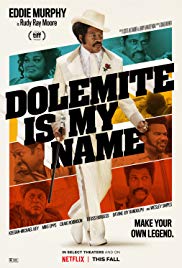
Greetings again from the darkness. The old flea market adage is “one person’s trash is another’s treasure”, and the same can be said for comedy. What you find obtuse and humorless may be the funniest thing your neighbor has ever seen or heard. No scientist can explain this phenomenon, and it’s never been better exemplified than with a scene in director Craig Brewer’s (BLACK SNAKE MOAN, HUSTLE & FLOW) latest film. Rudy Ray Moore and his group of friends are in a theatre watching Billy Wilder’s comedy THE FRONT PAGE (1974), starring Walther Matthau and Jack Lemmon. The befuddled looks on the faces of Moore and his cohorts can’t mask their confusion over the raucous laughter in the theatre and what they are viewing on screen. It’s a turning point for Rudy Ray Moore and his next career step.
Eddie Murphy stars as Rudy Ray Moore, and though it’s not necessary, having some knowledge of the career of the real Mr. Moore will likely enhance your viewing experience during this exceedingly entertaining, and sometimes riotous biopic. Ruby Ray Moore was a hustler who dreamed of making it big in show business – first as a singer, then as a stand-up comedian, and finally as movie star. His ambition and dreams kept him going, even after others wrote him off. We first meet Rudy as an assistant manager at Dolphin’s of Hollywood record store. He’s trying to smooth-talk the store DJ (Snoop Dogg) into playing Rudy’s R&B records … one of which is “The Ring-A-Ling-Dong” song. The DJ tells him the time for that music has passed, but the next light bulb soon goes off Rudy. A local panhandler (a terrific Ron Cephus Jones cameo) regales those in the store with tall tales from the ‘hood. Rudy decides to fine-tune those tales and turn it into a comedy act.
Add some clothes and attitude and that’s how Dolemite was born … Rudy Ray Moore’s onstage alter ego – part pimp, part rapping philosopher. His memorable catchphrase is repeated a few times throughout the film, and I’ll do my best to present a PG version: “Dolemite is my name, and ‘effing’ up mother-‘effers’ is my game.” Yep, now you have a better feel for Rudy and Dolemite. However, co-writers Scott Alexander and Larry Karaszewsi (also co-writers on Tim Burton’s ED WOOD, 1994), and especially Eddie Murphy, dig much deeper and provide a look at the man, his friends, and his career pursuits.
It’s pretty interesting to see a guy, without much going for him, figure out a strategy that ends up working. Part of his wisdom was in ‘knowing his audience’. His own preferences, and those of his friends, played right into what went on stage, on vinyl, and on screen. When a producer tells him his act will only be funny to the 5 blocks in Rudy’s neighborhood, Rudy brilliantly responds, “Yeah, but every city in America has these same 5 blocks.” It’s that kind of instinct, along with his generosity, and understanding his own shortcomings, that allowed him to reach a level of success. The scene where he cuts a deal with uppity actor D’Urville Martin (a superbly funny Wesley Snipes) portrays Rudy’s keen sense of persuasion … he played to the ego.
Eddie Murphy reminds us of his immense comedic talents and how he became such a mega-superstar in the first place. Here, he’s not really impersonating or mimicking Moore, but rather capturing his spirit and paying tribute to a man he so clearly respects. The supporting cast is also outstanding. In addition to Mr. Snipes, who we wish had more scenes with Mr. Murphy, Craig Robinson is hilarious as singer Ben Taylor, Keegan-Michael Key is socially-conscious playwright Jerry Jones, Titus Burgess is wide-eyed co-worker Theodore Toney, Mike Epps plays Moore’s pal Jimmy Lynch, and Kodi Smit-McPhee (THE ROAD) plays the student-DP. In addition, we get a couple of other cameos from Chris Rock as DJ Daddy Fatts, and Bob Odenkirk plays a film distributor with dollar signs in his eyes. Deserving of special mention is Da’Vine Joy Randolph (“On Becoming a God in Central Florida”) as Lady Reed, Rudy’s muse and discovery. She is funny and ferocious in this role that should lead to much more work.
The film is produced by Netflix and it screened at the inaugural North Texas Film Festival. The music (Scott Bomar) and especially the costume design (Ruth Carter) are top notch, and contribute to the story and film. Rudy Ray Moore became a Blaxploitation icon at a time when the comedy of Richard Pryor, Red Foxx, and Moms Mabley were popular – so hopefully that gives you some indication of the type of humor the film delivers. Raunchy humor with Kung-Fu action and plenty of skin – that’s the formula for the three Dolemite movies, as well as Moore’s comedy albums (and their covers). This was a time when dropping Fred Williamson’s name garnered instant respect. Some may compare this to James Franco’s THE DISASTER ARTIST, but instead I recall Mario van Peebles’ BAADASSSS!, a tribute to his filmmaking father Melvin. Hopefully your sense of humor will allow you to find the many laughs in this one, because Dolemite is dynamite … and that’ a WRAP!
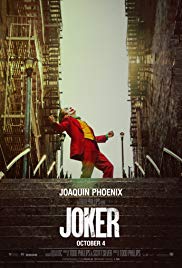
Greetings again from the darkness. The first thing to know is that this is not a Superhero movie. In fact, there are no heroes in the movie – unless you would like to apply the label to a single mom who lives down the hall from Arthur Fleck. Mr. Fleck lives at home with his invalid mother in a grungy, run-down apartment. He works as a clown-for-hire, dreams of becoming a stand-up comedian, and depends on social services to supply the 7 medications he takes since being released from Arkham State Hospital. It’s a bleak existence at a bleak time in a bleak city. Gotham is in the midst of a garbage workers’ strike (only the ‘super rats’ are happy), political upheaval, and a growing chasm between the classes. And then it gets worse for Arthur.
The second thing to know is that this is a standalone Joker film, and one mostly unrelated or not connected to previous projects featuring the colorful Clown Prince character played (and voiced) by such memorable actors as Cesar Romero, Jack Nicholson, Heath Ledger, Mark Hamill, Jared Leto and even Zach Galifianakis. Director Todd Phillips (who co-wrote the script with Scott Silver) is best known for such extreme comedies as “The Hangover” franchise and OLD SCHOOL, so he’s a bit outside of his usual wheelhouse. Phillips and Silver seem to embrace not just the history of the character, but also the look, texture and tone of filmmaking from an earlier era. The gritty and outcast feel of Scorcese’s TAXI DRIVER and THE KING OF COMEDY is present, and so are numerous tributes to familiar Joker moments of days gone by.
Three time Oscar nominee Joaquin Phoenix plays Arthur Fleck, and he delivers Arthur’s slow descent into madness, or shall we say further descent. It’s clear from the beginning that Arthur views himself as ignored by society, while all he wants to do is bring joy and laughter to others … and be noticed. His daydreams or visions of himself in a better world send a strong message. Phoenix shows us what full commitment to a role looks like. He lost 50 pounds, leaving a frame that contorts, moves and dances in a manner unlike what we’ve seen before. In fact, it’s a toss-up on which shows up more frequently, his dances moves or his maniacal, pained laughter. We are informed Arthur suffers from Pseudobulbar Affect, also known as emotional incontinence, which causes that creepy laughter to pop up at some inappropriate times. Of course, the comparisons to Heath Ledger’s Oscar winning turn in THE DARK KNIGHT are inevitable. The roles and films are written quite differently, and it’s safe to say both actors were all-in.
Action sequences and special visual effects are both noticeably absent, but the violence is sure to shock. This is not one for the younger kids, no matter how much they enjoy THE AVENGERS or WONDER WOMAN (or any other DC or Marvel film). This gritty, visceral approach is often a tough watch, and is much more a character study of mental illness than a costume drama … although Arthur’s clothes and make-up are front and center. When Arthur states, “I have nothing but bad thoughts”, we believe him. And the sympathetic back story explains a great deal, and will likely prove quite controversial.
Phoenix dominates the film (as he should), and supporting work is provided by Robert De Niro as Murray Franklin, a TV talk show host in the Johnny Carson mode; Zazie Beetz (DEADPOOL 2) as the single mom neighbor Sophie Dumond; Frances Conroy as Penny Fleck, Arthur’s mother; Brett Cullen as a not so empathetic Thomas Wayne; and Shea Whigham and Bill Camp as police detectives. I’ll hesitantly mention that Dante Pereira-Olson makes a couple of brief appearances as an adolescent Bruce Wayne, and just for fun, we get a shot of the young man honing the batpole skills he will use later in life. Just don’t expect any “real” Batman references.
Director Phillips delivers a film that looks and feels and sounds much different than other comic book movies. Cinematographer Lawrence Sher is a frequent Phillips collaborator (all 3 Hangover movies) and the dark look and gritty feel are present in most every shot. Hildur Guonadottir (this year’s Emmy winner for “Chernobyl”) serves up a foreboding score – one that never overwhelms, and one that contrasts perfectly with the more traditional songs utilized throughout: Stephen Sondheim’s “Send in the Clowns”, Jimmy Durante singing “Smile”, Cream’s “White Room”, “That’s Life” by Frank Sinatra, and Gary Glitter’s familiar “Rock and Roll Part 1 and 2”. The “Smile” song is especially relevant as its origins can be traced by to Charlie Chaplin’s MODERN TIMES, a silent movie classic featured in this film. Phillips even uses the Saul Bass designed Warner Bros logo to open the credits, making sure we understand the time period (no cell phones, etc).
The film traces Arthur’s slide into crime … a transition that he wasn’t seeking, and one that he believes was forced upon him. His rise as a savior to the working class is secondary to his own journey, and the chaos is handled on the perimeters of the film, preventing this from becoming a Super Villain movie. Keep in mind JOKER played at Venice, Telluride and Toronto – three prestigious festivals. This is just another thing that sets it apart from others in the genre. Despite the 1981 time stamp, the consistent anti-rich message and class disparity is prevalent throughout. This appears to be Phillips’ way of including a contemporary theme in a decades-old setting. And it’s a cautionary tale that there should be no clown left behind.
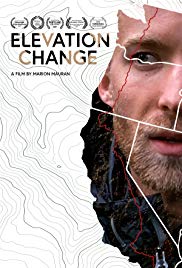
Greetings again from the darkness. When former Yale University high-jumper Sam Fox announces he is setting out to break the speed record on the Pacific Crest Trail, he does so with a confidence-bordering-on-arrogance that seems to be a natural trait amongst endurance athletes. This was 2011 and Sam’s goal was to raise $250,000 for the Michael J. Fox Foundation, a quite personal cause, given that his mother Lucy was diagnosed with Parkinson’s disease.
The Pacific Crest National Scenic Trail (PCT) is 2653 miles long and connects Canada to Mexico via Washington, Oregon, and California, across the Sierra Nevada and Cascade mountain ranges. Yes, it’s roughly 100 marathons covering some rugged terrain, so we can’t help but chuckle when Sam initially states that he’s not worried about the physical challenge, only the mental aspects of covering 44 miles per day for 60 days to break the record.
Running, hiking, and climbing every day for 2 months is more than most of us can imagine. We see Sam after Day 1 when he has traveled 66 miles in 21 hours, and the reality of his journey strikes us, as well as him. Sam has been described as ultra-competitive, and he’s told us his mother is his motivation. Thru-hiking is a serious endeavor and Sam’s support group includes his girlfriend Chloe, and two good friends John and Eric, who have agreed to assist with food, water, communication, logistics, navigation, and any other obstacles that arise. They are even handling his social media, which is being used as a promotional tool for fundraising.
This is director Marion Mauran’s first film, and in addition to selecting a fascinating subject, she gets lucky in that the PCT record-holder Scott Williamson (who deserves his own film) is not only a few days ahead of Sam on the trail, but he also agrees to be interviewed for the film. Mr. Williamson’s personal story is jaw-dropping, and he makes for a very interesting contrast in personality to Sam Fox. They each have their own motivations for taking on the trail, and Mr. Williamson is quite introspective, while the irritable Mr. Fox appears to seek and appreciate the spotlight. Unfortunately, we get no film of Williamson on the trail, but some of the segments of Fox filming himself provide terrific insight into the struggles.
Weather, rattlesnakes, bears, foot and leg injuries, and solitude are some of the obstacles faced, and when John gets hospitalized with shingles, Sam’s dad jumps in. We quickly see where Sam gets his determination, as the no-nonsense patriarch offers up his philosophy of pushing one’s self to the limit. Director Mauran and her crew mix in some breathtaking shots along the way, with the beauty of nature set against the pain and struggles of Sam’s trek.
We can’t help but compare this to the fantastic 2018 film FREE SOLO chronicling Alex Honnold’s climb of El Capitan in Yosemite. These are individuals that push through pain and mental turmoil, and take themselves to limits most of us can’t fathom. Ms. Mauran’s film might have been even more impactful had the parallels and contrasts between Sam Fox and Scott Williamson been further explored, but what we see is more than enough for us to sit back in our recliners and marvel at the spirit and commitment of endurance athletes.
Greetings again from the darkness. It’s been 80 years since THE WIZARD OF OZ was released and 50 years since Judy Garland died. So why do we still care so much? Of course the obvious reason is that, for many generations, her adventures as Dorothy Gale from Kansas marked the first time many of us kids could put ourselves in the shoes (mine weren’t ruby sparkles) of a lead character in a movie. Her fantastical journey ignited our imaginations and whisked us away to fight witches and flying monkeys, while making wonderful friends in a corn patch and enchanted forest. Oh, and that voice! However, there is another side to this coin. Judy’s story is also an example of the dark and tarnished side of Hollywood … she pulled back more than one curtain.
Renee Zellweger (Oscar winner for COLD MOUNTAIN, 2003) stars as Judy Garland, and her performance will likely put her in line for her fourth Oscar nomination. The film basically covers the last year of Judy’s life, and director Rupert Goold (TRUE STORY, 2015) is working from a script by Tom Edge adapted from Peter Quilter’s stage play, “End of the Rainbow”. There is no Lollipop Guild here. Instead, the harsh realities of Judy’s life are explored. The film opens with Judy and her kids, Joe and Lorna, performing on stage … and then being unceremoniously denied a room at a nearby luxury hotel. See, Judy’s career is in a bad way (admittedly undependable and uninsurable) – as is her health. She is broke, has no home, and offers for roles or performances have dried up. She ends up at her ex-husband Sid Luft’s (Rufus Sewell) home, which after some former-spouse bickering, is where the kids stay.
With no other real prospective gigs, Judy accepts an offer from Bernard Delfont (Michael Gambon) to perform at his Talk of the Town theatre in London. Most of the film covers her time in London, and the challenges for all involved. She’s 46 years old in the winter of 1968, and though her voice no longer carries the sublime purity of those early years, Judy still has incredible stage presence and an ability to connect with the audience. The challenges occur for her assigned assistant Rosalyn Wilder (who served as a consultant on the film, and is played here by rising star Jessie Buckley), as well as Judy herself. She misses her kids, and is battling loneliness and an addiction to pills – causing her to rarely eat or sleep. When her “friend” (and fifth husband) Mickey Deans (Finn Wittrock) shows up, Judy’s attitude perks up, but her already questionable dependability falters.
Flashbacks to Judy’s teenage years at MGM are used to portray how the studio and industry took control of her body, soul and career. Watching studio head Louis B Mayer (Richard Cordery) bully young Judy (played by newcomer Darci Shaw) by pretending to be a father figure while keeping her weight in line with a diet of cigarettes, diet pills, and soup, is just painful. These scenes, including those with young Judy’s frequent co-star Mickey Rooney, help us understand why she was in such a state by the time she hit London. Ms. Zellweger embodies the blend of frailty and determination and talent, as well as the insecurities that simultaneously drove Judy and held her back. Of course, few singers have ever possessed the vocal talent of Judy, but Zellweger admirably brings the appropriate strain and pain to the songs she sings for the movie, including “By Myself” and “The Trolley Song”.
Born Frances Ethel Gumm, Judy Garland first hit the stage at age 2, and never experienced a “normal” childhood or traditional relationship. Despite her immense talent, she was never able to find peace with the pressures of performing. Years of abuse led to an early death, not long after she finished her London run. The film never backs away from the tragic story, but also allows one of the brightest stars of an era to shine through. For those who only know Judy as that homesick girl from Kansas, or maybe also as the rosy-cheeked youngster on the Trolley in the holiday favorite MEET ME IN ST LOUIS (directed by her future husband Vincente Minnelli), there is likely a shock factor in seeing the broken icon in middle age. The film also deals with that always-present bond she had with her audience, especially with the gay community – although a certain sequence of the film involving a gay couple (both huge fans) seems quite improbable.
For a film like this to work (it was not sanctioned by Judy’s daughter Liza Minnelli), it all rides on the lead performance. Renee Zellweger beautifully captures both the tragic essence and the stunning talent of the late 1960’s Judy Garland, an iconic and revered entertainment figure. The film allows us to understand the lifelong mistreatment and heartbreak of this woman, as well as the strength and joy she received while performing live. Balancing the “early” Judy with the “later” Judy was a brilliant way of bringing her life full circle. Ms. Zellweger’s performance goes so much deeper than singing on stage … she embodies the insecurity and frailties of a woman who was never afforded the opportunity to live her own life.
NOTE: There was a 2001 TV mini-series entitled “Life with Judy Garland: Me and My Shadows”, based on daughter Lorna Luft’s memoir, in which Judy Davis (lip-synching to Ms. Garland’s songs) delivered an impressive and Emmy winning performance.
Greetings again from the darkness. The idea of a PBS “American Masters” documentary on jazz great Miles Davis could be cause for concern. The series is known for its high-level and mostly favorable profiles of influential people. Would the series go “deep” enough? Would it gloss over the dark side? Would it be able to capture the essence of an enigmatic man who changed the music world more than once? The final result is a documentary that acts as a terrific primer for those unfamiliar with Miles Davis, and one that should satisfy his most ardent fans as it chronicles each stage of the music. For this we can thank Stanley Nelson, a documentarian who has delivered several projects on the history of African-Americans.
By definition, the ‘cradle-to-grave’ approach limited to a 2 hour run time means certain aspects must be glossed over. We learn that Miles’ father was a dentist in East Saint Louis, allowing them to be the second wealthiest black family in the state. Of course, this did not shield them from racism and segregation, or even domestic violence within their home … a trait that Miles would carry throughout his own relationships later in life. “Music comes before everything.” It’s a battle cry from the memoir, “Miles: The Autobiography”. The film features actor Carl Lumbly narrating many of Miles’ own words throughout the film – with Lumbly’s voice bearing a sufficient resemblance to Miles’ distinct sound.
Montages of photos are utilized, initially to kick off the film with shots of Miles performing on stage, and then to mark the specific social and political era as the timeline shifts (1944, 1955, 1969, etc). Interviews are conducted with East Saint Louis residents, Miles’ childhood friends, musicians – those he played with and those he influenced, writers, and historians. Each brings their own perspective to telling Miles’ story, and perhaps none is more insightful than former dancer Frances Taylor, who was married to him from 1968-78. This era and their marriage was a key element of the 2015 film MILES APART starring Don Cheadle. Ms. Taylor passed away in 2018, and her recollections hold much weight and insight into Miles off stage.
The advantage of a chronological recap of his career is that it allows for a clear grasp of just how often the music of Miles Davis evolved over the years. At age 17, he was playing with Dizzy Gillespie and Charlie Parker, and in 1955 at the Newport Jazz Festival he introduced a new style that shook the industry and landed him a lucrative recording contract. He took film score to a new place with Louis Malle’s ELEVATOR TO THE GALLOWS and later played with the great John Coltrane. Of course Miles’ seminal 1959 album “Kind of Blue” is discussed by many who note the impact it had on jazz and music in general. We hear from Wayne Shorter, Herbie Hancock and Carlos Santana as each tries to describe a sound that defies description.
As he himself proclaimed, Miles was all about the music; and because of this, it makes sense that the film focuses on his innovative approach. Director Nelson does not, however, ignore the dark side of the man. As far back as high school Miles was “a genius and weird”, but lifelong battles with drugs and alcohol, and his history of being a difficult and violent partner, put the personal side in stark contrast to the beauty of his music. His first two wives, Frances Taylor and singer Betty Mabry, both documented his violent temper, and it’s a little disappointing that his third wife, actress Cicely Tyson was not interviewed for the film. They were married from 1981-88. Ms. Tyson turns 95 years old this year, and is still a working actor. It was the younger Ms. Mabry that revamped Miles’ fashion and introduced him to Jimi Hendrix and Sly Stone, helping usher in the jazz fusion era.
We do learn the story behind the recognizable raspy voice, and the film covers his time at Julliard, his first trip to Paris (where he met actress Juliette Greco), his collaboration with arranger Gil Evans, the influence of Clive Davis, and his performance with Quincy Jones not long before Miles died in 1991. It’s details like Miles Davis music provided the template for Hip-Hop that make the film click, but of course the real joy is derived from hearing his music from 5 decades of work. Someone in the movie states “I want to feel the way Miles sounds.” And we know exactly what she means.
Greetings again from the darkness. We don’t hear much about renegade scientists, at least not outside of science-fiction novels. It seems Jim Allison, the subject of this documentary, proudly embraces the label in real life. Many can thank him and his research and his hard-headedness for their being alive and cancer-free today.
Allison’s family hails from a quiet little, mostly Hispanic, south Texas town named Alice. He traces his Alice family roots to 1840, and his ancestors experienced the oil boom, agricultural advances, and the subsequent busts. His father later moved Jim, his two brothers and their mother to Dallas, which is where she died when he was 11 years old. Only near the end did Jim learn she had been suffering with lymphoma. Thus began his lifelong quest to cure the disease that killed his mother (and later his brother), and sent his dad into such a depressive state that Jim had to be raised by others.
In regards to the above mentioned hard-headedness, Jim’s brother discloses that, from an early age, they called him “diamond head”, a description that is quite self-explanatory. Much of the film takes us through Jim’s timeline. He studied Biology at the University of Texas in Austin in 1965, ultimately earning his Ph.D in 1973. It’s also where he met his wife Malinda, forming a couple that somehow worked despite his obsession with research and dalliances with music after hours. That’s right, Jim is a self-taught harmonica player who rarely misses a chance to play on stage in a club. There is even a clip of him performing with Willie Nelson at Austin City Limits. The infusion of Jim’s personal life helps balance the heavy dose of science served up – a necessary by-product of profiling a genius immunologist.
The film tracks Jim as a researcher at the Scripps Clinic in San Diego in 1974, and then as he was lured back to Texas in 1977 when MD Anderson opened a lab in Smithville, not far from Austin. He worked there until 1985 when UC Berkeley offered him a full professorship at a time when Immunology was still considered a quasi-science. We learn that it was really Jim’s research and work over many years that not only resulted in advancements in cancer treatment, but also the acceptance of Immunology within the Scientific community.
Bill Haney is not your typical documentarian. He is Harvard educated, a successful inventor and entrepreneur, and has founded businesses and non-profits. Mr. Haney seems focused on making the world a better place, and he recognizes that a man like Jim Allison deserves to have his story told … in fact, he deserves to be a household name. As a filmmaker, Mr. Haney understands that we connect best with personal stories. He introduces us to Sharon Belvin who was diagnosed with melanoma at age 22. Sharon tells her story and how none of the traditional chemotherapy treatments were working for her, and it wasn’t until she became part of the trial for Allison’s approach that she saw improvement. Hers is a fascinating case study, and that one that resonates with us because she is so personable and likable.
We are informed that various types of cancer kill up to 9 million people each year. Two reporters, Eric Benson from “Texas Monthly” and Andrew Pollack from “The New York Times” fill in the story with some of the industry progressions. There is even an attempt at simplifying T-Cells, T-Cell receptors and CTLA-4 for us non-science folks. The importance of Bristol-Myers Squibb and their patents is discussed, and we gain insight from Allison’s best friend and professional associate, Lewis Lanier. All of this helps us understand the challenging path Allison chose to pursue his work. The descriptions of him as a passionate and creative scientist may contrast with our predisposed impressions of scientists, but by the end, we understand why Jim Allison was awarded the Nobel Prize for Medicine in 2018. His Ipilimunab and its follow-up Immuno-Oncology have saved hundreds of thousands of lives. Director Haney’s choice of Woody Harrelson as a narrator for a science film deserves to be questioned, but his choice of Jim Allison as a man whose work deserves to be recognized, and whose name should be known, is beyond reproach. I’ll now think of him every time I hear a harmonica.
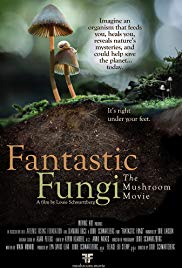 Greetings again from the darkness. Why did the mushroom get invited to the party? Because he’s a fun guy (fungi)! That joke works better when spoken rather than read, but it made me laugh as a kid, even though it wasn’t enough to keep me (and half my classmates) awake during those dull science films in junior high. Documentarian Louie Schwartzberg obviously stayed awake in class, and now he’s showing us how those films should be made … interesting, informative and entertaining.


 Posted by David Ferguson




 Movie Reviews from the Dark