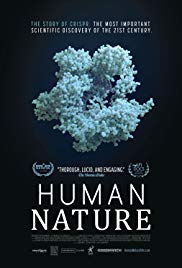
HUMAN NATURE (2020, doc)

March 12, 2020

 Greetings again from the darkness. That feeling when you start up a 95 minute documentary and a black and white clip of a Biologist giving a speech in 1966 fills the screen … it’s a moment of dread, which fortunately, filmmaker Adam Bolt quickly turns into a fascinating education. The fellow giving the 1966 speech (I missed his name) states that someday we will be able to alter human genes. More than 50 years later, Mr. Bolt’s film shows us that scientists are beyond that, and on the verge of developments that demand some serious and literally life-altering discussions.

Deep science and cinematic story-telling aren’t typically a good mix, but here we have a blending of journalists, researchers, and many types of scientists working with a knowledgeable filmmaker. They succeed in explaining the ‘why’ and ‘what for’ of gene-editing in a way that even a simpleton such as yours truly could follow. Going in, the concept of CRISPR (Clustered Regularly Interspaced Short Palindromic Repeats) was vague at best (for me), and those involved with the film explain how this has opened the scientific door to the building blocks of life through gene-editing.

For structure, the film is divided into six chapters: Needle in a Haystack, CRISPR, The Gene Machine, Brave New World, The Good Gene, and Playing God. These chapters touch on the story of young David Sanchez (afflicted with Sickle Cell Anemia), food and bacteria, Aldous Huxley’s book, eugenics, and morality. With so much to cover, the film excels in providing just enough for viewers, and putting the spotlight on those who can best explain their area of expertise or what results might mean.

Science often complements humanity while simultaneously standing opposed to nature. The film even shows the infamous JURASSIC PARK clip where Dr. Ian Malcolm (Jeff Goldblum) tries to confront the idea of genetic altering by stating, “Scientists were so preoccupied with whether or not they could, they didn’t stop to think if they should.” There are also clips from BLADE RUNNER and GATTACA, and they all lead us to the question on everyone’s mind … should we play God?  Most agree that stopping genetic diseases is a worthy goal, but how about designer babies? That’s where discussion of Huxley’s “Brave New World” and Hitler come in. Should we be architecting the “perfect human being”? When Dr. Jennifer Doudna asks, “What have I done?”, she’s smiling on the outside as a scientist, but surely has doubts as a person.

Keegan DeWitt’s score is top notch for a documentary, but a film about isolating individual and specific strands of DNA isn’t really about style. Listening to bioengineers discuss their own work and that of others in the field, gives us the basics of the science involved; however, as a society we must come to grips with that big question. Do we play the hand we’re dealt, or do we stack the deck and keep one up the sleeve? At some point very soon, we must decide. As the film states, after 2 billion years, this is the end of the beginning. What does the next stage look like?

watch the trailer:


WENDY (2020)

March 12, 2020

 Greetings again from the darkness. When you think of Peter Pan, you likely envision either the 1953 animated Disney film classic or the writings of J.M. Barre, who first introduced the character in his 1902 adult novel, “The Little White Bird.” Whatever your impressions and memories of Peter Pan, they likely differ from those of filmmaker Benh Zeitlin, who was Oscar nominated for his stunning 2012 film, BEASTS OF THE SOUTHERN WILD.

The story begins at a small town greasy spoon diner nestled along railroad tracks. Birthday boy Thomas (Krzysztof Meyn) is devouring a plate of bacon and taking ribbing from the locals who are teasing him with tales of his future working at the diner. He storms out yelping “I ain’t gonna be no mop and broom man”. Toddler Wendy watches as Thomas jumps on the passing train and disappears with the wind. A few years later, Wendy (newcomer Devin France) and her older twin brothers James and Douglas (Gage and Gavin Naquin) are awakened by a passing train and spot a giggling Peter (Yashua Mack) running along the top of the cars. The siblings climb out the window and leap to join Peter. Soon, they are on an adventure to an island (we assume is Neverland) which seems to be populated with kids who run and jump and play all day. Among them is Thomas, who hasn’t aged a day since his birthday bacon.

Any re-imagining of a classic comes with risks. Messing with people’s childhood memories inevitably leads to push-back. Benh Zeitlin gives the impression that he’s a passion-project only type of filmmaker. This interpretation means something to him, and it’s obvious in the detail and creativity. The similarities in visual style to his previous “Beasts” film are obvious, and render quite a different look and feel than we are accustomed to with fantasy movies. But then, this is not a Peter Pan for kids. It’s really a philosophical analysis of life. Everything is an adventure for kids, and then somewhere along the way, we lose ourselves and start the ‘adulting’ portion of life – leaving our childhood dreams behind.

Buzzo represents the once young boy who lost faith. He’s now an old guy dreaming of recapturing his youth. Mr. Zeitlin’s film, which he co-wrote with his sister Eliza Zeitlin, includes magical elements, fantasies, realism, life lessons, hardships, and the importance of personal connections. The score from Dan Romer is exceptional, as are the performances from youngsters Devin France and Yashua Mack. It was filmed on the volcanic island of Montserrat, and thanks to the mythical “Mother” who lives underwater, it becomes a fable about keeping the faith and never growing old. J.M. Barre’s famous first line was “All children, except one, grow up.” Are you that one child, or have you lost faith?

watch the trailer:


MARCEL DUCHAMP: ART OF THE POSSIBLE (doc, 2020)

March 11, 2020

 Greetings again from the darkness. The familiar phrase is “Art is in the eye of the beholder”, but do you know the full quote?  Author E.A. Bucchianeri actually wrote, “Art is in the eye of the beholder, and everyone will have their own interpretation.” Perhaps no artist lived this philosophy more than Marcel Duchamp; a true artist who inspired so many, and who convinced the art world that even an ‘idea’ could be art. There may be no more perfect fit than Matthew Taylor creating a profile on an artist who touched so many art disciplines … not unlike the director himself.

“I have forced myself to contradict myself in order to avoid conforming to my own taste.” Marcel Duchamp spoke these words and seemed to live by them. He was born in the Normandy area of France, and his grandfather ensured that art surrounded family members. Marcel, his two older brothers, and their sister all became artists. Marcel became the one who inspired, influenced, and created controversy and debate.

Mr. Taylor’s film is, for the most part, a chronological profile of Duchamp. He effectively uses interviews to emphasize the impact. As an example, performance artist Marina Abramovic, filmmaker Michel Gondry, and singer David Bowie … each creative giants in their respective field … have clips crediting the influence of Duchamp. Others interviewed include: Art historians, researchers, critics, and other artists.

The film takes us through Duchamp’s association with Dada, Cubism, and Conceptualism – though he claimed none of these. We get a peek at his use of science, language, geometry and technology in his work, and also learn the stories behind his most famous works, including Nude Descending a Staircase (1912), 3 Standard Stoppages (1914), his Mona Lisa parody LHOOQ (1919), and The Large Glass (an 8-12 year project). His “Readymades” include the R Mutt urinal from 1917, which absolutely tested the boundaries of what could be art.

Duchamp had a long-time affair with Brazilian artist Maria Martins, while his second wife, Alexina Sattler, was the former daughter-in-law of renowned painter Henri Matisse, an artist he had once used as a prime example of “retinal art” – pleasing only to the eye. Clearly Duchamp felt art was ‘of the mind’ and he felt taste to be subjective, even an enemy of art. Sometimes referred to as the “Father of Conceptualism”, Duchamp gave a lecture in 1962 titled “Apropos of Myself”, of which the full text is available online.

Mr. Taylor’s film and Mr. Duchamp’s work are quite enlightening as to how the definition of art was expanded, and how that transformation is still impacting today’s artists. It’s mentioned that most every artist wants fame and fortune, and though Duchamp wanted neither, he ended up with both. By the film’s end, we are in agreement with Duchamp that what’s important isn’t the art, but rather the artist. And few have been more important than Marcel Duchamp.

watch the trailer:


THE MIMIC (2020)

March 11, 2020

 Greetings again from the darkness. It has been said that “imitation is the sincerest form of flattery.” Writer-director Thomas F Mazziotti has not only based this story on his own real life experience, but with it proves that imitation can also be the sign of a psychopath. In fact, as the film begins, we are informed that 1 in 25 people are psychopaths, and also playing a role here is “The Sociopath Next Door: The Ruthless Versus the Rest of Us”, a 2005 book written by Martha Stout.

This is an unusual film with an offbeat rhythm. It reminds me a bit of CREEP, the 2014 movie starring Mark Duplass, in that the characters all seem like someone we could know, yet there’s something a bit off. Thomas Sadoski (“The Newsroom”) is Tony, a lead character, a widower, and our narrator. Tony has not adjusted to life without his wife, and part of the reason could be how his friends and neighbors are always bringing it up. Once the “Kid” shows up, Tony is taken on a ride that has him questioning not just other people, but reality.

“Kid” is actually Peter (Jake Robinson), a 31 year old, red pants wearing newcomer to town. He seems to fit right in with the elderly local newspaper ladies as they bicker about semi-colons, but his real attraction is to Tony – proclaiming “we’re on the same wavelength” after a few ‘coincidental’ meet-ups. It’s tempting to label this as a battle of nitwits, but neither of the men lack intelligence. They are both just awkward, and that includes Tony, our trusted narrator.

The film is basically a puzzle with numerous separate pieces loosely packaged as a series of vignettes that may or may not tie together. The segments certainly provide a showcase for a plethora of recognizable actors. The list includes: Austin Pendleton, Gina Gershon, Jessica Walter, Didi Conn, Marilu Henner, Tammy Blanchard, Matthew Maher, Jessica Keenan Wynn, Josh Pais, and Steve Routman. One segment I found particularly entertaining featured Doug Plaut and the legendary M Emmet Walsh as a writer and director discussing a project.

For the most part, it just seems the film, the writers, and the characters are all trying so desperately to be witty, clever, or funny, that whether it works as a cohesive project gets kind of pushed aside. The background circus music fits well and complements the theatrical pacing and cadence. Mazziotti’s film is certainly not cinema-as-usual, and it will likely find a cult following … perhaps among those bonding “on a personal pronoun basis.”


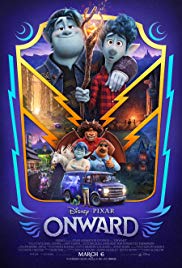
ONWARD (animated, 2020)

March 5, 2020

 Greetings again from the darkness. No studio has ever had a 25 year run like Pixar. This is their 22nd feature film over that span and every single one lands somewhere in the range of brilliant/instant classic to watchable/re-watchable. Though this latest may not reach instant classic level, it does stick to the Pixar standard template of highly entertaining while delivering a life lesson. This is the first time in the Pixar director’s chair for Dan Scanlon since MONSTERS UNIVERSITY (2013). It’s also the first original Pixar since COCO (2017) … and note, it’s rated PG.

The film opens with a “history” lesson detailing how the world was once populated by enchanted creatures like elves, unicorns, wizards, mermaids, fairies and sprites. Science and technology created shortcuts and soon the world’s “magic” had disappeared, relegating these creatures to life in the suburbs. We pick up the story on Ian Lightfoot’s 16th birthday. Ian is part of an elf family that includes his older brother Barley and their widowed mother Laurel. While Barley is a loud and rambunctious type who is obsessed with the Quest of Yore game and mythology (think Dungeons & Dragons), Ian is a more pensive type who still mourns the late father he never met. Both brothers are surprised when their mother presents a “gift” from their dad – one he left instructions to be held until Ian turned 16. The gift is a magical wizard staff that, with the included precious stone, can bring dad back to life for 24 hours.

Barley’s knowledge of the magical spells combined with Ian’s lack of self-confidence ends up botching things to the point that only half of dad is brought back – the bottom half. Under a tight deadline and in need of a replacement gem to bring dad back for a much desired final conversation, the brothers take off on an adventure that turns pretty wild. Their quest leads them to cross paths with many of the previously enchanted creatures, including the fabulous Manticore, and mom’s boyfriend, Officer Colt Bronco.

We have come to expect ‘magic’ from Pixar with every movie, and this one doesn’t disappoint. It may not be quite as awe-inspiring as some of their best work, but it’s still a terrific suburban fantasy adventure filled with comedy and life lessons … the most crucial of which is: being happy with what you have is more crucial to your inner-peace than getting what you hope for.

As always, the voice acting is top notch. Tom Holland (SPIDER-MAN: HOMECOMING) delivers the goods as Ian, and Chris Pratt (GUARDIANS OF THE GALAXY) brings the necessary wonder and excitement to brother Barley. Julia Louis-Dreyfus never really gets to shine as their mother, but then this story is focused on the boys. Octavia Spencer has fun as Manticore (we needed more Manticore!), Mel Rodriguez is a hoot as Officer Colt Bronco, and yes of course, John Ratzenberger sneaks in – he’s now voiced a character in all 22 Pixar films.

This is the first Pixar film to be totally free of input from ousted President John Lasseter, and it’s one of the very few to be released outside of the summer or awards season. The likely reason is that the studio has a second original film being released this June. SOUL will be directed by Pete Docter and is viewed as a companion piece to the already classic INSIDE OUT (2015). Given the time of year, it could be easy to overlook ONWARD, but it nails the Pixar trademark emotional finale … delivering a sentimental scene likely to stick with you. I have praised Pixar many times over the years as their creative teams really seem to “get it”. Regardless of the month, ONWARD will cast a spell.

watch the trailer:


THE WAY BACK (2020)

March 5, 2020

 Greetings again from the darkness. So much beer and booze. It would be easy to classify this latest from writer-director Gavin O’Connor as a sports movie. After all, he has given us two excellent ones in MIRACLE (2004) and WARRIOR (2011). However, as with those two films, there is much more going on here. This is about grief and addiction, and the difficulties in mending a life in tatters.

Jack Cunningham likes his morning shower. It helps get him prepared for a day of construction work and get over a late night of drinking. What’s unusual about his morning routine is that he drinks a beer while taking his morning shower, and then fills his Yeti with gin as he takes his post at the building site. Jack is played by Ben Affleck, who has returned to the screen with a serious acting gig after his fling as Batman. Of course, anyone who even casually keeps up with Hollywood gossip knows Mr. Affleck and his character here have in common a drinking problem. In fact, the actor filmed this immediately after his latest rehab stint. It’s quite possible that the collision of real life and fiction explain why this is Affleck’s best performance in many years (at least since HOLLYWOODLAND in 2006). He re-teams here with O’Connor, who directed him in THE ACCOUNTANT (2016).

As a former high school basketball star, Jack’s life has turned out much differently than expected. His construction job is beating him down, alcohol abuse is slowly destroying him, and he recently split with his wife Angela (Janina Gavankar) after a tragedy. Has he hit rock bottom? It’s likely he thinks so. As happens so often in life, an opportunity presents itself. The head Priest at his former catholic high school asks him to step in as basketball coach after the current coach has a heart attack. The team is terrible, and has been that way since Jack graduated 25 years ago. After a painful-to-watch evening of decision-making, Jack accepts the job.

As you would expect, it’s a team of misfits who have little concept of teamwork. Affleck excels as a coach who evaluates the talent he has and devises a strategy to not only improve individual player performance, but also inject the philosophies of teamwork and cohesion and commitment. He does this with the help of Algebra teacher slash Assistant Coach Dan (Al Madrigal, “I’m Dying Up Here”), who appreciates what Jack brings to the position, but is also protective of the boys and the school mission.

Jack manages to stay sober while coaching, but we see how fine that line is for an addict. Life suddenly rears up and plops down an emotional situation that is simply too much form him to handle. It’s here when we realize that while it appeared coaching the team gave Jack a glimmer of hope for a better life, it also allowed him to ignore the personal issues and relationships that had driven him to the bottle. The basketball scenes are the most fun to watch, but it’s the realistic life elements that elevate the story. It’s excruciating to watch Jack re-telling glory days stories to his ‘buddies’ at the local neighborhood bar, only to be helped home by the same old man who used to carry his father home from the same bar. The perpetuation of misery is a story that is all too relatable for many.

Jack’s good qualities are evident when he’s prodding ultra-quiet point guard Brandon (Brandon Wilson) into taking on a leadership role and thinking of his future, but that’s contrasted with his inconsiderate treatment of his sister Beth (Michaela Watkins) and Father Mark (Jeremy Radin), the team/school Chaplain. It’s the two sides of Jack that so clearly resonate with those who have experienced addiction. This is a guy who botched his college/basketball opportunity, but managed to build a new life, only to have it snatched away in the cruelest way possible. It’s imperative that he come to grips with all of that in some place other than the bottom of a beer mug.

The outstanding screenplay comes from Brad Ingelsby (OUT OF THE FURNACE, 2013), and with director O’Connor and the cast, the film has a throwback to the 70’s feel … gritty and realistic. This is not the smirking, strutting stud we are accustomed to seeing with Affleck. He seems immersed in the role and brings an understanding to the struggles, the rehab, and the importance of a support system. Redemption played a huge part in the classic HOOSIERS (1986) and most every other rag-tag sports team in movies, and THE WAY BACK shows us there really is no going back … instead, we must deal with life in order to move on.

watch the trailer:


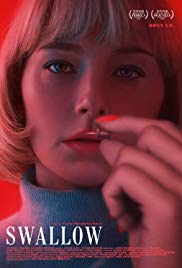
SWALLOW (2020)

March 5, 2020

 Greetings again from the darkness. Have you ever picked up a marble and wanted to ingest it?  How about a push-pin? A battery? Any other items normally considered inedible? If not, you likely don’t suffer from the psychological disorder known as pica – an eating disorder at the center of the feature film debut from Carlo Mirabella-Davis. While pica may be new and confounding to most of us, the real story is what drives someone to swallow items that could be harmful and cause severe pain?

Haley Bennett (THE GIRL ON THE TRAIN) stars as Hunter Conrad, a newly married trophy wife to spoiled and handsome Richie Conrad (Austin Stowell). Richie is so entitled that his even more entitled dad (David Rasche) makes a big deal out of promoting his son to partner by proclaiming at a dinner party that “he earned it.” Oh and this is after the parents bought the newlyweds a stunning home with a view. It’s obvious Hunter ‘married up’ from a socioeconomic perspective, but her GQ husband pays more attention to his cell phone than he does to his wife or the picture perfect dinners she prepares. Hunter’s Mother-in-Law (Elizabeth Marvel) offers up awkward support and passive-aggressive compliments … such as a self-help book entitled “A Talent for Joy.”

The book is a gift to Hunter immediately after Richie tells his parents “We’re pregnant!” A passage in the book mentions to ‘push yourself to experience new things’. It’s at this point where Hunter sees herself become even more of an accessory within the family. One morning she spots a decorative marble and pops it in her mouth. She seems to take pleasure in this, and … um … after it passes, displays it as some type of trophy. Soon other items join the marble on display, until finally, Hunter is in so much pain, she’s rushed to the hospital for surgery.

Pica is a disorder that’s difficult to understand. Haley seems to be complacent, having no real persona other than her pretty face and pristine wardrobe. Swallowing the items evidently delivers the feeling lacking in her life – a life where her job seems to be becoming the perfect wife, mother, and daughter-in-law. Worried about the safety of the unborn baby, the family hires Luay (Laith Nakli), a Syrian live-in nurse, to keep an eye on Hunter. Oddly enough, the war-toughened Luay shows more compassion to Hunter than anyone in the family.

The film shifts gears a bit when we start learning more of Hunter’s backstory during her trips to the psychiatrist (Zabryna Guevara). This backstory is of course tragic and explains a great deal about Hunter’s strange compulsion. It also leads to a sequence with Denis O’Hare, who is a welcome presence in most any movie. The two share a scene that allows Hunter to fill in the gaps of her life.

Director Mirabella-Davis doesn’t treat the rich as caricatures, but rather symbolic of the self-centeredness that seems to go with wealth. We see good in places we don’t expect it. We lack the trust in places we should be able to depend on. Additionally, we question whether finding one’s true self through genetics makes any real sense when compared with just making up one’s mind about the kind of person they want to be. This is a disturbing, trippy, darker-than-expected film with an interesting score from composer Nathan Halpern. When it veers from the skirts of horror and suspense towards political and social topics, the film loses steam and tries to cram in a bit too much. Still, it’s an unusual and creative film with a terrific performance from Ms. Bennett, and leaves us looking forward to the next Mirabella-Davis project.

watch the trailer:


GREED (2020)

March 5, 2020

 Greetings again from the darkness. “Greed for lack of a better word, is good. Greed is right. Greed works.” Those words were part of the iconic speech from Gordon Gekko (an Oscar winning role for Michael Douglas) in Oliver Stone’s 1987 film WALL STREET. Here we are 3 decades later, and there may not be a more tarnished word, attitude, or approach than ‘greed’, and filmmaker Michael Winterbottom re-teams with his “The Trip” collaborator Steve Coogan to deliver satire on today’s ultra-rich.

The always entertaining Mr. Coogan stars as Sir Richard McReadie, also known in the media by numerous other names like: Greedy McReadie, McGreedy, The King of High Street, and The Monet of Money (a label he seemingly applied to himself). Sir Richard is apparently modeled after fashion mogul Sir Philip Green (owner of Top Shop), and with his fake tan and blinding white teeth caps, makes a pretty easy target for Winterbottom’s bashing of the too-rich.

A loose structure to the film is provided by the contrast of the coordination and excess going into planning McReadie’s upcoming 60th birthday toga bash on the Greek isle of Mykonos, and the official inquiry by Parliament into his questionable business practices. Scenes from the committee hearings are interspersed throughout the film, along with some flashbacks to young McReadie (played by Jamie Blackley) honing his negotiation skills. There is also McReadie’s hired biographer Nick (played by David Mitchell), a spineless freelancer thrilled to have the job, despite his initial obliviousness to what McReadie is all about. Although Nick does uncover some of the cruel labor practices, the character seems to be a way for Winterbottom to poke at journalists simultaneously to his scalding the rich. Celebrities for hire also take shot to the bow.

Isla Fisher plays Samantha, McReadie’s ex-wife, whose Monaco residence helps hide the family/ex-family fortune. The relationship between these two is not just creepy on the balance sheet, but plays out in ways apparently acceptable to the lifestyles of the wealthy. Asa Butterfield plays their overlooked and underappreciate son Finn, and the always fabulous Shirley Henderson plays Irish mother Margaret in such a way that we wish more of the movie was about her. McReadie’s daughter Lily (Sophia Cookson) is pretty funny as she films her Reality TV show in the midst of her father’s party preparation … which includes Bulgarian workers building a replica of a Roman amphitheater to act as the site of a GLADIATOR reenactment – replete with a live lion (not a tiger)!

Sarah Solemani and Dinita Gohil play two of McReadie’s key assistants, and provide us a glimpse of how real people struggle to work amidst such waste and ego and unrealistic expectations. McReadie kinda quotes Shakespeare, but we feel certain he’s not a well-read man. Instead his talents are in bending a system and forcing others to acquiesce to his demands. The tabletop shell game he mastered as a parlor trick is really just a miniaturized version of his business empire … trading one highly-leveraged enterprise for the next, while cashing in on the process.

Winterbottom’s approach is often confusing and sometimes drifts towards mockumentary for flashbacks and interviews. It’s an uneven comedy that works at times, and doesn’t at others – not uncommon for satire. Coogan makes McReadie always fun (in a disturbing way) to watch, though the film never clicks better than the Keith Richards moment near the end. The anger-based acidic comedy satirizes what’s happening in the real world, and tries to further expose how the mega-rich take advantage of the rest of us. Some well executed bits make this one worth watching, but really offers little in the form of insight or solutions. Instead it’s just infuriating … at least in the parts where we aren’t laughing. We certainly don’t laugh over the closing credits as real world statistics are provided regarding inequality and third world labor.

watch the trailer:


THE BANKER (2020)

March 5, 2020

 Greetings again from the darkness. The ‘long con’ usually doesn’t work for movies since the story must be told within a 2 hour window. However, writer-director George Nolfi and co-writers Brad Kane, Niceole R Levy, David Lewis Smith and Stan Younger deliver a story inspired by the true actions and events of men who found a clever way to circumvent a system designed to prevent people of color from succeeding in business.

Anthony Mackie puts on glasses and a few sharp suits to play Bernard Garrett. We see young Bernard as a shoeshine boy in Willis, Texas in 1939, eavesdropping on the businessmen as they chat about high finance, and then taking notes on subjects such as return on investment and calculating property value. Young Bernard grows into a math whiz adult … one whose ambition is hampered only by the color of his skin. He has a chip on his shoulder and is intent on proving the world wrong. His supportive wife Eunice (Nia Long) introduces him to Los Angeles entrepreneur Joe Morris (Samuel L Jackson), whose enterprising approach and bold lifestyle both complements and contrasts with Bernard’s ambition and straight-laced personality.

Bernard realized early on that in order to build the real estate portfolio he envisioned … one that could provide opportunity for others in the black community … he needed the face of a white man to handle the negotiations. Initially that white face belonged to Patrick Barker (Colm Meaney), and the business grew quickly. Things really take off for the Garrett – Morris partnership when they begin training Matt Steiner (Nicholas Hoult) how to be the face of the company. Bernard’s shrewd business and financial sense flies over Steiner’s head, but with practice, he learns to “act” the part. Steiner’s training involves everything from golf to math to dinner table etiquette.

It was the late 1950’s and early 1960’s … racism was rampant. The Garrett – Morris story plays like an underground rebellion, and one that is surprisingly fun to watch unfold on screen. While the two men built their personal wealth, their actions also helped fight against racism and inequality. They ended up owning 177 buildings, and things might have continued on had Garrett not, against Morris’ better judgment, decided they were strong enough to change things back in his hometown of Willis, Texas. Morris labeled Garrett’s plan as “social activism” rather than business. Their real estate venture morphed into banking so that blacks could have access to business and personal loans. What seemed like a minor misstep from Steiner, blew the wheels off and created a worst case scenario for Garrett and Morris.

Mackie, Hoult and Jackson are all fun to watch here, with Mr. Jackson offering up many of his patented reaction shots and laughs. If anything, the filmmakers play things a bit too safe with the story-telling. It’s all a bit too slick and glossy, given the times. Sure, it’s a pleasure to see what amounts to a classic car show on the street, but it’s difficult to imagine things went quite this smoothly right up until they didn’t. This is an Apple TV production, and its release was delayed due to controversy surrounding Garrett’s second wife (not depicted in the film) and his son, who was originally listed as a Producer. An “Inspired by true events” banner to open a film typically means some dramatic license was taken, which we can assume was the case here. Regardless, the story of Bernard Garrett and Joe Morris and Matt Steiner is fascinating, and worthy of being told.

watch the trailer:


GO BACK TO CHINA (2020)

March 5, 2020

 Greetings again from the darkness. Seeing Chinese films reach mainstream status is a nice development in a cinematic industry that too often segments by nationality. Jon M Chu’s CRAZY RICH ASIANS was a huge hit in 2018, and then last year Lulu Wang’s brilliant THE FAREWELL was a favorite. Now comes a semi-autobiographical tale from writer-director-producer Emily Ting. All three films revolve around Americanized young adults revisiting their Chinese roots, though each for different reasons.

Anna Akana stars as Sasha Li, a twenty-something one year removed from fashion school. We first see her on her birthday botching a job interview and running up a monster bar tab with her posse of friends at the club that night. Having ignored calls from her father in China, she is shocked and humiliated when she discovers her dad has cut her off from the trust fund she has been blowing through living the high life in Los Angeles. As viewers, we are immediately turned off by Sasha’s immaturity and spoiled self. When her dad offers her a deal … come back to China and work in his toy factory for a year in order to get her trust fund back, we (and her friends) see it as a no-brainer. But it’s not until she gets an eviction notice and discovers her mother (Kelly Hu) is also being cut off, that she makes the decision to head back to the homeland.

Once Sasha is back in China, all of the pieces to the puzzle are present. It’s a dysfunctional family headed by the father Teddy (Richard Ng) who seems dedicated to being a successful businessman, while proclaiming he’s doing it all for the family … a family that consists of multiple offspring from multiple women. His oldest daughter Carol (Lynn Chen) is Sasha’s half-sister, though they barely know each other. Carol has been a dutiful loyal soldier to dad’s toy company, and a bit envious of Sasha’s free-wheeling lifestyle. Carol believes she has paid her dues, and it’s now time for Sasha to pay hers. Sasha also meets two younger half-siblings, as well as a particularly young Lulu (Kendy Cheung), whose role Teddy describes as “she takes care of me.” Yuck.

What happens next is relatively predictable. Sasha’s fashion design skills prove valuable to dad’s stale line of toys, so her ideas bring new life to the company and the employees. The latter are impacted by Sasha’s insistence on better working conditions. Of course, Sasha being Sasha, her lack of business savvy leads to problems and a fallout. The film’s wrap up is a bit too clean for the real world, but Ms. Akana has managed to win us over by this point, so we are apt to overlook the script and story issues.

Richard Ng seems a bit too old for his role as Teddy, but he excels in the business scenes where frustrations boil over. Teddy fails miserably as a father or relationship partner, but his instincts with Sasha seem sincere. Filmmaker Ting includes some commentary on social and cultural issues in China, including the ‘One Child Policy’, and the labor practices and family pressures. The film is part ‘coming of age’, part ‘coming home’, and part ‘coming to grips’. The life lessons for Sasha are quite clear as she transitions from spoiled princess to reality-based citizen. Her family may still be packed with dysfunction, but then, whose isn’t? Part of maturity is learning to deal with it, and understand that family does matter.

watch the trailer: