DELIVERANCE (1972) revisited

August 22, 2020

 Greetings again from the darkness. This is the next entry in my “Revisited” series, where I re-watch and then write about (not a traditional review) a classic movie. “City Slickers” could have been an apt name for this 1972 film, though it would have forced a new title for Billy Crystal’s 1991 comedy. DELIVERANCE was directed by John Boorman, and the script was adapted from James Dickey’s 1970 novel by the writer himself. Many have referred to this as a man-against-nature film, and it certainly works as an adventure tale; however, I find the psychological elements just as fascinating – the primal instincts and the personal transformations.

Those nine notes are every bit as iconic as the JAWS theme. “Dueling Banjos” always sends a chill up my spine, as I recall certain scenes from the film that are forever etched into my memory. We don’t even have to wait long to hear the song. It’s the first real sequence after the opening credits which feature only the banter of four buddies animatedly discussing their weekend canoe trip down the Cahulawassee River before a dam is built and the area flooded for a hydro-electric plant. During the banter, in a bit of foreshadowing, we hear Ned Beatty’s character ask, “Are there any hillbillies” where they are headed. The first glimpse of the four men occurs as they stop for gas and interact with the locals.

The personalities of each are quickly established. Lewis (Burt Reynolds) is the alpha male, and the one pushing the group to take the trip. Ed (Jon Voight) is Lewis’ friend who wants to be like him, though he lacks the confidence. Bobby (Ned Beatty) is an insurance salesman, who looks down on the locals and would rather be playing golf. Drew (Ronny Cox) is a nice guy, and the one who connects musically for the guitar and banjo picking with the local boy (Billy Redden) perched on the porch. It’s a fun, yet unsettling, scene to watch as the two pick away on their instruments. Their smiles end abruptly when the boy turns away in disgust as Drew tries to shake his hand. It’s not the last time the outsiders will be rebuffed.

 These are suburban men, settled in life, being pushed outside their comfort zone by wannbe-adventurer Lewis, who is the epitome of 1970’s machismo. His angry proclamation that “they’re drowning a river” is followed up with “because it’s there”, as an answer to why they are taking the trip. Lewis’ life vest flaunting his arms and chest, and his aggressive oratory (including the ironic, “You can’t judge people by the way they look, Chubby”) contrast with the conservative dress and mannerisms of the other men: Ed smoking a pipe, Drew strumming a guitar, and Bobby’s squishy body. For the first half of the film, Reynolds mesmerizes as the cocky Lewis.

As the men make their way down the river, they experience the sudden adrenaline rush that Lewis promised. Shooting the rapids on the river is truly man-against-nature, and the adventure that director Boorman and writer Dickey want us to initially believe is at the heart of the story. One of the key exchanges occurs at the campsight that night as Lewis acknowledges Ed’s “nice life, nice job, nice wife, nice kids”, and then asks him directly, “Why do you come on these trips with me, Ed?” It’s clear Ed is happy with his life, but he desperately wants to feel the power of being a survivalist and “real man”. It’s because of this exchange, that we find Ed’s hunting trip and face-to-face with a deer the next morning so gut-wrenching.

The second day finds some truly peaceful times with nature, and some stunning camera work and shots of nature courtesy of cinematographer Vilmos Zsigmund. It’s in these shots where we “get it” – the appeal of becoming one with nature. Of course, it’s once things seem so right, that things go so wrong. A drastic shift occurs. Ed and Bobby are confronted by local hillbillies in the most despicable way. Fear fills the screen and our minds. The menacing mountain men are played by Herbert “Cowboy” Coward (not really an actor) and Billy McKinney (whom you’ll recognize from FIRST BLOOD, THE OUTLAW JOSEY WALES, and many other roles). Still today, the sequence is terrifying and difficult to watch, and it’s when “squeal like a pig” entered our lexicon, while “He got a real purdy mouth” became seared into our brain.

Immediately following the nightmare sequence with the hillbillies, comes one of those psychological exchanges that elevate the film to greatness. Four frantic and desperate men debating “the law”, when in actuality, they are debating self-preservation. The close-up of Ned Beatty’s face says as much as any line of dialogue, and, as is often the case, a moral dilemma is resolved by choosing the path of least resistance. The day presents more horror, as Lewis and Drew meet with disaster, while Ed’s transformation takes place. It should be noted that the film’s budget was so tight, the actors performed their own stunts – including Jon Voight’s tense (and impressive) climb up the face of the rock cliff.

Director John Boorman was a 5-time Oscar nominee, including HOPE AND GLORY (1987). He also helmed one of my sleeper favorites, THE EMERALD FOREST (1985), as well as coming right out of the gate with his first feature (and cult favorite) POINT BLANK (1967), starring Lee Marvin and Angie Dickinson. Writer James Dickey wrote the 1970 novel and adapted his own novel for the screen. He was a novelist, poet, and college professor, as well as being named U.S. Poet Laureate. My favorite Dickey quote is, “The poet is one who, because he cannot love, imagines what it would be like if he could.”

For Ned Beatty and Ronny Cox, it was their feature film debut. Mr. Beatty had a 40 year acting career (he retired in 2013), and notched an Oscar nomination for NETWORK (1976), while seemingly appearing in most every movie in the 1970’s and 1980’s. He may be best remembered as Lex Luthor’s bumbling henchman in SUPERMAN (1978) and SUPERMAN II (1978), and kids today would recognize his voice as Lotso in TOY STORY 3 (2010). He also became good friends with Burt Reynolds, and was cast in many of Reynolds’ later films. His career allowed him to play a widely diverse roster of characters, and one of his often-forgotten best was in THE BIG EASY (1986). Mr. Cox is approaching a 50 year acting career, and he is also a talented singer-songwriter. His best known roles are as the Police Lieutenant in BEVERLY HILLS COP (1984) and BEVERLY HILLS COP II (1987), and as a corporate executive in both ROBOCOP (1987) and TOTAL RECALL (1990). In addition to his many movie roles, Cox appeared in numerous TV series throughout the years, and one of my favorites was a small town family drama entitled “Apple’s Way”, which ran for two seasons, 1974-75.

Jon Voight is an actor every movie lover is familiar with. As he approaches his 60th year in the business, the highly decorated actor has been nominated for four Oscars, winning for COMING HOME (1978), starring opposite Jane Fonda. His other nominations were for playing a gigolo in MIDNIGHT COWBOY (1969), a bad guy in the thriller RUNAWAY TRAIN (1985), and as Howard Cosell in ALI (2001). More recently he has been recognized for his stellar work in the superb cable TV series “Ray Donovan”. His daughter is Oscar winner Angelina Jolie, and Mr. Voight has had such memorable roles as boxer Billy Flynn in THE CHAMP (1979), Jim Phelps in MISSON: IMPOSSIBLE (1996), a sleazy hunter in ANACONDA (1997), and President Franklin Roosevelt in PEARL HARBOR (2001). And of course, we must mention the classic Jon (“John”) Voight episode of “Seinfeld.” JAWS fans might be surprised to know that he turned down the Hooper role that ultimately went to Richard Dreyfuss.

A remarkable 60 year career ended when Burt Reynolds passed away in 2018. Reynolds was a star running back for Florida State University before an injury ended his pro aspirations and caused him to pursue acting. For an extended period of time in the 1970’s and 1980’s, Reynolds was the biggest box office draw among actors. Some of his most popular films during the streak included: THE LONGEST YARD (1974), the SMOKEY AND THE BANDIT franchise (1977, 1980, 1983), SEMI-TOUGH (1977), SHARKY’S MACHINE (1981), THE CANNONBALL RUN (1981) and II (1984), and THE BEST LITTLE WHOREHOUSE IN TEXAS (1982). Most of these films played off of Reynolds’ extraordinary charm and good looks (and iconic cackle), while he often strutted tongue-in-cheek as he worked extensively with a close group of friends. He later experienced some personal relationship issues, financial difficulties, and extreme health scares. Although he continued to work during the late 80s and early 90s, it was his excellent supporting work in STRIPTEASE (1996) and BOOGIE NIGHTS (1997) that really vaulted him back into the Hollywood scene. The latter of those two movies nabbed him the only Oscar nomination of his career. Reynolds continued to work right up until the end of his life, spanning a career of almost 200 credits (TV and movies). Some of you fellow old-timers out there might recall Reynolds’ first recurring role was as Quint in “Gunsmoke”, the longest running TV series until eclipsed by “The Simpsons” (and by “Law and Order” in seasons, though it has about 150 fewer episodes). In DELIVERANCE, Reynolds’ Lewis is “a man’s man” – the kind of guy the other suburban dads aspired to. His on screen magnetism is obvious, and stardom followed. Reynolds spent most of his adult life in front of a camera – either movies, TV, paparazzi, or talk shows. And lest we forget, though he claimed to have tried, Reynolds became the first male centerfold for “Cosmopolitan” magazine in 1972, the same year this movie hit. That smirk, cigar and bear rug created quite a sensation at the time – brilliant marketing from editor Helen Gurley Brown.

While the Cahulawassee River is fictional, the filming location was most decidedly real. Cinematographer Vilmos Zsigmund captured the stunning beauty of Tallulah Gorge and the Chatooga River in northeastern Georgia. His camera work leaves no doubt as to nature’s double edge sword of beauty and danger. Mr. Zsigmund was a 4 time Oscar nominee, winning the award for CLOSE ENCOUNTERS OF THE THIRD KIND (1977). He was also responsible for THE DEER HUNTER (1978), HEAVEN’S GATE (1980), THE TWO JAKES (1990), and THE BLACK DAHLIA (2006). Editor Tom Priestley received his only Oscar nomination for his work on this film. Mr. Priestley also served as Editor on THE GREAT GATSBY (1974), TESS (1979), and 1984 (1984), and is the son of English writer John Boynton Priestley.
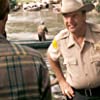
 Ned Beatty’s wife and John Boorman’s son have brief appearances as Ed’s family, and writer James Dickey has a small but key role as the hulking Sheriff of Aintry, who doesn’t buy the men’s recap of events. Reynolds dominates the screen for the first half of the movie, and Mr. Beatty shines in his degradation, but it’s Voight’s transformation into a semblance of Lewis that proves most remarkable. Rarely have primal instincts and survival mode been more effectively presented on the silver screen than in this film. This “guys’ weekend” turned nightmare received 3 Oscar nominations (Best Picture, Best Director, Best Editor), but this was the same year that CABARET beat out THE GODFATHER in a couple of categories, so DELIVERANCE took home no awards … although we will always have those 9 notes.

*Note: “Dueling Banjos” was credited to Eric Weissberg and Steve Mandel, but there was a lawsuit filed by Arthur “Guitar Boogie” Smith, who wrote “Feudin’ Banjos” in 1955.

As a bonus for reading this far, here is a short video of Steve Martin and Kermit the Frog performing “Dueling Banjos”:


And here is the original 1972 trailer:


WORDS ON BATHROOM WALLS (2020)

August 20, 2020

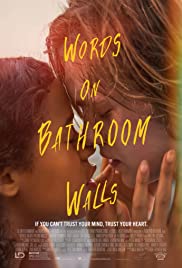
 Greetings again from the darkness. Very little outside ‘the norm’ is required for teenagers to ostracize one of their own. Sometimes it’s a haircut or a brand of shoes, or even some other minor detail that sets them apart. But when it’s a mental illness, the tribe can be merciless. Director Thor Freudenthal (DIARY OF A WIMPY KID, 2010) takes on Julia Walton’s 2017 novel, with a screenplay from Nick Naveda. The film features two rising young stars and addresses some of the challenges brought on by the uncertainties associated with a mental illness.

Charlie Plummer (so terrific in LEAN ON PETE, 2018) stars as Adam, a high school senior who has dealt with the challenges of undiagnosed mental health issues since he was quite young. His father abandoned the family years ago, and Adam’s devoted mother (Molly Parker, “House of Cards”) is not only patient and loving, but also committed to researching any possible treatment that would lead Adam to a better life. On the other hand, Adam and his mother’s new live-in lover Paul (Walton Goggins) don’t exactly see eye-to-eye on things, leading to more anxiety for Adam.

In an interesting and unique approach, director Freudenthal allows us to not only hear the voices Adam hears, but also see the hallucinations and visions he sees – three of whom are Rebecca (AnnaSophia Robb, THE WAY WAY BACK), a sweet, hippie-ish optimist; The Bodyguard (Lobo Sebastian), a cigar-chomping, bat swinging he-man; and Joaquin (Devon Bostick), an inappropriately horny ‘best friend from a 90’s move.” On top of that, there is a black mist that periodically manifests, enveloping Adam and bringing on crippling fear and isolation. After a years-long stream of drug therapy, Adam is pronounced “treatment resistant” and diagnosed as schizophrenic. Adam’s only mind-calming escape is when he’s cooking. He knows his way around the kitchen and his goal is to attend Culinary School after graduation.

One day, Adam has a psychotic break during Chemistry class. He gets expelled, which jeopardizes his Culinary School dream. His mother gets him admitted to a Catholic School run by Sister Catherine (Beth Grant) at the same time he is accepted into an experimental drug trial. He’s allowed to stay in school as long as he takes his meds and maintains his grades. It’s here where he meets the dynamic Maya (Taylor Russell, WAVES, 2019). Maya is smart and ambitious and proud, and the two quickly form a bond – an interesting bond between two smart high school kids carrying their own burdens and holding their own secrets.

Sister Catherine is balancing the specific needs of Adam with her responsibility to the school, and then there is also prom and graduation to deal with. With the new drug, the voices and visions disappear, but Adam has some issues with the side effects. A desperate plea for help from Father Patrick (Andy Garcia), the school priest, provides a boost as Adam tells him, “It’s nice to be listened to and not just observed.” That line provides significant insight into what it’s like to have this affliction, and that’s really where the movie excels … putting us in the shoes of a schizophrenic and allowing us to experience the good and bad moments. What can Adam trust? His eyes? His ears? His mind?

Adam and Maya are both trying to figure out who they are, at the same time learning what it really means to love someone. Adam refers to his illness as his “burgeoning insanity”, and in fact, schizophrenia does have a history of accelerating over time once it strikes a young person. The movie succeeds in taking away some of the mystique of mental illness, by making it approachable and something we want to better understand. There is a visual reference to Van Gogh’s “Starry Night” that might be a bit too “nail on the head”, but Freudenthal’s movie is profound and features two very talented young actors. The humanity beneath the surface of those society would rather pretend don’t exist is effectively compared to those stricken with cancer … those we would do anything for. I watched this film back-to-back with another teen-drama-romance new release entitled CHEMICAL HEARTS, and it’s extremely rare to find two such thought-provoking films centered on a pair of high school students … but quite a treat (although I believe all 4 actors are long past high school age).

Being released on August 21, 2020 in THEATERS ONLY

watch the (entirely too long) trailer:


CHEMICAL HEARTS (2020)

August 20, 2020

 Greetings again from the darkness. In the mid-1960’s Cat Stevens wrote the song “The First Cut is the Deepest.” It’s a beautiful and poignant song that has been a hit single for many artists, including Rod Stewart (1977) and Sheryl Crow (2003). Although the song is not associated with this film from writer-director Richard Tanne, I couldn’t stop thinking of it as the story unfolded – unsure if any teen romance has ever captured the sentiment with more emotional depth. The film is based on the 2016 novel, “Our Chemical Hearts”, by Krystal Sutherland.

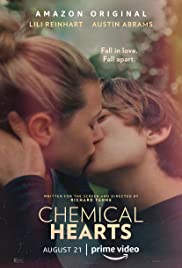
Henry Page (Austin Abrams, PAPER TOWNS) is a high school senior, who proclaims as our narrator, “You are never more alive than when you are a teenager.” Henry also laments that “nothing remarkable” has happened in his life yet. That changes quickly the day the teacher-sponsor of the school newspaper calls Henry and new student Grace Town (Lili Reinhart, CW series “Riverdale”) into the office to inform them they will be co-Editors this year. However, the remarkable part for Henry isn’t achieving his goal of being Editor, rather it’s meeting Grace.

Grace is not nearly as excited as Henry for the assignment, but agrees to edit the paper as long as she doesn’t have to write. It turns out Grace is beyond damaged, she’s a shattered soul. A recent car crash took the life of her true love boyfriend, and left her leg severely damaged, instantly ending her track career. In contrast, Henry’s hobby is Kintsugi, an ancient Japanese tradition of re-assembling broken pottery. Yep, Henry is a fixer, albeit a sensitive one, and Grace is broken. Despite Henry’s best intentions, we see where this is headed.

Henry falls quickly and hard for Grace, though she’s much slower to come around. She’s grieving and filled with guilt, and Henry is simply too young to understand what she’s going through – although he gives all he can. Every teenager believes they have the strangest home life on the planet, but Grace may very well take the prize. Hormones, drama, romance, New Jersey, and Neruda’s “100 Love Sonnets” all play a role here, and mostly we are mesmerized by two outstanding young actors. Ms. Reinhart brings exceptional depth to a difficult role, and she and Mr. Abrams are terrific together. I watched this film back-to-back with another teen-drama-romance new release entitled WORDS ON BATHROOM WALLS, and it’s extremely rare to find two such thought-provoking films centered on a pair of high school students … but quite a treat (although I believe all 4 actors are long past high school age).

Opens August 21, 2020 on Amazon Prime

watch the trailer:


YOU CANNOT KILL DAVID ARQUETTE (2020, doc)

August 20, 2020

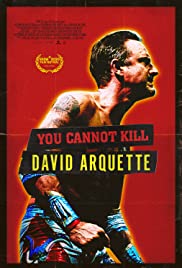
 Greetings again from the darkness. I’ll admit to knowing very little about professional wrestling, so this was the first I had heard about actor David Arquette’s scandal from nearly 20 years ago, as he promoted his movie READY TO RUMBLE (2000). Documentarian David Darg and Video director Price James collaborate here as co-directors to deliver a documentary on one of the strangest, most off-the-wall stories I’ve ever seen … and one that fits well with the reputation of the professional wrestling world.

In a sport that thrives on good guy vs bad guy, David Arquette became the most hated man in wrestling. The power brokers in the industry determined a publicity stunt with his becoming WCW Champion would lead to a boon for the business. The fan and wrestler backlash was harsh and severe, and Arquette claims it made him persona non grata in both the sport and in Hollywood, though his math doesn’t add up. He discloses his “10 years of rejections” for acting roles, when the wrestling brouhaha goes back 20 years. And on top of that, he has worked pretty consistently over those two decades – albeit mostly in projects that don’t appeal to mainstream audiences.

So all these years later, here comes David Arquette in his attempt to re-enter the world of wrestling and gain respect from those that think he disrespected their beloved sport. The temptation here is to label the documentary and Arquette a joke, but he seems so sincere in his desire to find his way, that we catch ourselves following his journey with interest. And it’s not always easy to do so. There is one moment in particular: Arquette is wearing a purple bedazzled wizard cape while sitting on a horse and vaping, when he states, “I’m sick of being a joke”. Umm.

Arquette is likely best known for his role in the SCREAM movies, of which there were four between 1996 and 2011, and a fifth is on the way for 2021. Or perhaps he is best known as the ex-husband of “Friends” star Courteney Cox, with whom he has a daughter. Then again, maybe his fame is derived from being part of a family entrenched in entertainment. This includes his acting sisters Rosanna, Patricia and Alexis (who died in 2016), brother Richmond, father Lewis (a well-established character actor), and grandfather Cliff, who created the popular character Charley Weaver.

We meet Arquette’s wife Christine McLarty (who looks like she could be Courteney Cox’s younger sister), a career news reporter who is now a film producer, and she seems to share our confusion on why David is pursuing this at age 46 – after a heart attack, which resulted in stints and blood thinners. When he speaks of his previous alcoholism, anxiety, and other mental and physical health issues, we hope this is his way of improving his health. However, as we follow him on the road, we realize, it really is about the wrestling and redemption.

The journey leads to a “backyard wrestling” match where amateurs looking to humiliate the actor pretty much beat the heck out of him. It’s at this point where he decides to train, and heads off to a facility in Virginia, followed by Cancun and Tijuana street wrestling, segments that prove quite entertaining. The pride of a wrestling match is mentioned, and we watch a ROCKY segment where Arquette chases a chicken, and is called “crazy white boy” while a Spanish version of “The Last Kiss” is played. I warned you this was a strange one.

At times we can’t help but think this is a hoax in the same way in which Joaquin Phoenix parlayed his acting “retirement” into I’M STILL HERE, a mockumentary on his pursuit of a hip hop career. The difference is that Arquette really trains and really wrestles, ending with a match at the “Legends of Wrestling” in Detroit against Ken Anderson. This is a film that feels like a gag when it starts, but very real by the end. It’s not enough to motivate me to go back and watch some of those terrible David Arquette movies, but it’s enough to tip my cap to a man pursuing respect and redemption.

Available at Drive-ins on August 21, 2020 and VOD on August 28, 2020

watch the trailer:


SKIN: A HISTORY OF NUDITY IN THE MOVIES (2020, doc)

August 17, 2020

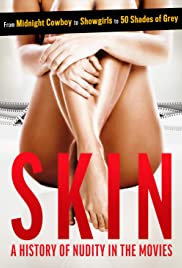
 Greetings again from the darkness. Actress Hedy Lamarr is still remembered today for so many reasons. Often described as the most beautiful actress of all-time, she turned down the lead roles in both GASLIGHT and CASABLANCA (both eventually went to Ingrid Bergman). Her best known role was in SAMSON AND DELILAH (1949), and she was the inspiration for both Disney’s SNOW WHITE and Catwoman in the original “Batman” comics. Married and divorced six times, she’s in the National Inventors Hall of Fame for being co-inventor of ‘frequency hopping’ technology that is still used today for cell phones. Beyond all of that, some may know Ms. Lamarr is considered to have performed the first (non-pornographic) on screen female orgasm in ECSTASY (1933). And what better way for director Danny Wolf to open his documentary chronicling nudity in movies than with the actress whose career started with such a bang?

We hear a bunch of industry folks recall the first time they saw nudity on the big screen, and some actors and actresses look back on the first time they appeared nude in a movie. For the most part, director Wolf takes us in chronological order through the various stages of film nudity, dating back as far as 1887. However, he wisely includes a prologue dealing with the present day status of power dynamics, the #MeToo movement, and, of course, the Harvey Weinstein case. There is a stunning collage of those who have been accused of improper and/or illegal behavior – the faces are familiar, but, sadly, there are too many to name. We are even informed that today, actors and actresses typically have very detailed contractual protection in regards to nudity.

The steady stream of talking heads includes perspectives from authors, casting directors, film directors, art historian, professors, film critics, and, as mentioned, actors and actresses. Before breaking into the segments divided by decades (60’s, 70’s, 80’s, etc), we are provided a history lesson on the early years. For me, this was the most interesting chapter as it details the infamous Hays Code, the Catholic Legion of Decency (that “C” rating is pretty rough!), and the twenty year reign of Joseph Breen (the Breen Light was needed for go-ahead). There is also a brief profile of nude model Audrey Munson and her fascinating impact on statues, print, and cinema, and ultimately a tragic life spent mostly in an asylum (she died at age 104). This early segment also features the “secret” behind Chesty Morgan playing DOUBLE AGENT 73, the rise of “Monster Nudies” and “Nudie Cuties”, an interview with Mamie Van Doren. It concludes with Roger Vadim’s AND GOD CREATED WOMAN (1956) starring Bridget Bardot, effectively ending the Hays Code era.

As the film treks through the eras, in the 1960’s we see the impact of Janet Leigh’s shower scene in Hitchock’s PSYCHO, and Marilyn Monroe proves nudity doesn’t kill a career. This was also the time of European influence on American cinema, and 1968 began the MPAA ratings system, with Brian DePalma’s GREETINGS (with Robert DeNiro) as the first Rated X movie (since edited to an R), and MIDNIGHT COWBOY becoming the first mainstream movie to carry an X rating.

Director Joe Dante talks us through much of the 1970’s as porn films like DEEP THROAT changed the landscape. It’s also the era where CARNAL KNOWLEDGE proved true movie stars could appear nude, and the decade that gave us LAST TANGO IN PARIS and THE LAST PICTURE SHOW. On the lower budget scale, this was peak Roger Corman time (the great Pam Grier is interviewed), the height of Drive-in movies (including cult favorite I SPIT ON YOUR GRAVE with Camille Keaton interviewed), and the notorious CALIGULA with commentary from Malcom McDowell.

Director Blake Edwards had the honor of ending the 1970’s with Bo Derek as a perfect “10”, and kicking off the 1980’s by having Mary Poppins (his wife Julie Andrews) appear topless in S.O.B. The decade of the 80’s takes some heat for serving up plenty of lame music and movies, but there were some memorable moments as well. Eric Roberts and Mariel Hemingway spend some time talking about STAR 80 and PERSONAL BEST, the latter which was the first mainstream film to feature a love scene with lesbian athletes. A highlight here is director Amy Heckerling ruminating on her classic FAST TIMES AT RIDGEMONT HIGH.

The 1990’s revived the “erotic thriller” genre (BASIC INSTINCT), as well as the NC-17 rating, of which Philip Kaufman’s HENRY & JUNE became the first recipient. The 1990’s were also the decade of BAD LIEUTENANT, THE CRYING GAME, BOOGIE NIGHTS, SHOWGIRLS, and AMERICAN PIE (the re-birth of the teen sex comedy). So, honestly, no word can possibly describe such a diverse group of films with nudity. The decade could easily support its own documentary, much like the 1970’s.

There is some insightful commentary surrounding contemporary cinema, including FIFTY SHADES OF GREY, and the inclusion of older actors and actresses in the “action”. Some of the best commentary during the film comes from Diane Franklin, Sylvia Miles, an old Russ Meyer interview, Liz Goldwyn (Samuel Goldwyn Jr’s daughter), Malcolm McDowell, and film critic Richard Roeper. But it’s director John Cameron Mitchell who provides the most searing observation on contemporary cinema when he states (paraphrased) – today the left would say any nudity or any sex scene is exploitive. And that’s the core of the debate. In this “Post-Weinstein” era, what is the “right” way to tell these stories and show these characters in a realistic manner, and yet do so in a way that isn’t exploitive, or puts actors or actresses in a situation that they feel uncomfortable or will regret? Proper conduct by those in power and straight communication between all involved seems like a good start. What would Hedy have to say?

Available On Demand August 18, 2020

watch the trailer:


THE SECRET GARDEN (2020)

August 6, 2020

 Greetings again from the darkness. In the years since Frances Hodgson Burnett’s novel was first published in 1911, “The Secret Garden” has become one of the most popular and oft-read children’s books. Previous film adaptations include the 1949 version with Margaret O’Brien and Dean Stockwell, and the 1993 version with Kate Maberly and Maggie Smith. Additionally, the novel has been adapted numerous times for the stage and television. Director Marc Munden is working with the screenplay adapted by Jack Thorne (WONDER, 2017), and the two had previously collaborated on the BBC series “National Treasure”. Readers of the beloved novel will certainly recognize the changes and differences within this version, both in characters and theme.

As the film begins, we are told it’s “the eve of Partition”, which was the 1947 division of British India into two separate states: India and Pakistan. This timing is, of course, quite a bit later than Ms. Burnett’s setting, but the effect is the same – young Mary Lennox (Dixie Egerickx) is orphaned when her parents die, and left alone when the servants desert her. She is shipped off to live with an uncle (Oscar winner Colin Firth) she doesn’t know. Accompanied to massive Misselthwaite Manor by the housekeeper, Mrs. Medlock (Julie Walters), Mary quickly understands that Uncle Archibald Craven is a grieving widow (his wife was Mary’s mother’s sister) who is not to be disturbed, and his hunchback is not to be stared upon. Mary soon learns that her spoiled brat manner will not be tolerated, though her natural spunk will prove advantageous. The young girl is one who is accustomed to be waited on, while also wanting to prove her independence.

Mary’s imagination is extraordinary and she often asks, “Do you want to hear a story?” CGI effects allow us to see what she has envisioned, whether it’s the wallpaper coming to life, or her mother and aunt frolicking through the halls or swinging in the garden. Mary soon befriends Martha the maid (Isis Davis), and then happens upon “Jemima” the dog while wandering the estate grounds. It’s here where the fantastical and supernatural meet reality, and a helpful Robin leads Mary to the key that unlocks the gates of the gardens that have been locked away since Uncle’s wife died. Mary and her new friend Dickon (Amir Wilson) go on adventures through the garden – a garden which has mystical powers.

One evening Mary hears cries echoing in the halls of Misselthwaite. Despite being forbidden from exploring, she discovers her cousin Colin (Edan Hayhurst) locked away in a far off bedroom. Colin is a sickly child, supposedly stricken with a spinal problem that keeps him from going outside. Mary continues to visit Colin, and soon she and Dickon are sneaking Colin into the secret garden, where the magical healing powers begin to take hold. The titular garden doesn’t make an appearance until about one hour in, but its beauty and wonder are on full display.

This is a story about the power of loss and grief and depression, and it offers the life lesson that the things we care for blossom and grow and thrive. This version has some elements of such classics as “Peter Pan” and “The Chronicles of Narnia” in that fantasy and magic play a much larger role than in the novel. Director Munden employs a darker approach and seems to emphasize self-discovery. Young actress Dixie Egerickx was a standout in the recently watched SUMMERLAND, and she is terrific here – despite the changes to the story that some fans might not embrace. The film seems a bit disjointed at times, but it’s always a feast for the eyes, and offers up one of the year’s best scores, courtesy of Oscar winner Dario Marianelli (ATONEMENT, 2007).

Available Video on Demand August 7, 2020

watch the trailer:


WAITING FOR THE BARBARIANS (2020)

August 6, 2020

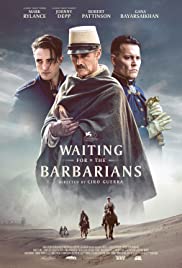
 Greetings again from the darkness. Nobel Prize winning author J.M. Coetzee’s revered novel was first published in 1980, and renowned composer Philip Glass later adapted the South African writer’s work into a 2005 opera. It’s a fascinating piece of literature that, on the surface, doesn’t lend itself easily to the silver screen. Perhaps it works because Mr. Coetzee wrote the screenplay himself, and rising star director Ciro Guerra brings it to life. Mr. Guerra’s two most recent films were both excellent: BIRDS OF PASSAGE (2018) and EMBRACE OF THE SERPENT (2015).

Mark Rylance (Oscar winner for BRIDGE OF SPIES, 2015) stars as The Magistrate of a desert outpost on the fringes of territory controlled by ‘The Empire’. The Magistrate is mild-mannered and non-confrontational. He’s a fair administrator, and Rylance’s outstanding performance ensures he’s a sympathetic figure, yet not a perfect man. The Magistrate’s approach is to maintain a peaceful co-existence with the local nomads, who are described as ‘barbarians’ by others in The Empire.

Things change quickly and severely when Colonel Joll (Johnny Depp) arrives at the settlement. We see his approach thanks to cinematographer Chris Menges’ beautiful wide shot of Joll’s horse-drawn carriage surrounded by desert and mountains. Depp plays Colonel Joll as a stoic man committed to a mission he never fully states. Instead he sermonizes about his interrogation process with such gems as “patience and pressure” are the key, and “truth has a certain tone”. It’s not long before we learn, right along with The Magistrate, that Joll’s definition of ‘pressure’ would be termed torture and brutality by any reasonable person. His ruthless ‘interrogations’ lead to the result he was sent to obtain: the local barbarians are planning an uprising.

Director Guerra provides sub-chapters for the various seasons through which the story progresses. The Colonel arrived in “Summer” sporting sunglasses, and proclaiming “Pain is truth. All else is subject to doubt.” It’s a mantra that plays out in various ways. “Winter” brings ‘the girl”, a native with two broken ankles and other signs of torture. The Magistrate and the girl (Gana Bayarsaikhan, EX MACHINA) have an unconventional relationship, one that doesn’t go over well with Joll’s police force or the other locals, including Mai (Greta Scacchi), one of the loyal outpost staff members.

“Spring” is subtitled ‘The Return’, and it includes The Magistrate returning the girl to her people, and his subsequent return to the outpost where Joll’s second-in-command, Officer Mandel (Robert Pattinson), has him arrested and tortured for consorting with the enemy. Pattinson plays his role in wild-eyed contrast to Depp’s stoicism. When “Autumn” rolls around, it becomes clear that the real question is, “Who is the enemy?” or, perhaps, “Who are the real Barbarians?” The Magistrate is viewed as a traitor and laughingly referred to as “one just man”.

It’s frustrating at times to think about the modern day application of this story. What is an empire? The violence, narcissism, and lust for power lead to a loss of humanity that is painful to observe. Filmed in Morocco and Italy, the oppressive nature of the frontier makes this quite a downer, and one that requires effort and time to connect as a viewer. It also allows Menges and his camera to capture the details of the office and apartment, along with the sparseness of the jail … both in contrast to the vast frontier. This is a either a tale of morality or a cautionary warning shot that solidifies Joll’s adage. Perhaps pain is indeed required for truth.

Available On Demand August 7, 2020

watch the trailer:


MADE IN ITALY (2020)

August 6, 2020

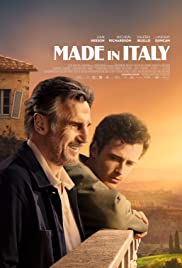
 Greetings again from the darkness. The Tuscan region of Italy is one of the most beautiful places on earth. It’s a terrific choice for the setting of one’s first screenplay and directorial debut. It’s also a marvelous spot for real life father and son actors to work together. All of that is in play here as noted actor James D’Arcy delivers his first feature as writer-director, and the father-son team of Liam Neeson and Micheal Richardson star as, yes, father and son. This is a story of estrangement and re-connecting amidst the glorious wonder of Tuscany.

Jack (Micheal Richardson) has delayed signing the divorce papers delivered by his wife Ruth (Yolanda Kettle, “Marcella”) in hopes of buying her family’s art gallery, which he has been managing. Ruth gives him one month to come up with the money. Jack knows his only hope is to sell the Tuscan estate he co-owns with his estranged father Robert (Liam Neeson). Father and son have rarely spoken since the mother-wife was killed in a car accident while Robert was driving. Like most any parent under duress, Robert made decisions he thought were best for his son, but were actually made with self-interest. In the wake of tragedy, rarely is shipping the kid off to boarding school a better choice than pulling them closer. This prevented the development of any relationship, though it also created a block in bohemian artist Robert’s work.

When they arrive at the home, the men are shocked at the advanced state of disrepair. Sharp-tongued local real estate agent (and ex-pat) Kate (Lindsay Duncan) gives them little hope for a sale unless renovations are made. The manual labor drives yet another wedge between father and son, and Jack finds an attractive good listener in local restauranteur and chef Natalia (Valeria Bilello). She happens to love the house he owns and, in jest, offers a dish of her “amazing” risotto as down payment.

The challenges of home renovations coupled with the locked away memories lead Jack and Robert to a breakthrough, but Jack’s issues with his wife and Natalia’s troubles with her ex-husband mean nothing goes smoothly for anyone. Most of the movie is spent with each of these folks trying to come to grips with the personal waters they themselves muddied.

Micheal Richardson does a very nice job here, and actually holds his own on screen with his powerhouse father. Richardson is the son of Liam Neeson and Natasha Richardson, and the grandson of Oscar winners Vanessa Redgrave and Tony Richardson, and the great-grandson of actor Michael Richardson. It’s nice to see father and son working together, though the story line might have hit a bit too close to home, given the death of Natasha Richardson in 2009 (a skiing accident). Writer-director James D’Arcy is known for his fine work in front of the camera, including Christopher Nolan’s DUNKIRK. Thanks to the work of cinematographer Mike Eley in capturing Montalcino, Mr. D’Arcy’s first feature behind the camera is watchable, despite being easily predictable and formulaic.

watch the trailer:


OUT STEALING HORSES (2020, Norway)

August 6, 2020

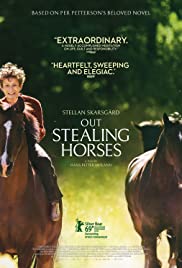
 Greetings again from the darkness. Contrasts are plentiful in this film. The bleakness of winter versus the greenery of summer. The resignation of old age versus the naivety of youth. Pet Petterson’s award-winning novel was released in Norway in 2003, and then in English version in 2005. Norwegian director Petter Moland tackles it with the best intentions, though the nuances prove too much for one movie. Mr. Moland is a fine director as evidenced by his excellent IN ORDER OF DISAPPEARANCE (2014) with Stellan Skarsgard and the English remake COLD PURSUIT (2019) with Liam Neeson.

Morland and Skarsgard reunite as the actor takes on the role of the elder Trond, who we first see as he has relocated to Norway from Sweden. Through his narration, we learn Trond has lived in Sweden for 42 years, and it’s a chance meeting with his new neighbor Lars (Bjorn Floberg) that triggers memories of one summer when he was 15 years old. It’s now 1999, and the impending new millennium has Trond self-isolating on top of the grief and loneliness he has carried since his wife was killed in a car crash. Skarsgard is an actor who can be either sympathetic or powerful, and he brings gravitas to a character who is mostly lost at this late stage in life.

Much of the film is spent in Trond’s flashback to 1948, when he lived the summer with his father, a “practical” man, at his cabin in Norway. Young Trond is played very well by Jon Ranes in his first role. He clearly admires his father (Tobias Santelmann, KON-TIKI, 2012) and enjoys working beside him and taking rain showers alongside. Over the weeks, Trond and his father become entangled with a village family after a tragedy involving Lars (the future neighbor) when he was very young, and Lars’ father and mother (Danica Curcic). What follows for Trond are the things in life that cause us to alter our view of people and the world. Lost innocence is rarely easy.

Cinematographer Rasmus Videbaek (A ROYAL AFFAIR, 2012) captures the beauty of nature during the 1948 summer, as well as the stark white stillness of 1999 winter. Some of the look and feel and symbolism reminds of the work of Terrence Malick. The stunning Norwegian landscapes play a role for us as viewers and for Trond. There are also some quiet moments that carry weight between the elder Lars and Trond, as the missing pieces of life slowly fall into place.

The elder Trond states his goal is “to sleep as heavily as possible without being dead”, but we see part of him may have already died. Flashbacks to that summer, and even earlier during the war, combine with some awkward conversations with Lars to fill in gaps that had blurred over the years. Childhood memories from old age are often not to be trusted, but coming to grips with one’s family and the past may bring peace – or it may not. Trond is an avid reader of Dickens’ “David Copperfield” and there are many references throughout. He’s even given life advice: “Don’t be bitter”, which is a worthy goal for all. It’s an odd film with multiple timelines and damaged characters at different stages. It may not reach the level of Petterson’s novel, but director Moland gives us plenty to mull.

watch the trailer:


PSYCHOMAGIC, A HEALING ART (2020, doc)

August 5, 2020

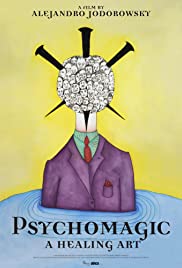
 Greetings again from the darkness. Alejandro Jodorowski is a long-time avant-garde and visionary director known for cult classics EL TOPO (1970) and SANTA SANGRE (1989). He’s now 91 years old, and this is his first film since ENDLESS POETRY (2016) – only categorizing this as a “film” is a bit of a stretch. More in line with what we see would be, ‘a procession of demonstrations of Jodorowski’s own trauma therapy that he calls Psychomagic’.

Fortunately, we kick off with Jodorowski himself explaining his therapy. He defines Psychoanalysis, founded by Sigmund Freud, as being based on science and words. In contrast, he defines his Psychomagic as based on acts and touch. We then transition directly into an ongoing session – a sequence likely to be the last one many people watch, as only the most curious (or those charged with reviewing the film) will subject themselves to more.

The rest of the runtime is broken into “cases” distinguished by the specific reasons people are seeking treatment. Few can argue that treatments for emotional trauma can vary widely, and that not everyone will be affected the same, and that we should all be open to whatever works. However, I can assure you, Psychomagic treatment is unlike anything you have seen or experienced. These filmed sessions come off more like an acting workshop than therapy, though we are to assume they are legitimate.

Not to spoil anything, but rather to offer a taste of what’s in store, you should brace for full body shoe polish while dancing at night, the shattering of dinner plates on the patient’s chest in nature, pouring cold milk on an unclothed person, the simulation of birth for ‘grown ups’, sledgehammers on pumpkins decorated with family photos (OK, this one actually makes some sense!), sprinkling water on a massive tree to treat depression, burying a wedding dress, and participating in Mexico City’s Walk of the Dead. And I have skipped over the connection between menstruation and finger-painting and cellos.

Artists often thrive with great freedom, and the therapeutic effects of art have certainly been proven many times. It’s just that watching this, I became something beyond skeptical. It reminded me of the old-time healers, and the fine line between healing and scamming. Perhaps it was the regular inclusion of clips from Jodorowski’s films that put me on high alert, or maybe it was simply the progression of segments that each struck as more outrageous than the last. Jodorowski is an old man with a history of creating art, so I’m choosing to give him the benefit of the doubt, though it’s not an easy task after enduring this.

watch the trailer: