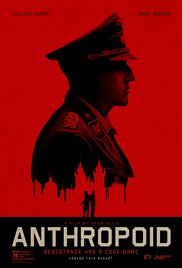
Greetings again from the darkness. It’s been more than 70 years since the Second World War ended, and it’s still producing fascinating stories, books, and movies. Director Sean Ellis co-wrote the script with Anthony Frewin after tireless research into a secret mission of the Czech resistance known as Operation Anthropoid. The purpose was to assassinate SS General Reinhard Heydrich, third in command of The Reich behind only Hitler and Himmler.
Hitler invaded Poland the year after taking Czechoslovakia and put Heydrich in charge. In addition to being the main architect behind the Final Solution, Heydrich became known as “The Butcher of Prague” as thousands of citizens were slain under his reign of terror.
The story is split into two distinct parts … the buildup and the aftermath. It’s late 1941 when we see Jan Kubis (Jamie Dornan) and Josef Gabcik (Cillian Murphy) parachute into the territory outside of Prague and make their way to the city only to discover their contact has been killed. Over the next few months, the two soldiers spend time planning, observing and blending in, while living with their host family – the Moravecs. They become attached to two local ladies (Charlotte Le Bon, Anna Geislorova), first as cover for the mission, and then in a more personal manner as tension builds and the mission gets closer.
Many of the original, historic and actual locations are used which adds an element of realism to a story that’s already plenty real and emotional. The second half of the story is what happens after the assassination. Seven of the original parachutists go into hiding in the basement of the Saints Cyril and Methodius Cathedral. The manhunt is brutal and extensive, and once the hideout is discovered, a seemingly unending parade of German soldiers and ever-increasing weaponry are unleashed. It’s a beautifully filmed, but gut-wrenching scene … think of the last stand at The Alamo.
An extended shootout (6 hours in real time) may not seem like a fun day at the movies, but this story goes to the bravery and desperation of those who refused to give in to the relentless savagery of the Germans. In addition to Ms. Le Bon and Ms. Geislorova, Czech screen vet Alena Mihulova is another standout here. The pacing of the story telling is a bit off at times, but director Ellis brings historical accuracy to a fascinating story in ways that movies such as Valkyrie and Inglourious Basterdsdidn’t even attempt. As courageous as those in the resistance were, the aftermath and reprisals do beg the question … was it worth the price? Not an easy question to answer even in hindsight.
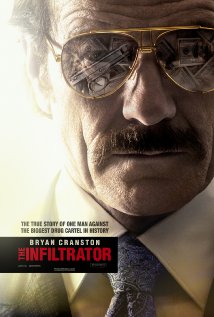
Greetings again from the darkness. The war on drugs has become a bit of a punchline in the real world, but has proven to be fertile ground for filmmaking: Sicario (2015), American Hustle(2013), Traffic(2000). Additionally, the popular Netflix show “Narcos” takes on the same Medellin drug cartel as this latest from director Brad Furman (The Lincoln Lawyer, 2011). The movie is based on the true events of Robert Mazur’s book “The Infiltrator: My Secret Life Inside the Dirty Banks Behind Pablo Escobar’s Medellin Cartel” (a title that’s very descriptive, if a bit long).
Bryan Cranston continues his impressive Hollywood run this time as Robert Mazur, the man who goes undercover to expose the money-laundering system of the cartel. His flamboyant alter-ego is known as Bob Musella, a character that allows Mazur (and Cranston) to show a side not typically seen. His antics get him inside Columbian Drug Lord Escobar’s organization in the mid-1980’s.
When Mazur realizes the traditional method of chasing the drugs isn’t working, he decides the age-old idiom “follow the money” might be a better approach. This takes him inside the world of international money laundering, and he learns that banks and governments are quite dependent on this huge business of drug money movement.
There are specific groups of people here: the government agencies, the small task force, the corrupt (and appreciative) bankers, the various levels within the cartel, and even Mazur’s family … all these forces intertwine to make life difficult for Mazur and his team, and provide a glimpse into the complexities of undercover work.
In addition to stellar work from Cranston, the cast is terrific. John Leguizamo plays Mazur’s motivated partner Abreu; Diane Kruger plays his undercover fiancé; Juliet Aubrey is Mazur’s real life wife who doesn’t much appreciate his declining the early retirement offer; Olympia Dukakis provides a dash of comedy relief as Mazur’s Aunt; Yul Vasquez is the creepy money manager for Escobar; Benjamin Bratt plays Roberto, Escobar’s right-hand man and the key to Mazur’s case; and Elena Anaya (The Skin I Live In, 2011) is Roberto’s wife. Also present are Amy Ryan, Jason Isaacs and the always great Michael Pare.
There are a couple of standout scenes – one involving chicken and voodoo, and another with a briefcase mishap, but my favorite is the Happy Anniversary cake scene in the restaurant where Mazur flashes his alter-ego Musella for his real wife to see … and she is understandably stunned.
The movie does a nice job of capturing the look and feel of the era (30 years ago), but it’s somehow missing the elevated suspense it portends to drag us and the characters through. Some elements seemed impossible to believe – why would Mazur risk his family’s safety? The timeline was a bit muddled. We aren’t sure how much time has passed, but there certainly don’t seem to be enough interactions before Roberto is telling Mazur he is “like family”. It plays a bit like those romance movies where the two leads are head over heels in love after a conversation or two. An element is missing and it affects the level of tension throughout the film. And that’s something even a Leonard Cohen song (“Everybody Knows”) can’t fix.
Greetings again from the darkness. Sporting the vibe of two buddies making a movie on their own terms, the film plays like a late night B-movie that would be perfect for one of those sleepless nights. Writer/director Desmond Devenish and co-writer Xander Bailey also star in their own movie … a decision that implies passion project and low budget (both of which can be good or bad).
Nothing in the script is new or groundbreaking, as we have a jewelry store robbery that ends in a double-cross and shootout among partners in crime. This is followed by a 7 year flash forward with the son of the dead partner seeking revenge for his father’s death, and the early-paroled partner on the hunt for the stolen diamonds. Of course, there is nothing wrong with a dose of familiarity as long as the characters and setting are interesting.
The original two partners are played by a couple of familiar and excellent actors: Kevin Gage as Mallick and Nick Mancuso as Roman. Both have great screen faces and voices, and we are left wishing these two could go at each other a bit longer. Also in the mix is Steve Earle, friend to Roman and later his son. Once Mallick is paroled, it’s filmmakers Devenish as Boyd and Bailey as Russell that get most of the screen time – along with Jenna Kannell (a Neve Campbell lookalike) as Boyd’s girlfriend Sloan.
After the worst (unintentionally comical) rock climbing movie scenes ever, we get more shootouts and double-crossing … although Carl Bailey as the Sheriff adds a quick dose of realism and interest. The film would have been better served with a more experienced actor in the role of Boyd, though Xander Bailey does a very nice job in the mostly thankless role of Russell.
The film squanders the desert setting and could have followed the model of last year’s Mojave (with Oscar Isaac), which put the desert front and center as a character unto itself. From a filmmaking perspective, it’s difficult to determine if budget limitations minimized the suspense and conflict, or if that was more script related. The one sure lesson here is … don’t squander the talents of Nick Mancuso or Steve Earle!
Greetings again from the darkness. I’ve said before that she is such a fascinating actress that I would probably buy a ticket to watch Tilda Swinton just stand on stage. In her latest collaboration with director Luca Guadagnino (I Am Love, 2009), Ms. Swinton’s character remains mostly silent, save a few well placed whispers and one uncontrollable outburst, and she is certainly worth the price of that ticket.
Adding to the movie fun here is a script by David Kajganich adapted from Alain Paige’s story that was the basis for the 1969 film La Piscine. Ms. Swinton plays Marianne Lane, a glam rock singer (think 60’s-70’s David Bowie) who has gone on holiday to recover from throat surgery. She is accompanied by her photographer/filmmaker boyfriend Paul (Matthias Schoenaerts), and the couple has sought seclusion and serenity on the picturesque Italian island of Pantalleria in the Strait of Siciliy. They spend their time sunbathing (European style) and enjoying intimacy in the swimming pool at the stunning compound they have rented.
Of course it wouldn’t be much of a movie if things went according to plan. Blowing into town like the upcoming sirocco winds is Marianne’s former lover and former music producer Harry (Ralph Fiennes), along with his daughter Penelope (Dakota Johnson). Showing up uninvited adds to the palpable underlying tension – which only gets thicker as the layers are peeled back. In addition to the former relationship of Marianne and Harry, it turns out Harry and Paul were once close friends, and it’s only been in the last year that Harry found out Penelope is his daughter (and there’s even some doubt on this).
Fiennes’ Harry is the kind of annoying blow-hard we want to punch after about 5 minutes. He is unrelenting with his energy and motor-mouth approach to most every moment in life. In that same 5 minute span, we also figure out his not-so-subtle desire to win back Marianne. His Lolita-type daughter may or may not be part of his plan, but she surely has her own sights set on Paul. Over food, wine and swimming, we learn more and more backstory on each character, and it’s pretty obvious the beautiful bodies and faces are masking mountains of vulnerabilities and insecurities.
Ms. Swinton, despite her minimal dialogue, makes Marianne a captivating character – balancing the entitlement of a rock star with a desperate attempt to be normal. Mr. Schoenaerts brings his usual physicality and simmering emotional quiet to the role of Paul – a guy much less “together” than he would have us believe. Penelope is a good fit for Ms. Johnson, as she mostly lounges around the pool leering lustfully at Paul. But it’s Mr. Fiennes who rules the roost here with his appendage-flapping portrayal of the vulgar and vulnerable Harry – complete with Monty Python references, Mick Jagger dancing and au natural pool diving. It’s a different kind of role for Fiennes and one he clearly relishes.
It’s a film filled with lush visuals and fans (like me) of Francois Ozon’s 2003 Swimming Poolwill recognize the stylings of cinematographer Yorick Le Saux. Beauty abounds: the setting, the water, the clothes, and the house. Things do get a bit clunky in the third act with a minor sub-plot involving Tunisian refugees. Fortunately that doesn’t negate the many good things here … including a terrific and creative soundtrack featuring a couple of deep cuts from the Rolling Stones, Nilsson’s “Jump into the Fire”, St. Vincent’s cover of “Emotional Rescue”, and even Robert Mitchum’s “Beauty is only Skin Deep”. It’s a stylish, ultra slow-burn emotional thriller that has a swimming pool shot somewhat reminiscent of the iconic one from Sunset Boulevard. If all of that is still not enough reason to buy that ticket … don’t forget about Ms. Swinton!
Greetings again from the darkness. Wars exist in many different forms. Some are over contested international boundaries, others are religious conflicts, while others are more personal and intimate. The stories of many refugees could be described as fleeing one type of war only to end up fighting a different kind. Such is the story of Dheepan.
Jacques Audiard is one of the most exciting filmmakers working today. A Prophet(2009) and Rust and Bone(2012) are both compelling films, and though his latest may not be quite at that level, it’s still full of intensity and personal drama. Mr. Audiard co-wrote the screenplay with Thomas Bidegain and Noe Dibre, and some of it is based on the remarkable real life story of lead actor Jesuthasan Antonythasan.
Dheepan is a Tamli soldier who is so desperate to flee Sri Lanka that he teams with a woman and young girl he doesn’t know to form what looks like a real family. By using passports of people killed during the war, the pre-fab family of three is issued visas to live in France. Dheepan gets a job as the caretaker for an apartment complex riddled with crime, violence and drugs – and learns to keep his mouth shut and eyes open.
It’s fascinating to watch these three people navigate their new life as they struggle with the language and a new culture. There are flashes of real family problems, but also the awkwardness of three whose only true bond is their escape from their previous life. Living in such close proximity means their true colors are bound to shine through no matter how much effort goes into the family façade.
Jesuthasan Antonythasan (Dheepan) and Kalieaswari Srinivasan (as Yalini his wife) are both excellent and powerful in their roles despite being so inexperienced as actors. Their exchanges are believable, as is their disparate approach to the future. Ms. Srinivasan is especially strong in her scenes with local thug Brahim, played by Vincent Rottiers. The two have such an unusual connection … alternating between warm and frightening.
Some have found fault with the final action sequence, but it’s such a fitting turn of events given Dheepan’s past … plus the camera work is outstanding. The film won the Palme d’Or at the 2015 Cannes Film Festival, and it’s another notch in the belt of filmmaker Jacques Audiard. It’s also a reminder that we can never really escape the past.
Greetings again from the darkness. Adam McKay and Michael Lewis sought to educate us on the corruption and deceit within the marrow of the financial world in The Big Short. Director Jodie Foster and three writers (Jim Kouf, Alan DiFiore, Jamie Linden) scale things way back to show the effects on a single, working class man … and how Wall Street and the media conspire to make it hard on us little guys.
George Clooney stars as Lee Gates, a Jim Cramer type cable news financial guru … the kind of media star who makes an Apollo Creed style entrance (complete with “dancing”) for each segment. Julia Roberts plays Patty, the show’s ultra-talented producer, and the one who keeps Gates and the show from flying off the rails. It’s just another typically hectic day in the studio, when the show is abruptly interrupted by a man who charges the stage pointing a gun at Gates. Kyle (Jack O’Connell, Unbroken) has a few things to get off his chest, and makes it clear that he blames Gates for a recent financial loss … and he expects some answers.
It turns out that Gates had presented a recent investment as a sure thing, and Kyle believed him. When that company lost $800 million overnight, Kyle’s loss was his $60,000 nest egg. Kyle represents the work-class folks who are simply fed up with the lies and manipulation for which the media and Wall Street seeming conspire on a regular basis.
It’s Jodie Foster’s first directorial outing since The Beaver(2011), and she seems at home with a straight-forward hostage-for-admission story. Created for a mass audience (no segment or issue goes too deep), there are snippets of Clooney and Roberts humor that will satisfy their fans. The three most interesting characters are the gun-wielding, end-of-the rope Kyle; his pissed-with-a-twist girlfriend played by Emily Meade (who provides the film a lift when it’s needed); and Caitriona Balfe as Diane Lester, the communications officer for the evil corporation at the heart of the swindle.
As with so many things these days, the hostage ordeal plays out on TV and captures the limited attention span of average Americans … heck, the film even references the OJ Simpson event. Of course, this film isn’t an instigator, but rather an exhibitor – a mirror of the times. Once the spectacle ends, everyone returns to their normal activities.
Since this thriller really only offers a few moments of real suspense, viewers might have more fun spotting and identifying the multitude of cable TV faces sprinkled throughout. The 1970’s were the era for extraordinary conspiracy movies, and this one is less Network or Chinatown, and more like Phone Boothor John Q. ‘Forget it Kyle. It’s Wall Street (and cable news).’
Greetings again from the darkness. What a compelling neo-noir quasi-crime thriller from first time director (and long time Peruvian actor) Salvador del Solar. The story is based on Alonso Cueto’s novel “La Pasagera”, and while it’s anchored by a terrific performance from Damian Alcazar, there are numerous twists, turns, and intense sequences.
Mr. Alcazar plays Magallanes, a former Army soldier now struggling to earn a living as a freelance taxi driver in the city of Lima. He has a second job as driver and part-time caretaker for his former military commander (played by Federico Luppi), who now suffers from Alzheimer’s disease … though to what extent plays a role throughout.
One day Magallanes picks up a passenger whom he immediately recognizes. When she exits the taxi, his breathless anxiety is a powerful moment. We slowly learn that the woman is Celina (the stunning Magaly Solier), and there is a dark and horrific secret that binds these two to the colonel.
Watching the numerous story lines unfold is a nerve-racking movie-going pleasure, as secrets and pain and struggles abound. Celina is close to losing her salon and is being pressured by a tyrannical loan shark – a rare cinematic female role absent any empathy. Secrets and circumstances being what they are lead Magallanes to plan blackmail against the colonel’s wealthy doctor son (Christian Meier). To say that nothing goes according to plan is a bit of an understatement.
The brilliance of the story is that we find ourselves pulling for Magallanes right up until the moment when we can’t possibly forgive him his transgressions … any more than Celina can. More than an example of the jumbled mess of war and terrorists, the film is a wonderful observation of human nature and how we often rationalize our worst actions to the point of delusion of our own goodness. No matter how hard we try to put things behind us, the bad choices are always there. Some sins just cannot be washed away, and redemption is not always possible. In the words of the characters … “well, that’s football.”
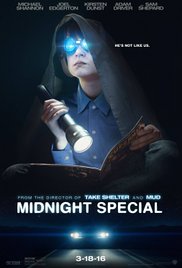
Greetings again from the darkness. Austin-based filmmaker Jeff Nichols serves up some of the familiar themes of spiritualism and parenting seen in his first three films: Mud (2012), Take Shelter(2011), Shotgun Stories(2007), but this time he goes a bit heavier on the science fiction … while maintaining his focus on the individual.
An exceptional opening scene kicks off the story, and Nichols makes sure we are alert by forcing us to absorb and assemble the slew of clues flying at us … an Amber alert, cardboard on the windows of a cheap motel, a news report tying us to San Angelo, Texas, duct tape on the peep hole, a duffel bag of weapons, two anxiety-filled men, and a goggled-boy under a white sheet who seems extremely calm in an otherwise hectic environment. We learn a lot, yet many questions remain.
As the boy and the two men speed off down the backroads, the setting switches to an eerily calm Calvin Meyer (the always great Sam Shepard), who is the leader of a religious cult similar to the Branch Davidians. “The Ranch” is desperate to get the boy back, and we learn they worship the numbers and words the boy has “received” from above. An FBI agent (Paul Sparks) leads the raid on the compound and takes us to an interrogation of Calvin by NSA analyst Paul Sevier (Adam Driver).
Alternating between sci-fi special effects and an “on the run” story line, we slowly pick up more details about the boy Alton (Jaeden Lieberher), as well as the men with him – his father Roy (Michael Shannon) and Roy’s childhood friend Lucas (Joel Edgerton). It’s not long before they reunite with Alton’s mother Sarah (Kirsten Dunst) and we really start to comprehend just how different and special Alton is.
It’s easy to see the influence of such films as Starman, E.T.: The ExtraTerrestrial, Close Encounters of the Third Kind, and The Day the Earth Stood Still. We are reminded that our society inevitably assumes the worst when something we don’t understand appears right in front of us. The Ranch sees the boy as a savior, and the government labels him a weapon. But it’s Shannon who captures the protective determination of a father trying to do the right thing for his son. Shannon again flashes the best ‘pained’ expression in the business, but it’s young Lieberher (so terrific in St. Vincent) who allows us to accept the father/son story in spite of the bright white lasers shooting from his eyeballs.
There are plenty of unanswered questions – not the least of which is, how did two “normal” parents end up with this “special” son? The visuals near the end are impressive to see on screen, but don’t appear to have much impact on the final questioning of Lucas or our understanding of how it all happened. It should also be noted that the piano score is especially impactful during both the quiet and thrilling moments. Director Nichols is a talented idea man, but he does leave us wanting more details. (That’s his brother singing the song over the closing credits.)
Greetings again from the darkness. The best neo-noir crime thrillers immersed in the grim tone of “True Detective”, Stieg Larsson’s trilogy and El secreto de sus ojos(The Secret in Their Eyes, 2009) have a way of drawing us into the atmospheric underbelly of society and keeping us grappling for solid ground until a resolution is in place. This gem from Spain comes courtesy of director Alberto Rodriguez, who co-wrote the story with Rafael Cobos. Cinematographer Alex Catalan also deserves much credit.
Juan (Javier Gutierrez) and Pablo (Raul Arevalo) are two police detectives thrown together to investigate the disappearance of two teenage sisters in a remote part of the southern country. It’s 1980, five years after the death of Franco, and the country is in the midst of political and social transition/turmoil. The two detectives are a microcosm of this transition as Juan is the old-school cop who views “physicality” as part of the interrogation process, while Pablo is next generation and believes in following the new rules of democracy and treating all with respect. Pablo, whose wife is back home in Madrid expecting their first child, is none too happy about being paired with Juan, who seems to have no real moral compass at this stage in his life and career.
When the violently abused bodies of the sisters are discovered, Juan and Pablo follow a trail of leads that take them through a mostly closed-circuit and uncooperative community … one eager to explain that those sisters had “a reputation”. The village women are all frightened to speak, the men are zealously protective of each other, and both are suspicious of outsiders. Even the Civil Guard systematically defends the old society of man-rule.
The contrast between the two polar opposite detectives, and their slow to develop meeting of minds, is more the focus here than the still quite interesting procedural work being done to investigate the murders and uncover the atrocities. This is not one of those heart-pounding, adrenaline-laced joy rides, but rather a slow-burn of police work and character development.
Aerial shots to open the film are breath-taking and included periodically throughout the film. Mr. Catalan’s work is combined with digitized versions of the work of photographer Hector Garrido to create the haunting atmosphere around an area of Spain that otherwise lacks the natural beauty we often associate with the country. This setting adds yet another layer to this mesmerizing movie-watching (for those of us who appreciate the genre).
Greetings again from the darkness. For those high school Literature teachers struggling to get their students to embrace the classics from writers like Jane Austen, this movie won’t help much. However, chances are good that those same students will enjoy this blending of 19th century British class warfare with “The Walking Dead” – likely one of their favorite shows. The zombie apocalypse has landed in the middle of Austen’s prim and proper story, including the repressed attraction between Elizabeth Bennett and Mr. Darcy.
Anyone expecting the serious undertones of Ms. Austen’s1813 novel will be disappointed … but the title should have provided a pretty solid hint. While her characters and general story line act as a structure here, it’s really based on Seth Grahame-Smith’s YA hit novel … delivering zombie battles and often zany humor. Burr Steers (Igby Goes Down) directs his own adapted screenplay and seems to really be having a great time – right along with his talented cast. The sets, costumes, dialogue and fight scenes work together to create an unusual movie experience that will generate plenty of laughs while not dwelling on the zombies or violence (it is PG-13). Expect most critics to destroy this one because it’s made simply for fun, not for art.
Of course, any Pride and Prejudice spin-off (even one with zombies) must pay particular attention to Elizabeth Bennett and Mr. Darcy. It turns out that Elizabeth and her four sisters are highly trained warriors raised to survive against the undead. It’s even clearer for Mr. Darcy as he is billed as a zombie hunter and protector of Mr. Bingley, the rich bachelor hooked on Jane Bennett. Things get muddled by the devious Mr. Wickham, a focused Lady Catherine de Bourgh, and especially the flamboyant fop Parson Collins. The interactions between these characters bounce between loyalty, romantic attraction, emotional turmoil and hand-to-hand combat … with enough comedic elements that most viewers will find plenty of opportunities to laugh.
The talented cast is all in. They play it mostly straight (with one major exception) to achieve the balance between somber and silly. Lily James (“Downton Abbey”) and Sam Riley (On the Road, 2012) are both fun to watch as Elizabeth and Darcy. They are the film’s best fighters … both with swords and words. Bella Heathcoate (Dark Shadows, 2012) is “the pretty one” Jane, who is wooed by Douglas Booth (Noah, 2014) as Mr. Bingley. Lena Headey (“Game of Thrones”) makes an impression in her limited screen time as an eye-patched Lady Catherine de Bourgh, and Jack Huston (“Boardwalk Empire”) is well cast as Wickham. Screen veterans Charles Dance and Sally Phillips take on the role of parents to the five Bennett daughters, but it’s Matt Smith (“Dr Who”), who turns the film on its ear with his unconventional twist on the oddball Parson Collins, who pretty much steals each of his scenes. He had those in the theatre laughing out loud more than a few times.
Pity is the word that comes to mind for any young man who takes these Bennett girls to the prom … or more likely to one of the societal balls. The weapons hidden under their formal gowns offer fair warning to zombies and handsy suitors alike. It’s this element of strong women (physically and emotionally) that might even allow Ms. Austen to appreciate what’s happened to her characters … were she alive to see it.
Even though the film offers plenty of fun with laughs and action and romance, let’s hope it doesn’t kick off a new zombie-adaptation trend. Here are a few titles that we hope never see the big screen: Sense and Sensibilities and Zombies, War and Peace and Zombies, Crime and Punishment and Zombies, The Old Zombie and the Sea, Wuthering Zombies, Romeo and Juliet and Zombies, and Alice’s Adventure in Zombieland.
 Greetings again from the darkness. It’s been more than 70 years since the Second World War ended, and it’s still producing fascinating stories, books, and movies. Director Sean Ellis co-wrote the script with Anthony Frewin after tireless research into a secret mission of the Czech resistance known as Operation Anthropoid. The purpose was to assassinate SS General Reinhard Heydrich, third in command of The Reich behind only Hitler and Himmler.


 Posted by David Ferguson