WIDOWS (2018)

November 15, 2018

 Greetings again from the darkness. Woman power. Black power. Racist old white men. Corrupt politicians. Abusive husbands. Cheating white husbands. Racist cops. Men are bad. Women are strong and good. If a filmmaker were to blend all of these stereotypes into a single movie, then as movie goers we should expect an ultra-talented filmmaker like Steve McQueen to go beyond conventional genre. Unfortunately, a nice twist on the heist movie formula from Lynda La Plante’s novel turns into predictability that whips us with societal clichés posing as societal insight.

I seem to be one of the few not raving about this movie. Hey it has the director behind  Best Picture Oscar winner 12 YEARS A SLAVE (Mr. McQueen),  a screenplay he co-wrote with Gillian Flynn (GONE GIRL) from the aforementioned novel by Lynda La Plante, and a deep and talented cast of popular actors. It ticks every box and it’s likely to be a crowd-pleaser, despite my disappointment. Every spot where I expected intrigue, the film instead delivered yet another eye-roll and easy-to-spot twist with a cultural lesson. Each of the actors does tremendous work, it just happens to be with material they could perform in their sleep.

It’s the kind of film where audience members talk to the screen – and it plays like that’s the desired reaction. This is the 4th generation of the source material, including 3 previous TV mini-series (1983, 1985, 2002). It makes sense that this material would be better suited to multiple episodes, rather than hurried through 2 hours. There are too many characters who get short-changed, and so little time to let the personalities breathe and grow. But this is about delivering as many messages as possible.

A strong premise is based in Chicago, and finds a team of four burglars on a job gone wrong. This leaves a mobster/politician looking to the four widows (hence the title) for reparations. Since the women have no money, their only hope is to tackle the next job their men had planned. Viola Davis, Michelle Rodriguez, Elizabeth Debicki, and Carrie Coon play the widows, though only the first three are given much to do, as the talented Ms. Coon is short-changed. In fact, Ms. Davis is such a strong screen presence that she dominates every scene she is in – she’s a true powerhouse. Even Liam Neeson can’t hang with her. Colin Farrell appears as a smarmy politician and Robert Duvall is his f-word spouting former Alderman dad. Cynthia Erivo has a nice supporting turn in support of the women, and Bryan Tyree Henry, Daniel Kaluuya, Jacki Weaver, Garret Dillahunt, Kevin J O’Connor, Lukas Haas, and Jon Bernthal fill out the deep cast … see what I mean about too many characters and too little time?

There is no single thing to point at as the cause for letdown. The story just needed to be smarter and stop trying so hard to comment on current societal ills. As an example, a quick-trigger cop shooting an innocent young African-American male seems thrown in for the sole purpose of ensuring white guilt and an emotional outburst from the audience. It’s difficult to even term this film as manipulating since we see the turns coming far in advance. Two far superior message films released earlier this year are Spike Lee’s BLACKKKLANSMAN and Boots Riley’s SORRY TO BOTHER YOU. For those who need only emotion and little intellect in their movies, this not-so-thrilling heist might work. For the rest of you, it’s good eye-roll practice.

watch the trailer:


A PRIVATE WAR (2018)

November 10, 2018

 Greetings again from the darkness. Marie Colvin was a (seemingly) fearless war correspondent obsessed with giving a voice to those forgotten during war. Were she alive today, she could not have hand-picked a better filmmaker than Matthew Heineman to tell her story. Director Heineman was Oscar nominated for CARTEL LAND (2014) and, combined with his CITY OF GHOSTS (2017), gives him two of the best ever documentaries that show what the front lines are like in both international wars and the equally dangerous wars being fought over drug territories. Heineman has carried his own camera directly into the center of those storms, while Ms. Colvin took her pen and pad. Simpatico.

Based on Marie Brenner’s Vanity Fair article “Marie Colvin’s Private War” (screenplay by Arash Amel), the film benefits from the extraordinary and courageous work of Ms. Colvin, and also a terrific performance from Rosamund Pike (words I’ve not previously written). Ms. Pike captures the extremes of Ms. Colvin’s life – the atrocities of war and the self-prescribed treatment of her PTSD through vodka, and does so in a manner that always seems believable. She lets us in to a world most of us can’t imagine.

As a war correspondent for Britain’s Sunday Times (since 1986), Ms. Colvin told the stories we’d rather not know. In her words, “I saw it, so you don’t have to.” The film begins with a stunning overhead view of 2012 war-ravaged Homs Syria (destruction courtesy of Assad’s soldiers) – a place that starts the film and later ends the story. We then flash back to 2001 London so we can witness Marie in society and struggling with a personal relationship. She then chooses, against her editor’s (Tom Hollander) guidance to cover Sri Lanka. It’s a decision that cost her an eye, while also providing her recognition as the eye-patch wearing female war reporter.

In 2003, a tip takes her to a previously undiscovered mass grave site in Fallujah. This is her first work alongside photographer Paul Conroy (played by Jamie Dornan). Having “seen more war than most soldiers”, Ms. Colvin’s severe alcoholism can’t kill the nightmares, visions, and PTSD. After time in a clinic, she returns to work. We see her in 2009 Afghanistan and then pulling no punches when interviewing Libya’s Muammar Gaddafi in 2011. During these assignments, we learn much about Ms. Colvin’s personality and approach. She is rarely without a cigarette, admits to wearing Le Perla lingerie (and why), carries Martha Gellhorn’s “The Face of War” as her field manual, and wins two British Foreign Journalist of the Year awards – though seeing her at the banquets is quite surreal.

Hollander’s subtle performance as news editor Sean Ryan is also quite impressive. He fears for her safety (and even questions her sanity) but is in constant conflict with the need to sell newspapers – something Ms. Colvin’s stories certainly did. Stanley Tucci has a role as Tony Shaw, her love interest, but despite her words, we never believe he and his sailboat are ever more than a distraction from her obsession with the front lines. The final sequence in 2012 Homs Syria is stunning, as is her final interview with Anderson Cooper on CNN.

Ms. Pike has altered her voice to mimic the deeper tone of Marie Colvin – her efforts confirmed in the final interview played at the film’s end. It’s quite a career boost for Ms. Pike, who has previously been known for playing ice queens in films like GONE GIRL. She captures the traumatized Marie, but also the obsession of someone whose DNA constantly drove her back to the stories that needed to be told.

Director Heineman’s unique perspective combined with the cinematography of 3 time Oscar winner Robert Richardson (a favorite of Scorcese, Tarantino, and Oliver Stone) delivers a realism of war that we rarely see on screen. Mr. Richardson also shot SALVADOR (1986) and PLATOON (1986) and his work here surpasses both. The film gives us a glimpse at the psychological effects of such reporting, and a feel for the constant stress of being surrounded by tragedy and danger. This is fitting tribute to a courageous and very skilled woman, although I do wish the men weren’t constantly helping her out of trucks and jeeps.

watch the trailer:


BOY ERASED (2018)

November 8, 2018

 Greetings again from the darkness. It has taken two movies this year, THE MISEDUCATION OF CAMERON POST and this one from writer-director-producer-actor Joel Edgerton, and I finally understand that the practice of conversion therapy (treatment designed to change a person’s orientation to heterosexual from something else) is real … and it’s widespread … and it’s cruel … and it’s absurd. I’ll readily admit that my little life bubble has previously protected me from knowing much about the world of conversion.

Lucas Hedges has quickly developed into a dependable dramatic actor with his moving performances in such films as MANCHESTER BY THE SEA, LADY BIRD, and MID90S. Here he stars as Jared Eamons, a college aged young man struggling with the inner turmoil that accompanies being a gay man raised by a Pastor-dad in the heart of the Bible belt. Since the film is based on the memoir of Garrard Conley, we can assume much of what we see and hear has been seen and heard by Mr. Conley in his life.

Jared’s parents are played by Nicole Kidman and Russell Crowe, and while the parental actions of their characters may confound us, both deliver strong performances. One especially impactful scene allows Ms. Kidman to show what sets her apart … it occurs in her scene at a table with Hedges when momma finally takes control. Director Edgerton appears as Victor Sykes, the director and “therapist” at Love In Action, the refuge program where Jared’s parents send him.

Over the opening credits we get childhood clips showing Jared was a “normal” little boy being raised in a loving household. Flash forward to his awkward date with a girlfriend who asks him “what’s wrong?”. Later, after being sexually assaulted by a college buddy, Jared comes out to his parents. His time in Sykes’ program is filled with unimaginable steps. A Genogram is to be completed, listing all of the personal problems and “dangerous” traits of relatives on the family tree – the point is to isolate the source of sin. One boy is beaten with bibles by his family in an effort to drive out the demons of homosexuality (nope, that’s not a joke). There is also a macho counselor (played by Flea of Red Hot Chili Peppers) who gives inspiring manly talks and teaches how to look, act, and stand like a real man. It’s all so pathetic and tragic.

Rather than focus on Jared and the others in the program, much of the time is spent with his parents and why/how they could make the decision to enter him into conversion therapy. Jared’s dad tells him he won’t be loved by God … a message also delivered by Sykes. When Jared’s mom (Kidman) states “our family is so normal”, we aren’t sure whether she believes it, or wishes it so – although she leaves no doubt how she pictures a normal family. Of course, it’s really Jared’s dad (Crowe) who takes the news as a personal affront to his manhood and religious beliefs … beliefs somehow more important than his own son.

Support work is provided by Joe Alwyn, Cherry Jones (as a doctor, and the only reasonable adult), Frank Hoyt Taylor, Britton Sear, and Jess LeTourette. Filmmaker Xavier Dolan (MOMMY, 2014) also has a role as Jon, one of those in the program. The music is provided by Danny Bensi and Saunder Jurrianns, and for the most part, director Edgerton stays consistent with his focus on characters – though his frequent use of slo-motion loses impact with each successive use. The film avoids any cheap sentimentality or emotional gut-punches, instead focusing on the daily dealings. Perhaps it’s meant to appeal to parents in this situation – those parents who are confused and misguided. We see this film more than we feel it, although I often found myself looking at these parents and asking, ‘what’s wrong with these people?’ When the film ends by telling us 36 states allow for conversion therapy, we quickly realize Jared’s parents may be more ‘normal’ than we thought (incredible as it seems).

watch the trailer:


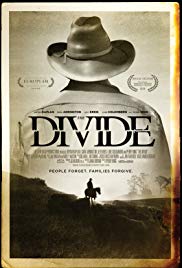
THE DIVIDE (2018)

November 8, 2018

 Greetings again from the darkness. Those of us who were watching movies in the 1970’s recall Perry King as one of the fresh-faced, hunky twenty-somethings in THE LORDS OF FLATBUSH (1974) … along with Sylvester Stallone and Henry Winkler. Now, more than 40 years later, not only does Mr. King star as crusty old rancher Sam Kincaid, but he also directs his first feature film. The script is written by Jana F Brown, in what is also her first screenplay. Due to its setting, the film could be labeled as a western, but it’s really a personal drama emphasizing the importance of family reconciliation.

Sam Kincaid (King) is an elderly rancher who lives on land that looks a great deal like the Lucas McCain ranch from the TV classic “The Rifleman”. We first see Sam as he shares his philosophy of mending fences with his hired help. If you are curious, it has to do with knowing “why the holes are there”. Luke (Bryan Kaplan) is the young ranch hand who must not only deal with the severe drought-plagued northern California climate of 1976, but also the past-their-prime tools and equipment. Presenting even more of a challenge is Sam himself.

Sam is suffering from Alzheimer’s disease and his house is decorated with personal notes reminding him how the light switch works, or to perform some other menial task. A particularly pointed note on the phone states, “your daughter doesn’t want to talk to you”. Luke figures out the father and daughter had some kind of falling out, but he soon realizes Sam’s disease is progressing pretty quickly. He tracks down daughter Sarah (Sara Arrington) and pleads with her to come visit her father.

As much as I enjoyed the banter between Sam and Luke, the film picks up a bit when Sarah and her son (Sam’s unknown grandson) arrive. Family issues, secrets and skeletons in the closet make communication between these folks more than a tad uncomfortable at times. However, slowly we see the “fence” mending … and Sam’s early philosophy becomes crystal clear. Campfire-style music plays throughout much of the film, and Sam’s repeated questions allow Luke, Sarah, and grandson CJ to comprehend what’s happening and what needs to be done. Sam’s recurring nightmare can only be stopped with a reconciliation that’s painful for all involved. Perry King proves his effectiveness as an aged rancher, and also as a first time filmmaker. He and Ms. Brown deliver a nice message … and the black and white photography serves the faces and setting quite well.

watch the trailer:


CAN YOU EVER FORGIVE ME? (2018)

November 1, 2018

 Greetings again from the darkness. Despite her regular role in all 7 seasons of “Gilmore Girls” and her co-lead role in the 6 season run of “Mike and Molly”, it was her raunchy turn in 2011’s BRIDESMAIDS that turned Melissa McCarthy into a star. Since then, she has been the lead in a string of comedies written specifically for her: IDENTITY THIEF, THE HEAT, TAMMY, SPY, THE BOSS, and GHOSTBUSTERS: ANSWER THE CALL. Mixed in was an overlooked little film called ST. VINCENT, a Bill Murray vehicle in which Ms. McCarthy first flashed some dramatic chops. With this latest, she shows that she’s no one-trick pony, but the character is a bit too narrow, and the material a bit too bland to convince us whether she is up to becoming an Oscar-caliber dramatic lead.

That’s not to say her performance isn’t noteworthy, because it is. She plays Lee Israel, a real life writer who had success as a celebrity biographer in the 1970’s and 1980’s, and then turned to a life of crime as a forger of collectible letters. This (mostly) true story of Ms. Israel features Ms. McCarthy in a poorly cut wig, very little make-up and the frumpiest of frumpy clothes. She’s also an aggressively bitter person who, in the film’s opening scene, get fired from her job in 1991 for drinking scotch at her desk and telling a co-worker to “F-off”. Classy, she’s not. Her actions and this firing are our indoctrination into her caustic personality.

Director Marielle Heller is no stranger to examining the life of someone who is not so happy, as she is best known as the writer/director of THE DIARY OF A TEENAGE GIRL (2015). Her latest is adapted from Lee Israel’s memoir by screenwriters Nicole Holofcener (ENOUGH SAID, 2013) and Jeff Whitty. After her firing, Ms. Israel hits desperate times. Her publisher (an always terrific Jane Curtain) tells her that a Fanny Brice biography has no market, and that no one wants to work with Israel anymore … she has burned every bridge. Fanny Brice and Tom Clancy both take some shots here as Israel tries to defend herself by dragging down others … a personality trait not uncommon among those who are so miserable in life.

As we watch this alcoholic, slovenly, abrasive person muddle through days – only showing any affection for her pet cat – there is quite a clever scene that could seem like filler were it not for what happens soon afterwards. Ms. Israel is at home watching THE LITTLE FOXES on TV and we see her perfectly mimicking Bette Davis. This ability to imitate others leads her into a career path of forging and selling personal letters “from” the likes of Noel Coward and Dorothy Parker. It also finds her crossing paths with miscreant Jack Hock (a flamboyant and energetic Richard E Grant). The two misfits form an odd friendship and partnership that begins to cash flow.

A sequence between independent bookstore owner Anna (a talented and under-utilized Dolly Wells) and Lee Israel teases us with the idea of a love interest, but Ms. McCarthy is unable to convince us that Lee’s vulnerability is genuine, and the potential relationship soon fizzles thanks to Lee’s crankiness and criminal path. While watching, I couldn’t help but feel that I was being manipulated into feeling sympathy towards Lee Israel, simply because she is a lonely female criminal. Typically male criminals in movies are social outcasts to be despised and/or feared, so this trickery is a bit unsettling. Personally, I find it difficult to muster sympathy towards any criminal, no matter their gender or how pathetic their life and personality might be.

The best film to date about a forger, CATCH ME IF YOU CAN, worked because of the cat and mouse between good and bad, and the criminal at the center was overflowing with personality. Here, we are stuck with a curmudgeon who uses multiple typewriters to create fake letters … all in the confines of a dirty apartment she shares with her cat. Were it not for Ms. McCarthy’s expertise at delivering caustic one-liners or Mr. Grant’s impeccable comic timing, this drama would fall flat. If we ever doubted the manipulation, be prepared for two kitty cat scenes designed to elicit “aww” from the audience.

Director Heller does a nice job of presenting an early 1990’s feel for New York, including the gay bar Julius’, which is evidently still in existence today. There is also an interesting point made about how collectors want to believe, so the authentication process is crucial to the industry – though we can’t help but wonder about potential fraud. On the downside, there is really nothing dryer than watching a writer write … even someone as miserable as Lee Israel, and even on collectible typewriters. Additionally, the score and soundtrack were much too loud for the film, and proved quite distracting in certain scenes. A Paul Simon song near the end seems like a plea for Oscar consideration, but by then, we are just relieved that the bad guy got caught. But that kitty … aww.

watch the trailer:


THE OTHER SIDE OF THE WIND (2018)

November 1, 2018

 Greetings again from the darkness. Film nerds unite! Most of us who (proudly) wear that label have known that filmmaker Orson Welles left a few unfinished projects when he died in 1985. The most famous – or infamous – of these was THE OTHER SIDE OF THE WIND. It was to be the comeback film for Mr. Welles, who had slipped from the artistic throne with his run of TV projects, shorts, and unsuccessful features during the 1960’s. Known as a perfectionist, and as someone more dedicated to the filmmaking part more than the “finishing” part, Welles filmed scenes for the movie from 1970-1976, and then picked it back up in the early 1980’s to begin the editing process … a process he never finished.

Best known for his all-time classics CITIZEN KANE (1941) and TOUCH OF EVIL (1958), Welles left mountains of copious production notes, and almost 100 hours of footage in multiple formats, and in both color and black and white stock, on this project that, even today, might best be described as experimental. Over the past 30 years there have been numerous attempts to raise the money required to finish the film, but all fell short until this one spearheaded by Peter Bogdanovich and Beatrice Welles (Orson’s daughter).

In what we can only interpret as semi-autobiographical, what we see on screen is the making of a documentary on a legendary director’s comeback film (his poke at artsy filmmakers). Clips of the unfinished film are shown throughout, while an industry party plays out, and numerous documentary filmmakers capture the scene from various angles with their always-present cameras. Got that?  Don’t worry, it takes at least a few minutes as a viewer to get the rhythm and layers of what’s unfolding before our eyes.

John Huston (himself an industry legend with 2 Oscars and 15 nominations) plays director Jake Hannaford, who is walking the fine line between Hollywood power and has-been. It’s his 70th birthday party, and Hannaford is compared to Hemingway (a description that better fit Huston than Welles), silently endures insinuations of his closeted homosexuality, desperately seeks funding to finish his film, and skulks around his own party winding through the hangers-on and those waiting for the final curtain.

Hannaford’s artsy film within a film, at least the clips we see, feature an inordinate amount of nudity from the leading lady (played by Welles 4th wife and the film’s co-writer Oja Kodar), and some ultra-coolness from the lead actor John Dale (played by Robert Random). Part of Hannaford’s desperation (both professional and persona) stems from a James Dean-type Dale walking off the set mid-picture.

Guests at the party include Peter Bogdanovich as director Brooks Otterlake, a young director once mentored by Hannaford. It’s an example of the student becoming the teacher. Susan Strasberg (daughter of famed acting coach Lee Strasberg) plays film critic Juliet Riche, a thinly-veiled portrait of Welles nemesis Pauline Kael. Other familiar faces in the cast include: Lilli Palmer, Mercedes McCambridge (Oscar winner), Edmond O’Brien (Oscar winner), Cameron Mitchell, Paul Stewart (from CITIZEN KANE), Tonio Selwart, Geoffrey Land, Norman Foster, Dennis Hopper (2 Oscar noms), Claude Chabrol, Stafford Repp (Sgt O’Hara from “Batman” series), plus Cameron Crowe (Oscar winner), William Katt, Frank Marshall (5 Oscar noms), Rich Little, Leslie Moonves (recently fired in disgrace CBS President), and Paul Mazursky (5 Oscar noms). It’s fascinating to see so many we recognize from more than 40 years ago. Of course, it’s Huston, with his face that’s made for black and white film, who is the dominating figure (his scenes were filmed prior to his work on CHINATOWN).

It’s easily viewed as a satire on the film industry, and it’s quite a fun, messy-by-design, now retro look at a fragile industry – and the even more fragile people who make movies. Welles’ love/hate relationship with the industry takes on an art form. He shows what’s good and what’s deplorable. Is it an experimental movie commenting on the post-studio world of independent filmmaking, or is it an iconic filmmaker, glory days behind him, in the midst of self-reflection. Perhaps it’s both. In addition to Welles’ early editing efforts, Oscar winning editor Bob Murawski (THE HURT LOCKER) was brought in to finish up what can now be described as a master class in film editing. It’s a wild ride for us film nerds. Are you ready to join us?

watch the trailer:


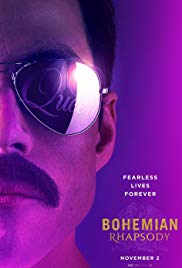
BOHEMIAN RHAPSODY (2018)

October 25, 2018

 Greetings again from the darkness. That VOICE! During my life, I’ve been fortunate enough to see many of rock’s greatest bands live in concert, including: The Who, The Rolling Stones, Bad Company, Led Zeppelin, Pink Floyd, and AC/DC. Each of these bands are amazing, but no other concert combined the energy, showmanship and musicianship as Queen (two different tours). And certainly no other lead singer donned a Harlequin leotard … only Freddie Mercury could make that look seem natural.

This is such an odd movie, and one that is somewhat difficult to discuss. It’s billed as an “inspiring story”, though one wonders how self-destructive living, an acrimonious band break-up, and dying young of AIDS could be considered inspiring. It’s not supposed to be a biopic, but the vast majority of the screen time is devoted to Freddie Mercury. And to really confound us, the film kind of drags (pun possibly intended) during the personal story times … and then explodes with greatness during the band and live performance segments.

Rami Malek plays Freddie Mercury, and he perfectly captures the swagger and strut of one of rock’s greatest theatrical showmen. Mercury was born Farrokh Bulsari in Zanzibar, and the film shows us his conservative family and time spent working as a baggage handler at Heathrow. Of course, things change quickly once he joins up with guitarist Brian May (played here by Gwylim Lee) and drummer Roger Taylor (Ben Hardy, MARY SHELLEY). When bassist John Deacon (Joseph Mazzello) is added, Queen is born.

With a story and script from two Oscar nominated writers, Peter Morgan (THE QUEEN, ironically) and Anthony McCarten (THE THEORY OF EVERYTHING), it’s surprising that much of the film is downright slow – especially the bits with frenemy Paul (Allen Leach). Perhaps this is more a factor of the issues with the director’s chair, where Bryan Singer is credited despite being fired during production. Cinematographer Newton Thomas Sigel filled in until Dexter Fletcher (next year’s Elton John biopic ROCKETMAN) was hired to complete the film. Lucy Boynton (so good in SING STREET) holds her own as Mercury’s wife and friend Mary Austin, and Mike Myers plays producer Ray Foster (with a tip of the cap to WAYNE’S WORLD). Other supporting work comes courtesy of Dickie Beau as influential DJ Kenny Everett, Aiden Gillen, Tom Hollander and Aaron McCusker.

The 20th Century Fox opening fanfare has its own Queen version, and is not to be missed as the film begins. Of course, it’s the infamous 1985 Live Aid performance that is the film’s highlight and one that will leave every audience member pumped up, smiling, and singing along. It’s a stunning sequence on a custom built Wembley Stadium stage, and it helps erase much of the tedium of the film’s non-band scenes. Erasing any doubt as to whether the film is worth the price of admission … hearing that VOICE at full volume on today’s theatrical sound systems. Killer Queen.

watch the trailer:


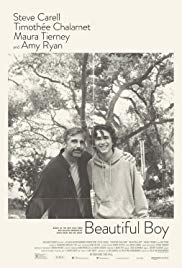
BEAUTIFUL BOY (2018)

October 25, 2018

 Greetings again from the darkness. There is absolutely nothing that compares to being a parent. Sorry, pet lovers, it’s not even close. And I’m not referring to the romantic notion of having one’s DNA live on as legacy. Rather, nothing compares to the weight of never-a-break responsibility felt in keeping a helpless newborn alive and properly nourished. And later, teaching the right life lessons so that it’s not your kid who bullies others in school, or steals, or damages the property of others. Someone’s kid is going to do those things, and most of us try our darndest to prevent it from being our kid. The reality is, that even the most attentive and best-intentioned parents can sometimes fall victim to a force beyond their control. Such is the situation in writer-director Felix Van Groeningen’s film (co-written with Luke Davis) based on the two memoirs penned by father and son David and Nic Sheff.

We open on David (Steve Carell) disclosing to a physician (Timothy Hutton) that his son Nic (Timothee Chalamet) is addicted to crystal meth, and asking two questions: 1. What is it doing to him? 2. What can I do to help him? The quiet desperation and pain is plainly evident on David’s face. We know immediately that this Steve Carell movie won’t be packed with laughs.

What follows is the harsh reality of drug addiction. Rehab – Relapse – Repeat. Much of the story is dedicated to David’s struggle and devotion to helping his son Nic in any way possible. He’s a helpless father who refuses to give up on his son, despite the constant desperation and frustration. Every glimmer of hope is soon crushed by yet another lie and more drugs. The film is such a downer that it makes LEAVING LAS VEGAS look like an old Disney classic.

Bouncing between timelines is a device that works for many stories, but here it seems to take away some of the poignancy and depth of some scenes. Just as we are being absorbed into a crucial moment, the film often breaks away to an earlier or later time. This is effective in getting the point across about the never-ending struggles, but we lose momentum on particular segments.

Supporting work comes courtesy of 4 talented actresses: Amy Ryan (as Nic’s mother and David’s ex-wife), Maury Tierney (as David’s current wife), Kaitlyn Dever (Nic’s girlfriend), and LisaGay Hamilton (involved in rehab). It’s a bit odd to see the mini-reunion of Ms. Ryan and Mr. Carell from their time on “The Office”, but mostly the on screen time is pretty limited for all four women. The reason this film works is the devastating work of two fine actors – Steve Carell and Timothee Chalamet. We never doubt dad’s commitment, just as we never doubt son’s helplessness in getting clean.

The soundtrack acts as a boost to the dialogue with such songs (perhaps a bit too convenient and obvious) as John Lennon’s “Beautiful Boy”, Neil Young’s “Heart of Gold”, and Perry Como’s “Sunrise, Sunset”. It’s debatable whether it’s possible for a movie to look “too good”, but it’s a bit off-putting to admire the camera work while someone is struggling on screen with drug addiction. The downward spiral of drug addiction feeds on the misery, and while we all enjoy beautiful cinematography, this is the rare time that it’s distracting – possibly preventing viewers from going all in. The inherent lesson here is that we can’t always save people from themselves. Knowing what to do isn’t always possible, and sometimes there is simply no right answer … even with “Everything”.

watch the trailer:


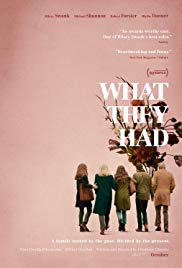
WHAT THEY HAD (2018)

October 25, 2018

 Greetings again from the darkness. “Til death do us part.” Only far too often, long term marriages are not broken by death, but instead by memories being cruelly erased through disease. Alzheimer’s and Dementia are dreadful diseases, even in the early stages. Writer-Director Elizabeth Chomko uses her feature film debut not to analyze the specifics of these diseases, but instead to focus on the incredibly personal and emotional fallout they produce.

At first glance, Bridget (Hilary Swank) seems to have figured things out in life. She’s a California career woman married to a successful man (Josh Lucas), and their daughter Emma (Taissa Farmiga) is a college student. Slowly, the truth is unfurled – much of it after she receives a frantic call from her brother Nick (Michael Shannon) back home in Chicago. Their mother (Blythe Danner) is missing, having wandered out into a snow storm wearing her pajamas. Bridget and her daughter Emma hop on a plane and land in the middle of a huge family ordeal. See, Nick is exhausted from being the caregiver, and believes the best thing for their mother (and for him) is to move her into an extended care facility. Dad (Robert Forster) is adamant that she remain home with him, where she (and he) are most comfortable.

Of course, the turmoil doesn’t end there. Bridget is in a loveless marriage. Emma has been evicted from her dorm for drinking. Nick’s long-time girlfriend has booted him to the backroom of the bar he owns. Bert, the father, is unwilling to accept or even discuss surrendering the life he’s known for decades. Ruth, the mom, is as apt to make a move on her son as to remember her daughter’s name. Contrasting personalities abound in this house. Despite having power of attorney, Bridget is still intimidated by her bullying father, and seems to have no empathy for the burden carried by Nick. It’s all very messy – just like a real family, and filmmaker Chomko revels in it.

It’s so wonderful to see Robert Forster in such a hefty role. These days, he’s typically relegated to a tertiary character where he mostly frowns and grunts. Not this time. He is at once a bullying force within the family, and an elderly man treading on fragile ground. He belittles his grown kids by calling his bar owner son a “bartender”, and having coerced his daughter into marrying a man for security. Mr. Forster nails the role, as does Michael Shannon as his irksome son. Shannon is one of the best actors working today and he is mesmerizing with his snap backs – sometimes funny, sometimes mean, sometimes both.

There is some horrible relationship advice served up. The family philosophy is “pick somebody you can stand, and make a commitment”, as there’s no such thing as “bells and whistles”. It’s not the romantic chatter most movies provide, but it plays to the complicated bond between parents and kids (of all ages). Director Chomko brilliantly and accurately handles the gut-wrenching effects of Alzheimer’s. She embraces laughter as a coping mechanism, and reminds us to enjoy the rare moments of clarity – those times a parent can remember who you are. There are a few cringe-inducing moments of mushy melodrama, but for the most part, Ms. Chomko delivers.

watch the trailer:


SUSPIRIA (2018)

October 25, 2018

 Greetings again from the darkness. It makes perfect sense when you think about it. After three artsy prestige projects (CALL ME BY YOUR NAME, A BIGGER SPLASH, I AM LOVE), Oscar nominated Italian filmmaker Luca Guadagnino decides to let his freak flag fly. And what better way than to pay homage to his fellow countryman Dario Argento’s 1977 surreal cult classic that featured a blinding color palette, obtuse camera angles, and enough schlock-horror (in a good way) to remain a midnight movie favorite for more than 40 years? While both movies are B**S**T crazy, we can’t help but think a filmmaker of Mr. Guadagnino’s caliber should have done better.

Dakota Johnson (FIFTY SHADES OF GREY) stars as Susie, a Bambi-eyed self-trained dancer raised in Ohio by her Mennonite parents. Following her dream, she shows up for an audition at the world renowned Markos Dance Company in Berlin. The film is set in 1977 (the same year as the original was released) and Susie sufficiently impresses the company director Madame Blanc (Tilda Swinton) to be invited to join.

A title card informs us that we are about to undertake “Six Acts and an Epilogue set in divided Berlin”. It should have added the run time of two-and-a-half hours (it seemed longer). For those of us who would pay to watch Tilda Swinton in any role, this one does deliver bonus value. The enormously talented actress who has disappeared into numerous characters over the years, plays two other roles here – disguised by heavy make-up in both. The trade-off is that Ms. Johnson is the lead, so not only are we subjected to the limitations of her acting, but also camera-trickery when it comes to her dance scenes. A bushy bushy red hairdo conceals her face during the most physically demanding dance sequences … think Cousin It from “The Addams Family”.

An almost entirely female cast features some interesting choices from across generational and geographical boundaries. Angela Winkler and Ingrid Caven have long been familiar faces on the big screen, and Mia Goth and Chloe Grace Moretz are fine choices for the younger company members. As an added bonus, Jessica Harper appears in one segment towards the end. Ms. Harper played the lead role of Suzy in the original. Other fun comparisons between the two films are the original score by Goblin compared to the updated (and more serene) score by Thom Yorke of Radiohead, and the muted color palette chosen by Guadagnino and cinematographer Sayombhu Mukdeeprom for this updated version.

The reason there is an open spot in the company for Susie is that Patricia (Chloe Grace Moretz) has disappeared after unloading her ‘coven of witches’ theory on an aged psychiatrist Dr. Josef Klemperer. Dr. Klemperer initially thinks the hysterical Patricia is delusional, and would prefer to wallow in his grief over his beloved wife Anke – missing since WWII. When Susie gets her shot at the lead in what is to be the company’s final performance of its most famous dance piece Volk, we get the film’s best sequence and one of a few WTF moments. A mirrored dance studio is the site of unexplained violence, and some terrific editing shoots us back and forth between art and mayhem. It’s difficult to watch but exceedingly well done.

Unfortunately, the truly bizarre and horrific moments are much too rare. In fact, some of the segments come off as unintentionally funny, which is not a good thing for a horror flick. The primal dancing never seems sensual, the bloodbath finale is too far over the top, and the political subtext with the Baader-Meinhof terrorist group just never seems to fit. While watching this, a few films came to mind: BLACK SWAN, THE WICKER MAN, MOTHER!, and ROSEMARY’S BABY, though this one doesn’t reach the level of any of those. Sometimes a movie just doesn’t lend itself to analysis or review, and it comes down to whether this is your cup of tea.

watch the trailer: