IF BEALE STREET COULD TALK (2018)

December 23, 2018

 Greetings again from the darkness. Humiliation and disgust register when we acknowledge that James Baldwin’s 1974 book is as relevant today as it was when published. Though the book hardly lends itself to a big screen presentation, writer-director Barry Jenkins (Best Adapted Screenplay Oscar winner for last year’s Best Picture winner MOONLIGHT) brings his cinematic artistry and deft touch to a story that is a touching love story wrapped in a tale of social injustice.

Filmmaker Jenkins has succeeded in delivering the rare film that is filled with both tender, warm, smile-inducing moments and moments of absolute frustration that fill us with outrage. It’s a beautiful film with a sweet story of love between two soul mates, and it’s also a story of race, class, and Harlem in the 70’s. The film begins with a Baldwin quote informing us that “Beale Street” is born from black roots – it’s not geographical, but rather cultural. He’s certainly not referring to today’s tourist destination in Memphis.

Tish (terrific newcomer Kiki Lane) and Fonny (Stephan James, played Jesse Owens in RACE) have been best friends since early childhood. They are now ages 19 and 22 respectively, and that friendship has blossomed into romantic attraction. Their fairy tale love story is shattered when a racist cop (Ed Skrein) falsely accuses Fonny of rape, and Fonny goes to prison. And if that’s not enough, we witness the scene where Tish and her family invite Fonny’s family over to announce she is carrying his baby. Fonny’s judgmental and religious zealot of a mother reacts with indignation and is beyond cruel to Tish. It’s one of the most emotionally explosive scenes of any movie all year. Regina King gives a powerhouse performance as Tish’s mom, and she goes toe-to-toe with Fonny’s mom played by Aunjunae Ellis (Yula Mae from THE HELP). Fonny’s dad (Michael Beach, AQUAMAN) and Tish’s dad (Colman Domingo, SELMA) are stunned by the situation, and wisely take their discussions to the corner bar.

That incredible scene of families clashing is offset by the tenderness and soulfulness of the scenes showing Fonny and Tish together … whether on the neighborhood streets, in their apartment, or talking with a glass barrier between them. As the timeline gets bounced around, we see Fonny and his old buddy Daniel (Byron Tyree Henry) in one exceptional scene, and we also see the bond between Fonny and his café manager friend played by Diego Luna. The depth of these scenes is difficult to relay, and the film acts as both a character study and social commentary relevant to today’s issues. There is so much precision and attention to detail in the story-telling and acting. The color palettes transition depending on the mood of the scene, as does the music – the strings used by composer Nicholas Britell are very much a part of the Tish-Fonny love story, and the brassy jazz music cover the rest.

We get to know Fonny as an artist and charming young man smitten with Tish, who is a gentle and angelic soul. We see his changes while in prison, and we see how others react to her (based on their race, gender and age) as she works the perfume counter at a department story. Baldwin’s writing is spot on as Tish (in her role as narrator) says “I hope that nobody has ever had to look at anybody they love through glass.”

Director Jenkins has delivered a special movie that is brilliantly constructed. It’s a story of love and family and the impact of racism without any of the preachiness we often get. Cinematographer James Laxton expertly captures the tone changes, and having the actors periodically look directly into the camera (at the viewer) proves quite powerful. This is romanticism vs. reality, and speaks to the power and beauty of love … and the strength to carry through even in an unjust situation brought on by a fractured society. It’s a beautiful film.

watch the trailer:


VICE (2018)

December 23, 2018

 Greetings again from the darkness. While it’s happening, we don’t always recognize life in terms of future historical merit. Time passes and perspective becomes possible. It’s at this point when we can reevaluate the actions and results of those involved. One might call this the benefit of hindsight, but philosopher George Santayana is credited with saying “Those who cannot remember the past are condemned to repeat it.” Filmmaker Adam McKay has moved on from his sophomoric comedies (STEP BROTHERS, ANCHORMAN: THE LEGEND OF RON BURGANDY) to full bore political satire, first with his “Funny or Die” videos (co-produced with Will Ferrell), then to his searing look at the financial crisis of the mortgage market with THE BIG SHORT (for which he won an Oscar for adapted screenplay), and now to the power dynamics within the Bush-Cheney administration … and how a quiet, unassuming insider became the most powerful man in America.

In one of the biggest casting head-scratchers of all-time, Christian Bale takes on the role of Dick Cheney. We are barely one scene in before all doubts are assuaged, and we are reminded yet again why Mr. Bale is one of the most talented and fascinating actors in cinematic history. With the weight gain, the hair, the growling voice (not unlike Bale’s Batman), the asymmetrical smirk – Bale becomes Cheney on screen and that allows us to focus on the manner in which filmmaker McKay unfolds the events – many of which we remember, even if we were blissfully unaware of the backstory.

Cheney is first seen in 1963 Wyoming as a drunk and somewhat rowdy youngster. The film then bounces the timeline to key events such as Cheney’s time as Donald Rumsfeld’s (Steve Carell) intern/lackey and the 1970’s (Bethesda, his being named youngest White House Chief of Staff, Ford’s loss to Carter, and the campaign for Wyoming Congressman). Cheney’s wife Lynne (played by Amy Adams) is portrayed as more ambitious than her husband (at least early on), and in one searing scene, yanks a young Cheney out of his funk and onto the upwardly mobile track. Were the timing 15 years forward, it’s not difficult to imagine Lynne as the rising political star.

The story really gets interesting once George HW Bush is elected and Cheney is brought back to D.C. as Secretary of Defense. From this point on, his near subversive quest for power is in overdrive. There are many quotes cautioning to ‘beware the quiet man’, and most fit the Cheney on display here. You’ve likely seen in the trailer where a finger-lickin’ George W Bush (Sam Rockwell) chows on barbeque as he offers the VP job to Cheney. Surprisingly, this is one of only two scenes where McKay makes Bush look like a buffoon. If you haven’t figured it out by now, it should be clear that McKay is not one to give the benefit of the doubt here … his mission is to highlight all ludicrous actions of our nation’s leaders during this time.

Supporting work is provided by a deep cast including Lilly Rabe and Allison Pill as the Cheney daughters (Liz and Mary), Justin Kirk as Scooter Libby, Bill Camp as Gerald Ford, LisaGay Hamilton as Condoleezza Rice, Tyler Perry as Colin Powell, Eddie Marsan as Paul Wolfowitz, and Don McManus as David Addington. There is also Bob Stephenson as Rush Limbaugh, cameos from Naomi Watts and Alfred Molina, and Jesse Plemons as the narrator whose true role is held at bay until near the film’s end.

September 11, 2001 brings on a very interesting segment when there is an emergency White House evacuation, and Cheney is whisked into a secure room and appears to overstep his authority … at least that’s how it appears to everyone other than Cheney. He is described as having power “like a ghost”, and it’s this scene and the follow-up discussions about Afghanistan, that McKay believes best exemplifies Cheney’s lust for power, and how ‘right and wrong’ are secondary to him.

Actual clips of Nixon, Reagan, bin Laden, Carter, and Obama are dropped into segments providing a quasi-documentary feel at times. Cheney’s heart issues, the political quandary resulting from his daughter coming out as gay, and the involvement of Americans for Tax Reform (ATR) and the Koch brothers all play a role here, as does the Unitary Executive Theory and the legal specifics that cause much debate. Also on display is some of the least complementary eyeglass fashion across 3 decades.

Even though his approach leans pretty far left, filmmaker McKay is to be applauded for a most entertaining look at how our government officials can manipulate policy and public statements, and may even stoop to focus groups in better understanding the views of the American people. Editor Hank Corwin (Oscar nominated for THE BIG SHORT) is a big part of maintaining the quick pace of the film, and the use of fishing as a metaphor somehow works.  “America” from WEST SIDE STORY is a fitting song to end the clever, funny and thought-provoking film and our look at the rare politician who amassed power while mostly avoiding the publicity that other politicians seek. Watch at your own risk – depending on your politics.

watch the trailer:


ROMA (2018)

December 23, 2018

 Greetings again from the darkness. It is possible for a filmmaker to be “too close” to the material when undertaking a story that is somewhat autobiographical. It’s also possible, in that situation, for them to catch lightning in a bottle and magic on the screen – and that’s exactly what writer/director Alfonso Cuaron has achieved with this look back at his childhood home life. In his follow-up to GRAVITY, for which he won the Best Director Oscar, Mr. Cuaron has dedicated the film to Libo, his family maid/nanny during his youth in Mexico City.

Balancing artistry and everyday humanity like few other films, it takes us inside the home of a well-off family: Antonio (Fernando Gredigaga), the father-husband-doctor; Sofia (Marina de Tavira, the only experienced actor in the main cast), the mother-wife; Teresa (Veronica Garcia), the grandmother; the four kids; and two live-in maids, Adela (Nancy Garcia Garcia) and Cleo (Yalitza Aparicio). There is no separating the human emotions from the near-poetic art form of Cuaron’s movie. It is unusually quiet, filmed mostly at midrange, and with no musical score. Yet, in the stillness and quiet, so much is happening.

The focus here is on Cleo. We hear many times how she is considered part of the family. Of course, she (and we) are reminded that’s only true to a certain extent as she is admonished for not cleaning up after the family dog or ‘wasting’ electricity in her living quarters by using the light in her tiny living quarters at night. First time actress Yalitza Aparicio brings a realism and accessibility to the role as the quiet, perpetually-in-motion maid/caregiver/nanny and she is mesmerizing to watch. Her duties include keeping the house clean, cooking meals, getting the kids up in the morning, getting the kids to/from school, and putting the kids to bed at night. What little scraps of time she has for a personal life are spent going on a date with the cousin of Adela’s boyfriend.  Fermin (Jorge Antonio Guerrero) is a martial arts fanatic and just prior to their intimacy, he demonstrates his skills to her with a shower rod and literally nothing else.

When Antonio and Sofia announce to the kids that dad will be attending a conference in Quebec “for a few weeks”, we as viewers understand what this means, even though the kids don’t. Spending time with his mistress means Sofia and Grandma Teresa must manage the house … but of course, as always, the bulk of the burden falls to Cleo. When Cleo finds out she’s pregnant, Fermin dumps her – leaving both Cleo and Sofia as abandoned by men. It’s fascinating to watch this unfold, and contrast how the two women react and cope. The dialogue is secondary to the situations in the film, but there is a great line of dialogue after the men leave: “We women are always alone.”

From a cinematic aspect, Cuaron’s film is a delight to watch – reminding at times of the classic Italian and French films of years past. Since his first film in 1995, Cuaron has frequently collaborated with (3 time Oscar winning) cinematographer Emmanuel Lubezki, but this time Cuaron wears multiple hats as writer/director/cinematographer/co-editor/producer. This is his movie – and his most personal one – from top to bottom. Working closely over the years with Lubezki has influenced Cuaron’s camera work … it’s stunning. He uses wide, initially static shots with slow pans – just the way we see in real life. And just like in real life, what he shows us is sometimes mundane and at other times various degrees of emotional. The remarkable opening credit scene could be quickly described as Cleo mopping the dog mess from the garage floor. But of course there is much more. We also see the reflection of planes flying overhead and hear only the sounds of everyday life. It sets the stage for the entire film.

This is 1970-71 Mexico City, so in addition to Cleo getting the kids to and from school, the street riots – some quite violent – play a role, as does the incessant sound of dogs barking in the background. Cleo’s trip to the delivery room is filmed with real doctors and nurses, while a later trip to the beach offers yet another gut punch … and both sequences maintain the overall feel of authenticity. Lest you think this is just another “small scale” indie, Cuaron goes big a few times – the street riot, a mass martial arts training session, and the beach trip. His film is a story of class and family, making it more than just a thing of celluloid beauty. It also brilliantly captures the essence of life’s emotions: the “bad” with two men who ignore their responsibilities, the “normal” with kids being kids, and the “good” with seeing Cleo become such a vital and beloved part of the family.

(Available on Netflix)

watch the trailer:


ON THE BASIS OF SEX (2018)

December 22, 2018

 Greetings again from the darkness. Earlier this year, the documentary RBG (co-directed by Julie Cohen and Betsy West) was a film festival and box office hit, helping turn 85 year old Supreme Court Justice Ruth Bader Ginsburg into a celebrity and cult icon, complete with best-selling “Notorious RBG” t-shirts and her own action figure. That documentary allowed us the rare opportunity to hear directly from a currently sitting Justice, and just about every viewer came away in awe – regardless of one’s political affiliations. Now, a few months later, we get the story of her younger years in a (loving) script written by Ms. Ginsburg’s nephew Daniel Steipleman.

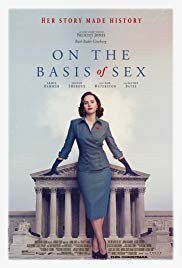
The film opens with a lone woman in a dress engulfed by a sea of young men in conservative business suits marching up the steps on day one of Harvard Law School in 1956. Inside the oak paneled hall, the school’s dean, Erwin Griswold (Sam Waterston) discusses what it means to be a ‘Harvard man’ and how this is only the sixth year women have been admitted. As he speaks, young Ruth (Felicity Jones) glances around the room at the (only) 8 other female students. At a later reception for the females, Dean Griswold asks each to stand and explain why they are worthy of taking a man’s spot in the class. It’s our first (not last) example of the sexism obstacles of the time – much different than those of today, where women procure more higher education slots than men.

By this time, Ruth and Martin Ginsburg (Armie Hammer) are both Columbia graduates, have been married for a couple of years, and are raising their first child, Jane. When Marty is diagnosed with testicular cancer, Ruth covers his classes and hers, is mother to young Jane, and also caregiver to a recovering Marty. Of course, her husband recovers and goes on to be a highly successful tax attorney on Wall Street, and their marriage continues until his death in 2010.

But this is Ruth’s story, and her strength is on display. As uplifting as it is to see that Marty was an immensely supportive husband, it’s deflating to see how a brilliant woman – number one in her class – is so disrespected during this era that she can’t even find a job at a law firm. For one committed to doing, Ruth accepts a job teaching instead. Her time as a professor at Columbia is spent encouraging students to explore the inequities of the law when it comes to men and women. In fact, it’s 1970 when Ruth and Marty work their only case together. A Colorado man, Charles Moritz (Chris Mulkey), is denied a tax deduction for the caregiver expenses in caring for his sick mother. By law, the deduction is only allowed for female caregivers, and this gives Ruth her first taste of ‘doing’.

It’s at this point, where Kathy Bates appears as civil liberties lawyer Dorothy Kenyon, and Justin Theroux as Mel Wulf, the ACLU Legal Director. Adding spice to Ruth’s and Marty’s life is their teenage daughter Jane (a very good Cailee Spaeny) who is quite headstrong in her own beliefs. The scenes in the Appellate Court are the film’s best, as is the Moot Court sequence – though we do wish more time had been devoted to the prep work and details for the court arguments.

Director Mimi Leder is known mostly for her TV work, and she delivers the story of an amazing woman in an easily accessible manner for mass audiences. It’s an approach that will hopefully allow many young people (yes, especially women) to gain a better understanding of what this woman went through and fought for during the decades before she became the second woman to serve on the US Supreme Court.  Two takeaways here are that Ruth Ginsburg is a superhero and pioneer of social change, and also that a marriage of equal partners carries great power. Her cameo as the film’s final shot, leaves no doubt that RBG is no longer concerned about which dress will make her look like a “Harvard man”.

watch the trailer:


WELCOME TO MARWEN (2018)

December 20, 2018

 Greetings again from the darkness. The main thing to keep in mind while watching this movie is that it’s based on the true story of a real guy – Mark Hogancamp – and it’s also a dramatization designed to entertain, enlighten and even inspire. Most of the time it’s pretty discomforting to watch, but what would you expect with a grown man who spends his time creating and photographing fictional and fantasy-laden WWI scenes in the model-scale village he built in his backyard? And he frequently does so while wearing women’s shoes.

When we first meet Mark Hogancamp (played by Steve Carell), he is three years removed from a brutal and savage attack by a group of men outside a local bar. While intoxicated, and after having been called a derogatory term, Mark confessed to the men that he sometimes wears women’s shoes. Not long after, he was being pummeled to near death in the parking lot. When Hogancamp awoke from the coma, he had no memory of his past, no taste for alcohol (he had been an alcoholic), and a shaky hand that prevented him from continuing to earn a living as an illustrator.

In his new world of mental and physical challenges, Mark does manage to tap into his artistic side and deal with his trauma in quite an unusual manner. He creates a WWII era Belgian village named Marwen – fused by his first name and that of Wendy, a neighbor he was quite fond of. Using dolls and action figures and other accessories found at the local hobby shop, Mark sets up elaborate battle sequences that feature the German SS standing in for his attackers outside the bar, and a battalion of courageous machine-gun toting ladies who protect US Air Force Captain Hoagie (a stand-in for Mark himself). He is also haunted by Deja Thoris, who he calls the Belgian Witch of Marwen.

Director Robert Zemeckis has long capitalized on unusual visuals and special effects in his films such as FORREST GUMP, BACK TO THE FUTURE, THE POLAR EXPRESS, and WHO FRAMED ROGER RABBIT, and here he uses motion-capture for his excellent action sequences. Rather than the lifelike images we’ve come to expect with motion-capture, Zemeckis and his team allow the figures to keep a touch of their doll-like attributes, so that we easily distinguish between reality and Mark’s fantasy escapes.

Opening with an action packed and vivid battle sequence, we slowly pull back through the viewfinder on Mark’s camera to see him and get our first glimpse at Marwen and its inhabitants. In time, each of the characters is unveiled – real life person and the Marwen counterpart (doll). The tough-as-nails women are Diane Kruger as Deja Thoris (Belgian Witch), Gwendoline Christie as Anna the visiting nurse, Janelle Monae as Julie the physical therapist, Merritt Weaver (“Godless”) as Roberta the hobby shop owner, Elza Gonzalez as Carlala and Mark’s meatball-making co-worker, Leslie Zemeckis (the director’s wife) as Suzette, Stephanie von Pfetten as Wendy (of Marwen fame), and Leslie Mann as new neighbor Nicol.

The screenplay was co-written by Caroline Thompson and director Zemeckis, and the dramatization effects could be noted if compared to the 2010 documentary MARWENCOL (the doc explains the truth behind the full town name) which details Mark’s story. It was a 2000 attack that left him in a coma for 9 days, and resulted in his transition to photography and war reenactments as a form of therapy. His photography is so exceptional that Mr. Hogancamp is featured in gallery showings and publications. In the film, we see his attempts to face his accusers in court, and how he was finally able to personally come to grips with his own shame and guilt in regards to the hate crime that changed his life.

As if the actual story doesn’t provide enough strange elements, director Zemeckis adds a few dashes of bizarre by having Nazis that come back to life, a time machine so similar to the BACK TO THE FUTURE Delorean that we can’t help but smile, a bell tower scene seemingly taken straight from Hitchcock’s VERTIGO … including a fall and landing that recalls THE OMEN. There is also Julie London’s surreal version of “Yummy Yummy Yummy”, and enough women’s shoes to stock a department store. Mark’s story is simultaneously tragic, unconventional, deserving of empathy, romantic, heart-breaking, redeeming, twisted, and uplifting. It’s rare for a feel-good movie to leave us feeling so ‘not good’ due to its nature, but I am still not sure I’ve fully evaluated what was presented.

watch the trailer:


MARY POPPINS RETURNS (2018)

December 17, 2018

 Greetings again from the darkness. The 1964 classic Disney film MARY POPPINS is much beloved and has been shared across generations for more than 50 years. It won 5 Oscars on 13 nominations, and shifted Julie Andrews from a Broadway star to an international movie star, as she won the Oscar for Best Actress while becoming the ideal nanny for most every boy and girl. Rarely do reboots, remakes, or sequels to the classics make much of a dent with the movie-going public, but it’s likely director Rob Marshall’s (CHICAGO, INTO THE WOODS) film will be an exception. Marshall balances nostalgia with contemporary, and benefits from a marvelous successor to the Mary Poppins role … Emily Blunt.

The film opens in low-key fashion as we follow Jack (Lin-Manuel Miranda) through town as he performs his lamplighting duties singing the melancholic “Underneath the Lovely London Sky”. It’s actually a bit of a dry opening that may have some impatient kids wondering why their parents dragged them to see this. Soon after, we are at the familiar 17 Cherry Tree Lane – the Banks’ home – easily recognizable from the original film. We meet grown up siblings Michael (Ben Whishaw) and Jane (Emily Mortimer). Jane is a labor organizer following in her mom’s footsteps, and Michael is a struggling artist and widower raising 3 kids. He has taken a teller job at the Fidelity Fiduciary Bank where his dad (now deceased) worked, but mostly he’s an emotional wreck. In fact, the only way to save the family home from foreclosure is with proof of his father’s bank shares … something the evil new Bank President, William Weatherall Wilkins (Colin Firth), conspires to prevent.

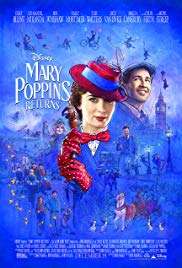
It’s at this point that the kids’ popcorn should just about be gone, so it’s fortunate that our beloved nanny makes her timely appearance … literally floating (with practically perfect posture) into the park where Georgie (an adorable Joel Dawson) and lamplighter Jack are flying a very recognizable kite. Jack, having been an apprentice under Bert the Chimney Sweep, is quite familiar with the significance of Mary Poppins’ arrival. Back on Cherry Tree Lane, Michael and Jane are shocked to see their childhood nanny back in the house, and Michael’s two spunky twins Anabel (Pixie Davies) and John (Nathanael Saleh) aren’t sure what to make of this mysterious visitor.

Director Marshall wisely utilizes the template from the original film, so many of the subsequent sequences have a familiar and cozy feel to them. Mary Poppins’ “Off we go” kicks off a fantastical bathtub adventure and leads to the first of many smile-inducing, visually spectacular moments. A broken porcelain bowl guides us to a beautiful hand-drawn animation (from Walt Disney Studios) sequence with horse-drawn carriage, penguins, and more. Meryl Streep performs “Turning Turtle” in her topsy-turvy studio, and there is an extended (perhaps a bit too long) dance sequence featuring Jack and the other lamplighters singing “Trip a Little Light Fantastic”.

Julie Walters appears as the Banks’ housekeeper and David Warner is Admiral Boom, the Banks’ canon-firing neighbor; however it’s two cameos that will really hit home with the older viewers: Angela Landsbury (not in the original) is the balloon lady singing “Nowhere to Go but Up”, and the remarkable Dick Van Dyke (a huge part of the original) plays an elderly Mr. Dawes Jr from the bank – and even performs a dance routine atop a desk. All of the actors perform admirably, yet this is clearly Emily Blunt’s movie. She shines as the practically perfect nanny, whether debating with her umbrella, digging in her mystical baggage, filling heads with ‘stuff and nonsense’, teaching life lessons to those in need, or singing solo and with others. It’s a wonderful performance and she becomes Mary Poppins for a new generation.

Director Marshall co-wrote the story and screenplay with David Magee and John DeLuca, and they have created a worthy sequel (a quite high standard) from P.L. Travers’ original books that is delightful and a joy to watch. The group of original songs by Marc Shaiman and Scott Wittman serve the story fine, but the one downside to the film is that none of the new songs are as catchy or memorable as those of the Sherman Brothers (Richard and Robert) from 54 years ago. They won Oscars for Best Score and Song (“Chim Chim Che-ree”), and left us singing others such as “Spoon Full of Sugar”, “Let’s Go Fly a Kite” and of course, “Supercalifragilistic”. These new songs including “Can You Imagine That”, “The Place Where Lost Things Go”, “A Cover is not the Book”, “Nowhere to Go but Up” all contribute to the story and to the viewer’s enjoyment, but none leave us singing or humming as we depart the theatre.

This is film where those behind-the-scenes are crucial to its success. Oscar winning cinematographer Dion Beebe (MEMOIRS OF A GEISHA) and Editor Wyatt Smith both are at the top of their game, and Costume Designer Sandy Powell delivers stunners, not just for the singing nanny, but for all characters. The core of the story remains rediscovering the magic in life, and finding joy in each other – and this sequel also provides the adventures to match the original. It’s simultaneously familiar and fresh, which is key to a successful follow up to a beloved classic. Director Marshall has signed on to Disney’s live action THE LITTLE MERMAID, but it’s with MARY POPPINS RETURNS where he has delivered a film that is practically perfect in every way.

watch the trailer:


MARY QUEEN OF SCOTS (2018)

December 6, 2018

 Greetings again from the darkness. The history of monarchs goes back more than a thousand years. These days we view British royalty as little more than telegenic subjects for gossip sites, though for hundreds of years, the crown carried real power. Of course, the system never made any logical sense. Why should a baby born to the “right” family be pre-ordained to rule the country? These birthrights even caused much confusion and debate … and wars … when there was uncertainty about which kid was the most important. And yes, kids is the proper term. Mary Stuart (Mary Queen of Scots), was six days old when her father King James V died, and she ascended to the throne (though the actual ruling was done by regents until she was older).

Saoirse Ronan stars as Mary and Margot Robbie is Queen Elizabeth I (daughter of King Henry VIII and Anne Boleyn). The two were cousins (not sisters), and the film examines many aspects of this era: the struggle for the throne between the two, the unusual circumstances that found two women in power, the behind-the-scenes maneuvering by men in an effort to wrestle power from the women, the importance of marriage and heirs, the conflicts between Catholics and Protestants, and the bizarre arrangement that caused Mary to spend nearly half her life in custody.

Director Josie Rourke is best known for her stage productions, some of which have been broadcast live in cinemas. This is her debut feature film, and her talent is quite obvious. She gets “big” with stunning sweeping vistas, and intimate with dark chamber meetings. The castles look and feel like castles, and not the sound stage sets we often see in costume productions. The film is a thing of beauty and the two lead actresses are sublime … and with much more screen time, Ms. Ronan delivers a ferocious performance.

The screenplay from Beau Willimon (creator, producer and head writer of “House of Cards”) is based on the John Guy book “Queen of Scots: The True Life of Mary Stuart”. This matters because Mr. Guy theorizes that the two sovereigns actually met in real life, something very much doubted by historians. Either way, it makes for an interesting (if not a bit hokey) segment in the film, as Elizabeth and Mary wander through billowing curtains in a clandestine spot. The costumes from Oscar winner Alexandra Byrne are so beautiful, they are nearly a character altogether.

Beginning at the end, we get an early look at Mary’s “martyrdom” march to her execution on 1587 at age 44. If you’ve ever read about the actual execution, you’ll be relieved to know it’s not shown on screen. Supporting work comes courtesy of Jack Lowden, Guy Pearce, Joe Alwyn, Gemma Chan, and an explosive David Tennant as a fire-breathing priest. This version plays up the inner-turmoil and challenges in power faced by the women – more so than the 1974 version starring Vanessa Redgrave and Glenda Jackson (the film received 5 Oscar nominations). Ms. Ronan and Ms. Robbie really help us understand the challenges these women faced – challenges that men on the throne wouldn’t have faced.

watch the trailer:


BEN IS BACK (2018)

December 6, 2018

 Greetings again from the darkness. So many families have been thrown into turmoil due to a loved one’s drug addiction. Count writer/director Peter Hedges among those, so know this is more than just another film for him … it’s personal. Mr. Hedges previous work includes the underrated PIECES OF APRIL (2003) and DAN IN REAL LIFE (2007), as well as an Oscar nomination for his ABOUT A BOY (2002) screenplay. This time out, he cast his own son Lucas in the titular role of Ben. It was a wise choice.

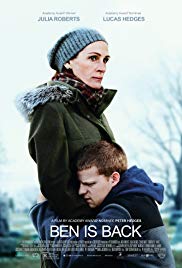
When your son is checked into drug rehab, and you pull up to your house on Christmas Eve and see him pacing in the front yard, should your first reaction be total joy or immense trepidation? Are you thrilled to see him or worried for your other 3 kids – each who is in the car with you? Such is the moment for Holly Burns (played by Julia Roberts). With excitement from her two youngest, and pleas of “no” from her teenage daughter Ivy (Kathryn Newton), Holly bolts from the car and embraces Ben (Lucas Hedges), her eldest and most self-destructive child.

What follows is the ultimate example of inner-conflict for both mother and son. Holly is simultaneously happy to see her son and apprehensive for his well-being and that of her family. Ben is putting up an “all is well” front, while carrying the guilt of lying through his teeth. This initial sequence is by far the most powerful segment of the movie, and adding punch to these scenes are Ms. Newton and Courtney B Vance as Holly’s husband and Ben’s stepfather. Lucas Hedges and Kathryn Newton are immensely talented and two of the fastest rising young stars. He was nominated for an Oscar for his performance in MANCHESTER BY THE SEA, and she is recognizable from her work on “Big Little Lies”.

After such a strong beginning, the story falters quickly as it spreads outside of the family home. At the local shopping mall, mother Holly spews vicious venom at the doctor who first prescribed the pain killer for Ben’s sports injury. She blames the now dementia-riddled doctor for ruining her son’s life – it’s an all too obvious and overblown moment of a parent needing to place the blame elsewhere. Soon after, we truly fly off the rails as mother and son treat us to a tour of the cities drug-related highlights. When the family dog goes missing, most people post on Facebook for help. Not this family. They hop into the car and revisit all the drug havens and dealers from Ben’s past. Of course, we do get the obligatory drug recovery meeting where Ben’s soliloquy praises his mother (she’s in attendance) and shows remorse for his many sins.

Every parent will understand the desperate feeling of mother Holly here or father David (Steve Carell) in BEAUTIFUL BOY, a similar-themed movie released earlier this year. We are also familiar with the deceptive and often dangerous actions of addicts, even those who were raised in our home. So while we are flexible in our judgement of Holly, Ms. Roberts’ performance is just too showy and over-the-top here, though she’ll likely be lauded for a dramatic role with only minimal dependence on her usual acting quirks. The first third of the movie is outstanding, however the rest comes across as an attempt to create intense drama when there’s already plenty.

watch the trailer:


SWIMMING WITH MEN (2018)

December 6, 2018

 Greetings again from the darkness. If you are surprised to find a movie about an all-men’s middle-aged synchronized swim team, then you’ll likely be shocked to learn that another film on the same topic, LE GRAND BAIN (Sink or Swim), was released earlier this year, and these follow up a 2010 documentary MEN WHO SWIM covering the Swedish Men’s synchronized swim team. That’s right … three films! It is with great pleasure that I report director Olive Parker and writer Aschlin Ditta have delivered a charming and heartfelt movie that is really quite enjoyable, and more nuanced than you might pre-judge it to be.

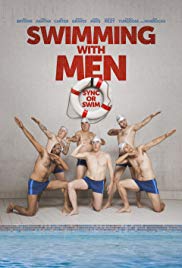
Rob Brydon (THE TRIP) stars as Eric, a successful accountant going through a mid-life crisis that negatively affects his work, his marriage to Heather (a terrific Jane Horrocks), and his relationship with his teenage son Billy (Spike White). Eric spends his office days in a foggy haze, waiting for 6:00 pm so he can hit the local pool for a few laps – his only time alone without thoughts of boredom. On one of these evening dips, he (and we) get quite a visual … 7 men in goggles and caps sitting on the pool floor in a coordinated manner.

Soon enough, thanks to his math and analytical skills, Eric is invited to join the swim club (first rule of swim club: Don’t talk about swim club!) consisting of team leader Luke (Rupert Graves), dentist Kurt (Adeel Akhtar), young scofflaw Tom (Thomas Turgoose), recent widower Ted (Jim Carter), former youth footballer Colin (Daniel Mays), the “new guy” (Ronan Daly), and “Silent Bob” (Chris Jepson). Rather than the island of misfit toys, it’s a group of slightly damaged men – each with their own story of why life isn’t so great at the moment. We learn about each right along with Eric, and easily see how he fits right in. This group alternates drowning their sorrows with a pint at the local pub with nearly drowning each other at the local pool … with only the best intentions, of course.

Once the lads learn there is a competition in Milan, they bring on local swim teacher Susan (a spunky Charlotte Riley, “Peaky Blinders”) to coach them towards respectability. Sure, we get a few clichés and the predictability of events is usually spot on; yet, there is a core to the story and to each of the men that brings a welcome depth. Their coordination in the water leads to their better balance on dry land (aka, everyday life).

This is far from traditional cinematic masculinity, and instead shows us the impact of friendship and purpose. The original reason for forming the team was to protest the meaningless of life – to find their purpose. This is accomplished through the brilliance of gentle British humor (think DANNY DECKCHAIR, THE FULL MONTY, EDDIE THE EAGLE), and the clumsiness of full-bodied men in a pool … accompanied by Tom Jones’ version of “It’s a Man’s, Man’s, Man’s World”.

watch the trailer:


SONG OF BACK AND NECK (2018)

December 4, 2018

 Greetings again from the darkness. Paul Lieberstein is best known and easily recognizable as Toby, Michael Scott’s HR nemesis on “The Office”. Mr. Lieberstein also wrote and directed many episodes of that popular TV show, and now he turns his talents to the big screen: donning all 4 hats as writer-director-producer-actor in his feature film debut as a filmmaker. It’s a romantic-comedy of pain, and the featured pain comes in both varieties: physical and emotional.

Fred (Lieberstein) is a long-term paralegal at the law firm his dad co-founded. He’s a frumpy every-man suffering in silence with loneliness and back pain so debilitating that his morning ritual is often performed by sliding prone on the floor through his house. A long-awaited appointment with a back specialist (played by BRIDESMAIDS director and “The Office” producer Paul Feig) is comprised of numerous smart-ass one-liners from the doctor that result in no help for the patient and the dreaded diagnosis of “the trifecta of back and neck pain”.

In addition to this physical pain, Fred is miserable at work as he’s forced to take direction from a cocky millennial lawyer (Clark Duke), who is the firm’s new partner now that Fred’s protective dad is retiring. He’s also miserable in his personal life due to loneliness. While we see that all this pain is interconnected, it takes a fortuitous encounter with Regan (Rosemary DeWitt), who is in need of a divorce attorney, to start Fred on the path of discovery and recovery.

Regan refers Fred to her acupuncturist Dr. Kuhang (Raymond Ma), who is astounded at the musical tones the injected needles produce along Fred’s spine. The leads to one of the film’s more outlandish recurring gags in the movie – a quite unique and humorous situation involving a cello. Other supporting work is provided by screen veterans Sam Anderson, Robert Pine (Chris Pine’s dad) and Brian d’Arcy James as Regan’s husband. Ike Barinholtz also provides a brief comedic cameo as an orderly, and Scott Hutchison delivers a welcome musical interlude. Mr. Hutchison, founder of Frightened Rabbit, sadly passed away earlier this year.

This is a nice little low budget indie that shows how even a temporary interpersonal connection can provide a spark of hope and remind us of how important fulfillment in life can be towards our physical and emotional health. Since the film is based on Mr. Lieberstein’s own back pain, he provides a special thanks to John E Sarno, MD, author of “Healing Back Pain: The Mind-Body Connection”. The film is wry and sad, while at the same time somewhat illuminating and hopeful. It’s a pleasant debut from filmmaker Lieberstein.

watch the trailer: