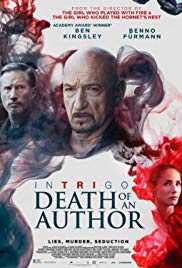
INTRIGO: DEATH OF AN AUTHOR (2019)

January 16, 2020

 Greetings again from the darkness. Daniel Alfredson directed two of the three films in the original “Millenium” trilogy by fellow Swede, the late Stieg Larsson. He handled THE GIRL WHO PLAYED WITH FIRE and THE GIRL WHO KICKED THE HORNET’S NEST. Alfredson has now signed on to direct a trilogy of films based on Hakan Nesser’s “Intrigo” novellas. This is the first in the series, with “Dear Agnes” and “Samaria” coming soon (each with completely different casts).

Nesser’s stories have been adapted for the screen by Alfredson and Brigitta Bongenheim, and they face the challenge of all crime stories making the move to movies … how to create an equal level of suspense. Benno Furmann (JOYEUX NOEL, 2005) stars as David, a translator by profession who has written his first novel. We first see David on vacation with his wife Eva (Tuva Novotny, ANNIHILATION, 2018), who spoils his plans by telling him she is leaving him for her therapist. We next see him planning or imagining her death.

Flash forward three years and David has arranged a meeting with successful writer Alex Henderson (Sir Ben Kingsley, Oscar winner for GANDHI, 1982) in hopes of receiving advice on his debut novel. Their meeting takes place at Henderson’s isolated island retreat, which serves as his primary residence away from ‘people’, the lot of whom he readily admits he doesn’t much care for. Henderson agrees to let David read passages of his novel, and the ‘cat and mouse’ game is afoot.

David has been contracted to translate the final book of Austrian writer Germund Rein, who recently committed suicide (mysteriously) while at sea. As the twists and turns unfold, David begins to wonder if there is a connection between Rein and his own story. A simple cough heard while listening to a radio concert sends David on the road. He discovers a code within Rein’s manuscript, and the film bounces between the multiple stories and layers.

When David’s fiction crosses over with his own reality, it’s our job as viewers to keep up and distinguish between the two. It’s not always easy as the structure seems designed to confuse. On the other hand, some of the aforementioned twists and turns might as well have neon signs explaining what is about to happen, why it happens and how it is related to what has already happened. Because of this, the film lacks the tension suspense and conflict necessary for this type of story. Storytelling is the focus, but it’s that storytelling that is the film’s downfall. While it’s always fun to watch Kingsley tear into a role, and some of the scenery is drop-dead gorgeous, we do hope the next two chapters of Nesser’s books transfer better to the screen.

watch the trailer:


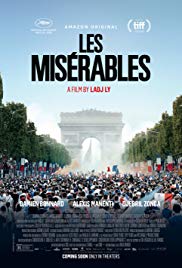
LES MISERABLES (France, 2019)

January 15, 2020

 Greetings again from the darkness. Being the new student in school can be an emotionally trying experience for some kids. Now take that pressure and put it in a patrol car for law enforcement in a tough part of town where racial and religious tensions are always on edge. The ‘new kid’ in this case isn’t a kid, but rather an adult cop … and the experience will eclipse ‘trying’ and shift directly to life-altering. “Ever since 2005 …” is a line that reminds us that the Paris riots of that year remain fresh in the minds of locals, and police harassment is applied to most every stop or interrogation. This is an area that has yet to reclaim balance and writer-director Ladj Ly, having grown up in this part of the city, is more qualified than anyone to tell these stories.

Montfermeil is the Paris suburb where Victor Hugo wrote his classic 1862 novel “Les Miserables”. Recently divorced Stephane (played by Damian Bonnard) has transferred to the Anti-Crime Squad (ACS) in the area to be closer to his young son. His first day on the new job involves riding on patrol with local officers Chris and Gwada, who are veterans of these streets. Chris (played by Alexis Manenti) is a racist, hardened by the locals who have nicknamed him “Pink Pig”. Chris’s intimidation methods are old school and iron-fisted. Gwada (played by Djebril Zonga) is an African-Muslim who tries to capitalize on his own roots with locals, even though they now consider him a traitor.

Immediately obvious is the fact that Stephane’s ‘by-the-book’ approach doesn’t meld with the forceful posture assumed by Chris and Gwada. “Greaser” is the nickname Chris gives to Stephane, emphasizing that the new cop doesn’t fit on the streets or in the patrol car. As the prime example of how this environment can cause a small situation to escalate quickly due to one wrong word or movement, a young thief named Issa takes a lion cub from a travelling circus as a prank. The next thing we know, the Muslim Brotherhood is involved and threats are flooding every interaction, creating tensions for all. When the cops finally track down Issa, an accident occurs that further escalates the tensions between various street factions and the cops. Things get really ugly when it’s discovered a young boy captured the event with his drone.

Director Ly opens on citywide excitement at the 2018 World Cup with a backdrop of Paris sites such as The Eiffel Tower and Arc de Triomphe. The script from Ly and co-writers Giordano Gederlini and Alexis Manenti doesn’t allow us to wallow in the happiness for long. Soon, we are on the streets with the cops in Victor Hugo’s (and Ly’s) setting – contemporary only in look, not feel or substance. We are dropped into an environment where each moment is dictated by racial-social-political lines. Foot chases, car chases, and confrontations are de rigeur. Disenchantment cloaks kids and adults alike, and the fear of anarchy never wanes. A bad day for Issa turns into maybe the worst ever first day for Stephane. This is one of the year’s most incredibly tense and gripping films, and one that leaves us exhausted and dumbfounded. It’s a brilliant work.

January 2020 UPDATE: The film has been Oscar nominated for Best Foreign Language Film

watch the trailer:


INVISIBLE LIFE (Brazil, 2019)

January 15, 2020

 Greetings again from the darkness. Masterful storytelling when combined with expert filmmaking is a treasure to be appreciated and enjoyed, even if the story is not so pleasant. Such is the case with this gem from writer-director Karim Ainouz, who adapted the screenplay with Murilo Hauser and Ines Bortagaray from the novel “The Invisible Life of Euridice Gusmao” by Martha Bathala. Based in Rio de Janiero, the film blends the vibrant colors of the area with the traditional and restrictive Latin American family expectations of the 1950’s.

The story spans 5 or 6 decades, and when we first meet sisters Euridice and Guida, it’s clear they share a tight emotional bond that goes deeper than blood. Though their personalities differ greatly, they are both ahead of their time and out of step with the conventions of the era. Euridice (a strong performance by Carol Duarte) longs for independence and aspires to be a concert pianist after a hoped-for Conservatory in Vienna, while Guida (a powerhouse Julia Stockler) is a dreamer seeking true love, and whose party girl ways must be kept hidden from their conservative father. Both young ladies are spirited, yet respectful.

Their lives are forever altered when Guida runs off to Greece with her sailor lover. As is too often the case with young dreamers, she returns home once her spontaneous choices prove to be poor judgment. Her father rejects his pregnant daughter since, in his eyes, she has disgraced the family. The parents mislead Guida about her sister’s whereabouts, so Guida assumes Euridice is off at conservatory fulfilling her dreams. This sets Guida off on her own solitary path.

In actuality, Euridice has married and experienced one of the worst ever wedding nights, featuring what is likely cinema’s most unsexy bathroom lovemaking scene. There is an element of horror films to this segment of the film, as the sisters are living their worst nightmares, while being separated from each other … unable to communicate. The male-dominated Latin culture and family traditions prevent their mother from ‘disobeying’ the father’s order, so the cruel lie continues as the sisters unknowingly live their lives within the same town. There is even one excruciatingly painful-to-watch scene that finds them in the same restaurant at the same time, yet oblivious to the presence of the other.

Each woman’s inner-strength pushes them forward. Guida (now Gisele) befriends a wise former prostitute Filomena (an excellent Barbara Santos) who becomes her mentor in poverty. Euridice tries to make the best of her situation while keeping her dream alive. Mostly what we have is a tragic story without one specific tragedy – other than the daughter spurned by her father. There are so many moments of pain and frustration, with undelivered mail being among the worst. The film is beautifully shot by cinematographer Helene Louvart, and it reminds us that ‘life happens’, and it’s not all love and Bach. This is an emotional and heart-breaking story, and devotees of The Lifetime Channel will likely be disappointed in the ending. For me, I have no qualms about the emotional wringer the film puts viewers through – even after the opening scene foreshadowing.

watch the trailer:


JUST MERCY (2020)

January 9, 2020

 Greetings again from the darkness. 2019 movie year brought us BRIAN BANKS, CLEMENCY, and now JUST MERCY. Three movies centered on death row and racism in the justice system. Being imprisoned for a crime one didn’t commit is simply something most of us can’t fathom. Add in the death penalty, and it truly becomes a horrifying tragedy. Bryan Stevenson is a Harvard Law graduate who founded Equal Justice Initiative, a non-profit organization whose mission is to get innocent/wrongly convicted people off of death row.

Filmmaker Destin Daniel Cretton (SHORT TERM 12, THE GLASS CASTLE) brings Mr. Stevenson to the screen through the story of Walter “Johnny D” McMillian. Mr. McMillian was so obviously not guilty, that the road block set up to stop him on his way home from work speaks to the deep-rooted racism embedded in an Alabama police force so desperate to solve the murder of a white woman. Oh, and the town is Monroeville. The same town where Harper Lee wrote “To Kill a Mockingbird.” Cretton’s script, co-written with Andrew Lanham (THE GLASS CASTLE) follows attorney Stevenson’s efforts to unravel the racism and miscarriage of justice.

Michael B Jordan plays Bryan Stevenson, and Oscar winner Jamie Foxx plays Walter McMillian. Their shared scenes are extraordinary, and bring out the best in Mr. Foxx. Oscar winner Brie Larson (Mr. Cretton’s good luck charm) plays Stevenson’s assistant Eva Ansley, a hard-working idealist, who unfortunately is given little to do here. Tim Blake Nelson makes quite an impact as Ralph Myers, a convicted murderer with a twitchy delivery – and the state’s only witness against Walter. Rafe Spall is the corrupt DA with a southern accent that is painful to our ears, and Karan Kendrick plays Walter’s wife Minnie. In an all-too-brief turn, O’Shea Jackson plays death row inmate Anthony Ray Hinton, whose story could just as easily be at the center of movie like this one.

The film opens in 1987 and continues through McMillian’s re-trial in 1992. Along the way Mr. Jordan effectively portrays a man that realizes things are much worse than he anticipated. The film is based on Stevenson’s 2014 memoir “Just Mercy: A Story of Justice and Redemption”, but it’s Mr. Foxx who excels here. He conveys the feelings of resignation that the man has for his situation … a situation so beyond his control, and one that he understands is biased against him. Watching McMillian come to trust Stevenson through actions rather than words, is exceptional acting by Foxx. We’ve seen how hope can be a dangerous thing on death row, and it’s certainly an emotion that Foxx’s McMillian is slow to embrace.

Bryan Stevenson is now a world renowned Civil Rights attorney and his foundation has made a difference for many convicts. He continues to fight against a racially-biased system, and it does seem that the attention is causing a change in attitudes. The movie comes across a bit slick and formulaic for the message it carries, but perhaps that’s by design so that more people will give it a watch. The intent is certainly admirable.

watch the trailer:


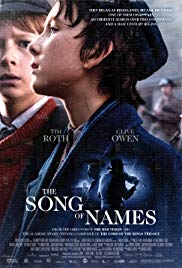
THE SONG OF NAMES (2019)

January 9, 2020

 Greetings again from the darkness. The title refers to a sacred Jewish ritual where the names of the Holocaust victims are recited in a musical style. It’s a process that (sadly) covers a few days. In this film, it takes on a personal, as well as historical, significance. British cultural affairs expert Norman Lebrecht wrote the 2001 novel on which writer-director Francois Girard (THE RED VIOLIN, 1998, plus plays, operas and 2 Cirque de Soleil shows) and co-writer Jeffrey Caine based the film.

We open in 1951 London just minutes before the scheduled performance of young violin virtuoso Dovidl “David” Rapoport. He is to play Bruch and Bach in a concert sponsored by his “adoptive” father figure Gilbert Simmonds, who has sunk his entire life savings into producing the concert. Despite the assurances of Simmonds’ son Martin, who has become like a brother to David, the featured performer is a no-show … leading Martin to search for him over the next 35 years.

The film covers the story from the time Dovidl’s Polish-Jewish father (played by Jakub Kotynski) agrees to his leave 9 year old, a violin prodigy, with the non-Jewish Simmonds in an attempt to protect the boy from the German invasion of Poland in the late 1930’s. As Dovidl and Martin grow together, their bond become stronger. Martin is present when Dovidl renounces Judaism, even as becomes more proficient with his instrument and more saddened by the Holocaust that he avoided in his home country.

Both boys are played at three different ages by three different actors. Dovidl is played by Luke Doyle at ages 9-13, Jonah Hauer-King at ages 17-23, and by Clive Owen in middle age. Martin is played by Misha Handley at ages 9-13, Gerran Howell at ages 17-23, and by Tim Roth in later life. The actors do a good job of capturing Martin’s early irritation at Dovidl’s arrogance, the shock of the no-show betrayal, and the later in life man who changed everything when he found out about his family, as well as the music teacher so desperate to find his long lost friend/brother.

The film bounces between the three timelines so that we have a full picture of the impact they have had on each other’s lives, and how Dovidl’s disappearing act was quite devastating. Much of the film centers on Martin tracking down leads and talking to folks for some idea of the path taken by Dovidl. Mr. Roth is especially effective (and surprisingly understated) in his performance as a man haunted by the unexplained actions of a loved one. His wife, played by Catherine McCormack, is simultaneously understanding, patient, and emotionally affected.

Stanley Townsend plays Martin’s father. He cares for Dovidl as if her were a son, and provides what’s necessary for the prodigy to develop and be groomed for performance. Three-time Oscar winner Howard Shore delivers a score that follows the good times and bad, not an easy task for a family drama within the shadow of the Holocaust. One specific sequence stands out, and it is filmed on the hallowed grounds of Treblinka – now a memorial, where the extermination camp once stood.

There are many facets to the story, and most involve heavy emotions. We see children bearing more than they should. Parents protecting their children in times of crisis. The difference between religion and ethnicity is discussed. Broken trust proves especially damaging. Dovidl’s disappearing act could be compared to that of JD Salinger, in that he seemingly vanished for years. And maybe most of all, the idea of survivor’s guilt is a theme, as Dovidl explains, “You don’t have to be guilty to feel guilty.” The film may have some pacing issues, but it affords such a wealth of conversation topics, that any flaws are easily forgiven.

watch the trailer:


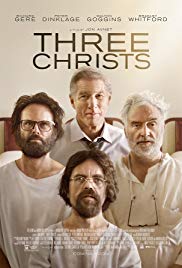
THREE CHRISTS (2020)

January 9, 2020

 Greetings again from the darkness. Based on the actual events documented in the book “The Three Christs of Ypsilanti” by Social Psychologist Milton Rokeach, the film turns ground-breaking work from 60 years ago into a generic, somewhat bland big screen production … albeit with a talented cast. Director Jon Avnet (FRIED GREEN TOMATOES, 1991) co-wrote the script with Eric Nazarian, and they evidently believed the strong cast would be enough. Instead, we get what in days past would have been described as the TV movie of the week.

The actual story is quite interesting. Dr. Alan Stone (the dramatized version of Dr. Rokeach) is played here by a blond-haired Richard Gere. Dr. Stone comes to Michigan’s Ypsilanti State Hospital in 1959 to study delusions of schizophrenics. Up to that time, we are informed that only extreme treatments were utilized, with minimal psychoanalysis practiced. Dr, Stone’s approach is through therapeutic treatments. Specifically, he arranges for group therapy consisting of only three patients – each who claims to be God/Christ.

Leon (Walton Goggins) demands to be addressed as God. He is the most perceptive of the three, though it’s quite clear, he mostly wants a friend. Joseph (Peter Dinklage) says he is Jesus Christ of Nazareth, though he speaks with a British accent, listens to opera, and wants only to return to England (a place he’s never been). Clyde (Bradley Whitford) claims to be Christ “not from Nazareth”, and he spends much of each day in the shower attempting to scrub away a stench that only he can smell.

The film is at its best, and really only works, when the doctor and the three patients are in session. It allows the actors to play off each other, and explores the premise of how they go about working through the confusion of having each believe the same thing … while allowing Dr Stone’s approach to play out. Where things get murky and clog up the pacing are with the number of additional characters who bring nothing of substance to the story. Stone’s wife Ruth (Julianna Margulies in a throwaway role) pops up periodically with alcoholic tendencies or a pep talk for hubby. Stone’s young research assistant Becky (Charlotte Hope, “Game of Thrones”) seems to be present only as an object of desire for all the Gods, and to remind us of the era’s drug experimentation. And beyond those, Stone carries on a constant battle with hospital administrators played by Kevin Pollack, Stephen Root, and a rarely-seen-these-days Jane Alexander (we shouldn’t forget she’s a 4-time Oscar nominee).

Alec Baldwin’s “I am God” from MALICE is still the best, but it’s always fun to watch a God complex … and this film offers four. The story is bookended with Dr Stone dictating his preparatory notes for a hearing on his professional actions, and the film does serve as a reminder that electroshock therapy and severe drug therapy are likely not as effective as empathy for many patients. It’s rare that God, Freud and Lenny Bruce are all quoted in the same film, but mostly this one just never pushes far enough.

watch the trailer:


CLEMENCY (2019)

December 28, 2019

 Greetings again from the darkness. You surely complain about your job. Most everyone does. But what if your career path had led you to oversee a dozen court-mandated executions, and the next one was already scheduled? In her first feature film, writer-director Chinonye Chukwu takes us inside the world of Warden Bernadine Williams, who manages a maximum-security prison, including inmates on death row. It’s the rare film in this sub-genre that doesn’t preach anti-death penalty politics, and instead focuses on the emotional toll it takes on those who must carry out the sentence.

Warden Williams (Alfre Woodard) is a seasoned prison professional who keeps her emotions in check, while sticking to policies and procedures. She is a restrained, often stoic person – both at work and at home. Early in the film, a lethal injection goes awry, and the warden finds this inexcusable. She wants answers and she prepares to make sure the next one scheduled … for inmate Anthony Woods … goes smoothly. Aldis Hodge plays Mr. Woods, a death row inmate for 15 years. His execution date is fast approaching despite his claims of innocence and the evidence showing he was not the one who killed the police officer. Woods’ attorney (Richard Schiff) has informed him that his last strand of hope is a decree of clemency by the governor.

Bernadine’s job involves dealing with family members, protestors, lawyers, media, guards, medical staff, procedures, final statements … and even the search for veins. The stress is obviously taking a toll, and even her home life is a wreck. Husband Jonathan (Wendell Pierce) is frustrated at her aloofness. He’s a high school teacher and reads a passage of “Invisible Man” to his class – words that hit home for him. Bernadine must also deal with the prison priest (Michael O’Neill) and the two share a powerful moment that relays the strain on both. Bernadine speaks matter-of-factly to Mr. Woods as she outlines the procedure of his execution. In another powerful moment, Mr. Woods attempts to exercise his last bit of control over his life and death. It’s brutal to watch.

Even though the death sentence is for convict Anthony Woods, most every other person involved expresses some desire to retire or walk away. This speaks clearly to the burden associated with taking the life of another human being. In a meeting with his former partner Evette (Danielle Brooks), Woods is given hope of a legacy outside of crime, while Evette expresses what she needs to him. This life is no fairy tale, and hard edges and difficult moments are around every corner.

Ms. Woodard has long been an underrated actress. Her only Oscar nomination came in 1983, and she has been outstanding in most roles since TV’s “St Elsewhere” in the 1980’s. She manages to convey humanity and realism in most every character she plays. Mr. Hodge starred in the title role of BRIAN BANKS earlier this year, and in both roles, he possesses a strength of character that allows the audience in. In Ms. Chukwu’s film, both are isolated in some way and struggling with how to deal.

Although the film spends very little time on the question of guilt or innocence, or whether the death penalty is a law of morality that fits within society, the approach of examining the psychological impact of those involved proves worthy of discussion. We do wish the script had not delivered such stand-off characters … ones so difficult to connect with. But perhaps that’s the inevitability of the environment – one that cuts much deeper than following the ritual of preparing for the next execution.

watch the trailer:


LITTLE WOMEN (2019)

December 23, 2019

 Greetings again from the darkness. More than 150 years have passed since Louisa May Alcott’s novel was published (volume 1 was published in 1868, volume 2 in 1869). By my count, there have been seven previous movie adaptations, dating back to the silent film era and through the more familiar George Cukor-Katharine Hepburn (1933), Mervyn Leroy-June Allyson (1949), and Gillian Armstrong-Wynona Ryder (1994) versions. One might think that sufficient, yet, after viewing this latest, you’ll likely join me in believing that director Greta Gerwig and Louisa May Alcott (and by natural extension Jo March) are kindred spirits … timeless storytellers of the moment.

Oscar nominated (writing and directing) for her standout LADY BIRD (2017), Ms. Gerwig remains true to the beloved source material while adding her own contemporary touch. She begins with the adult March sisters and then flashing back 7 years to the stage of living together and battling through the difficult and awkward transitional phase. The four sisters Jo (Saoirse Ronan), Meg (Emma Watson), Amy (Florence Pugh), and Beth (Eliza Scanlen) are exceptionally well cast, and we immediately recognize the familiar personality traits of each. Jo is the serious, determined writer who has an understanding of financial necessities. Meg is the warm facilitator beloved by all. Amy has ambitions (or is it dreams?) of being a great artist and living an exceptional life. Beth, the youngest, radiates a sweet nature and love for the piano.

Much of the story is told through the eyes of Jo. Her independent spirit and frustration with how the world is, boils over at times. She states her disappointment at being born a girl, and is described as having “a nature too noble to curb.” While viewing, one must keep in mind that this was the Civil War era (the girls’ father is a military Chaplain), and women had achieved very few rights in society. The contrast is never more evident than when comparing Marmee (Laura Dern), presented here as a near flesh-and-blood saint, with Aunt March (Meryl Streep), one quite at ease in thumbing her nose at societal norms for one reason … she is rich.

Fans of the novel will be pleased that Timothee Chalamet plays “Laurie Laurence”, who struggles every bit as much as the sisters in finding his way towards adulthood. His scenes with Jo are exceptional. Chris Cooper, not seen nearly enough in movies these days, perfectly captures the broken spirit of Mr. Laurence, a man never quite able to escape his own personal loss. Other key cast members include James Norton as tutor/teacher John Brooke, Louis Garrel as Friedrich (here a Frenchman), and Tracy Letts dropping some deadpan comedy as Jo’s publisher Mr Dashwood.

Ms. Gerwig (perhaps with a future as one of the greatest filmmakers) displays storytelling and cinematic craftsmanship at the highest level. She bounces between timelines (over at least 7 years) and different sisters’ stories, showing how each is so different … yet all interconnected. These spirited sisters, raised in the same modest home, have their own independent thoughts and ideas of how they want to live their lives. This delivers multiple comings-of-age and examines ‘a woman’s place’, whatever that means. In fact, the message is that a woman’s place is whatever she decides, and while her options are many (despite obstacles), her decisions are personal. None of the four sisters are played by American actors, and all four perform admirably. Pay particular attention to Florence Pugh (MIDSOMMAR) and her work as Amy. Also impressive is the Production Design by Jess Gonchor and the score by 2-time Oscar winner Alexandre Desplat. This one is all about the storytelling and characters, so take in the bunch known as the March sisters. As a side note, Greta Gerwig’s next movie is a live-action BARBIE movie, with Margot Robbie in the lead.

watch the trailer:


UNCUT GEMS (2019)

December 23, 2019

 Greetings again from the darkness. It’s debatable whether this movie should be labeled an indie crime thriller or a ‘Scared Straight’ session for gambling addicts. Benny Safdie and Josh Safdie are filmmaking brothers who seem to specialize in adding a frenetic pace to the lives of characters who consistently make bad decisions. Their excellent 2017 film GOOD TIME (starring Robert Pattinson) set the tone for their latest, featuring an Adam Sandler performance unlike anything we’ve previously seen from him.

After a brief prologue at an Ethiopian mine, we are dropped right into Howard’s world. Well, more specifically, we find ourselves on the camera end of Howard Ratner’s colonoscopy, while also seeing the vibrant glow of the rare opal extracted from that opening mine. Remarkably, the colonoscopy may be Howard’s (and our) most relaxing moment of the movie. The character of Howard is based on a guy the Safdie brothers’ dad worked for in the Diamond District when they were growing up. He’s played here by Mr. Sandler, who delivers a performance so memorable that we now can’t imagine anyone else in the role.

Here is what we learn about Howard: he’s arrogant and foolish and energetic and hopeful. He lives life on the edge … or perhaps he’s already tipped. He’s a Jewish jeweler based in inner-city Manhattan, and as the film begins, he owes a lot of money to someone who has hired goons to collect. Howard has an irascible wife Dinah (Idina Menzel, Elsa’s voice in FROZEN) who is fed up with his antics … one of which is his employee/mistress Julia (newcomer Julia Fox). Howard has an insatiable gambling addiction and he’s always on the brink of a life-changing big score or a colossal failure that could cost him everything. He’s a hustler who has to move faster each day to prevent the collapse of his house of cards: sports bets, pawns, loans, lies, and empty promises.

So if you think you now have a feel for this, I can assure you that you are mistaken. The frenetic pace is relentless to watch. We kind of like Howard, but yet, we want nothing to do with him. His latest scheme involves the expectation that the rare opal will solve his many financial woes. In the meantime, his business associate Demany (LaKeith Stanfield) brings him a high profile client … NBA player Kevin Garnett. The film looks and feels like a gritty 1970’s flick, but it’s based during the 2012 Eastern Conference Finals, and Garnett plays himself (and quite well). Garnett borrows the opal for good luck and that’s when all ‘heck’ breaks loose. Also in play here is Howard’s rotten brother-in-law (Eric Begosian), to whom he also owes money. Adding even more NYC flavor are Judd Hirsch, John Amos, and sports radio host Mike Francesca, as Howard’s bookie.

Daniel Lopatin (aka Oneohtrix Point Never) provides an electronic score that helps ensure we are never comfortable watching what is unfolding, and cinematographer Darius Khondji (EVITA) keeps his camera in constant motion – just like the characters. Production Designer Sam Lisenco creates Howard’s world through the jewelry shop, the house, the apartment, and especially that back office. Set Decorator Kendall Anderson wins a place in my heart for the Pete Maravich poster.

The Safdie brothers co-wrote the script with their editor Ronald Bronstein (who also worked on GOOD TIME), and afterwards you’ll find yourself going back through all the poor choices made by most every character. The brilliantly sustained level of uneasiness includes a segment featuring The Weeknd, and one revolving around a school play for Howard’s daughter. The Safdie style is present throughout, and most conversations are loud and heated and threatening. If you are the type that needs at least one likable character, or a serene environment, or respectful adult conversation, you are out of luck here. Howard is an exhausting character in an exhausting story within an exhausting movie … just as it was intended.

watch the RED BAND trailer (PROFANITY WARNING):


A HIDDEN LIFE (2019)

December 20, 2019

 Greetings again from the darkness. With a title pulled from a line in George Eliot’s “Middlemarch”, enigmatic filmmaker Terrence Malick continues his deep probe into humanity and faith … recurring themes in most of his films, and especially the run that began with his excellent THE TREE OF LIFE (2012). This current film is easily his most accessible over that period as it focuses on the (mostly) true story of Austrian WWII conscientious objector Franz Jagerstatter.

The film opens with contrasting images: a black screen with sounds of nature fading to a bucolic Austrian Alps village versus dramatic historical clips of Hitler (I believe from Leni Reifenstahl’s 1935 Nazi propaganda film TRIUMPH OF THE WILL). The rural farming village we see is Sankt Radegund, the idyllic community where Franz Jagerstatter (played by August Diehl, INGLORIOUS BASTERDS) lives off the land with his wife Franziska “Fani” (played by Valerie Pachner) and their three young daughters. It’s a family bonded by love. The family and fellow villagers go about the rigors of daily life as the war spreads. In 1940, Franz is sent to Enns Military base for training, and is then returned to his village under a farming exemption.

What follows is a first half filled with dread as Franz struggles with his own beliefs in a new world order that has no room for individual thought. He refuses to swear an oath to Hitler, despite the rest of the villagers doing so. He knows what this means, as does his wife. As Franz refuses the “Heil Hitler”, he is described as being something worse than an enemy – a traitor. He holds firmly to his principles … vague to us, yet crystal clear to him. He becomes a pariah in his own village, as even the priest urges him to relent by stating he has “a duty to the fatherland.”

Don’t they know evil when they see it?” Franz asks the question we have all been asking since Hitler came to power. When he is called to duty in 1943, Franz and Fani know the eventual outcome. Franz is asked by many, and in various ways, “What purpose does it serve?” No one can make sense of his stand. As he is imprisoned at Tegel Prison, solicitors played by Matthias Schoenaerts and Alexander Fehling both try to convince him to pledge loyalty and save his life. Franz’s response is, “I can’t do what I know is wrong.”

With the first half being filled with dread and anxiety, the second half is all about the suffering. Franz is locked away with very little access to the nature or family he holds so dear, while Fani is a village outcast, trying desperately to raise their daughters and put food in their mouths. They are each in their own prison – isolated from the life they love. From Tegel Prison in 1943, Franz writes many letters to Fani. The letters are philosophy mixed with hope and love, and provide the source of how his story was discovered many years ago.

Anyone familiar with Malick’s films know that each is a visual work of artistry. Instead of his usual cinematographer, 3-time Oscar winner Emmanuel Lubezki, this film features the camera work of Jorg Widmer (who assisted Lubezki on THE TREE OF LIFE). The film lives up to our expectations, especially in capturing the vitality and spirit of nature through lush landscapes, mountains, trees, grasses, gardens, streams, rivers, and a waterfall. The family is one with nature, which stands in stark contrast to Franz inside the cold prison walls. Composer James Newton Howard brilliantly uses a lone violin, as well as a mixture of classical music. This was the final film for two extraordinary actors who recently passed away. Michael Nyqvist plays the Bishop who tells Franz that if God gave us free will, then we are responsible for what we do and what we don’t do. Bruno Ganz plays the head judge on the committee that decides Franz’s fate.

We could describe the film as either a tragic love story or an ode to faith and principles. Both fit, and yet both fall short. Terrence Malick is a confounding and brilliant and artistic filmmaker. After his breakthrough film DAYS OF HEAVEN (1978), he took a 20 year hiatus before filming THE THIN RED LINE (his other WWII film). Recently he has proven much more productive, yet he remains a meticulous craftsman – taking three years to edit this film. His visual style is quite unique, yet he has the skill to make a messenger’s bicycle bell send chills. He was able to meet Franz’s surviving daughters (now in their 80’s) prior to filming, as they still live near this village. We are quite fortunate that this exquisite filmmaker is allowing us to tag along on his search for the meaning of life and his exploration of faith … just make sure you set aside 3 hours for the lesson.

watch the trailer: