STARDUST (2020)

November 24, 2020

 Greetings again from the darkness. Traditionally, an “unauthorized biopic” will contain some of the less-desirable, and often more entertaining aspects of its subject; however, writer-director Gabriel Range (with co-writer Christopher Bell) admit up front that this is mostly “fictional”. Since David Bowie’s son, filmmaker Duncan Jones, announced that the family was not participating in the project, we somehow miss out on both the personal “dirt” and the actual music of the icon. What remains is an odd couple road trip representing Bowie’s first American tour in 1971.

Johnny Flynn stars as a young (early 20’s) David Bowie. Flynn is a musician-actor recently seen as Mr. Knightley in this year’s excellent EMMA. He’s very talented, but certainly bears little physical resemblance to the androgynous waif of early-1970’s Bowie. We first see Flynn’s Bowie through his dream during an airplane flight. The riff on 2001: A SPACE ODYSSEY is our first clue that the film will track Bowie’s transformation from David Jones to David Bowie to Ziggy Stardust. It plays as a search for his identity … though he mostly just seems to desire being hailed as a star, rather than a musical genius.

Jena Malone appears as Bowie’s first wife, Angie. She’s presented as quite controlling and eager to bask in the success she expects from her husband. We also see her teasing their open marriage, and pregnant with Duncan. When Bowie lands in America, he’s put through the ringer with U.S. Customs and Immigrations – his flowing dress doesn’t help. Bowie is disappointed that Mercury Records has sent Ron Oberman (an excellent Marc Maron) as his station-wagon driving publicist – not exactly the red carpet he envisioned.

Bowie and Oberman on the road is the highlight of the movie. Bowie is relegated to playing the worst imaginable gigs … like a Eureka vacuum salesman conference, while Oberman preaches practicality. Beyond that, Bowie seems self-defeating at every opportunity and we never quite understand his motivation. Miming during an interview with a rock publication can’t seem wise to anyone, no matter how offbeat they perceive themselves. On top of the disastrous American trip, Bowie is dealing with the “family curse”, as his mother describes it. Bowie’s brother Tony (Derek Moran) is shown battling a mental illness, likely schizophrenia. Of course, given his gene pool, David is concerned for his own well-being.

Recent biopics of Elton John (ROCKETMAN, 2019) and Freddie Mercury (BOHEMIAN RHAPSODY, 2018) are perfect examples of what this film is not. This is more of an exploration of identity before Bowie became an iconic theatrical rocker. The influences of Iggy Pop and Marc Bolan (played by James Cade) are hinted at, but mostly the birth of Ziggy Stardust just seems to happen. Commencing countdown to a biopic of a musician before he’s famous, and being handicapped by not having access to his original music, is quite a challenge, and considering those things, even if it’s watchable, it’s likely to be crucified by Bowie devotees.

watch the trailer


HILLBILLY ELEGY (2020)

November 23, 2020

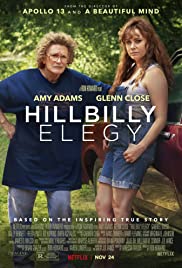
 Greetings again from the darkness. “We don’t use that word.” That is law school student JD’s reaction when someone refers to those like his family as hillbillies. He’s understandably defensive, despite his daily navigations between two distinct worlds. Oscar winning director Ron Howard (A BEAUTIFUL MIND, 2001) presents the true story of JD Vance, a young man who earns his way out of his Appalachian background to gain admittance to Yale Law School, only to get dragged back into the life he worked so hard to escape. Vanessa Taylor (Oscar nominated for THE SHAPE OF WATER, 2017) adapted the screenplay from Vance’s own memoir.

The first thing noticed about this film is that it stars Amy Adams (6) and Glenn Close (7), who between them, have 13 Oscar nominations for acting. That’s a pretty distinguished pedigree for a cast. Ms. Adams has been seen recently in the TV mini-series “Sharp Objects” and as Lynn Cheney in Adam McKay’s VICE (2018). Ms. Close was most recently nominated for her performance in THE WIFE (2018). Other notables in the cast include Haley Bennett (excellent in SWALLOW earlier this year), Freida Pinto (SLUMDOG MILLIONAIRE), and Gabriel Basso (THE KINGS OF SUMMER, 2013).

As the film begins in 1997, we find a young JD (Owen Asztalos) in a tough spot, and we quickly get a feel for the chaos commonplace around his family in Jackson, Kentucky … and also the bond that comes with being a family in the hills. The obligatory family photo ends the segment. We then skip ahead 14 years as the family has 3 houses on the same street in Middletown, after some of them find a way out of Jackson. In this blue collar town hit hard by a financial downturn, they admit to missing only “hope”. The story is told from the perspective of an older JD (Basso), who struggles with the emotional turmoil that his mother Bev (Adams) constantly creates. Remarkably, it’s Mamaw (Close) who provides the strength and stability in the family, and yet, she always seems one small step from exploding at the universe. There is an odd grounded nature and tough-mindedness to Mamaw that Ms. Close radiates on screen. It’s an interesting performance, that some may call over-the-top … a phrase also likely to be used for Ms. Adams as she displays the desperation of an addict, and the broken spirit of one whose shot at life disappeared early on.

For such a stereotypical “simple” family, the complexities of the story and characters are sometimes difficult to appreciate. JD’s sister Lindsay (Bennett) does her best to raise her own family while also managing her mother and grandmother, so that JD can pursue law school. She understands he has possibilities, whereas she has few. And JD’s law school girlfriend Usha (Pinto) truly has no concept of his childhood and family. Class differences are on full display not just with Usha, but also at the dinner where JD (a former Marine) is maneuvering to secure a summer internship that keeps him teetering in the balance of moving forward or falling back.

It’s at this point where JD receives a call from Lindsay informing that mother Bev has overdosed on heroin. It’s yet another example of his own mother inadvertently subverting his efforts to make a new life for himself. Addiction, relapse, financial struggles, family abuse, and untold secrets are the pieces that make up JD’s family pie. When his “old” life collides with his “new” life, will it drag him back down? He periodically faces decisions that are legal and/or morality based, and given his circumstances, it’s never as straightforward as it should be.

Without the power of Glenn Close and Amy Adams, director Howard likely would have had the film slide into the maudlin mode so common with Hallmark or Lifetime Channel movies, and while it’s not the Oscar bait Howard aims for, Netflix has yet another watchable film in their stable. Mr. Howard’s decision to bounce back and forth between 1997 and 2011 does provide the history we need to understand JD’s dilemma, but the see-saw approach is at times distracting. Home movies provided by JD Vance are shown over the closing credits, and it’s here where we realize just how closely Ms. Close physically resembles the real Mamaw. We walk away easily seeing how the circle of this life becomes perpetual, and just how challenging it can be to break free.

Premieres on Netflix November 24, 2020

watch the trailer


SOUND OF METAL (2020)

November 19, 2020

 Greetings again from the darkness. Many of us have attended concerts and experienced a ringing in our ears for a while afterwards. Have you ever thought about the musicians who are playing that music night after night? It’s a risk requiring precautions … and even then, disaster can occur. The first narrative feature from writer-director Darius Marder uses the hearing loss of a heavy metal drummer to explore what happens when the life we know is suddenly snatched away.

Riz Ahmed (TV mini-series “The Night Of”) stars as Ruben, the aforementioned drummer. The film opens with Ruben drumming on stage as his lead singer/girlfriend Lou (underrated Olivia Cooke, THOROUGHBREDS, “Bates Motel”) screams out the lyrics punk-style for their band, Blackgammon. We witness Ruben’s euphoria in the moment, with his “Please Kill Me” tattoo visible across his chest. Afterwards, we see the couple in their RV living a happy life of veggie juice, yoga, and slow dancing between gigs. The first crack in the armor is Lou’s scratching her arm from anxiety, and the next is devastating for Ruben and the couple.

Ahmed is terrific in the most important moments, and he’s assisted by top notch sound design from Nicolas Becker (GRAVITY, 2013). This allows us to feel and experience the moment Ruben realizes he has a problem, and how he begins to process this. Director Marder utilizes subtitles/closed captioning throughout, both for the deaf community and to make Ruben’s situation visceral for viewers. When the doctor explains hearing loss, frustration and defiance kick in for Ruben. He becomes focused on the $40-80,000 cochlear implant option, and views it as a way to maintain his normal life.

Lou becomes worried for Ruben’s well-being, and we learn he’s a recovering heroin addict. He reluctantly agrees to a remote deaf community/rehab facility run by Joe (Paul Raci). It’s here that Ruben learns sign language and begins to adjust to his new reality. Joe is a very patient and sage advisor, and preaches that being deaf is not a handicap – it’s not viewed as something to fix. Implants are considered an affront to the deaf culture, and the film neither shies away from this conflict, nor magnifies it.

The clash between Joe’s patience and guidance, and Ruben’s desire to get his normal life back comprise much of the film. The final scene between the two is gut-wrenching thanks to extraordinary acting from Ahmed and especially Raci. Supporting work in the film is provided by Lauren Ridloff (a hearing-impaired actor) and Mathieu Amalric as Lou’s dad. The final act is quite something to watch. The director says the film is about the finality of life changes, and letting go of what we can’t fix. Joe urges Ruben to appreciate the stillness, and we also see a love story that served its purpose and run its course. Will the distortion lead Ruben to find peace in the stillness? Depending on your stance in regards to the debate within the deaf community, the ending either works for you or it doesn’t. Either way, it’s well done and well-acted.

Amazon Studios will release this in theaters November 20, 2020 and on Prime Video December 4, 2020

watch the trailer


THE LAST VERMEER (2020)

November 19, 2020

 Greetings again from the darkness. Knowing the film is based on Jonathan Lopez’s 2008 book, “The Man Who Made Vermeers” removes some of the mystique from the story; however Dan Friedkin’s (stunt pilot on DUNKIRK) directorial debut is an enticing look at a blending of art history and world history. The screenplay was co-written by John Orloff, Mark Fergus, and Hawk Ostby.

It’s May 29, 1945, three weeks after the fall of Hitler’s Reich, and the Dutch military is on a mission to reclaim valuable art and collectibles confiscated by the Nazis during the war. Some of these were hidden in Austrian salt mines by order of Hermann Goring, actions also depicted in the 2014 film, THE MONUMENTS MEN. After serving in the war, Captain Joseph Piller (Claes Bang, “Dracula” 2020) is tasked with tracking down those who stole the art, and those who sold the art to Germans. It’s a task meant to preserve his country’s culture. One particular piece, “Christ with the Adulteress” held special significance, as it was billed as ‘the last Vermeer’, a long lost painting by Dutch master Johannes Vermeer (“The Girl with the Pearl Earring”), for which Goring had paid a record price.

Investigation on this painting led Piller and his assistant Minna (Vicky Krieps, PHANTOM THREAD 2017) to Han Van Meegeren (played with panache by Guy Pearce and his stylish eyebrows). Piller is also helped by his friend Esper Vesser (Roland Moller, ATOMIC BLONDE 2017) who supplies a bit of muscle and brawn. Van Meegeren has a fancy manner of speech, and Piller determines he’s the key to the case, and to unlocking what occurred and how. At the same time, the Ministry of Justice (August Diehl, INGLORIOUS BASTERDS 2009) is after Van Meegeren for conspiracy, and the parties end up in court.

Piller and Van Meegeren existed in real life, and though some dramatic license is taken, much of what we see actually happened. Art experts and politics collided. And it’s not surprising that egos ruled the day (not unlike today). The twist may or may not be a shocker to those who know the story, but it’s still fascinating that folks would risk their lives in such a manner during the darkest of times. It seems opportunists exist regardless of the era. Mr. Bang and Mr. Pearce are both excellent here, and it’s quite fun to watch their verbal wranglings. Director Friedkin adds an Epilogue that will surely bring a smile to most viewers.

Opening in theaters November 20, 2020

watch the trailer


HEARTS AND BONES (2020)

November 19, 2020

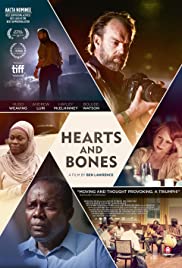
 Greetings again from the darkness. How would you feel if someone photographed the worst moment of your life, and then exhibited it for the world to see? That question is at the heart of this drama, the first narrative feature from writer-director Ben Lawrence. His co-writer is Beatrix Christian, who also wrote the screenplay for JINDABYNE, an excellent 2006 film directed by Ben’s father, Ray Lawrence.

Daniel Fisher (Hugo Weaving, “The Matrix” and “The Lord of the Rings” franchises) is a renowned war photographer, and we first see him on assignment in 2018 Iraq. When he returns home to the Western Sydney suburbs, his longtime partner Josie (Hayley McElhinney, THE BABADOOK 2014) surprises him with news that she’s pregnant. They still struggle with the pain of losing their previous daughter, Eve. On top of that, Fisher’s work is scheduled to be the centerpiece of a high profile exhibit coming soon. The stress manifests itself physically through shaking hands and fainting spells.

Fisher is a bit of a mess when he’s tracked down by Sebastian Ahmed (the screen debut of Andrew Luri), who requests that Fisher not include photographs of the massacre which occurred in his south Sudan village 15 years prior. Sebastian says the memories are too painful, as he lost his family during that time. He’s now a refugee building a new life for his pregnant wife Anishka (Bolude Watson) and their young child. Sebastian works as a taxi driver and in a commercial laundry, and when he pushes Anishka to let him buy a house for their family, she says matter-of-factly, “We work. That is our life. It’s all we do.” It’s a frustrating dose of reality for Sebastian who sees a house as confirmation that they belong.

There is so much going on in what, on the surface, appears to be a quiet little film where two men form an unlikely friendship. PTSD is a factor for both men, as war has left its mark, as it so often does. Sebastian has kept his past life a secret from his wife, but that’s only part of the story when it comes to why he doesn’t want the photographs exhibited. Fisher is described as “documenting human pain and misery”, while his work is labeled “misery porn”. Is that fair? We get both sides of the gray area associated with that question noted in my first paragraph above.

Filmmaker Lawrence benefits from four terrific performances, and though the ending is a bit shaky, the stress and emotional turmoil that those four characters endure is extremely well handled. “Who are you?” is a question Anishka asks her husband, and by the end it can be asked of all four characters. There is little wonder why this has been so warmly received on the film festival circuit … it’s thought-provoking and emotional.

In theaters and On Demand November 20, 2020

watch the trailer


ANTEBELLUM (2020)

November 14, 2020

 Greetings again from the darkness. This is the movie for anyone unaware that racism was prevalent during the Civil War, and still continues to this day. Of course anyone fitting that description is likely enjoying their life in a cave, and is clueless that movies exist. It even goes as far to “inform” us that slaves were abused, tortured, and lynched, while today racism can take the more subtle form of a less desirable restaurant table or a concierge with an attitude. However, while the message may be unnecessary and too obvious, the originality and creative approach of filmmakers Gerard Bush and Christopher Renz is commendable, especially for their first feature film.

An uninterrupted extended take kicks off the movie, and shows us the lay of the land at a cotton plantation where the slaves are controlled by confederate soldiers. When an attempted escape goes wrong, the brutality of the soldiers is on display. One of the slaves is Eden, played by Janelle Monae. She’s the favorite of the General (Eric Lange, seen recently in two popular cable mini-series, “Escape at Dannemora” and “Perry Mason”), and he literally brands her as his property. Many of the sequences are difficult to watch as the cruelty and abuse is not sugar-coated.

When we next see Ms. Monae wake up from a dream, she’s living in a swanky home with a perfect husband (Marque Richardson) and cute daughter. She’s now Veronica, a well-known author and speaker who is living the American dream. A night on the town with her friends played by Gabourey Sidibe (Oscar nominated for PRECIOUS, 2009) and Lily Cowles purposefully comes across like it’s from a different movie altogether. It’s this contrast the filmmakers use to deliver their M Night Shyamalan style twist. Afterwards, it’s wheels-off for the movie, but we are able to assemble the pieces of what we’ve seen to this point.

Jena Malone and Jack Huston also play key roles here, but it’s Ms. Monae who gets the majority of the screen time, and mostly nails both Eden and Veronica. Although much of the film and story seems exaggerated and over-played, cinematographer Pedro Luque (THE GIRL IN THE SPIDER’S WEB, 2018) delivers a beautifully shot film, so it always looks good, regardless of what else we might be thinking. Filmmakers Bush and Renz likely have much more nuanced and effective storytelling in their future, and we do expect Ms. Monae to take the step from supporting roles to leads. She’s earned it.

watch the trailer


AMMONITE (2020)

November 12, 2020

 Greetings again from the darkness. “Peanuts” creator Charles Schulz injected “It’s the Great Pumpkin, Charlie Brown” (1966) with downtrodden Charlie repeating the line, “I got a rock” after each house on the trick or treat trail. It was funny because no one would rather have a rock than candy, right? Well, maybe no one except Mary Anning, the 19th century English fossil collector and paleontologist whose story is at the core of writer-director Francis Lee’s (GOD’S OWN COUNTRY, 2017) new film. His latest film has received some backlash due to the fictionalized approach it takes with her personal life.

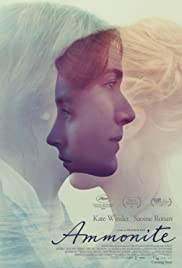
Oscar winner (plus 6 other nominations) Kate Winslet stars as Mary Anning, and we first find with her living a quiet life of near solitude in Lyme Regis, a sea side town in West Dorset, England. Having never received her deserved recognition from the scientific community for her discoveries, Mary cares for her mother (Gemma Jones, who also played Winslet’s mother in SENSE AND SENSIBILITY, 1995), an elderly woman burdened with having watched 8 of her 10 children die before her. They eke out a living peddling the stones Mary finds and polishes to tourists. Mary rarely speaks and her face shows the wear and tear of a mostly joyless life.

One day, Rodrick Murchison (James McArdle, MARY QUEEN OF SCOTS, 2018) drops into the shop. As a fellow scientist, he is aware of and interested in Mary’s work. He condescendingly introduces his wife Charlotte (4 time Oscar nominee Saoirse Ronan) as suffering from “melancholia”. When Charlotte falls ill, Rodrick asks Mary to look after her while he continues his travels. Dr. Lieberson (Alec Secareneau, AMULET, 2020) examines Charlotte and recommends rest and sea air. He also takes notice of Mary, an occurrence to which she pays little mind.

The contrast between Charlotte and Mary is not limited to age and class. They aren’t particularly fond of each other initially, though Mary slowly nurses her back to health. The two ladies finally connect over a heavy rock half-buried in sea wall sediment. The evolution of their relationship is slow, but thanks to the two outstanding actors, it’s quite something to watch. Ms. Winslet is particularly affecting as the woman beaten down by life and reluctant to allow any glimmer of hope. We see this in her interaction with neighbor Elizabeth Philpot (Fiona Shaw), a woman with whom there was a previous bond. The old saying goes, “opposites attract”, and here the two opposites, Mary and Charlotte, bring out the best in each other.

The skilled actors never allow the film to slide into melodrama, and instead offer two occasions where unbridled emotion jump off the screen. A passionate and liberating love scene is the first, and then a later re-connection provides the second. Mostly, Mary forces herself to conceal her rare happiness – we wonder if this is due to her belief it won’t last, or if it’s because she feels unworthy. Either way, it’s quite something to watch Ms. Winslet allows us to sense what’s she’s experiencing inside.

Music from Voker Bertelmann and Dustin O’Halloran never overpowers the moment, and the extremely talented cinematographer Stephane Fontaine works his magic. His previous work includes: JACKIE (2016), ELLE (2016), CAPTAIN FANTASTIC (2016), RUST AND BONE (2012), A PROPHET (2009), all beautifully filmed. Filmmaker Lee’s controversial dramatic license with the relationship is apparently done to better explain Mary Anning’s life, and it’s likely the first film where new acquaintances connect in a deep way thanks to the unearthing of a unique rock. Filming took place in Lyme Regis, the actual town where Mary Anning collected fossils in the 1800’s.

Watch the trailer


DREAMLAND (2020)

November 12, 2020

 Greetings again from the darkness. Outlaws on the run have been fertile ground for movies over the years, and young director Miles Joris-Peyrafitte and writer Nicolas Zwart give the genre their best shot (pun intended). The easiest comparisons are probably Sam Peckinpah’s THE GETAWAY (1972), Jonathan Demme’s SOMETHING WILD (1986), and Arthur Penn’s Oscar nominated classic BONNIE AND CLYDE (1969). However, given the style of this film, Terrence Malick’s BADLANDS (1973) was likely more of an influence for the filmmakers.

Phoebe Evans (as voiced by Lola Kirke, GONE GIRL, daughter of Bad Company drummer Simon Kirke) is our narrator, and from 1955 she recounts the story of her half-brother Eugene. Most of what she tells takes place twenty years earlier – 1935 Dust Bowl Texas during the Great Depression. Finn Cole (“Animal Kingdom”) stars as Eugene, and we pick up a few years after his dad left the family behind and headed for what he expected would be an easier life in Mexico. Mother Elizabeth (Kerry Condon, “Breaking Bad”) is now re-married to local Deputy George Evans (Travis Fimmel, LEAN ON PETE) and his bad haircut, and they now have a young daughter Phoebe (the magical smile of Darby Camp, THE CHRISTMAS CHRONICLES). Eugene reads Detective stories and mostly tries to stay out of George’s way, while Phoebe is a curious little sister, easily the most intelligent of the lot.

One fateful day, Eugene’s beloved detective stories come to life. After a local bank robbery turns violent, he discovers Allison Wells (two-time Oscar nominee Margot Robbie, I TONYA) hiding in his barn, with a bullet in her leg. Despite the $10,000 reward on her head, Allison sweet talks young Eugene into keeping her whereabouts secret, and helping her plot an escape. She swears she didn’t kill anyone and rationalizes the bank robbery by blaming the government for letting people suffer hard times. Eugene may or may not buy her story, but he recognizes this is the most excitement he’s likely to ever have in his life … plus, he’s smitten.

During the first half of the film, we follow Eugene as he helps Allison and holds the secret. When the second half kicks in, we find ourselves along for the ride as the two are on the run from the law, including Eugene’s stepfather George. Along the way director Joris-Peyrafitte includes some flashbacks to the botched bank robbery giving us a look at Allison’s “Clyde”, Perry Montroy (played by Garrett Hedlund). There are also numerous artsy flashes of coastline, supposedly representing Allison and Eugene’s landing spot should they escape. Of course, we know where this is headed – a shootout finale. Filmed in New Mexico, we do get the feel of the hard life fought by those during this era, including the powerful and devastating dust storms that require gas masks to prevent suffocation. The film is watchable thanks to the performances and atmosphere, though it’s not at the level of similar type movies listed earlier.

Watch the trailer


JUNGLELAND (2020)

November 9, 2020

 Greetings again from the darkness. We’ve rarely seen more improvement from an actor than what we’ve witnessed on screen from Charlie Hunnam in his nearly 25 year career. His work was particularly strong in James Gray’s LOST CITY OF Z (2017), and he builds on that here as the older brother filled with dreams of a better life. Writer-director Max Winkler (FLOWER, 2017, and son of Henry) co-wrote the script with Theodore Bressman and David Branson Smith (INGRID GOES WEST, 2017), and while it has a ‘seen this before’ vibe, we remain engaged throughout.

Hunnam stars as Stanley, the visionary who manages the underground boxing career of his brother Lion (Jack O’Connell, UNBROKEN, 2014). Lion is quiet and reserved, while Stanley thinks talking is the key to life. We don’t get the full back story on the brothers, but enough to know that Stanley has made an endless stream of bad decisions that have left the brothers squatting in a deserted foreclosed house in Massachusetts that requires them to sneak in and out of windows for access. Preaching a belief in “fate”, Stanley gushes about their future, which he envisions as a beautiful house in California and tailored Italian clothes.

In a scene that we assume has occurred numerous times, Stanley finds himself unable to pay the $2000 he owes his crime boss Pepper, played by Jonathan Majors. Rather than kill Stanley, Pepper offers him the kind of deal that seems too good to be true. All the Kaminsky brothers have to do is drive Sky (Jessica Barden) across the country to Reno, where they are to deliver her to Yates (John Cullum). At this point, we only know enough about Yates to understand that he’s not an upstanding citizen. If the brothers manage to execute this “simple” task, Pepper will ensure that Lion is added to the list of fighters of “Jungleland”, a bare-knuckles, no-holds-barred fight in San Francisco where the Grand Prize is $100,000. Stanley sees this as a much better alternative than being killed, and Lion agrees to go along with the plan.

What follows is a road trip with the Kaminsky brothers, their Whippet dog Ash, and Sky, the mysterious young lady whose minimal dialogue masks intentions that don’t necessarily mesh with the mission of trip. On the road, Stanley makes a few more less-than-brilliant decisions, while Lion and Sky bond … or do they? Regardless, things get challenging and obstacles appear everywhere. Once Yates appears, it’s a joy to behold 90 year old Jack Cullum (“Northern Exposure”) as he tears into the role of tough guy.

Mr. Winkler’s film actually has very little fighting in it, especially when compared to Gavin O’Connor’s outstanding 2011 film, WARRIOR. Instead, this is about brotherly love and the ties that bind (although so was O’Connor’s film). Surprisingly, the soundtrack features Bruce Springsteen singing “Dream Baby Dream”, and we do learn how to dress a knife wound with duct tape.

watch the trailer


LIE EXPOSED (2020)

November 9, 2020

 Greetings again from the darkness. The fine line of demarcation between “art” and pornography is one of society’s longest-running debates. “I know it when I see it” was made official in 1964 by Supreme Court Justice Potter Stewart in a case where the subjective categorization of obscenity was on trial. Of course the obvious problem with that definition is that everyone “sees it” differently. Director Jerry Ciccoritti (“Schitt’s Creek”) presents a film version of Jeff Kober’s stage play “Pornography”. Mr. Kober, a veteran actor, also appears here as a key character.

Leslie Hope stars as Melanie, our lead character and narrator. Melanie is diagnosed with a terminal illness, and her reaction to that affects her marriage, her sobriety, her friends, and results in a controversial art exhibit. That art exhibit acts as a framing device and structure for a film that is mostly various vignettes assembled together in a somewhat related, yet haphazard manner. We initially witness Melanie’s anxiety over opening night, and the reason for her trepidation is slowly revealed … the exhibit is set up as a peep show of the tintype photographs taken of her vagina. Yep, the worst possible news from the doctor led her to expose her lady parts, while also falling into the stereotypical lustful affair with the photographer (played by writer Kober).

We watch as each of her invited friends take a glimpse at the photographs. It’s not until the closing credits that we see Melanie the way they see Melanie, but the ensuing conversations tell us what we need to know. Each of the attending couples and friends gets their own dedicated segment preceded by their own tintype photograph. These cool retro photographs were the highlight to this viewer. However the focus of the film is how each person reacts to the exhibit and how it impacts their own relationship, most of which seem teetering on the brink of collapse. After each vignette, we are returned to the exhibit’s opening night, and also get additional color on Melanie’s search for meaning in life.

The characters we briefly get to know include Melanie’s husband Frank (Bruce Greenwood), who seems impossibly patient and understanding, given the situation. A substantial portion of their conversations occur over the phone while Frank sits alone in their bedroom (or even asleep). Others we meet: Mickey (Kristin Lehman), an alcoholic middle-aged party girl, Jerry (Daniel Maslany, brother of Tatiana), the acting DJ and AA member under sponsor Frank, Diane (Megan Follows), Tom (Kris Holden-Reid), Brian (David Hewlett), and married couple Betsy (Grace Lynn Kung) and Gregg (Benjamin Ayres), who air entirely too many grievances for our comfort.

Alcoholism and AA are referenced throughout the film, and Mickey even spouts, “Alcoholism is a good idea taken too far.” A misplaced debate on the best rock and roll drummer falls flat, but at least offers a momentary reprieve from the non-stop chatter on sex and vaginas. Obviously the title has dual meanings, and what the film does best is reinforce the need for art to spark conversation, debate and reflection.

watch the trailer