Greetings again from the darkness. The old saying “opposites attract” is on full display in director and co-writer Julie Delpy’s latest, as she offers up a twist on the French farce by adding a dark undercurrent. Additionally, the film addresses the personal and societal challenges facing women in their 40’s who are successful in their career, and who also hold out hope for finding true love.
Ms. Delpy also stars as Violette, a germaphobe divorcee who works in the fashion industry in Paris. The film opens as Violette and her best friend Ariane (Karen Viard) are deep into girl-chat while hanging out at a spa … each annoyed that they are without a soul mate that would complete their lives (or at least fill the sexual void).
After dumping a freshly caught tuna in Violette’s lap (as they meet for the first time), and then informing her that he understands she’s not his type … you know, since she is a lesbian (which she is not) … Jean-Rene (Dany Boon) re-groups and begins charming her with his grounded and simple nature. These two form a cute, but odd couple of opposites and seem to very much enjoy each other’s company.
Things start to get confusing for the couple when her 19 year old son Lolo (Vincent Lacoste) begins his (initially) subtle clandestine activities designed to break up the couple. Soon enough we realize this wannabe artist goes well beyond typical passive-aggressive activities, and straight into full-on psychotic mode with Oedipal tendencies. His psychological warfare against Jean-Rene slowly builds from childish antics, to deceitful and devilish scheming, to downright criminal … all with a sense of black comedy for us viewers (can’t say the same for Jean-Rene).
Other movies such as Cyrus and We Need to Talk about Kevinhave dealt with the mother-son relationships ranging from creepy to dangerous, but Delpy’s movie always hits us with a dose of laughter when it’s needed. The use of the movie classic Village of the Damned(1960) is especially spot on as Violette and Jean-Rene continue to plug away as a couple … even when it’s obvious to us that 3 is too many for a healthy relationship – especially when one could be a reincarnation of Damien from The Omen. The perfect ending reminds us that no one beats the French when it comes to a farce; even when the darkness is sprinkled on a bit heavier than usual.
Greetings again from the darkness. Being the parent of an autistic child carries challenges that require incredible patience and love and extraordinary effort. Writer Jennifer Deaton and Director Janet Grillo (Fly Away, 2011) deliver an insightful and interesting look at these challenges through the eyes of two parents, their autistic daughter, their teenage son, and the in-home caregiver they hire.
The film begins with a glimpse of what appears to be two different worlds: a street wise teenage girl helping her younger sister “escape” from a foster home, and two beaten down parents of a young autistic daughter. Soon enough, these two worlds collide and Jack/Jacqueline/Donna is hired by the parents to be a live-in companion for their daughter. The parents are so desperate for help that they fall for the savvy con being played by Donna.
None of what happens is surprising … Donna turns out to have a knack for helping autistic Glory, the parents begin to experience a bit more happiness, the teenage son develops a crush on Donna, and the cloud of truth is constantly hovering. Even though some of the scenes are bit corny, for the most part the story is told in a grounded manner that allows us to connect with all of the characters – conveying the pressures, stress and periodic moments of breakthrough.
The acting is strong throughout. Taylor Richardson (A Most Violent Year) is exceptional as the autistic Glory. She is believable and never goes beyond what fits for the character. Famke Janssen and Scott Cohen are solid as the parents, and Israel Broussard shows real promise as teenage Robert/Bobert. Donna/Jack’s younger sister has limited screen time, but Sophia Anne Caruso (Brigitta in TV’s live version of “The Sound of Music”) makes it work. Shouldering much of the film is Anna Sophia Robb (Bridge to Terabithia, The Way Way Back) as Jack/Donna. She does her best work in the second half of the film, as her initial tough-girl stint is a bit shaky. However her scenes with Glory are outstanding, and it’s a pleasure to watch her slowly turn over a new leaf.
As strong as the cast is, much of the credit goes to director Grillo (ex-wife of David O. Russell) who has a real understanding of the world of autism, and keeps us focused on importance of family, the need to be loved, and the rewards of finding one’s place in the world.
Greetings again from the darkness. We all have good days and bad. Sometimes we energetically leap from bed, while other days we barely muster the energy to push off the covers. For those who are bi-polar, those peaks and valleys are mere child’s play. When “up”, they often are filled with frenetic creativity and hyper-energy. When “down”, life holds no purpose and the simplest daily actions are deemed impossible. Medication seems to be their only hope for “normal”.
Writer-director-editor-composer Paul Dalio admits much of the story comes directly from his life and that Carla and Marco carry much of him. Katie Holmes plays Carla and Luke Kirby (Take This Waltz, 2011) plays Marco … theirs one of the few on screen meet-cutes to occur in a psychiatric hospital (not counting McMurphy and Chief). When the pendulum swings, Carla frantically scrawls out poetry based on nature and feelings. Marco is also a poet – the rapping kind – but he seems more addicted to the energy and spirit that goes with being up.
The film is really two-in-one … a star-crossed love story and a commentary on treatment (to medicate or not to medicate – that is the question). The writings and work of clinical psychologist Kay Redfield Jamison play a vital role here, and she even appears as herself in a critical scene. Carla really wants to get “right”, especially when she discovers she is pregnant. Marco, on the other hand, spends much of his time trying to maintain the “high” as he finds life so much more fulfilling and interesting when not medicated. Marco uses the track record of many suspected bi-polar types as proof that greatness is near – Emily Dickinson, Tchaikovsky, and Van Gogh.
Bradley Cooper was Oscar nominated for his bi-polar role in Silver Linings Playbook, and both movies pay some attention to the challenges faced by families. Carla’s parents are played by Christine Lahti and Bruce Altman, while Griffin Dunne is Marco’s dad. The best intentions often fail miserably, leaving all parties feeling frustrated and emotionally distraught. The movie seems to make the argument that medication is the only real hope if a sufferer wants to live anything approaching a normal life, and it’s Ms. Jamison’s stated contention that medication will neither change the personality nor negatively impact creativity.
Katie Holmes offers up her best work since Pieces of Aprilin 2000. Of course, there was a “marriage” mixed in there that stomped down her career. This role reminds that she is capable of finding the core of a deep character. Welcome back. Spike Lee is listed as a Producer here, and Mr. Dalio says Lee, who was his NYU Film School professor, encouraged him to explore this facet of his affliction. Dalio’s wife Kristina Nikolova shared cinematographer duties with Alexander Stanishev.
The film, previously entitled “Mania Days”, does a nice job of showing us the extremism involved with being bi-polar, as well as the challenges that come from being part of the medical field or familial support staff.
Greetings again from the darkness. The first film from Jordan to be nominated for a Best Foreign Language Oscar has drawn comparisons to the epic classic Lawrence of Arabia, and the legendary Monument Valley canon of John Ford. This feature film debut of writer/director Naji Abu Nowar takes a more intimate approach in being more while also being less.
It’s 1916 in Hijaz Province, Arabia – nearing the end of the Ottoman Empire – and the film opens with a voiceover of fatherly advice that provides our basic introduction to the tribe’s customs. Soon enough we are watching a couple of Bedoin brothers doing typical brotherly things. The older brother Hussein alternates between teasing young Theeb and teaching him some basic survival skills.
Circumstances are such that the boys find themselves on a cross-desert adventure that is both beautiful and dangerous. It’s a rare snapshot into this part of the world as it is transitioning from an era where the tribesmen were renowned guides across this stretch of desert, to the modern era where trains (The Iron Donkey) transport people and cargo in significantly less time.
More than anything, this is a coming of age story for young Theeb. He quickly learns to apply life lessons taught by his big brother and their late father. Each decision becomes a matter of life and death, and it’s the expressive eyes and facial gestures of Jacik Eid as Theeb that makes this so much more than a stunningly beautiful film to look at. The sand, the sun, and the colorful canyons are like so much of nature – simultaneously visually spectacular and life-threatening. Watching Theeb react to each moment through wits and quick-thinking is a unique experience, and when we realize that Theeb fully understands his place in making things right for the family, it becomes emotionally profound.
Theeb is defined as “wolf” and it’s the strength, independence and savvy of young Theeb that grabs the viewer and prevents us from simply enjoying the landscape and photography. We are engaged with the adventure of this growing-up-too-fast young man.
Greetings again from the darkness. Distinguishing between right and wrong has always been pretty easy for me, which probably explains my fascination when a good book or movie presents a decision weighted by moral ambiguity … especially one involving life and death. Such is the case with writer/director Tobias Lindholm’s (A Hijacking, 2012) latest, which has been Oscar nominated for Best Foreign Language Film (Denmark). It’s tension-filled and overflowing with moments that will make you question yourself and your beliefs.
Three parts make up the whole, and each segment brings its own pressures and is presented with its own camera technique. We see Commander Claus Pederson (Pilou Asbaek) leading his squad of Danish soldiers in their Afghan peace-keeping missions. The film bounces between these boots on the ground and Pederson’s wife (Tuva Novotny) back at home in Denmark trying to maintain a sense of normalcy for their three kids. The final act is a tense courtroom drama that will undoubtedly mess with your head.
Mr. Asbaek (“Game of Thrones” and the upcoming Ben-Hurremake) is spell-binding as Commander Pederson. When a land mine causes the loss of one of his men, Pederson proves that he is no desk-jockey, but rather a leader by example. He has a calm presence that inspires his men, though his fearless approach is quietly questioned by some. His in-the-heat-of-the-moment decision with his squad under fire saves the life of an injured soldier, while also resulting in a tragedy that could affect his military career, his family life, and his freedom.
It’s interesting to see how director Lindholm parallels the struggles of Mr. and Mrs. Pederson … albeit in different worlds. The personal and emotional challenges are everywhere and affect everyone. The 3 kids miss their father and struggle in their own ways with their new world. The wife misses her husband and battles to keep the kids in line. The husband misses his wife and their closeness. He also misses the little joys that come with being a (present) father. The soldiers struggle with their orders to patrol a community that doesn’t seem to want them. Even the community struggles with the constant threat of danger.
Commander Pederson’s fateful decision is the focus of the courtroom drama. The dilemma faced by him and his men is truly a no-win situation. His job was to protect his men while also protecting the citizens of the community. It’s a judgment call in the heat of the moment. Either decision would be right and either decision would be wrong. The issue on trial is so complex that it’s very likely the desired verdict would be split among those in the theatre. When Pederson’s wife tells him “It’s not what you did that matters. It’s what you do now.” We certainly understand her, but do we agree? Is it possible to judge a war crime when lives are in immediate danger? What would you do? Unless you’ve been in those boots, it’s impossible to know. The best intentions can be eclipsed by a will to live and quest to save those for whom you are responsible. Is lying ever OK, and if so, what is the fallout? How does it impact you, those you love, and those whose respect you have earned?
This is an exceptionally well made movie with a script that constantly has us questioning our morals. while providing no easy answers.
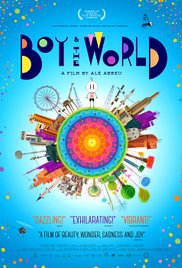
Greetings again from the darkness. It may not be Pixar, but this wonderful film from Ale Abreu is absolutely worthy of its Oscar nomination for Best Animated Feature, though it’s heavier on message than story. It’s a wonderful reminder that one of the best features of animation is that the look can be unconventional and still be effective.
The stick figure boy is on a mission to re-connect with his father, who left the family’s country home to find work in the big city. For Abreu’s film, the boy’s real purpose is to be our tour guide through this exploration of the state of the “civilized” world. It’s an adventure that provides the boy (and us) insight into cities, the sea, the countryside and agricultural life. It’s also an examination of the loss of childhood innocence as we are exposed to reality.
A rare hand-drawn presentation is also mixed-media, as it utilizes a few real news clips to emphasize the cluttered, damaged world. It’s a different approach in making the arguments regarding climate change, carbon footprints and socioeconomic imbalance. The hand-drawn core here is more complex than what we initially believe. Colors explode onto the screen, and the visuals often carry multiple meanings in depicting the intended message.
Dialogue is minimal and often garbled in a manner that reminds of any adult in the Charlie Brown comics … but we are never confused on what is being conveyed. In addition to the visuals, sound effects play a huge role, as does the music from composers Ruben Feffer and Gustavo Kuriat, and Brazilian jazz favorite Nana Vasconcelos. It’s a unique approach to reminding us that our harsh treatment of the planet could play like a horror story or dangerous adventure to the innocent eyes of a child.
Greetings again from the darkness. The best neo-noir crime thrillers immersed in the grim tone of “True Detective”, Stieg Larsson’s trilogy and El secreto de sus ojos(The Secret in Their Eyes, 2009) have a way of drawing us into the atmospheric underbelly of society and keeping us grappling for solid ground until a resolution is in place. This gem from Spain comes courtesy of director Alberto Rodriguez, who co-wrote the story with Rafael Cobos. Cinematographer Alex Catalan also deserves much credit.
Juan (Javier Gutierrez) and Pablo (Raul Arevalo) are two police detectives thrown together to investigate the disappearance of two teenage sisters in a remote part of the southern country. It’s 1980, five years after the death of Franco, and the country is in the midst of political and social transition/turmoil. The two detectives are a microcosm of this transition as Juan is the old-school cop who views “physicality” as part of the interrogation process, while Pablo is next generation and believes in following the new rules of democracy and treating all with respect. Pablo, whose wife is back home in Madrid expecting their first child, is none too happy about being paired with Juan, who seems to have no real moral compass at this stage in his life and career.
When the violently abused bodies of the sisters are discovered, Juan and Pablo follow a trail of leads that take them through a mostly closed-circuit and uncooperative community … one eager to explain that those sisters had “a reputation”. The village women are all frightened to speak, the men are zealously protective of each other, and both are suspicious of outsiders. Even the Civil Guard systematically defends the old society of man-rule.
The contrast between the two polar opposite detectives, and their slow to develop meeting of minds, is more the focus here than the still quite interesting procedural work being done to investigate the murders and uncover the atrocities. This is not one of those heart-pounding, adrenaline-laced joy rides, but rather a slow-burn of police work and character development.
Aerial shots to open the film are breath-taking and included periodically throughout the film. Mr. Catalan’s work is combined with digitized versions of the work of photographer Hector Garrido to create the haunting atmosphere around an area of Spain that otherwise lacks the natural beauty we often associate with the country. This setting adds yet another layer to this mesmerizing movie-watching (for those of us who appreciate the genre).
Greetings again from the darkness. If I find myself three minutes into a movie and have already executed a couple of eye-rolls, any hopes for a decent little Romantic-Comedy-Drama would ordinarily be dashed. However, having Rebecca Hall’s character narrate her writing efforts as she taps away on the keyboard, actually does serve the story. The first feature from director Sean Mewshaw and his screenwriting wife Desiree Van Til takes advantage of a beautiful setting, a slew of contrasts, and some heartfelt music to keep us interested in how things plays out.
Ms. Hall plays Hannah, the grieving young widow who has stashed herself away in a lakefront cabin located in the rural Maine community in which she was raised. Her grief remains burdensome some two years after the tragic death of her husband Hunter Miles – a folk singer whose only album (and subsequent death) created a public mystique and a defensiveness on the part of Hannah to protect and control his legacy.
As a Ph.D from Brown, periodic contributor to the local newspaper, and soul mate of Hunter, Hannah undertakes the writing of his biography in the shadow of the studio monument that continues to expand with trinkets left at his gravesite by a cult of fans paying respect. Griffin Dunne plays her friend and owner of the local bookstore and publisher of the newspaper. His less than enthusiastic critique of her early pages of the biography correspond with the vigorous pursuit by a Hofstra Pop Culture Professor with a book publishing deal who wants to make Hunter a key element of his new project.
Jason Sudeikis plays Andrew, and his fast-talking big city mannerisms don’t initially mesh so well with the hyper-sensitive and protective grieving widow. The two spar like brother and sister, and the initial adversarial relationship means only one thing in the movie world … romance is in the air. Fortunately, the focus on telling the story of Hunter acts as a form of grief therapy for Hannah and a bit of redemption of spirit for Andrew. Of course, the path to enlightenment is not simple for either. Hannah’s “friend with benefits” is a hunky local power company worker played by Joe Manganiello (“True Blood”), and Andrew’s big city music industry girlfriend is played by Dianna Agron (“Glee”). But as you would expect, the biggest obstacle faced by the two leads is their own stubbornness.
We learn the most about Andrew and Hannah when they are around others. An Easter luncheon with Hannah’s family is especially insightful. Her parents are played by Blythe Danner and Richard Masur, and as viewers we long for more scenes featuring these two characters (and terrific actors). We sense that these parents see right through Andrew and Hannah. Can Hannah let down her guard so that she can move on with life? Can Andrew quell his ambition so that the emotional connection takes place?
Beautifully shot (with British Columbia substituting for Maine), the aspect of nature plays a role in contrasting country girl with city boy, and it’s the accidental discovery of a long lost song that highlights the stark difference in motives … while also being the impetus for change. Hunter’s original music is heard throughout the film, and it’s actually Damien Jurado whose singing and songwriting add an element of intrigue and realism. Hannah, as narrator, states “In the middle, we feel like it’s never going to end.” While that may be true for many romance movies, the filmmakers here avoid the “too cute” moments that spoil most in this genre … and impressively overcome those early eye-rolls.
Greetings again from the darkness. Homage or Spoof or outright Farce? Though the Coen Brothers motivation may be cloudy, their inspiration certainly is not. The Golden Age of Hollywood is skewered by the filmmaking brothers who previously applied their caustic commentary to the movie business in Barton Fink (1991). However, this latest seems to borrow more from the unrelated universes of their films A Serious Man(2009) and Burn After Reading(2008) in that it alternates tone by focusing first on one man’s attempt to make sense of things, and then with a near slapstick approach to “urgent” situations.
The film seems to be made for Hollywood geeks. Perhaps this can also be worded as … the film seems to be made for the Coen brothers themselves. Rather than an intricate plot and subtle character development used in their classic No Country for Old Men(2007), this is more a collection of scenes loosely tied together thanks to their connection to Eddie Mannix, Capitol Pictures “fixer”. Josh Brolin plays straight-laced Mannix, a twist on the real Eddie Mannix, notorious for his behind the scenes work at MGM in controlling the media, protecting the stars and studio, and protecting movie stars from their own idiotic actions. He was a real life Ray Donovan. It’s Mannix’s job that creates the hamster wheel to keep this story moving (complimented by narration from Michael Gambon).
We witness a typical day for Mannix as he confesses to the Priest that he had a couple of cigarettes after promising his wife he would quit, negotiates with communists who have kidnapped the studios biggest movie star, deftly handles the studio head’s greedy desire to shift a western movie star into a genre for which he is ill-prepared, plans a cover-up for the starlet having a baby out of wedlock, and juggles the demands of the competing twin gossip columnists searching for scandal. Mannix keeps his cool through all of this while mulling a lucrative job offer from Lockheed that would put him right in the midst of the nuclear war scare.
With an exacting attention to period and industry detail, the Coen’s remind us of the popular genres and circumstances of the era. George Clooney plays mega star Baird Whitlock, working on the studios biggest picture of the year – a biblical epic entitled “Hail, Caesar!” (think Ben-Hur, The Robe, etc). Whitlock is kidnapped by a group of communist writers (not yet blacklisted) who are striking out against a capitalistic studio that doesn’t share the rewards with the creative folks. It’s a different look than what Trumbo offered last year. In a tribute to Roy Rogers and famed stuntman Yakima Canutt, there is a segment on popular westerns featuring Alden Ehrenreich (Beautiful Creatures, 2013) as Hobie Doyle, a popular actor whose an artist with a rope and horse and guitar, but not so smooth on his transition to the parlor dramas being filmed by demanding director Laurence Laurentz (a terrific Ralph Fiennes). In boosting Doyle’s public perception, the studio sets him up on a date with a Carmen Miranda-type played by Veronica Osorio. Her character is named Carlotta Valdez in a nod to Hitchcock’s Vertigo. Another sequence features Scarlett Johansson as DeAnna Moran, an Esther Williams type (with a behind the scenes nod to Loretta Young) in a Busby Berkeley-esque production number featuring the synchronized swimming so prominent in the era. One of the film’s best segments comes courtesy of Channing Tatum in a take on films like On the Town, where sailors would sing and dance while on leave.
Tilda Swinton (whose appearance improves any movie) appears as the competing twin sister gossip columnists Thora and Thessaly Thackery. Her hats and costumes are sublime and pay worthy tribute to Hedda Hopper (who also balked at being termed a gossip columnist). Jonah Hill’s only scene is from the trailer, and it could be misleading to any of his fan’s coming to see his performance; and the same could be said for Frances McDormand (a very funny scene as a throwback editor). And so as not to disappoint their many critics, the Coen’s have a terrific scene featuring four men of various religious sects who are asked their opinion of the script – so as not to offend any viewers. The pettiness is palpable.
Roger Deakins is, as always, in fine form as the cinematographer. The water and western productions are the most eye-catching, but he does some of his best camera work in the shots of individual actors or scenes-within-a-scene. We have come to depend on Joel and Ethan Coen for taking us out of our movie comfort zone, while providing the highest level of production – music, costumes, sets, camera and acting. While this latest will leave many scratching their heads, the few in the target audience will be applauding fiercely.
Greetings again from the darkness. “There’s air freshener behind the Virgin”. That line should provide the necessary caution for you to be braced for just about anything to be said by any character in this latest from director Nicholas Hytner. Billed as “A mostly true story”, it’s actually more commentary on how we treat those less fortunate and how we use others for our own gain. That bleak message is cloaked here in humor and a wonderful performance from Dame Maggie Smith.
Alan Bennett is an author, playwright and screenwriter known for The History Boysand The Madness of King George(Oscar nominated for his script). He is also at the core of this story – every bit as much as Ms. Shepherd, the lady in the van. While living in upper crust Camden Town, Mr. Bennett offered to let Ms. Shepherd park her van in his driveway for a few weeks until she could make other arrangements. This van was also her home, and the years (as they are apt to do) came and went until this arrangement had lasted 15 years (1974-1989).
You might assume that Ms. Shepherd was an extremely appreciative “squatter”, but in fact, she was quite a cantankerous and difficult woman, possibly/probably suffering from mental instability. Maggie Smith brings a humanity to the role that she had previously owned onstage and radio. She goes far deeper than the wise-cracking old lady role we have grown accustomed to seeing her play … though her vicious dialogue delivery remains in prime form. Throughout the film, we assemble bits and pieces of Ms. Shepherd’s background: an educated-French speaking musician-turned nun-former ambulance driver-who “possibly” won awards for her talents. She is also carrying a burden of guilt from a past tragic accident that keeps her in the confessional on a consistent basis.
Mr. Bennett is played by Alex Jennings (The Queen, 2006), and the film actually presents dual Bennetts – the one doing the writing, and the one doing the living. These two Bennetts are a virtual married couple – arguing over Ms. Shepherd, and jabbing each other with barbs aimed directly at known emotional weaknesses. The living Bennett claims to be so full of British timidity that he couldn’t possibly confront the woman junking up his driveway. The writer Bennett takes the high road and claims he would rather write spy stories than focus his pen on the odorous, obnoxious transient living in his front yard. Of course, now that we have a play and movie, it’s difficult to avoid viewing Mr. Bennett’s actions as anything less than inspiration for his writing … though the extended charitable actions cannot be minimized.
With director Hytner and writer Bennett reuniting, it’s also interesting to note that more than a dozen actors from The History Boysmake appearances here. The list includes James Corden, Frances de la Tour, and Dominic Cooper. Also in supporting roles are Roger Allam and Deborah Findlay (playing constantly irritated neighbors), Gwen Taylor as Bennett’s dementia-stricken mother, Jim Broadbent as a blackmailing former cop, and Marion Bailey as a staffer at the abbey.
Filmed at the same house where the van was parked for so many years, the film is a reminder to us to exercise tolerance and charity in dealing with the poor. Even Bennett’s grudgingly-offered assistance is a step above what would typically be expected. While we could feel a wide spectrum of emotions for the two main parties here, it’s Ms. Shepherd’s character who says “I didn’t choose. I was chosen”. We are left to interpret her words in a way that is either quite sad or accepting.
The film mostly avoids dime store sentimentality, and that’s in large part due to Maggie Smith’s performance. Few are as effective at frightening young kids or putting the elite in their place. The ending scene shows the real Alan Bennett cruising into the driveway on his bicycle just as the blue plaque honoring the lady in the van is displayed. We can be certain this gesture would not generate a “thank you” from her.
 Greetings again from the darkness. The old saying “opposites attract” is on full display in director and co-writer Julie Delpy’s latest, as she offers up a twist on the French farce by adding a dark undercurrent. Additionally, the film addresses the personal and societal challenges facing women in their 40’s who are successful in their career, and who also hold out hope for finding true love.


 Posted by David Ferguson






 Movie Reviews from the Dark