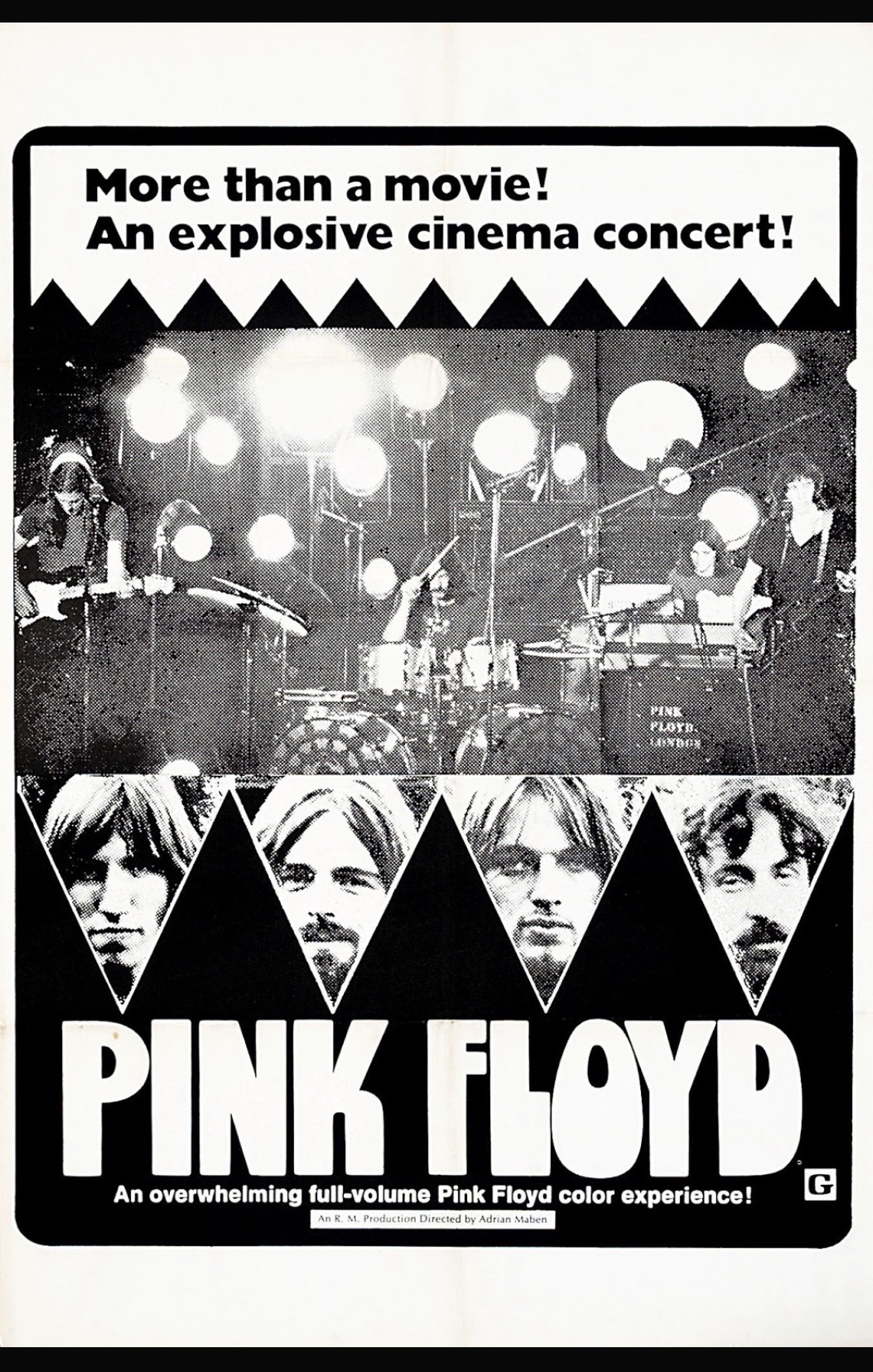
 Greetings again from the darkness. No one familiar with Pink Floyd would expect a conventional concert film from the band. So how about a live concert from the ancient Roman amphitheater in Pompeii, the city destroyed by the eruption of Mount Vesuvius in 79 A.D.? And just for fun, we’ll have the band playing to an empty arena … no fans allowed. Now THAT is a Pink Floyd concert film.
Adrian Maben’s film was first released in 1972, and has had subsequent video releases since, so it’s likely most Pink Floyd fans have seen the film in one form or another. However, it’s time to watch again – only this time in a remastered 4K version that looks and sounds great. The beginning of the film shows all of the band’s equipment being set up (and yes, they had challenges with running enough electrical power to the area).
If you aren’t sure, this is the post-Syd Barrett lineup with Roger Waters on bass (and gong), David Gilmour on lead guitar, Richard Wright on keyboards, and Nick Mason on drums. In keeping with the times, we often see Gilmour and Wright going shirtless, scraggily hair on Waters, and sandals for the Italian sand. Also making his way around the band and equipment is Peter Watts (father of actress Naomi Watts), the band’s stage and sound manager.
It’s quite a visual to see the band and all the high dollar equipment set up in the middle of an empty majestic relic of the past. Songs played in the amphitheater include “Echoes” (split into two pieces), “A Saucerful of Secrets”, “One of These Days” (mostly Mason’s drumming), and then add-ons include “Careful with that Axe, Eugene”, “Mademoiselle Nobs” (with canine vocals), and “Us and Them”. We get some limited interviews, but the only real insights gained are: Mason likes pie without the crust, and the band readily admits to much arguing (no surprise there).
Pink Floyd was always willing to experiment with sounds and sights – here we get some early graphics and effects, including volcanic lava. This film offers a look into those early 1970’s years, and there are even some segments filmed inside the studio for the classic album, “The Dark Side of the Moon”. Certainly, the film helps make sense of the superb lyric, “The lunatic is in my head”.
In theaters and in IMAX beginning April 24, 2025


 Posted by David Ferguson
 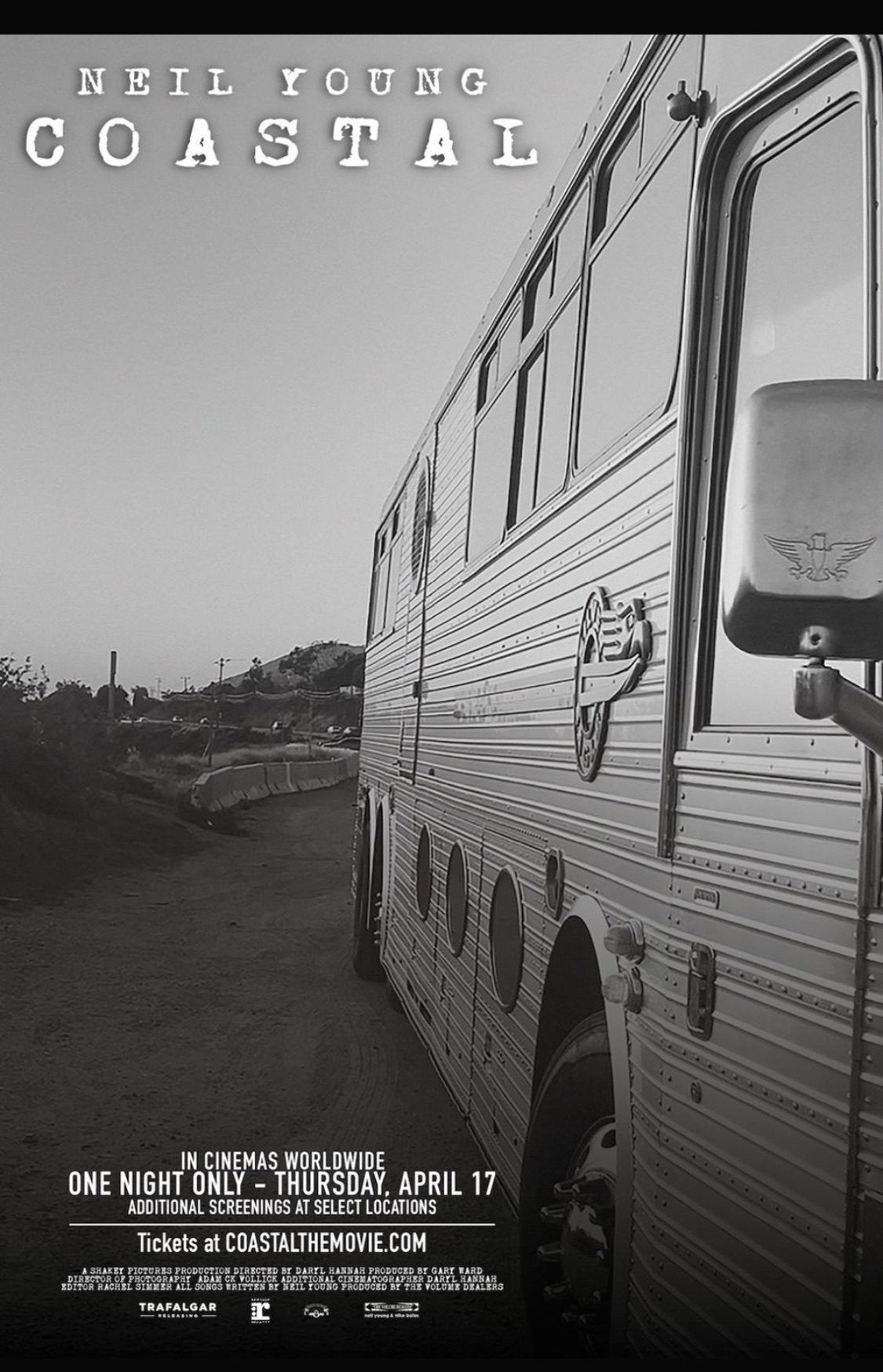 Greetings again from the darkness. Over his 60-year career, Neil Young has proven to be one of a kind. As an incredibly talented songwriter with an instantly recognizable singing voice, he’s also acclaimed for his guitar playing. Few musicians have cut a wider swath of diverse music than the Canadian-born Young. His success began in the 1960’s with Buffalo Springfield and Crosby, Stills, Nash, and Young. A solo career with two amazing albums (“After the Gold Rush”, “Harvest”) took him to new heights in the 1970’s, followed by some hard-rocking tunes with Crazy Horse. Since then, he’s kept fans guessing as to what style each successive record would feature.
 Greetings again from the darkness. So why did John Lennon and Yoko Ono leave England to live in New York? This film provides the answer. Where did they choose to live? The film provides the answer. Why did John perform his only full post-Beatles concert in 1972? This film provides the answer. Why did they become so politically and socially active during those first 18 months in the States? This film provides the answer. And if you ever wondered how John felt about American television, well you guessed it … this film provides the answer.
 Greetings again from the darkness. It’s been more than forty years since cancer took the life of 35-year-old Andy Kaufman, and we still don’t know how best to describe him: actor, comedian, illusionist, performance artist, prankster, or something more bizarre. It’s like no one knew ‘the real Andy’, and whether that was his intent or not, that’s the feeling we are left with after watching this bio from Alex Braverman.
 Greetings again from the darkness. The list of icons known by a single name is relatively short and includes such luminaries as Elvis, Prince, Cher, Bono, Beyonce, and Sting. Immediately recognizable with only her first name, Liza Minnelli also fits right in. Documentarian Bruce David Klein has delivered a tribute to her early years as the daughter of worshipped idol Judy Garland and famed film director Vicente Minnelli, and outlines her own path to stardom after tragedy to being recognized as one of the greatest performers of all time.
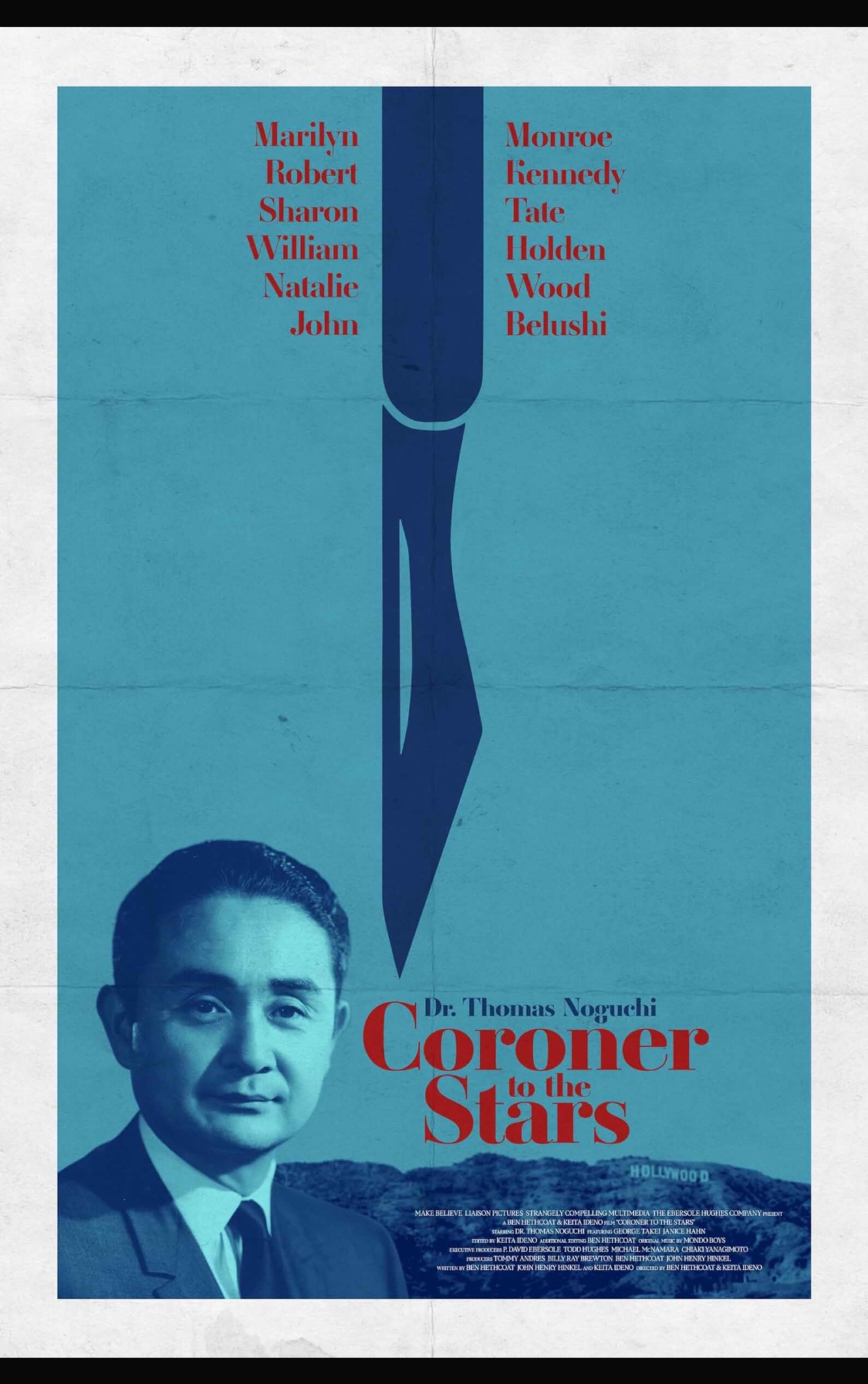 Greetings again from the darkness. Most Americans can’t name their county’s Chief Medical Examiner-Coroner. However, when one person held the position in Los Angeles County from 1967 through 1982, it’s understandable that he spent an inordinate amount of time in press conferences and TV interviews. Dr. Thomas Noguchi has been described as a “Renaissance Man” – a doctor, chef, and artist, as well as a pursuer of fame. Co-directors Ben Hethcoat and Keito Ideno present the story of Dr. Noguchi, “Coroner to the Stars”.
 Greetings again from the darkness. Music lovers know very well how radio changed in the 1990’s. Consolidations, mergers, and mandated playlists became the norm. Traveling from city to city and town to town made this abundantly clear. Where once independent stations were keyed in to local culture, corporate radio commanded the airwaves. The exceptions were ‘pirate radio stations’ and Sue Carpenter not only founded one of the best (KBLT), she put together this documentary on how she did it.
 Greetings again from the darkness. Realistically speaking, there should be more words for ‘friendship’, designating the multiple levels on which ‘being friends’ can occur. If Financial Advisors can have “A” (like Warren Buffett), B, C, and D (like me) clients, then wouldn’t it be reasonable for us to have levels of friendship for those we entrust with our kids and a house key versus those we meet periodically for happy hour, or those we acknowledge in the grocery store with a wave and a smile? OK, so while the viability of friendship by ranking is not likely, this latest from Josh Greenbaum (BARB AND STAR GO TO VISTA DEL MAR, 2021) introduces us to a friendship we can all strive for.
 Greetings again from the darkness. Almost all little kids imagine themselves as Superman, a larger-than-life figure who accomplishes incredible things … while flying through the air! Filmmakers Ian Bonhote and Peter Ettedgui collaborate again, this time to tell the story of the man who became Superman on screen for a new generation, and then, after a horrible accident, became a real-life inspiration and advocate for so many folks around the world. We also note that it’s impossible to tell the Christopher Reeve story without also gaining insight into his equally determined wife and caregiver, Dana Reeve.
 Greetings again from the darkness. Apologies in advance for any improper labels or descriptions included here. This documentary dates back fifty years to when the term “gay lifestyle” was acceptable. Further to the point, the focus is on Studio One, a West Hollywood disco for gay men. It took a while for the doors to open for other persuasions in what is now referred to as LGBTQ+. Filmmaker Marc Saltarelli really delivers a history lesson – not just for a landmark building, but for an era when gay men were sometimes arrested for simply walking down the street together.
