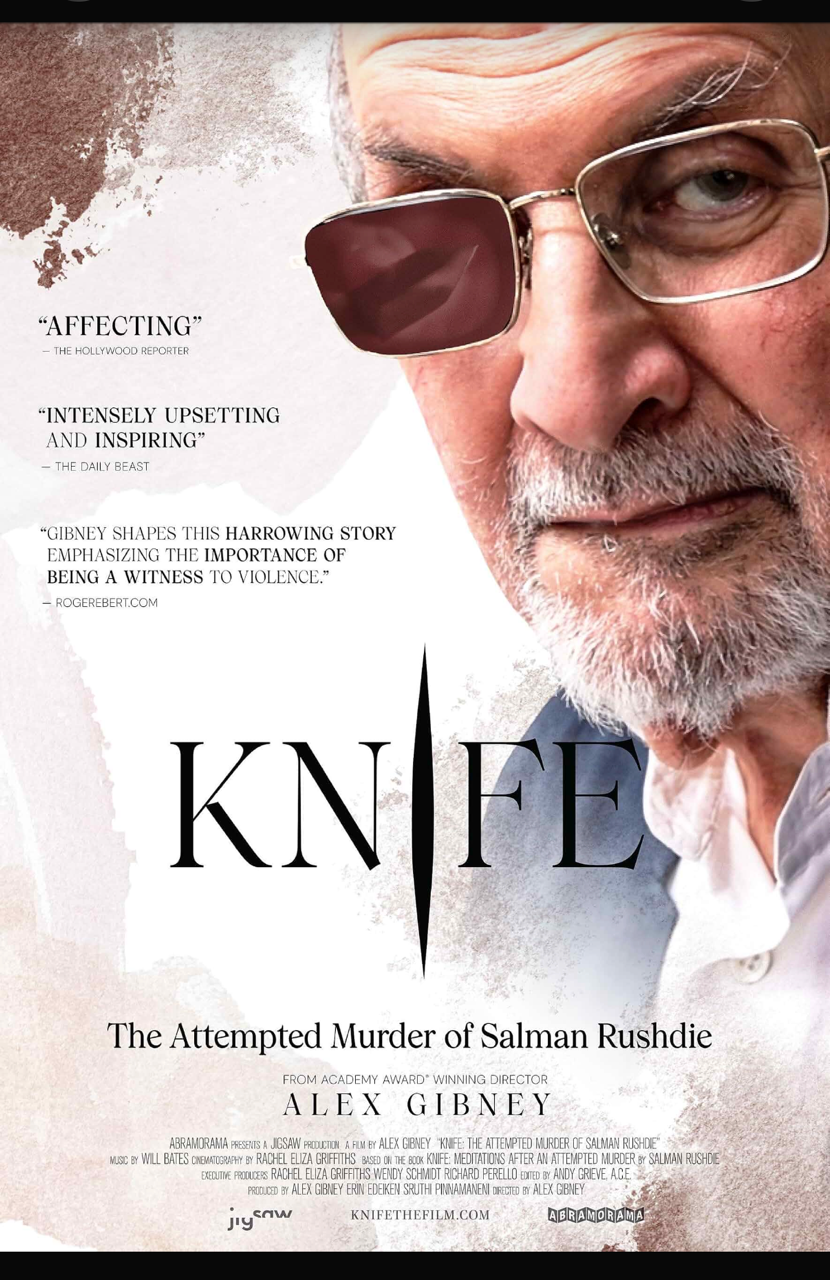
 Greetings again from the darkness. Seeing someone get violently attacked is horrifying, whether that be live or a video replay. An additional adjective can be added, ‘shocking’, when the attack occurs on a public figure in a public place. Such is the case when author Salman Rushdie was ambushed on stage at Chautauqua Institute (NY) in 2022. The attacker used a knife to stab Rushdie 14 times. One of the best documentarians working today, Alex Gibney (ENRON: THE SMARTEST GUYS IN THE ROOM, 2005; and an Oscar winner for TAXI TO THE DARK SIDE, 2007), brings this story to the screen based on Rushdie’s 2024 memoir “Knife: Meditations After an Attempted Murder”.
Salman Rushdie makes for quite an eloquent narrator of his own story, and you are likely familiar with him as the target of Iranian Ayatollah Khomeini-issued fatwa in 1988, after Rushdie released his book, “The Satanic Verses.” A bit of quick math tells you that, at the time of this attack, Rushdie had lived more than thirty years with a death threat following him around. Mr. Gibney structures the film in intertwined pieces, including the attack, Rushdie’s hospital and recovery stint, the recordings by his wife, his earlier background as a writer, and his post-attack return to writing.
The film opens with Rushdie on stage at the event that would change his life, yet miraculously, not end it. Gibney elects not to show the video of the attack until much later in the film, however, the early images of Rushdie in the hospital bed make it clear just how violent this attack was. Rachel Eliza Griffiths is a renowned writer and Rushdie’s fifth wife. The video and photos she took of him in the hospital are incredibly personal, while also documenting his amazing recovery from a near-death attack. She understands the importance of documenting his recovery, and it’s clear these two adore each other.
Rushdie tries to recall those early days in the hospital, and one of his most vivid memories is a dream sequence involving Death from Bergman’s 1957 THE SEVENTH SEAL (a clip is included), and we also get scenes from TWELVE ANGRY MEN (1957) and PSYCHO (1960), two classic movies in which knives played a prominent role. Our first look at Rushdie’s injured eye is stunning, and as we learn more about his severe injuries, we can’t help but wonder just how he recovered so quickly and maintained such a positive outlook.
This is a man who uses language at an elevated level, and despite living most of his adult life under threats, his writings are often inspirational and about freedom of expression, especially in regard to religion. The archival footage of his early years provides a profile of a man who has always had the courage to write and say what he felt needed to be expressed. Amazingly, he was cleared to leave the hospital after six weeks, and Gibney films Rushdie’s return to the very stage (on Day 401) where the attack took place. It’s an emotional moment, and one Rushdie says brings him full circle and allows him to make peace … although neither Rushdie nor his wife mention the attacker’s name (a young man likely to spend the rest of his life in prison). Perhaps the most powerful words come not from the filmmaker or either of the talented writers, but rather when Rushdie recalls a lesson learned from his parents: “What can’t be cured, must be endured.”
Opening in theaters on September 17, 2026


 Posted by David Ferguson
  Greetings again from the darkness. Being the creative force behind what many consider to be the best TV show of all time – one that changed the face of television – is both a blessing and a burden. David Chase is that man, and his often dour disposition hides the creative genius behind “The Sopranos” (1999-2007). Oscar winning documentarian Alex Gibney (TAXI TO THE DARK SIDE, 2007; ENRON: THE SMARTEST GUYS IN THE ROOM, 2005) re-creates Dr. Melphi’s office for his sit down with Chase, and it’s a smooth move to encourage Chase to open up in the same setting where his creation, Tony Soprano, often let his guard down. This is not really meant as an introduction to garner new fans for reruns, but rather as a tribute to David Chase and a peek behind the curtain for hardcore fans.
