AMERICAN CHAOS (2018, doc)

September 13, 2018

 Greetings again from the darkness. Politics in the United States is an embarrassment to any citizen who is paying attention these days. And by “these days”, I’m referring to at least a couple of generations, if not even more. The bickering between and within political parties is more closely related to playground arguments than debates among statesmen. The most effective wall being built is the one between the two sides – it’s a wall that has little to do with reason or “the greater good”, and everything to do with standing steadfast in one’s belief that an opinion is a fact that should be shared by all. Enter stage and film producer Jim Stern … a self-described political junkie.

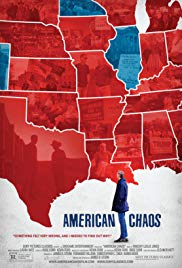
Mr. Stern grew up in a house of “Kennedy Democrats” and all but worships former President Barack Obama. He opens his film with clips of past Presidents, dating back to Theodore Roosevelt, and states his purpose as a desire to understand how so many Americans could vote for Donald Trump. It’s an admirable mission, and Mr. Stern is to be commended as one of the few extremists (on either side) willing to listen to what the other side is saying. It’s 9 weeks after the election, and Stern is in the audience for Obama’s farewell speech. He (Stern) has tears in his eyes, as the man he so admires is being replaced by one who inspires little faith or respect.

We now flashback to 6 months prior to the election. Stern paraphrases Atticus Finch from TO KILL A MOCKINGBIRD, and pledges to try and understand the other side by getting to know their point of view. His road trip takes him from Florida to Cleveland to West Virginia to Arizona. Stern’s approach is to present himself as a neutral interviewer so that folks don’t get defensive, and instead just open up about their views. He speaks to a man who is a legal immigrant from Cuba, a Midwest Pastor who is every bit as adamant in his beliefs as Stern is in his own, a conservative radio talk show host in Arizona who eloquently states her case, and folks in West Virginia who just want the coal mines back up and running so that they might escape poverty. One of the men he speaks with is part of the infamous Hatfields and McCoys feud, and he admits to voting for Obama twice – but is now convinced Trump is the best hope for rescuing the state’s economy.

Stern uses the ongoing campaign as the structure for his road trip and story, and doesn’t shy away from admitting Hillary Clinton’s “basket of deplorables” speech was a turning point … as was the last minute renewing of the FBI investigation into her actions. But since we know all of that, what is most fascinating here is listening to regular folks … voters … providing insight into their viewpoints. These mid-America citizens are tired of politicians being bought and sold. Trump was saying what these people were thinking – he was reaching out to (mostly white) disaffected voters. Stern is stunned at the ovation Trump receives at the Republican convention in Cleveland. He is surrounded by tens of thousands of Americans who don’t believe what he believes. It’s a powerful moment for him and the film.

“They hate her (Hillary) and they hate Obama too.” Stern is hit with the harsh reality that his idol is not idolized by all. His most accurate statement is that blue state voters and red state voters simply do not understand each other. With so many of one group clustered in California and the northeast, while the others are spread across the middle of the country, it’s really no surprise that these citizens have different views and needs. It’s also not surprising that since the “mainstream media” is equally clustered in those two geographic areas, that information distributed is skewed towards those views and issues. Abortion and gay rights appear to be non-factors in his discussions, while jobs, corruption and illegal immigration are what matter.

Again, Mr. Stern is to be commended for letting these citizens speak their mind. It’s a nice contrast to another high profile documentarian renowned for editing to prove his own well-publicized views. Stern’s brother was a key negotiator in the Paris Accord, so he certainly has a personal stake in the drastic political change. In fact, we often see his true emotions despite his ability to remain impartial to those speaking on camera. Election night with violin music is a bit too much, but for the most part, Jim Stern and Atticus Finch work together here to enlighten the “other” side.

watch the trailer:


HAL (2018, doc)

September 6, 2018

Oak Cliff Film Festival 2018

 Greetings again from the darkness. There may never have been a director with a comparable streak of 6 films in terms of quality and variety as Hal Ashby delivered between 1971 and 1979. At least 4 of those films would be included on a list of my all-time favorites. Ashby was a maverick filmmaker during an era when filmmaking style and tone shifted, and he was at least partially responsible for some of that change. Amy Scott (fittingly trained as a film editor) chose to make Ashby the subject of her directorial debut, and we can only assume her admiration for his work and curiosity about his later career was her inspiration.

HAROLD AND MAUDE (1971), THE LAST DETAIL (1973), SHAMPOO (1975), BOUND FOR GLORY (1976), COMING HOME (Best director nomination, 1978), and BEING THERE (1979) are the films that comprise the aforementioned “streak”, and are also the projects that afforded Ashby the opportunity to work with such industry talents as writers Robert Towne, Jerzy Kosinski, and Waldo Salt; cinematographers Haskell Wexler, Michael Chapman, and Caleb Deschanel; and actors such as Ruth Gordon, Jack Nicholson, Warren Beatty, Lee Grant, Jon Voight, Jane Fonda, Shirley MacLaine, Melvyn Douglas, and Peter Sellers. All of these folks contributed to the edge in independent filmmaking that arose in the 70’s.

Director Scott works diligently to paint a full portrait of Ashby the man, so that we might better understand the odd career arc. A challenging early family life pushed him to grow up too fast, and with 5 marriages balanced by 5 divorces, it’s likely that Ashby was never destined to be a settled down family man. His drug addictions served to undermine what was already his difficult and demanding style on set, and his trademark look of long scraggily hair and unkempt beard ensured he was never mistaken for an industry insider.

Much of what we learn comes from the voice of Ashby himself, courtesy of audio tapes. Other insights and remembrances come from interviews with: Judd Apatow, Rosanna Arquette, Jeff Bridges, Beau Bridges, Lisa Cholodenko, Caleb Deschanel, Jane Fonda, Lou Gossett, Lee Grant, Dustin Hoffman, Alexander Payne, David O Russell, Cat Stevens, Jon Voight, and Haskell Wexler. We also hear from legendary director Norman Jewison, who gave Ashby his first job as film editor. Ashby later won an Oscar for Best Editor on Jewison’s IN THE HEAT OF THE NIGHT (1967) … and the clip shown of him accepting the award highlights a man who barely resembles the man we would come to recognize over the next few years.

We learn that his ever-present battle with studio executives likely led to his not getting the opportunity to direct TOOTSIE, and more importantly to me, we get an explanation of what happened to Ashby’s 8 MILLION WAYS TO DIE (1986) – a film I always thought was oh-so-close to being a great 80’s movie, but instead was a bit of a mess. And now we know why. There may not be a more revered and respected filmmaker and influencer of other filmmakers … certainly not one who is less discussed. Ashby’s BEING THERE ranks with the very best political satires of all-time (yes, even DR STRANGELOVE OR: HOW I LEARNED TO STOP WORRYING AND LOVE THE BOMB), and few could juggle comedy and drama any better. Hal Ashby died from cancer in 1988 at age 59. Was it his uncompromising manner or was it the effects of drugs that brought his career to a halt, and prevented him from achieving the blockbuster status of his peers Coppola, Scorsese, and Spielberg? We’d like to think it’s the age old ‘art vs. commerce’ argument, but that simply doesn’t hold up. Regardless, for a few years, no one did it better than Hal Ashby, and he did it his way.

watch the trailer:


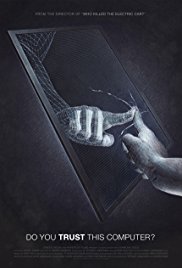
DO YOU TRUST THIS COMPUTER? (2018, doc)

August 16, 2018

 Greetings again from the darkness. When asked if they believe a computer could ever be conscious, two young woman combine to respond: ‘No. Unless they program it that way’. And that answer is at the core of director Chris Paine’s (WHO KILLED THE ELECTRIC CAR?) latest exploration of Artificial Intelligence. Are we controlling the machines, or could they end up controlling us?

Early on, the point is made that science-fiction has numbed us to the potential pitfalls and risks of A.I. Fingers are pointed at some favorites such as TERMINATOR 2: JUDGMENT DAY, 2001: A SPACE ODYSSEY, WARGAMES, EX MACHINA, THE MATRIX, and ROBOCOP. We have come to accept A.I. as high level entertainment rather than acknowledging the inroads being made by firms such as Google.

It is explained that Google search is actually a form of Artificial Intelligence and the algorithms are collecting more data than we have stopped to realize.  For a film like this, expert talking heads are a necessity, and director Paine delivers. We hear from AI experts, writers, journalists, and doctors. The lineup includes Jonathan Nolan, Elon Musk, and Stuart Russell, and each offers fundamental insight for the topic, leaving us with the notion that A.I. is capable of ‘incredible miracles, as well as incredible horrors’. We are also informed that “it’s not the future, it’s the present”.

Specific areas impacted by A.I. and explored here include: self-driving cars, medical applications, military weaponry, and financial market data. Weaponized drones are an example, and one surgeon provides a real life case study of how a computer would have an advantage over him. Time is spent on the “Jeopardy” experiment where IBM’s Watson (created by David Farucci) goes up against the top contestants and wins. Robotics are also a focus here, and the impact goes far beyond the loss of factory jobs.

Well known documentary writer Mark Monroe (ICARUS, FED UP, THE COVE) helps director Paine with the presentation structure since so many topics are touched upon. The electronic score is a bit overbearing at times, and we can’t help but question the motivation behind the film’s dedication, “In Memory of Stephen Hawking”. The film could be viewed as high tech fear-mongering, however, it’s more of a wake-up call to pay attention to the developments that are occurring (and how data is being collected and processed). The last thing we want is for the film’s opening quote to come true: “You are my creator, but I’m your master” (Mary Shelley from “Frankenstein”).

watch the trailer:


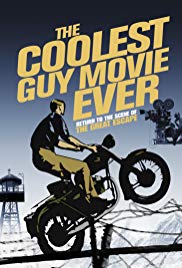
THE COOLEST GUY MOVIE EVER (2018, doc)

August 11, 2018

 Greetings again from the darkness. As one who watches more than 200 movies each year, I absolutely understand how someone could be extraordinarily passionate about a particular film … even to the point of bordering on obsession. First time director Christophe Espenan clearly feels that way about THE GREAT ESCAPE. In fact, his sentiment is so strong for the film that he assembled a team and took off to Bavaria in order to re-trace the filming locations some 50 years after John Sturges and his all-star cast were there.

The documentary kicks off with the modern day team trekking through a heavily wooded area. We learn they are searching for the exact location of the movie’s prison camp. It was built on a studio backlot, and background research reveals that trees had to be cleared to construct the prison, and the promise was made to re-plant twice as many trees once production ended. In the five decades since, the trees have flourished into what could now be described as a forest … with no signs of the prison camp that was part of cinematic history. So what should have been a highlight of Mr. Espenan’s movie, turns into something akin to Geraldo Rivera opening Al Capone’s vault.

Based on Paul Brickhill’s book, the iconic 1962 film starred Steve McQueen, James Garner, Richard Attenborough, Charles Bronson, Donald Pleasence, James Coburn, David McCallum, and Gordon Jackson. It surely belongs on any list of ‘cool guy’ movies, along with THE MAGNIFICENT SEVEN (released two years prior). Both films were directed by Mr. Sturges and feature terrific and memorable scores from the great Elmer Bernstein.

Archival footage of interviews from James Coburn and James Garner are included, as well as numerous photos and clips from the film itself. Mr. Espenan carries an album of screenshots from the film and does a nice job of matching up specific locations and scenes as he and the team walk through the towns. Local Hotel Alpina is featured as the place where much of the cast and crew stayed during filming, and the hotel staff fondly remembers when their paths crossed. Lawrence Montaigne serves as narrator, and since he also had a small part in the movie, his insight is appreciated … though he was better known for this frequent TV series appearances, before passing away in 2017.

A substantial portion of the film’s 55 minute run time is devoted to the motorcycle stunts of Steve McQueen. However, on the whole, the film does not feel stretched, but rather just a bit too lightweight for today’s documentary standards. It comes across as more of a tribute or fanboy whim than a “making of” or “behind-the-scenes” project delivering insight or detail. It did succeed in getting me to add THE GREAT ESCAPE near the top of my list for classic films to revisit … it’s one I’ve never reviewed, and definitely should.

watch the trailer:


KING COHEN: THE WILD WORLD OF FILMMAKER LARRY COHEN (2018, doc)

August 5, 2018

 Greetings again from the darkness. “That’s not the way it’s done.” Larry Cohen admits to having heard those words many times over the years, but in fact, it’s an accurate description of his 6 decade career as a Producer-Director-Writer. Filmmaker Steve Mitchell serves up a biopic and career retrospective of Mr. Cohen, and kicks it off with  Cohen fan director JJ Abrams telling a story about the IT’S ALIVE prop baby and crossing paths with the man himself.

Larry Cohen might be described as a schlock movie maker known only to those who are drawn to B-movie horror films. But that would be an injustice to the man who sold his first script at age 17, was the creative force behind numerous TV series, and has been a successful screenwriter for the films he directed, and many he didn’t. Walking us through a mostly chronological order of his life and career are Mr. Cohen himself, as well as numerous other industry folks … plus his current and ex-wife.

Mr. Cohen relays a story about his grandfather’s wish to play the banjo, and how that story convinced young Larry that we was going to do what he wanted to do, and not be talked out of it. That turned into the mantra for his life and career. We learn that he was a talented and creative writer who only began making movies himself because he tired of other directors and producers messing up his work. Typically working with a very limited budget, Mr. Cohen mastered the art of guerilla filmmaking – “stealing scenes” when he had no authorization or permit to film. This includes a clip of Andy Kaufman joining an NYPD parade whilst dressed in full uniform. He also regularly filmed at his own house … a beautiful home originally built by William Randolph Hearst.

Filmmaker Mitchell generates a treasure trove of inside stories from such recognizable figures as actor Yaphet Kotto, who explains how BONE and BLACK CAESAR started the Blaxploitation boom; legendary make-up and effects artist Rick Baker describing the IT’S ALIVE baby; actor Michael Moriarty speaks in reverent tones about his multiple collaborations with Cohen; Fred Williamson sparks a battle of egos in recollections of events; and Traci Lords, James Dixon, both of Cohen’s wives, Mick Garris, Eric Roberts, and Robert Forster all add their flavor to the lore of working with Larry Cohen. Directors Joe Dante and Martin Scorsese speak to his influence and how credible the work is viewed by other filmmakers.

Even more fascinating stories are presented as Cohen talks about working with the great film composer Bernard Hermann, and then the shock of losing his friend to an unexpected early passing. The Betty Ford story is also quite funny in how it relates to Cohen getting THE SECRET FILES OF J EDGAR HOOVER filmed at Quantico and at Hoover’s home. There are also segments about Cohen’s work with two cinematic legends – Sam Fuller and Bette Davis. Not many can match this diverse list throughout their career, and Larry Cohen just seems to accept it as doing what needs to be done.

He is described as “the master of the premise” as he has no shortage of fresh ideas, and his name would likely be more well-known were he more interested in self-promotion. Instead, he concentrated on projects that were entertaining and profitable, and importantly, filled with social commentary and humor. His process of writing scripts in long-hand or dictating into a handheld recorder contrasts with today’s technology, but it has not been detrimental to his daily writing. It’s hard to know if this film works better as a treat for fans of Cohen’s work or as an education for those unfamiliar. Mr. Cohen jokes that one film is not enough time to share all of his experiences. On second thought, he’s not joking.

**Note: Larry Cohen’s younger sister was Ronni Chasen, the Hollywood publicist who was shot dead at a Beverly Hills traffic light in 2010.

watch the trailer:


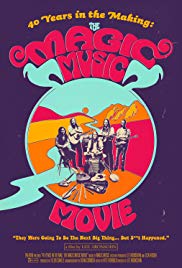
40 YEARS IN THE MAKING: THE MAGIC MUSIC MOVIE (2018, doc)

August 5, 2018

 Greetings again from the darkness. Yes, I readily admit to being spoiled. Attending university in Austin, Texas meant (cheap) access to some truly amazing bands and music. Some of these performers went on to various levels of success, while others just kind of vanished. Because of this, I easily relate to Lee Aronsohn’s nostalgic and emotional mission to document the history of his favorite band, Magic Music, and pull off a nearly miraculous reunion concert some 40 years after the band broke up. Sure, his roots are Boulder, Colorado in the early 1970’s, but the connection he feels is universal.

When an early title card informs us that the film’s soundtrack consists of various unreleased songs from 1970-76, you will likely wonder why you should have any interest in a local Colorado band from five decades ago – especially one that never even had a recording contract. When we hear the music for the first time, we begin to understand. It’s a mixture of The Byrds, The Hollies, and CSNY with a dose of Grateful Dead. These hippies produced some beautiful harmonies! And hippies they were. Name another band that was formed at Pygmy Farms, a naturalistic living commune. The band members often lived in school buses in the mountains, only returning to Boulder to play music – often on the college campus.

The history of the band is fairly interesting, and over the years, it was made up of 7-8 different guys with nicknames like Tode, Flatbush, Poonah, and Spoons. They were the opening act for both Jesse Colin Young and Cat Stevens, and turned down their shot at a record deal because they steadfastly refused to add a drummer. Of course, 40 years later, they admit that “drums are pretty cool”. A total lack of business sense stood in the way of the wide world hearing their music. We’ve often known of bands breaking up due to a battle of egos, and this one is no different. After the breakup in 1976, the band members spread out across North America, their music only a distant memory to those who had heard them play live.

Enter TV writer/producer Lee Aronsohn, known for two mega-hits, “The Big Bang Theory” and “Two and a Half Men”. When Mr. Aronsohn became a father, he found himself singing Magic Music songs to his young daughter. Since he could never escape the music of his college years, he decided to see if he could recreate it. This is as much a personal journey for Aronsohn as it is a history of a band that never “made” it. His efforts to track down the band and arrange for the 2015 reunion concert are impressive and quite emotional. While you are likely unfamiliar with Magic Music, there is a certain pleasure and satisfaction in imagining one’s favorite band getting back together for one last jam. It’s obvious this meant a great deal to Mr. Aronsohn, and it’s a reminder of the power of music … and the magic.

watch the trailer:


GENERATION WEALTH (2018, doc)

August 2, 2018

 Greetings again from the darkness. John Lennon wrote “Money don’t get everything, it’s true. What it don’t get, I can’t use. Now give me money. That’s what I want.” Gordon Gekko said “Greed, for lack of a better word, is good.” Photographer-Director Lauren Greenfield (THE QUEEN OF VERSAILLES, 2012) has spent the past 25 years chronicling the excesses of society. She now lets us in on what she has seen under her microscope (camera lens). It’s no surprise that we see a society that values money and beauty, no matter the cost. She also makes this very personal by confessing her own decisions and experiences along the way.

Serving as her own videographer, Ms. Greenfield’s film began as a photographic gallery exhibition, was published as a photography book, and has now morphed into a feature length documentary – one that blends much of her previous work. Her lens focuses on such varied subjects as celebrity kids, porn stars, eating disorders, the fashion world, beauty pageants for kids, high commerce, plastic surgery, family sacrifices, the end of the gold standard, and historical societies. It will likely cause you to blush, as well as shake your head in a disgusted all-knowing manner.

An unusual lineup of interviewees includes author Bret Easton Ellis, whose “Less Than Zero” is acknowledged as an inspiration by Ms. Greenfield; porn star Kacey Jordan, whose affiliation with bad boy Charlie Sheen made tabloid headlines; former billionaire Hedge Fund Manager Florian Homm; a workaholic woman with no time for a family or life; a participant from “Toddlers and Tiaras”; and journalist Chris Hedges who offers up a history lesson.

Every segment of the film is about excess. The beauty pageant kid crows “money, money, money”. Mr. Homm croons “come to me” as if speaking directly to money. The son of a rock star (Kevin Cronin of REO Speedwagon) speaks to growing up wealthy, and a high school classmate of Kate Hudson recalls her spouting off about her famous parents. Ms. Jordan admits to hoping one of her sex tapes (she has “lots”) will put her on top like it did for her hero Kim Kardashian. Mr. Hedges explains via the Great Pyramids, that societies accrue their greatest wealth at the moment their decline begins (which of course is an obvious mathematical certainty). His point is that all “great” societies of the past have crumbled, but he expects when it happens to us, it will bring down much of the world.

As director Greenfield interjects her own family (including her two sons) into the film, we get the feeling she is either making amends or perhaps using the process as her own therapy for the sacrifices she made for her career … a career that puts a magnifying glass to society. She discusses the emphasis on wealth during the Ronald Reagan Presidency, and even throws in a glimpse of similar excesses in China, Moscow, Ireland and Dubai.

The old values of hard work and saving money have morphed into what has now become the new American Dream of consumption and luxury. It’s a Kardashian society – or at least a society that dreams of living the life of a Kardashian. By the end of the film, the entertaining tales of Mr. Homm’s lust for the almighty greenback has given way to a devastatingly sad (in a pitiful way) story unworthy of his cigar twirling. A Beverly Hills woman so desperate to purchase the hot new luxury handbag explains the “what’s next” syndrome. The fixation, even addiction, to money, status, and physical beauty seems to be one that can’t be cured … though the film ignores those who don’t share in the “dream”. We are reminded to be careful what you wish for, and that “Money can’t buy me love” … or even much happiness. Ms. Greenfield’s tale attempts to end with a lesson in values – hug those close to you, but the overall message is entirely too downbeat for such a final pick-me-up.

watch the trailer:


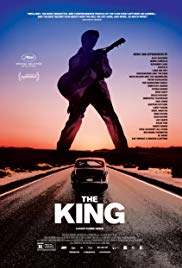
THE KING (2018, doc)

July 19, 2018

 Greetings again from the darkness. Those of us in the United States have always loved a rags-to-riches success story … it’s the personification of the American Dream. The only thing we seem to enjoy more is tearing down the pedestals that we build for those folks, and then ripping apart their legacy. Acclaimed director Eugene Jarecki (WHY WE FIGHT, 2005) strains rigorously in his attempts to connect Elvis Presley selling out his talent for money with the transformation of the U.S. from a democracy to a crumbling capitalistic empire (likened to ancient Rome). The really interesting thing is that the film, despite being a staccato mess, is quite fascinating.

Director Jarecki’s gimmick here is that he is taking a musical and historic road trip in the 1963 Rolls Royce once owned by Elvis. Along the way, he picks up passengers – some of which are musicians who perform in the backseat. The passenger list includes James Carville, John Hiatt, M Ward, Linda Thompson (ex-girlfriend of Elvis), Immortal Technique, and “best friend” Jerry Schilling (a comical description if you’ve read his book).

Chuck D from Public Enemy is interviewed due to his famous lyric: “Elvis was a hero to most, but he never meant s**t to me”. The contradictions from this interview fit nicely with the contradictions throughout the film. George Klein takes Jarecki on a quick tour of Humes High School, and Ashton Kutcher babbles about fame – though he makes one spot on remark regarding the prison of fame, something much of the film seems to ignore. Producer Ethan Hawke spends a good amount of time on camera and in the front seat, while author and activist Van Jones seems narrowly focused on cultural appropriation and angry that Elvis never used his clout to help the minorities that influenced him.

Filmed in 2016, the film works hard to include the Presidential election, and we even see the sanctimonious Alec Baldwin adamantly proclaiming that Trump won’t win. Jarecki is himself an activist, and here he stretches to prove his points – tying together everything from Elvis’ induction into the Army to the Trump election more than a half-century later (and 40 years after his death).

The road trip kicks off in Elvis’ birthplace of Tupelo, where we meet some locals who talk about the lasting impact of Elvis on their town – a town still drenched in poverty. Memphis is next, and we hear about the 3 local kings: BB, Elvis and MLK. Jarecki even inserts a shot of the Rolls next to the Lorraine Motel. There is a terrific bit with the students from Stax Music Academy who perform “Chain of Fools” in the backseat. We then head to NYC and Nashville, capping off the musically creative portion of Elvis’ career. Next up is Hollywood, Hawaii, and finally Las Vegas.

At times, the film is just flat out weird. One segment force feeds parallels with the 1933 KING KONG movie (yes, really), then Elvis as a tourist, and finally, Dan Rather’s all too familiar voice performing “America the Beautiful” … each piece featuring the Empire State Building. But just when a Bernie Sanders rally makes you want to turn off the film, we get an insightful Mike Myers effectively pointing out the hypocrisy of the American Dream as sold by the government, or David Simon questioning the choice of the Rolls over one of Elvis’ prized Cadillacs, or Sam Phillips’ (Sun Records) son re-telling the story of how his father lost Elvis to the carnival-barker Colonel Tom Parker (neither a Colonel nor a Parker).

Jarecki and co-writer Christopher St. John try to weave a tapestry of fame and money with cultural and societal shifts. Some segments work, while others fall flat. The editing of talking heads sometimes gives the feel of a debate, but often the scattered and choppy film meanders through multiple messages whilst driving the backroads of the country. We get clips of Elvis on the Ed Sullivan Show and getting his famous locks sheared in the Army, and the 1968 comeback special; however, there is little mention of Priscilla, Lisa Marie or Graceland.

Judging Elvis for money grab without seeming to take into account his young age (he was 21 when he first appeared on Sullivan, and 23 at his Army induction) and his extreme poverty of youth, much less the power of his domineering agent, seems to be harsh judgement in an era that had never seen such media giants as the Kardashians or Justin Bieber. When Jarecki’s road chief admits, “I don’t know what the hell you’re doing” (when Jarecki asks him what he thinks he’s doing with the movie), it’s the first time we can actually relate to what someone has said. Despite all of that, you’ll likely be glued to the screen for the full run time – either enjoying the songs, watching the clips, or trying to see if Jarecki’s puzzle pieces even fit together.

watch the trailer:


THIS IS CONGO (2018, doc)

June 28, 2018

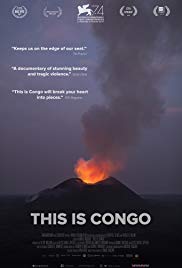
 Greetings again from the darkness. We citizens of the United States complain if our coffee is too strong or the line to purchase our new shoes is too long. In fact, we are world famous for our tendency to complain about anything and everything. Filmmaker Daniel McCabe never compares us directly to those in his subject country – but then he doesn’t need to. The words and pictures speak for themselves. For most, if not all of their lives, citizens of The Congo have been immersed in war … each day a struggle to survive, with only rare moments of feeling safe.

McCabe’s approach is to show us the lives of three separate individuals – each different, yet the same. We meet Colonel Ndala, a Congolese Army officer and war hero who has 12 bullet wounds to show for his love of country. There is also Mama Romance, an illegal mineral dealer who for 10 years has risked her life to make a better one. Lastly, there is Hakiza Nyantaba, an elderly tailor who totes his sewing machine with him every time war forces him to evacuate his home for the latest displacement camp. Early in the movie, we learn that growing up a child in The Congo should be “paradise”, but instead it’s “misery”. We witness the misery through the eyes of these three people.

Through the altered voice of a shadowy military figure, director McCabe presents a timeline of the unfortunate history of this region, dating back to King Leopold II “rescuing” the enslaved citizenry from the Arabs … only to exploit the region’s vast rubber mineral supply for his own riches. We also learn about the power struggle for control of The Congo between the U.S. and Russia during the Cold War, and the role neighboring countries Rwanda and Uganda have played in financing the multiple rebel factions (more than 50 and counting). This history lesson drives home the point that for the people of this area, regime changes, political corruption, self-serving involvement of other countries, and rebel uprisings are quite sadly, the way of life. As recently as 2016, President Joseph Kabila canceled the country’s election in order to extend his reign of power.

The film is beautifully photographed, and perfectly captures the often stunning landscape between violent bursts of war and personal fright. Mama Romance tells us that “hunger will teach you how to eat”, and with that, we understand the risks she takes. Colonel Ndala speaks to his dream of returning to his family farm life if somehow the never-ending war actually ends. Mostly we feel how these folks only experience joy and hope in short spurts. They are a resilient lot and their story deserves to be known, despite our being told “the country belongs to hell”.

watch the trailer:


THE GOSPEL ACCORDING TO ANDRE (2018, doc)

June 20, 2018

 Greetings again from the darkness. Being an expert, or even a genius, in one’s chosen field doesn’t necessarily translate to celebrity or a life in the public eye. Few of us can name the best structural engineer or the best commercial airline pilot, yet we regularly drive over bridges and book flights to our vacation spots. However some professions lend themselves to a bit of fame … and that’s either a burden or an opportunity depending on perspective.

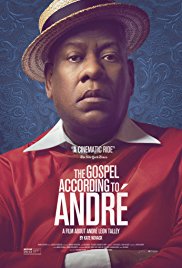
Director Kate Novack (writer of PAGE ONE: INSIDE THE NEW YORK TIMES, 2011) focuses her camera on one who seized the opportunity. Andre Leon Talley was raised in the Jim Crow South of North Carolina and rose up to become a literal giant in the fashion industry. It’s mostly a biopic of a fascinating, larger than life figure, but also a quasi-history of the fashion industry since the 1970’s. Andre crossed paths with all of the greats, and many of them are interviewed here: Marc Jacobs, Anna Wintour, Tom Ford, Valentino, Fran Leibowitz, Manolo Blahnik, and Isabella Rossellini – along with her pigs, a chicken and a turkey. We learn that he worked for Andy Warhol, was mentored by Diana Vreeland, and worked alongside Anna Wintour (teaching her as much as he learned).

Fashion is fleeting, style remains.” So Andre tells us as the film begins. He knows the difference between the two, and understands that beauty comes in many forms. Certainly the first, and often the only black man on the front row of runways in Paris and New York, Andre has lived quite the life. Director Novack’s film is at its best when Andre is front and center. He commands attention with his size, his clothes, his voice, his charisma, and mostly his talent. Claiming his eye developed watching the Sunday fashions at the black church of his youth, we also learn young Andre preferred shopping to attending a ballgame with his taxi-driving father.

Thin until age 40, Andre now describes himself as a manatee. The racism he faced within the industry is vivid as he recalls being called “Queen Kong”. Sometimes criticized for not taking a more active and vocal stance against racism, Andre simply proclaims that he was too busy with his career … his same reason for having ‘no love life’. The emotional moments of his recollections fade quickly in the segments where he discusses capes, and later veils. His expertise is on full display.

Looming over much of the film is the backdrop of the 2016 Presidential election. It’s often distracting, but does lead to one of the more powerful moments. This verbose, grandiose couture figure is stunned and mostly at a loss for words as Donald Trump takes his oath. For most of the film and for most of his life, Andre has talked the talk and walked the walk – and continued talking while he walked. As one of style and influence, he has plenty to say and there’s a reason for us to listen.

watch the trailer: