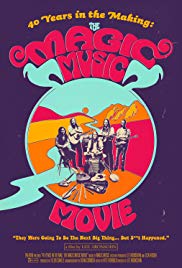
40 YEARS IN THE MAKING: THE MAGIC MUSIC MOVIE (2018, doc)

August 5, 2018

 Greetings again from the darkness. Yes, I readily admit to being spoiled. Attending university in Austin, Texas meant (cheap) access to some truly amazing bands and music. Some of these performers went on to various levels of success, while others just kind of vanished. Because of this, I easily relate to Lee Aronsohn’s nostalgic and emotional mission to document the history of his favorite band, Magic Music, and pull off a nearly miraculous reunion concert some 40 years after the band broke up. Sure, his roots are Boulder, Colorado in the early 1970’s, but the connection he feels is universal.

When an early title card informs us that the film’s soundtrack consists of various unreleased songs from 1970-76, you will likely wonder why you should have any interest in a local Colorado band from five decades ago – especially one that never even had a recording contract. When we hear the music for the first time, we begin to understand. It’s a mixture of The Byrds, The Hollies, and CSNY with a dose of Grateful Dead. These hippies produced some beautiful harmonies! And hippies they were. Name another band that was formed at Pygmy Farms, a naturalistic living commune. The band members often lived in school buses in the mountains, only returning to Boulder to play music – often on the college campus.

The history of the band is fairly interesting, and over the years, it was made up of 7-8 different guys with nicknames like Tode, Flatbush, Poonah, and Spoons. They were the opening act for both Jesse Colin Young and Cat Stevens, and turned down their shot at a record deal because they steadfastly refused to add a drummer. Of course, 40 years later, they admit that “drums are pretty cool”. A total lack of business sense stood in the way of the wide world hearing their music. We’ve often known of bands breaking up due to a battle of egos, and this one is no different. After the breakup in 1976, the band members spread out across North America, their music only a distant memory to those who had heard them play live.

Enter TV writer/producer Lee Aronsohn, known for two mega-hits, “The Big Bang Theory” and “Two and a Half Men”. When Mr. Aronsohn became a father, he found himself singing Magic Music songs to his young daughter. Since he could never escape the music of his college years, he decided to see if he could recreate it. This is as much a personal journey for Aronsohn as it is a history of a band that never “made” it. His efforts to track down the band and arrange for the 2015 reunion concert are impressive and quite emotional. While you are likely unfamiliar with Magic Music, there is a certain pleasure and satisfaction in imagining one’s favorite band getting back together for one last jam. It’s obvious this meant a great deal to Mr. Aronsohn, and it’s a reminder of the power of music … and the magic.

watch the trailer:


GENERATION WEALTH (2018, doc)

August 2, 2018

 Greetings again from the darkness. John Lennon wrote “Money don’t get everything, it’s true. What it don’t get, I can’t use. Now give me money. That’s what I want.” Gordon Gekko said “Greed, for lack of a better word, is good.” Photographer-Director Lauren Greenfield (THE QUEEN OF VERSAILLES, 2012) has spent the past 25 years chronicling the excesses of society. She now lets us in on what she has seen under her microscope (camera lens). It’s no surprise that we see a society that values money and beauty, no matter the cost. She also makes this very personal by confessing her own decisions and experiences along the way.

Serving as her own videographer, Ms. Greenfield’s film began as a photographic gallery exhibition, was published as a photography book, and has now morphed into a feature length documentary – one that blends much of her previous work. Her lens focuses on such varied subjects as celebrity kids, porn stars, eating disorders, the fashion world, beauty pageants for kids, high commerce, plastic surgery, family sacrifices, the end of the gold standard, and historical societies. It will likely cause you to blush, as well as shake your head in a disgusted all-knowing manner.

An unusual lineup of interviewees includes author Bret Easton Ellis, whose “Less Than Zero” is acknowledged as an inspiration by Ms. Greenfield; porn star Kacey Jordan, whose affiliation with bad boy Charlie Sheen made tabloid headlines; former billionaire Hedge Fund Manager Florian Homm; a workaholic woman with no time for a family or life; a participant from “Toddlers and Tiaras”; and journalist Chris Hedges who offers up a history lesson.

Every segment of the film is about excess. The beauty pageant kid crows “money, money, money”. Mr. Homm croons “come to me” as if speaking directly to money. The son of a rock star (Kevin Cronin of REO Speedwagon) speaks to growing up wealthy, and a high school classmate of Kate Hudson recalls her spouting off about her famous parents. Ms. Jordan admits to hoping one of her sex tapes (she has “lots”) will put her on top like it did for her hero Kim Kardashian. Mr. Hedges explains via the Great Pyramids, that societies accrue their greatest wealth at the moment their decline begins (which of course is an obvious mathematical certainty). His point is that all “great” societies of the past have crumbled, but he expects when it happens to us, it will bring down much of the world.

As director Greenfield interjects her own family (including her two sons) into the film, we get the feeling she is either making amends or perhaps using the process as her own therapy for the sacrifices she made for her career … a career that puts a magnifying glass to society. She discusses the emphasis on wealth during the Ronald Reagan Presidency, and even throws in a glimpse of similar excesses in China, Moscow, Ireland and Dubai.

The old values of hard work and saving money have morphed into what has now become the new American Dream of consumption and luxury. It’s a Kardashian society – or at least a society that dreams of living the life of a Kardashian. By the end of the film, the entertaining tales of Mr. Homm’s lust for the almighty greenback has given way to a devastatingly sad (in a pitiful way) story unworthy of his cigar twirling. A Beverly Hills woman so desperate to purchase the hot new luxury handbag explains the “what’s next” syndrome. The fixation, even addiction, to money, status, and physical beauty seems to be one that can’t be cured … though the film ignores those who don’t share in the “dream”. We are reminded to be careful what you wish for, and that “Money can’t buy me love” … or even much happiness. Ms. Greenfield’s tale attempts to end with a lesson in values – hug those close to you, but the overall message is entirely too downbeat for such a final pick-me-up.

watch the trailer:


THE KING (2018, doc)

July 19, 2018

 Greetings again from the darkness. Those of us in the United States have always loved a rags-to-riches success story … it’s the personification of the American Dream. The only thing we seem to enjoy more is tearing down the pedestals that we build for those folks, and then ripping apart their legacy. Acclaimed director Eugene Jarecki (WHY WE FIGHT, 2005) strains rigorously in his attempts to connect Elvis Presley selling out his talent for money with the transformation of the U.S. from a democracy to a crumbling capitalistic empire (likened to ancient Rome). The really interesting thing is that the film, despite being a staccato mess, is quite fascinating.

Director Jarecki’s gimmick here is that he is taking a musical and historic road trip in the 1963 Rolls Royce once owned by Elvis. Along the way, he picks up passengers – some of which are musicians who perform in the backseat. The passenger list includes James Carville, John Hiatt, M Ward, Linda Thompson (ex-girlfriend of Elvis), Immortal Technique, and “best friend” Jerry Schilling (a comical description if you’ve read his book).

Chuck D from Public Enemy is interviewed due to his famous lyric: “Elvis was a hero to most, but he never meant s**t to me”. The contradictions from this interview fit nicely with the contradictions throughout the film. George Klein takes Jarecki on a quick tour of Humes High School, and Ashton Kutcher babbles about fame – though he makes one spot on remark regarding the prison of fame, something much of the film seems to ignore. Producer Ethan Hawke spends a good amount of time on camera and in the front seat, while author and activist Van Jones seems narrowly focused on cultural appropriation and angry that Elvis never used his clout to help the minorities that influenced him.

Filmed in 2016, the film works hard to include the Presidential election, and we even see the sanctimonious Alec Baldwin adamantly proclaiming that Trump won’t win. Jarecki is himself an activist, and here he stretches to prove his points – tying together everything from Elvis’ induction into the Army to the Trump election more than a half-century later (and 40 years after his death).

The road trip kicks off in Elvis’ birthplace of Tupelo, where we meet some locals who talk about the lasting impact of Elvis on their town – a town still drenched in poverty. Memphis is next, and we hear about the 3 local kings: BB, Elvis and MLK. Jarecki even inserts a shot of the Rolls next to the Lorraine Motel. There is a terrific bit with the students from Stax Music Academy who perform “Chain of Fools” in the backseat. We then head to NYC and Nashville, capping off the musically creative portion of Elvis’ career. Next up is Hollywood, Hawaii, and finally Las Vegas.

At times, the film is just flat out weird. One segment force feeds parallels with the 1933 KING KONG movie (yes, really), then Elvis as a tourist, and finally, Dan Rather’s all too familiar voice performing “America the Beautiful” … each piece featuring the Empire State Building. But just when a Bernie Sanders rally makes you want to turn off the film, we get an insightful Mike Myers effectively pointing out the hypocrisy of the American Dream as sold by the government, or David Simon questioning the choice of the Rolls over one of Elvis’ prized Cadillacs, or Sam Phillips’ (Sun Records) son re-telling the story of how his father lost Elvis to the carnival-barker Colonel Tom Parker (neither a Colonel nor a Parker).

Jarecki and co-writer Christopher St. John try to weave a tapestry of fame and money with cultural and societal shifts. Some segments work, while others fall flat. The editing of talking heads sometimes gives the feel of a debate, but often the scattered and choppy film meanders through multiple messages whilst driving the backroads of the country. We get clips of Elvis on the Ed Sullivan Show and getting his famous locks sheared in the Army, and the 1968 comeback special; however, there is little mention of Priscilla, Lisa Marie or Graceland.

Judging Elvis for money grab without seeming to take into account his young age (he was 21 when he first appeared on Sullivan, and 23 at his Army induction) and his extreme poverty of youth, much less the power of his domineering agent, seems to be harsh judgement in an era that had never seen such media giants as the Kardashians or Justin Bieber. When Jarecki’s road chief admits, “I don’t know what the hell you’re doing” (when Jarecki asks him what he thinks he’s doing with the movie), it’s the first time we can actually relate to what someone has said. Despite all of that, you’ll likely be glued to the screen for the full run time – either enjoying the songs, watching the clips, or trying to see if Jarecki’s puzzle pieces even fit together.

watch the trailer:


THIS IS CONGO (2018, doc)

June 28, 2018

 Greetings again from the darkness. We citizens of the United States complain if our coffee is too strong or the line to purchase our new shoes is too long. In fact, we are world famous for our tendency to complain about anything and everything. Filmmaker Daniel McCabe never compares us directly to those in his subject country – but then he doesn’t need to. The words and pictures speak for themselves. For most, if not all of their lives, citizens of The Congo have been immersed in war … each day a struggle to survive, with only rare moments of feeling safe.

McCabe’s approach is to show us the lives of three separate individuals – each different, yet the same. We meet Colonel Ndala, a Congolese Army officer and war hero who has 12 bullet wounds to show for his love of country. There is also Mama Romance, an illegal mineral dealer who for 10 years has risked her life to make a better one. Lastly, there is Hakiza Nyantaba, an elderly tailor who totes his sewing machine with him every time war forces him to evacuate his home for the latest displacement camp. Early in the movie, we learn that growing up a child in The Congo should be “paradise”, but instead it’s “misery”. We witness the misery through the eyes of these three people.

Through the altered voice of a shadowy military figure, director McCabe presents a timeline of the unfortunate history of this region, dating back to King Leopold II “rescuing” the enslaved citizenry from the Arabs … only to exploit the region’s vast rubber mineral supply for his own riches. We also learn about the power struggle for control of The Congo between the U.S. and Russia during the Cold War, and the role neighboring countries Rwanda and Uganda have played in financing the multiple rebel factions (more than 50 and counting). This history lesson drives home the point that for the people of this area, regime changes, political corruption, self-serving involvement of other countries, and rebel uprisings are quite sadly, the way of life. As recently as 2016, President Joseph Kabila canceled the country’s election in order to extend his reign of power.

The film is beautifully photographed, and perfectly captures the often stunning landscape between violent bursts of war and personal fright. Mama Romance tells us that “hunger will teach you how to eat”, and with that, we understand the risks she takes. Colonel Ndala speaks to his dream of returning to his family farm life if somehow the never-ending war actually ends. Mostly we feel how these folks only experience joy and hope in short spurts. They are a resilient lot and their story deserves to be known, despite our being told “the country belongs to hell”.

watch the trailer:


THE GOSPEL ACCORDING TO ANDRE (2018, doc)

June 20, 2018

 Greetings again from the darkness. Being an expert, or even a genius, in one’s chosen field doesn’t necessarily translate to celebrity or a life in the public eye. Few of us can name the best structural engineer or the best commercial airline pilot, yet we regularly drive over bridges and book flights to our vacation spots. However some professions lend themselves to a bit of fame … and that’s either a burden or an opportunity depending on perspective.

Director Kate Novack (writer of PAGE ONE: INSIDE THE NEW YORK TIMES, 2011) focuses her camera on one who seized the opportunity. Andre Leon Talley was raised in the Jim Crow South of North Carolina and rose up to become a literal giant in the fashion industry. It’s mostly a biopic of a fascinating, larger than life figure, but also a quasi-history of the fashion industry since the 1970’s. Andre crossed paths with all of the greats, and many of them are interviewed here: Marc Jacobs, Anna Wintour, Tom Ford, Valentino, Fran Leibowitz, Manolo Blahnik, and Isabella Rossellini – along with her pigs, a chicken and a turkey. We learn that he worked for Andy Warhol, was mentored by Diana Vreeland, and worked alongside Anna Wintour (teaching her as much as he learned).

Fashion is fleeting, style remains.” So Andre tells us as the film begins. He knows the difference between the two, and understands that beauty comes in many forms. Certainly the first, and often the only black man on the front row of runways in Paris and New York, Andre has lived quite the life. Director Novack’s film is at its best when Andre is front and center. He commands attention with his size, his clothes, his voice, his charisma, and mostly his talent. Claiming his eye developed watching the Sunday fashions at the black church of his youth, we also learn young Andre preferred shopping to attending a ballgame with his taxi-driving father.

Thin until age 40, Andre now describes himself as a manatee. The racism he faced within the industry is vivid as he recalls being called “Queen Kong”. Sometimes criticized for not taking a more active and vocal stance against racism, Andre simply proclaims that he was too busy with his career … his same reason for having ‘no love life’. The emotional moments of his recollections fade quickly in the segments where he discusses capes, and later veils. His expertise is on full display.

Looming over much of the film is the backdrop of the 2016 Presidential election. It’s often distracting, but does lead to one of the more powerful moments. This verbose, grandiose couture figure is stunned and mostly at a loss for words as Donald Trump takes his oath. For most of the film and for most of his life, Andre has talked the talk and walked the walk – and continued talking while he walked. As one of style and influence, he has plenty to say and there’s a reason for us to listen.

watch the trailer:


EATING ANIMALS (2018, doc)

June 18, 2018

 Greetings again from the darkness. Our food supply and sources have become a deserved focal point of interest over the past few years, and director Christopher Quinn brings the 2009 best- selling book by Jonathan Safran Foer to the big screen to ensure we are paying attention. What began as a project looking at how animals were raised to fulfill the demand for edible meat, evolved into an analysis of traditional farming methods versus today’s prevalent factory/big corporation farming. We learn that the growing demand for affordable and convenient food in the 1970’s really kicked off the factory farming industry, and now it’s roughly 99% of the market. Only 1% of farmers resisted and survived (as farmers).

We eat meat not because of how it’s produced, but in spite of it.” Consumers demand delicious, affordable and convenient food, and the film looks at beef, chicken, turkey, pigs and dairy. We are told that factory farming began accidentally thanks to an overshipment of baby chicks several decades ago. Farming and our food supply haven’t been the same since. There is some rare behind-the-scenes footage from factory farms that is difficult to watch. Narrator and Producer (Oscar winning actress) Natalie Portman talks us through the disgusting “pink lagoons” of hog poop, as well as how the raising of animals for food is said to be responsible for up to half of climate change, and for having a significantly negative impact on air pollution and water quality.

Of course most people, when asked, are against animal abuse and geological degradation so what goes on “inside” the barns remains confidential and secure. Going behind the doors of Confined Animal Feeding Operations, we witness conditions and actions that we would prefer not to see. We are informed that 80% of the anti-biotics being produced go towards farm factory animals, and the goal is to modify normal growth size and speed by 4 times. With this approach comes increased risk of pandemics, superbugs, and flu viruses. That’s our tradeoff for the delicious, affordable and convenient demands.

The USDA comes under attack here as well. The agency is accused of silencing the whistleblowers who are doing the job the agency was created to do. They are now ‘protecting the fox, not the hen house’. This is all tracked back to politics and money from the big corporations affiliated with or benefitting from factory farming. Some old clips of Col Harland Sanders (of KFC fame) proves even he was concerned about this many years ago.

Emotion comes into play here as the connection of traditional farmers to their animals is contrasted to the mass production of farm factories. Industry secrecy and protection is presented as a red flag, and the independent farmers are shown as good guys while the giant corporations remain faceless and (mostly) nameless. Only towards the end of the film do we gain some insight into the research being conducted on meat replication through plant-based systems. It’s brilliantly compared to the early days of “gas light substitute” as a name for Edison’s electricity. We are told that India and China now combine to total almost 3 billion people, and their diets are trending towards that of the U.S. – leading to more pressure for faster and cheaper food. Traditional farming isn’t even taught in school these days, and the film barely touches on the always on-going debate between “humanely” raising animals for food vs. veganism. The film succeeds in showing us the problems, but doesn’t offer much in the way of solutions or even a better way … although it’s clear one is needed.

watch the trailer:


WON’T YOU BE MY NEIGHBOR? (2018, doc)

June 8, 2018

DALLAS INTERNATIONAL FILM FESTIVAL 2018

 Greetings again from the darkness. Is it too good to be true? We often ask that question in life, but when it comes to Fred Rogers of “Mr. Rogers’ Neighborhood”, director Morgan Neville’s documentary proves the answer is no … he was good and true. Fred Rogers hosted the children’s TV show on PBS for more than 30 years, starting in 1968. The terrific (and surprisingly emotional) film provides the background of the show, and more importantly, profiles a wonderful man.

Director Neville (BEST OF ENEMIES: BUCKLEY VS VIDAL, 2015) has produced numerous biopics on musicians ranging from Keith Richards to Muddy Waters to Johnny Cash to Brian Wilson. His subject this time out was known for his singing the show’s familiar opening number, and his lyrical legacy was his substantial impact on many generations of children. Mr. Rogers was an ordained minister and, in the early days of television, recognized that violent cartoons were not appropriate programming for the formative childhood years. Even in the early years, he was an outlier with sincerity and wholesomeness in entertainment. He never shied away from tough topics – not even death – whether it was the assassination of Robert Kennedy or a dead fish in the aquarium on set. He spoke directly to children in a voice and language they understood.

There are interviews with fellow cast members, long timer crew members, and relatives, including his wife Joanne. We hear Francois Clemmons (Officer Clemmons on the show) discuss how Mr. Rogers addressed Clemmons’ homosexuality and race, adding poignancy to the shared televised foot bath. Archival footage takes us back to the early years, and we see Lady Aberlin and Daniel Tiger in both black and white and color segments. We learn that the puppet Daniel most resembled the personality of the host himself … a quiet, patient, compassionate being who cared about others.

We see footage of Fred Rogers testifying in front of a Senate sub-committee to prevent funding for PBS from being eliminated, and we see numerous cardigan sweaters and tennis shoes. Mostly we see the approach of a man who built a legacy on kindness and human decency … a lifetime pursuit of uniting that led to struggles with depression. His obsession with 143 – both his weight and his code for “I love you” provides some insight into his personality, and mostly we hear others speak of his lasting impact.

Rather than comedy and pranks, Mr. Rogers was intent on making kids feel safe and secure in a scary world. Sure he educated – often subtly – but it was his innate ability to comfort that kept kids coming back. There are naysayers who say he is responsible for generations of entitled kids who grew into entitled adults, but the film addresses this by showing Roger’s commencement address where he clearly explains the “special” label. His final show was in 2000 and he died in 2003. His legacy is simple yet powerful. We can each do better. We can each be better. We can each be better neighbors.

watch the trailer:


POPE FRANCIS: A MAN OF HIS WORD (2018, doc)

May 18, 2018

 Greetings again from the darkness. Director Wim Wenders has had a varied and diverse career dating back 50 years with both narrative and documentary films. He is probably best known for PARIS TEXAS (1984), WINGS OF DESIRE (1987), and PINA (2011). As a filmmaker, he seems to excel at finding a slightly different way of looking at a subject or topic, and because of this, some of his projects are better received than others. This time out he is granted remarkable one-on-one access to Pope Francis, as well as some terrific archival footage obtained from the Vatican.

Jorge Mario Bergoglio from Buenos Aires, Argentina became Pope in 2013, and he chose Francis as his papal name. Director Wenders spends much of the movie making the connection and correlation to his namesake St Francis of Assisi – some 800 years ago. Wenders’ artistic flair comes through in the black and white dramatization sequences, which are meant to send us back to the time of Assisi so we can grasp the parallels.

This is no sales pitch for Catholicism, but rather an introduction to the man, his vision and approach. It seems clear that this “reformer” is what was needed after the ultra-conservative Pope Benedict “retired” (an unprecedented step). Rather than harp on the prior missteps, the film focuses on this most engaging and sincere man who is devoted to the causes of poverty and immigrant rights. He believes we should follow the Law of Nature: we should all live in harmony; and that we are all responsible for the world and community in which we live. Pope Francis tells us of his 3 T’s: terra (land), trabajo (work), and techo (housing), and how those are the foundation of a future named “hope”.

Beyond those elements, this is no sound bite film. It is quite humbling to listen to a man so universal in thought. He has zero tolerance for pedophilia inside the church or out, and he firmly believes in the rewards of listening – yet another dot Wenders tries to connect with St Francis of Assisi. The camera (and hence, us) travels the globe with the Pope – Africa, Brazil, Greece, the United States, Israel and more. So many countries, religions and races are touched. He even symbolically washes the feet of the less fortunate.

There is a good deal of talking head interviews with the Pope himself, and he never shies away from a question … leading us to the single criticism of the film. Wenders, acting here as narrator and facilitator, simply doesn’t push hard enough on some of the difficult topics that could lead to real insight and debate. So we are left to ponder if this wonderful man can mitigate change within a Church that is not much known for it (check out the demographics of the group of Cardinals Francis addresses). Wenders delivers an affectionate glimpse of the man, and we leave with a bit more admiration and hope – not such a bad thing.

watch the trailer:


THE DEVIL AND FATHER AMORTH (doc, 2018)

April 20, 2018

 Greetings again from the darkness. In 1971, William Friedkin directed one of my all-time favorite films, THE FRENCH CONNECTION. He won the Oscar for Best Director. But of course that’s not the movie which entrenched him as a cinematic legend. Two years later he directed THE EXORCIST, a film that, 45 years later, still regularly appears at or near the top of most “Best Horror film” lists.

For most of his adult life (he’s now in his 80’s), Mr. Friedkin has been associated with exorcisms, and he kicks off this documentary by confessing that he will be attending his first ever actual exorcism … and will be filming the ceremony. It’s a ritual very few of us have ever witnessed, and we learn that more than 500,000 Italians seek exorcisms from a priest each year. The director seems very anxious to take us along on his journey.

We get interviews and footage from multiple associated folks: Jeffrey Burton Russell, author of “The Prince of Darkness” and other satanic novels; William Peter Blatty, author of “The Exorcist”; a young Los Angeles priest who simultaneously expresses skepticism while stating he wouldn’t want to get that close to the devil;  and a couple of Neurosurgeons and some Psychiatrists. There are also interviews with a brother and sister recalling her experience of having a liberating exorcism performed on her, and the titular Father Gabriele Amorth – one of the most beloved figures in the Catholic Church. He was Head Exorcist for the Diocese of Rome for more than 30 years.

Whether the movie works for you or not (whether you believe it’s real) likely depends on the interview we neither see nor hear. Mr. Friedkin’s build up is to the exorcism he attends as Father Amorth performs the 9th exorcism on ‘Cristina’. It’s May 1, 2016 and there are perhaps 12-15 people in the room, including Cristina’s parents and boyfriend. She has struggled with “demonic possession” for years, and the footage is quite startling – especially the audio of the guttural voice from such an innocent looking lady. It’s also Father Amorth’s 91st birthday and he literally thumbs his nose at the devil. It’s after this ceremony where Friedkin claims he was to interview Cristina in a local church. Inexplicably, he doesn’t have his camera, so we only hear him tell of the horrific events.

Mr. Friedkin directs the film (co-written with noted film critic Mark Kermode) and also acts as our guide through the rituals and beliefs associated with exorcisms. There is a bit of a “Dateline” vibe to the production, though it’s a bit surreal to hear Father Amorth proclaim to the evil spirits, “You are banned forever”. As has been the tradition for years, religion and science are at odds with the subject. Neurosurgeons label it “delirium”, while Psychiatrists call it “Disassociate Trance Disorder”. Is it merely a placebo effect caused by religious beliefs, or does Satan exist? Perhaps author Jeffrey Burton Russell says it best: “stay away from this stuff”.

watch the trailer:


HE LIED ABOUT EVERYTHING (2018, doc)

February 24, 2018

 Greetings again from the darkness. We have learned through books, movies, and especially real life, that evil can arrive in many forms and often strikes when we are at our most vulnerable. Such is the remarkable and personal story told here by Benita Alexander. As an Emmy winning Producer for NBC News, she proclaims that she should be the last person who should fall victim in the way that she did. Whether seizing the professional opportunity to tell a fantastic story or going through the process as a form of therapy, Benita guides us through a maze of deceit that rocked the medical world, as well as her personal life.

Home video from a honeymoon suite in picturesque Santorini Greece in 2014 is how Benita initiates her confession of having fallen fast and hard for Dr. Paolo Macchiarini, a world renowned surgeon. In what can best be described as a whirlwind romantic fairy tale, Benita describes love at first sight (at a 2013 interview), Cinderella-type wedding plans featuring world leaders and the Pope, and the crushing emotional angst when it all came crashing down.

Benita utilizes her investigative reporting skills to present her story in a way that helps us understand how all of this could have happened. The doctor swept her off her feet with lavish gifts and jet-setting trips, and then charmed her friends and family – all while receiving accolades for his revolutionary work with artificial trachea transplants. The film takes us to New York City, Rome, Barcelona, London and Russia, as Benita’s high and low points are revealed.

Steven Spielberg’s movie CATCH ME IF YOU CAN told the story of charlatan Frank Abignale, and though he stole money and broke trust, Abignale’s tale possesses none of the evil or madness of Dr. Paolo Macchiarini. His were no pranks. This was no episode of “Punk’d”. This doctor’s cruelty goes far beyond. We hear words like Frankenstein and murder to describe him and his reprehensible actions that left patients dying excruciating deaths. Benita tries to balance the story with her shattered dreams and the medical scandal, but seriously, it’s difficult to muster much sympathy for someone getting caught up in the social lives of the elite. It’s the doctor’s inexcusable medical fraud that is most overwhelming to us as viewers and caring human beings.

Benita is denied the ribbon on her story package as her final phone conversation leaves her lacking an answer to “Why?”  Her emotions and pain are minimized to us when she admits to being “conflicted”. This viewer found no reason for conflict, only anger and disgust. Dr. Paolo Macchiarini may have been “selling hope”, and falling for his act may be forgiven, but once the fraud is exposed, there is no room for mercy or conflict.

The documentary is scheduled to stream on Investigation Discovery starting February 14. Valentine’s Day is either the best or worst day for this airing, depending on your perspective.