2040 (doc, 2020)

June 4, 2020

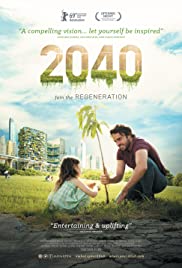
 Greetings again from the darkness.  Where do you see yourself in “X” years? That’s a common job interview question, and with a slight twist, it’s the question Damon Gameau asks himself and us … only his question is about our planet, and it’s meant to have us consider life for the next generation. Mr. Gameau makes it personal by structuring this as a (future) video letter to his 4 year old daughter Velvet, and describing what the world could be when she turns 25. What we immediately notice is that Gameau takes an optimistic approach, in contrast to the doom-and-gloom versions of climate change that we’ve come to expect. Rather than scare tactics, Gameau dishes hope.

In 2015, Australian Gameau delivered a documentary (THAT SUGAR FILM) where he dove mouth-first into the evils of sugar in our diet, and it’s his experience and training as an actor that allows him to come across as ‘one of us’ as he finagles his way through complicated topics. This time out, he tackles climate change and the environment, and he does so by focusing on the solutions and approaches that already exist. This is designed to prove to us that making a better tomorrow is within our grasp, and there’s no need for a miracle – and no excuse for waiting for one.

We follow along to different countries, and hear from many experts. The topics include carbon off-set, the oceans’ acidity level, solar-powered microgrids in Bangladesh, soil regeneration, on-demand self-driving electric cars, and doughnut-hole economics. Along the way, Gameau lets us hear from the experts, as well as a group of school kids who tell us what they’d like their future world to look like.

Science is discussed, but true science geeks may find this a bit too light on data and research. Gameau chooses instead to give us a glimpse into some available solutions from around the globe. We do learn that the oceans absorb heat and carbon, so carbon off-set through sequestering carbon and reducing emissions is essential. We learn that one-third of farmland is used to grow food for animals, so the advantage to growing more food is obvious – and it also leads to interesting discussions of soil regeneration. Given our current structure, it’s difficult to imagine if many parking lots and roads could be converted to greenspace again, and the on-demand self-driving electric cars segment was quite enlightening.

Kate Raworth wrote the 2017 book “Doughnut Economics: Seven Ways to Think like a 21st Century Economist”, and the Gameau gives us an animated overview of what this means. Whether it’s a practical solution is unclear, but Gameau has enlisted passionate people to his cause of focusing on existing solutions to provide a better future. Even though his ‘imagined’ year 2040 features him with grey hair, and the score throughout is quite obtrusive, Damon Gameau is to be commended for an entertaining and positive look at what we can do right now to ensure a better tomorrow. There is hope.

The film is available VOD on June 5, 2020, and for more information: https://whatsyour2040.com/

watch the trailer:


THE PAINTER AND THE THIEF (2020, doc)

May 21, 2020

 Greetings again from the darkness. Artists think differently than the rest of us. Not only do they see the world with an offbeat or skewed vision, but they process life events in ways we sometimes can’t fathom. For instance, if a crime were committed against you – say, your property was stolen – your natural response would be anger, or a desire for justice for the perpetrator. In Norwegian director Benjamin Ree’s documentary, Czech artist Barbora Kysilkova reacts much differently when her two most valuable paintings are stolen. She befriends the thief.

We see the security video footage. Karl-Bertil Nordland and another man break into Oslo’s Galleri Nobel and then walk out with Barbora’s paintings. Upon being apprehended, the painter and thief have a chat in the courtroom. Bertil confesses that he chose the paintings because they were “beautiful.” The artist is intrigued and invites the thief to pose for a portrait when he is released from jail. As if this situation isn’t bizarre enough, Bertil claims he has no idea where the stolen paintings are, and has no memory of what happened. Yes, he’s also a drug addict.

It’s a bit uncomfortable to watch post-prison Bertil lounging on Barbora’s sofa as she sketches him and they converse about philosophies of life. Slowly, their relationship builds into a friendship. It’s an unlikely connection through art. We get a rare glimpse of an artist at work, as we see Barbora in her studio working on her pieces. Of course, she is also saddened by the loss of the two unrecovered pieces, and we also witness the artist struggle with the commerce/business side of art, as she faces frequent rejections from galleries as she attempts to display her work. This is on top of the lectures from her boyfriend … lectures delivered in the manner a parent would talk to their kid.

One of the more surreal moments occurs when the camera films Barbora at Bertil’s place, and she sketches him and his girlfriend in a provocative pose. During all of this, we hear Barbora discussing why she finds Bertil interesting, despite his junkie-criminal lifestyle. After all, he is the kind of guy who scores a fix on his way to rehab. Things get very interesting … in a weird way … when Ree turns the tables and films Bertil analyzing Barbora.

These two have studied each other over the years, and may have a better understanding of their friend, than they do of themselves. Watching Barbora act as caregiver for an injured Bertil is a confusing development to process, but it goes back to how artists see the world through their own eyes. Her paintings may be ultra-realistic, but her life barely qualifies as our reality … at least until the rent is past due. The connections through the circle tattoo may come across as somewhat creepy, and we find ourselves a bit skeptical of many scenes where the camera is present, but there is no denying this works as a remarkable character study of two people we wouldn’t normally categorize as friends.

Neon is presenting this via Virtual Cinema beginning May 22, 2020

watch the trailer:


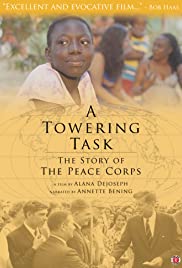
A TOWERING TASK: THE STORY OF THE PEACE CORPS (2020, doc)

May 21, 2020

 Greetings again from the darkness. The PSAs that frequently popped up on my childhood TV are vivid memories, though it took many years before I had any concept of what the Peace Corps was, how it was formed, and what it did. Director Alana DeJoseph, herself a Returned Peace Corps Volunteer (RPCV), and writer Shana Kelly want to make sure we all know the history of the organization, what its mission has been for almost 60 years, and most importantly, that the Peace Corps still exists today.

William J Lederer and Eugene Burdick co-wrote the 1958 political novel “The Ugly American”, and the best-seller had a surprising effect on John Kennedy’s ability to get The Peace Corps established not long after he became President of the Unites States.  In 1961, President Kennedy named his brother-in-law, Sargent Shriver, as the organization’s first director. Shriver was a passionate leader and served as the director into 1966. We see archival footage and photographs of Shriver’s time with the Peace Corps, and learn that a memo from his task force was responsible for the phrase “A Towering Task”, a recurring reference over the years, and the title of this film.

From the beginning, there were vocal skeptics. An escape plan for ‘draft dodger’ is how many cynics labeled The Peace Corps, and it was a difficult label to shake. We learn that in the beginning, four out of every five applicants was denied admission, and the footage of those early training regimens looked more like the Marines than a volunteer service organization. Still, many were attracted to the stated mission: Promote World Peace and Friendship, a mission that remains in place today.

In addition to the treasure trove of archival footage and speeches, there are many interviews with authors, former volunteers, and many of the directors who have served. We view some of the recruiting films and PSAs and travel through the procession of US Presidents from Kennedy through Trump, and explore the various challenges faced by the Peace Corps. One of the more in-depth segments involves the longest-serving former director Loret Miller Ruppe, who was director from 1981-89. Her recounting the story of the Prime Minister of Fiji and his words to Ronald Reagan are a highlight.

Ms. DeJoseph and Ms. Kelly have delivered a most-informative history of the Peace Corps in a matter-of-fact manner. Four-time Oscar nominee Annette Bening serves as the narrator, and her work is serviceable, though lacking in energy. The film is neither propaganda nor a hard sell for volunteers, and it’s not what one would call entertaining. Instead, it serves as a detailed timeline of this important agency, and that is an important step for posterity.

Available in Virtual Cinema beginning May 22, 2020

watch the trailer:


MOSSVILLE: WHEN GREAT TREES FALL (2020, doc)

May 9, 2020

 Greetings again from the darkness. The film draws its title from both the town it studies and a Maya Angelou poem. It opens with a short excerpt from that poem; though not until we have watched documentarian Alexander Glustrom’s film do we fully understand the connection. Mossville is a rural community just outside Lake Charles, Louisiana. It was settled by free slaves in the 1800’s, and this is the story of how that history is literally being bulldozed from existence.

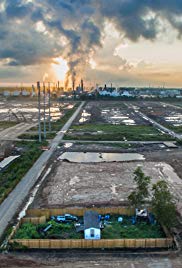
Mr. Glustrom makes the story personal by serving up the stories of Mossville residents Stacey Ryan and Erica Jackson, with Mr. Ryan getting the most attention since he is truly the last holdout. Holdout from what? Well that would be the massive industrial construction project of SASOL (South African Synthetic Oil Limited), which the state leaders excitedly announced would bring a $14 billion investment inside the Louisiana borders. We learn the Mossville population peaked at more than 8000, but after the SASOL land purchase, most of the community no longer exists.

Stacey Ryan is a holdout, and aerial views show the stunning transformation of the land from majestic trees and comfortable homes to acreage stripped of anything living that’s not operating heavy equipment … other than Mr. Ryan. His little plot stands out as an anomaly – a mobile home and battered pickup in the midst of a steady stream of bulldozers and dump trucks. Even after his utilities are cut off, Mr. Ryan remains. He explains that during his school days, he was referred to as “Greasy” because he was constantly working on cars. His mechanical skills allow him to rig up electrical, water, and sewer. He’s a resourceful guy fighting industrial facility encroachment.

“Fenceline community” seems to be an insufficient description of Mossville. An EDC spill … a toxic industrial accident … affected many in the area, and that’s where Erica Jackson comes in. She’s located in the “voluntary buyout” area, and explains how her family has been inordinately impacted by disease since the spill. The widespread health issues of her family and previous neighbors are addressed by an Environmental attorney, but it’s a story we’ve heard many times before. Corporate negligence and systemic racism seem to be ignored when it comes to “progress” and when capital investments are at stake. A reasonable middle ground seems possible, though that’s rarely the case.

Mr. Ryan states, “I elected to stay behind because there is no other place for me.” He has his own personal dreams for raising his son, and no one can spend this time with him and judge him as some radical or rebel … he even introduces us to the Mossville Sabretooth Squirrel! He’s simply trying to stay connected to his family roots, though deep down, he knows the days are numbered. There is no fairy tale ending, as this is the reality of a population that is outgrowing its home planet. Mr. Ryan states, “To them, I don’t exist.” This brings us back to the Maya Angelou poem: “They existed. They existed. We can be. Be and be better. For they existed.”

now streaming in Virtual Cinemas

watch the trailer:


SPACESHIP EARTH (2020, doc)

May 7, 2020

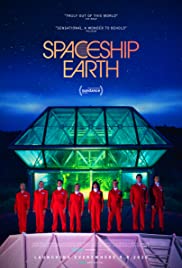
 Greetings again from the darkness. Most all of us built a terrarium for science class when we were in junior high. Did you ever fantasize about living in it? Well that’s basically what happened in 1991 when 8 scientists were sealed up in Biosphere 2, a giant terrarium built in Oracle, Arizona. Their mission was to live a self-sustained existence for two years, and this was done in the name of scientific research that might one day lead to humans living in space. It was known as Biosphere 2 since they considered Earth to be number one, and filmmaker Matt Wolf kicks off the documentary with actual news clips from that day in 1991 when the door was shut behind the eight biospherians.

After running those initial clips, Mr. Wolf immediately takes us back 25 years prior, and introduces us to The Synergists – a group of resourceful, very smart, free-thinkers who assembled in San Francisco under the charismatic leadership of John Allen. At first, it’s a little confusing why we are watching these old ‘home movies’ from what appears to be a commune, and listening to these people, now 50 years older, talking about the good old days. Of course, the backstory of these folks with nicknames like Johnny Dolphin, Flash, Salty, and Firefly turns out to be the foundation of Biosphere 2 … but not before they form Synergia Ranch in 1969 New Mexico, and then build a ship in Oakland from scrap metal in 1974. Their ship was named Heraclitus, after the Greek philosopher, and their inspiration was derived from writers Buckminster Fuller (“Spaceship Earth”), Rene Damaul (“Mount Analogue”), and William S Burroughs.

It’s understandable if your thoughts drift towards ‘cult’ or ‘commune’, but as one of them states, they were “a corporation, not a commune.” With international interests in a hotel, an art gallery, and a theatrical group, amongst other enterprises, they were able to sustain their creative pursuits … unlike the many hippies of the era numbed by drug use. Inspired by the 1972 movie SILENT RUNNING, Mr. Allen and their in-house architect Phil Hawes began working on the idea of a self-contained space colony. By 1986, design work for Biosphere 2 had begun and Ft Worth oil billionaire Ed Bass was bankrolling the project. It was a massive undertaking both from planning and construction, plus the training and selection of biospherians began in 1990.

Given today’s ‘social distancing’ due to COVID-19, it’s a bit ironic that we are looking back at a 28 year ago small group isolation in a self-contained environment. Filmmaker Wolf doesn’t shy away from the science world skeptics who, with a smidge of jealousy labeled the venture “trendy ecological entertainment.” Whatever you call it, this was an international event and drew interest from all walks of life, right up until 1993 when the biospherians walked out of the dome. In another sign of remarkable symmetry to today’s world, in 1994 Mr. Bass fired most of the original group, and put Steve Bannon (yes THE Steve Bannon) in charge of Biosphere 2. It might not surprise you that most of the scientific data and research soon disappeared.

Wolf takes us 25 years after the mission to catch up with Mr. Allen and other Synergists. The Synergia Ranch still exists and John Allen remains as energetic and idealistic as he was in the 1960’s. Biosphere 2 is now open to the public and being managed by the University of Arizona, and we still aren’t sure whether a pre-fab paradise will work in space. Wolf’s film is filled with interesting tidbits from 3 different eras, and though the early days are quite entertaining, it seems entirely too much time is devoted to the time prior to the Biosphere. And because of that, many of our questions remain unanswered as to whether the two years advanced research, or whether the effort was nothing more than a glorified publicity stunt. Either way, capturing this in documentary form allows the 1991 Biosphere 2 project to be explained to future generations … some we hope will be as innovative, and dream as big as the Synergists.

The documentary will release May 8, 2020 on Hulu, VOD, Virtual Cinemas, and participating Drive-Ins.

watch the trailer:


NATALIE WOOD: WHAT REMAINS BEHIND (doc, 2020)

May 4, 2020

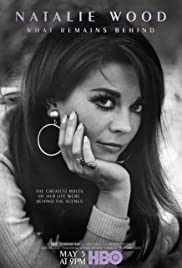
 Greetings again from the darkness. Natasha Gregson Wagner recalls hearing that the body of her mother, actress Natalie Wood, had been found near Santa Catalina Island. It was November 21, 1981 and Natasha was 11 years old. Now she’s a producer of this documentary, as well as providing her own perspectives, and conducting some of the interviews, in particular the one with her stepfather Robert Wagner. If you are looking for a definitive answer to one of Hollywood’s unsolved mysteries, you won’t find it here (or anywhere). Instead, it’s a dive into the life and career of one of our brightest stars through the words of her friends, family, and co-workers; plus some clips, personal home movies, previously unseen photographs, and Natalie’s own words.

Natalie Woods’ on screen luminescence lasted nearly forty years, which is remarkable considering she died at age 43. It’s noted that generations (plural) watched her grow up. She delivered memorable roles at all stages of her career: as a child actor playing the Santa Claus skeptic in MIRACLE ON 34th STREET (1947); as an angsty teenager opposite James Dean in REBEL WITHOUT A CAUSE (1955), as a blossoming young woman in SPLENDOR IN THE GRASS (1961); as a 1960’s swinger in BOB AND CAROL AND TED AND ALICE (1969); and in her final role (released posthumously) in BRAINSTORM (1983). She was nominated for 3 Oscars by the time she was 25, and is also remembered as Maria in Best Picture winner WEST SIDE STORY (1961), as famed stripper Gypsy Rose Lee in GYPSY (1962), co-starring with Steve McQueen in LOVE WITH THE PROPER STRANGER (1963), co-starring with Robert Redford in THIS PROPERTY IS CONDEMNED (1966), and opposite George Segal in the comedy THE LAST MARRIED COUPLE IN AMERICA (1980).

Clearly, given the films and roles listed above, Natalie Wood was the epitome of a movie star. She was beautiful, talented, and lived a life that kept her in the fan magazines (known today as tabloids). The film is structured in an unusual manner for a biographical documentary. A loose outline would start with the personal life (husbands, kids, love interests), then move into the career, and wrap up with her death, the aftermath of her death, and the impact she had on loved ones. Of course, there are many overlaps, but the key takeaway is that this is a very personal look by those who were connected to Natalie.

Laurent Bouzereau is a documentarian who has specialized in shorts and “making of” (behind-the-scenes) projects for 25 years. He’s also an author, movie buff, and known collector of movie memorabilia. Here he delivers a nice tribute to Natalie Wood, though one gets the feeling that Natasha had much to do with the final presentation. We see her interview Daddy Gregson and Daddy Wagner, the only names she ever remembers having for her biological father, British Producer-Agent Richard Gregson, and her stepfather Robert Wagner. Gregson, afflicted with Parkinson’s disease, died in August 2019, while Wagner is now 90 years old. Both interviews are personal to Natasha, though it’s the Wagner session that packs the most emotional punch.

Even when we hear about Natalie’s film career, it seems most want to talk about how likable and talented she was. This includes interviews with Robert Redford, Richard Benjamin, Mia Farrow, George Hamilton, and Mart Crowley. Mr. Crowley was a screenwriter and close friend who died recently (March 2020), and had met Natalie on the production of SPLENDOR IN THE GRASS. So while Ms. Woods’ career is important, even more time is spent on the personal side. Natasha and her sisters recall time with Willie Mae, their nanny who was like part of the family. We also learn of Natalie and Wagner’s (aka RJ) first date on her 18th birthday, as well as their two marriages to each other – with her marriage to Gregson, and relationship with Warren Beatty nestled between.

One of the more fascinating segments comes from Natasha reading excerpts from an unpublished first-person article Natalie had written for “Ladies Home Journal” in 1966. It reads like a diary and provided Natasha and us with personal insights we couldn’t have known. Natalie’s parents were Ukrainian immigrants, although not much time is devoted to Natalie’s stage mother or the strained relationship the family now has with Natalie’s sister (and actress) Lana Wood. Instead, the focus is mostly upbeat. Plus we all came for the Wagner interview to hear him speak about the night of Natalie’s death. It’s surprisingly emotional.

Natalie’s oft-reported “fear of dark water” is hit head on, and there is even mention of her overdose and mental struggles. But this is mostly a positive recounting of her life, and owes a great deal to Manoah Bowman’s biography “Natalie Wood: Reflections on a Legendary Life.” Bowman is also a producer on the film. Natalie Wood is one whose mysterious and much too early death has overshadowed her work, and as daughter Natasha says, the person she was.

The documentary premieres on HBO Tuesday May 5, 2020

watch the trailer:


THE BOOKSELLERS (doc, 2020)

April 15, 2020

 Greetings again from the darkness. One might think that the only thing less interesting than watching someone read a book would be watching them talk about a book they are buying and not intending to read. Director-Editor-Producer DW Young somehow manages to make the topic quite engaging … due in no small part to the stream of bibliophiles and antiquarian booksellers we meet. The philosophy of the film is best expressed through one of the many spot-on quotes sprinkled throughout: “Books are a way of being fully human.”

It’s either cheating or hedging one’s bet when a director secures an interview with the eloquent Fran Lebowitz for a documentary. If the documentary is about books, well that’s even better. She perfectly describes the joy in “crawling around” bookstores in search of just the right one. She recalls the days when bookstores lined 4th Avenue, in what had been labeled “Book Row.” These days, only one remains – The Strand, which was founded in 1929. We learn that in the 1950’s, there were 358 bookstores in New York City, and now your search for a good read is limited to 79. The oldest remaining NYC bookstore is the stunning Argosy on E. 59th, and it’s being operated by the three daughters of Louis Cohen who opened the store in 1925. Ownership of the building is key to the bookstore remaining open for nearly 100 years.

Director Young takes us inside the beautiful and historic Park Avenue Armory for the NYC Antiquarian Book Fair. It’s here where we see a Fidel Castro doll (I guess everything is collectable!), and more importantly get a feel for how the rare book trade works. These collectors are obsessive about their books and compulsive in their mission of the next rare discovery. We see warehouses, apartments, offices, and stores jam packed with books, and to cap it off, we hear from the folks who have made this their passion. Not just bibliophiles like Ms. Lebowitz, Gay Talese, and Susan Orlean, but the boots-on-the-ground booksellers and collectors. There is even a segment on Martin Stone, the legendary book scout or bookrunner, who was also a rock ‘n roll guitarist.

“The internet killed the hunt.” A perfect example is given on how the world wide web changed book selling and collecting. In the old days, a collector could spend years assembling a full collection of Edith Wharton books, whereas today, a credit card and an afternoon on the internet would yield the same results. This is ‘buying’ contrasted with ‘collecting’, and the old school collectors have either adjusted or are struggling. Even auctions have changed, and Bill Gates’ purchasing Leonardo Da Vinci’s “The Codex Leicester” via phone … for $28 million … is an example.

Movies about book dealers are discussed, including THE BIG SLEEP and UNFAITHFUL, and we see a clip of Larry McMurtry’s speech championing book reading and bookstores. It should also be noted that Mr. McMurtry is a long time book seller and collector from Archer City, Texas. One of the industry’s new celebrities is the ultra-charming Rebecca Romney, who became famous for her stints on TV’s “Pawn Stars” as the resident book expert. Ms. Romney is leading the new wave of collectors, and her passion as a glass-half-full type is contagious.

Author Maurice Sendak said “There’s so much more to a book than reading.” Here, we learn about the importance of book jackets and special bindings, and how these rare books are actually historical evidence … artifacts of culture. This explains why ‘book burning’ has the history it does as both symbolizing and physically accomplishing the destruction of certain segments of society. We also learn those in this business don’t think highly of Kindle. The words may be the same, but the experience certainly isn’t.

The film is billed as a behind-the-scenes look at the New York rare book world, but it spends more time exploring the folks who make-up this business/industry/lifestyle. Their passion, and one might even call it a fetish, is quite interesting. The argument can be made that their work is quite important in preserving history. Smooth jazz accompanies the story, and it’s only fitting that I learned a new word: Incunabulum, which is an early printed book. These collectors express concern about their legacy, so hopefully the film will spur even more people to understand the historical relevance of books in our cultured society.

Opens in Los Angeles virtual cinema on April 17, and nationally on VOD (Apple/iTunes, Amazon, and cable, satellite and digital platforms) on June 5, 2020

watch the trailer:


SPITFIRE 944 (doc short, 2006)

April 14, 2020

Greetings again from the darkness. I watch a lot of short films, yet post very few of those reviews on this site. For this special film, I am not offering up any type of review other than to encourage you to take 14 minutes and watch this documentary short.

Filmmaker William Lorton’s Great Uncle was Jim Savage, who was an Air Force field surgeon during WWII. When he died, Lorton discovered some untouched footage his Great Uncle had shot at an airbase.  One sequence in particular caught his eye: a wheels up landing in a grassy field by a Spitfire, followed by some airmen huddled up afterwards. After some research, Lorton tracked down the pilot, (retired) Lt Col John Blyth, who agreed to meet with Lorton and his crew.

The film clips are fascinating, but it’s 83 year old Blyth recalling his missions that is truly captivating. Blyth flew reconnaissance missions in a British Spitfire retrofitted with extra fuel tanks and cameras. What was missing? Guns. Blyth actually flew over Germany with no guns or escort!  Lorton films Blyth as he views the clip for the first time. It’s quite something to behold.

You can watch the documentary short here (thanks to Sundance, and a friend of a friend for sharing):


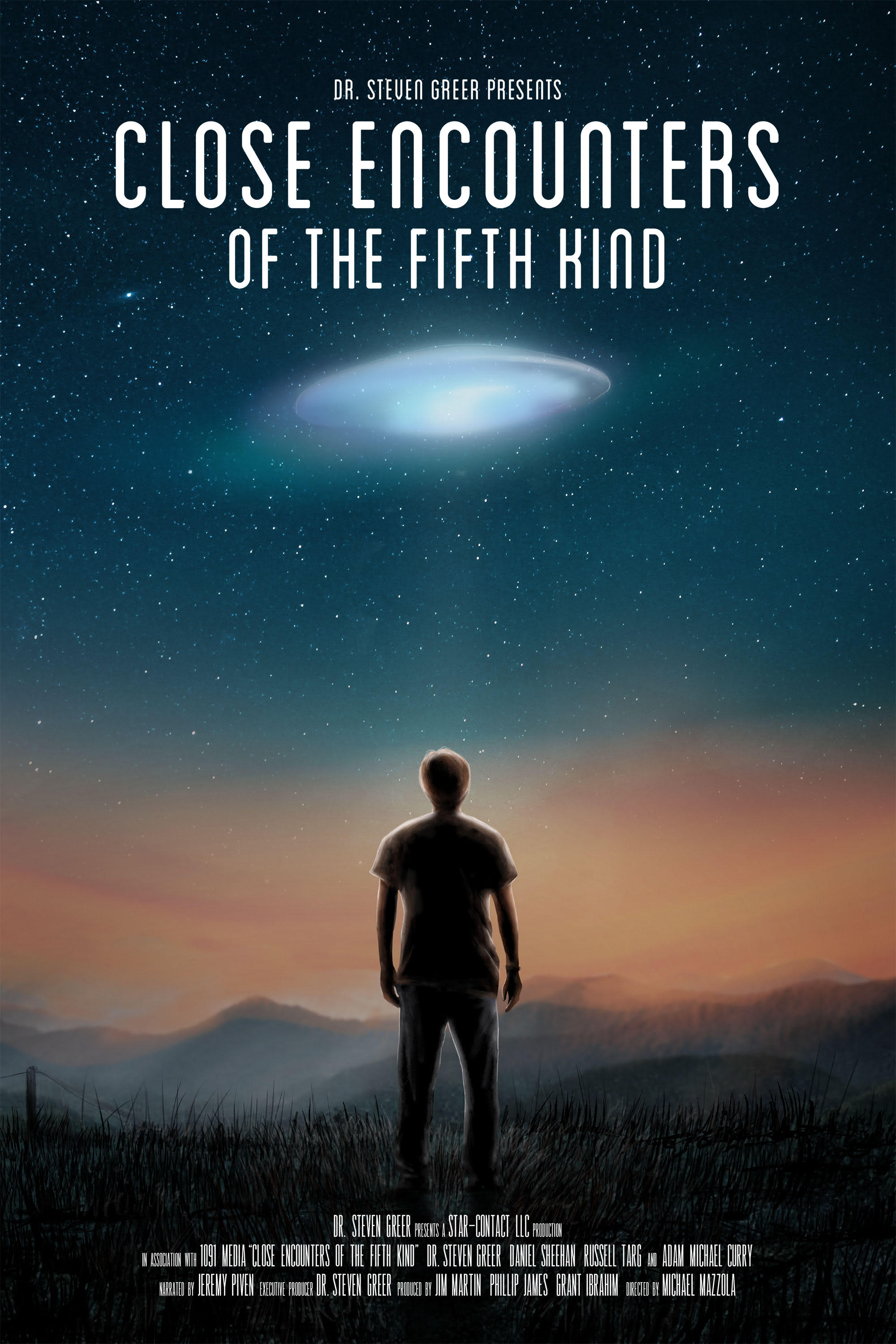
CLOSE ENCOUNTERS OF THE FIFTH KIND (2020, doc)

April 7, 2020

 Greetings again from the darkness. Whether you’re a believer or a skeptic, one must respect the dedication to the mission of Dr. Steven Greer. His documented research into extraterrestrial activity dates back more than 25 years, and he has briefed every president since Bill Clinton on the topic. This is the third documentary for Dr. Greer, including SIRIUS (2013) and UNACKNOWLEDGED (2017), the latter of which was directed by Michael Mazzola – also the director of this current film.

Mr. Mazzola divides the film into 3 chapters: Blood and Treasure, The Crossing Point of Light, and A New World. However, the film’s structure matters little, as this is mostly another opportunity for Dr. Greer to present his research, his beliefs, and allow others to comment. Dr. Greer is the founder of the Center for Study of Extra Terrestrial Intelligence (CSETI), and he was also behind the 1993 Disclosure Project, which persuaded the government to release previously classified documents pertaining to UFOs and extraterrestrials.

Of course, Steven Spielberg’s 1977 double Oscar winner CLOSE ENCOUNTERS OF THE THIRD KIND remains quite popular today, and the title to Mazzola’s film refers to what CSETI categorizes as the 5th kind of alien encounter: proactive human communication with an extraterrestrial. In support of this, Dr. Green spends a good amount of time explaining his group events, where believers gather to experience these encounters. It’s at this point where much of the film focuses on Universal consciousness (ESP, meditation, etc.). The parameters of pure heart and peace are said to be necessary for group meditation cohesion. It’s very similar to the idea of “attraction” – if we think about something, that thing is more likely to appear or happen.

A quote from a physicist opens the film, and numerous quotes are highlighted throughout courtesy of intellects, scientists, and spiritualists. Scientific analysis is provided and we hear from some brainy talking heads, including Dr. Edgar Mitchell, a former astronaut. Attorney Daniel Sheehan gets plenty of screen time as well, and does his part to fit right in with the line-up of articulate, knowledgeable experts who offer up their commentary. These are not the wild-eyed types we see on local news or lesser documentaries. These are folks with actual experience backed by video and photographic evidence.

Dr. Greer asserts that since “no human has ever been harmed”, we can assume the extraterrestrials are not here to cause damage – an easily debated point. He also claims that these aliens are up to a billion years ahead of us, though he never explains the math on that. Actor Jeremy Piven seems an odd choice as narrator, given his propensity for roles as a fast-talking smart-aleck, but a montage of video from around the globe (the most recent from December 29, 2019) lends credence to Dr. Greer’s claim that the collective conscience has a relationship to the physical world. He has also accepted that skeptics will always exist, and that he will be ridiculed for his work and beliefs. If nothing else, perhaps the film will open up a few minds to the possibility.

watch the trailer:


WALDO ON WEED (2020, doc)

April 3, 2020

 Greetings again from the darkness. Waldo James Mysterious Dwyer is a hefty name for a huge baby (13.5 pounds) born in 2014 to parents Brian and Danielle. When we first meet Brian, he’s a partner at Pizza Brain, a quaint neighborhood place to pick up a slice in Philadelphia. Waldo is their first child, and it’s clear from the beginning that these are loving, doting parents. He’s a spirited and active child, and at 6 months, a stunning diagnosis of eye cancer (Retinoblastoma) staggers the couple.

If you are a parent, you know with absolute certainty that you would do anything for your kid … especially if they are in pain. When Waldo has a severe reaction to chemotherapy, Brian takes the advice of his friends Larry and Mike, and begins researching cannabis as an alternative treatment. Since it’s illegal in Pennsylvania, Brian travels cross-country to California where medicinal cannabis is legal. The next thing we know, he’s been advised by “Dr Dina” and is boxing up a care-package disguised as birthday party goodies. He’s able to purchase an 8 month supply, and the next day, Waldo is getting his first dose. Immediate results bring smiles (and hope) to Brian, Danielle, and Waldo.

Much of the footage we see was shot by Brian on a video recorder he received at a baby shower. Tommy Avallone (THE BILL MURRAY STORIES: LIFE LESSONS LEARNED FROM A MYTHICAL MAN, 2018) turns the footage into a story, and better yet, a love letter/video journal from father to son. Brian and Danielle are devoted parents, but it’s Waldo who will steal your heart. His smile will lift you up, and his dancing will have you beaming.

We learn that in April 2016, Pennsylvania passed a bill legalizing medicinal cannabis; however, since the process of bringing it to market was going to last a couple of year, Brian and Danielle packed up Waldo and headed to the west coast. To categorize their plan as non-existent would not be an understatement, yet they knew this was necessary for their son’s health. You might cry a little. You’ll certainly smile plenty. And hopefully, we’ll all be a bit more empathetic and understanding towards parents … we don’t always know what they’re dealing with. Never underestimate what parents will do for their kids.

watch the trailer: