Greetings again from the darkness. Hollywood has long ignored the pushback on its habit of casting younger women as the love interest of older men. In most of those movies, the relationships are treated as normal and expected. In the few movies that turn the tables, a relationship between an older woman and younger man is typically treated as either comedy or scandal … consider Harold and Maude(1971) and Notes on a Scandal(2006). In this latest film, writer/director Michael Showalter (The Baxter) and co-writer Laura Terruso strive to balance heartfelt emotions with situational laughs.
Sally Field returns to leading lady status as Doris, a never-married frumpy accountant in her late 60’s who has been living in her childhood home whilst caring for her ailing mother … hoarding everything from magazines to packaged food seasoning to a single water ski. The film begins with the open casket funeral of Doris’ mom, and we see her brother (Stephen Root) and his obnoxious and rude wife (Wendi McLendon) immediately pounce on Doris to clear out the clutter and sell the house. They even set her up with a hoarder specialist/therapist (Elizabeth Reaser) who finds the case quite challenging.
The real fun in the movie begins with a close encounter in the office elevator, when Doris and her cat-eye glasses come face to face with a handsome and charming young man who offers up a compliment – something Doris rarely experiences. Of course, a few minutes later, we learn the young man is John (Max Greenfield, “New Girl”), the new artistic director in Doris’ office. For years, Doris has depended upon cheesy romance novels to supply the fantasy in her life, and now the lessons from that reading kick into full gear.
It’s a night out with her best friend Roz (Tyne Daly) that results in a chance interaction with a cocky motivational speaker (Peter Gallagher) whose catchphrase is “Every week has seven days. None of them are named Someday”. He leaves Doris with this thought: “Impossible means I’m possible”. When combined with those romance novels, Doris now sees a realistic chance for love if she pursues the man of her dreams … the aforementioned (and half her age) John.
With the help of Roz’ teenage granddaughter (Isabella Acres), Doris learns how to Facebook stalk, and soon enough ends up at a concert with John’s favorite techno band, Baby Goya and Nuclear Winters (led by Jack Antonoff of Fun.). John and his group of hipster friends are enamored with Doris’ vintage clothes and quirky sense of style and speech. She soon finds herself posing in spandex for Baby Goya’s album cover, going to dinner parties, and joining a rooftop knitting group of millennials.
Judging by the boisterous laughing by women in the theatre, this is a prime GNO flick for women of all ages. Most of the comedic situations seemed pretty obvious and predictable, and I found some traits of Doris to be less than appealing. However, as a statement on what happens when the outside world passes by, and generational gaps become almost impossible to bridge, the film makes a bold statement on real friendship between mature women. It poses the question, what determines whether a personal awakening is real or imagined?
Sally Field (turning 70 in 2016) gives a terrific performance, and it goes much deeper than someone who puts her reading glasses on top of her regular glasses and wears giant bows in her giant hairpiece. Ms. Field has excelled in such previous work as “Sybil” (1975), Norma Rae(1978), Places in the Heart(1983), and Lincoln (2011). She understands comedy and human drama, and as Doris … you’ll kind of like her. You’ll really kind of like her!
Greetings again from the darkness. Leave it to the Duplass brothers (Executive Producers here) to turn the traditional sports movie genre upside down. Of course, this is about as much of a sports movie as Dodgeball: A True Underdog Story, but it does use the backdrop of the Olympics to make a point about fading fame. Mostly though, it’s an excuse to crack wise, spew profanities and spoil anything and anyone remotely innocent.
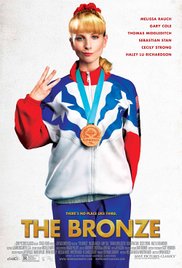
Melissa Rauch (Bernadette on “The Big Bang Theory”) stars as Hope, a former bronze medalist in Women’s gymnastics, who captured the hearts of Americans when she battled through an Achilles injury to perform her final event. The movie picks up a decade after Hope’s Olympic heroics and we first see her enjoying a clip of her big moment. And by enjoying, I mean … well, never mind. It turns out Hope never was able to compete again, and instead continues to milk her celebrity status around small town Amherst, Ohio. When her dad (Gary Cole) gently nudges her to take a coaching job, she shouts “I’m a star, not a coach!” Hope is a selfish brat whose egoism has her clinging to former glory and preventing her from joining society.
Hope gets tricked into coaching Maggie, the town’s up-and-coming gymnastics prodigy. Maggie (Haley Lu Richardson) idolizes Hope and is her polar opposite in every possible personality trait – a very welcome upbeat and perky addition to the movie. Instead of embracing the opportunity, Hope goes out of her way to sabotage naïve Maggie’s dream. Along the way, she also mistreats the gym owner who somehow fancies her – despite Hope’s hopelessness. Twitchy Ben (Thomas Middleditch) is a sweet guy who sees the good in Hope and does his best to pull her from the dark side.
A twist of fate places Hope at odds with her old flame and former Olympic gold medalist, Lance (Sebastian Stan), who is now a leader in the world of women’s gymnastics. These two banter like siblings who dislike each other, and also execute one of the wackiest ever on-screen comedic sex scenes – for all of you who have fantasized about frolicking with a gymnast.
Director Bryan Buckley is best known for his 50-plus TV commercials that have aired during Super Bowls, but here he lets Melissa Rauch do her thing (she also co-wrote the script with her husband Winston Rauch). There is some commentary on fame and celebrity (and cameos from Olga Korbut, Dominique Dawes, Dominique Moceanu), and some insight into narcissism; but mostly it’s a chance for Ms. Rauch to flaunt her foul motor-mouth with some extremely crass and raunchy lines. It’s kind of cute in an absurdly profane way, and some might agree it beats watching real gymnastics.
Note: Including a Doris Day song on this film’s soundtrack may be the funniest, or at least most ironic moment.
Greetings again from the darkness. The scene playing over the opening credits is baffling to us and sets the tone of peculiarity that runs throughout the film. A lady gets out of her car during a rainstorm to perform an unthinkable act as we watch through the windshield as the wipers rhythmically clear our view. Next we watch as Colin Farrell’s wife announces, after 11 years of marriage, she is leaving him for another man. Curiously, Farrell asks if her new man wears glasses or contacts.
Welcome to a dystopian future via the warped and creative mind of writer/director Yorgos Lanthimos (Dogtooth, 2009). It really boils down to a satirical look at relationships and our societal outcast of single adults. In Lanthimos’ world, Farrell, now a single man, must check in to the oddest country hotel you’ve seen. He has 45 days to find a romantic partner. If he doesn’t, he will be transformed into the animal of his choice. He chooses the lobster because of its long life span … ignoring the probability of ending up on a restaurant platter.
It’s an oddball world overly structured with rules enforced by the Hotel manager – a terrific Olivia Colman. Farrell befriends a couple of other single fellows: the limping man (Ben Whishaw), and the man with a lisp (John C Reilly). It’s funny and uncomfortable and kind of sad to watch these folks awkwardly try to connect with others with a deadline fast-approaching.
The first half of the movie is really black comedy at its finest, but once Farrell escapes the Hotel and joins the “loners” in the forest, the tone shifts a bit. An uneven romance develops between Farrell and a woman played by Rachel Weisz (who is also the film’s narrator). Even though this group of loners pride themselves on independence, it’s ironic that Farrell has merely traded one set of rules for another … courtesy of the rebel leader played by Lea Seydoux.
It’s a bizarre film, and one from which we can’t look away. The deadpan-yet- emotional dialogue delivery is strange enough, but the site gags are even further off the charts – keep an eye out for animals (former singles) strolling by in the background (peacock, camel, etc). There is certainly insight into modern day relationships and how people connect based on instantaneous judgments … but at least we don’t have to dig our own graves … yet!
Greetings again from the darkness. The old saying “opposites attract” is on full display in director and co-writer Julie Delpy’s latest, as she offers up a twist on the French farce by adding a dark undercurrent. Additionally, the film addresses the personal and societal challenges facing women in their 40’s who are successful in their career, and who also hold out hope for finding true love.
Ms. Delpy also stars as Violette, a germaphobe divorcee who works in the fashion industry in Paris. The film opens as Violette and her best friend Ariane (Karen Viard) are deep into girl-chat while hanging out at a spa … each annoyed that they are without a soul mate that would complete their lives (or at least fill the sexual void).
After dumping a freshly caught tuna in Violette’s lap (as they meet for the first time), and then informing her that he understands she’s not his type … you know, since she is a lesbian (which she is not) … Jean-Rene (Dany Boon) re-groups and begins charming her with his grounded and simple nature. These two form a cute, but odd couple of opposites and seem to very much enjoy each other’s company.
Things start to get confusing for the couple when her 19 year old son Lolo (Vincent Lacoste) begins his (initially) subtle clandestine activities designed to break up the couple. Soon enough we realize this wannabe artist goes well beyond typical passive-aggressive activities, and straight into full-on psychotic mode with Oedipal tendencies. His psychological warfare against Jean-Rene slowly builds from childish antics, to deceitful and devilish scheming, to downright criminal … all with a sense of black comedy for us viewers (can’t say the same for Jean-Rene).
Other movies such as Cyrus and We Need to Talk about Kevinhave dealt with the mother-son relationships ranging from creepy to dangerous, but Delpy’s movie always hits us with a dose of laughter when it’s needed. The use of the movie classic Village of the Damned(1960) is especially spot on as Violette and Jean-Rene continue to plug away as a couple … even when it’s obvious to us that 3 is too many for a healthy relationship – especially when one could be a reincarnation of Damien from The Omen. The perfect ending reminds us that no one beats the French when it comes to a farce; even when the darkness is sprinkled on a bit heavier than usual.
Greetings again from the darkness. Superhero movies have been dominating the box office for the better part of two decades, and most tend to lean towards moody and intense … though Iron-Manand The Avengers have certainly enjoyed adding searing one-liners to the mix. As for ratings, superheroes have steadfastly claimed PG-13 as the perfect blend of massive action, massive muscles and massive audiences. So it’s a little surprising to find a movie about a relatively unknown superhero, that’s the first feature from director Tim Miller (previously a visual effects guru), crashing through the R-rated barrier in no-holds-barred fashion. It’s startling and refreshing to see a new take on what had become just a bit too familiar.
This is a movie for which you will want to actually read the opening credits and stay for the post credit scene (a 2-parter). Additionally, you will want to make sure you keep not only little kids away (remember the hard R-rating), but also any grown-ups who are offended by harsh language (on the Tarantino scale), ultra-violence (on the Kill Billscale) or any combination of sex, sex talk or sex jokes (all at an entirely new level). To label this movie as crass or profane is like calling Chewbacca somewhat fuzzy. And while it pushes the raunch-o-meter, it’s also blazingly funny at times (especially for a cancer movie).
The previously mentioned opening credits refer to the writers as “the real heroes here”, and while the plot is pretty textbook superhero stuff, it’s the barrage of one-liners and sight gags at which those writers so excel. They even make sure those unfamiliar with the Wade Wilson backstory understand that he is a former special forces operative turned mercenary for the average Joe’s and Jane’s. In no time, it’s drilled into our heads that he is also a wiseacre, wisenheimer, wise-ass, wisecracker and any other adjective that means funny but not wise.
Ryan Reynolds stars as Wade Wilson/Deadpool and leaves no doubt that he has finally found the role that fits him as well as his red suit. If you are convulsing as you flashback to Mr. Reynolds as Green Lantern (2011), take solace in the fact that this movie fires a couple of deadly shots at that oh-so-disappointing effort. His girlfriend Vanessa is played by Morena Baccarin (“Homeland”), and his best buddy/bartender is played by TJ Miller (“Silicon Valley”). Since Reynolds had a brief appearance as Deadpool in X-Men Origins: Wolverine(2009), there are numerous nods to that franchise, including two key roles here for Colossus (Stefan Kapicic) and Negasonic Teenage Warhead (Brianna Hildebrand). The target of Deadpool’s revenge comes in the form of Ed Skrein (The Transporter Refueled) as Ajax and Gina Carano as Angel Dust … accompanied by her theme song “Angel of the Morning” (unfortunately it’s the Juice Newton version, and not the more powerful Merrillee Rush and the Turnabouts version). Lastly, it’s pure joy to see Leslie Uggams cast in a spunky supporting role, and Stan Lee appears in what might be his most unique cameo yet.
As for music, the range is Neil Sedaka to DMX – yep, you’re unlikely to find a more diverse soundtrack. Your kid may have a Captain America figurine on their bookshelf, but the R-rating for this one is solidified in the first 10 minutes, and is relentlessly reinforced until the movie ends – this means don’t bring your kids! We can only imagine how much fun those old enough to watch are going to have, and brace yourself for an onslaught of Deadpool comebacks over the next few weeks … only hopefully not in church, at the office, in front of grandma, etc …
Greetings again from the darkness. Here comes yet another write up where I am out of step with the majority of film critics. While most are heaping hatred on it for idiocy and self-obsession, my response is … isn’t that the point of a sequel to Zoolander, itself a tribute to idiocy and self-obsession? Maybe the difference stems from my not being a big fan of the 2001 original. Granted, the sub-plot of child labor from the original was (and remains) a real world issue, while this one is fuzzy-focused on a plot to kill the beautiful people in hopes of finding the fountain of youth … less real world tragedy and more like holding a mirror up to society’s insecurities.
The fashion industry was skewered in the original, but couldn’t wait to embrace this sequel. In the 15 years since that first Zoolander, a symbiotic relationship has formed between TV – Movies – Music – Fashion. The lines are blurred now that actors have become models and models are acting. TV shows are built around fashion and fashion shows boost music. And all of these elements are tied into the explosion of social media outlets. The greatest impact yet is probably the fact that most every person has a camera (phone) attached to them at all times and in every environment … we have a citizenry of selfie-taking models.
What can’t be denied is that the sequel is a smorgasbord of celebrity cameos (some might call it overkill). There are times the cameos pop up so fast that it’s challenging to keep up. Spotting the celebs, following the sight gags and catching the one-liners … that’s the tripod on which writer/director/star Ben Stiller has built his Zoolander second home. Though it’s not as quotable as the original, the production value is much improved. Never is this more evident than the slick looking opening chase scene that sets the stage for national narcissism being attacked for the next 90 minutes.
Ben Stiller and Owen Wilson return as male models Derek Zoolander and Hansel, though when we first see them, they have been in years-long hiding … Derek claiming to live as a “hermit crab”. The film begins by catching us up on why they are in hiding (it’s related to Derek’s Center for Kids Who Can’t Read Good), and what’s up with others like Mugatu (Will Ferrell), Derek’s wife Matilda (Christine Taylor), and Billy Zane (Billy Zane). The gag is that Derek and Hansel are now “old and lame” … literally out of fashion in fashion.
As with most comedies, it’s best to avoid the trailer and any details or punchlines before walking into the theatre. You need only know that the old favorite characters are still here and an army of new ones (including Penelope Cruz and Kristen Wiig) arrive – some for a few scenes, others for only a few seconds. Satire is still the name of the game and the biggest fashion icons are front and center: Marc Jacobs, Tommy Hilfiger, Valentino, Anna Wintour and “both Wangs”. A big assist goes to Kiefer Sutherland who joins in the fun of poking fun at his own image. There’s even a jab at celebrity political endorsements with the line “She’s hot. I trust her.”
Justin Theroux is back as Stiller’s co-writer and also plays a role in the sub-plot involving Derek’s son, and the script proudly plays homage to the original (as it should) while still moving into contemporary themes (as it should). So “Relax” (nod to Frankie) and take in the fun. It’s the type of fun akin to riding a roller coaster … fun while it lasts, and over when it’s over. To paraphrase Derek, it’s a ‘really really ridiculously’ good time.
Greetings again from the darkness. If I find myself three minutes into a movie and have already executed a couple of eye-rolls, any hopes for a decent little Romantic-Comedy-Drama would ordinarily be dashed. However, having Rebecca Hall’s character narrate her writing efforts as she taps away on the keyboard, actually does serve the story. The first feature from director Sean Mewshaw and his screenwriting wife Desiree Van Til takes advantage of a beautiful setting, a slew of contrasts, and some heartfelt music to keep us interested in how things plays out.
Ms. Hall plays Hannah, the grieving young widow who has stashed herself away in a lakefront cabin located in the rural Maine community in which she was raised. Her grief remains burdensome some two years after the tragic death of her husband Hunter Miles – a folk singer whose only album (and subsequent death) created a public mystique and a defensiveness on the part of Hannah to protect and control his legacy.
As a Ph.D from Brown, periodic contributor to the local newspaper, and soul mate of Hunter, Hannah undertakes the writing of his biography in the shadow of the studio monument that continues to expand with trinkets left at his gravesite by a cult of fans paying respect. Griffin Dunne plays her friend and owner of the local bookstore and publisher of the newspaper. His less than enthusiastic critique of her early pages of the biography correspond with the vigorous pursuit by a Hofstra Pop Culture Professor with a book publishing deal who wants to make Hunter a key element of his new project.
Jason Sudeikis plays Andrew, and his fast-talking big city mannerisms don’t initially mesh so well with the hyper-sensitive and protective grieving widow. The two spar like brother and sister, and the initial adversarial relationship means only one thing in the movie world … romance is in the air. Fortunately, the focus on telling the story of Hunter acts as a form of grief therapy for Hannah and a bit of redemption of spirit for Andrew. Of course, the path to enlightenment is not simple for either. Hannah’s “friend with benefits” is a hunky local power company worker played by Joe Manganiello (“True Blood”), and Andrew’s big city music industry girlfriend is played by Dianna Agron (“Glee”). But as you would expect, the biggest obstacle faced by the two leads is their own stubbornness.
We learn the most about Andrew and Hannah when they are around others. An Easter luncheon with Hannah’s family is especially insightful. Her parents are played by Blythe Danner and Richard Masur, and as viewers we long for more scenes featuring these two characters (and terrific actors). We sense that these parents see right through Andrew and Hannah. Can Hannah let down her guard so that she can move on with life? Can Andrew quell his ambition so that the emotional connection takes place?
Beautifully shot (with British Columbia substituting for Maine), the aspect of nature plays a role in contrasting country girl with city boy, and it’s the accidental discovery of a long lost song that highlights the stark difference in motives … while also being the impetus for change. Hunter’s original music is heard throughout the film, and it’s actually Damien Jurado whose singing and songwriting add an element of intrigue and realism. Hannah, as narrator, states “In the middle, we feel like it’s never going to end.” While that may be true for many romance movies, the filmmakers here avoid the “too cute” moments that spoil most in this genre … and impressively overcome those early eye-rolls.
Greetings again from the darkness. Homage or Spoof or outright Farce? Though the Coen Brothers motivation may be cloudy, their inspiration certainly is not. The Golden Age of Hollywood is skewered by the filmmaking brothers who previously applied their caustic commentary to the movie business in Barton Fink (1991). However, this latest seems to borrow more from the unrelated universes of their films A Serious Man(2009) and Burn After Reading(2008) in that it alternates tone by focusing first on one man’s attempt to make sense of things, and then with a near slapstick approach to “urgent” situations.
The film seems to be made for Hollywood geeks. Perhaps this can also be worded as … the film seems to be made for the Coen brothers themselves. Rather than an intricate plot and subtle character development used in their classic No Country for Old Men(2007), this is more a collection of scenes loosely tied together thanks to their connection to Eddie Mannix, Capitol Pictures “fixer”. Josh Brolin plays straight-laced Mannix, a twist on the real Eddie Mannix, notorious for his behind the scenes work at MGM in controlling the media, protecting the stars and studio, and protecting movie stars from their own idiotic actions. He was a real life Ray Donovan. It’s Mannix’s job that creates the hamster wheel to keep this story moving (complimented by narration from Michael Gambon).
We witness a typical day for Mannix as he confesses to the Priest that he had a couple of cigarettes after promising his wife he would quit, negotiates with communists who have kidnapped the studios biggest movie star, deftly handles the studio head’s greedy desire to shift a western movie star into a genre for which he is ill-prepared, plans a cover-up for the starlet having a baby out of wedlock, and juggles the demands of the competing twin gossip columnists searching for scandal. Mannix keeps his cool through all of this while mulling a lucrative job offer from Lockheed that would put him right in the midst of the nuclear war scare.
With an exacting attention to period and industry detail, the Coen’s remind us of the popular genres and circumstances of the era. George Clooney plays mega star Baird Whitlock, working on the studios biggest picture of the year – a biblical epic entitled “Hail, Caesar!” (think Ben-Hur, The Robe, etc). Whitlock is kidnapped by a group of communist writers (not yet blacklisted) who are striking out against a capitalistic studio that doesn’t share the rewards with the creative folks. It’s a different look than what Trumbo offered last year. In a tribute to Roy Rogers and famed stuntman Yakima Canutt, there is a segment on popular westerns featuring Alden Ehrenreich (Beautiful Creatures, 2013) as Hobie Doyle, a popular actor whose an artist with a rope and horse and guitar, but not so smooth on his transition to the parlor dramas being filmed by demanding director Laurence Laurentz (a terrific Ralph Fiennes). In boosting Doyle’s public perception, the studio sets him up on a date with a Carmen Miranda-type played by Veronica Osorio. Her character is named Carlotta Valdez in a nod to Hitchcock’s Vertigo. Another sequence features Scarlett Johansson as DeAnna Moran, an Esther Williams type (with a behind the scenes nod to Loretta Young) in a Busby Berkeley-esque production number featuring the synchronized swimming so prominent in the era. One of the film’s best segments comes courtesy of Channing Tatum in a take on films like On the Town, where sailors would sing and dance while on leave.
Tilda Swinton (whose appearance improves any movie) appears as the competing twin sister gossip columnists Thora and Thessaly Thackery. Her hats and costumes are sublime and pay worthy tribute to Hedda Hopper (who also balked at being termed a gossip columnist). Jonah Hill’s only scene is from the trailer, and it could be misleading to any of his fan’s coming to see his performance; and the same could be said for Frances McDormand (a very funny scene as a throwback editor). And so as not to disappoint their many critics, the Coen’s have a terrific scene featuring four men of various religious sects who are asked their opinion of the script – so as not to offend any viewers. The pettiness is palpable.
Roger Deakins is, as always, in fine form as the cinematographer. The water and western productions are the most eye-catching, but he does some of his best camera work in the shots of individual actors or scenes-within-a-scene. We have come to depend on Joel and Ethan Coen for taking us out of our movie comfort zone, while providing the highest level of production – music, costumes, sets, camera and acting. While this latest will leave many scratching their heads, the few in the target audience will be applauding fiercely.
Greetings again from the darkness. “There’s air freshener behind the Virgin”. That line should provide the necessary caution for you to be braced for just about anything to be said by any character in this latest from director Nicholas Hytner. Billed as “A mostly true story”, it’s actually more commentary on how we treat those less fortunate and how we use others for our own gain. That bleak message is cloaked here in humor and a wonderful performance from Dame Maggie Smith.
Alan Bennett is an author, playwright and screenwriter known for The History Boysand The Madness of King George(Oscar nominated for his script). He is also at the core of this story – every bit as much as Ms. Shepherd, the lady in the van. While living in upper crust Camden Town, Mr. Bennett offered to let Ms. Shepherd park her van in his driveway for a few weeks until she could make other arrangements. This van was also her home, and the years (as they are apt to do) came and went until this arrangement had lasted 15 years (1974-1989).
You might assume that Ms. Shepherd was an extremely appreciative “squatter”, but in fact, she was quite a cantankerous and difficult woman, possibly/probably suffering from mental instability. Maggie Smith brings a humanity to the role that she had previously owned onstage and radio. She goes far deeper than the wise-cracking old lady role we have grown accustomed to seeing her play … though her vicious dialogue delivery remains in prime form. Throughout the film, we assemble bits and pieces of Ms. Shepherd’s background: an educated-French speaking musician-turned nun-former ambulance driver-who “possibly” won awards for her talents. She is also carrying a burden of guilt from a past tragic accident that keeps her in the confessional on a consistent basis.
Mr. Bennett is played by Alex Jennings (The Queen, 2006), and the film actually presents dual Bennetts – the one doing the writing, and the one doing the living. These two Bennetts are a virtual married couple – arguing over Ms. Shepherd, and jabbing each other with barbs aimed directly at known emotional weaknesses. The living Bennett claims to be so full of British timidity that he couldn’t possibly confront the woman junking up his driveway. The writer Bennett takes the high road and claims he would rather write spy stories than focus his pen on the odorous, obnoxious transient living in his front yard. Of course, now that we have a play and movie, it’s difficult to avoid viewing Mr. Bennett’s actions as anything less than inspiration for his writing … though the extended charitable actions cannot be minimized.
With director Hytner and writer Bennett reuniting, it’s also interesting to note that more than a dozen actors from The History Boysmake appearances here. The list includes James Corden, Frances de la Tour, and Dominic Cooper. Also in supporting roles are Roger Allam and Deborah Findlay (playing constantly irritated neighbors), Gwen Taylor as Bennett’s dementia-stricken mother, Jim Broadbent as a blackmailing former cop, and Marion Bailey as a staffer at the abbey.
Filmed at the same house where the van was parked for so many years, the film is a reminder to us to exercise tolerance and charity in dealing with the poor. Even Bennett’s grudgingly-offered assistance is a step above what would typically be expected. While we could feel a wide spectrum of emotions for the two main parties here, it’s Ms. Shepherd’s character who says “I didn’t choose. I was chosen”. We are left to interpret her words in a way that is either quite sad or accepting.
The film mostly avoids dime store sentimentality, and that’s in large part due to Maggie Smith’s performance. Few are as effective at frightening young kids or putting the elite in their place. The ending scene shows the real Alan Bennett cruising into the driveway on his bicycle just as the blue plaque honoring the lady in the van is displayed. We can be certain this gesture would not generate a “thank you” from her.
Greetings again from the darkness. These days the topic of racism is usually only addressed in the form of hatred and closed mindedness. This documentary/comedy looks at how racism within a culture is sometimes not only acceptable, but even encouraged as a tradition … and somehow it makes some sense.
You might recognize Ravi Patel. He is an actor from Transformers and “It’s Always Sunny in Philadelphia”, and here his real life search for a wife is the focus – as is the cultural contrasts between his roots in India and his single life in the United States. Ravi co-directs with his sister Geeta Patel, though Ravi is predominantly on screen while Geeta spend her time operating the camera … while simultaneously jabbing and prodding her 29 year old brother with questions on his dating approach.
The movie picks up when Ravi has recently split with his long time girlfriend, Audrey Wauchope. Despite being very close with his parents, there is one reason Ravi never informed them of the relationship: Audrey is a white girl, not an Indian. Ravi’s parents are the product of an arranged marriage, the long-standing cultural tradition that not only matches male and female Indians, but takes it a step further by only pairing up Patels with roots in the same small geographic area of India. It’s a form of selective mating that dates back many generations.
Things get interesting and the laughs pick up as Ravi agrees to let his parents work the Indian dating network so that he can test out their traditions – in hopes of finding a match as well-suited as what theirs is. This process begins with “biodata”; a type of personal resume submitted by boys and girls – a precursor to the meet-up.
It really plays like a home movie, or a video journal, as Geeta films Ravi on dates and directly after, as he provides feedback on whether it was a good match. There is also a creative use of black & white animation to fill in the interview gaps where only Ravi’s audio is available.
The family quest to find a mate for Ravi provides some interesting and entertaining insight into the culture, but the best parts of the film come courtesy of the parents. The mother and father are exceptionally intelligent and very loving and engaged in supporting the success of their kids. Whenever the film drags a bit, a scene with either parent picks us right back up. It’s their commitment to the cause that highlights the cultural customs and challenges faced by immigrants as they struggle to get in step with American society while holding onto the tradition they so respect.
 Greetings again from the darkness. Hollywood has long ignored the pushback on its habit of casting younger women as the love interest of older men. In most of those movies, the relationships are treated as normal and expected. In the few movies that turn the tables, a relationship between an older woman and younger man is typically treated as either comedy or scandal … consider Harold and Maude (1971) and Notes on a Scandal (2006). In this latest film, writer/director Michael Showalter (The Baxter) and co-writer Laura Terruso strive to balance heartfelt emotions with situational laughs.


 Posted by David Ferguson