Greetings again from the darkness. The tagline nails the tone of the film: “On August 21, 1970 two of America’s greatest recording artists met for the first time.” Director Liza Johnson proceeds to tell the story of worlds colliding – an Oval Office meeting with President Richard Nixon and Elvis Presley. Of course, this is a fictionalized and satirical accounting, since Nixon didn’t kickoff his recording passion until the following year.
It would be pretty easy to bash the film as heavy on cheese and light on historical accuracy, but that would be missing the point. These two public figures couldn’t have been much different from each other, but the script (Joey and Hanala Sagal, and Cary Elwes) finds a way to have these two icons hold a conversation … bonding over their mutual hatred of The Beatles.
The terrific opening credit sequence perfectly captures the time period and is a work of art unto itself. We first see Elvis shooting out the picture tubes in the TV room at Graceland. He’s disgusted with the news reports of Woodstock and drug use among America’s youth. Constructing a loose plot to meet with President Nixon and offer his service as a Federal Agent-at-large, Elvis is mostly interested in adding a federal badge to his collection.
Michael Shannon plays Elvis and Kevin Spacey takes on the Nixon role. Rather than a finely tuned impersonation, Shannon goes after more of an impression or re-imagining of The King. It’s a perfect fit for this setting, and there is nothing like watching Shannon give an impromptu karate demonstration for the leader of the free world in the most famous room in America. Spacey, on the other hand, is spot on in capturing the posture, mannerisms, sound and essence of a man who carried much personal baggage with his political power.
The chain of events leading up to the meeting plays a bit like a farcical comedy. Nixon’s staff of Bud Krough (Colin Hanks), Dwight Chapin (Evan Peters) and HR Haldeman (Tate Donovan) is equal parts incredulous and opportunistic. We get two members of Elvis’ “Memphis Maphia” with Alex Pettyfer playing Jerry Schilling and Johnny Knoxville adding even more humor as Sonny West. There is a nice blend of “little” comedy moments and outright laughers – Elvis impersonators confronting him in an airport, the Secret Service reaction to Elvis’ gift to Nixon of collectible WWII pistols, and Elvis meeting with a DEA official played by Tracy Letts.
I found myself smiling throughout, with full understanding that this satirical look at a meeting between two famous men with little common ground has no real historical importance … other than resulting in the all-time most requested photograph from the National Archives. But for 86 minutes of smiling, I say to the filmmakers and actors … Thank you. Thank you very much.
Greetings again from the darkness. Fairy tales have long been a fruitful source for movie material. Some, like Disney productions, land gently on the family/children end of the scale; while others like the Brothers Grimm material are much darker and adult in nature. And now, along comes director Matteo Garrone and his blending of three stories loosely based on the 17th century tales published by Giambattista Basile … and “black comedy” falls short as a description.
Mr. Garrone is best known for his chilling look at an Italian crime family in the award winning Gomorrah (2008), so a trilogy of demented monarchial fantasies may seem a bit outside his comfort zone … but grab ahold of your crown jewels and be ready for just about anything.
A very strong opening leads us into the first story about a King (John C Reilly) and Queen (Salma Hayek) who are by no one’s definition, the perfect couple. The Queen’s inability to have children leads her to strike a deal with a Faustian seer who promises a baby to the royal couple. The only catch is that the King must kill a sea monster, and the Queen must eat its heart after it’s properly prepared by a virgin. Yep, it’s pretty dark and pretty odd. Of course, as with all actions, there are consequences (albino twins of different mothers) … some of which are not so wonderful.
The second story involves a lecherous King (Vincent Cassel) who falls in love with a local woman based solely on her singing voice. Much deceit follows and the actions of two sisters (played by 3 actresses – Hayley Carmichael, Stacy Martin, Shirley Henderson) and some supernatural aging products lead to a twisty story of romance that can’t possibly end well for anyone involved.
The third of our 3-headed story is the strangest of all, as a King (Toby Jones) nurtures a pet flea until it grows to behemoth size. Yes, a pet flea would be considered unusual, but eclipsing even that in uniqueness is the King’s willingness to offer the hand of his daughter (Bebe Cave) in marriage to a frightening ogre who lives a solitary life in the mountains.
These three stories are interwoven so that we are bounced from one to another with little warning … which seems only fitting given the material. Knowing the theme of the three stories does not prepare one for the details – neither the comedy, nor the dramatic turns. All actors approach the material with deadpan seriousness which adds to the feeling of a Grimm Brothers and Monty Python mash-up.
Alexandre Desplat provides the perfect score for this oddity, though the audience may be limited to those who can appreciate grotesque sequences assembled with the darkest of comedy. The moral to these stories may be difficult to quantify; however, it’s a reminder that actions beget consequences no matter the time period.
Greetings again from the darkness. Can you go home again? The answer is usually complicated and often a factor of one’s own choices. What’s clear is that those choices leave a wide range of emotions in the wake. Writer Gene Gallerano and director Jeff Barry share the story of Beau Baker, a young man who 7 years ago, walked away from his comfortable suburban lifestyle and a bright future as a lawyer.
When first we meet Beau, he is sleeping on the streets of New York … awakened by a gentle foot nudge from his Uncle Nolan (Reed Birney, VP on “House of Cards”). Beau reluctantly agrees to return home when he is informed that his parents have recently died in a car crash. See, after Beau left home, he joined the Occupy Wall Street movement, and just never returned home after the movement fizzled.
Once back in Texas, Beau is informed that he is the executor of his parent’s estate, as well as the legal guardian for his two teenage sisters … much to the dismay of his Type-A Aunt Uma (Peri Gilpin). 17 year old Claire (Lorelei Linklater, Boyhood) and 13 year old Arden (newcomer Catherine Elvir) have mixed reactions to the reappearance of a brother they barely ever knew. Claire is angry and bitter, while Arden takes to Beau’s carefree ways and avoidance of responsibility.
The film was shot in Dallas, and offers peeks at the historic Texas Theatre, the Margaret Hunt Bridge, and St. John’s school. There is also a glimpse of the cultural clash between New York and Dallas, and it’s provided through Beau’s wardrobe and speech. Whether he can fit in with old acquaintances (including his old girlfriend Nikki Moore), and kick his carefree lifestyle to become a true role model for his sisters is the core of the film.
Writer Gene Gallerano also stars as Beau Baker, and does a nice job walking the line between selfish slacker and grown-up. The road from homeless street person to legal guardian doesn’t come with a handbook, and Beau makes most every mistake possible. On the bright side, we can tell pretty early on where the character and story is headed and that it’s going to be a feel good story of redemption – and overcoming the challenges that family brings. There are a couple of other interesting characters courtesy of the rarely-seen-these-days Janine Turner (as a bored housewife drawn to Beau), and Paul Benjamin (as a wise and generous neighbor). The inconsistent sound mix doesn’t affect our connection to Beau and especially Arden (in a terrific first on screen performance from young Miss Elvir). We really want what’s left of this family to come together.
Greetings again from the darkness. Remember when the 1980’s TV show “Dallas” saved Romania? Though it’s the tongue-in-cheek theme of this innovative docudrama, it’s understandable if you haven’t previously heard about this connection in the Romania-United States pop culture clash. Married filmmakers Livia Ungar and Sherng-Lee Huang deliver a visually unique standout even amongst the unusual offerings of a film festival.
In the 1980’s communist Romania, “Dallas” was the only Western show permitted to be broadcast to the general public … the idea being it would act as a warning of the evils of capitalism. Of course the result was much different, and Romanians embraced the film as a fantasy lifestyle. The show perpetuated the Poverty vs Wealth, and Communism vs Freedom differences.
Ms. Ungar also stars as a version of her youthful self, and her training in art plays a huge role in how she presents this story … it’s artsy, imaginative and even impressionistic at times. She utilizes “Endless Column” from Romanian sculptor Constantin Brancusi as the imagery for the link to United States culture and dreams. Time is also a bit relative here, as we bounce forwards and backwards periodically.
One of the more fascinating segments is the Southfork Ranch-style Hotel developed by a Sunflower Oil business tycoon (who also spent time in prison). It’s known as the Southfork of Slobazia, and one of the most oddball songs/videos you’ll ever hear/see accompanies us on the tour.
Patrick Duffy, who of course played Bobby Ewing in the “Dallas” series, plays an unusual American tourist named Mr. Here. Mr. Duffy contributes quite a bit of narration and his appearance adds to the surreal feel of the film. There are also re-stagings or reimaginings of some actual “Dallas” plotlines, including the infamous “Pam’s dream”. For those who like their movies on the extreme end of the artsy scale, they will be quite happy. Others may just be satisfied with the excessive number of shots featuring Ms. Ungar’s rear end in tight denim jeans.
Greetings again from the darkness. Richard Linklater’s now twenty-five plus years of filmmaking are loosely tied together with his constant desire to explore and observe how, within the confines of society, people connect with each other (or don’t). In what he has termed a “spiritual sequel” to his cult classic Dazed and Confused, the filmmaker takes us down memory lane to a college campus as the 1970’s devolved into the 1980’s.
Many of these characters and moments are undoubtedly snatched from Linklater’s own experiences as a college baseball player at Sam Houston State (after graduating from Bellaire High School). Linklater knows these guys. Heck, he WAS one of these guys! The cinematic kinship goes beyond Dazed and Confused, and influence can be seen as the follow-up to his Boyhood film, with some flavor from Animal Houseand a dose of Bull Durham.
The film opens with Jake (Blake Jenner) driving his 442 muscle car up to the baseball house while “My Sharona” from The Knack blasts from his car stereo. What follows is a look at the behind the scenes tribal nature of a sports team, and how that blends with the predictable manner in which 18-21 year old boys handle a sudden shot of freedom. Conversation and activities center on three things: baseball, girls, and beer … with priorities shifting given the circumstances of the moment. What’s never missing is the ultra-competitiveness of these individuals raised to be the best. Whether it’s nerf basketball in the living room, foosball at the bar, or flicking knuckles, the goal of that point in time is to be better than the other guy … even a friendly game of ping pong turns hyper-tense as it nears game point.
Linklater has assembled a terrific cast that not only succeeds in capturing the time period, but also the essence of the age group. Some of the faces will be familiar, and each character fits nicely into the profile. Tyler Hoechlin (Tom Hanks’ son in Road To Perdition) is team captain McReynolds, Wyatt Russell (son of Kurt and Goldie) plays elder statesman and team spiritualist Willoughby, Juston Street (former Longhorn player) plays the jacked-up overly intense freshman pitcher, J Quinton Johnson is the sometimes rational second baseman, and Glen Powell is a real standout as the smooth-talking and philosophical Finnegan … also a master of pranks. Despite the ever-present quest for girls, Zoey Deutch’s Beverly is the only female character with much screen time, and she makes the best of it as a smart, ambitious love interest for young Jake.
I’ve always believed that the music of our youth goes a long way in defining each generation. Linklater seems to agree (the soundtrack is spot on) as this group is bounced between the fading days of disco, the sterile and soulless transition to Urban CowboyCountry music, and the desperate pleas of new edge Punk Rock. Within the 3 days we are with the guys, they take their athlete swagger to each venue type, and even mix in a party thrown by Beverly’s “artsy-fartsy” group. Figuring out where one fits is a rite of passage not to be missed.
Linklater ensures that our tight knit teammates fill our ears with an endless stream of quips, wise-cracks and put-downs, each designed to register dominance – if only for the briefest moment. We even get a sequence featuring the ballplayers actually playing ball, and though their tone shits once on the field, the personalities remain evident. In addition to adding “f***withery” to our vocabulary, the production design is brilliant and captivating all by itself. The album and book covers, cars (a Gremlin sighting), stereo equipment and costumes all provide the throwback feel necessary for the film. Though it lacks any real plot, and feels meandering (just like its characters), Linklater provides the best insight yet into the driving forces of young male primates of 1980. It’s not always pretty or something of which to be proud, but … that’s what I’m talking about!
Greetings again from the darkness. Movie profanity and crude humor are best used selectively, and certainly not as a comedy crutch. Melissa McCarthy has not built her career on subtlety, but even for her standards, this latest comes across as a lazy effort with missed opportunities for both laughs and a message.
Ms. McCarthy re-teams with those responsible for Tammy (2014), including her husband writer/director Ben Falcone and co-writer Steve Mallory. Here she plays Michelle Darnell, an egotistical hyped-up business tycoon with no sense of integrity or humanity … constantly wearing an odd turtleneck. Somehow the filmmakers thought it a good idea to explain this lack of soul showing a young Michelle being continually “returned” to her orphanage (run by a nun played by Margo Martindale).
When Michelle’s business rival (and former business associate and former lover) Renault/Ron (Peter Dinklage) turns her into the SEC for insider trading, the correlations with Martha Stewart become impossible to ignore. There is even an acknowledgment of this by McCarthy’s character. Once released from white collar prison, Michelle hits rock bottom and ends up sleeping on her former assistant’s sofa. Kristen Bell is Claire, the assistant that Michelle once dumped on and now crashes with. Ms. Bell is mostly relegated to “straight man” to McCarthy’s string of lame punchlines.
In the spirit of exaggeration in lieu of creativity, three scenes in particular stand out: the street fight between rival scout troops, a ridiculous breast grope-off with McCarthy and Bell, and a clumsily staged sword fight between McCarthy and Dinklage. The missed opportunity to have a point about girls in business, and stooping to schmaltz with the Michelle family story are every bit as disappointing as the mostly unfunny and constant use of profanity-laced insults. Saying “suck his d***”over and over in one scene does not make it funny … in fact, it’s a bit sad.
Exacerbating the frustration is the misuse and underuse of such talents as Cecily Strong, Kristen Schaal, Tyler Labine, and Kathy Bates. Ella Anderson as Claire’s daughter does come across as a real kid, and she’s part of the best scenes in the movie. Somehow a movie that (finally) calls out the Girl Scouts on their unfair-to-girls business model, manages to disappoint on every other front.
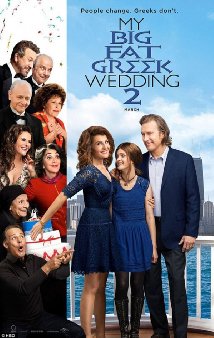
Greetings again from the darkness. It’s been 14 years since the Portokolas family took over movie theatres, the box office, and casual conversation in most every social setting. I’ll readily admit that, despite my leanings toward more serious film fare, I was a huge fan of the 2002 surprise mega-hit. The movie was refreshing and observational, with commentary on proud cultures and helicopter parenting – but mostly it was funny. Bundt cakes and Windex will forever be a part of movie lore … as this sequel reminds us.
Given the Hollywood proliferation of sequels, re-makes and re-imaginings, the only thing surprising here is that it took so long for Wedding number 2. And yes, that is the only surprise. Nia Vardalos obviously wrote this script as a love letter to the fans of the original. It fits like a warm blanket – comfortable and familiar. The setting, the characters and the jokes … all familiar … yet still pleasant and easy to watch.
With that title, we know we are in for another Greek wedding. However, Toula (Ms. Vardalos) and Ian (John Corbett) have one daughter – 17 year old Paris (Elena Kampouris), and her big decision is whether to stay local for college or leave Chicago and the family for NYU. Since the wedding is not for the daughter, it falls to Toula’s parents. It seems Gus (Michael Constantine) and Maria (Lainie Kazan) have been living in sin for 50 years – all because the priest never signed the marriage certificate. Let the histrionics begin!
Director Kirk Jones (Nanny McPhee, Waking Ned Devine) stays true to the spirit of the Vardalos script and legacy, and much of the movie plays like one big inside joke for fans of the original. Windex make an appearance in each of the three acts, and we get a shot of decorated Bundt cakes, some exaggerated make-up and hair styles, and a steady stream of family members who just can’t help their propensity for being loud and up in everyone’s business.
Most of the original cast returns. Andrea Martin is back as scene-stealer Aunt Voula, and Mama-Yiayia (Bess Meisler) gets her usual “pop-ups” plus a touching moment in the wedding spotlight. New faces include Alex Wolff (brother of Nat, son of Polly Draper) as Paris’ prom date; and Rita Wilson (also a producer with her husband Tom Hanks) and John Stamos have a couple of scenes as a Greek couple; while Mark Margolis (“Breaking Bad”, “Better Call Saul”) appears as Gus’ brother from the homeland.
Nostalgia and familiarity are the keys here, and there is no reason to be overly-critical of a movie that is so pleasant and light-hearted. “There you go!”
Greetings again from the darkness. Hollywood has long ignored the pushback on its habit of casting younger women as the love interest of older men. In most of those movies, the relationships are treated as normal and expected. In the few movies that turn the tables, a relationship between an older woman and younger man is typically treated as either comedy or scandal … consider Harold and Maude(1971) and Notes on a Scandal(2006). In this latest film, writer/director Michael Showalter (The Baxter) and co-writer Laura Terruso strive to balance heartfelt emotions with situational laughs.
Sally Field returns to leading lady status as Doris, a never-married frumpy accountant in her late 60’s who has been living in her childhood home whilst caring for her ailing mother … hoarding everything from magazines to packaged food seasoning to a single water ski. The film begins with the open casket funeral of Doris’ mom, and we see her brother (Stephen Root) and his obnoxious and rude wife (Wendi McLendon) immediately pounce on Doris to clear out the clutter and sell the house. They even set her up with a hoarder specialist/therapist (Elizabeth Reaser) who finds the case quite challenging.
The real fun in the movie begins with a close encounter in the office elevator, when Doris and her cat-eye glasses come face to face with a handsome and charming young man who offers up a compliment – something Doris rarely experiences. Of course, a few minutes later, we learn the young man is John (Max Greenfield, “New Girl”), the new artistic director in Doris’ office. For years, Doris has depended upon cheesy romance novels to supply the fantasy in her life, and now the lessons from that reading kick into full gear.
It’s a night out with her best friend Roz (Tyne Daly) that results in a chance interaction with a cocky motivational speaker (Peter Gallagher) whose catchphrase is “Every week has seven days. None of them are named Someday”. He leaves Doris with this thought: “Impossible means I’m possible”. When combined with those romance novels, Doris now sees a realistic chance for love if she pursues the man of her dreams … the aforementioned (and half her age) John.
With the help of Roz’ teenage granddaughter (Isabella Acres), Doris learns how to Facebook stalk, and soon enough ends up at a concert with John’s favorite techno band, Baby Goya and Nuclear Winters (led by Jack Antonoff of Fun.). John and his group of hipster friends are enamored with Doris’ vintage clothes and quirky sense of style and speech. She soon finds herself posing in spandex for Baby Goya’s album cover, going to dinner parties, and joining a rooftop knitting group of millennials.
Judging by the boisterous laughing by women in the theatre, this is a prime GNO flick for women of all ages. Most of the comedic situations seemed pretty obvious and predictable, and I found some traits of Doris to be less than appealing. However, as a statement on what happens when the outside world passes by, and generational gaps become almost impossible to bridge, the film makes a bold statement on real friendship between mature women. It poses the question, what determines whether a personal awakening is real or imagined?
Sally Field (turning 70 in 2016) gives a terrific performance, and it goes much deeper than someone who puts her reading glasses on top of her regular glasses and wears giant bows in her giant hairpiece. Ms. Field has excelled in such previous work as “Sybil” (1975), Norma Rae(1978), Places in the Heart(1983), and Lincoln (2011). She understands comedy and human drama, and as Doris … you’ll kind of like her. You’ll really kind of like her!
Greetings again from the darkness. Leave it to the Duplass brothers (Executive Producers here) to turn the traditional sports movie genre upside down. Of course, this is about as much of a sports movie as Dodgeball: A True Underdog Story, but it does use the backdrop of the Olympics to make a point about fading fame. Mostly though, it’s an excuse to crack wise, spew profanities and spoil anything and anyone remotely innocent.
Melissa Rauch (Bernadette on “The Big Bang Theory”) stars as Hope, a former bronze medalist in Women’s gymnastics, who captured the hearts of Americans when she battled through an Achilles injury to perform her final event. The movie picks up a decade after Hope’s Olympic heroics and we first see her enjoying a clip of her big moment. And by enjoying, I mean … well, never mind. It turns out Hope never was able to compete again, and instead continues to milk her celebrity status around small town Amherst, Ohio. When her dad (Gary Cole) gently nudges her to take a coaching job, she shouts “I’m a star, not a coach!” Hope is a selfish brat whose egoism has her clinging to former glory and preventing her from joining society.
Hope gets tricked into coaching Maggie, the town’s up-and-coming gymnastics prodigy. Maggie (Haley Lu Richardson) idolizes Hope and is her polar opposite in every possible personality trait – a very welcome upbeat and perky addition to the movie. Instead of embracing the opportunity, Hope goes out of her way to sabotage naïve Maggie’s dream. Along the way, she also mistreats the gym owner who somehow fancies her – despite Hope’s hopelessness. Twitchy Ben (Thomas Middleditch) is a sweet guy who sees the good in Hope and does his best to pull her from the dark side.
A twist of fate places Hope at odds with her old flame and former Olympic gold medalist, Lance (Sebastian Stan), who is now a leader in the world of women’s gymnastics. These two banter like siblings who dislike each other, and also execute one of the wackiest ever on-screen comedic sex scenes – for all of you who have fantasized about frolicking with a gymnast.
Director Bryan Buckley is best known for his 50-plus TV commercials that have aired during Super Bowls, but here he lets Melissa Rauch do her thing (she also co-wrote the script with her husband Winston Rauch). There is some commentary on fame and celebrity (and cameos from Olga Korbut, Dominique Dawes, Dominique Moceanu), and some insight into narcissism; but mostly it’s a chance for Ms. Rauch to flaunt her foul motor-mouth with some extremely crass and raunchy lines. It’s kind of cute in an absurdly profane way, and some might agree it beats watching real gymnastics.
Note: Including a Doris Day song on this film’s soundtrack may be the funniest, or at least most ironic moment.
Greetings again from the darkness. The scene playing over the opening credits is baffling to us and sets the tone of peculiarity that runs throughout the film. A lady gets out of her car during a rainstorm to perform an unthinkable act as we watch through the windshield as the wipers rhythmically clear our view. Next we watch as Colin Farrell’s wife announces, after 11 years of marriage, she is leaving him for another man. Curiously, Farrell asks if her new man wears glasses or contacts.
Welcome to a dystopian future via the warped and creative mind of writer/director Yorgos Lanthimos (Dogtooth, 2009). It really boils down to a satirical look at relationships and our societal outcast of single adults. In Lanthimos’ world, Farrell, now a single man, must check in to the oddest country hotel you’ve seen. He has 45 days to find a romantic partner. If he doesn’t, he will be transformed into the animal of his choice. He chooses the lobster because of its long life span … ignoring the probability of ending up on a restaurant platter.
It’s an oddball world overly structured with rules enforced by the Hotel manager – a terrific Olivia Colman. Farrell befriends a couple of other single fellows: the limping man (Ben Whishaw), and the man with a lisp (John C Reilly). It’s funny and uncomfortable and kind of sad to watch these folks awkwardly try to connect with others with a deadline fast-approaching.
The first half of the movie is really black comedy at its finest, but once Farrell escapes the Hotel and joins the “loners” in the forest, the tone shifts a bit. An uneven romance develops between Farrell and a woman played by Rachel Weisz (who is also the film’s narrator). Even though this group of loners pride themselves on independence, it’s ironic that Farrell has merely traded one set of rules for another … courtesy of the rebel leader played by Lea Seydoux.
It’s a bizarre film, and one from which we can’t look away. The deadpan-yet- emotional dialogue delivery is strange enough, but the site gags are even further off the charts – keep an eye out for animals (former singles) strolling by in the background (peacock, camel, etc). There is certainly insight into modern day relationships and how people connect based on instantaneous judgments … but at least we don’t have to dig our own graves … yet!
 Greetings again from the darkness. The tagline nails the tone of the film: “On August 21, 1970 two of America’s greatest recording artists met for the first time.” Director Liza Johnson proceeds to tell the story of worlds colliding – an Oval Office meeting with President Richard Nixon and Elvis Presley. Of course, this is a fictionalized and satirical accounting, since Nixon didn’t kickoff his recording passion until the following year.


 Posted by David Ferguson







 Movie Reviews from the Dark