Just posted: the BEST OF 2017 film list!
This year’s post has MANY recommendations for those of you willing to step outside of your movie watching comfort zone! Hopefully you can find something on the list that interests you. Check it out:
Just posted: the BEST OF 2017 film list!
This year’s post has MANY recommendations for those of you willing to step outside of your movie watching comfort zone! Hopefully you can find something on the list that interests you. Check it out:
Opening Night December 5, 2017
Winspear Opera House – Dallas, TX
It’s pretty easy to tell if a stage production is “working”. For a tragedy, we hear sniffles emanating from the audience, and for a comedy we hear laughter. When it comes to the re-telling of a family Christmas classic, we watch to see if the kids are engaged. Near the end of this touring version of “Dr. Seuss’ How the Grinch Stole Christmas! The Musical”, most every kid in the theatre is yelling “Christmas” at the stage in a desperate attempt to feed the floundering Grinch the correct line. Of course, Philip Bryan as The Grinch knows exactly what he’s doing, and it’s a brilliant gesture to allow the kids in the audience to believe they are participating … just as we believe The Grinch’s heart has grown as he learns the true meaning of Christmas.
The Dr. Seuss book was first published in 1957, and the iconic animated TV short first aired in 1966. In 2000, director Ron Howard delivered his live-action feature film, and Broadway was home to a hit run in both 2006 and 2007. Since then, there have been numerous tours of the hit stage musical, and many kids and families have been entertained by seeing The Grinch, his dog Max and the Whoville residents brought to life on stage.
“Welcome, Christmas” and “You’re a Mean One, Mr. Grinch” are the two songs familiar from the TV show, and both were written by Albert Hague and Dr. Seuss. There are new elements to the story, and seven new songs with music by Mel Marvin and Timothy Mason (book and lyrics), including “Who Likes Christmas?”, “One of a Kind”, and “It’s the Thought that Counts”. All the songs contribute to the story-telling, but none are especially memorable on their own. There is a twist in approach, as we first meet Max the dog … a much older Max. He acts as our narrator recalling his days with The Grinch, as they are acted out around him. Bob Lauder stars as Old Max, and has a wonderful voice for narration and singing.
Little Cindy-Lou Who and the rest of the Whoville folks are decked out in a pink, red, and white color scheme compounding the chaotic feel created by the holiday season and by having Christmas stolen while they sleep. The Whoville songs are often difficult to understand, despite being performed energetically. The sets (designed by John Lee Beatty) remain true to the original Dr. Seuss book and the centerpiece Christmas tree is especially wonderful.
Of course, what everyone comes to see is The Grinch. His green costume (designed by Robert Morgan) with creepy long fingers is a sight to behold, and Mr. Bryan takes full advantage of the spotlight, both with his physicality and his wide-ranging voice. At various times he reminds of Michael Keaton in BEETLEJUICE (1988), Jim Carrey from the 2000 film, and even The Joker from THE DARK NIGHT (2008). The kids are especially attentive while The Grinch is on stage, as are the much older kids (known as adults) in the audience.
Any production of The Grinch is challenged to overcome the iconic voices of Boris Karloff and Thurl Ravenscroft from the TV version, as these men possessed two of the most recognizable and iconic voices in entertainment history. Director Matt August has been behind both Broadway productions and numerous national tours, and he certainly puts on an entertaining show – assisted here by the live orchestra conducted by Peter Nilson, and some contemporary touches including a laugh-inducing belch, and a hashtag for the milennials. It’s been 60 years since the book was published, and the mean old Grinch and his dog Max can still entertain us.
Greetings again from the darkness. Despite my fascination and quasi-obsession with movies, the Science Fiction genre has never really appealed to me. Sure, there have been a few dozen exceptions over the years (and it depends how you categorize certain movies), but it’s the non-classics in the genre that just never seem to connect with my love of film. So when Steven Spielberg states that he doesn’t consider his beloved CLOSE ENCOUNTER OF THE THIRD KIND (CE3K) to be a “sci-fi” film, you won’t see me get offended, or even offer a contrary argument. Of course, the difference is that Mr. Spielberg makes his claim based on his belief of life “out there”, while I simply have no desire to defend the category label.
For its 40th anniversary, the film is making the rounds in selected theatres, and the big screen is a must for this gem. Released in the same year and just a few months after George Lucas’ groundbreaking STAR WARS, Spielberg’s follow-up to JAWS confirmed his status as a revolutionary filmmaker, and cemented 1977 as one of the finest movie years of all-time (including ANNIE HALL, SATURDAY NIGHT FEVER, A BRIDGE TOO FAR, JULIA). CE3K would become the first of 7 Best Director Oscar nominations for Spielberg (inexplicably only one win to date).
Spielberg is credited as the writer, though many contributors are “uncredited”: Hal Barwood (now known for video games), Jerry Belson (Emmy winner for “The Odd Couple” and his work with Tracey Ullman), and John Hill (QUIGLEY DOWN UNDER), and Matthew Robbins (CRIMSON PEAK). Paul Schrader and Walter Hill also contributed to the script, making this the veritable vegetable soup of screenplays. The film came at a time when Columbia Pictures was struggling, so in order to remain under budget, Spielberg had to make some compromises on the final version. In a highly unusual development in the movie industry, Spielberg was able to revise, re-edit, and add new scenes to a 1980 re-release of the film – realizing his original vision.
Richard Dreyfuss stars as Roy Neary, a blue collar family man from Muncie, Indiana. With an acting career spanning more than 50 years (many recognize his baby face in THE GRADUATE as he offers to call the cops), it was AMERICAN GRAFFITI that caused his career to take off, leading to JAWS in 1975, and his stellar 1977 with both CE3K and THE GOODBYE GIRL. He later overcame a severe drug habit to star in such crowd favorites as WHAT ABOUT BOB?, MR. HOLLAND’S OPUS and “Madoff”. His wife Ronnie in CE3K is played by Teri Garr, whose acting career also covers more than 50 years, including small roles in five different Elvis movies in the 1960’s and her best known roles in YOUNG FRANKENSTEIN and TOOTSIE (for which she received a Best Supporting Actress Oscar nomination). In recent years, she has had to turn her energy and attention to health issues.
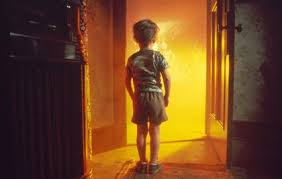
Melinda Dillon stars as Jillian, mother to young Barry (Cary Guffey) who is abducted by the aliens. Ms. Dillon received her first (of two) Oscar nomination for her work in the film, and is still seen annually breaking a leg lamp in the holiday favorite A CHRISTMAS STORY, although she retired from acting ten years ago. Young Mr. Guffey is now 45 years old and hasn’t acted since 1985. Director Stanley Kubrick considered him for the role of Danny in THE SHINING, but ultimately decided on Danny Lloyd, another youngster who decided against remaining in showbiz.
Francois Truffaut was an Oscar nominated director known for kicking off the French New Wave of Cinema with his all-time classics THE 400 BLOWS and JULES AND JIM, and it was quite surprising to see him cast in the role of UFO expert Claude Lecombe. It’s likely that cinephile Spielberg loved the idea of working with a peer whose work he so admired. Truffaut is a significant screen presence despite his challenges with the English language (which led to “dialogue cheat sheets” throughout filming). Bob Balaban, so familiar to “Seinfeld” fans, plays the translator, while Justin Dreyfuss (Richard’s real life nephew) is the noisy and obnoxious son during the hectic family scene. Roberts Blossom is the one in the film who admits to spotting Bigfoot, and is best known as Kevin’s neighbor in HOME ALONE and the braced-up car seller in CHRISTINE. He was also a well-respected poet before passing away in 2011. Other familiar faces include Lance Henrikson (ALIENS), George DiCenzo (BACK TO THE FUTURE), Carl Weathers (ROCKY), CY YOUNG (OK, more a name than a face), Bill Thurman (Coach Popper from THE LAST PICTURE SHOW), and gas mask salesman Gene Rader, who hails from Paris, Texas.
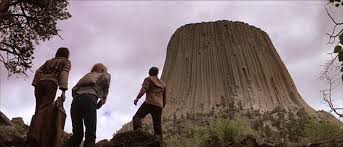
Desert discoveries are a key here, and offer more insight into Spielberg’s attention to history. The “lost” plane is a tribute to real life Flight 19 which disappeared in 1945, and The Cotopaxi was a real cargo ship that sunk … both becoming part of Bermuda Triangle lore. Devil’s Tower in Wyoming is also significant here, and it’s Spielberg’s nod to John Ford’s frequent use of Monument Valley in his westerns. Spielberg has admitted to watching Ford’s THE SEARCHERS dozens of times while filming CE3K. Another tribute comes in the form of a wind-up monkey with cymbals. It was previously seen in REBEL WITHOUT A CAUSE, and can also be viewed as a precursor to the infamous clown in POLTERGEIST.
Spielberg acknowledges being inspired by President Nixon and the Watergate scandal. He wondered what else the government might be hiding from us. Remarkably, he gets his point across with a total absence of modern day cynicism. As opposed to what we usually see these days, the military isn’t trying to bomb the mothership and citizens aren’t retreating in a panic to bunkers. Instead, the military is working to keep the public safe (albeit through some sneaky strategy), the scientists are approaching communication through a protocol steeped in research and data gathering, and Dreyfuss and Dillon are trying to figure out why they were “chosen”. Spielberg delivers sweetness and warmth rather than a show of power and might. It’s such a pleasant viewing experience to watch people we like and to whom we can relate.
Some points of interest related to the film include a cameo from famed UFOologist J Allen Hynek, who is seen smoking a pipe as the abductees are released from the mothership. Mr. Hynek actually created the phrases Close Encounters of the First, Second, and Third Kinds. ABC news anchor Howard K Smith is seen since CBS would not grant permission for Walter Cronkite to appear. The film’s stunning visual effects come courtesy of Douglas Trumball, who also collaborated with Stanley Kubrick on 2001: A SPACE ODYSSEY. Of course, the Visual Effects Oscar that year went to STAR WARS, and that speaks to the contrast between the films. STAR WARS is clearly a special effects movie, while CE3K is much more of a character study … a study of human emotions.
As for other Oscar categories, the film was nominated for 9 total, with the only win going to Cinematographer Vilmos Zsigmond, though it was also awarded a Special Achievement Oscar for Sound Effects Editing. Spielberg was nominated, but Woody Allen won Best Director for ANNIE HALL, and Richard Dreyfuss actually won the Best Actor Oscar that year for THE GOODBYE GIRL. The great John Williams was of course nominated for his iconic 5 note melody (following up his immortal JAWS theme), and he instead won the Oscar that year for … repeat after me … STAR WARS. A quirky note on the music – the “voice” of the mothership was a tuba, not an instrument that typically gets much publicity.
While Stanley Kubrick opted not to show aliens in 2001: A SPACE ODYSSEY, this film not only puts the aliens front and center, it reminds us to keep an open mind to those unfamiliar to us … a lesson that is still important today. The film was named to the National Film Registry in 2007, and seeing it on the big screen allows for the full impact of awe and wonderment. It’s rated PG and can be enjoyed by most ages. Spielberg only asks that you leave the cynicism at home.
watch the trailer:
It’s time for a quick mid-year look back at my favorite movies from the first six months of 2017. We all understand that most movies vying for Oscar attention are released in the 4th quarter, but every year there are some terrific movies released early in the year that deserve a bit more attention and a bigger audience. Below is a breakdown of my favorites from the 118 (new release) movies I watched between January 1 and June 30, 2017. These are listed alphabetically by genre so as not to spoil the year-end Iist.
DOCUMENTARY
Abacus: Small Enough to Jail – rather than “too big to fail”, this is the story of the only financial institution indicted for their role in the 2008 mortgage crisis.
City of Ghosts – RBSS (Raqqa is Being Slaughtered Silently) is a faction of citizen journalists risking their lives to report on ISIS activities.
Ella Brennan: Commanding the Table – tracing the fifty year path to success of a determined New Orleans restaurateur
Score: A Film Music Documentary – renowned film composers offer insight into the process of creating effective and beloved film scores
True Conviction – three wrongly convicted ex-cons create a kind of detective agency to serve and assist others who are in the same situation
INDIES and/or QUIRKY COMEDIES
Band Aid – a husband and wife try to save their marriage by communicating, laughing, and arguing through their musical jams
Katie Says Goodbye – a nice girl in a small dusty town does what she thinks she has to do in order to escape to the west coast and start over
La Barracuda – Half sisters, both daughters of a dead music legend, struggle to bond and find peace or satisfaction in their father’s legacy
Mr. Roosevelt – Austin based comedy centered on a pet tragedy and one woman’s desperate attempt to make peace with the past
ROM-COM/DRAMA
The Big Sick – a true relationship story filled with laughter and drama that brings something new to a genre where quality stands out.
WIDE RELEASES
Baby Driver – it’s funny, charming, and a little odd, but mostly it’s a wild ride featuring old school car chases and a lead-footed savant
War for the Planet of the Apes – the best of the most recent trilogy cementing Caesar (Andy Serkis) as one of the best recurring characters in movie history
Wonder Woman – some terrific Act One sequences, tributes to 1978 Superman, a couple of stellar action sets, and a likeable hero. The movie that saved DC comics.
BIO
A Quiet Passion – while there is nothing quiet about Cynthia Nixon’s portrayal of Emily Dickinson, the film helps explain her life and what inspired her writing.
Chuck – the real life inspiration for Stallone’s Rocky Balboa, Chuck Wepner (The Bayonee Bleeder) was known for taking a punch. The movie delivers one.
DRAMA
The Hero – it could be seen as a tribute to Sam Elliott’s career … or a glance at the challenges of finding one’s place as the years advance.
The Lost City of Z – beautiful photography and sustained tension make for a wonderful adventure film based on the explorations of Col. Percival Fawcett.
Wakefield – if you’ve ever thought about putting your life on hold, or just enjoy commentary on suburban living and career pressures, this one is for you.
HORROR
Split – a return to form for M. Night Shyamalan, and a nightmarish look at what it would be like to be kidnapped by someone with 23 personalities.
WORLD CINEMA
Frantz – Francois Ozon’s version of one man’s quest for a clear conscience after WWII left him burdened with guilt. His trip is not a simple one.
Julieta – An estranged daughter, recollections of her life, and painful self-evaluation provide the palate for this latest from Almodovar.
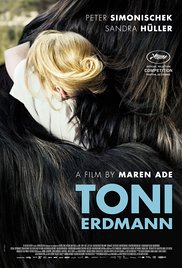
Toni Erdmann – the comical shenanigans of a prankster father as he attempts to inject life lessons into the stressful daily career life of his daughter. Oscar nom last year
Truman – a terrific script and one of the most realistic films ever about long-term male friendship and being there when it matters
Underrated: Free Fire
Overrated: John Wick 2
The 6th annual Oak Cliff Film Festival kicks off Thursday evening (June 8, 2017) at the historic Texas Theatre on Jefferson Blvd in Dallas. The festival has grown each year and is now nationally recognized for its unique and vibrant melding of film, music, workshops, and parties, along with live interactions and insight from writers, directors, producers and actors. And if that’s not enough to entice you, the festival takes advantage of various local venues … each with its own personality and flavor.
Full details and ticket information is available at http://oakclifffilmfestival.com/ and here’s a quick look at some of the most intriguing events:
Thursday June 8: Director Janicza Bravo will be joined by her writer/actor Brett Gelman to present the opening night feature LEMON, an absurdist comedy starring Michael Cera. The evening’s second feature film is one of Anton Yelchin’s final screen appearances in the Dallas premiere of director Gabe Klinger’s PROTO.
Friday June 9: The Texas premiere of GOLDEN EXITS from filmmaker Alex Ross Perry. The cast includes: Emily Browning, Jason Schwartzman, Mary-Louise Parker, and Adam Horovitz. Immediately following the evening’s second film A LIFE IN WAVES will be a Texas Theatre musical special event ‘behind the screen’.
Saturday June 10: A full 13 hours of events start at 11:00 am and involves 8 different venues, making this the most interesting and difficult to plan day of the festival. The schedule includes workshops, happy hours, short films, live music, and feature films such as back-to-back screenings from iconic director Alejandro Jodorowsky and his son Adan.
Sunday June 11: The Alamo Drafthouse Cedars has a screening of director John Carroll Lynch’s film LUCKY with legendary character actor (90 year old) Harry Dean Stanton. There is also a block of documentary short films, as well as the Texas premiere of director Jeff Baena’s THE LITTLE HOURS – another absurdist comedy, though this one features Aubrey Plaza and Alison Brie as nuns. The festival’s final spotlight feature is A GHOST STORY from acclaimed director David Lowery (AIN’T THEM BODIES SAINTS) featuring Rooney Mara and the reigning Academy Award winning Best Actor Casey Affleck.
This only covers a few of the movies and events that are options over the four days, and it’s also a reminder of how exciting and innovative a film festival can be. An added bonus is the local flavor of a Dallas neighborhood that has much to discover.
EARTHxFilm Opening Night – Chasing Coral
The official Opening Night of the inaugural EARTHxFilm event proved to be an evening of hope buoyed by passion, optimism and commitment. Scheduled in conjunction with the seventh annual EARTH Day Texas, the reception, introductions, and opening film Chasing Coral were held at Dallas Music Hall at Fair Park.
EARTHxFilm President Michael Cain, one of the most influential forces on the Dallas film scene for years, expressed that this is a “gift to the city” from philanthropist and businessman Trammell Crow, and that many worked diligently to bring it all together – including Ryan Brown and Dennis Bishop. Notably, Mr. Cain acknowledged the support of both The Dallas International Festival and Dallas Video Fest. This type of support and collaboration is not typical of all cities, but DIFF’s Lee Papert and James Faust, and DVF’s Bart Weiss are all extraordinary ambassadors for the Dallas film industry, and we are quite fortunate to have them working in our city.
Filmmakers in attendance were recognized, and Mr. Cain said the group ranged from 12 year old first-timers to Oscar winners. His stated wish was for everyone in the audience to become EARTHxFilm missionaries and encourage others to join in. Education is a key focus of the organization, and we were shown about 15 one-minute films created around the idea of nature, conservation, environmentalism, etc. It was a very nice way to kick off the evening and prepare us for the featured screening of Chasing Coral.
CHASING CORAL
Whether you have spent vacation time snorkeling, watched the National Geographic channel, or even paid a bit of attention during high school science class, you likely have some level of understanding of what a vital ecosystem coral reefs are to Ocean life. Director Jeff Orlowski has a track record of important environmental documentaries with his 2012 Chasing Ice. Both of these movies have been well received at Sundance and other film festivals, as well as by scientific experts.
Mr. Orlowski was contacted by underwater photographer Richard Vevers once the Vevers team recognized the accelerated breakdown of corals as the ocean water temperature rose slightly. The film takes us to such places as The Great Barrier Reef in Australia, the Florida Keys, American Somoa, Hawaii, Bermuda and the Bahamas. The obvious message is that concern exists around the globe, not just in one particular locale.
The film does an excellent job of defining and explaining the importance of coral, and once Zach Rago is introduced, the energy and passion jump significantly. A charming, self-described “coral nerd”, he is also an extremely knowledgeable and committed scientist dedicated to saving this ecosystem that he worships, and he understands the important role it plays to all life.
Little doubt exists that those involved fully believe carbon emissions are to blame for the warming waters resulting in coral bleaching and finally coral death. They also believe that by reducing said emissions, there is still time to prevent the total global coral destruction predicted for the next quarter century.
If the film has any misguided moments, it would be related to the screen time spent on the challenges and frustrations associated with underwater time-lapse photography, especially from a hardware standpoint. As viewers, we are far more interested in the coral endangerment and the photography shots that do exist … especially some of the stunning before/after looks as coral reefs are quickly destroyed.
A trip to the Coral Convention provides us a glimpse at how research and information is shared by those who are working on this and other environmental issues. With limited resources, it’s crucial that access to information is available to those who need it. Finally, the film leaves us with a reminder that forests, reefs, and other ecosystems are all vital to our lives; and while the current path is quite saddening, there is optimism that we have time to stop the damage if we act now.
For more information: EARTHxFilm.org EARTHDayTX.org
The Dallas International Film Festival ran March 31 through April 9 (it will return for its 12th year in 2018)
This is the end. The final day of DIFF 2017. Despite periodically feeling more like a marathon than entertainment, it’s always a bit sad when the closing credits roll on the festival’s final movie. My tally for this year’s festival is 30 films watched, 14 of which were documentaries. Just like every year, the DIFF programming provided a diverse schedule of films from around the globe, and a deep lineup of documentaries that range from biographical to social interest. For a list of the winners, please visit www.dallasfilm.org Below is a recap of the three films I watched on Sunday April 9, 2017:
FRANTZ
Director Francois Ozon won me over as a fan for life with his 2003 writing-mystery Swimming Pool. His latest stands in stark contrast to that gem, as there are no mind games for the viewer, other than those the characters play on each other. Actually, this is quite a straightforward story of romance, loss and hope; and it’s an example of expert filmmaking from a director in full control of story, setting, character and camera.
It’s 1919 in historic and ancient Quedlinburg, Germany. WWI has recently ended and the loss of her soldier fiancé is still so fresh for Anna (an excellent Paula Beer) that she makes daily treks to lay flowers on the grave of Frantz. She spots an unknown foreigner paying respects to Frantz, and since it’s a small town, the two are soon enough sitting together in the parlor of Frantz’ parents’ house where Anna lives. It’s an awkward encounter between a grief-stricken German family and a Frenchman paying respects to the family of a fallen “friend”.
That these folks are so quick to accept and encourage these recollections of Adrien (Pierre Niney) speaks loud and clear to human nature in times of grief – we desperately cling to any connection, positive memory, or new strand of information. Then again, Adrien’s perspective is every bit as interesting as that of the parents and Anna. He seeks forgiveness and inclusion, yet is unable to come clean on his motives and past.
More human nature is on display as we initially see how the Germans treat the (outsider) Frenchman, and then later as Anna travels to France, we see how the French treat this (and presumably all) German. Anger, mistrust and deceit are ever-present amongst this group of people who seemingly only want a touch of happiness, and it’s fun to note the parallels between the initial story in Germany and the later time in France.
Director Ozon flips between black & white and the periodic use of color when hope and new direction exists. It provides a personal and dramatic look to the film, along with visual clues as to what’s really occurring on screen, and is nicely complemented by the flowing score from Phillipe Rombi (Swimming Pool, Joyeux Noel). Ozon also selects one of Manet’s lesser known paintings, Le Suicide, as a link between the past and the terrific ending that reinforces the movie’s message, “life goes on”.
STEP (documentary)
Director Amanda Lipitz proves that a documentary can be both inspiring and sad. She takes us inside the Baltimore Leadership School for Young Women and introduces us to the senior girls on the Step dance squad known as the “Lethal Ladies”. The school was founded in 2009 with the goal of sending every student to college, in spite of the challenges and barriers faced in this inner city community. This is the school’s first senior class, and everyone – students, teachers, parents, administration – is on edge.
Emotions overflow throughout the film. The normal roller coaster ride that accompanies high school girls is somehow magnified when the pressures of becoming the first one in the family to attend college collide with such harsh realities of poor grades, no food in the fridge, no power in the home, and inconsistent support from parental units. There is also the goal of winning the year-end Step competition against schools that have a more successful track record, and who likely don’t face the extremes of Baltimore street violence and poverty that is normal for these girls each day.
Ms. Lipitz’ film, a Sundance award winner, never backs away from the emotion of the moment and yet still manages to maintain the long-game perspective of trying to get each of these students graduated and accepted into college. She dives into the home lives of a few of these girls and though all of the parents want the best for the kids, it’s quite obvious that the type of home support and structure varies widely even amongst these few we follow.
The real beauty of this environment is that the school provides structure, guidance and support all along the way. The Step coach pushes them hard daily towards being the best they can be going into the competition. The girls push themselves and each other, and overcome some personality conflicts, all for the sake of a stronger team. The school principal has one-on-one meetings to light a fire when necessary, and you’ve likely never seen a more dedicated high school college counselor who doles out hugs and motivation in whatever dosage is necessary.
The key message here is that it takes a combination of inner-strength and drive, and a support system of family, teachers, coaches, administrators and friends for kids to have a chance at finding a way to succeed at life … whether that’s at Johns Hopkins or a local community college program. This is a special film with a real-world case study of students looking for a way up, and of those looking to provide the necessary boost.
ABACUS: SMALL ENOUGH TO JAIL (documentary)
We are all sick and tired of the phrase “too big to fail”. The 2008 financial crisis very nearly crippled the United States economy, and regardless of how you feel about the bailout funded by taxpayers, there is no question that some of the participants got off with nary a scratch … and some even received giant bonuses in spite of their fraudulent activities. All of that has been written about and reported on ad nauseam. Highly acclaimed documentarian Steve James (Hoop Dreams, The Interruptors) turns his camera not on “too big to fail”, but rather “small enough to jail”.
The only financial institution to be criminally indicted in the wake of the 2008 crisis was a small community bank in New York’s Chinatown. Thomas Sung founded Abacus Federal Savings Bank and his daughter’s have been running it for years. We learn that Mr. Sung was partly inspired to give up his law profession in order to serve the Chinese community by watching George Bailey (James Stewart) do the same thing in the classic film It’s a Wonderful Life.
Once we see how the 5 year legal process and more than 2 month long trial wrap up, it’s pretty tempting to call this a witch hunt for the purpose of publicity by New York District Attorney Cyrus Vance, Jr. So much of what occurred seems to have been done for the TV cameras and the newspaper headlines … especially the humiliating and public chain gang walk in shackles that, as one journalist pointed out, has never been done before and could not have been done with another minority group. Mr. Vance clearly needed a conviction as a political stepping stone. His biggest mistake was in choosing the wrong target. Of course he couldn’t attack the numerous giant financial institutions based in NYC, but he was unprepared for the fight and backlash that he received due to the Abacus pride and principles, and beliefs in one’s people.
Director James doesn’t focus so much on the incompetence of the DA office as he does the far more interesting bank owners and family members. Their determination and conviction to having run their business in the right way goes beyond inspiration and dips into reverence. It’s not David vs Goliath but it is a clash of contradictory values. It would have been interesting to hear even more from the journalists who covered the process and trial, but we get enough to understand their surprise at how the case was handled by the government.
We depend on our government to do the right thing, and when it doesn’t, we deserve to get angry. This film is one of those that will generate some fiery post-movie discussions … discussions that need to be had.
The Dallas International Film Festival ran March 31 – April 9
The penultimate day of the festival has arrived. It’s second Saturday and the end is in sight. Today also means the category winners have been announced and most will receive another screening during one of the TBA slots from the original programming schedule. This gives festival attendees a chance to catch up on any must-see films they might have missed during the week. Below is a recap of the two films I watched on Saturday April 8, 2017:
BEFORE I FALL
A middle-aged man is probably not the best choice to comment on the film version of a popular YA novel. In fact, there may be no more tortuous sound to male ears than the first 10 to 15 minutes of incessant teen girl jabbering served up here during the carpool ride to school. Lauren Oliver’s novel is adapted by Maria Maggenti, and Ry Russo-Young directs this mash-up of Groundhog Day, Mean Girls and Heathers. Even though not much new ground is covered with this one, it’s handled in a way that the message isn’t lost, and even comes across as quite sincere.
Zoey Deutch delivers a strong and forthright lead performance as Samantha, and it’s on her shoulders which the success of most scenes rest. Ms. Deutch is the daughter of actress Lea Thompson (Back to the Future) and director Howard Deutch (Pretty in Pink), and appeared recently in Richard Linklater’s Everybody Wants Some! She is a star in the making and has the ability to come across as likeable, even when playing a character who isn’t.
Samantha is part of a four girl squad perched atop the social pyramid at their “Pacific northwest” high school. Filling out the royal panel are Cynthy Wu as Ally, Medalion Rahimi as Elody, and Halston Sage (Paper Towns) as Lindsay the evil Queen of the full-of-themselves quadrangle. These girls spend most of each day congratulating each other on their perfections and scalding other high schoolers who they view as less-worthy. Elena Kampouris, as Juliet the “psycho”, endures especially harsh comments and treatment … finally peaking at a keg party where she ends up in a scene reminiscent of Carrie, only with Solo cup booze in place of pig blood.
Of course, if this were a full movie about how poorly teenage girls treat each other, there would be no need for cameras to roll. The hook is that after that keg party, Samantha is killed in a car crash. But rather than go sadly and quietly into the grave, she ends up re-living the day over and over until she completes her self-analysis personality adjustment.
Supporting actors include Jennifer Beals as Samantha’s mother, Erica Tremblay (her brother Jacob starred in Room) as Samantha’s little sister, Logan Miller and Kian Lawley as the secret admirer and jerky boyfriend, Liv Hewson with nice boots and a key bathroom scene, and Diego Boneta (Rock of Ages) as the teacher whose Sisyphus lesson provides the obvious literary reference for Samantha’s again and again week.
The film easily slides into the Me and Earl and the Dying Girl sub-genre, and we should all be in complete support of any project that encourages teenagers to re-evaluate their daily choices and make the changes necessary to become a better person. The message to “be nice” is something worth rooting for.
I AM NOT MADAME BOVARY (Wo bu shi Pan Jim Liam)
Have you ever watched a movie through a telescope? How about a porthole? Such is the effect of the highly unusual circular aspect utilized by Director Xiaogang Feng and cinematographer Pan Luo. Most of the movie is delivered through a round view using maybe one-third of the screen, and is meant to position us with the same restricted view of the world as the small town villagers. The exceptions are a couple of larger square/rectangle scenes in Beijing and the widescreen wrap-up at the end.
Bingbing Fan stars as Lian, and we follow her quest for what she views as justice in her decade-long battle with Chinese bureaucracy. Here is my attempt at explaining the set-up: She and her husband agreed to get a “fake” divorce so that they could obtain a better apartment through public housing distribution. During this time, her husband met and married another woman, and now she wants the original divorce overturned so that they can get a “real” divorce. It’s a matter of principle and justice. Her 10 year legal positioning leaves a wake of mayors, politicians, judges, and officials.
While Lian’s pursuit of justice may seem a bit confusing and not the least bit humorous, the reactions of the bureaucrats provide many comical exchanges as it becomes quite clear that self-preservation and saving their own jobs and positions are what matters most. Over the years, many take their best shot at reasoning, tricking and even threatening Lian in an effort to get her to give up the cause. She remains resolute. An example of the humor includes the snowball effect where one of the Chinese officials asks if “you have ever wondered how a sesame seed becomes a watermelon”. Whether this is brilliant philosophy or poorly translated subtitles matters little – the meaning is clear and fitting.
Writer Zhenyun Liu makes a risky choice in holding back the true motivation of Lian’s battle until near the end. Knowing this earlier likely would have made us more supportive of Lian, but instead the decision leaves us as confused as the bureaucrats … the likely reason for this decision. The score features terrific use of drums and percussion, and the film provides the best yet description of marriage: tolerate until it hurts. The widescreen epilogue reminds us that even the most painful parts of the past may fade … but not without a good fight!
The Dallas International Film Festival runs March 31 – April 9, 2017
It’s the second Friday of DIFF which means a high profile new release in the prime time slot. This year it’s The Lost City of Z. The epic and historical tale hit theatres nationally next week, so it’s nice to get an early peek. Below is a recap of the 2-and-a-half films I watched on Friday April 7:
THE LOST CITY OF Z
We aren’t likely to watch a more beautiful or expertly photographed film this year. Director James Gray’s project looks and feels like a throwback to days of epic filmmaking, and cinematographer Darius Khandji’s (Se7en, Evita, The Immigrant) fills the screen with green and gold hues that deliver both a sense of realism and a touch of romanticism. The quibble here is with the emphasis on the biographical rather than the more interesting and compelling and adventuresome expeditions to the “new” world.
Our hero (and the film’s portrayal provides no other description) is military man and explorer Percy Fawcett played by Charlie Hunnam. Based on the book by David Grann, the film divides focus into three areas: the stuffy, poorly lit backrooms of London power moguls; the 1916 WWI front line where Fawcett proves his mettle; the jungles of Amazonia wherein lies Fawcett’s hope for glory and redemption. It’s the latter of these that are by far the most engaging, and also the segments that leave us wishing for more detail.
The three Fawcett expeditions form the structure for the quite long run time (2 hours, 21 minutes). In 1906 the Royal Geographic Society enlisted Fawcett for a “mapping” journey to distinguish boundaries around Bolivia in what had become a commercially important area due to the black gold known as rubber. Fawcett was not just a manly-man, he was also obsessed with overcoming his “poor choice in ancestors” and gaining a position of status within society. Using his military training and personal mission, that first expedition (with help from a powerful character played by the great Franco Nero) was enough to light Fawcett’s lifelong fixation on proving the existence of Z (Zed) and the earlier advanced society.
Back home, Fawcett’s wife Nina (Sienna Miller) shows flashes of turn-of-the-century feminism, though lacking in judgment when she suggests a ridealong with her husband on his next expedition. Though the couple spends little time together, given the years-long trips, they do manage to produce a hefty brood of kids, the eldest played by Tom Holland (the new Spider-Man).
1912 brings the second Amazonia expedition, the one in which renowned Antarctic explorer James Murray (a snarly Angus Macfayden) joins Fawcett and his by now loyal and expert travel companion Henry Costin (a terrific Robert Pattison). The trip proceeds as one might expect when an ego-driven, unqualified yet wealthy passenger is along for only the glory. Murray’s history is well documented and here receives the treatment he earned.
It’s the third trip in 1925 that Fawcett makes with his son that will be his last, and the one that dealt the unanswered questions inspiring Mr. Grann to research and write his book. It’s also the segment of the film that leaves us wanting more details … more time in the jungle. With the overabundance of information and data available to us these days, the staggering courage and spirit of those willing to jump in a wooden canoe on unchartered waters and trek through lands with no known back story, offer more than enough foundation for compelling filmmaking. It’s this possibility of historical discovery that is the real story, not one man’s lust for medals and confirmation. More jungle could have elevated this from very good to monumental filmmaking.
CHEER UP (documentary)
Well I was due for my first major disappointment, and it came courtesy of a documentary with an interesting synopsis. The leader of Finland’s “worst” cheerleading squad travels to Texas to gain tips and training ideas to improve her squad’s performance. I only lasted 40 minutes of the listed 86 minute run time, and I’m still not sure if this is director Christy Garland’s final version of the film, or if this was simply a rough cut rushed for a festival screening. And that’s where I will leave my comments
SKY ON FIRE (Chongtiang Huo)
A late night screening of an action movie from China/Hong Kong has a responsibility to the genre to check certain boxes, none of which included thought-provoking or socially conscious issues. Instead, success depends on a visual onslaught of explosions, car chases, helicopter flights, sleek and modern tall building sets, loud and massive gun battles, and confined area martial arts duels.
Writer/director Ringo Lam and his cast (Daniel Wu, Hsiao-chuan Chang, Amber Kuo) subject themselves to all of the violent perils listed above, and even toss in cancer and the battle for revolutionary healing drugs to ensure there is never a moment of peace and quiet during the film.
The “ex-stem cells” are the McGuffin that creates the good guys vs bad guys scen ario. Will this medical breakthrough be used to cure cancer and other diseases, or will they be weaponized for power? So while that’s the question asked in the film, my movie-buddy JJ asked the real question … has Michael Bay already begun work on an Americanized version? Surely that mammoth skyscraper explosion is already on his Bay-splosion radar.