Greetings again from the darkness. R.C. Sheriff wrote this 1928 play based on his experience as a British Army officer in WWI. The play’s successful two year run led to a 1930 big screen adaptation directed by James Whale and starring Colin Clive – two legends of cinema who also collaborated on FRANKENSTEIN and BRIDE OF FRANKENSTEIN. Now, exactly 100 years after “the Spring Offensive”, director Saul Dibb (THE DUCHESS, 2008) delivers screenwriter Simon Reade’s version of Sheriff’s story and a tribute to those who served in the Great War.
It’s the Spring of 1918 and a stalemate in the trenches of Northern France has occurred during the fourth year of the war. Fresh from training, a baby-faced Lieutenant named Raleigh (Asa Butterfield, HUGO) is assigned to a front line unit whose commanding officer is his former school mate, Captain Stanhope (Sam Claffin, THE HUNGER GAMES: MOCKINGJAY). The others in the unit include Trotter (Stephen Graham), who eats and talks incessantly to mask his anxiety; Hibbert (Tom Sturridge), who suffers from shell-shock; Mason (Toby Jones), the cook who brings subtle comedy relief: and Osborne (Paul Bettany), the heart and soul of the team.
Slowly cracking under the untenable pressure is Captain Stanhope. His coping method involves a problem with whiskey which drives his raging temper. That temper masks a not-so-obvious commitment to his men … men who walk on eggshells around him. Most of the movie takes place in the dugout over 6 days, and though the soldiers spend much time in a holding pattern, the battle sequences involve an ill-planned surprise attack on a nearby German hold, and of course, the famous battle that kicks off the Spring Offensive – a 3 month run that cost the lives of more than 700,000 from both sides.
With military orders such as “hold them off for as long as you can”, this is no romanticizing of war. Bravery and courage in the face of likely death are balanced with overwhelming human emotions. Confusion and disorientation abound as bombs explode in an environment that offers no place to hide or escape. The war ended later that year on November 11, and trench warfare would never again be the predominant strategy.
Greetings again from the darkness. Why is it that estranged mothers always seem to show up when we are frantically trying to clean up all evidence of a murder that took place in our apartment? OK, maybe that’s not really a common occurrence, but it’s certainly at the heart of this Hitchcockian psychological mind-bender from writer/director Rupert Jones. His brother, the very talented and always interesting Toby Jones, stars as the quiet ex-con attempting to get his life on track.
A pre-credit opening scene has Carl (Toby Jones) borrowing an uncharacteristically flashy (and quite hideous) shirt from a helpful neighbor for his date which was arranged online. After passing out on the sofa, Carl discovers his date Abby (Sinead Matthews) dead in the bathroom and flashes back to a brief moment of violence. Both Carl and we viewers are disoriented – a sensation that sticks with us until the end credits roll.
An ominous voicemail leads to a visit from Carl’s mother, played by Anne Reid. What follows are Mommy issues galore (on par with PSYCHO in this department). Mother and son have irreconcilable differences over something in the past, but she clearly understands his ‘tendencies’ better than he does – especially those related to women, alcohol and violence.
Director Jones has a very interesting visual style, as well as a unique approach to story-telling. He expects commitment and attention from viewers, and rewards those who play along. Despite the claustrophobic feel of Carl’s apartment, there are some creative camera angles to go with the imposing nighttime shots of the building’s exterior.
The three main actors are all excellent. Ms. Reid is a screen veteran who has spent most of her career on British projects, and she excels as the slightly creepy, domineering figure in Carl’s life. While the dialogue is minimal, Mr. Jones and Ms. Matthews, as Carl and Abby, have one exchange that really stands out.
Abby: “You’re a sneaky snake”
Carl: “What do you think that makes you?”
Abby: “Nasty”
It’s such a raw moment, and a turning point (along with the voicemail) in their evening. Much of our effort goes into slowly assembling the pieces and clues that are doled out along the way, and it takes a sharp eye to catch some of them … while we are challenged by others to determine if they are dreams, or actual memories. A kaleidoscope changes color, shape and perception as it’s twisted – just like this movie. It’s a fun ride if you enjoy the twists and turns of determining which parts of a nightmare are reality and which parts are something else.
Greetings again from the darkness. David Leitch has taken the rare Hollywood career path of stuntman-to-director. His expertise in fight scenes is beyond reproach as evidenced by his limited work on JOHN WICK(2014), and in his helming this heavily promoted, style over substance summer action film masquerading as a spy thriller. Kurt Johnstad (300) adapted Antony Johnston and Sam Hart’s graphic novel “The Coldest City”, and in collaboration with director Leitch and the ultra-talented Charlize Theron, has created some of the most brutal, bone-crunching and violent fight scenes ever seen on screen.
Ms. Theron stars as Lorraine, an MI6 agent whose life-sustaining nourishment is apparently derived from Stoli on the rocks and an endless supply of cigarettes. The opening scene features a naked Lorraine submerged in an ice cube bath seeking relief for her bruised and battered body. She then heads to an official debriefing by her supervisor (Toby Jones) and a CIA officer (John Goodman); they want details on what went wrong with her most recent mission. Those details come through flashbacks of Lorraine’s trip to Berlin to investigate the murder of a fellow agent and the stolen list of all agents. It’s 1989, and the Cold War concern is that the list falls into the hands of the KGB, immediately placing all agents and missions in peril.
With the recurring backdrop of President Reagan exhorting Mr. Gorbachev to “tear down that wall”, the film in no way employs the clever clandestine strategies of the TV series “The Americans”, or even slightly resembles international espionage classics like TINKER TAILOR SOLDIER SPYor THREE DAYS OF THE CONDOR. Instead, whatever plot lines or MacGuffins exist have one sole purpose: generate another fight scene for Lorraine.
Stairwells, kitchen utensils, a skateboard, water hoses, car keys and a corkscrew all have their moments (no, it’s not a Jackie Chan movie), as do a couple of car chase sequences. Ms. Theron is a physical marvel (she performed most of her own stunts) as she takes on numerous adversaries in various locations all while sporting more fashionable black & white outfits (with coordinated stilettos) than we can count. She has proven many times (MAD MAX: FURY ROAD, NORTH COUNTRY, MONSTER) that she is much more than a pretty face, and this is her most grueling role to date.
This is undoubtedly Charlize’s show, and supporting work is provided by an underutilized James McAvoy (fresh off of SPLIT) as the rebellious Berlin station agent, Eddie Marsan as a German Stasi known as Spyglass, James Faulkner as MI6 Chief, Roland Moller as the Soviet Bremovych, the always-cool Til Schweiger as the watchmaker, and Bill Skarsgard (Pennywise in the upcoming ITremake). Sofia Boutella plays the wonderfully named Delphine LaSalle, a French agent who, like most of the human race, is attracted to Ms. Theron/Lorraine.
Though it’s understandable we don’t get to see much of Berlin, the soundtrack continually reminds us that we are in 1989 thanks to music from such varied artists as David Bowie, Public Enemy, Nena, The Clash, Depeche Mode and A Flock of Seagulls. There is even a throwback clip from MTV making a crack about the ethics of sampling, and Cinematographer Jonathan Sela’s background in music videos works perfectly for the flash cut action segments.
A more intricate and full-bodied story tied to the international espionage of the Cold War could have elevated the film to a more elite status; however, it immediately becomes one of the top female-led action films and features some of the most impressive and fun to watch cinematic fight scenes ever. Next up for director Leitch is Deadpool 2, so we will soon find out if he can inject humor into his expert action.
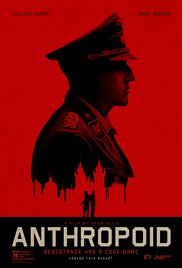
Greetings again from the darkness. It’s been more than 70 years since the Second World War ended, and it’s still producing fascinating stories, books, and movies. Director Sean Ellis co-wrote the script with Anthony Frewin after tireless research into a secret mission of the Czech resistance known as Operation Anthropoid. The purpose was to assassinate SS General Reinhard Heydrich, third in command of The Reich behind only Hitler and Himmler.
Hitler invaded Poland the year after taking Czechoslovakia and put Heydrich in charge. In addition to being the main architect behind the Final Solution, Heydrich became known as “The Butcher of Prague” as thousands of citizens were slain under his reign of terror.
The story is split into two distinct parts … the buildup and the aftermath. It’s late 1941 when we see Jan Kubis (Jamie Dornan) and Josef Gabcik (Cillian Murphy) parachute into the territory outside of Prague and make their way to the city only to discover their contact has been killed. Over the next few months, the two soldiers spend time planning, observing and blending in, while living with their host family – the Moravecs. They become attached to two local ladies (Charlotte Le Bon, Anna Geislorova), first as cover for the mission, and then in a more personal manner as tension builds and the mission gets closer.
Many of the original, historic and actual locations are used which adds an element of realism to a story that’s already plenty real and emotional. The second half of the story is what happens after the assassination. Seven of the original parachutists go into hiding in the basement of the Saints Cyril and Methodius Cathedral. The manhunt is brutal and extensive, and once the hideout is discovered, a seemingly unending parade of German soldiers and ever-increasing weaponry are unleashed. It’s a beautifully filmed, but gut-wrenching scene … think of the last stand at The Alamo.
An extended shootout (6 hours in real time) may not seem like a fun day at the movies, but this story goes to the bravery and desperation of those who refused to give in to the relentless savagery of the Germans. In addition to Ms. Le Bon and Ms. Geislorova, Czech screen vet Alena Mihulova is another standout here. The pacing of the story telling is a bit off at times, but director Ellis brings historical accuracy to a fascinating story in ways that movies such as Valkyrie and Inglourious Basterdsdidn’t even attempt. As courageous as those in the resistance were, the aftermath and reprisals do beg the question … was it worth the price? Not an easy question to answer even in hindsight.
Greetings again from the darkness. When one imagines the most exciting topics for movies, mathematics tends to fall pretty far down the list. Heck, most students only take math classes because they have no choice, so why should anyone be interested in the story of a young Indian man who revolutionized the mathematics world at Trinity College in Cambridge in the early 20th century? The reason is that Srinivasa Ramanujan’s personal story is about more than numbers … it’s about faith and passion and overcoming life’s obstacles.
The story also has an intriguing by-product of demonstrating the difference between intelligence and genius. Trinity College at Cambridge was staffed by some of the smartest, best-educated professors on the planet when this self-taught odd young man appeared with ideas and notebooks filled with equations and concepts that most couldn’t even fathom, much less accept.
Dev Patel plays Ramanujan, the spirited man from Madras India who accepted his remarkable talent as a gift from God. His initially difficult relationship with Trinity Professor GH Hardy (Jeremy Irons) was a clash of two men whose passion for math far eclipsed their comfort in the real world. Hardy was a bit of an outcast at the university, while Ramanujan struggled to provide for his new wife, and had little patience for those who doubted his work.
Writer/director Matt Brown doesn’t seem to believe that the relationship between these two gentlemen is strong enough to hold a mainstream audience, so he commits what comes across as an excessive amount of time to the long-distance battles of the wife and mother of this genius. On the math side, Mr. Brown doesn’t allow us to get lost in minutiae of math equations, but also misses the mark on just how groundbreaking and extraordinary Ramanujan’s work was. There is little doubt that the story of genius, when combined with the abrasive mentorship, racism, elitism and health challenges provides more than enough material to keep us glued to the screen. The rest is merely distracting.
Strong support work is provided by Toby Jones (as Littlewood), Stephen Fry, and Jeremy Northam (as Bertrand Russell), but it’s Patel and Irons who carry the weight here. It’s especially rewarding to see Irons as a co-lead again. There have been other popular math movies like A Beautiful Mind, Good Will Hunting, and Proof, but it’s The Theory of Everythingthat seems to have the most in common with the story of Ramanujan and Hardy. So give it a shot … and remember to show your work!
Greetings again from the darkness. Fairy tales have long been a fruitful source for movie material. Some, like Disney productions, land gently on the family/children end of the scale; while others like the Brothers Grimm material are much darker and adult in nature. And now, along comes director Matteo Garrone and his blending of three stories loosely based on the 17th century tales published by Giambattista Basile … and “black comedy” falls short as a description.
Mr. Garrone is best known for his chilling look at an Italian crime family in the award winning Gomorrah (2008), so a trilogy of demented monarchial fantasies may seem a bit outside his comfort zone … but grab ahold of your crown jewels and be ready for just about anything.
A very strong opening leads us into the first story about a King (John C Reilly) and Queen (Salma Hayek) who are by no one’s definition, the perfect couple. The Queen’s inability to have children leads her to strike a deal with a Faustian seer who promises a baby to the royal couple. The only catch is that the King must kill a sea monster, and the Queen must eat its heart after it’s properly prepared by a virgin. Yep, it’s pretty dark and pretty odd. Of course, as with all actions, there are consequences (albino twins of different mothers) … some of which are not so wonderful.
The second story involves a lecherous King (Vincent Cassel) who falls in love with a local woman based solely on her singing voice. Much deceit follows and the actions of two sisters (played by 3 actresses – Hayley Carmichael, Stacy Martin, Shirley Henderson) and some supernatural aging products lead to a twisty story of romance that can’t possibly end well for anyone involved.
The third of our 3-headed story is the strangest of all, as a King (Toby Jones) nurtures a pet flea until it grows to behemoth size. Yes, a pet flea would be considered unusual, but eclipsing even that in uniqueness is the King’s willingness to offer the hand of his daughter (Bebe Cave) in marriage to a frightening ogre who lives a solitary life in the mountains.
These three stories are interwoven so that we are bounced from one to another with little warning … which seems only fitting given the material. Knowing the theme of the three stories does not prepare one for the details – neither the comedy, nor the dramatic turns. All actors approach the material with deadpan seriousness which adds to the feeling of a Grimm Brothers and Monty Python mash-up.
Alexandre Desplat provides the perfect score for this oddity, though the audience may be limited to those who can appreciate grotesque sequences assembled with the darkest of comedy. The moral to these stories may be difficult to quantify; however, it’s a reminder that actions beget consequences no matter the time period.
Greetings again from the darkness. After suffering through the miserable Mirror Mirrorearlier this year, my fairy tale palate needed cleansing. The original Brothers Grimm tale was actually pretty dark and first time director Rupert Sanders has some success going heavy into ominous with his version. The movie has some flaws, but is actually quite fun to look at.
Early on, we get a taste of Charlize Theron as the wicked stepmother/evil queen. Her calm voice and unforgiving stare prove quite chilling and one of the best parts of the movie. The magic mirror (on the wall) shows signs of life and we understand quickly that this Queen’s power will not be used for the greater good. The palace itself is quite a site and Snow White’s escape provide us a behind-the-walls pass, including the medieval sewer system.
My favorite parts of the movie are the foreboding Black Forest and its polar opposite fairyland. The art decoration for both is excellent and fairyland even offers a nod to the Disney cartoon version. Both sets offer some stunning visuals … the forest ogre, the dwarfs and the white buck with a matrix rack. Ahh, the dwarfs. Can’t have Snow White without them. This group (originally eight) have the superimposed heads of actors we all recognize: Bob Hoskins, Ian McShane, Ray Winstone, Nick Frost, Eddie Marsan, Toby Jones, Johnny Harris, and Brian Gleeson. This camera trick allows us to connect pretty quickly with the group.
Kristen Stewart brings her successful Twilightrun to fairy tale land. She isn’t given much to do other than fight and gaze. Her Joan of Arc look serves the film’s purpose, but does any guy really think she is “fairer” than Charlize? Chris Hemsworth (Thor) plays the titular Huntsman and serves the cause admirably, as does Sam Claflin as Snow’s lusty, trusty childhood friend. Sam Spruell plays the Queen’s henchman brother, but is most memorable for one of the worst haircuts in Hollywood history … straight out of Dumb & Dumber.
The battle scenes are well done, the soundtrack is not overbearing as one would expect, but there seems to be something missing here. The film is fun to look at it, but just doesn’t deliver on any type of emotional level. Perhaps the material is just too familiar after all these years of hoping the first bite of an apple doesn’t render us unconscious.
SEE THIS MOVIE IF: you prefer the darker, sinister version that the Brothers Grimm intended OR you are just trying to wash away the memories of Julia Roberts cackling as the wicked Queen earlier this year
SKIP THIS MOVIE IF:you are expecting something in line with the classic animated Disney version
Greetings again from the darkness. Having not read the Young Adult novels of Suzanne Collins, my comments will be limited to the movie only and not a comparison to the books. The screenplay was a joint affair courtesy Ms. Collins, Billy Ray, and director Gary Ross (Seabiscuit). Whether or not you read the books, you surely know that this has been an anticipated film version in the vein of Twilight and Harry Potter. My analysis is that it falls short of Harry and is superior to the vamps.
What this film definitely is … proof that Jennifer Lawrence is for real. She burst onto the scene in her Oscar nominated turn in Winter’s Boneand once again, her squirrel recipes come in handy. Lawrence plays Katniss Everdeen, a tough as nails and very resourceful resident of the dirt poor District 12. She provides for her little sis and their emotionally vacant mother, and does so by honing her bow and arrow skills hunting in the vast woodlands.
Without going into too much detail, the dystopian world of Panem is divided into 12 districts and a Capitol. As a combination entertainment and price for previous rebellion, an annual lottery is held to select a boy and girl from each district … “tributes” to their community. Those drawing the proverbial short straw are entered into a brutal fight to the death, where 23 are to be killed and one left standing. In the 74th annual Hunger Games, Katniss volunteers to take the place of her little sister. So she and Peeta Mellark (Josh Hutcherson, The Kids are All Right) are whisked away to the Capitol to meet their mentor, Haymitch Abernathy (Woody Harrelson), a one time winner who now celebrates daily by downing as much booze as possible.
In stark contrast to the hopeless community from which they arrive, the Capitol is a gleaming, bright-colored land of enchantment filled with wildly costumed residents seemingly bored by the atrocity of the annual event. Seneca Crane (Wes Bentley, American Beauty) is the man in charge of staging and manipulating the event for the highest possible ratings and entertainment value. He carries out his duties while sporting a very unique satanic beard, unlike you have seen before.
After prepping from a futuristic Tom Ford named Cinna (Lenny Kravitz), the tributes appear in front of a futuristic Ryan Seacrest played by the flamboyant Stanley Tucci. His Caesar Flickerman is charged with interviewing so as to help the audience make a connection. Nothing like humanizing the prey.
It takes a full hour, but the actual Hunger Games finally begin. Quickly the faceless characters disappear and the game of brutality and brains begins. Lawrence is truly a standout here since she has tremendous ability as an actress, and sells her athletic ability quite well. I can’t say I was as taken by Mr. Hutcherson, who spends most of the film looking like a wounded puppy.
While the PG-13 rating keeps it from becoming a gore fest, I found the action sequences to be quite entertaining. More interesting to me was how the story and characters are posed so that a viewer might interpret meaning in just about any manner one cares to twist. There are political views and human nature traits and commentary on the Reality TV world that are primed for claiming … regardless of one’s opinion. To me, that’s a weakness. I would rather the story take a stand and make a statement. But then I remind myself that this is the first in a trilogy of Young Adult stories. It’s not designed for deep thought. The movie succeeds in reaching the goal of producing a strong young female character in a world run amok.
The movie and story seems a mash-up of The Running Man(1987) and Japan’s Battle Royale(2000), but do deliver some other interesting characters, notably Donald Sutherland as the viscious President, Elizabeth Banks as the colorful PR expert Effie Trinket. T Bone Burnett teams with James Newton Howard for the music, and the Tracker Jackers will definitely cross your mind the next time you have a wasp nest to deal with. The missed opportunities with political commentary and a more in-depth love story do not harm the entertainment value here, and the box office success guarantees we will see “Catching Fire” and “Mockingjay” to finish out the trilogy.
SEE THIS MOVIE IF: you read the books (haha … like you haven’t already seen the movie at least twice) OR you want to follow the career of Jennifer Lawrence (super star in the making)
SKIP THIS MOVIE IF: you are expecting an incredibly intense, socio-political commentary OR a satanic looking beard could cause nightmares
Greetings again from the darkness. Based on the best-selling 1974 John LeCarre’ spy novel, opinions on this movie will cover the full spectrum. Many will find it painfully slow and frustrating, if not impossible to follow. Others will be thrilled with the subtle clues and reality-based exchanges between British spies in the early 70’s. This is no James Bond thriller with exploding yachts, world class fist fights and bikini-clad women. Rather, it’s a peek at what real life spies do … huddle in soundproof rooms and exchange information through stunted conversation where just shy of enough is said.
John LeCarre’ actually worked for the British Secret Service prior to becoming an author (also wrote The Constant Gardener and The Russia House). He based this novel around the discovery of a traitor, which remains the biggest scandal in the history of British intelligence. This story covers some of that and even more. We see how trust and loyalty are so crucial, yet none of these men ever fully trusts the fellow agent sitting next to him. Very little is spoken, but much is communicated through a nod, raised eye brow, a slight cock of the head, or even the adjustment of one’s spectacles. Cigarettes and scotch are the common ground from which discussions spring.
Swedish Director Tomas Alfredson delivered the exceptional vampire drama Let the Right One In a couple of years ago. Mr. Alfredson has a distinctive feel for the look of a film, and atmospheric is a word that fits this movie, as well as his earlier one. The tone, color and texture is key to this world, and we are immersed in blues and grays. His camera work is unique and wondrous as he massages the small, confined spaces and allow us to pick up the gestures of all involved.
The cast is a group of wonderfully talented (mostly) men: Mark Strong, John Hurt (Control), Toby Jones (Tinker), Colin Firth (Tailor), Ciaran Hinds (Soldier), David Dencik (Poor Man)and Stephen Graham. Especially enjoyable are Tom Hardy as a rogue agent who breaks the “mole” theory wide open, Benedict Cumberbatch as the youngest agent, and of course, Gary Oldman as George Smiley. Oldman’s performance will awe many and bore a few. This is a man trained to say only what must be said. You can see the resolve in his eyes. These still waters run VERY deep. Some will compare him to the performance of Sir Alec Guiness in the BBC production, and both are terrific and strong (though different).
While a rousing recommendation would be nice, it’s just not in the cards. This movie will have a very specific audience … those who thrive on mental jigsaw puzzles and are inspired by juggling an endless stream of characters and possible plots. If that describes you, then get in line on opening day.
note: John LeCarre’ has a quick cameo during the Christmas party flashback
SEE THIS MOVIE IF: you are the type who likes to play six chess matches at a time OR your addiction to spy novels leans towards the most realistic of the genre, rather than the most action-packed
SKIP THIS MOVIE IF: the Bond movies are your preference in spy thrillers OR needing a scorecard to keep track of the players ruins a game for you
Greetings again from the darkness. I was initially ambivalent on seeing a movie about Marilyn Monroe making a movie. My twisted thinking was that I have already seen the actual film The Prince and the Showgirl, and this particular story is based on a book by Colin Clark who claims to have had a connection/fling with Marilyn during the production phase of the film. Since I had always doubted Clark’s claim, it wasn’t until early reviews of Michelle Williams‘ performance hit Twitter that I started to get interested.
For an actor, playing Marilyn Monroe must be similar to playing Elvis. Everyone on earth knows what the real deal looks and sounds like. What is interesting about this film is that it is chock-full of actors playing well known people. In addition to Williams/Monroe, we get Eddie Redmayne as Colin, Kenneth Branagh as SirLawrence Olivier, Julia Ormond as Vivia Leigh (Olivier’s wife), Toby Jones as Arthur Jacobs, Dominic Cooper as Milton Greene, Karl Moffat as DP Jack Cardiff, Dame Judi Dench playing Dame Sybil Thorndyke, Zoe Wannamaker playing Paula Strasberg (Monroe’s acting coach), and Dougray Scott as Arthur Miller (the famous writer and Monroe’s husband at the time).
Michelle Williams dominates the film just as Monroe would have. She mimics the iconic movements, but best succeeds in capturing the essence of Marilyn. History states that Olivier was very impatient with Marilyn and struggled with her irregular schedule and “method” approach to acting (which he abhorred). It is little wonder that Marilyn struggled so with her first and only film outside of the U.S. Many have an image of Ms. Monroe as a ditsy blonde, but there are a couple of well-documented autobiographies that show a pretty shrewd business person and one very aware of her marketable and valuable public image.
As for the film, it rates a couple of ticks higher thanks to the outstanding performances of both Michelle Williams and Kenneth Branagh. If not for them, it would be little more than a TV movie. Speaking of, this is the first feature film for director Simon Curtis, whose previous work has been seen on television. Personally, I would have preferred a movie that focused on either the making of The Prince and the Showgirl or a view of the human side of Marilyn. Here, we get a shortage of each.
SEE THIS MOVIE IF: you want to see Michelle Williams’ beautiful performance as Marilyn (she is likely to get an Oscar nom)
SKIP THIS MOVIE IF: you are looking for any real insight into what Marilyn was like as a real person (this one just skims the surface)
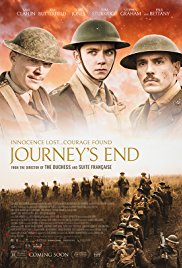 Greetings again from the darkness. R.C. Sheriff wrote this 1928 play based on his experience as a British Army officer in WWI. The play’s successful two year run led to a 1930 big screen adaptation directed by James Whale and starring Colin Clive – two legends of cinema who also collaborated on FRANKENSTEIN and BRIDE OF FRANKENSTEIN. Now, exactly 100 years after “the Spring Offensive”, director Saul Dibb (THE DUCHESS, 2008) delivers screenwriter Simon Reade’s version of Sheriff’s story and a tribute to those who served in the Great War.


 Posted by David Ferguson







 Movie Reviews from the Dark