Greetings again from the darkness. My goal is to give every movie a fair shake, and to seek out the best elements even when a film disappoints. I don’t recall a time when this goal has been more difficult to achieve than after watching this latest from director Brad Peyton (SAN ANDREAS, 2015) and co-writers Leo Sardarian (“StartUp”), Aron Eli Coleite (“Locke & Key”).
Jennifer Lopez stars as Atlas Shepherd, a brilliant government analyst and expert on AI, especially on Harlan (Simu Liu, BARBIE), ominously deemed the world’s first AI terrorist. We know Atlas is smart because she has a chess winning streak against the computer and she wears black frame eyeglasses. After an opening which features Earth in peril, we flash forward 28 years, where it’s evolved into “good AI” versus “evil AI”. Don’t worry, Atlas is on the side of good, despite her constantly frazzled state (with perfect hair) and the personal (emotional) baggage she carries with her.
After years of searching, Atlas discovers the location for Harlan, and General Boothe (Mark Strong, character actor extraordinaire) forms a team led by Colonel Elias Banks (Sterling K Brown, AMERICAN FICTION, 2023) to capture Harlan so his CPU can be studied. Of course, the mission doesn’t go as planned and by the end, I was wondering which racked up the most points: explosions or Ms. Lopez’s cringy acting moments. Terrible punchlines regarding a running coffee gag placed third in the competition. Since I admittedly search for positives in every movie, let’s go with Simu Liu’s unusual blue-eyed effect, the tight pants on Agent Atlas, and giant robotics that look like the one that went rogue in ROBOCOP (37 years ago). Apologies, but that’s the best I can do for this one, other than to say we have an early Razzie frontrunner.
Greetings again from the darkness. From one who watches too many movies every year, I’m amazed this film is the work of a director making his feature film directorial debut. Writer-director Cord Jefferson was one of the lead writers for the excellent series “Master of None”, and he has adapted the 2001 novel “Erasure” by Percival Everett for the big screen. It’s a brilliant satire and commentary on a society that has twisted things to the point where no one knows what to say or how to say it.
The film opens with a college professor pushing back on a student’s overly emotional reaction to his use of the N-word in class. What strikes us in the scene is that the professor is black and the student is white. The confrontation costs Thelonious “Monk” Ellison (the always great Jeffrey Wright) his job at a New England university, and perfectly sets the stage for the rest of the story – much of which centers on Monk’s incredulity at the progression of events around him.
Without a steady teaching paycheck, Monk heads to his see his agent Arthur (well-known character actor John Ortiz), who informs that his most recent intellectual book has no market, and suggests he write something a bit more mainstream. Monk heads to the Boston book festival and hears author Sintara Golden (comedian Issa Rae, BARBIE) in a public reading of a particularly stereotypical excerpt from her latest best-seller, purported to telling “black stories, our stories”. Monk simply can’t believe there is an audience for this or that it passes for black representation.
On a lark, Monk sits down to crank out a “black” story by a black writer. He does so as a joke, and is shocked, and a bit annoyed, that a publisher comes back with a huge offer. The negotiations with the publisher are hilarious. We see two white professionals desperate to offer a cool black book, yet so afraid to say the wrong thing (something offensive), that they inexplicably agree to Monk’s terms … changing the title to an unpublishable curse word. As a bonus, Monk has published the book under the pseudonym Stagg R. Lee (a takeoff on the classic Lloyd Price song). The publishing deal requires Monk to assume the identity of a wanted fugitive as part of the backstory for marketing purposes. When the movie offer rolls in, Monk is again beside himself, and states, “the dumber I act, the richer I get.”
While all this is going on, Monk is also facing some struggles in his personal life with his mother (80 year old Leslie Uggams, “Roots”) who is struggling with dementia, his financially-strapped sister Lisa (Tracee Ellis Ross, Diana’s daughter, THE HIGH NOTE, 2020), and brother Cliff (Sterling K Brown, WAVES, 2019, “This is Us”) whose recent divorce was caused by his revealing his preference for a gay lifestyle. All of this for a family whose dad committed suicide years ago. In the midst of all the family and professional drama, Monk strikes up a relationship with Coraline (Erika Alexander, GET OUT, 2017), a neighbor across the street, though he can’t bring himself to come clean with this latest publishing scheme.
The best comedies have something to say, and the best satires are often quite cynical as they expose the absurdity of our world. Monk is dumbfounded at many of the same things that dumbfound us, and this peaks at his meeting with an aptly named movie producer, Wiley Valdespino (played by Adam Brody, READY OR NOT, 2019). Myra Lucretia Taylor (THE BIG SICK, 2017) has a supporting role as the housekeeper, and there are too many terrific scenes to count. One of the best is a debate between Monk and Sintara, and the writing is priceless and brilliant. An intelligent man like Monk cannot wrap his head around the fact that black books pandering to white readers who are trying to follow the rules is the new path to success. Filmmaker Cord Jefferson delivers the message (warning?) in a smart, funny movie featuring a wonderful lead performance by Jeffrey Wright.
Opening in theaters nationwide on December 22, 2023
Greetings again from the darkness. ‘Life will find a way.’ The iconic line spoken by Jeff Goldblum in JURASSIC PARK (1993) fits right into this offbeat science-fiction film from writer-director Mel Eslyn and co-writer and co-lead actor Mark Duplass. You may not be familiar with indie filmmaker Eslyn, but Duplass has built a career by specializing in projects that rip us out of our comfort zone, and then force us to consider a topic from a new perspective … as evidenced by films like CYRUS (2010) and CREEP (2014).
The pre-credit opening scenes quickly establish the personalities of Ray (Sterling K Brown) and Billy (Duplass). Ray is a dedicated and serious scientist, while Billy is the former US President (likely inspired by George W Bush). The two are lifelong friends who have been living a few years isolated in the biodome created by Ray. We are to assume these are the final two human survivors on Earth, and we may also assume they are still alive thanks to Ray’s ecosystems of fish for protein and plants for nutrients.
Initially, this gives us the appearance of a buddy film as the two men share a morning jog and discuss the dynamics of Mario and Luigi. It’s the first of our clues, along with Billy reading “Kiss of the Spider Woman”, and the repeated viewings of LETHAL WEAPON. However, the tone shifts pretty quickly with a certain development in the fish habitat. It’s best to avoid any further specifics on where the story goes from here, because although there are leaps of faith that must occur by viewers, the core elements raised here are certainly unusual.
A recurring gag about a magic trick with a bowling ball (and its thud), and an ever-present green light in the sky, punctuate the Ray and Billy chats centered on philosophy, gender roles, friendship, masculinity, adaptation, and of course, survival. This is termed a “two-hander” since only two performers make up the entire cast. Sterling K Brown and Mark Duplass are both likable actors and they expertly overcome any shortcomings in the script. And despite those flaws, you’ll likely carry on some internal discussions with yourself long after the final drop.
Greetings again from the darkness. Welcome to the Greater Paths Baptist Church. Or what’s left of it. Writer-director Adammo Ebo has expanded her 2018 short story (same title) into a feature film that serves up a satirical look at the proliferation of mega churches and all that entails – ego, greed, self-absorption. Her best move was casting Regina Hall and Sterling K Brown in the crucial lead roles.
In the faux-archival footage, we see Pastor Lee-Curtis Brown (Sterling K Brown) eloquently and passionately sermonizing to the massive congregation. At its peak, his church had 26,000 members who filled the offering plates each Sunday. We know this because this pastor is not shy about flashing his designer label clothes or collectible cars, or mentioning the private jets and helicopters. He uses these glitzy material goods to reinforce what good Christians each member is. But that was then, and this is now. The church has been closed due to a very public scandal involving Pastor Lee-Curtis and his inappropriate behavior with teenage boys.
The story here involves the pastor and his first lady wife Trinitie (Regina Hall) as they strategize about creating excitement for the grand re-opening of their church. The scandal is clearly the biggest hurdle; but so is Heaven’s House, a local church run by ‘Pastor Sumpter and Pastor Sumpter’, a husband and wife team played by Conphidance and Nicole Beharie (so good in BREAKING, 2022). After the scandal, Heaven’s House welcomed many transferring members and is now in the process of growing their church to a new level.
This is a mockumentary and the “documentary” filmmakers follow Lee-Curtis and Trinitie around most of the day, sometimes even when they aren’t particularly welcome. Because of this, we see Lee-Curtis as a narcissist mostly devoid of any semblance of reasonable perception of how others view him. He may seek the road to redemption, but that trust has been broken. Trinitie stood by her man through the hard times, and it seems clear they are both desperate to regain the power and privilege that is now lost.
Sterling K Brown and Regina Hall are both fully committed to these roles. Brown’s intensity, no matter how displaced his character feels, absolutely works. And Regina Hall’s performance is even more fun to watch. She’s especially effective at showing Trinitie’s inner turmoil of maintaining dignity versus the desire for the power lifestyle. She excels at biting her tongue and struggles to avoid letting her true feelings show … she’s a pillar of loyalty behind a cheerleader’s fake smile. She also delivers the perfect final shot.
This mockumentary isn’t funny in the Christopher Guest way, but rather with a bleak commentary on power-hungry people and megachurches, with a few exceptions. What once was a congregation over 20,000 is now only the “Devout Five”. We get the best ever pinkie toe joke, and Ms. Hall and Mr. Brown go all in on their rendition of Crime Mob’s “Knuck You if You Buck” while driving. It’s a bit confusing that the faux-doc doesn’t fully follow the idea of only showing what the camera crew captures, but the description of “EGO” as ‘edging God out’, and a marketing plan seemingly tied to a glittery handheld sign and statue of Jesus give us some idea about these two. In TOMBSTONE, Doc Holiday states, “My hypocrisy knows no bounds”, and that’s so true for Lee-Curtis and Trinitie. While there are flashes of brilliant satire, unfortunately the target is just too easy, and the filmmaker chooses to remain on the surface rather than dig deep for the juicy part.
Greetings again from the darkness. Kicking off a successful franchise that can sustain multiple sequels is the dream of most actors, writers, directors, and producers. When it clicks, a movie franchise can be a cash cow for many years. Unfortunately, it’s just not that easy to create characters that viewers will invest in, or story lines that will keep those viewers interested. Author Mark Burnell has already published four books in his Stephanie Patrick series, and director Reed Morano brings the first one to the big screen. By the time the end credits roll, we have little doubt that “franchise” was the goal.
An opening scene finds Stephanie Patrick (Blake Lively) pointing a gun at the head of a man who is unaware of her presence. A freeze frame shifts us to “8 months earlier.” Stephanie is a mess. She is supporting her heroin addiction through prostitution, all with the objective of numbing her pain. Three years earlier, her family was killed in a plane crash. It’s the kind of tragedy followed by a grief so devastating that Stephanie has basically given up on life.
Stephanie is jolted back to life when a journalist informs her that it was a bomb planted by a terrorist that brought down the plane her family was on. Now, Stephanie has a reason to exist … revenge. Clearly some suspension of disbelief is in order here. Actually everything about this story is a stretch from reality or even believability. Quick, name all of the heroin addicts who become world class assassins in 8 months. OK, that’s probably not a fair question since you likely don’t know many heroin addicts, and you hopefully don’t know many assassins. But you get the point.
The film plays like a brochure for a travel agent, as the story and Stephanie have stops in Tangier, England, Ireland, Madrid, New York, and Marseilles. Each stop is pretty brief – merely long enough for some killing. Of course most of the stops occur after former MI6 agent Ian Boyd (Jude Law) trains her on the finer points of being a contract killer. The training includes jogging uphill, a frigid lake swim, how to fight in the kitchen, how to get run off the road while driving, and the invaluable advice to shoot your victim twice (but your teacher only once). Oh yes, and she has to impersonate a presumed-dead assassin. Fortunately, Stephanie was top of her class at Oxford, so she is smart enough to make sense of all these things that make no sense to us.
And another thing … why do all these people have such perfect and complete files on their targets? Photographs by Glamour Shots, map coordinates to hideouts, and an alphabetical list of known accomplices are all quite helpful when former MI6 and former CIA agents (Sterling K Brown) are trying to get a heroin addict to do their dirty work. Brown’s CIA agent turned ‘information broker’ is the oddest of many odd characters here. He lives in a stunning ultra-modern home and has no qualms about hitting on hot assassins that he knows only by reputation. Thanks to all those marvelously complete files, the only unknown here is the mysterious U17. Well, U17 seems to be mysterious to everyone except those watching the movie.
Blake Lively is a talented actress as evidenced by her work in THE TOWN, THE SHALLOWS, and A SIMPLE FAVOR. She is simply miscast here. Despite the “training” her Stephanie received from Ian, we never once believe she is ready to kill all the bad guys. This contributes heavily to the lack of believability presented by the film. It’s a serious story that is ultimately impossible to take seriously as a viewer.
There is a difference in believable and stylish, and director Reed Morano certainly serves up style. She is known mostly for her work as a cinematographer, though she did direct the first 3 episodes of “The Handmaid’s Tale.” Ms. Morano and cinematographer Sean Bobbitt hit us with some jarring camera work, and the musical inserts are just a tad too cutesy and obvious at their given time: “I’m Sorry”, “It’s Now or Never”, and “Where Did You Sleep Last Night?” (a cover by Sleigh Bells).
Having author Mark Burnell adapt his own novel may have been a mistake, as there are far too many plot holes and ridiculous moments for this to work as any type of thriller. Here are three examples: we never know why Stephanie didn’t get on the flight with her family; it makes little sense that the journalist tracked her down; and is that supposed to be a twist or not? Given the inclusion of Bond producers (and half-siblings) Barbara Broccoli and Michael G Wilson (stepson of Cubby Broccoli), we can safely assume that the vision was to turn Mr. Burnell’s books into a franchise along the lines of James Bond and Jason Bourne – right down to the fight scenes and international settings. This film certainly sets things up for round two, and if that happens, let’s hope more attention is paid to the script … a crucial element if viewers are expected to buy in.
Greetings again from the darkness. Whether in sports or music or movies, watching talent blossom and grow is wondrous. For movie lovers, this describes young filmmaker Trey Edward Shults, whose first feature film KRISHA really grabbed me at a film festival in 2016. His follow-up was the critically acclaimed IT COMES AT NIGHT (2017), and now with only his third film, Mr. Shults has delivered an even more ambitious story with wide-reaching impact, yet he remains true to his intimate and personal approach. In fact, with WAVES, he basically delivers two brilliant films in one.
A terrific opening credits sequence takes us inside the life of a teenager. There is constant motion, laughter, the longing for independence, and signs of responsibility and structure. Tyler (Kelvin Harrison Jr,LUCE, 2019) is a high school student, talented athlete, pianist, son, brother, and boyfriend. He’s living an upper-middle class life in a beautiful home with his dad (a powerhouse Sterling K Brown), stepmom (Renee Elise Goldsberry), and younger sister Emily (breakout star Taylor Russell). His dad owns a construction company, and is tough and demanding as a parent, incessantly pushing his son to do and be more. His fatherly advice comes in the form of telling Tyler that black men have to work harder than white ones … never stopping to give praise or affection. He’s the type of father who challenges his son to arm wrestle while in a restaurant and critiques his wrestling match victory by telling him the lesser opponent should have been dispatched much quicker. The pressure is relentless, though offered with the best intentions … a college scholarship and a successful life.
Tyler’s stepmom is loving and supportive, and his sister Emily is very sweet and quiet, living in the shadows of big brother. Tyler and his girlfriend Alexis (Alexa Demie) seem to have a good relationship and Tyler appears to be dealing with the pressures. But then, as is common with life at this age, things go sideways quickly. A shoulder injury, self-medication, and Alexis’ late period bring this ideal world crashing down on Tyler. Just when it seems things can’t get worse, they do.
Shults’ film is really two love stories separated by a tragic line. Whereas the first half belongs to Tyler, the second half is owned by his sister Emily. Dealing with a situation and emotions that should be beyond her maturity level, Emily proves how strong she is, and how the heart can always respond to compassion and caring. She meets one of Tyler’s ex-teammates Luke (yet another brilliant Lucas Hedges performance). Luke is socially clumsy and 180 degrees from being a smooth-talker, but he’s smitten with Emily and offers her a lovely, if unlikely, companionship. First love is almost always awkward and watching these two navigate is quite charming and heart-warming. A road trip leads to bonding and a better understanding of each other.
As the film shifts in focus and tone, characters are pushed to emotional limits. The film offers snapshots of moments without disturbing the flow or Shults’ commitment to rich texture. The photography from cinematographer Drew Daniels is creative and varied, and adds much to the presentation. Music is also vital here. The score from Trent Reznor and Atticus Ross adds the perfect touch, and the soundtrack contrasts the tastes of today’s generation with what the parents relate to (Dinah Washington’s “What a Difference a Day Makes”), even forming a surprising connection at one point. For other fans of Shults’ film KRISHA, you will enjoy a quick scene with Krisha Fairchild as a high school teacher.
Proms, pregnancy, parties, pills, and parents are all common topics for films dealing with teens, but this one digs deeper than most. It’s based in south Florida and is quite the stylish and heartfelt drama, slicing open the traits that make us human. A lifetime of good decisions builds a foundation, and one or two bad choices can topple all the good ones. When Tyler and his teammates are pumping up before a match with chants of “I cannot be taken down!”, we all know that life can absolutely take you down. Tyler learns this lesson in the harshest of ways, while his sister Emily deals with the aftermath. Themes of acceptance and forgiveness give this the feeling of the work of a much more experienced filmmaker, but evidently Trey Edward Shults is just this talented.
Greetings again from the darkness. The feature film directorial debut of Drew Pearce is original and clever, while teasing with hope for a bit more than it delivers. Mr. Pearce is best known for writing the screenplay for IRON MAN 3, and now as a first time director, he shows enough promise to leave us interested in what comes next.
The film is set in dystopian Los Angeles a mere 10 years in the future. The streets are flooded with desperate rioters after a mega-corporation shuts off the clean water supply. The company is the film’s real villain, and the only one that The Nurse (Jodie Foster) can’t treat. See, she runs Hotel Artemis, an underground hospital for top tier criminals – the element that can’t just pop into the local community clinic for treatment on the latest bullet hole or knife wound. These patients follow a subscription plan and must stay current on their dues to gain admission.
The Nurse forgoes any attempt at personal vanity and is instead an agoraphobic, booze-chugging, (mostly) stick-to-the-rules type, who pops in anti-anxiety tapes and ear buds whenever her pulse quickens. She has run the place since it opened 22 years prior and is assisted by a mountain of man named Everest (get it?) played well by Dave Bautista. He’s a combination bodyguard, bouncer, handyman and assistant healthcare professional (check his badge).
The set design by Ramsey Avery deserves special mention as the Hotel Artemis is quietly housed in the shell of a former grand art deco hotel, now a victim to the city’s carnage – though the neon sign remains illuminated. Its vacation spot-themed rooms are a sight to behold, despite the frustratingly low lighting. Occupants are incognito and use their room names as identifiers. Sterling K Brown is Waikiki, a philosophical bank robber who dragged his brother Honolulu (Brian Tyree Henry) here for treatment after a heist went wrong. Acapulco (the always energetic Charlie Day) is a crass, motor-mouthed arms dealer, while Nice (Sofia Boutella, THE MUMMY) is a freakishly skilled assassin.
The stress level picks up when the biggest crime lord of Los Angeles shows up seriously wounded. Known as The Wolf King, an admittedly bad choice for a nickname, Jeff Goldblum brings some smooth-talking toughness, humor and twisted class to the proceedings. More than a few tentacles are attached to The Wolf King and other folks we’ve previously met, not the least of which is a very special ink pen stolen by Honolulu. Mix in an injured cop (Jenny Slate) with a personal link to The Nurse and her constantly alluded to tragic backstory, and the movie puts off a Graphic novel vibe … missing only the off-the-cuff insanity. It’s just a bit too grounded for its own good.
The high tech/low rent feel forces us to recall BLADE RUNNER and ESCAPE FROM NEW YORK, but of course, this film isn’t at the level of either, as it lacks top tier suspense. It is a terrific reminder of what a talented actress two-time Oscar winner Jodie Foster is, and what a shame that we haven’t seen her in such a substantial screen role since 2013’s ELYSIUM. She really sinks her teeth into this odd character, and more than the action scenes, she keeps us interested the entire run time. The score is a bit too heavy on the droning electronic bass line, and while the Florida joke and nod to John Phillips (The Wolf King, “California Dreamin’”) earns some bonus points, it’s really the performance of Ms. Foster and the set design that saves a too-safe script.
Greetings again from the darkness. Adaptations of Superheroes, Comic Books, and Graphic Novels have been driving the movie theatre box office for a few years now. Where the financial success of a film was once measured in tens of millions, it’s now hundreds of millions. Beyond that, these enormous productions are pressured to make political and social statements … providing the hope of which real life leaders seem to fail. This latest from Marvel and director Ryan Coogler (CREED, FRUITVALE STATION), carries all of that plus the expectations of an entire gender and race. It’s a heavy burden for a comic book character, however it seems, regardless of one’s perspective, it’s likely the film delivers, satisfies, and … oh yeah … entertains.
The bar has been set so high for action sequences and special effects, that we take the great for granted and only speak up on those that falter. What allows this film to take its place among the best of the genre is a combination of story depth and the payoff for showing us a world we haven’t previously seen. The cultural aspects of the (mythical) African country of Wakanda are not only interesting, but the setting itself is breath-taking. An explosion of color, texture and technology blended with intriguing and multi-dimensional characters bring the film to life and draw us into this wonderland of tradition, culture and humanity.
It seems ridiculous to speak of a comic book film in these terms, but the number of talking points raised during its runtime are too many and too varied to discuss in this format. What we can make clear is that it’s cool to watch an entire movie where people of color and women are strong, confident, and intelligent. Chadwick Boseman has played Thurgood Marshall (MARSHALL), James Brown (GET ON UP), and Jackie Robinson (42), and here he takes on a fictional icon in King T’Challa/Black Panther. He perfectly captures the pensive nature of a King balancing tradition with the needs of his people to evolve and transition. His chief adversary “Killmonger” is played terrifically by Michael B Jordan (CREED, FRUITVALE STATION) as a man out for revenge and power. For most movies this head to head battle would be enough … but not this time.
Lupita Nyong’o (Oscar winner for 12 YEARS A SLAVE), Danai Gurira (“The Walking Dead”), and relative newcomer Letitia Wright play Nakia, Okoye, and Shuri respectively; a triumvirate of three of the strongest women you’ve likely ever seen on screen. Nakia is the love interest, but also carrying out her own humanitarian missions, while also proving to be beyond adequate as a soldier. Okoye is the ultimate warrior and absolutely loyal to her country, while Nakia (T’Challa’s sister) is a contemporary version of James Bond’s Q – the ultimate technology whiz, and one with the zippiest zingers. Any of these characters could be the basis for a standalone movie, but together they elevate this to something much more than a couple of dudes in sleek suits fighting.
Martin Freeman (THE HOBBIT), Daniel Kaluuya (GET OUT), Sterling K Brown (“This is Us”), Angela Bassett, and Forest Whitaker are all contributors, and Andy Serkis is a frenzied standout in an all-too-brief turn as Klaue. The strong cast delivers even in the few moments when the script lags. In fact, the only piece of this puzzle that didn’t seem to fit was the traditional hand-to-hand combat to determine the next king. Why is it that a nation so advanced still relies on primitive courses of decision-making? Perhaps this is merely commentary on our society, though providing a more intellectual solution would have been in line with the rest of the story.
The world of Wakanda is stunning. The costumes are sleek, colorful and fascinating. The characters are multi-dimensional. The action sequences are top notch (armored rhinos!). The cinematographer is Rachel Morrison, who recently made history by being the first woman to receive an Oscar nomination for cinematography (MUDBOUND). It’s these factors that allow Mr. Coogler’s film to achieve the level of importance that most comic book films wouldn’t dare to strive for. On top of everything, it accomplishes the one thing I demand from these type of movies … it’s quite fun to watch!
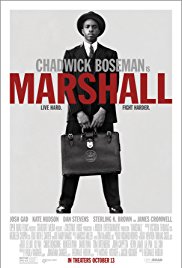
Greetings again from the darkness. The question must be asked: is the movie worthy of the man? The man was the first attorney for the NAACP. He won 29 of the 32 cases he argued in front of the U.S. Supreme Court, including the ground-breaking 1954 Brown v. Board of Education (separate but equal public education). This man was a trailblazer for Civil Rights, and in 1967 became the first African-American Supreme Court Justice. This man was, of course, Thurgood Marshall … a man who unquestionably deserves not just a movie, but a really good and important one.
Chadwick Boseman has taken on film versions of such icons as Jackie Robinson in 42 and James Brown in GET ON UP, so he likely jumped at the chance to play the revered figure, Thurgood Marshall. Mr. Boseman has true movie star screen presence, and supplies the young Mr. Marshall with a self-assured swagger that accompanies a brilliant legal mind – a mind that refused to be ignored during a time it was desperately needed. Lest he be labeled a superhero, the film does portray Marshall smoking and drinking, while also hinting at his carousing. The common flaws of a great man.
It’s 1941 and the young (33 years old) Marshall is the lone NAACP attorney, so he spends his time ping-ponging around the country fighting for fair trials for those African-Americans accused simply because they aren’t white. He works only for “innocent” people and his efforts during this time were crucial to the Civil Rights movement gaining attention and legitimacy. Most of the film centers on a case in Connecticut (no, not the Jim Crow south) where a black man, Joseph Spell (Sterling K Brown), is accused of sexual assault of a “respectable” married white woman, Eleanor Strubing (Kate Hudson). If you are reminded of the great book and film TO KILL A MOCKINGBIRD, you must know that those literary and cinematic standards are such that few can ever hope to reach.
What follows is not one of the more dramatic or tension-filled cinematic courtroom dramas. There is simply too much levity for the film to be classified as a historical heavyweight. That said, the man and his story are fascinating, and though director Reginald Hudlin chooses a deft touch rather than a sledge hammer, it’s likely the wise choice if the goal is to entertain, while also educating the masses to Marshall’s early career. Josh Gad co-stars as Marshall’s co-counsel Sam Friedman, a specialist in legal technicalities within the insurance industry. Boseman and Gad have nice chemistry (at times it feels like a buddy movie), and as a Jew in those times, Friedman is himself stuck in limbo between staunch racism and acceptance by the white community.
James Cromwell plays Judge Foster, yet another man caught between the old world he has lived in his entire life and the fast-changing society and legal system that permits him to silence Marshall, while also forcing (somewhat) fair treatment of the accused Spell. Dan Stevens (BEAUTY AND THE BEAST) is Loren Willis, the disgusted and disgusting prosecutor. This character is so cartoonish that the only thing missing is a neon necklace that flashes “racist” as he speaks. Sophia Bush has a brief, yet important scene and Sterling K Brown (as Mr. Spell) has the film’s most heart-breaking moment as he sits on the stand and explains why he lied.
Director Reginald Hudlin seems like an odd choice for the project. He has been working mostly in TV since back-to-back-to-back bombs BOOMERANG (Eddie Murphy), THE LADIES MAN(Tim Meadow) and SERVING SARA(Matthew Perry). Mr. Hudlin has experienced more success as a Producer, having been Oscar nominated for DJANGO UNCHAINED. Here he works with the father and son screenwriters Jacob Koskoff and Michael Koskoff. The elder Michael is a well respected criminal attorney and legal historian, and certainly understands the expectations that come with offering a public look at a near-mythical figure … especially one as revered as Thurgood Marshall.
This isn’t so much a movie about the icon as it is about a young man on the path to greatness and importance (he served on the Supreme Court from 1967-1991). The soundtrack is filled with jazz which complements the light-hearted approach, and further distances from any semblance of “heavy” or “historical”. Director Hudlin adds a contemporary touch by having Trayvon Martin’s parents (Sybrina Fulton, Tracy Martin) appear in a scene near the end. On the downside, multiple upshot camera angles are designed to make his lead character look larger than life. The truth is, Thurgood Marshall required no help in looming large. Hopefully this mainstream approach pays off and many are introduced to the legacy of a man who is more than worthy of this movie … and another.
 Greetings again from the darkness. My goal is to give every movie a fair shake, and to seek out the best elements even when a film disappoints. I don’t recall a time when this goal has been more difficult to achieve than after watching this latest from director Brad Peyton (SAN ANDREAS, 2015) and co-writers Leo Sardarian (“StartUp”), Aron Eli Coleite (“Locke & Key”).


 Posted by David Ferguson
  Greetings again from the darkness. From one who watches too many movies every year, I’m amazed this film is the work of a director making his feature film directorial debut. Writer-director Cord Jefferson was one of the lead writers for the excellent series “Master of None”, and he has adapted the 2001 novel “Erasure” by Percival Everett for the big screen. It’s a brilliant satire and commentary on a society that has twisted things to the point where no one knows what to say or how to say it.
 Greetings again from the darkness. ‘Life will find a way.’ The iconic line spoken by Jeff Goldblum in JURASSIC PARK (1993) fits right into this offbeat science-fiction film from writer-director Mel Eslyn and co-writer and co-lead actor Mark Duplass. You may not be familiar with indie filmmaker Eslyn, but Duplass has built a career by specializing in projects that rip us out of our comfort zone, and then force us to consider a topic from a new perspective … as evidenced by films like CYRUS (2010) and CREEP (2014).
 Greetings again from the darkness. Welcome to the Greater Paths Baptist Church. Or what’s left of it. Writer-director Adammo Ebo has expanded her 2018 short story (same title) into a feature film that serves up a satirical look at the proliferation of mega churches and all that entails – ego, greed, self-absorption. Her best move was casting Regina Hall and Sterling K Brown in the crucial lead roles.



 Movie Reviews from the Dark