THE BRUTALIST (2024)

December 20, 2024

Greetings again from the darkness. Too many view WWII as just another page in history books, when in fact, so much changed around the globe because of that war. Almost 80 years later, the war continues to provide stories for filmmakers, and when it comes to storytelling, few do it better than this latest from writer-director (actor-turned-filmmaker) Brady Corbet and his co-writer (and romantic partner) Mona Fastvold. The two had previously collaborated on THE CHILDHOOD OF A LEADER (2015) and VOX LUX (2018).

This is an old-fashioned epic on a grand scale with a few specific features that deserve to be highlighted. At 3 hours and 35 minutes in run time, Corbet included a throwback intermission (with a 15 minute countdown on screen). The opening credits run right-to-left horizontally, while the closing credits run diagonally. For true film geeks, the film is shot in VistaVision to capture the period feel. Part 1 covers 1947 through 1952, while Part 2 covers 1952 through 1960, and the Epilogue takes us to Venice in 1980.

Oscar winner Adrien Brody stars as Laszlo Toth, a Hungarian architect who arrives in post-WWII America after using heroin “for the pain” on the boat ride over. Due to administrative and governmental red tape, Laszlo had to go ahead of his wife and niece, to whom he writes regularly. A familiar face from home greets him upon his arrival. Attila (Alessandro Nivola, FACE/OFF, 1997) has already been Americanized to the point where he’s married and running a custom furniture business. He offers Laszlo a room to sleep and a chance to help design furniture. When Harry Lee Van Buren (Joe Alwyn, THE FAVOURITE, 2018), the son of a wealthy Pennsylvanian tycoon, contracts for a re-design of dad’s library, Laszlo gets a chance to show his brilliance. It turns out, Harrison Lee Van Buren Sr (Guy Pearce) does not like surprises and tosses the workers out.

Soon, a cooler head prevails for the tycoon, and he tracks down Laszlo for a project of much larger scale – a massive memorial on a hill overlooking the city. The project builds an odd connection between rich Harrison and brilliant Laszlo – although the rich guy remains anything but stable, and his son flaunts his own arrogant annoying tendencies (an Alwyn specialty). Laszlo maintains one true friendship. He bonds with Gordon (Isaach de Bankole) after meeting him in the food shelter line. Despite the new World, Laszlo continues to struggle with poverty; however, one of Van Buren’s lawyers is amenable to assisting with the paperwork for bringing Laszlo’s family to the states.

Part two brings wife Erzsebet (Felicity Jones, THE THEORY OF EVERYTHING, 2014) and mute niece Zsofia (Raffey Cassidy, THE KILLING OF A SACRED DEER, 2018) to America. Erzsebet is wheelchair bound after nearly starving to death due to the war. She’s a smart woman married to a creative genius, and yet the land of opportunity continues to toss hurdles in their path (not the least being Laszlo’s continued use of drugs). The moments of hope include a trip to the stunning Carrara quarry to locate the perfect piece for Van Buren’s project.

It should be noted that, despite the lead character’s name, this is a fictional account of the period, and the journey is both physically and emotionally draining. That’s also true for viewers, as I was exhausted by the end. Corbet uses the Epilogue to take us to Venice in 1980 for the first Architectural Biennal. It’s a fitting end after watching the battles of Jews versus Christians, and Immigrants versus American born, all while the United States is booming. I wasn’t ever able to understand the message Corbet was sending by exaggerating footsteps throughout, but I do recognize that Cinematographer Lol Crawley and Production Designer Judy Becker worked some magic along with Corbet and Fastvold … and yes, Adrien Brody, who along with Guy Pearce, deliver some of the finest acting we’ve seen all year. This is not a film so much about the brutalist style of architecture, but rather a film about character and personality during brutal times – and finding a way to utilize one’s true talent, while also remaining true to one’s roots. This is a complex story and one that fully captured me right from the unconventional opening credits.

Opens in limited theaters on December 20, 2024 and wide in January 2025

WATCH THE TRAILER
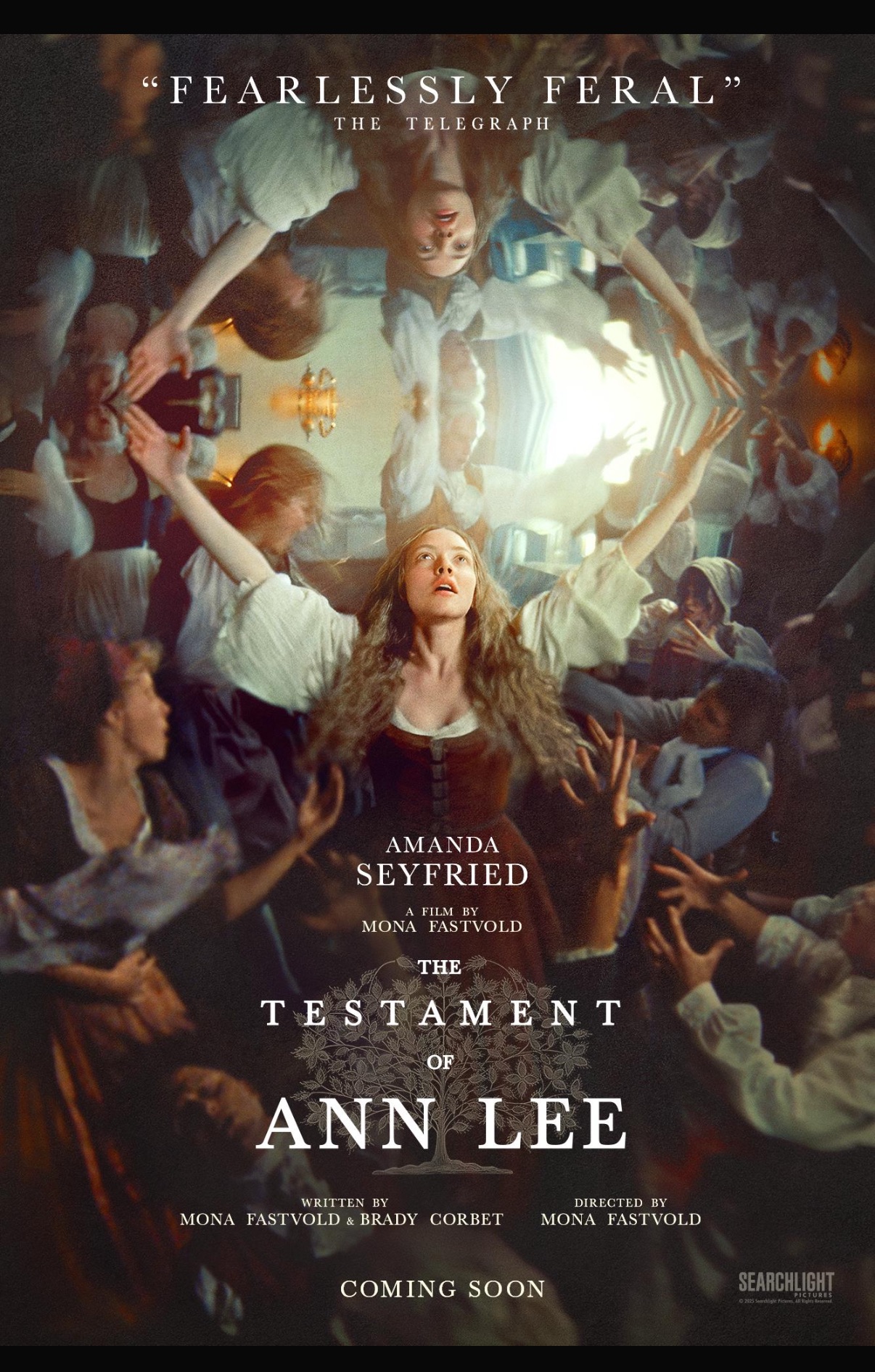

THE WORLD TO COME (2021)

February 11, 2021

 Greetings again from the darkness. I’d be hard-pressed to name a movie that is more somber, front beginning to end, than this film from director Mona Fastvold (writer of VOX LUX, 2018) and co-writers Ron Hansen (THE ASSASSINATION OF JESSE JAMES BY THE COWARD ROBERT FORD, 2017) and Jim Shepard (based on his short story). Allowing only a few sparks of hope in the second act, the film’s ending finds us nearly as beaten down as the four main characters we’ve just watched.

Structured as though Abigail (Katherine Waterston) is reading her own journal entries as they play out in real life, the film captures the brutal conditions of working a hillside farm in upstate New York during 1856. But more than that, it conveys the price of a joyless existence on the frontier, when days were spent adhering to chores. For everyone, this meant little social interaction; and for women this meant cooking, cleaning, and giving birth. Abigail mesmerizes with her balletic poetry in describing the drudgery of her life and marriage to Dyer (Casey Affleck). Dyer is a sullen man who says little, but remains dutiful in his responsibilities. He is attuned enough to allow Abigail her space after diphtheria claims their young daughter … though he seems mostly unchanged by the tragedy.

Abigail’s emptiness and unrequited quest for meaning seem her destiny until the day that new arrivals rent the next farm over. As Finney (Christopher Abbott) guides the wagon by, Abigail and Tallie (Vanessa Kirby) lock eyes, signaling to them (and us) that life on the frontier is about to become more exciting than collecting that day’s eggs from the chicken coup. This moment arrives mere weeks after Abigail as narrator has informed us, “With little pride and less hope, we begin the new year.” And just like that, she has hope.

The two women begin to spend days together building a connection first borne from isolation and loneliness, and soon growing into a true relationship. Dyer deals with his wife’s affinity for the new girl with a nonchalance that masks his agitation. Finney, on the other hand, is a quietly simmering man of anger that wreaks of a violent nature just below the surface. These are combustible elements in a world where this type of relationship between women is simply not discussed or admitted.

We witness the beginning, middle, and end of the relationship between Abigail and Tallie. We see how each lights up around the other … although Tallie’s well-coiffed auburn hair always seems out of place in an environment where showers and shampoo would be scarce. It’s really Abigail’s narration and lyrical use of language that propels the story, and as lovely as her words are, the actual pacing of the film is a bit slow at times. Of course, that corresponds to the oppressive bleakness of this world, adding to the challenge for viewers.

The four lead performances are all terrific. The two men have less screen time and certainly less dialogue, but we never once doubt where they stand. Ms. Waterston has been a standout with her work over the past few years, and Ms. Kirby recently posted one of last year’s finest performances in PIECES OF A WOMAN. She’s clearly a star in the making. Composer Daniel Blumberg’s work is a good fit, and cinematographer Andre Chemetoff works wonders with the muted color palette. Bucharest is the stand in for 19th century upstate New York, allowing us to see the harshness. Period lesbian romances are rare, though this is the third in a short period of time along with AMMONITE (2020) and PORTRAIT OF A LADY ON FIRE (2019). Just prepare yourself for an hour and a half of anguish.

In theaters February 12th, 2021 and on digital March 2nd, 2021

WATCH THE TRAILER


THE MUSTANG (2019)

March 21, 2019

 Greetings again from the darkness. A herd of wild horses frolic and gallop and relax in the prairies that separate majestic peaks of the Sierra Nevada mountain range. Suddenly the peace being enjoyed by the horses is interrupted by the deafening noise of a helicopter above. The purpose of the helicopter is to push the herd towards the corral and trucks that are part of the round-up. An opening title card informs us that more than 100,000 wild horses roam the U.S. countryside and the government is only able to manage a small percentage. Part of that process involves therapy for prisoners … an obvious analogy being the two wild beings try to tame each other. When the prisoners have trained the horses, an auction is held, and many of the animals will be used in law enforcement – an irony not dwelled upon here.

Roman Coleman is a guilt-riddled man. A man of short fuse and violent ways. He readily admits to the prison psychologist (Connie Britton) that “I’m not good with people.” After 12 years in isolation, he’s been transferred to general population and he seems pretty indifferent about it. His guilt is the type that only a split-second violent outburst can saddle one with – though we don’t hear the specifics until late in the film. The psychologist assigns him to “outdoor maintenance” which is a fancy institutional term for, well, shoveling horse manure.

As he observes the rehabilitation program, where the convicts train the wild mustangs under the tutelage of crusty old horse trainer Myles (Bruce Dern), Roman is drawn to the wildest of the wild … a mustang kept in a dark stall and labeled untrainable. The parallels to Roman himself are obvious, and soon head trainer Myles and fellow convict Henry (Jason Mitchell, MUDBOUND) have invited Roman into the program. It’s here where man and horse prove how similar their temperaments are – they both react with anger to most any situation. After a particularly cruel and unfortunate outburst, Roman is back to solitary confinement and studying up on horses.

Writer-director Laure de Claremont-Tonnerre co-wrote the story with Mona Fastvold and Brock Norman Brock (BRONSON). It’s the director’s first feature film and she shows a real knack for pacing … letting the uncomfortable scenes between man and horse breathe and play out. Speaking of uncomfortable, when Roman’s pregnant daughter Martha (rising star Gideon Adlon, BLOCKERS) shows up to get his signature on a form so that she can run off with her boyfriend, the history and lack of commonality between the two is palpable. Their scenes together are excruciating. Sure this is a cliché-filled concept, but the director and especially the cast keep us glued to the screen and caring about what happens.

Matthias Schoenaerts stars as Roman, and it’s yet another stellar performance from the actor who exploded onto the movie screen with BULLHEAD (2011) and RUST AND BONE (2012). Since then, it’s been one terrific turn after another. His physical presence and soulful eyes convey so much. He has mastered the strong silent type, but here he expertly uses body language to communicate with both the horse and the audience. The drug-dealing sub-plot appears to have been included to remind us just how dangerous a prison yard can be, but we never lose sight of the pain involved with second chances and learning to be a better person. There are some similarities to two excellent 2018 movies, LEAN ON PETE and THE RIDER, but this first time filmmaker wisely lets her talented cast do their thing, as she complements their work through cinematographer Ruben Impens’ (BEAUTIFUL BOY) fabulous work up close and with expansive vistas. Robert Redford was an Executive Producer on the film, so the beauty of the area is not surprising. The film allows emotions to play out right through the final shot.

watch the trailer:


THE CHILDHOOD OF A LEADER (2015)

July 21, 2016

childhood of a leader Greetings again from the darkness. Brady Corbet has established a pretty nice career as an actor (Melancholia, Funny Games), and along comes his feature film debut as a writer/director (co-written with Mona Fastvold). In this day of remakes and reboots, this one is anything but. The “Overture” sets the mood with video clips of the WWI aftermath and the explosive score from Scott Walker quickly establishes itself as a character unto itself.

Subsequent title cards are broken into three “Tantrums”, as we witness the ever-escalating inappropriate behavior from young Prescott (Tom Sweet). In what on the surface could be classified as a nature vs nurture expose’, the film leaves little doubt that Prescott is rebelling against the monotony of his environment and the disengaged parents to which he is tethered. However, it also seems evident that young Prescott is inherently “off”. He seems to be cold and emotionally removed as he engages in battles of will with his parents … his father (Liam Cunningham) a US diplomat knee-deep in negotiations that will lead to the Treaty of Versailles, and his mother (Berenice Bejo), a self-described “citizen of the world”.

Two obvious film comparisons would be The Omen (1976) and We Need to Talk About Kevin (2011). The ominous music and settings leave little doubt that we are headed somewhere very dark here, though it’s not in the religious sense of The Omen and it’s more global than the intimacy of ‘Kevin’. Thinking of this as evil in the making would be a just description, though a different title might have held the ending a bit longer.

Support work is provided by Stacy Martin as the French teacher and Yolanda Moreau as the housekeeper who has moments of connection with the challenging Prescott, but Robert Pattinson fans will be surprised at how little screen time he has – especially for dual roles.

Young Tom Sweet is fascinating to watch in a very tough role for a child actor, and director Corbet proves he is a filmmaker we should follow closely. His visual acumen is something special, and offsets a script that could have used a bit of polishing. The movie will probably prove divisive – either you will find it mesmerizing and creepy, or you simply won’t connect at all. That’s often the case with a creative and bold project.

watch the trailer: