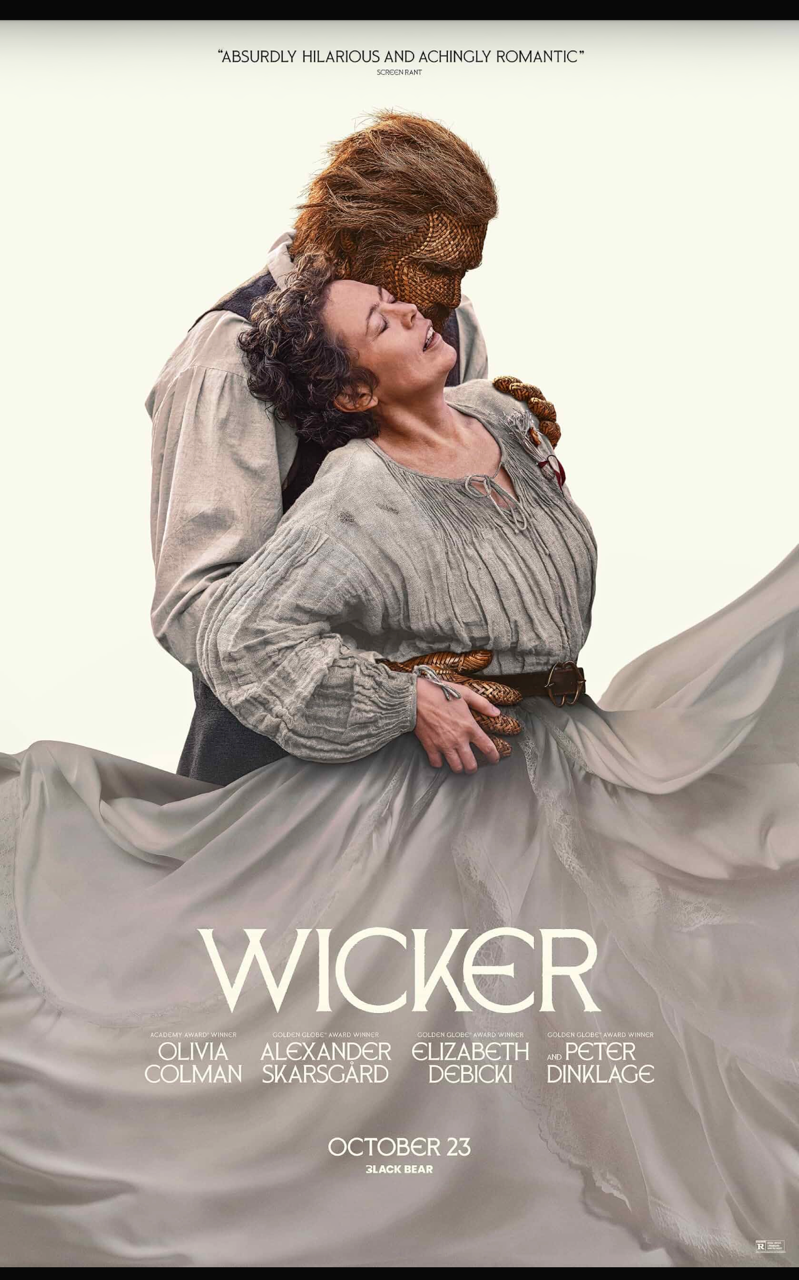
WICKER (2026)

October 20, 2026

Greetings again from the darkness. The husband and wife co-directing and co-writing team of Alex Huston-Fischer and Eleanor Wilson have delivered the pleasant surprise film of the year. It’s based on the 2008 short story, “The Wicker Husband”, written by Ursula Willis-Jones and it manages to be thoroughly entertaining while poking around into human psychology.

Oscar winner and actor-extraordinaire Olivia Colman stars as Fisherwoman. All folks in the village are known by their job or lot in life. No actual names are used. So, when I say Mrs. Tailor (Elizabeth Debicki, TENET, 2020) is the villain of the story, you immediately know what her husband does for a living. Fisherwoman, a disheveled and unkempt woman, not only lives a life of solitude, but she also is subjected to a relentless stream of cruel comments from those in the village. At the Bottlewasher’s wedding, a local custom involves not a bouquet, but rather shaken wicker eggs to determine the next bride-to-be. The magic egg rolls to Fisherwoman.

After absorbing the expected wisecracks and put-downs, she heads to the remote home of the mystical master Basketweaver (Peter Dinklage), and promptly orders ‘a husband’. One month later she is giddy at the altar as she and the Wicker Husband (Alexander Skarsgard) recite their vows. Wedding night exertions leave their bed in need of repair, and Wicker Husband simply asks for a hammer so that he may fix the bed … a task he performs numerous times.

Fisherwoman and Wicker Husband develop a bond, and the entire village takes note when they share a dance at the Butcher’s wedding (lots of weddings for a small village). Love and respect within a marriage are admirable and necessary traits, but what we soon witness is the opposite end of human traits: jealousy, distrust, feelings of inadequacy, and a desire for comeuppance.  By simply asking the question, “Do you love your wife?”, the Wicker Husband establishes himself as a noble creature, and that’s more than others can bear.

The film presents as brilliant social satire in the form of a fable, replete with romance and villainy. Although it’s set in a long ago small rural village, we immediately recognize the personality types and signs of emotions (good and bad). The acting here is superb. Olivia Colman delivers yet another performance that somehow stuns us. Peter Dinklage goes ‘Shakespearian’ and shines while working alone in his workshop. Richard E Grant jolts us as the bumbling town doctor in his only scene, and Alexander Skarsgard is totally believable as the object of desire buried under a spectacular skin of wicker.

As if the acting and story aren’t impressive enough, the technical aspects are superb. The wicker sound effects are familiar and spot on, while Weta Workshop’s prosthetic designer Joe Dunckley and lead makeup effects artist Sarah Rubano knock it out of the park on the wicker suit(s) and effects. Production designer Renato Cseh delivers an authentic feel to the village, while Oscar winning cinematographer Lol Crawley’s (THE BRUTALIST, 2024) work has been accurately described as folk art. This is surely a strange movie, yet it’s one that will grow an audience.

The film opens in theaters beginning October 23, 2026

WATCH THE TRAILER


THE BRUTALIST (2024)

December 20, 2024

Greetings again from the darkness. Too many view WWII as just another page in history books, when in fact, so much changed around the globe because of that war. Almost 80 years later, the war continues to provide stories for filmmakers, and when it comes to storytelling, few do it better than this latest from writer-director (actor-turned-filmmaker) Brady Corbet and his co-writer (and romantic partner) Mona Fastvold. The two had previously collaborated on THE CHILDHOOD OF A LEADER (2015) and VOX LUX (2018).

This is an old-fashioned epic on a grand scale with a few specific features that deserve to be highlighted. At 3 hours and 35 minutes in run time, Corbet included a throwback intermission (with a 15 minute countdown on screen). The opening credits run right-to-left horizontally, while the closing credits run diagonally. For true film geeks, the film is shot in VistaVision to capture the period feel. Part 1 covers 1947 through 1952, while Part 2 covers 1952 through 1960, and the Epilogue takes us to Venice in 1980.

Oscar winner Adrien Brody stars as Laszlo Toth, a Hungarian architect who arrives in post-WWII America after using heroin “for the pain” on the boat ride over. Due to administrative and governmental red tape, Laszlo had to go ahead of his wife and niece, to whom he writes regularly. A familiar face from home greets him upon his arrival. Attila (Alessandro Nivola, FACE/OFF, 1997) has already been Americanized to the point where he’s married and running a custom furniture business. He offers Laszlo a room to sleep and a chance to help design furniture. When Harry Lee Van Buren (Joe Alwyn, THE FAVOURITE, 2018), the son of a wealthy Pennsylvanian tycoon, contracts for a re-design of dad’s library, Laszlo gets a chance to show his brilliance. It turns out, Harrison Lee Van Buren Sr (Guy Pearce) does not like surprises and tosses the workers out.

Soon, a cooler head prevails for the tycoon, and he tracks down Laszlo for a project of much larger scale – a massive memorial on a hill overlooking the city. The project builds an odd connection between rich Harrison and brilliant Laszlo – although the rich guy remains anything but stable, and his son flaunts his own arrogant annoying tendencies (an Alwyn specialty). Laszlo maintains one true friendship. He bonds with Gordon (Isaach de Bankole) after meeting him in the food shelter line. Despite the new World, Laszlo continues to struggle with poverty; however, one of Van Buren’s lawyers is amenable to assisting with the paperwork for bringing Laszlo’s family to the states.

Part two brings wife Erzsebet (Felicity Jones, THE THEORY OF EVERYTHING, 2014) and mute niece Zsofia (Raffey Cassidy, THE KILLING OF A SACRED DEER, 2018) to America. Erzsebet is wheelchair bound after nearly starving to death due to the war. She’s a smart woman married to a creative genius, and yet the land of opportunity continues to toss hurdles in their path (not the least being Laszlo’s continued use of drugs). The moments of hope include a trip to the stunning Carrara quarry to locate the perfect piece for Van Buren’s project.

It should be noted that, despite the lead character’s name, this is a fictional account of the period, and the journey is both physically and emotionally draining. That’s also true for viewers, as I was exhausted by the end. Corbet uses the Epilogue to take us to Venice in 1980 for the first Architectural Biennal. It’s a fitting end after watching the battles of Jews versus Christians, and Immigrants versus American born, all while the United States is booming. I wasn’t ever able to understand the message Corbet was sending by exaggerating footsteps throughout, but I do recognize that Cinematographer Lol Crawley and Production Designer Judy Becker worked some magic along with Corbet and Fastvold … and yes, Adrien Brody, who along with Guy Pearce, deliver some of the finest acting we’ve seen all year. This is not a film so much about the brutalist style of architecture, but rather a film about character and personality during brutal times – and finding a way to utilize one’s true talent, while also remaining true to one’s roots. This is a complex story and one that fully captured me right from the unconventional opening credits.

Opens in limited theaters on December 20, 2024 and wide in January 2025

WATCH THE TRAILER