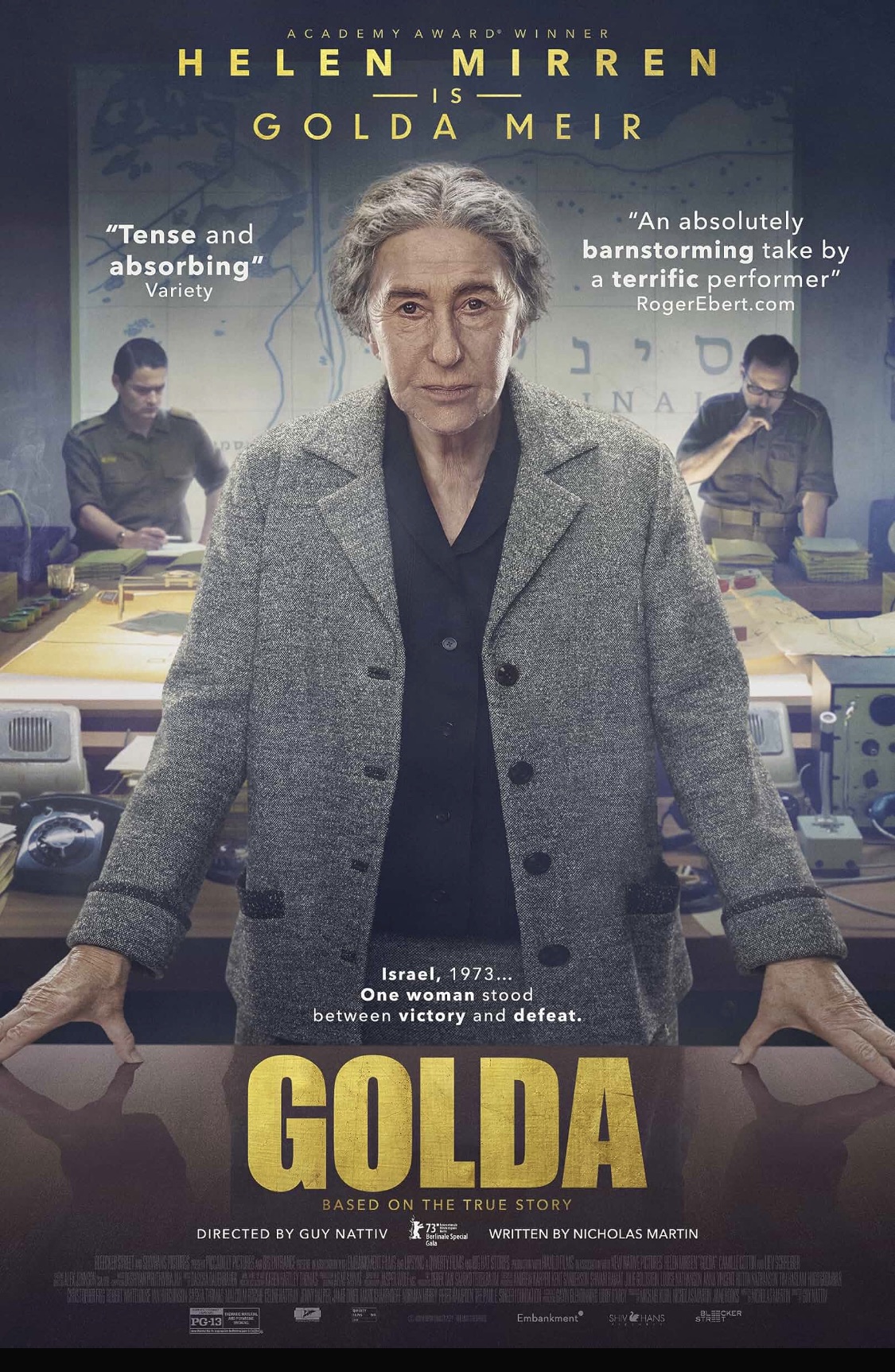
GOLDA (2023)

August 24, 2023

Greetings again from the darkness. More than forty years have passed since the great Ingrid Bergman portrayed Israel Prime Minister Golda Meir in the TV miniseries, A WOMAN CALLED GOLDA (1982). Fighting through cancer during filming, it was Ms. Bergman’s final role, and she won a posthumous Emmy for a performance that left quite a mark on this young (at the time) viewer. Guy Nattiv won an Oscar for his excellent short film, SKIN (2018), and here he takes on a narrow, yet vital window in the term of Golda Meir … a time when the survival of her country was in jeopardy. The screenplay was written by Nicholas Martin (FLORENCE FOSTER JENKINS, 2016).

Under heavy make-up and facial prosthetics, Oscar winner Helen Mirren expertly captures the essence of Golda Meir at a time she was carrying an unimaginable burden. The opening shoots through a quick slideshow of history before settling into 1973 and the escalating conflict between the Arab states (led by Egypt and Syria) and Israel. Despite the presence of some intelligence warning of such, Israel was caught off-guard by the surprise attack, and found themselves scrambling for the next 3 weeks – the period that makes up the core of the movie. Slump-shouldered and chain-smoking (sometimes defiantly), we see Golda making huge decisions between trips for lymphoma treatments. Her decisions would be the determining factor on how many soldiers would die, and whether Israel would remain independent.

It’s the level and question of that intelligence that provides the film’s framing structure of Golda Meir appearing before the Agranat Commission – a commission designed to render after-the-fact judgment on her decision-making and war strategy. As we witness, some of that strategy involves gut feelings and instincts, yet what the film makes clear is that Golda understands war kills real people – these aren’t just numbers in a report. Included in these meetings are the Minister of Defense, Moshe Dyan (Rami Heuberger), Chief of Staff “Dodo” Elazar (Lior Ashkenazi), and Field General (and future Prime Minister) Ariel Sharon (Ohad Knoller). Camille Cotton plays Golda’s longtime personal assistant Lou Kaddar, and some of the best scenes are the private conversations between U.S. Secretary of State Henry Kissinger (Liev Schreiber) and Golda, as she pushes for assistance and support, with Kissinger in a tough spot.

This Yom Kippur War lasted barely three weeks, yet the profound stress of war-induced decisions is obvious in Golda, as is her stance as a tough leader. For her, this did not mean sacrificing human emotions, but rather being decisive, communicative, and surrounding yourself with a capable team … although disloyalty in her administration is hinted at by some. Golda lived (just) long enough to witness the infamous Treaty signed by Menachim Begin and Answar Sadat, a treaty made possible through her leadership.

The film more closely resembles DARKEST HOUR (2017), with Gary Oldman’s Oscar-winning performance as Winston Churchill during WWII, than THE QUEEN (2006), Ms. Mirren’s own Oscar-winning turn as Queen Elizabeth. Actual newsclips are mixed in for historical perspective and the score by Dascha Dauenhauer leans heavily on dramatic stringed instruments. A final song by Leonard Cohen caps things off. While it’s true that most of the storytelling doesn’t reach the level of Ms. Mirren’s performance, that performance is enough to convey the high stakes involved.

Opens on August 25, 2023

WATCH THE TRAILER


FOXTROT (Israel, 2017)

March 22, 2018

 Greetings again from the darkness. The most dreaded knock on the door. Every parent or spouse of someone who has served their country during war time fully understands that indescribable feeling of opening the door and seeing uniformed soldiers waiting to deliver the worst possible news. That knock is how Israeli writer/director Samuel Maoz (LEBANON, 2009) chooses to open his film. Knowing her son Daniel is dead sends Daphna (Sarah Adler) into hysterics, and the experienced messengers know to administer something to help her relax and sleep. Her husband Michael (Lior Ashkenazi, FOOTNOTE) stands stunned, mostly unable to respond.

What follows is one of the most stunning first Act performances we’ve seen on the big screen. That is not hyperbole. Mr. Ashkenazi is remarkable over the first approximately 20 minutes as a parent in shock, experiencing devastating grief. The news is debilitating to his physical and mental being. Additionally, the filmmaking during this segment is quite something to behold. The close-ups add a heavy dose of humanity, while the terrific overhead camera angle presents Michael as trapped, while also adding to the disorientation that is so key. The one-hour alarm set to remind him to “drink some water” would be humorous if not for the fact that its structure prevents the man from totally breaking down.

The second Act takes us away from Daphna’s and Michael’s contemporary Tel Aviv apartment and plops us into a remote military outpost where 4 young soldiers are charged with guarding a road passage. Thanks to this boring assignment, the young men find ways of adding interest to their days: timing canned goods that roll down the ever-increasing slope of their sinking-in-the-muck domicile container, raising the bar for the periodic camel that lopes by, and giving the rare passers-by a bit of a hard time as their ID’s are checked. ‘Of course, this is war territory, so when something goes wrong, it goes terribly and horrifically wrong.

Our final Act takes us back to the original apartment as Michael, Daphna and their daughter are working to reconcile their feelings and somehow re-assemble the pieces of their shattered lives … though the shifts from that heartbreaking first Act are what sets the script apart from so many movies. Cinematographer Giora Bejach continues the exemplary camera work during this curious segment that leaves us feeling somewhat uncertain at first.

This family is stuck in the war that never ends. Like so many in the area, they carry burdens, guilt and grief that, like the war, also never ends. That first Act is transcendent filmmaking and acting, and the three acts work together as a prime example of the melding of visual and emotional storytelling. Most of the film takes place in one of two locales, and it’s the subtleties in each shot that tell us what we must know. And yes, the foxtrot dance does play a role, but like most of this film, it’s best discovered on your own.

watch the trailer:


7 DAYS IN ENTEBBE (2018)

March 15, 2018

 Greetings again from the darkness. Freedom fighters or terrorists? Which label gets applied is often dependent upon one’s point of view. In 1976 an Air France flight from Tel Aviv to Paris via Athens was hijacked. Director Jose Padilha (“Narcos”, ROBOCOP, 2014) brings us the big screen version of Gregory Burke’s (’71) screenplay.

The 7 day ordeal bounces between the captors and hostages at the abandoned terminal in Uganda and the political maneuverings of the Israeli government officials as they deliberate whether to break with policy and negotiate with terrorists. There are also flashbacks to the planning stages with the hijackers, in an attempt to help us understand their perspective.

Daniel Bruhl plays Wilifried Bose and Rosamund Pike plays Brigitte Kuhlmann. These are the two main hijackers who get most of our attention. Mr. Bruhl seems destined to always play the ultra-serious character, and Ms. Pike is once again miscast … something that happens whenever she is cast. Although she seems to throw down her best Patty Hearst look, we never really buy these two as committed to the cause, which prevents the necessary build-up of suspense.

The film’s biggest flaw is not capitalizing on the opportunity afforded by Nonso Anozie’s Idi Amin Dada, and even more disappointing is the abbreviated scenes between Shimon Peres (Eddie Marsan) and Yizhak Rabin (Lior Ashkenazi, FOXTROT). The two actors excel in their head-to-head confrontations, but we feel cheated every time it cuts away.

Once a strategy is formed, we are introduced to the Special Ops team (IDF). They only have a day or two to train and rehearse, and one of the key players is Ben Schnetzer (THE BOOK THIEF, 2013). He and his girlfriend quarrel over his duty, which keeps him away from her dancing performance with Batsheva Dance Company.  As Operation Thunderbolt proceeds, the crosscuts between Special Ops training and the dance rehearsals are setting the stage for the film’s climax.

So the hijackers never really generate the feeling of danger, the government deliberations are cut short, and the filmmaker takes a huge creative risk by synchronizing the final rescue mission with the opening night dance performance. The film is negatively impacted by poor pacing, an overall lack of tension for such a terrifying historical event, and questionable, albeit creative, story-telling structure. It does serve the purpose of educating those unfamiliar with the story, and it’s a reminder that even 4 decades later, the Israeli – Palestinian hostilities continue. As a special note of interest, the only Special Ops member killed in the raid was Yoni Netanyahu, the brother of the current Prime Minister of Israel.

watch the trailer:


NORMAN (2017)

May 4, 2017

 Greetings again from the darkness. With the subtitle, ‘The Moderate Rise and Rapid Fall of a New York Fixer’, writer/director Joseph Cedar removes one layer of the mystery that otherwise envelops the lead character Norman Oppenheimer. We find ourselves somewhat sympathetic for the obviously lonely guy, while also accepting this as Cedar’s commentary on today’s real world obsession with networking. “It’s who you know” is the call of the business world, and few stake claim to more contacts that Norman.

Richard Gere stars as Norman, and we immediately notice his usual on screen air of superiority is missing, replaced instead by a fast-talking sense of desperation … in fact, Norman reeks of desperation. Cedar divides the film into four Acts: A Foot in the Door, The Right Horse, The Anonymous Donor, and The Price of Peace. These acts begin with Norman stalking/meeting an Israeli Deputy Minister after a conference, buying him an $1100 pair of Lanvin shoes, and then tracking their relationship over the next few years as Micha Eshel (Lior Ashkenazi) ultimately becomes Prime Minister of Israel, and is embroiled in a scandal that directly impacts Norman.

It’s a terrific script with exceptional performances from both Mr. Gere and Mr. Ashkenazi (who also starred in director Cedar’s excellent Oscar nominated Footnote, 2011). Their awkward initial connection seems grounded in reality – despite the expensive gift. These are two men who dream big, but go about things in quite different ways. Other terrific actors show up throughout, including: Michael Sheen as Norman’s lawyer nephew; Steve Buscemi as a Rabbi; Dan Stevens, Harris Yulin and Josh Charles as businessmen; Isaach De Bankole as the shoe salesman; Hank Azaria as Norman’s mirror-image from the streets; and Charlotte Gainsbourg as a disconcertingly quiet and calm Israeli investigator.

There are many interesting elements in the film – some are small details, while others are quite impactful. Examples of these include the whimsical music from Japanese composer Jun Miyake, Norman’s questionable diet, the emphasis on “Unnamed US businessman”, the twist on a simple question “What do you need?”, the recurring shot of the shoes, and the creative use of split screen montage during multiple phone calls.

Most hustlers don’t generate a great deal of success, and Norman is often an annoying, even an unwelcome presence. However, it seems clear he is well-intentioned, and despite a proclivity for fabricating facts, his sincerity makes him a somewhat sympathetic figure … one that by the film’s end, has accomplished quite a few favors that should have delivered the recognition and influence he so craved. Norman’s “art of the deal” may not be textbook, but it makes for entertaining viewing.

watch the trailer:


FOOTNOTE (Hearat Shulayim, Israel, 2011)

April 2, 2012

 Greetings again from the darkness. In the United States, we typically get limited access to the films of Israel. In recent years, there have been two that I like very much: The Band’s Visit, and Waltz for Bashir. Written and directed by Joseph Cedar, Footnote was nominated for the Best Foreign Language Academy Award. It’s a very creative and insightful story utilizing slight comedic elements to show the destructive forces of petty professional jealousy within a family.

Most parents wish for true happiness for their children. If the professional success of their offspring far exceeds their own … it is a reason to swell with parental pride. But what happens when father and son choose similar career paths? What happens when animosity builds as the father’s life work (30 years of research) is deemed unnecessary and irrelevant? What happens when the son becomes publicly revered and adored for his populist writing? Well, in the case of father Eliezer (Shlomo Bar-Aba) and son Uriel (Lior Ashkenazi), we get strained relations and a thesis on the pitfalls of pride and ego.

 All of that is sufficiently fascinating for a story, but here we get an even more severe test of human nature. The father is erroneously informed that he has won the prestigious Israel Award, providing vindication and meaning to his work and well, his being. See, the award was supposed to go to the other Professor Shkolnik … yes, his son. This much is shown in the trailer, but the true guts of this story is what happens after this mistake.

There are a few impactful scenes in the film, but two really jumped out for me. In a very early scene, the son is receiving yet another reward and he is attempting to provide some credit for his father’s inspiration. However, the words seem to add credence to his irrelevancy instead. The best part? The camera never leaves the face of the father as he sits quietly listening in immeasurable pain. The other scene takes place in a beyond cramped meeting room for the Award committee to discuss the mistake with Uriel. The manner it is filmed and the choreography more than make up for the fact that the group of brilliant academics never thought to find a more suitable meeting place.

The score of the film is one that I would appreciate more without having the film playing. The music is wonderful, but often distracting to the moment. It is interesting to note how it changes along with the posture and walking pace of Eliezer after he is informed of his award. One need not be an academic researcher or writer to understand the damaged relationship between father and son … and how it has impacted wives, mothers and sons. That’s a story that is painful in any language.

SEE THE MOVIE IF: you want to see an insightful Israeli film exposing the dangers of misplaced ego and pride within the family circle.

SKIP THE MOVIE IF: selfish parents or competitive contempt are subjects you prefer to avoid … in any language

watch the trailer: