SUMMER CAMP (2024)

June 1, 2024

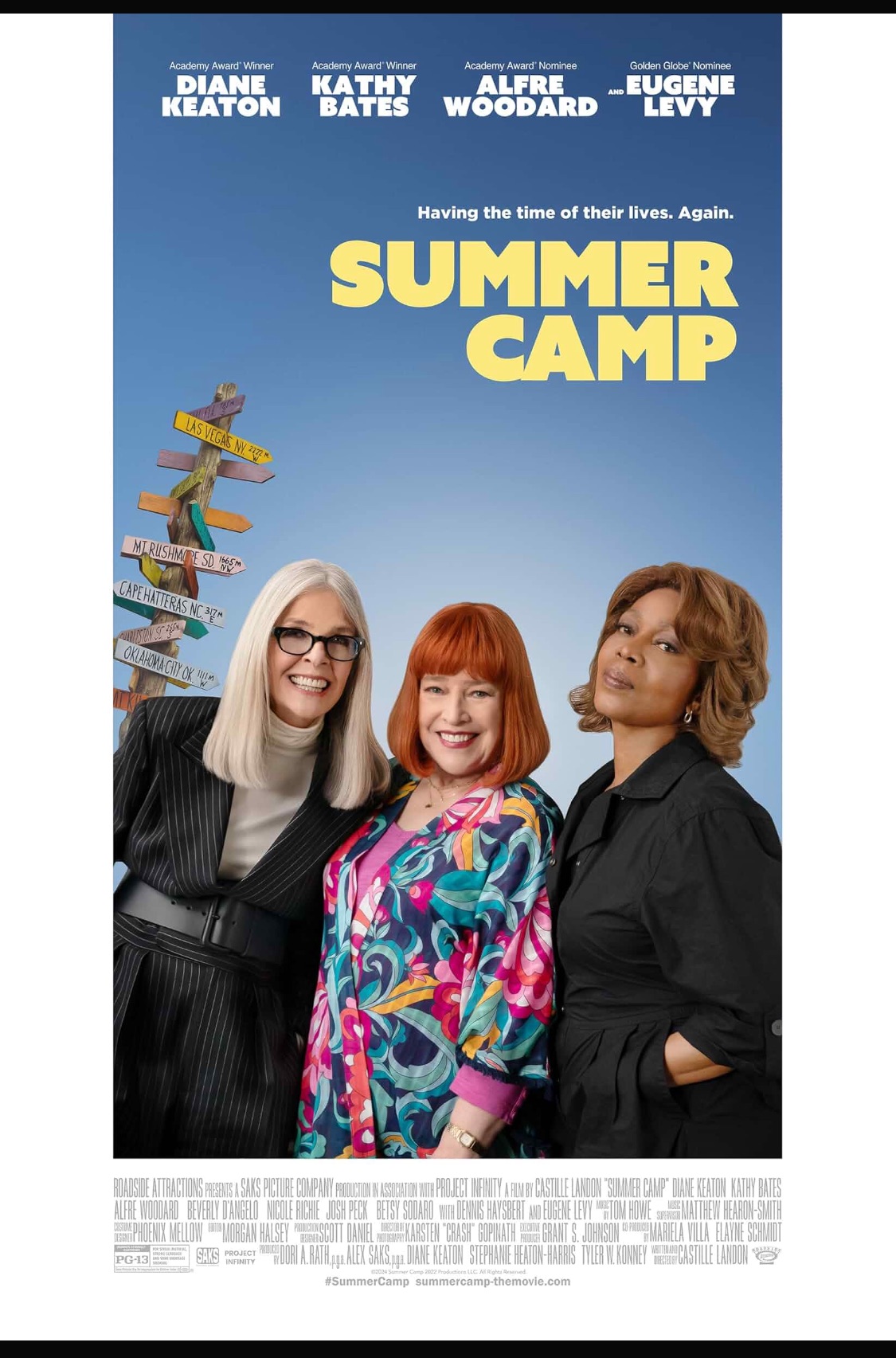
Greetings again from the darkness. There is always space (and a need) for silly or mindless entertainment. But even that genre requires some skill and refinement, so as not to stoop to imbecilic. The Farelly brothers, the Monty Python troupe, Abrams & Zucker, and Mel Brooks all understood this when crafting a movie. Writer-director Castille Landon has been making movies for a while now, and it appears this concept has eluded her despite assembling her most well-known cast.

Camp Pinnacle was established in 1928 (according to the sign) and there is a group of young girls we see maneuvering through a traumatic first-time event for one of them who is not quite 11 years old. An older girl offers some very personal assistance, and a lifelong friendship begins among the three outcasts in Sassafras Cabin. Year after year, the girls return for a few weeks of camp shenanigans and bonding. We then jump ahead for the Camp’s 50-year reunion (we assume this is 50-year reunion of the year these girls started attending and not 50 years for the camp itself, which would have put this at 1978).

Self-help guru (we don’t use that word) Ginny Moon (Kathy Bates, Oscar winner MISERY, 1990) is the driving force behind organizing the reunion, and especially in getting her grown-up friends to attend. Mary (multi-Emmy winning Alfre Woodard) is a nurse, while Nora (Diane Keaton, Oscar winner ANNIE HALL, 1977) is a workaholic business owner. Personalities are quickly established. Ginny Moon has never married and rides around in a pink tour bus with her catchphrase, “Get Your S*** Together” plastered on the side. Mary is a talented nurse who is questioning her long marriage to her self-centered husband (Tom Wright). Nora is the type who uses her work as an excuse to avoid living a life.

Supporting roles are covered by Beverly D’Angelo, Betsy Sodaro, Josh Peck, Eugene Levy (as a love interest!), Dennis Haysbert, and Nicole Richie. There is really no reason to go in depth into what happens in this film. It seems obvious the filmmaker is hoping to capitalize on the success of recent films like BOOK CLUB and 80 FOR BRADY. The potential was certainly here, but the final product is simply insulting, belittling, and demeaning to women. Food fights and pillow fights may be camp staples, but inane dialogue and unbelievable situations and reactions make for painful viewing. Ms. Keaton, in particular, seems to mail in her performance with an overdose of her patented head shakes and sighs (and wardrobe). Ms. Bates and Ms. Woodard outclass her in every scene, with Ms. Woodard delivering the film’s single best scene in her confrontation with her husband.

For years we have heard that the acting opportunities for older women are limited, and clearly there is an audience for stories about mature women. What’s equally obvious is that these women deserve significantly better stories and better roles. Exploring the concept of finding one’s self in life’s later stages is a topic worth pursuing … it’s simply a concept that deserves better than this.

Opening May 31, 2024

WATCH THE TRAILER


LOVE, WEDDINGS & OTHER DISASTERS (2020)

December 3, 2020

 Greetings again from the darkness. Very much in the same mold as the late Garry Marshall’s VALENTINE’S DAY (2010), NEW YEAR’S EVE (2011), and MOTHER’S DAY (2016), this one also utilizes the multi-story approach with all characters ultimately crossing paths as a payoff. If you are familiar with those movies, then you know what to expect here. However, if you are not familiar, there is no good way to prepare you, other than you’ll either love it or hate it.

Writer-director Dennis Dugan has been a frequent Adam Sandler collaborator, with movies landing in the “good” (HAPPY GILMORE, 1996), the “bad” (GROWN UPS 2, 2013), and the “ugly” (JACK & JILL, 2011). Mr. Dugan’s co-writers here are married couple Eileen Conn and Larry Miller. The cast includes Oscar winners Diane Keaton (ANNIE HALL, 1977) and Jeremy Irons (REVERSAL OF FORTUNE, 1991), and many faces you’ll recognize from other films.

The opening sequence will be enough to let you know where you fall on the ‘love it or hate it’ scale. Jessie (Maggie Grace, TAKEN) is skydiving with her local news anchor fiancé, and their mid-dive argument leads to a break-up and a crash landing into a lakeside wedding. The video (there’s always a video these days) goes viral, and Jessie becomes a social media celebrity burdened with the moniker, “Wedding Trasher” … not the best marketing for a wannabe wedding planner.

Jessie goes up against legendary wedding planner Lawrence (Mr. Irons) for the soon-to-be Mayor’s wedding, which loosely ties into the Mayor’s brother’s participation in a TV Game Show called “Crash Couples”, where mismatched folks are chained together in hopes of taking home the one million dollar prize. The show is hosted by the film’s director, Dennis Dugan. Lawrence is an egomaniacal high-falutin wedding planner and all-around rude dude who gets set up on a blind date with Sara (Diane Keaton), who is, yes, actually blind. Her entrance is just one of the painfully overdone physical pratfalls dropped in throughout the film, presumably to appeal to a wider comedy audience.

Andrew Bachelor plays the charismatic laugh-a-minute guide on a Duck tour who goes searching for his “Cinderella” … love at first sight for him. Next up we have Diego Bonita as a sensitive guitar player in the band Jessie wants to hire for the Mayor’s wedding. And I’ve yet to mention the involvement of the mafia thanks to the Mayor’s brother’s partner in the “Crash Couples” game. The multitude of characters and story lines all intersect at the wedding Jessie has planned – an event with hurdles just high enough for her to conquer. Some of the characters tie in more easily than others, but it’s best to just go with the flow here, no matter how cringe-inducing it might be at times.

On the bright side that surely most of us can agree on, Elle King (Rob Schneider’s daughter) is superb as the singer in the park who reappears throughout. Her songs fit the story, and her voice and sound are top notch and quite welcome. Romantic comedies sometimes get a bum rap, and few slide as cleanly into the “love it or hate it” mode as this one.

watch the trailer


HAMPSTEAD (2019)

June 13, 2019

 Greetings again from the darkness. Were this not inspired by the true story of Harry Hallowes, finding something positive to say about the film might prove difficult. Hallowes was (sometimes) affectionately known as the “Hampstead Hermit”. The crux of his story is that he was awarded legal “squatter’s rights” for his many years living in a small shack on the vast land where the Athlone House (now foreign owned) sits. Director Joel Hopkins (THE LOVE PUNCH, 2014) works from a script by Robert Festinger (Oscar nominated for IN THE BEDROOM, 2001) to turn the story into a cutesy romantic comedy.

Diane Keaton stars as Emily Walters, widowed for more than a year by a man who left her in debt and with the added bonus of discovering he had been having an affair with a younger woman. Brendan Gleeson stars as Donald Horner, the gruff, well-read man from the shack. It’s an idyllic British community with quaint shops and leisure bicycle riders – the kind of place where locals mostly wave and smile while the generic background music plays. Emily, who lives in the luxury apartment she shared with her late husband, is trying to figure out how to dig out of the financial hole she’s in. The first idea should have been getting a job other than volunteering at a charity dress shop, but this is the type of movie where real world problems magically dissipate and we know things are going to be just fine.

The film is mostly tolerable when Brendan Gleeson is on screen, even when Ms. Keaton is annoying him with her usual quirks. Of course the two end up liking each other (it is a rom-com after all), and she helps him with his legal battle to keep his “home”, while he helps her find meaning in her days again. Ms. Keaton mostly wears her familiar turtlenecks and scarfs, and we even get an early beret visual punchline (later ruined).

The always fun Lesley Manville owns her role as Fiona, neighbor and quasi-rival to Emily. More of Ms. Manville would have helped. Other supporting roles are covered by James Norton, Adeel Akhtar, Simon Callow, Jason Watkins, and Hugh Skinner. Many familiar faces, each given little to do. Thanks to the real life Harry Hallowes, there is a message here about the difficulty in living life on one’s own terms – a near impossibility without somehow affecting on infringing on others. Otherwise, this is one that will only appeal to fans of Ms. Keaton and of movies that require little effort or thought from viewers.

watch the trailer:


AND SO IT GOES (2014)

July 26, 2014

and so it goes Greetings again from the darkness. It’s very painful to witness the aftermath of an artist who has surrendered all creative efforts. Rob Reiner seems to be the director’s version of actor Nicolas Cage … just keep churning out projects that require no effort, yet provide a paycheck. Pride be damned!

This movie is clearly aimed at the over 55 group, and falls into the genre I fondly call “gray cinema”. Although a more fitting description of this movie’s specific genre would be “insipid cinema”. It’s one of those movies that assumes anyone watching it has no interest in thinking, and only goes to the theatre for air conditioning and popcorn.  It’s not condescending, as that would imply it thought itself to be sharper/wittier than the audience.  Instead, it treats the audience as if we have reverted to the level of adolescence for comedy, romance and dialogue.

Michael Douglas stars as Oren Little, a selfish, racist, bitter, lonely Realtor faced with the insurmountable life decision of leaving Connecticut for his lake house in Vermont. The only thing left is selling off his $8 million family house … that is, until his estranged, former drug-addicted son shows up on his way to jail and drops off Oren’s 10 year old granddaughter (Sterling Jerins). Fortunately for the little girl, Oren’s neighbor is the kindly Leah (Diane Keaton) who embraces the girl despite Oren’s aloofness.

Enough about the story … though it is written by Mark Andrus who also wrote the decent As Good As it Gets. If you were to subject yourself to this movie, you would see: Michael Douglas and Diane Keaton alternating between scripted, lifeless flirtations and scripted, lifeless bickering; a pathetic attempt at slapstick by having Oren deliver another neighbor’s baby on his sofa; the running gag of Ms. Keaton’s character breaking into tears while singing during her nightclub act; and a paintball gun used to ward off a dog doing business on the manicured lawn. If you don’t overdose on lameness with those scenes, you should be warned that somehow a little boy’s penis is the subject for multiple one-liners. Somehow this even overrides Oren’s racism for levels of inappropriateness (without the laughs).

Mr. Reiner has directed 3 classic films: This is Spinal Tap, The Princess Bride, and When Harry Met Sally. He also has some other entertaining films to his name including A Few Good Men and Misery. All of that just makes his last decade the more disappointing ( a very kind word for it). I will never be convinced that “gray cinema” cannot be entertaining and thought-provoking. Douglas and Keaton shouldn’t have to limit themselves to supporting roles only in order to part of a quality film. However, if this is all they get offered, I recommend working personally with writers to develop projects that don’t embarrass themselves or the audience.

Other than the obvious questions about how this script received the “go-ahead”, two questions have stuck with me since seeing this one:  Why did Frankie Valli appear in this and not Jersey Boys?  Why doesn’t Frances Sternhagen work more?

SEE THIS MOVIE IF: you clearly understand that there are no refunds for movie ticket purchases

SKIP THIS MOVIE IF: you are not at the age where dog pooping jokes crack you up.

* The trailer is not being posted here just in case it might trick you into going to the movie.  If you still go, I absolve myself of any blame.


THE GODFATHER II (1974) revisited

April 21, 2012

 Six weeks ago was The Godfather in a theatre setting. This time it was the exceptional sequel, which generated an equal amount of movie bliss. Experiencing these two classic movies on the big screen almost 40 years after release reinforces what great films they are … and how few truly great films get made. We are reminded that a powerful well-written story, world class cast, visionary director, brilliant photographer and stunning composer are all necessary components for movie greatness.

This sequel explores three time periods: the journey of 9 year old Vito to the U.S., his rise to power in Little Italy, and Corleone life after Vito’s death. Some find the cuts to varying timelines to be distracting. Personally, I find it fascinating and a very effective way to tell the entire story. Watching an almost mute 9 year old Vito land on Ellis Island and transform into a twenty-something community “leader” is one of the more powerful and unlikely events ever seen on screen. Mixing that with Al Pacino holding little back as a power-mongering Michael is downright frightening. If you doubt this, look at it from the perspective of Diane Keaton‘s May, or John Cazale‘s Fredo.

The film received 11 Oscar nominations and won 6, including Best Picture. Robert DeNiro won for his tremendous turn as young Vito, in a performance with very little English. This is early DeNiro … the Mean Streets, Taxi Driver era. DeNiro and Marlon Brando remain the only two actors to have won Oscars for playing the same character. DeNiro’s Supporting Actor competition came from two other cast members: Lee Strasberg as Hyman Roth (supposedly based on Meyer Lansky) and Michael V Gazzo as Pentangeli. Mr. Strasberg was the famed acting teacher whose prized pupils included none other than Al Pacino (who talked him into taking this role). Strasberg was also bequeathed 75% of the Marilyn Monroe estate and there was much scandal after his death when his widow auctioned off most of it.  Gazzo’s grizzled look and voice dominate his scenes and leave you feeling uneasy about what’s really going on with him.

 Here are a few other interesting points.  Most of this script was original for the film, though the background story of Vito was drawn from Mario Puzo‘s novel. Director Francis Ford Coppola considered casting Joe Pesci as the young Clemenza, but ultimately decided on Bruno Kirby. Dominic Chianese plays Hyman Roth’s right hand man Johnny Ola. Chianese has been recently seen in both The Sopranos and Boardwalk Empire. B-Movie mogul Roger Corman plays one of the Senators on the committee interrogating Michael and Pentangeli. Harry Dean Stanton plays one of the FBI bodyguards, and former heartthrob Troy Donahue plays Connie’s (Talia Shire) goofy boyfriend Merle. One of my favorite characters in the film is Don Fanucci, robustly played by Gastone Moschin. His strutting and preening always creeps me out and makes me laugh.

Besides being the first sequel to win a Best Picture Oscar, The Godfather II is simply one of the finest films ever made. At 200 minutes, it requires both a time and mental commitment, but along with The Godfather, Coppola and Puzo have provided us exemplary story telling through expert filmmaking … and a piece of movie history.

here is a link to my comments on the original: https://moviereviewsfromthedark.wordpress.com/2012/03/03/the-godfather-1972-revisited/

below is a link to the trailer, but be warned … it contains 3 plus minutes of actual footage.  If you have not seen the film, I would not recommend watching the trailer:


THE GODFATHER (1972) revisited

March 3, 2012
 Black screen. Cue the lone trumpet’s haunting opening notes of Nino Rota‘s theme.  Close up of a suffering man.  “I believe in America.” That, my friends, is a powerful opening to a truly great film.
 
It’s been 40 years since it’s original release, and this latest remastering looked and sounded amazing on Cinemark’s largest screen. Following those opening moments, we get our first look at Marlon Brando as Vito Corleone. On this screen, it was almost like seeing him for the first time … a disquieting figure that oozes power and commands respect.
 
There is no need for another review of this truly classic American film.  Instead, this will offer a few observations (possible spoilers) and notes of interest … combined with the highest possible recommendation to watch this one again!
 
At its core, author Mario Puzo‘s story is about power, loyalty, trust and family.  We witness what happens when one is viewed as having too much power. Loyalty is rewarded, and disloyalty brings the harshest possible penalty.  Trust is gained over time, but lost in a flash. And family is the most complex subject of all.
 
 Over the years, there have been a few movies with more star-studded casts, but it’s difficult to imagine a more perfectly selected cast: Marlon Brando, James Caan, Robert Duvall, Al Pacino, John Cazale, Sterling Hayden, Richard Conte, Diane Keaton, Talia Shire, Abe Vigoda.  Each of these actors have graced the screen in numerous roles, but for this three hour film, they become Corleones, associates, enemies, etc.  
 
There were a few things that jumped out at me during this viewing.  The use of oranges (the fruit) contradicts the health benefits preached by the medical profession. Every time we see a bowl of fruit, a fruit stand or someone peeling, eating, or selecting an orange, a scene of doom (usually quite violent) is soon to follow.  Carlo is even wearing an orange suit when Sonny (James Caan) shows up and paints the sidewalk with him. Don’t miss the billboard featuring oranges that Sonny drives by just before he pulls up to the toll booth. Brando’s final scene is preceded by him playfully scaring his grandson with an orange peel.  I understand the importance of Vitamin C, but I think I’ll stick with supplements!
 
 It’s very interesting to note the camera angles throughout the movie.  In an unusual approach, director Francis Ford Coppola uses an “eye-level” camera almost exclusively.  This gives the viewer the feeling of being part of the scene, especially during the small group meetings within Corleone’s dimly lit office.  The few exceptions are the overhead shot of Corleone being gunned down, the Los Angeles cityscape, and a couple of shots at the wedding to emphasize the scale of the event.
 
The famous “Mattress Sequence” was put together by George Lucas (Star Wars fame) for his friend Coppola.  This is the segment after the Louis Restaurant shooting where we get a montage of B&W crime photos and newspaper headlines. These are real life crime photos and one of the shots is of Frank Nitti, Al Capone’s trusted enforcer.
 
It’s quite fascinating to recognize how many “classic” lines of dialogue sprung from the movie, especially when you notice the minimalistic approach to dialogue used by Puzo and Coppola.  Much of the communication is non-verbal body language, glances, nods and shrugs … Brando, especially, is a master at this.
 
 One of the more remarkable facets of the film is the transformation of Michael (Al Pacino).  We first see him as a dashing war hero relaxing at the wedding with his girlfriend (a baby-faced Diane Keaton). He is very laid back and kind of cocky with the thought that he can rise above the dirty family business. He sees himself as better than that. Watch the subtle changes in his appearance … his hair, his posture, his eyes, even his hat!  As great as Brando is as the Don, it’s Pacino’s performance that really takes the film to an unprecedented level.  It’s really fun to compare Michael’s even-keeled, calm processing approach to the high-strung, act-now-think-later approach of his brother Sonny.
 
 The final note involves actor John Cazale. Here (and in part 2) he plays Fredo as a frightened, insecure puppy who is desperate to find his place.  Imagine your father being Vito Corleone and your brothers are Sonny and Michael.  It’s to be expected that you might be overlooked and overpowered in conversation. The really interesting note about Cazale is that this was his feature film debut.  He went on to make 4 more films before cancer took his life in 1978.  Cazale made 5 films and all 5 were nominated for Best Picture (both Godfather films, The Conversation, Dog Day Afternoon, The Deer Hunter).  He was engaged to Meryl Streep at the time of his death.
 
So the real point here is that if you ever doubt the magic and power of movies … shut off your phone, close the blinds, take the cannoli, and let The Godfather absorb your thoughts.  While you are at it, remember … it’s not personal, it’s business (only you shouldn’t really believe that).
 
Thanks to Cinemark for making me an offer I couldn’t refuse.

WOODY ALLEN – HAPPY 75th!

December 1, 2010

Woody Allen turned 75 today.  Some have already stopped reading.  Others can’t wait to read the rest.  Such is the life of one of the most prolific filmmakers in cinematic history.  Some of us love his films.  Others express such sentiments as “not another Woody Allen movie”!  Many from both camps have little regard for how his personal life has played out.  Here, I only want to talk about movies.

He began writing jokes for the newspaper and talk shows when he was 15, but it wasn’t until the early 1960’s that his career really began to take hold … as a stand-up comedian.  His first foray into movie directing was in 1966 with What’s Up Tiger Lily?  In reality, that was the first “Mystery Science Theatre” because he took a Japanese spy film and re-wrote the dialog for comedic effect.  Since 1966, Woody Allen the director, has consistently cranked out an average of almost one movie every year.  43 films total, not counting the one he is currently working on.

 The first phase of his filmmaking is now known as “the early, funny ones”.  I am a little fuzzy on exactly how long this phase lasted, but I assume it concluded about the same time as his relationship with Diane Keaton.  History leads us to believe things changed for him in 1977 with the instant classic Annie Hall.  Adored by critics and filmgoers, the film won him his first and only (so far) Academy Award.  In 1979, he released my personal favorite, and he claims, his least favorite, Manhattan.

During the “Mia Farrow” phase, his pace of one per year continued with some more successful than others.  Hannah and Her Sisters, Crimes and Misdemeanors and Bullets Over Broadway all performed well enough at the box office, while also achieving the critical success he claimed to care so little about.

Many of his harshest critics claimed his movies always centered around the same three themes:

  1. God.  Specifically the questioning of his existence.
  2. Life After Death.
  3. Love and/or The Meaning of Life

The rebuttal from his supporters stated these topics were fascinating when Mr. Allen explored them through his writing and filmmaking.  What is extremely clear is that he was one of the few filmmakers who had control and the power to make the films he wanted to make, despite the fact that none were blockbusters and a few never turned a profit.

His current phase began with the startlingly good Match Point, which was also the first Woody Allen film not based in his beloved New York.  He states the financial restrictions of Hollywood forced him to film overseas.  He has worked overseas since and his 2008 gem Vicky Cristina Barcelona even included some Spanish dialogue.

So while I have no intention of changing anyone’s mind about the films of Woody Allen, his 75th birthday seemed the perfect time to stop and take notice of a remarkable career.  So many films from a man who cared so little for a headline or compliment, yet the line of high-profile actors wanting to work with him was never-ending.  He could actually be considered a blue-collar artist – a guy who spends his work hours writing and filming, and consistently meets his deadlines and produces solid work … sometimes even brilliant work.  Do that for 44 years in the movie world, and they tend to remember you.

 Which leads me to my favorite Woody Allen quote:  “I don’t want to achieve immortality through my work. I want to achieve it by not dying”.


MORNING GLORY (2010)

November 16, 2010

 Greetings again from the darkness. It would be easy to dismiss this film as typical lighthearted Hollywood fluff that carries no real message (other than a 2 hour escape). The interesting thing is that its really not an escape – we are tossed right into the workaday world of a manic TV producer. Additionally, though it has plenty of light moments, it also carries a bit of depth in breaking down a couple of lead characters.

Rachel McAdams plays Becky Fuller, morning TV show producer. Becky is a cute, driven, frantic, EverReady Bunny ball of energy who watches multiple TV’s and carries on multiple conversations, all while texting incessantly. She is hired by Jeff Goldblum in his final attempt at resurrecting ratings for “Daybreak”, a mere blip of competition to “The Today Show”.

The story gets interesting when Becky recruits/blackmails news legend Mike Pomeroy (Harrison Ford) to co-anchor the show with Diane Keaton‘s character. To compare, Keaton’s character will kiss a frog or don a pink tutu and has mastered the perpetual smile so necessary for morning TV. Ford’s character may not have smiled since 4th grade and views the mission of TV as delivering news and hard stories and information.  The good news is that Keaton is actually in control and not over the top, as she has been in most of her recent movies.  Ford certainly takes grumpy to the extreme.

The conflict in the story comes from Ford’s character (labeled the world’s third worst person), whom the world has passed by, and McAdams’, who is the eternal optimist. It’s pretty obvious they will somehow save each other, but still I found it entertaining to watch the road.  I also got a kick out of the exploits forced upon the poor weatherman played by Matt Malloy.  The weatherman role has always seemed to me an odd intersection of clown and scientist.

The film itself, directed by Roger Michell (Venus, Notting Hill) and Aline Brosh McKenna (The Devil Wears Prada), does a nice job with insight into those whose personalities are bound tightly to their job. There were a few occasions where the film felt choppy – like some scenes were cut or reinserted, and the music was consistently weak. I also could have done with about 8 fewer scenes of McAdams running through New York in her heels – we get that she never stops moving! The love story with Patrick Wilson felt forced, though making the point was necessary.  And thank goodness, there was no May-September romance between Ford and McAdams!  Even though it’s not at the level of Broadcast News, it offers enough depth and comedy to make this a worthwhile film to see.

SEE THIS MOVIE IF: you can’t imagine letting loose of your blackberry for anything or anyone OR you are fascinated by any woman who can sprint while in heels.

SKIP THIS MOVIE IF: you actually believe Harrison Ford is a grumpy old man OR watching Diane Keaton kiss a frog crosses the line for you