OPPENHEIMER (2023)

July 22, 2023

Greetings again from the darkness. As pupils slouched in our school desks during history class, we easily and naturally disassociated with the many stories of war. World War II was lumped in with WWI, the Civil War, and The Revolutionary War. There were names and dates to memorize for quizzes and final exams, yet even with relatives recounting stories of kin, a personal connection was rare. As we aged and experienced modern-day warfare, the personal connection became all too real. Reality struck that soldiers are human beings with families, and despite their missions and marching orders, most are as innocent as the ‘tragic civilian casualties’ reported on the newswires. Along these lines, an aspect of war that has often remained overlooked is the behind-closed-doors decision-making of politicians and military leaders. Filmmaker-extraordinaire Christopher Nolan takes us behind those doors through the eyes of J Robert Oppenheimer, the Father of the Atomic Bomb. What we see is quite frightening.

Prepare yourself. At a full three hours in length, Nolan’s film is a hefty undertaking for viewers. It demands full focus and attention to details and nuance, as you spend significant time listening to brilliant men talk amongst themselves. Nolan adapted the screenplay from the 2005 biography, “American Prometheus: The Triumph and Tragedy of J Robert Oppenheimer”, written by Kai Bird and Martin Sherman. The end result is a film centered on complex physics and mathematics, yet presented in a simplified manner such that it’s much more a character study than a science class. The key is what characters say to each other, how they say it, and how they debate and rationalize the morality of the objective … building a bomb designed to kill people.

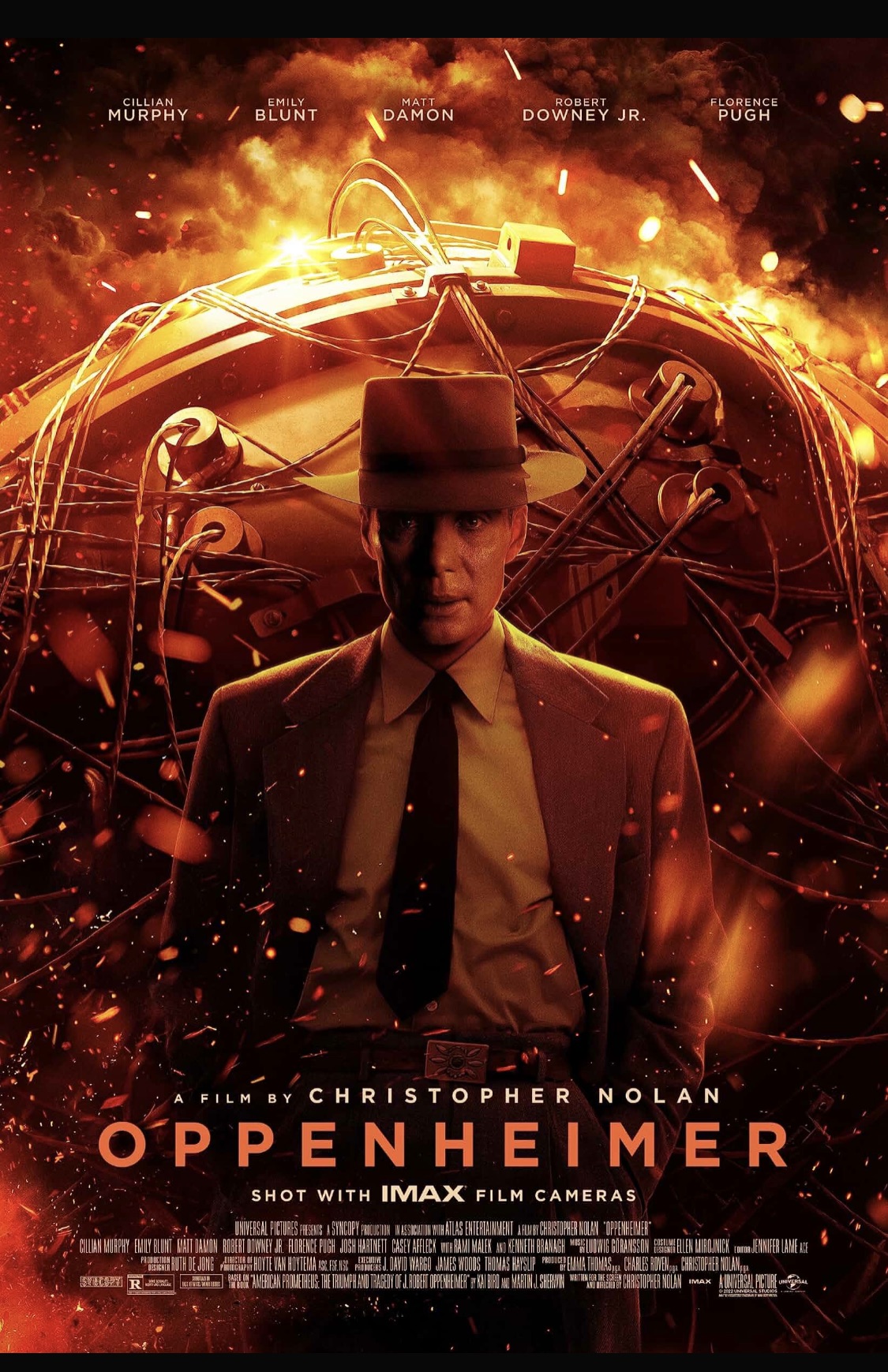
The morality of The Manhattan Project is under the microscope here, as is the motivation and concern of Oppenheimer. We get some early background establishing him as an upcoming mind in the world of physics from his academic stops around the globe. Some know Cillian Murphy from “Peaky Blinders” or as Scarecrow in Nolan’s Batman movies. I’d also recommend a couple of Murphy’s underrated gems: FREE FIRE (2016) and RED EYE (2005). It’s hard to overstate how spot on Murphy is as Oppenheimer. He lost weight for the role and captures the distinctive movements and speech patterns, as well as the familiar poses and deep-in-thought eyes. We never once question whether this is Oppenheimer, the leader of the science team at the Los Alamos Lab and the Father of the Atomic bomb … the one who “sees beyond the world we live in.”

Once Major Groves (Oscar winner Matt Damon) recruits Oppenheimer to run and assemble the great scientific minds, the obvious question to those involved is … even if we can create this bomb, should we do it? This weighs heavily on Oppenheimer – a man so engulfed by science that his haunting visions are that of atoms and particles and experimental reactions (perhaps a bit too heavy in the first act). Groves is the military leader of the project and the liaison between the scientists, the military, and the government. It’s also clear that while Oppenheimer’s brilliance is recognized and necessary to the project, almost no one outside of the scientists trusts him. This is where antisemitism and fears of communism arise. Oppenheimer was Jewish and, though he never joined the communist party, was associated with many who did. This included his love interest, Psychiatrist Jean Tatlock (the fabulous rising star Florence Pugh), his wife Kitty (Emily Blunt), and his brother Frank (Dylan Arnold).  

The teamwork and stress involved with building the bomb in Los Alamos is conveyed as rooms full of brilliant minds determine the future path of the country and the world. This culminates in the stunning sequence of The Trinity Test near Alamogordo. A blending of complete silence, along with spectacular sound and light, is truly a technical highlight of the film. The initial celebration of success initially overshadows the true meaning … the bomb is now ready for Hiroshima and Nagasaki, killing two hundred thousand people and essentially ending WWII, less than four years after the bombing of Pearl Harbor by the Japanese (never mentioned here).

The bombings are heard via radio news reports, and it’s at this point where the weight of what the scientists have done is fully realized. Oppenheimer became a national hero and his Time Magazine cover proves it. A meeting with President Harry S Truman (Oscar winner Gary Oldman sporting a Missouri accent) doesn’t go well, as Oppenheimer is introduced to political gamesmanship, something he would face even more directly in the near future. Lewis Strauss (Oscar winner Robert Downey Jr) is a key player as chairman of the US Atomic Energy Commission, and through him, we witness ego, ambition, and petty behavior that leads to a level of vindictiveness typically only seen at the junior high level.

Multiple timelines are covered. There is the background information on Oppenheimer’s early years, his well-rounded academia, his love life (lives), his building of the Los Alamos lab team, the overseeing of the bomb development, his time as a hero, the later backroom kangaroo court designed to disgrace him, and Strauss’ Senate Confirmation hearing for Secretary of Commerce. All of these tie together, and it’s those final two that make up the last act of the film – giving us a taste of just how nasty politics was 70 years ago (not unlike these days).

Nolan has assembled a deep cast with numerous Oscar winners and a roster of talented actors. Among the familiar faces not already named above are: Oscar winner Kenneth Branagh as Danish Physicist Neils Bohr, Oscar winner Rami Malek as experimental physicist David Hill, Oscar winner Casey Affleck as Military security advisor Boris Pash, Tom Conti as Albert Einstein, Benny Safdie, Dane DeHaan, Jason Clarke, Josh Hartnett, David Krumholtz, Matthew Modine, Alden Ehrenreich, Scott Grimes, Tony Goldwyn, James D’Arcy, James Urbaniak, Olivia Thirlby, James Remar, and (Nolan regular) David Dastmalchian.

The film is a historical biopic and also an unconventional thriller. Is this about unparalleled advancement in science or is it about the moral dilemma of mass destruction and death? Politics, military, ego, power, science, love, revenge, and redemption are all displayed as Oppenheimer struggles with the power he has created and the lack of power in how it’s used. My favorite line in the film is aimed at Oppenheimer when someone informs him that he’s now “not just self-important, but actually important.” The stakes are clear during the test when it’s stated that there is a “near zero” chance of destroying the world.

Cillian Murphy is a shoe-in for a Best Actor nomination, and his performance mesmerizes us. It’s nice to see Robert Downey Jr remind us of his true talent, and he should be rewarded with a Best Supporting Actor nomination. Florence Pugh and Emily Blunt, in the only two substantive women roles, should both receive consideration as well. Pugh’s role is limited but memorable, while Blunt shines in her best scene during the security hearing.

Christopher Nolan has delivered near perfection in technical movie-making, and on top of that, the story and characters are real life, and the performances are top notch. His use of Black & White film for Strauss’ perspective allows the viewer to differentiate the Oppenheimer viewpoint. Impressively, while there are some visual effects, Nolan has stated that no CGI was used in the film, and that’s most evident in the relatively short closing credit roll – where we typically get dozens if not hundreds of technical experts listed. Ludwig Goransson’s (Oscar winner for BLACK PANTHER) score packs an emotional punch, and Jennifer Lame’s editing is excellent and vital. Lastly, cinematographer (and regular Nolan collaborator) Hoyte Van Hoytema drives home the power of smart men in a room, as well as the devastation of the bomb test. This is excellent filmmaking and a reminder that the only thing we love more than lifting new heroes onto the pedestal of worship is tearing down those same heroes with a dose of humility. These types of movies rarely get produced these days, so here’s hoping enough people go back to the theater to see it to inspire more filmmakers to take a shot.

Opened nationally July 21, 2023

WATCH THE TRAILER


I SAW THE LIGHT (2016)

March 31, 2016

I saw the light Greetings again from the darkness. Most Hollywood musical biopics follow a similar and predictable structure, which is why Walk Hard: The Dewey Cox Story was so easily able to parody the genre. Of course, the legendary singer/songwriter Hank Williams deserves more than predictable storytelling … but unfortunately, that’s exactly what he gets here.

Tom Hiddleston delivers a spot on physical impersonation of Hank – right down to the slightly hunched over (due to Spina Bifida Occulta) posture and bouncy onstage waggle. Yes, the very British Tom Hiddleston, who plays Loki in The Avengers and Thor movies, has managed to capture the presence of one of the all-time great Country and Western icons. Mr. Hiddleston worked on the beloved songs with Rodney Crowell and delivers some very nice singing – so nice in fact that the singing is distracting and misleading. Hank Williams sang his songs in angst … a tortured soul seemingly without choice in his need to share his art. No one could be expected to perform with that emotion, and the void is obvious.

As source material, director Marc Abraham (Flash of Genius, 2008) utilizes “Hank Williams: The Biography” co-written by George Merritt, Colin Escott, and William MacEwen. It may be the least creative title possible for a biography, and the movie correlates perfectly. We track Hank’s early days as a struggling singer whose dream is to someday perform on the hallowed stage of The Grand Ole Opry, to his gas station marriage to Audrey May (Elizabeth Olsen), through his alcoholism, drug use, womanizing, superstardom, fall from grace, and ultimately tragic death at the age of 29.

Despite the nature of Williams’ short life, the film only skims the surface and rarely digs too deeply. The steady stream of women/wives is difficult to track … perhaps that’s the point. Audrey is the only one who gets much screen time and Ms. Olsen plays her as an ambitious shrew who comes across as impossible to like and as unwilling to work at the relationship. A staggering number of Hank Williams songs are embedded as merely interludes separating scenes of misery for all involved … especially Hank, who seems to find little joy in life.

We’ve all seen the destruction that fame often leads to, and when combined with Hank’s painful back disorder and relentless alcoholism, it’s little wonder his body simply surrendered at such an early age. The movie just seems a bit too high-gloss for such a tortured soul, and despite the best efforts of Tom Hiddleston, the film is not worthy of someone who left the musical legacy of Hank Williams.

watch the trailer:


HAIL, CAESAR! (2016)

February 6, 2016

hail caesar Greetings again from the darkness. Homage or Spoof or outright Farce? Though the Coen Brothers motivation may be cloudy, their inspiration certainly is not. The Golden Age of Hollywood is skewered by the filmmaking brothers who previously applied their caustic commentary to the movie business in Barton Fink (1991). However, this latest seems to borrow more from the unrelated universes of their films A Serious Man (2009) and Burn After Reading (2008) in that it alternates tone by focusing first on one man’s attempt to make sense of things, and then with a near slapstick approach to “urgent” situations.

The film seems to be made for Hollywood geeks. Perhaps this can also be worded as … the film seems to be made for the Coen brothers themselves. Rather than an intricate plot and subtle character development used in their classic No Country for Old Men (2007), this is more a collection of scenes loosely tied together thanks to their connection to Eddie Mannix, Capitol Pictures “fixer”. Josh Brolin plays straight-laced Mannix, a twist on the real Eddie Mannix, notorious for his behind the scenes work at MGM in controlling the media, protecting the stars and studio, and protecting movie stars from their own idiotic actions. He was a real life Ray Donovan. It’s Mannix’s job that creates the hamster wheel to keep this story moving (complimented by narration from Michael Gambon).

We witness a typical day for Mannix as he confesses to the Priest that he had a couple of cigarettes after promising his wife he would quit, negotiates with communists who have kidnapped the studios biggest movie star, deftly handles the studio head’s greedy desire to shift a western movie star into a genre for which he is ill-prepared, plans a cover-up for the starlet having a baby out of wedlock, and juggles the demands of the competing twin gossip columnists searching for scandal. Mannix keeps his cool through all of this while mulling a lucrative job offer from Lockheed that would put him right in the midst of the nuclear war scare.

With an exacting attention to period and industry detail, the Coen’s remind us of the popular genres and circumstances of the era. George Clooney plays mega star Baird Whitlock, working on the studios biggest picture of the year – a biblical epic entitled “Hail, Caesar!” (think Ben-Hur, The Robe, etc). Whitlock is kidnapped by a group of communist writers (not yet blacklisted) who are striking out against a capitalistic studio that doesn’t share the rewards with the creative folks. It’s a different look than what Trumbo offered last year. In a tribute to Roy Rogers and famed stuntman Yakima Canutt, there is a segment on popular westerns featuring Alden Ehrenreich (Beautiful Creatures, 2013) as Hobie Doyle, a popular actor whose an artist with a rope and horse and guitar, but not so smooth on his transition to the parlor dramas being filmed by demanding director Laurence Laurentz (a terrific Ralph Fiennes). In boosting Doyle’s public perception, the studio sets him up on a date with a Carmen Miranda-type played by Veronica Osorio. Her character is named Carlotta Valdez in a nod to Hitchcock’s Vertigo. Another sequence features Scarlett Johansson as DeAnna Moran, an Esther Williams type (with a behind the scenes nod to Loretta Young) in a Busby Berkeley-esque production number featuring the synchronized swimming so prominent in the era. One of the film’s best segments comes courtesy of Channing Tatum in a take on films like On the Town, where sailors would sing and dance while on leave.

Tilda Swinton (whose appearance improves any movie) appears as the competing twin sister gossip columnists Thora and Thessaly Thackery. Her hats and costumes are sublime and pay worthy tribute to Hedda Hopper (who also balked at being termed a gossip columnist). Jonah Hill’s only scene is from the trailer, and it could be misleading to any of his fan’s coming to see his performance; and the same could be said for Frances McDormand (a very funny scene as a throwback editor). And so as not to disappoint their many critics, the Coen’s have a terrific scene featuring four men of various religious sects who are asked their opinion of the script – so as not to offend any viewers. The pettiness is palpable.

Roger Deakins is, as always, in fine form as the cinematographer. The water and western productions are the most eye-catching, but he does some of his best camera work in the shots of individual actors or scenes-within-a-scene. We have come to depend on Joel and Ethan Coen for taking us out of our movie comfort zone, while providing the highest level of production – music, costumes, sets, camera and acting. While this latest will leave many scratching their heads, the few in the target audience will be applauding fiercely.

watch the trailer:


THE JUDGE (2014)

October 11, 2014

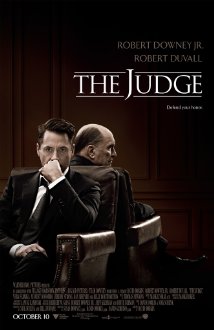
judge Greetings again from the darkness. It’s hard to beat a good on screen courtroom drama for tension and conflict. Despite centering around a long time judge accused of manslaughter and being defended by his estranged son, a hotshot defense attorney, this one eschews gritty courtroom action in favor of uncomfortable and explosive family dynamics. And thanks to the acting abilities of Robert Duvall and Robert Downey Jr, that’s a good thing.

Mr. Downey’s Iron Man/Tony Stark character has ingrained in movie goers his motor-mouthed smart-aleck persona that fits very well with the lacking-a-conscience cocky defense attorney who only defends the type of white collar criminals who can afford his unmatched courtroom savvy. When Hank (Downey) returns home for the funeral of his mother, we quickly witness the strained relationship with his demanding-perfection magistrate father (Duvall), and the historical family details slow-drip for the next couple of hours.

Hank’s older brother (Vincent D’Onofrio) was once a promising baseball player whose career was cut short after an automobile accident (with a crucial component). Hank’s younger brother (Jeremy Strong, who played Lee Harvey Oswald in Parkland) is a mentally handicapped young man attached to his video camera. Hank also (of course) runs into his high school sweetheart (Vera Farmiga) and her daughter (Leighton Meester), as a reminder of what he left behind in his quaint hometown when he chose fortune and big city life.

John Grisham has made a career, actually two (books and movies), dissecting lawyers and courtrooms. As you might imagine, director David Dobkin (Wedding Crashers, Fred Claus) doesn’t have Grisham’s eye and ear for the courtroom, so the script often slips into manipulative melodrama during the trial (think Grisham-lite). But the scenes between Duvall and Downey more than make up for the fluffy parts. The kitchen confrontation and the bathroom sequence couldn’t be any more different, or any more powerful. One is the exorcism of a parent-child relationship gone bad, and the other is a vivid depiction of old age and disease.

This is old-fashioned mainstream movie-making. It’s about relationships and family and personality and life choices. There are no explosions or CGI or car chases. Even the key crime happens off screen. It’s also not breaking any new ground, and if not for the acting, could be just another TV movie. A perfect example is Vera Farmiga, who brings an edge to a role that otherwise would be superfluous. Same with Hank’s brothers. Both roles are severely underwritten, but D’Onofrio and Strong somehow make them work. Billy Bob Thornton brings a presence to an otherwise not-believable role as a slick special prosecutor wearing $1000 suits. Even Dax Shepard plays his comic relief country-bumpkin attorney slash furniture re-seller in an understated (for him) manner.

Other support work is provided by Ken Howard as the judge, Emma Trembley (Hank’s daughter), Balthazar Getty as the deputy with a grudge, Grace Zabriske as the victim’s vengeance seeking mother, David Krumholtz as a District Attorney, and Denis O’Hare as Duvall’s doctor.

In better hands, the script could have become much sharper and the film much crisper. Prepare for cheese and schmaltz, but it’s difficult to imagine more fun than watching Duvall and Downey go nose to nose and toe to toe. If you stay for closing credits, you’ll hear Willie Nelson wobbly warble through a Coldplay song.

SEE THIS MOVIE IF: you want to see two excellent actors battle each other as only resentful father and sons can

SKIP THIS MOVIE IF: even a single teaspoon of courtroom schmaltz is more than your movie doctor recommends

watch the trailer: