OPPENHEIMER (2023)

July 22, 2023

Greetings again from the darkness. As pupils slouched in our school desks during history class, we easily and naturally disassociated with the many stories of war. World War II was lumped in with WWI, the Civil War, and The Revolutionary War. There were names and dates to memorize for quizzes and final exams, yet even with relatives recounting stories of kin, a personal connection was rare. As we aged and experienced modern-day warfare, the personal connection became all too real. Reality struck that soldiers are human beings with families, and despite their missions and marching orders, most are as innocent as the ‘tragic civilian casualties’ reported on the newswires. Along these lines, an aspect of war that has often remained overlooked is the behind-closed-doors decision-making of politicians and military leaders. Filmmaker-extraordinaire Christopher Nolan takes us behind those doors through the eyes of J Robert Oppenheimer, the Father of the Atomic Bomb. What we see is quite frightening.

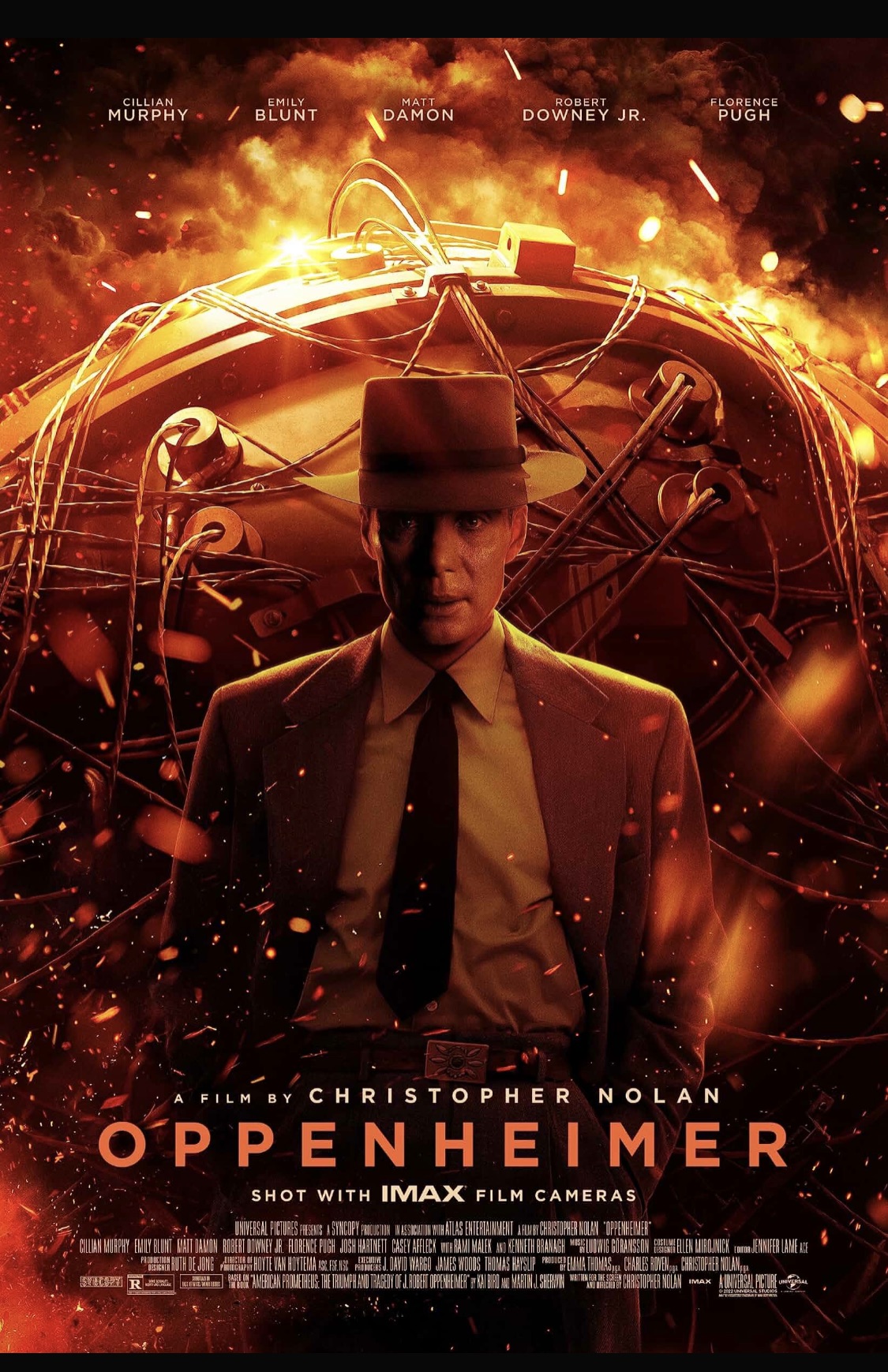
Prepare yourself. At a full three hours in length, Nolan’s film is a hefty undertaking for viewers. It demands full focus and attention to details and nuance, as you spend significant time listening to brilliant men talk amongst themselves. Nolan adapted the screenplay from the 2005 biography, “American Prometheus: The Triumph and Tragedy of J Robert Oppenheimer”, written by Kai Bird and Martin Sherman. The end result is a film centered on complex physics and mathematics, yet presented in a simplified manner such that it’s much more a character study than a science class. The key is what characters say to each other, how they say it, and how they debate and rationalize the morality of the objective … building a bomb designed to kill people.

The morality of The Manhattan Project is under the microscope here, as is the motivation and concern of Oppenheimer. We get some early background establishing him as an upcoming mind in the world of physics from his academic stops around the globe. Some know Cillian Murphy from “Peaky Blinders” or as Scarecrow in Nolan’s Batman movies. I’d also recommend a couple of Murphy’s underrated gems: FREE FIRE (2016) and RED EYE (2005). It’s hard to overstate how spot on Murphy is as Oppenheimer. He lost weight for the role and captures the distinctive movements and speech patterns, as well as the familiar poses and deep-in-thought eyes. We never once question whether this is Oppenheimer, the leader of the science team at the Los Alamos Lab and the Father of the Atomic bomb … the one who “sees beyond the world we live in.”

Once Major Groves (Oscar winner Matt Damon) recruits Oppenheimer to run and assemble the great scientific minds, the obvious question to those involved is … even if we can create this bomb, should we do it? This weighs heavily on Oppenheimer – a man so engulfed by science that his haunting visions are that of atoms and particles and experimental reactions (perhaps a bit too heavy in the first act). Groves is the military leader of the project and the liaison between the scientists, the military, and the government. It’s also clear that while Oppenheimer’s brilliance is recognized and necessary to the project, almost no one outside of the scientists trusts him. This is where antisemitism and fears of communism arise. Oppenheimer was Jewish and, though he never joined the communist party, was associated with many who did. This included his love interest, Psychiatrist Jean Tatlock (the fabulous rising star Florence Pugh), his wife Kitty (Emily Blunt), and his brother Frank (Dylan Arnold).  

The teamwork and stress involved with building the bomb in Los Alamos is conveyed as rooms full of brilliant minds determine the future path of the country and the world. This culminates in the stunning sequence of The Trinity Test near Alamogordo. A blending of complete silence, along with spectacular sound and light, is truly a technical highlight of the film. The initial celebration of success initially overshadows the true meaning … the bomb is now ready for Hiroshima and Nagasaki, killing two hundred thousand people and essentially ending WWII, less than four years after the bombing of Pearl Harbor by the Japanese (never mentioned here).

The bombings are heard via radio news reports, and it’s at this point where the weight of what the scientists have done is fully realized. Oppenheimer became a national hero and his Time Magazine cover proves it. A meeting with President Harry S Truman (Oscar winner Gary Oldman sporting a Missouri accent) doesn’t go well, as Oppenheimer is introduced to political gamesmanship, something he would face even more directly in the near future. Lewis Strauss (Oscar winner Robert Downey Jr) is a key player as chairman of the US Atomic Energy Commission, and through him, we witness ego, ambition, and petty behavior that leads to a level of vindictiveness typically only seen at the junior high level.

Multiple timelines are covered. There is the background information on Oppenheimer’s early years, his well-rounded academia, his love life (lives), his building of the Los Alamos lab team, the overseeing of the bomb development, his time as a hero, the later backroom kangaroo court designed to disgrace him, and Strauss’ Senate Confirmation hearing for Secretary of Commerce. All of these tie together, and it’s those final two that make up the last act of the film – giving us a taste of just how nasty politics was 70 years ago (not unlike these days).

Nolan has assembled a deep cast with numerous Oscar winners and a roster of talented actors. Among the familiar faces not already named above are: Oscar winner Kenneth Branagh as Danish Physicist Neils Bohr, Oscar winner Rami Malek as experimental physicist David Hill, Oscar winner Casey Affleck as Military security advisor Boris Pash, Tom Conti as Albert Einstein, Benny Safdie, Dane DeHaan, Jason Clarke, Josh Hartnett, David Krumholtz, Matthew Modine, Alden Ehrenreich, Scott Grimes, Tony Goldwyn, James D’Arcy, James Urbaniak, Olivia Thirlby, James Remar, and (Nolan regular) David Dastmalchian.

The film is a historical biopic and also an unconventional thriller. Is this about unparalleled advancement in science or is it about the moral dilemma of mass destruction and death? Politics, military, ego, power, science, love, revenge, and redemption are all displayed as Oppenheimer struggles with the power he has created and the lack of power in how it’s used. My favorite line in the film is aimed at Oppenheimer when someone informs him that he’s now “not just self-important, but actually important.” The stakes are clear during the test when it’s stated that there is a “near zero” chance of destroying the world.

Cillian Murphy is a shoe-in for a Best Actor nomination, and his performance mesmerizes us. It’s nice to see Robert Downey Jr remind us of his true talent, and he should be rewarded with a Best Supporting Actor nomination. Florence Pugh and Emily Blunt, in the only two substantive women roles, should both receive consideration as well. Pugh’s role is limited but memorable, while Blunt shines in her best scene during the security hearing.

Christopher Nolan has delivered near perfection in technical movie-making, and on top of that, the story and characters are real life, and the performances are top notch. His use of Black & White film for Strauss’ perspective allows the viewer to differentiate the Oppenheimer viewpoint. Impressively, while there are some visual effects, Nolan has stated that no CGI was used in the film, and that’s most evident in the relatively short closing credit roll – where we typically get dozens if not hundreds of technical experts listed. Ludwig Goransson’s (Oscar winner for BLACK PANTHER) score packs an emotional punch, and Jennifer Lame’s editing is excellent and vital. Lastly, cinematographer (and regular Nolan collaborator) Hoyte Van Hoytema drives home the power of smart men in a room, as well as the devastation of the bomb test. This is excellent filmmaking and a reminder that the only thing we love more than lifting new heroes onto the pedestal of worship is tearing down those same heroes with a dose of humility. These types of movies rarely get produced these days, so here’s hoping enough people go back to the theater to see it to inspire more filmmakers to take a shot.

Opened nationally July 21, 2023

WATCH THE TRAILER


A CURE FOR WELLNESS (2017)

February 15, 2017

a-cure-for-wellness Greetings again from the darkness. It might seem peculiar for the director of the Pirates of the Caribbean franchise, The Lone Ranger, and the Oscar winning animated Rango to be the driving force behind an atmospheric Gothic mystery-thriller, but Gore Verbinski seems to ignore any attempt to generalize or label his films. In fact, this latest film (written with Justin Haythe) attempts to challenge genre conventions by cloaking us in familiar themes and expecting us to be surprised by the late twist.

Dane DeHaan has established himself as an actor with no boundaries. He has played characters as diverse as James Dean in Life, and Cricket in Lawless. This time he dons a business suit as Lockhart, an ambitious, young, morally flexible, workaholic financial hotshot. By bending a few FCC regs, Lockhart has maneuvered himself into a plush corner office on Wall Street, and is now strong-armed by senior management into taking on the less-than-appealing task of traveling to a “wellness spa” in Switzerland in order to bring back the CEO whose signature is necessary to complete a lucrative merger.

The cinematography of Bojan Bazelli is gorgeous throughout, and it’s literally breathtaking as we view the Manhattan cityscape, and then follow Lockhart’s train streaming through the Swiss Alps mountains and tunnels. These are the “wow” shots, but the camera finds beauty even once the story takes us inside the sanitarium with the dark history … and confounding present. The building’s history seems somewhat sinister, but its current day secrets are every bit as creepy. What exactly is the sickness that “the cure” is treating? Why does no one ever leave? What’s with the eels? What’s with the water? Why are teeth falling out? Why are the townfolks so off-put by those on the hill? What answers do the puzzles bring?

Shutter Island offers the most obvious comparison with its similar tone and atmosphere, but others that come to mind include The Island of Dr. Moreau, One Flew Over the Cuckoo’s Nest, and especially, Hitchock’s Rebecca. Verbinski makes marvelous use of sound throughout – whether it’s Lockhart’s creaking crutches, the squeak of doors, the drip of ever-present water, or the metallic whir of machines. The look, sound, and feel create the tension necessary to prevent viewers from ever really relaxing, even if we wish the movie wasn’t so darn long.

Filmed at Castle Hohenzollern in Germany, it’s a perfect example of how on filming on location adds an element that no soundstage can hope to achieve. Support work comes from some familiar faces like Jason Isaacs as Dr. Volmer, Celia Imrie, Carl Lumbly, Ivo Nandi, Harry Groener, and Adrian Schiller. However, it’s Mia Goth (Everest, 2015) who has the biggest impact on screen outside of DeHaan. Her unusual look and slightly-off mannerisms are perfect for the role of Hannah, who is so crucial to the twist.

Spanning two-and-a-half hours, the film abruptly flies off the rails in the final 15 minutes. It acts as a release for the stress it has caused, and as a reminder that director Verbinski likes to have fun with his films. It’s quite possible that the film will struggle initially to find an audience, but later find success as a cult favorite and/or midnight movie. Whether you deem it silly or creepy, love it or hate it, you’ll likely appreciate the look of the film and the creative surge of Verbinski. At a minimum, it will generate some talk about Big Pharma and how we seem to always be searching for a “cure” of the latest societal ailment … or you may just have nightmares about eels in your bathtub!

watch the trailer:


KNIGHT OF CUPS (2016)

March 19, 2016

knight of cups Greetings again from the darkness. Some are calling this the third segment of a Terrence Malick trilogy – in conjunction with The Tree of Life (2011) and To The Wonder (2012). While the first of these three movies is considered an artful thought-inducing commentary on parenting and growing up, the third might just prove director Malick is the ultimate prankster … or maybe this is his grand social experiment to see just how far he can push his viewers.

Let’s start with the positive elements, as that won’t take long. Cinematographer Emmanuel Lubezki is an eight time Oscar nominee and three time winner (The Revenant, Birdman, Gravity), and has been the Director of Photography on these three Malick movies. He is a master with the camera, and truly creates art whether he is shooting nature, an isolated figure, or even the convoluted party scene in this latest. All three films are beautiful to look at … which doesn’t necessarily translate to being a pleasure to watch. OK, that’s the end of the good stuff.

The movie title, as well as the chapter titles flashed during the film, originates from Tarot cards. Unfortunately, the in-film titles seem to have little (or no) connection to the scenes that follow, nor those that precede. My guess is that Malick was playing truth or dare, and his opponent dared him to include Tarot cards in his next film … a worthy challenge for any director.

If you are looking for a story or anything approaching coherency or character development, Mr. Malick would have you believe that the trite tradition of beginning/middle/end is dead, and its replacement is a mosaic of barely related fragments with no need for such frivolity as conversation. Sure, the characters move their lips, but mostly what’s heard is whispered narration and mood music.

If somehow you aren’t yet excited to rush out to the theatre, perhaps you may be enticed by the random stream of empty or nearly empty buildings, odd angles of Los Angeles architecture, Christian Bale roaming the rocky desert, Las Vegas (just because), lots of fancy swimming pools, and family members apparently arguing (without us hearing most of their words, of course).

Here is what we know. Christian Bale plays a screenwriter apparently experiencing some type of writer’s block. While blocked, he reflects on his life and the six women with whom he had relationships (Cate Blanchett, Natalie Portman, Frieda Pinto, Teresa Palmer, Imogen Poots, Isabel Lucas). We know nothing of his character’s writing ability, but it’s obvious he has been successful in attracting beautiful women to his bed – and then, like most guys, screwing things up beyond repair. Bale’s character also has an angry (and perhaps ill) brother (Wes Bentley) and an angry (and perhaps ill) father (Brian Dennehy). At times, they are all angry together and angry at each other, and it’s apparently over the suicide of the youngest brother/son … though we are never clear on who blames who, or if they all blame each other and themselves.

To be sure, Terrence Malick is the only director making movies like this. His films attract the best actors working … even though no script exists. He may be the painter who paints like no other painter, and thereby appeals to the smallest possible audience. What I do know is that I counted 32 fellow movie goers walk out of the theatre during the movie, not to return. It’s possible the popcorn was somehow tainted, but more likely they value their time on Earth.

It’s certainly possible that my mental capacity falls substantially short of what’s required to comprehend the metaphysical Malick message. Or perhaps the project is as pretentious as it seems. Or perhaps I’m just not in on the joke. There is one line from the film that does make a point, “To suffer binds you to something higher than yourself”. Perhaps Malick is providing a service to those of us who suffer through this movie … if only we knew to what we were being bound.

Oh, and what’s with the helicopters?

watch the trailer … try muting the sound and closing your eyes for the full experience.


LIFE (2015)

December 22, 2015

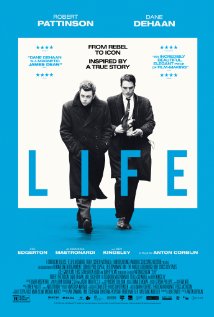
life Greetings again from the darkness. The film’s title has multiple meanings: “LifeMagazine as the source for the famous photographs we have seen so many times; the crossroads in “Life” of both rising star James Dean and photographer Dennis Stock; and a philosophical look at “Life” – how quickly things can change, and how we should appreciate the moments.

Director Anton Corbijn (A Most Wanted Man, The American) and screenwriter Luke Davies offer up a snapshot of 1955 as the not-quite-yet-famous James Dean (Dane DeHaan) traveled cross-country with photographer Dennis Stock (Robert Pattinson) from Los Angeles to New York to Indiana. Each man was searching for their true self as Stock’s professional ambition and personal stress are palpable, while 24 year old Dean’s ambivalence about his pending superstardom borders on self-destructive.

DeHaan and Pattinson both underplay their roles, and it’s certainly more than a little confusing to see Pattinson in a movie about James Dean where he is not the actor playing the icon. DeHaan captures the low key, soft-spoken side of Dean but only teases at the “rebel” studio head Jack Warner (Sir Ben Kingsley) wanted so badly to control. We get a feel for Dean’s vision of challenging roles in quality productions … a commitment to the art of acting he no doubt sharpened in his time with acting guru Lee Strasberg. The story leans more heavily to the tale of photographer Stock, which is unfortunate, because he is significantly more awkward than interesting. Pattinson plays him as a social misfit who broods nearly as much as the “moody” young actor he is stalking through the streets.

The period look is well appointed, and we are privy to some of the moments of Dean’s life just prior to the release of East of Eden and his being cast in Rebel Without a Cause. His relationship with Pier Angelli (Alessandra Mastronardi), friendship with Eartha Kitt (Kelly McCreary), and his bond to the family and farm of his childhood in Indiana are all captured. In fact, it’s the clumsy relationship with Stock that comes across as the least realistic portion … though it may very well have happened this way. Even the manner in which the famous photographs were taken is underplayed … although it makes for a terrific tie-in with the closing credits where the real Stock/Life Magazine photographs are displayed.

It’s now been 60 years that James Dean has exemplified Hollywood “cool”, a label that can never be removed due to his tragic death in 1955 after making only three films. Capturing the essence of what made Dean cool is unnecessary because it’s present in every scene of those three films, as well as the photographs taken by Dennis Stock. That’s all the legacy either man needs.

watch the trailer:


THE AMAZING SPIDER-MAN 2 (2014)

May 11, 2014

spider 2 Greetings again from the darkness. This follow-up to The Amazing Spider-Man (2012) seems to have the mission of throwing as much onto the screen as possible. There are not one, but three key villains, a teenage love story, a deathbed scene, numerous moments of soul-searching, a stream of wise cracks and puns, the most outrageous laboratory setting, a cartoonish evil doctor accent, the constantly furrowed brow of Aunt Mary (Sally Field), flashbacks and video of the mysterious father, teasers for future movies, and of course, enough action and special effects to ward off any thoughts of peace.

Personally, I find Andrew Garfield to be a nice fit as Spidey, but I just can’t buy him as ultimate science geek Peter Parker. He bumbles about and bats his eyes too much for my tastes, and can’t stand toe to toe with Gwen Stacy (real life squeeze Emma Stone) in scientific banter. Still, the original story is interesting enough that any minor issues are easily overlooked.

At its core, this entry is a story of revenge. The foundation for Peter Parket’s troubles all stem from Oscorp, so we are treated to some behind the facade sets that will keep viewers on their toes. After an initial face-off with bad guy Aleksei Sytsevich (a maniacal Paul Giamatti), we see the transformation of goofy Max Dillon (Jamie Foxx) into the shocking (get it?) Electro. If that’s not enough, childhood buddies Peter Parker and Harry Osborn (Dane DeHaan) are reunited to set the stage for more good vs evil.

The story would have benefited from more concentration on any of these three stories, while dropping one altogether. The viewer would have benefited from a slower jolt (one more!) in the transformation of Max to Electro. We needed to find the humanity, rather than just desperation. The same goes for Peter and Harry. The dots are a bit too far apart for connection, though DeHaan (so good in Lawless and Chronicle) is a striking contrast to the doe-eyed, beautifully coiffed Garfield.

It’s nice to see Stone’s Gwen portrayed as a smart, ambitious young woman who also understands how demanding a relationship is, and the responsibility that goes with dating a superhero. Speaking of responsibility, the lack of Uncle Ben’s influence here is disturbing, though probably necessary given the exploration of backstory on Peter’s parents (Campbell Scott, Embeth Davidtz).

When Paul Giamatti reappears near the end as Rhino, it’s a bit difficult to not think “enough is enough”. And oddly, this fight sequence ends abruptly, evidently setting the stage for future Spidey. And speaking of the future, the end credits scene plays as nothing more than a teaser trailer for the next X-Men movie, while robbing us of any details to the Sinister Six.

Admittedly, I feel somewhat overdosed on Superhero and Comic book adaptations, yet the action and effects are still quite fun to watch, even if director Marc Webb (Ok, that pun is just too easy) seems to jumble up too many story lines.

***NOTE: I find humor in the fact that both lead actors from Sideways (2004) have now played villains in Spider-Man movies. Paul Giamatti in this one and Thomas Haden Church in Spider-Man 3 (2007)

***NOTE: fans of The Matrix will experience deja vu as Peter Parker discovers his father’s laboratory

watch the trailer:

http://www.youtube.com/watch?v=aHvdlGLR0Xw


THE PLACE BEYOND THE PINES (2013)

April 4, 2013

place Greetings again from the darkness. With an extended tracking shot to open the film, we follow Ryan Gosling, a motorcycle stunt rider, from his trailer through the carnival grounds and right into the metal sphere with his co-riders. It’s an exhilarating start to the film and introduces Luke (Gosling) as a heavily-tatted star attraction on the carnival circuit.

This is director Derek Cianfrance’s follow-up to his 2010 critically acclaimed Blue Valentine (which also featured Gosling). While that film painfully presented the gut-wrenching misery of a crumbling marriage, this latest shows multi-generational fallout from poor decisions and faulty father-son relationships. Cianfrance has quite an eye for well-intentioned, but inadequate personality types. This latest is presented in triptych format … three distinct story divisions. The first segment is mesmerizing and top notch filmmaking.  It follows Luke’s attempt to “do right” by his newly place3discovered infant son – the result of last year’s carnival trip to this same town and a tryst with Romina, a local gal played by Eva Mendes.

Gosling is especially effective (yet again) as he falls in with a local mechanic played by a terrific Ben Mendelsohn (frightening in Animal Kingdom). The two hatch a scheme to capitalize on Luke’s bike riding skills by robbing banks. These “jobs” allow us to see the other side of Luke, who seems sincere in his desire to provide for the child and win back Romina. Things go badly when Luke crosses paths with rookie street cop Avery Cross (played by Bradley Cooper). Watching Gosling’s contradictory personalities is quite amazing … he flips from quietly charming to cold-blooded brutal bank robber in the blink of an eye.

place4 The story then shifts to follow Avery and his strained relations with his wife (Rose Byrne), their infant son, and Avery’s former state Supreme Court judge father (Harris Yulin). A sub-plot brings in police department corruption led by … who else? … Ray Liotta. Mr. Liotta still possesses the beady-eyed stare that can scare the crap out of his fellow actors and anyone watching the movie. This corruption and the idealistic and ambitious nature of Avery aren’t a very pleasant mixture, but it sets the stage for the final act.

Flashing forward 15 years, brings us to a fairly predictable situation that still proves interesting. The previous stories focused on the failed relationships of Luke and his father, Luke and his mis-fired attempt at being a dad, and the awkwardness of Avery and place2his father. Now we see the resulting mess that are the two now teenage boys. The sons are played by Emory Cohen and Dane DeHaan (memorable as Cricket in Lawless). DeHaan especially shines as the Gosling/Mendes prodigy.

Sean Bobbitt is the film’s Director of Photography and he deserves special mention for his work with Cianfrance in bringing a different and intimate look to the characters, setting and story. Also, Mike Patton’s unusual score fits perfectly and keeps the viewer on track. This is a very uncomfortable movie to watch, but those who enjoy tough, artsy films will be rewarded.

*NOTE: During the Q&A after the screening, director Cianfrance mentioned that Ryan Gosling is not “typical” actor, but that he has quite a feel for characters and visual story telling. Unfortunately, a couple of days later Mr. Gosling announced he was taking a sabbatical from acting.  Luckily for us, he has built a pipeline of movies that should keep us satisfied for the next couple of years.

SEE THIS MOVIE IF: you are a fan of gritty independent films OR you enjoy triptych story structure OR you just want to see Ryan Gosling at his coolest riding motorcyles

SKIP THIS MOVIE IF: you are looking for an uplifting, inspirational story … no superheroes saving the world in this one.

watch the trailer:

http://www.youtube.com/watch?v=G07pSbHLXgg


LAWLESS (2012)

September 3, 2012

 Greetings again from the darkness. Gangster and family crime dramas are always a favorite film genre, especially when “based on a true story”, as this one claims. The story comes straight from the novel “The Wettest County in the World” by Matt Bondurant, the grandson of Jack Bondurant, portrayed in the film by Shia LaBeouf. The screenplay and direction come courtesy of the latest collaboration from Nick Cave (alt-Rocker) and John Hillcoat (The Road).

The cast is deep and talented. The three Bondurant brothers are played by Tom Hardy (Forrest), Jason Clarke (Howard) and LaBeouf (Jack). The brothers are moonshiners who also run their own bootlegging business in Franklin County, Virginia during prohibition and the great depression. They are assisted by a moonshine savant named Cricket (Dane DeHaan as a dead ringer for Leonardo DiCaprio in What’s Eating Gilbert Grape). A beautiful former Chicago dancer played by Jessica Chastain stumbles into their café while inexplicably searching for a quieter life. Mia Wasikowska is the preacher’s daughter with a rebellious streak who gets courted by Jack. Gary Oldman is terrific, though sadly limited in screen time, as the notorious gangster Floyd Banner, and Guy Pearce plays Special Detective Charlie Rakes. Rakes is a corrupt, outlandishly colorful character out of Chicago who is on assignment to either get a cut of the business or kill everyone in the process … all while smelling like a “nancy” and keeping blood off his tailored suits. He does this with the worst movie haircut since Anton Chigurh. Pearce plays him like a mix of a Christoph Waltz villain and Willem Dafoe’s detective in The Boondock Saints. Quite a visual.

 With this cast and a very stylistic look provided by wonderful camera work, color scheme, and costumes, it’s a bit confounding that the movie isn’t a little better than it is. The war between outlaws and crooked lawmen, splashed with minor love stories and interesting characters seems to have a gap. Apparently there are too many vying for too little screen time. Gary Oldman’s character has a stunning and violent screen entrance, but then is wasted and ignored for the balance of the film. Chastain’s Maggie is carrying a back-story that is clearly very intriguing, but all we get is a few pouty looks.

 Since the novel’s author is the grandson of Jack, we can assume that’s why LaBeouf gets so much attention and screen time. He is the family runt, and can’t wait to prove his worth to his brothers. Even if this is true, this story line is nowhere near as interesting as that of Forrest, Floyd Banner, Detective Rakes, or Maggie. Whenever LaBeouf came on screen, I felt like I was watching an actor. When Hardy or Clarke were featured, it felt like real hillbillies were trying to protect their moonshine business. Speaking of Hardy, he dominates the screen again … just like in Inception and The Dark Knight Rises (as Bane). So anxious to watch his career continue to develop.

Nick Cave and Warren Ellis combine on the excellent score, as well as some of the fine songs performed by The Bootleggers. The music adds even more to the film’s feel. With all of the characters here, this might have taken a step up as a mini-series. As it stands, it falls short of The Untouchables or HBO’s Boardwalk Empire. While entertaining enough, it leaves us with an empty feeling and a hokey shootout finale.

** RECOMMENDATION: for an excellent movie about a family criminal group, see Animal Kingdom (from Australia)

SEE THIS MOVIE IF: you enjoy the gangster/outlaw/bootlegger genre and relish the violence and street justice OR you want to see another powerful screen performance from rising star Tom Hardy, grunts and all.

SKIP THIS MOVIE IF: you believe the obnoxious, near-constant screen presence of Shia LaBeouf is enough to ruin whatever potential a hillbilly bootlegger movie might offer

watch the trailer: