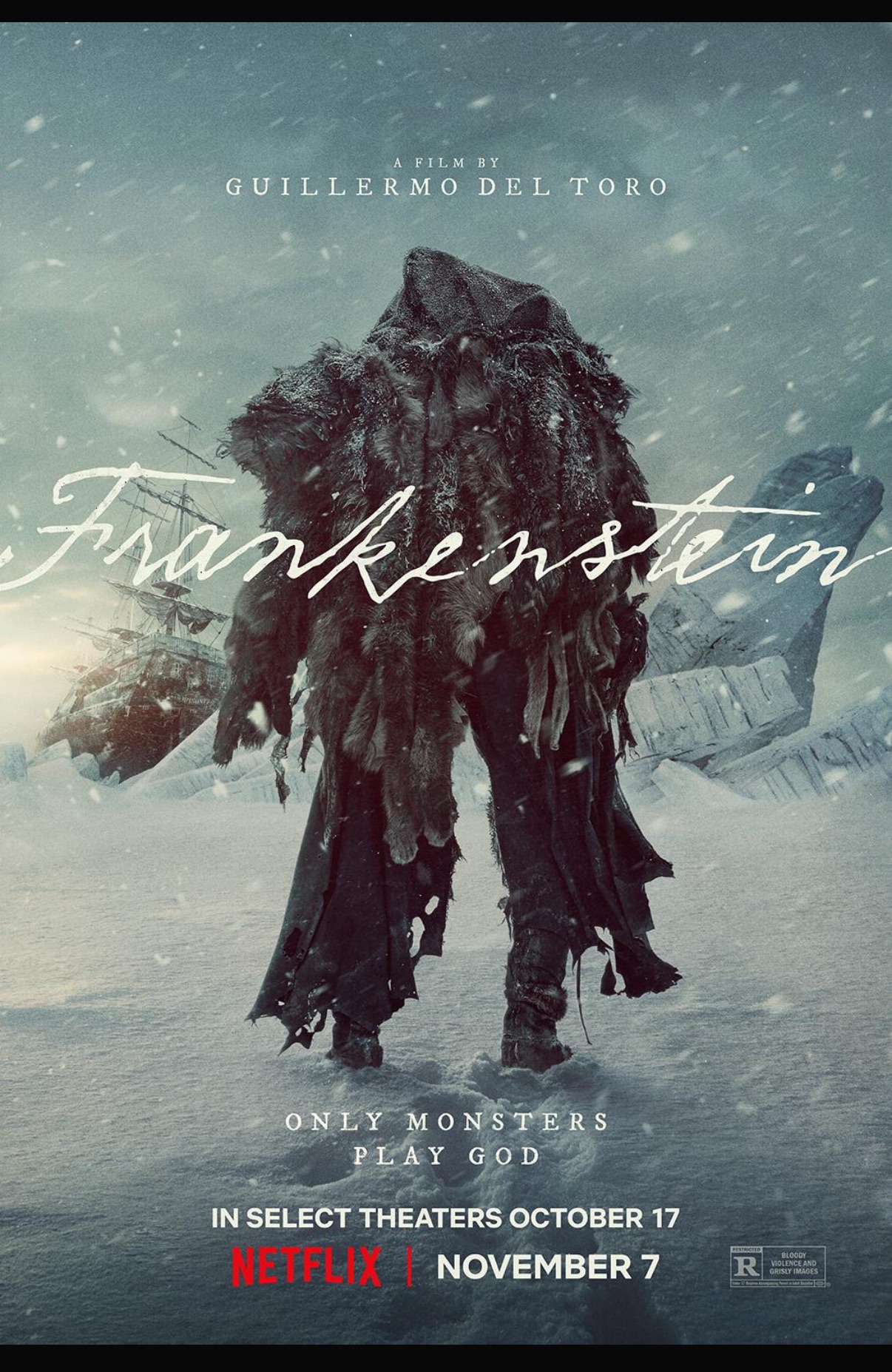
FRANKENSTEIN (2025)

December 29, 2025

Greetings again from the darkness. As a lifelong lover of cinema, I tend to latch on to the works of those who so obviously feel the same. Among those who have achieved some level of mainstream success are Martin Scorses, Quinton Tarantino, Steven Spielberg, and Christopher Nolan. Another filmmaker who definitely belongs in the group, and it may surprise some, is Guillermo del Toro (an Oscar winner for PINOCCHIO, 2022, and THE SHAPE OF WATER, 2017). Other gems in his oeuvre include CRIMSON PEAK (2015) and PAN’S LABRYNTH (2006).  The esteemed director has long claimed that his “dream project” is a film version of Mary Shelley’s 1818 novel, “Frankenstein: Or, The Modern Prometheus”.

The dream is now a reality, and what a thing of beauty it is. The visuals here eclipse all expectations, and the only caution I would offer is that the tone and themes are a bit of a twist from traditional takes on the story … and we all know there have been many previous takes. All of this confirms what a remarkable source material Mary Shelley’s novel is. That’s not to say del Toro’s version is ‘new’, yet it’s certainly an oddity and an outlier to what we’ve come to expect from Frankenstein movies.

Setting the film in 1857 (nearly 40 years after the novel) affords del Toro some benefits of advancements, as well as audience familiarity to the times. It may seem strange, or even contrary, but to me, this film’s central theme is humanity – how we use it and how we sometimes work against it. An opening in the Arctic where creature (Jacob Elordi) and creator (Oscar Isaac) cross paths yet again – after chases that only become clear later in the film – and it’s horrifying and stunning. Pivotal to the sequence is Captain Anderson’s (Lars Mikkelsen, “House of Cards”, and brother of Mads) ship and crew.

Victor Frankenstein, the human God/creator, is played with enthusiastic ambition that often drifts into mania. He’s a man of science whose vision refuses to be contained. Even in success, his need to control override his accomplishments … meaning the creature is truly born into misery and pain, resulting in confusion and a need to find where and how he belongs. Is it possible for a laboratory experiment to be a tortured soul? Director del Toro clearly believes this … as did James Whale in those early versions. It’s in these moments where Elordi truly shines as the creature – it’s a terrific performance through prosthetics.

Two-time Oscar winner Christoph Waltz and Mia Goth (a dual role) are both terrific in supporting roles, and it’s best if nothing further is disclosed about their characters as each are key to the story. Beyond the fascinating, tragic, and heartbreaking story is a film with such stunning visuals that it stands alone as a work of art. Guillermo del Toro’s talented crew includes cinematographer Dan Laustsen, Production Designer Tamara Deverell, Oscar winning Set Decorator Shane Vieau, and two-time Oscar winning composer Alexandre Desplat, who delivers an incredible score (one certain to be nominated). Of course, as previously stated, this was the “dream project” of Guillermo del Toro, and he has delivered one for the ages … dreams really do come true!

WATCH THE TRAILER


JURASSIC WORLD: REBIRTH (2025)

July 1, 2025

Greetings again from the darkness. It’s been 32 years since John Hammond “spared no expense” on ice cream and Chaos Theory Doctor Malcolm pleaded that the colorful jeep “must go faster”. That 1993 film by Steven Spielberg awed us and changed the course of cinema. Now director Gareth Edwards (ROGUE ONE: A STAR WARS STORY, 2016; GODZILLA, 2014) brings us the seventh film in the ‘Jurassic’ franchise. Having adapted Michael Crichton’s books for the first two in the series, renowned screenwriter David Koepp (who has also contributed to Mission: Impossible, Indiana Jones, and Spider-Man franchises, among others) returns for “Rebirth”.

Opening with a flashback to fifteen years prior, we see the InGen lab where experimental cross-breeding has resulted in dino-mutations, and we are only about four minutes in when we get the first dino snack (an unfortunate lab worker). Returning to modern day times (five years after the end of JURASSIC WORLD: DOMINION), we find a citizenry somehow bored with the dinosaurs that have been released into the wild – most of which have died or are dying due to environmental issues caused by us despicable humans. The exception is a remote island near the equator where the climate most resembles prehistoric times, and the beasts are free to roam … as it’s now a “No people allowed” sanctuary. It’s also a former InGen lab site.

This all sets the stage for greedy Big Pharma executive, Martin Krebs (Rupert Friend) to plan an excursion with the goal of collecting DNA from the three largest dino species from land, sea, and air. Oh, and minor detail – the DNA has to be collected from live specimens. The DNA can supposedly be used for major medical breakthroughs. Krebs hires Zora Bennett (Scarlett Johansson), a mercenary for “situational security and reaction”, and Dr Henry Loomis (Jonathan Bailey, WICKED, 2024) a paleontologist trained by the infamous Dr Grant. Zora assembles the rest of the team, including friend and boat captain Duncan Kincaid (Oscar winner Mahershala Ali), and the rest of his crew.

Separately, a family sailing the same waters is introduced. Reuben (Manuel Garcia-Rulfo) and his two daughters, college-aged Teresa (Luna Blaise) and clever 11-year-old Isabella (Audrina Miranda), along with Teresa’s lazy and spacey boyfriend Xavier (David Iacono). This secondary group provides us with ‘normal’ folks to fear for as their boat is dino-attacked, leaving them stranded in the sea, awaiting recovery by the pharma boat. This creates a strange mixture of folks and, most importantly, allows for the mandatory kid-in-peril. Another dino-attack on the boat separates the family from the team and begins the process of scratching characters from the story.

The adventures are quite different for the two groups, and the island scenery is consistently awe-inspiring. But we are all here for dinosaurs, and on that front, the film never disappoints. Very few gaps occur between sightings or attacks, and the dinosaurs dazzle. A slumbering by the river T-Rex provides one of the best chase/attack scenes from any of the Jurassic movies (with a tip of the raft to the Crichton novel). Of course, we know who the villain will be, and we know how things go for villains in these movies. The story includes an altruistic approach from Loomis, who flashes some survival instincts despite a career spent in an air-conditioned museum, rather than a dino-filled jungle.

We are left to ponder what the titular “Rebirth” refers to. The film doesn’t offer anything new, outside of the mutants … including the much-anticipated D-Rex (sporting the head of a Beluga whale?). Your individual level of critique will determine whether you buy Scarlett Johansson as the ultimate tough warrior, although John Mathieson’s stunning cinematography and composer Alexandre Desplat’s score (generously sprinkled with John Williams’ iconic JP score) are complementary to an overall entertaining and crowd-pleasing big-budget summer blockbuster, with many nods to the previous films in the franchise. Race cars and dinosaurs in the same summer … spared no expense.

Opens in theaters on July 2, 2025

WATCH THE TRAILER


THE PHOENICIAN SCHEME (2025)

June 11, 2025

Greetings again from the darkness. At this point it seems clear that Wes Anderson makes movies for himself and his devoted followers … and his loyal troupe of actors. I can’t think of another filmmaker whose movies are so instantly recognizable and consistently similar in look and feel. The pacing, verbal style, color palette, and overall rhythm of his latest compares favorably to some of his previous, including: ASTEROID CITY (2023), THE FRENCH DISPATCH (2021), THE GRAND BUDAPEST HOTEL (2014), and MOONRISE KINGDOM (2012). Rather than a criticism, that’s intended instead as a notice to viewers. If, like me, you’ve enjoyed his past films, you’ll likely take pleasure in this one.

Benecio Del Toro (one of the great faces in cinema) takes the lead here as wealthy businessman Zsa-zsa Korda, who inexplicably defies death about as often as most people brush their teeth. Due to his frequent near-death experiences and the risk involved in pursuit of his latest project, Korda names his daughter, Liesl (Mia Threapleton, daughter of Kate Winslet), a nun-in-training, as his sole heir and invites her to be part of the latest venture. The enterprise is exceedingly well-planned as evidenced by the labeled wardrobe boxes. Of course, the project is too convoluted for us to understand, but that matters little. It’s the globe-trotting and interactions with famous faces that raise the entertainment value.

‘Deadpan’ is today’s magic word – as it is in most Wes Anderson films. And if there is a secondary word of the day it would be ‘goofy’, because this undoubtedly falls on the light-hearted end on the Anderson scale. It’s filled with jokes, site gags, and purposefully oddball moments designed to elicit laughter (or at least enjoyment). The third of the lead triumvirate here is Michael Cera, who seems completely at ease – actually excelling in the Anderson world. He plays Bjorn, a character more complex than we are initially led to believe … although we don’t believe it, even initially.

Joining in the fun is an all-star line-up of actors other filmmakers only dream of casting. These include: Willem Dafoe, Scarlett Johansson, Rupert Friend, Richard Ayoade, Jeffrey Wright, Hope Davis, Benedict Cumberbatch, and Mathieu Amalric, each memorable in their segments. You won’t want to miss Tom Hanks and Bryan Cranston as brothers taking on the infinitely unskilled duo of Del Toro and Riz Ahmed (as a crowned Prince) in a game of basketball … and even that pales to the scene with Bill Murray as God.

Anderson co-wrote the script with frequent collaborator Roman Coppola and the score comes from 2-time Oscar winner Alexandre Desplat. Cinematographer Bruno Delbonnel perfectly captures the Anderson flavor in what I believe is their first time working together. What I find fascinating is that while watching the film, the characters and story struck me as a bit of a lark, yet some moments have come back around in my mind, and it seems quite clear that Anderson purposefully and slyly buried some life messages in this little comedy. What I’m saying is that the film works as a comedy, but also may carry a bit more heft that what I thought while watching. That falls under the definition of refined filmmaking.

WATCH THE TRAILER


THE FRENCH DISPATCH (2021)

October 28, 2021

Greetings again from the darkness. Few things in the cinematic world are more instantly recognizable than a Wes Anderson movie. In fact, historically speaking, perhaps only Jacques Tati comes as close to having a signature style easily spotted by viewers (unless you want to count Tom Cruise sprinting or Julia Roberts cackling). This is Mr. Anderson’s 10th feature film in 25 years, and I now rate 5 of these very highly, though all 10 have a certain appeal. This latest, co-written by Anderson with frequent collaborators Roman Coppola, Hugo Guinness, and Jason Schwartzman, could be considered his most ambitious to date … and likely the most ‘Wes Anderson’ of all.


Billed as a love letter to journalists, it becomes crystal clear, that by this, Anderson means the esteemed stable of writers from the early days of “The New Yorker”. In fact, Anderson structures the film as if it were following the path of a magazine being published. We are informed upfront that this edition features “an obituary, a travel guide, and 3 feature articles”. An episodic format is not unusual for films, yet Anderson never does anything by the book. Each piece takes place in its own time period, and there appears to be little connection or crossover among key characters. Still, somehow he makes this work by ensuring each piece stands on its own and is filled with unusual characters and those patented, fabulous Anderson visuals.

The obituary is that of Arthur Howitzer Jr (a deadpan Bill Murray), the founder and publisher of “The French Dispatch” magazine, a spin-off from The Liberty Kansas Evening Sun … a move from a small town in Midwestern United States to a charming small town in France (hilariously and fittingly) named Ennui-sur-Blasé. Howitzer adores his writers, and the only guidance he offers them is, “Just try to make it sound like you wrote it that way on purpose”. He also has a “No Crying” sign posted in his office, likely as much as a reminder to himself as a rule for the staff.

Our travel guide section is fortunately quite brief since it involves Owen Wilson as a bicycle tour guide showing us around the town – the “Local Color”- of Ennui-sur-Blasé. This takes us to the first feature story, and the best of the lot. Tilda Swinton excels (doesn’t she always?) as a writer and art expert giving a colorful lecture entitled “The Concrete Masterpiece”. She tells the story of Moses Rosenthaler (Benecio del Toro), a genius modern artist serving a life sentence for murder, and as she lectures, we see it play out. While incarcerated, Moses continues to work and his muse is a prison guard named Simone, played exceptionally well by Lea Seydoux. Her nude posing for him leads to his signature modern art piece, which attracts the attention of an ambitious art dealer played by Adrien Brody.

“Revisions to a Manifesto” is the next feature, and it involves a young activist named Zeffirelli (Timothee Chalamet). He’s a chess expert, quite moody and has a questionable quest. He’s being covered by writer Lucinda Krementz (Frances McDormand), who is unable to maintain objectivity, and inserts herself right into the story, amongst other things. The segment pays tribute to the activism of the 1960’s and is filmed mostly in black and white.

The third feature, “The Private Dining Room of the Police Commissioner” involves writer Roebuck Wright (Jeffrey Wright) telling his story while a guest on Liev Schreiber’s Talk Show in the 1970’s. Roebuck is obviously inspired by James Baldwin, and he famously recalls every line he’s ever written. The story he recites involves a legendary chef played by Steve Park.

Actors mentioned so far are just the headliners, and Anderson has packed the film with his usual troupe, as well as dozens of others – some you’ll recognize, and some you won’t. There are at least seven Oscar winners involved: Christoph Waltz, Fisher Stevens, and Angelica Huston (as narrator), in addition to the aforementioned Swinton, McDormand, del Toro, and Brody. Numerous Oscar nominations and awards are included in the group of other familiar faces like Willem Dafoe, Saoirse Ronan, Edward Norton, Lois Smith, Henry Winkler Bob Balaban, Elisabeth Moss, and Mathieu Amalric.

Other frequent Anderson collaborators who deliver standout work include Production Designer Adam Stockhausen, Cinematographer Robert Yeoman, Editor Andrew Weisblum, and composer Alexandre Desplat. The film looks and sounds remarkable, and somehow it doesn’t feel like it’s moving fast – although we can barely keep pace. The film can be compared to ordering a flight at your local distillery. Each flavor is tasty, but they may not add up to a full drink.

Wes Anderson has delivered another stylish, fun film to watch, and one that is endlessly entertaining. It may not have as many moments of laughter as some of his previous films, yet there are still plenty of sight gags, insider references, and light-heartedness bathed in nostalgia – even if it’s not quite as whimsical. Shot in the French town of Angouleme, the visuals are as impressive as any you’ll find, serving up a collage of time, caricatures, color, and topics.

Opening nationwide in theaters on October 29, 2021

WATCH THE TRAILER


LITTLE WOMEN (2019)

December 23, 2019

 Greetings again from the darkness. More than 150 years have passed since Louisa May Alcott’s novel was published (volume 1 was published in 1868, volume 2 in 1869). By my count, there have been seven previous movie adaptations, dating back to the silent film era and through the more familiar George Cukor-Katharine Hepburn (1933), Mervyn Leroy-June Allyson (1949), and Gillian Armstrong-Wynona Ryder (1994) versions. One might think that sufficient, yet, after viewing this latest, you’ll likely join me in believing that director Greta Gerwig and Louisa May Alcott (and by natural extension Jo March) are kindred spirits … timeless storytellers of the moment.

Oscar nominated (writing and directing) for her standout LADY BIRD (2017), Ms. Gerwig remains true to the beloved source material while adding her own contemporary touch. She begins with the adult March sisters and then flashing back 7 years to the stage of living together and battling through the difficult and awkward transitional phase. The four sisters Jo (Saoirse Ronan), Meg (Emma Watson), Amy (Florence Pugh), and Beth (Eliza Scanlen) are exceptionally well cast, and we immediately recognize the familiar personality traits of each. Jo is the serious, determined writer who has an understanding of financial necessities. Meg is the warm facilitator beloved by all. Amy has ambitions (or is it dreams?) of being a great artist and living an exceptional life. Beth, the youngest, radiates a sweet nature and love for the piano.

Much of the story is told through the eyes of Jo. Her independent spirit and frustration with how the world is, boils over at times. She states her disappointment at being born a girl, and is described as having “a nature too noble to curb.” While viewing, one must keep in mind that this was the Civil War era (the girls’ father is a military Chaplain), and women had achieved very few rights in society. The contrast is never more evident than when comparing Marmee (Laura Dern), presented here as a near flesh-and-blood saint, with Aunt March (Meryl Streep), one quite at ease in thumbing her nose at societal norms for one reason … she is rich.

Fans of the novel will be pleased that Timothee Chalamet plays “Laurie Laurence”, who struggles every bit as much as the sisters in finding his way towards adulthood. His scenes with Jo are exceptional. Chris Cooper, not seen nearly enough in movies these days, perfectly captures the broken spirit of Mr. Laurence, a man never quite able to escape his own personal loss. Other key cast members include James Norton as tutor/teacher John Brooke, Louis Garrel as Friedrich (here a Frenchman), and Tracy Letts dropping some deadpan comedy as Jo’s publisher Mr Dashwood.

Ms. Gerwig (perhaps with a future as one of the greatest filmmakers) displays storytelling and cinematic craftsmanship at the highest level. She bounces between timelines (over at least 7 years) and different sisters’ stories, showing how each is so different … yet all interconnected. These spirited sisters, raised in the same modest home, have their own independent thoughts and ideas of how they want to live their lives. This delivers multiple comings-of-age and examines ‘a woman’s place’, whatever that means. In fact, the message is that a woman’s place is whatever she decides, and while her options are many (despite obstacles), her decisions are personal. None of the four sisters are played by American actors, and all four perform admirably. Pay particular attention to Florence Pugh (MIDSOMMAR) and her work as Amy. Also impressive is the Production Design by Jess Gonchor and the score by 2-time Oscar winner Alexandre Desplat. This one is all about the storytelling and characters, so take in the bunch known as the March sisters. As a side note, Greta Gerwig’s next movie is a live-action BARBIE movie, with Margot Robbie in the lead.

watch the trailer:


OPERATION FINALE (2018)

August 29, 2018

 Greetings again from the darkness. Historical dramas, by definition, carry added depth and weight to stories that sometimes seem almost beyond belief. Such is the true story of the 1960 Mossad mission to capture Adolph Eichmann, the noted architect of the Final Solution, who was hiding in plain sight in Argentina. You might think there have already been enough Holocaust movies, but director Chris Weitz (ABOUT A BOY) hones in on the personal aspects of loss and anger, and the need for justice.

Matthew Orton’s first screenplay benefits greatly from a terrific cast, especially the two main characters played by Ben Kingsley (Adolph Eichmann) and Oscar Isaac (Mossad agent Peter Malkin). Sir Ben is notably restrained in his performance of the last surviving mastermind of the Holocaust, and one of the most despised men on the planet. His subdued performance aligns perfectly with the “ordinary” man of which we’ve since read. Mr. Isaac adds the element of psychology in his “good cop” approach to getting Eichmann to crack.

Playing much like a heist movie, we see the team assembled and the quite convoluted plan devised. The high risk strategy underscores the desperation so many felt in their need to see Eichmann pay for his atrocities. The manhunt required some political tip-toeing, and we even gain a history lesson on the role of the Catholic Church. A tip from a “secret” Jewish daughter (Haley Lu Richardson) and her father (Peter Strauss) set things in motion. Sylvia (Ms. Richardson) actually dates Klaus Eichmann (played by Joe Alwyn), who is a picture-perfect Aryan carrying on the horrid Nazi tradition of hatred.

Of course, Klaus is the son of Adolph, and the one who spills the beans about his father being “a big deal” in the war … thereby ruining the quiet and mostly unassuming life they have been living with Adolph’s wife (a nearly unrecognizable Greta Scacchi). Sylvia and Klaus meet at a movie when she shushes him and his friends. Director Weitz even includes a clip of IMITATION OF LIFE (1959), a film that not coincidentally stars his mother, Susan Kohner. It’s a nice touch.

Much of the film takes place in the safe house where Adolph Eichmann is blindfolded and spoon-fed. It’s here that the psychological games and political maneuverings begin. Supporting actors who add strength to the film include team members Melanie Laurent (Hanna), Michael Aranov (chief negotiator Zvi), Lior Raz (as the demanding team director), Nick Kroll, and Simon Russell Beale (as Prime Minister David Ben-Gurion). There is a history of bumpy romance between Hanna and Peter, though it adds little to the story.

Alexandre Desplat’s score is terrific, especially during a creative and informative opening credit sequence. “Who did you lose?” is a recurring question throughout, as it’s 1960 and everyone involved lost someone – a driving force behind their persistence and commitment to the cause. The film is focused on the mission to capture, not the details of the subsequent trial; however it does close with archival photos of the actual trial – adding historical relevance to this fine dramatization.

watch the trailer:


THE SHAPE OF WATER (2017)

December 8, 2017

 Greetings again from the darkness. Recent release JUSTICE LEAGUE is filled with superheroes, but filmmaker-extraordinaire Guillermo del Toro finds his league of misfits and outcasts to be much more interesting – as do I. The numerous possible descriptions of this movie are all accurate, yet alone, each falls short: a fairy tale, fable, monster movie, unconventional romance, sci-fi, cold war saga, and commentary on societal misfits. What is also true is that it’s a gorgeous film with terrific performances, and it pays lovely tribute to the classics.

A government research facility in 1962 Baltimore is the setting, and “The Asset” being secured and studied is an amphibian man that was captured in South America by a sadistic Richard Strickland (Michael Shannon) and his electric cattle prod. Now the military, and a 5-star General played by Nick Searcy, is in charge. The lead scientist played by Michael Stuhlbarg certainly has a different agenda than the military, whose focus seems to be more on preventing the Russians (closer than you think) from stealing the asset than in actually seizing the rare scientific opportunity for advancement.

While all the ominous and clandestine government operations are being conducted, a member of the nighttime cleaning crew – a mute woman named Elisa (Sally Hawkins) – makes a very personal connection with the fish man through nutritious snacks, Big Band music and sign language. This is the enchanting portion of the story and is admittedly (by del Toro) inspired by the 1954 classic CREATURE FROM THE BLACK LAGOON (a personal favorite of mine). Elisa and the amphibian man experience a romantic courtship not unlike what we have seen in many other love stories … that is, if you overlook the amphibious being that makes up half of this couple. In fact, “going with” the story is crucial to one’s enjoyment. Sit back and let the magic and wonder and fantastical nature of del Toro’s imagination sweep you away – just as it has done for Elisa.

There are many elements of the film worth exploring, and it’s likely to take another viewing to capture many of them. The band of misfits is comprised of the fish man (Doug Jones), Elisa (Ms. Hawkins), Elisa’s wise and wise-cracking co-worker Zelda (Octavia Spencer), and Elisa’s neighbor Giles (Richard Jenkins), a closeted gay graphics design artist. These are the nice folks/beings who make up the world that seems to be run by bullies and predators (sound familiar?). There is even a religious debate here as it’s mentioned that the creature was treated by a God in his natural environment, and a brief discussion is had over what might a God look like. All of the actors are superb, and Miss Hawkins delivers her second knockout performance of the year (the other being MAUDIE).

“The future” is a central theme of the story, though Elisa is most focused on now – how to find some happiness in a world that has been so challenging. Elisa realizes she and the creature are more similar than not, and she feels his pain each time the power-hungry Strickland (Shannon) pops him with the electric cattle prod. There is an ethereal beauty (and yes, sensuality) to the scenes with Elisa and the amphibian man, and it even leads to a terrific song (“You’ll Never Know” by Renee Fleming) and dance dream sequence. In addition, you’ll notice many nods and tributes to classics such as Mr. Ed, Dobie Gillis, Betty Grable, Bill “Bojangles” Robinson and Shirley Temple, and Carmen Miranda singing “Chica Chica Boom Chic”. It’s also no accident that the apartments of Elisa and Giles are located directly above a palatial old movie theatre that is struggling to make ends meet. All of these pieces are tied together as Mr. del Toro honors the art forms he so adores.

For those who enjoy such detail, it should be noted that the color green plays a huge role throughout the film … the water, the creature, the uniforms, the furniture, the walls – even the Jello, the pie and Strickland’s (teal) Cadillac. The use of color ties in the ever-present mythology, and the theme of meanness and power versus kindness and love.

Cinematographer Dan Laustsen adds to the magical feel with his camera work and lighting that perfectly complements the characters and tone. Oscar winning composer Alexandre Desplat delivers yet another spot on score that not only syncs with story, but also the numerous classic songs included. Guillermo del Toro is one of the most creative and inventive contemporary filmmakers, and though this one may fall a tick below his masterpiece PAN’S LABRYNTH, it is sure to dazzle and mesmerize those who give it a chance … and let’s hope there are many who do!

watch the trailer:


ALONE IN BERLIN (2016)

January 22, 2017

alone-in-berlin Greetings again from the darkness. When war hits close to home, the grieving of surviving family members never ends. At the end of World War II, author Hans Fallada was given access to the Gestapo file of Otto and Elise Hampel. Fallada wrote a 1947 novel based on their story, and in 2009 it was translated to English for his bestseller “Every Man Dies Alone”. Director Vincent Perez collaborated with Achim von Borries and Bettine von Borries to adapt the novel for the big screen.

Otto (Brendan Gleeson) and Elise (Emma Thompson) play a mostly quiet, working class couple who pay the ultimate price for a cause in which they don’t believe. Their protest takes the form of a clandestine 2 person operation. They systematically distribute postcards with anti-Hitler messages … nearly 300 of the cards between 1940 and 1942. It’s a drip campaign that takes the form of non-violent political resistance, and certainly rankles those of the Third Reich.

Daniel Bruhl plays Escherich, the Nazi officer put in charge of the investigation (labeled Operation: Hobgoblin). He is charged with finding the source of the cards and punishing those responsible. As the hunt drags on, Escherich is presented as a Nazi with a conscience, and bears the brunt of his superior’s frustration, while living in as much fear as those he is chasing.

The film has a somber tone, and somehow never generates the tension or dread that this couple must have been dealing with on a daily basis for so long. In fact, Alexandre Desplat’s score seems to fit a movie much more intense than what we are watching on screen. Mr. Gleeson delivers his usual grounded and believable performance despite a script that could have used a bit more potency. The film does deliver the always powerful message of having no regrets when you are standing up for what’s right.

watch the trailer:


AMERICAN PASTORAL (2016)

October 20, 2016

american-pastoral Greetings again from the darkness. Tackling one of the great American novels is a difficult challenge for even the most seasoned film directors … and a dubious undertaking (at best) for a first-timer. Philip Roth won a Pulitzer Prize for his 1997 novel “American Pastoral”, and there have been rumblings of a Hollywood production for more than a decade. It’s somewhat surprising that the screen version is directed by first time director Ewan McGregor … with the Scottish actor also taking on the lead role of local Jersey boy and sports hero Seymour “Swede” Levov.

The story examines the cracks behind the façade of a seemingly perfect family … the sports hero marrying the beauty queen. Of course, there is always more going on within a family than most care to admit (at least that was the case in the days prior to Facebook). There’s an early scene where Swede has introduced Dawn (Jennifer Connelly) to his father (Peter Riegert), and the philosophical and religious differences perfectly capture the changing times and mores from one generation to the next. Never has this been more true than the late 1960’s and early 1970’s … political and social upheaval were daily occurrences – and sometimes quite violent.

The first half of the movie is exceptionally well done and captures the essence of why the second half feels like a total decimation of everything Swede thought he had. He and Dawn’s daughter Merry is beautiful and feisty and stutters … something that only enhances the anger she expresses and anguish she causes for her parents. Her innocent questions as a young child evolve into radical political beliefs and affiliations as she grows up.

Merry (ironically named) is by far the most interesting character in the story, but with the focus on Swede, Dakota Fanning only has brief moments that are worthy of her talent, and Dawn has only a few emotional moments that allow Ms. Connelly to flash the acting depth she hasn’t shown in years. So much time and attention is devoted to Swede that the second half is a bit of a letdown and leaves too many details and questions unanswered.

John Romano’s (The Lincoln Lawyer) adaptation of the American classic took a different direction than we might have preferred, but it’s a thankless job since so many have considered this as unfilmable. McGregor shows a good eye as a director, though it’s obvious this material needed a more experienced filmmaker at the helm. The great Alexandre Desplat provides a classy score … the piano pieces are especially well suited. Supporting work is solid from David Strathairn as narrator Nathan Zuckerman, Rupert Evans as Swede’s brother, Molly Parker as Merry’s therapist, Uzo Aduba as Swede’s employee, and Valorie Curry as a misguided revolutionary. It’s a reminder that family dynamics may be the most complex organism, and when blended with the volatile times of the Vietnam War, a generational gap should be expected … even if it’s difficult and emotional to accept.

watch the trailer:


TALE OF TALES (Italy, 2016)

April 20, 2016

tale of tales Greetings again from the darkness. Fairy tales have long been a fruitful source for movie material. Some, like Disney productions, land gently on the family/children end of the scale; while others like the Brothers Grimm material are much darker and adult in nature. And now, along comes director Matteo Garrone and his blending of three stories loosely based on the 17th century tales published by Giambattista Basile … and “black comedy” falls short as a description.

Mr. Garrone is best known for his chilling look at an Italian crime family in the award winning Gomorrah (2008), so a trilogy of demented monarchial fantasies may seem a bit outside his comfort zone … but grab ahold of your crown jewels and be ready for just about anything.

A very strong opening leads us into the first story about a King (John C Reilly) and Queen (Salma Hayek) who are by no one’s definition, the perfect couple. The Queen’s inability to have children leads her to strike a deal with a Faustian seer who promises a baby to the royal couple. The only catch is that the King must kill a sea monster, and the Queen must eat its heart after it’s properly prepared by a virgin. Yep, it’s pretty dark and pretty odd. Of course, as with all actions, there are consequences (albino twins of different mothers) … some of which are not so wonderful.

The second story involves a lecherous King (Vincent Cassel) who falls in love with a local woman based solely on her singing voice. Much deceit follows and the actions of two sisters (played by 3 actresses – Hayley Carmichael, Stacy Martin, Shirley Henderson) and some supernatural aging products lead to a twisty story of romance that can’t possibly end well for anyone involved.

The third of our 3-headed story is the strangest of all, as a King (Toby Jones) nurtures a pet flea until it grows to behemoth size. Yes, a pet flea would be considered unusual, but eclipsing even that in uniqueness is the King’s willingness to offer the hand of his daughter (Bebe Cave) in marriage to a frightening ogre who lives a solitary life in the mountains.

These three stories are interwoven so that we are bounced from one to another with little warning … which seems only fitting given the material. Knowing the theme of the three stories does not prepare one for the details – neither the comedy, nor the dramatic turns. All actors approach the material with deadpan seriousness which adds to the feeling of a Grimm Brothers and Monty Python mash-up.

Alexandre Desplat provides the perfect score for this oddity, though the audience may be limited to those who can appreciate grotesque sequences assembled with the darkest of comedy. The moral to these stories may be difficult to quantify; however, it’s a reminder that actions beget consequences no matter the time period.

watch the trailer:

https://www.youtube.com/watch?v=J9ETi804w-E