LITTLE FISH (2021)

February 4, 2021

 Greetings again from the darkness. In another time, it would be expected to label director Chad Hartigan’s film as a science fiction romance. However, we aren’t in another time – no matter how much we might wish we were. The story revolves around a global pandemic that is working its way … unseen … through society. Drug companies are frantically testing possible cures, while medical personnel are treating those afflicted as best they can. Sound a bit too familiar? Lest you judge too harshly as a quick cash-in, you should know the film was wrapped prior to the COVID-19 outbreak, so call it serendipity or pure luck, but the timing is impeccable.

It’s called “NIA”, an abbreviation for Neuro-Inflammatory Affliction. Those who get the virus lose their memories. Some experience a slow drop in their ability to recall, while it hits others like a quick slap. Newlyweds Emma (Olivia Cooke, SOUND OF METAL, THOROUGHBREDS) and Jude (Jack O’Connell, UNBROKEN, 2014) are our conduits to this world of fear, anxiety, and love. We experience their courtship through flashbacks, as the film is bookended by an Oceanside scene which makes no sense to us the first time, but certainly does at the end.

Mattson Tomlin adapted the screenplay from Aja Gabel’s short story, and is also credited with the screenplay for the upcoming Matt Reeves movie THE BATMAN, starring Robert Pattinson. It’s very well written and the two leads perform admirably. Ms. Cooke, in her native British accent, continues to shine in both her performances and choice of projects. Montages and flashbacks are used so that we have a feel for this relationship. Emma and Jude are the kind of couple who have an engagement fish, instead of a ring. They are both ‘low-talkers’, so you’ll need to be tuned in, but the concern over the virus looms heavy over every character … even memory tattoos are big business.

Other excellent movies dealing with memory include ETERNAL SUNSHINE OF THE SPOTLESS MIND (2004) and MEMENTO (2000), though Mr. Hartigan’s movies is more similar in tone to the former than the latter. This is a romance with lots of hugging and tight holds. Emma asks, “How do you build a future when you keep having to rebuild the past?” We know that memories evolve and fade and change, but this NIA virus has us questioning if love is simply a bond held together by shared memories – and if the memories are gone, is the love gone as well? The movie is quite a downer to watch, and will very probably tug hard on your heartstrings; yet it’s very well made and all too topical. Please excuse me if I refrain from using the science fiction label.

In Theaters and On Demand on February 5, 2021

WATCH THE TRAILER


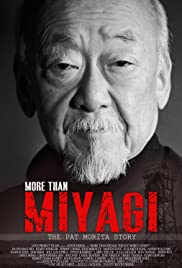
MORE THAN MIYAGI: THE PAT MORITA STORY (2021, doc)

February 4, 2021

 Greetings again from the darkness. Mr. Miyagi not only taught Daniel-san how to stand up for himself in THE KARATE KID (1984), but his “wax on, wax off” entered our  lexicon as his philosophy educated us on how seemingly unrelated pieces of life can fit together. Pat Morita embraced the iconic role of Mr. Miyagi, and also appeared in the three sequels. Filmmaker Kevin Derek is here to tell us the rest of the man’s story.

Using a straightforward and traditional biographical profile structure, Mr. Derek takes us through the life of Pat Morita. We see photographs of him as a young boy who spent many childhood years immobilized – held captive in a body cast after extensive spinal surgery. Once healed, he joined his family in one of the internment camps during WWII.

At age 30, Mr. Morita’s professional goal as a stand-up comedian was to appear on The Ed Sullivan Show sporting one of the more politically incorrect nicknames, “The Hip Nip”. Though he never played ‘Sullivan’, his career turned out just fine thanks to support from Red Foxx. Laura Marr, Lenny Bruce’s mother, became Morita’s agent, and not only did his stand-up career take off, but he also secured his early acting gigs.

It was his “Happy Days” role as Arnold that took him mainstream. Many of the leads from the cast provide memories of working with Morita. Ron Howard doesn’t appear, but Marion Ross, Anson Williams, Danny Most, and Henry Winkler all do. They speak fondly of Morita and call him a “sweet guy.” Although Morita’s first shot at leading his own series (“Mr. T and Tina”) didn’t succeed, he was securing regular acting gigs. Of course, it was being cast as Mr. Miyagi in THE KARATE KID that made him a star.

Fellow ‘KK’ cast members Ralph Macchio, William Zabka, and Martin Kove all tell stories about working with Morita, and more importantly rave about what a generous and kind soul he was … referring to him as a “lovely man.” So you might be wondering, where’s the story? Well it’s Morita’s personal demons that may surprise. He died in 2005 at age 73, but he spent most of his life as an alcoholic – often working while inebriated. His wife Evelyn is interviewed here, but his daughters did not participate.

Much is made of his being born and raised in America, but spending his career bouncing from Japanese to Chinese roles, and masking the inner turmoil. We see clips from his wedding at Elvis Presley’s Las Vegas mansion, and his personal assistant also provides insight into working with him. One of the lowest points of his career is retold by Henry Winkler and Evelyn as they remember his struggles with alcoholism during a televised “Happy Days” reunion. It’s painful to hear.

Kevin Derek also directed THE REAL MIYAGI (2015), which was a profile of Fumio Demura, often recognized as the greatest karate master of a generation. Demura was also Morita’s stunt double in THE KARATE KID. Here, Derek simply allows Morita’s story to unfold – the ups and downs. Only a few actors get to create such an iconic character as Miyagi, and Morita actually played him in four films. His star on the Hollywood Walk of Fame is shown, and the current day successful spinoff “Kobra Kai” is discussed, yet we are left with a feeling of sadness for a man who accomplished so much, while never achieving his own inner-peace.

WATCH THE TRAILER


DARA OF JASENOVAC (2021, Serbia)

February 4, 2021

 Greetings again from the darkness. Knowing that kids are resilient doesn’t lessen the impact of their mistreatment or abuse. Director Predrag Antonijevic and writer Natasa Drakulic (who also stars) focus their film on the fascist Croatian Ustase government during WWII. Croatia housed the only extermination camp run by non-Germans in Europe during the war. The purpose was to preserve the purity of Croatian blood by murdering Serbs, Jews, and Roma. There was even a camp at the Jasenovac complex specifically for kids.

The film opens with armed soldiers marching Serb citizens across the countryside to the awaiting trains. The men are separated from the women and children, and the film mostly follows 10 year old Dara (Biljana Cekic). She is traveling with her mother, older brother, and younger brother Bode, who is not yet two years old. Dara is quiet and strong, and exceedingly observant for her age.

We see bodies being dumped in the river, and then at Gradina Concentration Camp, we watch in horror as the military forces the prisoners into a morbid game of musical chairs. The sole purpose of this is simply to add a level of excitement for the executioners. Even the visiting Nazis seem appalled by this. The film periodically bounces to the camp where Dara’s father is digging mass graves and dumping bodies … at gunpoint, of course. He’s desperate in his attempts to find out if his family is still alive – almost oblivious to how close he is to death himself.

This is young Biljana Cekic’s first screen credit, and she’s remarkable in her ability to convey so much thought and emotion, while maintaining the stone-face necessary to avoid drawing unwanted attention. Her Dara sacrifices much as she kicks into protective mode after tragedy strikes. We’ve seen other Holocaust movies where the day-to-day will to survive is this strong, but the stories are rarely told through the eyes of a 10 year old girl. The Croatian fascists are portrayed as eager sadists, and the healthy boys are brain-washed into “little Serbs”, while the sick children are allowed to die … with Nuns as accomplices.

The frantic actions of the Red Cross are shown as one of the ways we see that even in the worst possible conditions, good-hearted people find a way to help. For Dara, everyone in her life gets taken from her, and we watch relentless misery, dread, pain, and suffering unfold on screen. It’s a reminder of the evils of fascism and the dangers involved with looking down on others due to race or religion. For non-Serbs, this is mostly and unknown and untold story of atrocities and cruelty – upwards of 100,000 were killed. Now that we know of this “Balkan’s Auschwitz”, and we think of modern day Balkan conflicts, we can’t help but wonder what purpose it served. It’s a tough watch, and yet another reminder of the importance of remembering history.

In select theaters February 5, 2021

WATCH THE TRAILER


TRIBES ON THE EDGE (2021, doc)

February 1, 2021

 Greetings again from the darkness. From certain angles, we see the striking resemblance to her grandfather, world renowned researcher, explorer, and oceanographer Jacques Cousteau. Celine Cousteau builds on her family legacy by documenting her journey to Brazil in an effort to provide exposure to the plight of indigenous communities in the rain forests along the Amazon … each tribe in a battle for survival. Ms. Cousteau also explains how this issue is crucial to the world, not just those grasping to the long traditions of jungle life.

We get to watch as her crew assembles and gets taken by boat deep into the Amazon region. In the process, we learn there are approximately 10,000 known indigenous people living in the area she visits, plus an estimated 2000 that have never had “outside” contact. These tribes go back many generations, and Cousteau educates us by taking us along on her mission to these communities. Most striking is the prevalence of malaria and hepatitis within the tribes, when neither disease existed in these communities for hundreds of years. She discusses the conspiracy theory that the government is systematically exterminating these people via “white medicine” in order to gain access to the protected land – land that is brimming with resources, especially oil, minerals, and fish.

The Cousteau team spends much of their time in the Rio Novo section of Vale do Javari which allows us to get a feel for how this tribe lives and the challenges they face. These challenges range from snake bites to lack of medical supplies, and of course the constant threats of political maneuverings. Cousteau also educates us about FUNAI and SESAI, two agencies charged with protecting indigenous people in the demarcated land areas. Neither seems capable of doing so.

A brief segment covers Sydney Possuelo, a Brazilian explorer and tireless activist for the protection of Brazil’s isolated indigenous people. Cousteau’s point is clear – these are the caretakers of the rain forest, and have been for many years. Their existence is threatened, and we should care because of the interconnection to all people. As the Amazon rain forests are destroyed, so is the oxygen and water that sustain us.

Premiers February 2, 2021 on VOD, including iTunes, Amazon, Vudu, Google Play and YouTube.

WATCH THE TRAILER


THE HAUNTING (1963) revisited

January 30, 2021

*** This is an entry into my “Revisited” series where I re-watch a classic movie and then write about it – not with a traditional review, but rather a general discussion of the movie, those involved with it, and its impact or influence.
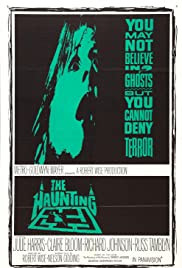
 Greetings again from the darkness. Long ago, filmmakers figured out how to have fun with ‘things that go bump in the night’. Of course some do it better than others, and how scary or creepy you find a movie will depend on your personal phobias and preferences. For a combination of haunted house, ghost story, and psychological thriller, few are better than this 1963 gem from director Robert Wise. I’ve strategically planned this after the recent success of two limited series from Netflix: “The Haunting of Hill House” (2018) and “The Haunting of Bly Manor” (2020). Although the two series were marketed as being related, in fact only the 2018 series was based on the 1959 novel from Shirley Jackson … the same as Wise’s 1963 film.

The story begins with Dr. John Markway (Richard Johnson) being contracted to conduct a scientific study of psychic phenomena and paranormal activity in the now vacant Hill House mansion that has a 90 year history of strange and tragic endings for its past inhabitants. He will be joined by two hand-picked volunteers, Eleanor Lance (Julie Harris) and Theodora (Claire Bloom), as well as Luke Sanderson (Russ Tamblyn), the young man who stands to inherit Hill House. Eleanor has a history of paranormal connection (as a child) and Theo is a clairvoyant with ESP tendencies. Luke is mostly an obnoxious rich kid hoping to cash in on his inheritance.

We get an early introduction to Eleanor’s home life, and in those days she would likely have been labeled a spinster. She has spent many years taking care of her recently deceased mother, and is now out of step with reality … and burdened with guilt from her sister, who not only treats her like a child, but also blames Eleanor for their mother’s death. Being selected for the Hill House research is a dream come true for her – a chance to do something for herself. Her arrival at the gates of the manor provide a glimpse of just how important this is to her. She refuses to heed the caretaker’s (Valentine Dyall) warning, and demands to be allowed in.

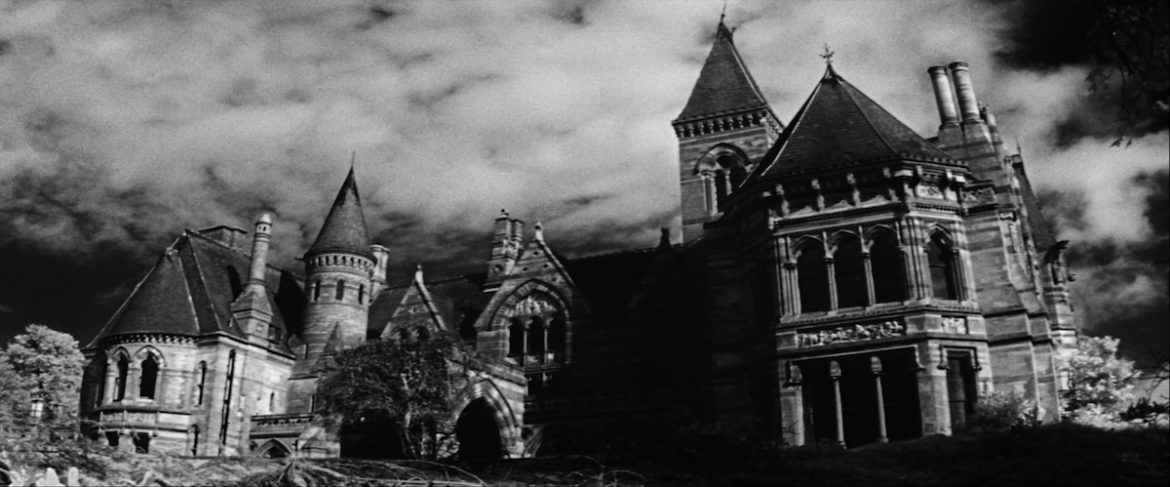
Our first view of Hill House is seen through Eleanor’s eyes and we hear her inner voice acknowledge the feeling of having the house “watch her” as she drives up. The exterior shots of the neo-Gothic mansion are truly awe-inspiring and intimidating. She is greeted at the door by the other caretaker (Rosalie Crutchley), who takes socially awkward to a new level with her zombie-like warnings of the night and the dark. Soon the others arrive, and the initial conversations allow us to understand the differing personalities and get our first look at the interior of Hill House.

The initial set-up is for a scientific, first hand analysis of supernatural occurrences inside the house … all led, of course, by Dr. Markham. Sexual tension plays a role here as Eleanor is attracted to Dr. Markham, who conveniently has not mentioned that he’s married. Simultaneously, Theodora teases and flirts with Eleanor, while only admitting to not being married, yet still cohabiting as an “us”. What is abundantly clear from the beginning is that Hill House itself is a featured character. Director Wise and cinematographer Davis Boulton utilize creative camera angles and specialized lighting, and capture the essence of the home through terrific set design. In a rare case for horror movies, very few special effects are present outside of sounds; although the spiral staircase in the library and the heaving wooden doors are quite memorable.

Director Robert Wise was a 4 time Oscar winner (THE SOUND OF MUSIC, 1965, WEST SIDE STORY, 1961) and was also Orson Welles’ film editor on CITIZEN KANE (1941). Wise directed such diverse films as STAR TREK: THE MOTION PICTURE (1979); the sci-fi classic THE DAY THE EARTH STOOD STILL (1951); SOMEBODY UP THERE LIKES ME (1956), which turned Paul Newman into a star; RUN SILENT RUN DEEP (1959) a submarine movie starring Clark Gable and Burt Lancaster; THE SAND PEBBLES (1966), which was Steve McQueen’s only Oscar nomination; and another horror gem AUDREY ROSE (1977). Well-liked by actors and respected in the industry, Mr. Wise died in 2005 at age 91.

Screenwriter Nelson Gidding and director Wise both previously received their first Oscar nominations for I WANT TO LIVE (1958), and were frequent collaborators, including: ODDS AGAINST TOMORROW (1959), THE ANDROMEDA STRAIN (1971, adapted from Michael Crichton’s novel), and THE HINDENBURG (1975). Gidding adapted Shirley Jackson’s tremendous novel, “The Haunting of Hill House”, with some variations that turned it into more of a psychological cinematic experience. Mr. Gidding passed away in 2004 at age 84.
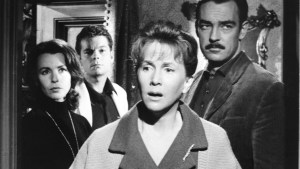
 Julie Harris received her Oscar nomination for EAST OF EDEN (1955), where many fell in love with her as Abra, the girl torn between two brothers, one of which was played by Oscar nominee James Dean in his star-making turn. Ms. Harris’ career spanned seven decades (1948-2009), and, as a 5-time Tony winner, she remains one of the most honored and respected stage performers of all-time. Much of her later career was on stage and television, including a long run on “Knot’s Landing”. She passed away in 2013 at age 87.

Claire Bloom, who plays Theodora, is still alive today and turns 90 the day after Valentine’s Day 2021. He acting career has spanned eight decades (1948-2019), and one more gig will get her to a remarkable nine! Never one to shy away from controversy, Ms. Bloom shines here as the lesbian with ESP, and she is also a renowned stage actress recognized for her Shakespearian work. She had marriages to Oscar winning actor Rod Steiger and Pulitzer Prize winning author Phillip Roth, and many will recall her role as Queen Mary in THE KING’S SPEECH (2010).

The two male leads in the film were played by Richard Johnson and Russ Tamblyn. Mr. Johnson is known as the actor who turned down the role of James Bond in 1962, setting the stage for Sean Connery’s historic run. Johnson was briefly married to Kim Novak (VERTIGO, 1958), and his career lasted seven decades (1950-2015), and he remained working until his death in 2015 at age 87.  Mr. Tamblyn was coming off his role as Jets’ leader Riff in Robert Wise’s WEST SIDE STORY (1961), and he had earlier appeared in SEVEN BRIDES FOR SEVEN BROTHERS (1954). He was Oscar nominated for his role in PEYTON PLACE (1957), and during his 8 decade career (1948-2018), he appeared in 6 movies that were Oscar nominated for Best Picture. He is 86 years old and recently appeared in the 2018 limited series “The Haunting of Hill House”. He is the father of actor Amber Tamblyn.

For fans of James Bond movies, you’ll be pleased to see Lois Maxwell appear in this film as Dr. Markway’s wife. Of course, Ms. Maxwell is known to fans as Miss Moneypenny in 14 James Bond movies, second only to Desmond Llewelyn’s 17 appearances as Q. She passed away in 2007 at age 80.

 In the movie, Hill House is described as a 90 year old New England house with a history of psychic phenomena. However, the exterior shots are actually of a neo-Gothic mansion (hotel) in Ettington Park near Stratford-Upon-Avon. It’s an active hotel with a history tracks back to the 11th century. The interior shots were conducted on a UK studio set. In 1999 director Jan De Bont (SPEED, 1994) delivered a second adaptation (not a remake) of Jackson’s novel, starring Liam Neeson and Catherine Zeta Jones. A different house was used for Hill House.

Wise’s film is now nearly 60 years old, and it holds up today thanks to the house, the performances, the direction, and the decision to create a psychological thriller and character study. The power of suggestion is key, yet it never loses the core of being a haunted house story … a house that seems to want Eleanor (note the parallels to the origin story of Abigail told in one of the early scenes). There have been debates about whether that initial set-up takes too long, or if more attention should have been paid to why the house is drawn to Eleanor (and vice versa), but overall, it holds up very well as classic horror. On a separate note, no one could accuse the film of being cursed, as most everyone associated, enjoyed a long a fruitful career and life … even the house!

WATCH THE TRAILER


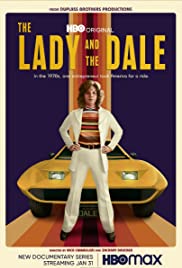
THE LADY AND THE DALE (2021, docuseries)

January 30, 2021

 Greetings again from the darkness. Unlike our first glimpse of the shark in JAWS, we don’t have to wait long. A 1974 episode of “The Price is Right” gives us an upfront look at a 3-wheeled car known as The Dale. If you expect the fuel-efficient auto oddity to be the featured attraction of this four-part docuseries from directors Nick Cammilleri and Zackary Drucker, then you are in for quite a ride. While the history of the Dale is chronicled, this is actually the fascinating story of Elizabeth Carmichael, and how she achieved fame and notoriety – the highest highs and the lowest lows of the American Dream.

What makes her story fascinating? For starters, ‘she’ was born Jerry Dean Michael, a con man who claimed to grow up a poor farm boy in Jasonville, Indiana. Per classmates interviewed here, Jerry was neither poor, nor a farmer, but rather a middle class kid whose family ultimately relocated to Detroit, where he later joined the Army. The lies, cons, and fraud come lickety-split … so fast we can barely keep up as we blitz through his scams and his failed marriages, with at least two with kids he never saw. Not once. Lest you think this is over-hype, we also gets bits and pieces from the actual FBI file opened on Jerry Michael.

Always on the move … usually running from the law … Jerry spent time as a vacuum salesman, and then ran a small newspaper, which led to printing counterfeit money. He was often a fugitive and ran through as many names as he did jobs and homes. By 1966, Jerry Michael began presenting himself as Elizabeth Carmichael, and instructing his kids to refer to him as “mother”. Shockingly, his wife, Victoria, went along with this, and became “Aunt Victoria.” It’s an understatement to label this family and life as unconventional.

Candi Michael, one of Jerry’s daughters, is interviewed throughout the four episodes, and provides clear recaps of the many stages of her life. And what a crazy life it was. She explains, matter-of-factly, that her father became her mother, and the kids were trained to immediately stop what they were doing and hop in the car, so the family could instantly escape the latest brush with the law. The family zig-zagged across the country, never in one place very long, but often either in California or the Deep South.

The first episode, “Soldier of Fortune” is loaded with background information, and takes us through Elizabeth’s “self-transition”, as she gave herself hormone shots obtained from veterinarians. We also hear from Susan Stryker, a trans historian, who provides perspective and commentary through all episodes. The episode concludes detailing how, in the midst of a national gas crisis, Elizabeth became enamored with Dale Clifft’s new, fuel-efficient, 3-wheeled vehicle. She opened a business in Los Angeles called 20th Century Motor Car Company, and had visions of dollar signs dancing in her head.

Episode 2, “Caveat Emptor: Buyer Beware” opens with Rudyard Kipling’s poem, “If”, and those words go a long way towards describing how Elizabeth Carmichael was approaching life and viewing herself. Of course, her thinking was twisted enough to allow her to become a marketing phenomenon in the automotive industry and she positioned her car company (with no cars to sell, mind you) as competing head to head with the Big 3 American car makers: GM, Chrysler, and Ford. What’s amazing is that Elizabeth was so good at making folks believe, that deposits came flooding in for the ‘option’ to buy a car once they rolled off the production line.

It’s at this point that we begin hearing from some of the engineers and staff that worked for her, and it’s quite obvious that this was a giant shell game. Sure, some of the employees trusted her and were striving to build the car, but being paid on Fridays with stacks of cash should have been a warning sign. This is also the time when local media began to show interest. The key local reporter was Dick Carlson (father of Tucker Carlson) and he’s interviewed for the film, explaining how they sensed the ruse, and kept digging. Things took a turn for Elizabeth on December 31, 1974 when Japanese investors arrived to watch a disastrous test drive of the Dale. After getting close to what Candi called a “normal” life, the family high-tailed it to Texas to escape California regulations (and the law).

“The Guilty Fleeth” for Episode 3 opens with Elizabeth stating, “If I can stay out of jail, I can run for President.” Normally this type of person would be impossible to understand, but we’ve had four years of exposure to something similar, so comprehension comes much easier. We see clips from news reports and hear audio recordings of Elizabeth talking. In California, folks lined up for refunds after the media reports created doubt, and the FBI tracked her down. Not long after, she faced conspiracy charges and was exposed as a man (she had not had the second surgery). This meant serving time in a men’s prison, where she was beaten. The 9 month trial was all over TV and it’s not surprising to learn that Elizabeth acted as her own attorney … before jumping bail and fleeing yet again.

Episode 4, “Celestial Bridge”, covers Elizabeth’s final years in Austin, Texas, running a flower business … right up until an 1989 episode of “Unsolved Mysteries” ended up exposing her again, and having her extradited to California to serve an 18 month jail sentence. This final episode also devotes a good deal of time to the history of transsexuals, including Rene Richards, and comes full circle as we see a bright yellow Dale car on display at the Peterson Automotive Museum. Produced by Mark and Jay Duplass, this docuseries uses stop-action animation, archival footage and photos, and interviews from those who were there to detail the bizarre life of a fascinating person. It also ties in the aspect of a close-knit family in spite of all the obstacles faced for so many years. You may have seen a 3-wheeled car, but you’ve never known a life lived like Jerry/Elizabeth.

The Four-Part Docuseries premieres January 31 on HBO and HBO MAX

WATCH THE TRAILER


THE LITTLE THINGS (2021)

January 30, 2021

 Greetings again from the darkness. When a script has bounced around Hollywood for 30 years without getting produced, there is usually a good reason why. Written by John Lee Hancock in the early 1990s, a handful of directors have been attached at various times, but it’s the writer himself who has managed to get it on screen all these years later. Mr. Hancock has found his niche as a director by targeting the precise middle of mainstream with such films as SAVING MR BANKS (2013) and THE BLIND SIDE (2009), an approach more challenging when the topic is chasing a brutal serial killer.

Of course, casting three Oscar winning actors is always a wise choice. Two-time Oscar winner Denzel Washington (TRAINING DAY, 2001, GLORY, 1989) stars as Joe Deacon, a defrocked L.A. homicide detective banished to the California desert as a Deputy Sheriff in Kern County. “Deke” suffered a heart attack, went through a divorce, and lost his job as a result of being haunted by an especially grisly unsolved case. When Deacon is tasked to pick up evidence in Los Angeles, he stumbles into a case being worked by his hotshot replacement, Jim Baxter. Oscar winner Rami Malek (BOHEMIAN RHAPSODY, 2018) brings his unorthodox mannerisms to the role and soon (and unsurprisingly) the ‘old school’ and ‘next gen’ detectives are teaming up to work a serial killer case with (unsurprising) similarities to Deke’s old case.

Denzel is especially effective in the first half of the film. His Deke is a quiet man with extraordinary observational and listening skills, and he brings none of his patented histrionics to the role. Deke’s ‘little things’ process quickly identifies a suspect, and it’s a doozy. Oscar winner Jared Leto (DALLAS BUYERS CLUB, 2013) is Albert Sparma, a greasy-haired appliance repair man (who let’s this guy in their house?) with a penchant for following news of the city’s crimes. Soon enough he’s taunting Deke and Baxter, and enjoying every minute of their frustration at the lack of evidence. It’s the cat and mouse game we’ve seen many times.

I’m a fan of retro movies, and Hancock announces upfront that this one is set in 1990. There are two reasons for this: that’s the era when he wrote the script, and it corresponds to a time when the Night Stalker was fresh on the minds of L.A. citizens. (side note: Netflix is currently showing the superb docuseries, “Night Stalker: The Hunt for a Serial Killer”). The idea of mismatched partners with polar opposite personalities is another aspect that we are quite familiar with, and Hancock even uses flashbacks to show us exactly what haunts Deke.

Supporting work comes from Chris Bauer, Terry Kinney, Glenn Morshower, Natalie Morales, and Michael Hyatt, with the latter two providing a non-victim female presence – although neither is given much to do. The most interesting aspect of the story is how Baxter is falling into the same emotional void as his new mentor, but unfortunately, not much time is devoted to this. In fact, the story has very little to keep us interested, and instead that burden falls to Washington, Malek, and Leto. Hancock has delivered a dark, brooding crime thriller that fails to deliver the thrills. It certainly pales in the obvious comparisons to David Fincher’s Fincher’s SE7EN (1995) and ZODIAC (2007), but is fine for killing time while stuck at home during a pandemic.

Now available on HBO Max

WATCH THE TRAILER


SUPERNOVA (2021)

January 28, 2021

 Greetings again from the darkness. Relationships end. Sometimes that brings relief, other times pain. For long time couple Sam and Tusker, the end is speeding towards them and they are each taking approaches on how best to handle. Writer-director Harry Macqueen delivers a tender story that is elevated by two extraordinary lead performances.

Colin Firth (Oscar winner, THE KING’S SPEECH, 2010) stars as Sam, a concert pianist, and Stanley Tucci (Oscar nominated, THE LOVELY BONES, 2009) co-stars as Tusker, a published novelist. These are arguably career best performances from both, and they complement each other so well on screen that we simply forget we are watching actors and accept the plight of this couple – of these two men. Driving along in their RV from a bygone era, they have the familiar exchanges that come from spending a lifetime together. We enjoy their banter, but it’s Sam’s opening line that sets the tone when he says, “We’re not going back, you know”. He’s referring to a suitcase that Tusker didn’t allow him to help pack, though soon enough we realize that line is even more to the point when it comes to their life journey.

As the bucolic northern England countryside passes by, it becomes evident that Tusker has early onset dementia. Though more present than not, he sometimes forgets a word, while in his worst moments doesn’t know where he is or how he arrived. The purpose of the trip is two-fold: Sam is giving a ‘comeback’ concert after many years away from the circuit, and this is Tusker’s farewell visit to family and friends. Of course, we (and Tusker) also recognize that this is likely the final fond memory this couple will make. While Sam is insistent that he can help Tusker remain productive, Tusker is well aware that he will quickly become a burden to the man he loves – and that’s not something he wants to see happen.

Dementia is a slow fade, often over many years. Recognizing that it’s happening to you is as painful as watching a loved one decline. People deal with this in their own way, and Macqueen’s film handles it gently, while the actors exhibit much grace in their portrayals. The line, “It’s not about fair. It’s about love” really struck a nerve, and made it clear that these are two characters we like and believe in – inside a story that’s heart-wrenching. Star-gazing plays a role here, and there’s only a mild poke at Margaret Thatcher’s policy towards gays. This isn’t a movie of politics, but rather one of emotions and humanity. Not much happens here … only everything. Best to reach for the stars, as “we’re not going back.”

*side note: I did have to look up “frog-marching” since it’s used in conversation, and I had not previously heard the phrase.

The film hits theaters on January 29, 2021 and Digital on February 16, 2021

WATCH THE TRAILER


THE MAN WHO SOLD HIS SKIN (2021, Tunisia)

January 28, 2021

 Greetings again from the darkness. Lao Tzu wrote, “Being loved deeply by someone gives you strength, while loving someone gives you courage.” But to what extreme would you go for true love, and how far is too far? Writer-director Kaouther Ben Hania offers an early scene on a commuter train as Sam Ali and Abeer flirt and tease to the point that he publically, and loudly, proclaims his love for her. Unfortunately for him, his outburst occurs in Syria, where human rights are always in peril. In fact, this love story is burdened with the weight of human rights, individual choices, and the power of art.

Ms. Ben Hania bookends her film with a choreographed art installation coated in a blizzard of white walls and white gloves. It’s 2011, when a distant relative in law enforcement assists Sam Ali (Yahya Mahayni) with his (quite creative) escape from Syria to Lebanon – after a painful slap of reality accompanies Sam’s goodbye to his beloved Abeer (Dea Liane in her first screen credit). As Sam flees for his life, Abeer is pressured by her family into an arranged marriage.

We then flash forward one year to find Sam working in a Beirut chicken factory. He scrounges for food at the buffet of local art galleries until one day he is spotted by Soraya (a blond Monica Bellucci), the agent for acclaimed artist Jeffrey Godefroy (Koen De Bouw). When Sam and Godefroy meet, the artist tells him that art is “alive” and, more precisely, “I want your back”. A Faustian deal is cut. Godefroy turns Sam Ali into a living piece of art by tattooing his back, and Sam gets the travel visa he desperately needs to reunite with Abeer.

With Sam basically a commodity (there are even T-shirts of his back in the gift shop), there are protests to his being exploited – this despite Sam enjoying the nice hotels, room service, and promise of the visa. Of course, as with any commodity, it’s only a matter of time before the almighty dollar comes into play, and soon Sam is auctioned off to a collector. Subtle humor has a role throughout much of the film, and Mr. Mahayni is quite believable as a Syrian refugee sacrificing for love. Ms. Ben Hania’s film is inspired by “Tim”, an original artwork tattoo by Wim Delvoye sold to a collector in 2008. Mr. Delvoye, a controversial Belgian artist, even makes a brief appearance here as an insurance agent. This is a thought-provoking love story, survival tale, and commentary on the bent side of the art world. When is a man truly free? We don’t typically think of Tunisia as a hotbed for cinema, but this film deserves attention.

This is Tunisia’s entry for the Foreign Language Oscar

WATCH THE TRAILER


BABY DONE (2021)

January 21, 2021

 Greetings again from the darkness. “I don’t want to not have a baby.” This is just one of the zingers Zoe rattles off during this charming, and often quite funny film from director Curtis Vowell and writer Sophie Henderson. Fellow New Zealander Taika Waititi is an Executive Producer, and his influences are apparent (and always welcome). In a light-hearted way, while still maintaining plenty of heart, the film explores the fear of losing or compromising one’s true self when parenthood strikes.

Rose Matafeo delivers a terrific performance as Zoe, a tree-climbing arborist by profession, and a thrill-seeking adventurer by choice. Her partner in life, and in the tree-trimming business and in the thrill seeking, is Tim (Matthew Lewis). They are the type of couple who go to a friend’s baby shower and peek into the gender reveal box before dominating the party games. Zoe is fed up with losing friends, and describes the life cycle as “Married, house, baby, done”, implying that people aren’t the same after having completing these steps and no longer want to hang out with free-wheelers and the unencumbered like her and Tim.

Denial. That’s the best description of how Zoe reacts to finding out she’s pregnant. Besides not telling Tim (a major relationship gaffe), she continues on with tree-trimming and pursues the “Tree Climbing Championship” she has qualified for (I still wonder if that’s really a thing). When Tim and her friend Molly (Emily Barclay) find out about the secret, feelings are hurt and emotions wreak havoc. Comedy is provided through the prenatal/antenatal class instructor, as well as through Zoe’s new acquaintance Brian (Nic Sampson) whom she connects with online. See, Nic … well, he, uh … has a thing for pregnant women. Not babies, mind you. But pregnant women – which by definition seems to limit the prospects of a long-term relationship.

The always-great Rachel House makes a brief appearance as the headmaster at a local school, and much of what we see is a mess created by pregnant Zoe as she attempts to stay focused on her “bucket list”. The film excels at presenting two versions of anxiety with Zoe and Tim, and it’s loaded with relatively small moments that are quite relatable – some funny, some more serious. Like it or not, parenthood creates life changes, and the topic benefits from New Zealand wit, and a cast that perfectly complements the sharp and insightful script.

In select theaters and VOD on January 22, 2021

WATCH THE TRAILER