 Greetings again from the darkness. Kermit the Frog. Bert and Ernie. Big Bird. Cookie Monster. Abby Cadabby. Grover. Oscar the Grouch. Guy Smiley. Mr. Snuffleupagus. Prairie Dawn. The Two-Headed Monster. Elmo. Count Von Count (The Count is my personal favorite). What a lineup of characters … each with their own personality and look, and every one designed to appeal to kids and help educate. It’s been more than 50 years since “Sesame Street” first hit the TV airwaves, and filmmaker Marilyn Agrelo (MAD HOT BALLROOM, 2005) uses Michael Davis’ book, “Street Gang: The Complete History of Sesame Street” as a guide to this personal peek behind the curtain, and a look at the folks who made the show such a success.
The four main drivers responsible for the show were Joan Ganz Cooney, Lloyd Morrisett, Jon Stone, and Jim Henson. Ms. Cooney and Mr. Morrisett co-founded the Children’s Television Workshop, which led to the research and funding necessary to kick off “Sesame Street”, the show. Ms. Cooney brought on Mr. Stone to develop and produce the programming, and of course, Mr. Henson, the creator of the Muppets and “Fraggle Rock” was the master puppeteer who was with the project from its inception in 1969.
The background information is quite interesting. Morrisett recalls hearing his 3 year old daughter singing beer jingles she had memorized from watching TV. He instinctively knew TV was making an impact and could be better utilized. Cooney talks about her initial business plan and how, at the time, a woman wasn’t going to be accepted as the face of an innovative program – risky for investors and networks. We also see many clips of Stone and Henson at work on set, and numerous people offer perspective on the creativity and effort that went into those early years. In fact, the film opens with a look at the 1981 New York City set as an episode is being filmed. Some of the cast members interviewed include Roscoe Ormon (Gordon), Sonia Manzano (Maria), and Bob McGrath (Bob).
With an early emphasis on providing educational programming for minority and inner city kids, we hear of Mississippi’s refusal to air the program due to minority cast members. The focus on 3 to 5 year olds was revolutionary at the time, and the societal benefits of injecting fun into learning was immense, though brilliantly, the creators made it interesting for adults as well. Filmmaker Agrelo has much to cover here, and does a nice job segmenting so that each piece of the Sesame Street puzzle is clear. The focus is on the early years (pre-Elmo). The dynamics of Frank Oz and Jim Henson as master puppeteers is a joy to behold, while Joe Raposo and Christopher Cerf offer perspective on the frantic pace to generate the music necessary for each episode … including the “lawsuit” involved with “Letter B”.
As with any educational efforts, but especially those with an entertainment push, addressing the difficult and uncomfortable issues is critical. We hear about the iconic segment where the characters deal with Mr. Hooper’s death in the 1980’s. Even today, it’s held up as the standard for helping kids deal with death. Jim Henson’s unexpected death at age 53 in 1990 is also discussed, and clips from that funeral will likely bring a tear to your eye. Big Bird singing Kermit’s signature song, “Bein’ Green” got to me. There is a bit on Carroll Spinney (Big Bird and Oscar), who passed away just over a year ago, and all of the key characters get their moment.
This is an HBO Documentary and Chicken Soup for the Soul production, and it’s an enlightening ‘behind-the-scenes’ look at the visionaries responsible for this groundbreaking, Emmy and Peabody award-winning show that probably saved public television. So my advice is to “Put down the Ducky” and give this documentary a watch. It’s sure to take you to where “the air is sweet.”
The film will be released in theaters on April 23, 2021 and On Demand on May 7, 2021


 Posted by David Ferguson
 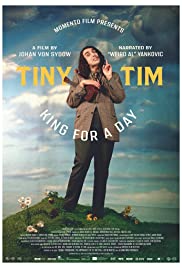 Greetings again from the darkness. I’m not sure how many people under age 50 even know who Tiny Tim was. Perhaps they recall a mention of his most popular song “Tiptoe Through the Tulips” in one of the Harry Potter books, or remember hearing the song in the 2010 horror film
  Greetings again from the darkness. They’ve been together for 10 years, and when Doug proposes – seemingly spontaneously – to Lori, her reaction is ‘slightly’ askew from what he expected. The real question here is, how do two people have a 10 year romantic relationship and never once discuss marriage, kids, a house, or literally anything to do with their future? That’s the premise for the dramedy from writer director Jeff Rosenberg and co-writer Laura Jacqmin.
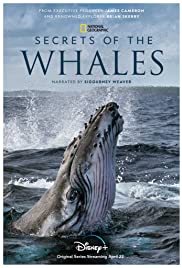 Greetings again from the darkness. For many of us, our exposure to whales is limited to learning in school they are the largest mammals on Earth, and browsing travel guides displaying fantastic photographs of breeching whales alongside various tour excursions. National Geographic is on a mission to take us deeper into the world of these marvelous marine creatures. This 4-part docuseries is Executive Produced by Oscar-winning director James Cameron and award-winning photographer Brian Skerry, and was filmed over 3 years in multiple locations around the globe.
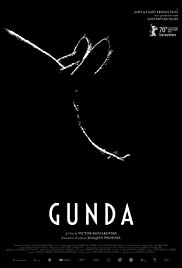 Greetings again from the darkness. We open on a pig in prone position with her head sticking through an opening in the barn. It takes a minute to realize the sow isn’t sleeping, but rather giving birth. Slowly the newborn piglets begin tumbling out into the world. Cutting to a reverse camera angle, we see the 12-13 babies desperately trying to latch onto mom for their first meal. The runt of the litter struggles more than the others. Award-winning filmmaker Viktor Kosakovskiy runs this first segment just over 19 minutes. There is no dialogue. No human on screen. The soundtrack is all natural from nature: the snorts from mama sow, the squeals from piglets, and unseen birds chirping.
 Greetings again from the darkness. I will admit upfront that I’m no fan of watching late thirty-somethings living their lives like a never-ending fraternity party. So when the film opens on a disco ball, and we see a woman breaking up with her boyfriend on the phone while the thumping dance blasts, and then she immediately hooks up with the equally-aged DJ … well, I was concerned that writer-director Argyris Papadimitropoulos and co-writer Rob Hayes decided to make this film as a kick to the shins of any job-holding, respectable grown-up movie watcher. Fortunately, it’s not as bad as all that.
 Greetings again from the darkness. If we have to depend on Dublin filmmaking for the year’s first stellar comedy, then so be it. This is the first feature film from writer-director Rachel Carey, but it certainly won’t be the last. Somehow she’s created a black and blue comedy that plays like a mash-up of
  Greetings again from the darkness. Chinese gaokao is the College Entrance Exams that determine the future of high school students and their families. The pressure is extreme for the kids, and when the film opens, the exams are only 60 days away. One of the students leaps to her death from an upper breezeway to the concrete courtyard below. Her fellow classmates converge on the scene with cell phones recording the tragedy. One girl, Chen Nian, quietly covers up the body. While most assume the pressure of the impending test was too severe for the girl, Nian knows better. The relentless bullies that motivated the suicide have now turned their attention to Nian.
 Greetings again from the darkness. Over the past five decades, blended families have become commonplace, while at the same time single women and same-sex couples have utilized sperm-donors to enrich and expand their families. Michael Rothman’s documentary kind of combines these two as he explores the 37 half-siblings resulting from anonymous sperm-donor number 5114 at the California Cryobank.
 Greetings again from the darkness. Co-directors Travis Cluff and Chris Lofing previously collaborated on the horror film,
  Movie Reviews from the Dark