NOT GOING QUIETLY (2021, doc)

August 12, 2021

Greetings again from the darkness. Nicholas Bruckman provides an intimate profile of a fascinating man, Ady Barkan, a brilliant and relentless advocate for health care rights. Barkan’s ALS diagnosis and commitment to cause is interesting enough to carry the film, but by following Barkan, the film serves a dual purpose of educating us on activism and political maneuverings.

Bruckman bookends his film with Ady’s testimony to a congressional committee on healthcare. He’s in a wheelchair and speaking through an eye-controlled speech machine, similar to the one we saw Stephen Hawking use for many years. We then flashback 3 years to meet Ady’s wife – his college sweetheart Rachael – at their home in Santa Barbara, California. As an attorney and activist, we get to know Ady as a man who cares deeply and is committed to fighting injustice. He’s especially keyed in on healthcare and social issues.

At only 32 years of age, Ady is diagnosed with ALS. Amyotrophic Lateral Sclerosis is commonly referred to as “Lou Gehrig’s Disease”. He explains that there is “no cure, and very little treatment”, and that the doctors tell him he has three to four years to live. Ady explains that “dying is bad”, but dealing with the insurance company is even worse. The ventilator prescribed by is doctor is deemed “experimental” by the insurance company, meaning it’s not covered. So what would any good activist do? Well Ady, turns his own experience into a crusade. He founds the #BeAHero campaign with Liz Jaff, a social media strategist. She films Ady’s interactions and confrontations with politicians, and they put together a 40 day, 30 congressional district road trip in a specially equipped RV. Their team also includes Tracey, who leads the role-playing on birddogging politicians, and Ady’s friend Nate, who assists him with the physical challenges. Their goal is to flip the House in the 2018 election.

Ady Barkan is a funny, intelligent, informed, opinionated, and impassioned man. He knows how to speak to an audience, as well as to politicians who don’t share his commitment to healthcare rights, including coverage for pre-existing conditions. On the trip, Ady’s health and condition deteriorate before our eyes. It’s frightening to watch, knowing how quickly his body begins to fail. But his spirit and his team are relentless, and when circumstances force the dialogue and cause to shift, there is no hesitation.

Bruckman avoids turning Ady into a one-dimension savior. We get to see him with his precocious young son Carl, who was born one year after Ady’s diagnosis. Rachael probably doesn’t get the screen time she deserves as working mother and caregiver, but it’s clear this family has chosen to live every minute they have, and even plunge into the future with optimism. Ady notes how losing his voice is worse for him than paralysis, but his eyes light up when he’s with his family. We aren’t sure which aspect of Ady is most inspirational, but it’s obvious that he’s a special man. This was an Audience Award winner at SXSW, and deservedly so.

In theaters August 13, 2021

WATCH THE TRAILER


THE MEANING OF HITLER (2021, doc)

August 12, 2021

Greetings again from the darkness. The Holocaust and Nazi Germany. No subjects are likely even close in regards to the number of documentaries on topic. Yet somehow, there always seems to be more to mine. Co-directors Peppa Epperline and Michael Tucker have based their project on the 1978 book by Sebastian Haffner. The objective is to pull back the curtain on the self-conceit at the center of the cult of Hitler. How did this happen? How has it been repeated? How do we expose this without adding to the fascination of Hitler? It’s quite a conundrum, and one not easily navigated.

One of the first points made near the film’s beginning is that most agree understanding Hitler is not possible. So by that definition, a cinematic pursuit for meaning is a futile undertaking. But that doesn’t stop the filmmakers from trying. On their quest, they interview many experts and travel to various places of interest – museums, historical sites, camps, and even Treblinka.

Hollywood’s fascination with Hitler is discussed, including Mel Brooks’ THE PRODUCERS (2005) and the “Springtime for Hitler” sequence, Quentin Tarantino’s INGLOURIOUS BASTERDS (2009), and the superb DOWNFALL (2004). An excellent point is made in regards to the film comparisons of how Hitler’s suicide is typically portrayed behind closed doors, while Holocaust victims are not afforded such dignity. There is even a segment on Leni Riefenstahl’s documentary on the Nazi way, TRIUMPH OF THE WILL (1935). Novelist Francine Prose labels the work, “kitsch”.

Infamous Holocaust denier David Irving is featured, and we hear him describe Auschwitz as “not important”. The technological advances in microphones are explained in regards to how the “Hitler bottle” allowed him to be more demonstrative during speeches, often resulting in working the audience into a frenzy. Interviews are included throughout the film, and feature historians (Saul Friedlander), authors, deniers, psychologists, and even Nazi hunters.

“Fascinating Fascism” is examined as pageantry and spectacle and other enticing aspects. The theatrical presentation that led to this fetish might today be termed marketing. It’s a bit of a relief to see the filmmakers avoided focusing too much on the parallels to a particular modern day phenomenon, despite the timing being right to study similarities. They do, however, make the comparison to Beatlemania, and how history has a tendency to repeat itself in various forms.

The film bounces around some, with certain segments more insightful than others, and there are some astounding points made. One of those interviewed states, “The Nazi ideals were acted out by people who were absolutely normal.” It’s a frightening thought. Another discusses the human conflict: humans are animals that kill, as well as being herd animals. The Nazi mission played into both. What the film left me with was the belief that the Nazi propaganda has been repurposed as history, leading to the fascination, whereas the focus of that era should be something else.

WATCH THE TRAILER


CRIME STORY (2021)

August 12, 2021

Greetings again from the darkness. Thanks to (or maybe because of) Stallone, Schwarzenegger, Bruce Willis, and Liam Neeson, we are rarely without a senior citizen action film. However, it’s a bit surprising for most of us to see Oscar winner Richard Dreyfuss (THE GOODBYE GIRL, 1977) load up his gun and take to the streets for revenge. Writer-director Adam Lipsius scored a double Oscar coup by also casting Mira Sorvino (MIGHTY APHRODITE, 1995) as Dreyfuss’ detective-daughter.

“Based on actual events”, Mr. Lipsius bookends the film with the elderly Ben Myers (Dreyfuss) riding in the back of a limousine. He’s barely coherent, but in the opening we can make out, “If I wake up, I’ll choose different.” We then flashback 12 hours to re-live what is likely Ben Myers’ worst day ever. He’s been diagnosed with terminal cancer, and though he’s a former mobster, he says he went “legit” 12 years ago, and runs a local bar with his loyal-to-a-fault sidekick Tommy (the always interesting Pruitt Taylor Vince). Ben’s estranged daughter (Sorvino) hits him up for money she says is for the daughter and grandkids that Ben has never acknowledged. Next thing we know, Ben’s house has been robbed of all his cash (a quite substantial amount) and trashed by 3 men who take advantage of Ben’s beloved dementia-stricken wife Nan (Megan McFarland).

This kicks off Ben’s mission of revenge. Gun by Glock, body by Devito. His daughter is concerned he’s taking this on by himself, and there is the added complication of her working for a politician that Ben once helped out of what would have been a career-ending jam. In fact, there are so many sub-plots, sub-sub-plots and characters who come and go, that much of this makes little sense. It works best when focusing on an aging (former) mobster trying to even the score, and gets a bit shaky when it reverts to dysfunctional family stuff. I believe there are five crying scenes, which is entirely too many for any movie not named SOPHIE’S CHOICE.

For those of us who recall Dreyfuss from his early TV days, a brief appearance in THE GRADUATE (1967), and of course in AMERICAN GRAFFITI (1973) and JAWS (1975), there is some enjoyment to be had in watching ‘Mr. Holland’ take a violent approach to revenge … though he’s certainly no AARP reincarnation of John Wick. Overall, it’s a pretty generic take on geriatric anger, with bonus points for a spot on description of what it feels like when one’s spouse is ravaged by dementia.

Arrives August 13, 2021 in select theaters, On Demand, and on Digital

WATCH THE TRAILER


NINE DAYS (2021)

August 5, 2021

Greetings again from the darkness. The meaning of Life is an ambitious topic to tackle for any filmmaker, but certainly as a first feature film. Japanese-Brazilian writer-director Edson Oda not only doesn’t shy away from existential questions, he has found a creative way of exploring these, leaving us with plenty to discuss after viewing. His approach is often bleak and slow-moving, yet his film excels in pushing us to examine our own attitude and appreciation for the gift of life.

Winston Duke (US, 2019) stars as Will, a kind of guardian angel charged with selecting the replacement souls after deaths occur on his watch. Will has a wall of old-style tube TVs, each with its own VCR wired up. He spends his time watching folks go about their lives. He takes notes and maintains files. See, those he watches are the ones Will previously selected for life. He picks his team, but he no longer plays the game (although he was once alive). His job now is to tweak humanity in the right direction by selecting “good” souls who are tough enough to handle life – not overly sensitive types, and certainly not those too self-centered.

There is no denying Oda’s film is high-concept, and some may outright dismiss his premise. What if pre-life was a competition to determine worthiness?  Will sets up nine days of interviews for the next round of souls. Of course, some won’t last the full nine days, but the process involves a series of quizzes as the candidates watch the wall of TVs and offer up their answers to Will’s questions. Well, all but one, that is. Emma (Zazie Beetz, JOKER, 2019) is a free-spirited soul who sees Will for what he is and what he was. She answers his questions with her own questions, or simply states that she can’t answer. He is intrigued and frustrated by her willingness to play this out in her own way.

Tony Hale (“Veep”) and Bill Skarsgard (IT, 2017) are a couple of the other candidates, and each has their moments to shine. Benedict Wong (DOCTOR STRANGE, 2015) plays Kyo, Will’s co-worker and the one who assists him with the interview process. Kyo also strives to make sure Will maintains some humanity, despite a recent event that shook him to his core, and now has Will second-guessing himself. As Emma slowly gets Will to open up about his ‘alive’ time, we also see how Will recreates a special moment for the candidates as they are dismissed … providing them with a taste of life.

A ‘taste of life’ is fitting because the point Oda is trying to make is that the best parts of life are emotions and sensations – the intangibles that bring joy, fear, and sadness. It’s not all cupcakes and unicorns, and being so tough to block out the senses is not the best way of living. Without him realizing, Emma helps Will re-connect with his inner-being of when he was alive. His re-awakening is a highlight.

The candidates are informed that, if chosen, their memories will be wiped clean, yet “you’ll still be you”. This conforms to the theory that much of who we are is inherent at birth. Again, some may disagree. Oda’s film will inspire thought and debate. If each of us aced our pre-life interviews, let’s make the most of it!  This is a terrific film with a unique look and style, and a standout performance from Winston Duke. We can only hope enough folks take the time to watch and think about the message.

WATCH THE TRAILER


ANNETTE (2021)

August 5, 2021

Greetings again from the darkness. The anticipation of seeing a film directed by Leos Carax (HOLY MOTORS, 2012), and written and scored by Ron Mael and Russell Mael of Sparks fame, is derived from expecting the unexpected … experiencing something we’ve never before experienced cinematically. And although the film is likely to be quite divisive – beloved by some, dismissed by others, confusing for all – the ingenuity, creativity, and risk-taking are quite something to behold. As for the narrative coherence? Well that’s quite a different topic.
A mere six weeks ago I watched and reviewed Edgar Wright’s excellent documentary THE SPARKS BROTHERS, where Ron and Russell discussed their affinity and vision for movies, despite a few near misses over the years. This particular material was originally conceived as a rock opera album, and it’s probable that very few directors would even attempt the transition to the big screen. It would be equally challenging as an opera, a play, or a stage musical. In simple terms, this is a musical-drama-romance; however in reality, it’s confoundingly difficult to define or describe.

The opening sequence begins in a recording studio with director Carax at the sound board as the Sparks band performs “So May We Start?” Soon they are marching the streets of Santa Monica, joined in singing the song by the lead actors of the movie we are about to watch. The narrator tells us, “Breathing will not be tolerated”, which takes on a touch of irony during a pandemic.

Adam Driver stars as Henry, an offbeat stand-up comedian, and Oscar winner Marion Cotillard stars as Ann, a popular opera singer. Henry bills himself as ‘The Ape of God’ and performs an abrasive comedy act that is interactive with his audience. He psyches up for each performance by shadow-boxing in a robe while puffing on a cigarette. Ann is often shown alone on stage (Catherine Trottman sings the opera parts, while Ms. Cotillard sings the rest). The couple is engaged when we open, and they later marry, have a child (the titular Annette), and take different approaches to their career. Henry and Ann are polar opposites and that’s best exemplified by how they end their respective shows: he ‘moons’ his audience, while she gracefully bows in appreciation.

Henry is a man filled with love, yet clueless on how to love. He’s a tortured soul – the kind that doesn’t believe he deserves the life he has and finds a way to self-destruct. Henry and Ann are passionate lovers and their duet “We Love Each Other So Much” has the most unusual timing that you’ll see in a musical; in fact, the musical interludes (with repeating lyrics) often arise at the most inopportune (or at least unexpected) moments. Ms. Cotillard’s talents are never fully utilized, while much of the film’s weight is carried by Mr. Driver.

After tragedy strikes, the story becomes quite bizarre with Henry and “Baby Annette”. To say more would spoil that which should remain surprising. Simon Helberg’s role as conductor increases in the second half, and his character’s past with Ann lends itself to the complexity of relationships. This is a dark love story, and one that befuddles right up to the end. Director Carax and the Mael brothers could slide into the Avant-garde corner, but that might scare off even more potential viewers, so let’s use ‘fantastical’ instead. Sometimes it tries a bit too hard to shock or agitate, and the stories are a bit discordant, but it’s all for a good cause: provocation. The film, dedicated to Carax’s daughter Nastya (who appears in the opening sequence), sometimes feels like the wild nightmares that you (mostly) don’t want to end. And that’s about all that should be said to preserve the experience.

This Musical opens in theaters on August 6, 2021 and on Amazon Prime Video on August 20, 2021

WATCH THE TRAILER


JOHN AND THE HOLE (2021)

August 5, 2021

Oak Cliff Film Festival 2021

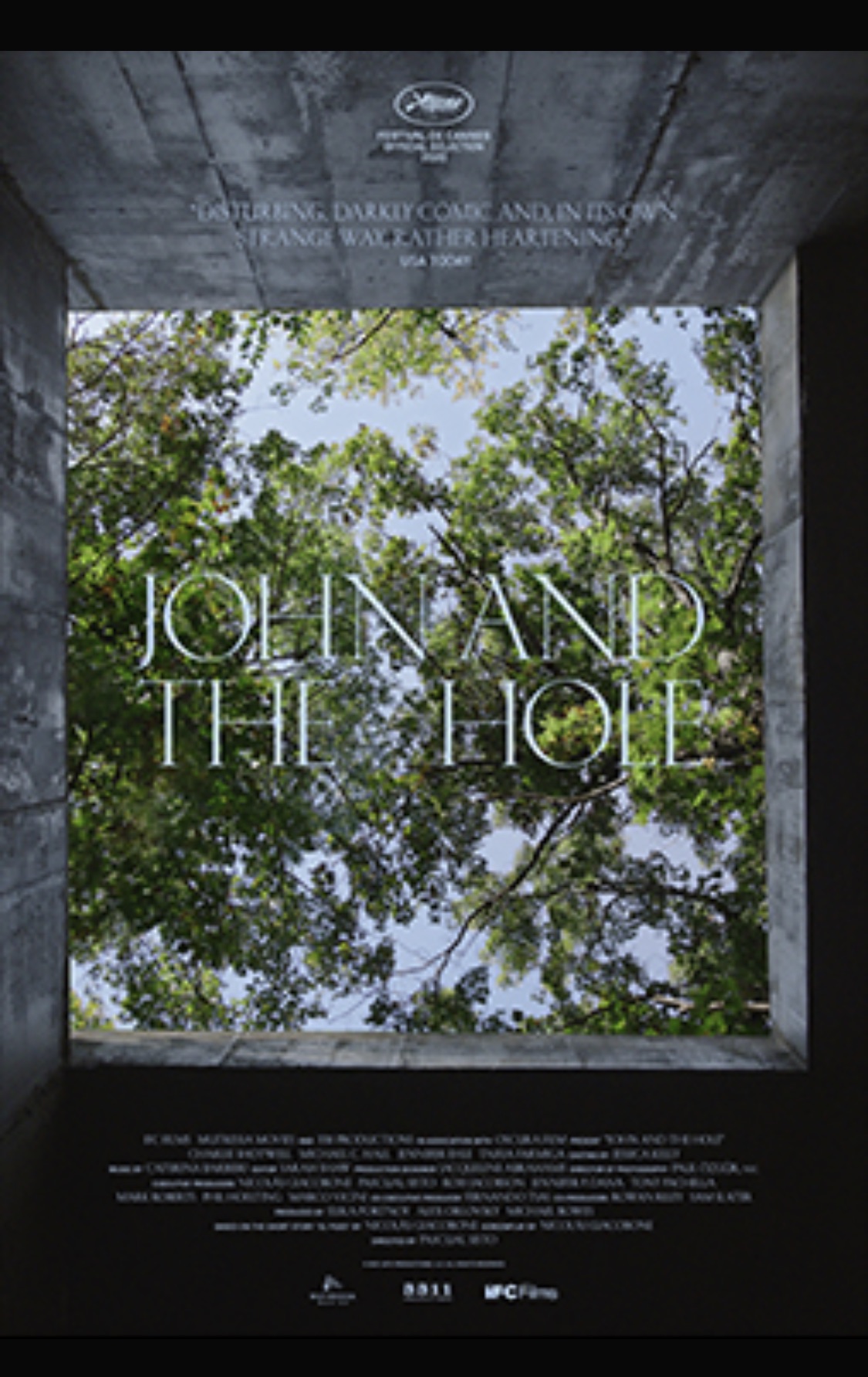
Greetings again from the darkness. Why would anyone be surprised that the actions of a teenager make no logical sense? Thirteen year old John (an excellent Charlie Shotwell, CAPTAIN FANTASTIC, 2014) comes across as a shy kid, and a curious one as well. He’s a talented tennis player, enjoys going head-to-head in video games with his online friend, and even plays piano. Despite his upper class family life, we sense there is something a bit off about John – although his busy parents are supportive and his banter with his older sister is pretty normal. But his emotionless demeanor sends our mind to dark, uncertain places … places we hope John doesn’t go, although we kind of expect him to.

This is the first feature film directed by Pascual Sisto, and the script comes from Oscar winner Nicolas Giacobone (BIRDMAN, 2014). You should know it’s not the typical narrative arc. One day John, with the help of his shiny new drone, locates a long-forgotten unfinished bunker in the nearby woods. The next thing we know, John has drugged his family and dumped them in that hole. That’s not a spoiler, as it’s shown in the trailer. When Mom (Jennifer Ehle, SAINT MAUD, 2020), Dad (Michael C Hall, “Dexter”), and sis (Taissa Farmiga, “American Horror Story”) awaken in the mucky pit, they are frightened and confused. When John appears to deliver food and blankets, he offers nothing in the way of an explanation.

As movie watchers, we have been conditioned to expect this type of situation will lead to significant violence. Instead, we watch as John steps into his newfound freedom. His image of adulting is what he’s observed from his parents: classical music, wine, cooking, milking the ATM, and driving the car. He has bypassed the coming-of-age stage, passed “go”, and moved directly into his version of adulthood. We know this can’t end well, but John is thirteen and isn’t mature enough, regardless of this manufactured freedom, to plan ahead.

This is a wealthy family living in a glass house … an unmistakable metaphor. A sense of entitlement and pursuit of money has distracted the parents from focusing on the importance of teenage years. Whether they realize this looking up at him from the bunker is debatable. John’s story is told by a mother to her daughter, an unusual sequence that acts as an awkward framing device. Cinematographer Paul Ozgur delivers terrific camera work with the house, the bunker in the woods, and John’s odd demeanor. This is an unsettling film that is more psychological drama than thriller or character study. It clearly borrows from two masters, Michael Haneke and Yorgos Lanthimos, but falls short of their best work (as you’d expect). Still, the film has a certain style, and reminds us that the moral to the story of a teenager’s actions often boils down to “don’t do that”.

Opens in select theaters and On Demand August 6, 2021

WATCH THE TRAILER


INFINITUM: SUBJECT UNKNOWN (2021)

August 5, 2021

Greetings again from the darkness. In 2015, director Sean Baker’s use of an iPhone to film TANGERINE was viewed as experimental or rogue. Since then, other filmmakers have utilized this method, though it’s only been during the pandemic when filmmakers, desperate to create, have used the iPhone out of necessity. Such is the case with Matthew Butler-Hart, who not only utilized the mobile device for the majority of scenes, but also directed a couple of cameos remotely via Zoom. Co-written with his wife Tori Butler-Hart, who also stars, the film takes full advantage of empty streets and the absence of other people during the lockdown.

Ms. Butler-Hart stars as Jane, whom we first see as she awakens alone in the attic of a house. She’s gagged and bound to a chair, with no recollection of how she got there. She also experiences visions in flashes – some type of memories – as she looks for an escape route. She notices that she’s under surveillance, but after her initial stage of fright, she becomes quite determined to free herself. And that’s where things get really interesting. In the mode of GROUNDHOG DAY (1993) or HAPPY DEATH DAY (2017), only without Sonny and Cher music or a homicide, Jane is constantly re-awakening to find herself back in the same attic, in the same chair, with the same constraints.

Sir Ian McKellan plays the founder of Wytness Research Centre and Conleth Hill (“Game of Thrones”) plays a scientist. These two talking heads (filmed via Zoom) serve up the Quantum science overview that provides the structure of Jane’s situation, and also offer a couple of short breaks for Jane, who appears in nearly every other scene. The Wytness Centre holds the key to her situation, and we are informed that the work there is “propelling human evolution to a staggering new dimension.”

Jane stays focused on solving the puzzle that will allow her to escape the house (mysterious staircase and all) and track down what is causing her to experience these events time and time again. There is a video game feel to this as Jane frantically tries to reach the next level of escape, only to be zapped back to the starting point with each failure. Although time is relative and a parallel universe is in play here, we can’t help but notice Jane seems to lack the food, water, and basic hygiene one would require. That point has little impact on the creativity of the story and situation. Rorschach tests appear in certain places, as does a mint condition VW van. What we don’t see are people, though Quantum science does hold infinite possibilities.

Ms. Butler-Hart delivers a strong performance and keeps us interested in her character as she carries the film. Mr. Butler-Hart delivers excellent “camera” work, and the ultra-low budget film shows what can be accomplished. The lockdown has caused isolation and uncertainty for many, and mind games can certainly affect one’s perspective. The Butler-Harts have plans to convert this little film to a graphic novel and TV series, and it appears the “time” is right for both.

Coming to Theaters and VOD on August 6, 2021

WATCH THE TRAILER


NAKED SINGULARITY (2021)

August 5, 2021

Greetings again from the darkness. After co-writing the screenplay (adapted from the Stephen King book) for the box office horror hit IT (2017), Chase Palmer gets his first opportunity to direct a feature film. He also co-wrote this screenplay with David Matthews, as the two have adapted the 2008 novel “A Naked Singularity” by Sergio De La Pava. Think of it as a meaning-of-life science fiction comedy drama heist film that critiques the justice system. You know what they say about trying to be all things to all people. But it does get bonus points for trying hard!

John Boyega (Finn in the STAR WARS movies) stars as Casi, a Public Defender who is exasperated with the NYC criminal court system. Casi is overworked and underpaid, and his heart of gold and frumpy suit matter little in his courtroom clashes with Judge Cymbeline (Linda Lavin, “Alice”), who thrives on antagonizing and baiting the young attorney. Casi’s early idealism has faded and now he’s just fed up, looking for a way out. The talented Olivia Cooke (SOUND OF METAL, 2020) co-stars as Lea, a bored clerk at a city impound lot. Lea is a previous client of Casi’s and they cross paths again when his lawyer friend Dane (Bill Skarsgard, Pennywise in IT) passes along a file for her latest case.

There are basically three stories going on here: First, Casi is (unsuccessfully) fighting the bias in the halls of justice. Second, there is a weird glitch in the matrix, referred to as a “ripple” by Casi’s stoner friend Angus (Tim Blake Nelson), who works out physics problems on the wall of his apartment. And third, there is a botched drug deal featuring creepy hoodlum Craig (Ed Skrein, DEADPOOL, 2016), who has dragged Lea right into his web of crime. Of course, Lea already had a criminal record, and she’s frustrated that the system penalizes her for the past … leaving her with lousy options for employment. She’s too is looking for a way out.

As the film begins, director Palmer includes a quote from Candide: “If this is the best possible world, what then are the others?” This goes directly to the dreamers – those who imagine escaping their situation, and those who imagine making it better. Act 3 becomes a heist film, but we miss out on the fun part, as the planning just seems to happen. When the big day arrives, some things go right, and some things go wrong. Mostly, it’s an unrealistic chain of events that involves every character listed above, plus The Golem (Kyle Mooney) as the leader of the drug-dealing Hasidic Jews, a couple of NYC Detectives, and a Mexican cartel boss, who raises eyebrows outbidding Craig for the Navigator where the drugs are stashed. It seems fairly likely that Lincoln contributed to the film’s production since “Navigator” is mentioned numerous times.

Director Palmer utilizes a countdown to the big event … assuming the “ripple” wouldn’t be considered a bigger event … and that provides the odd pacing for the film. Also odd is the inclusion of a Popeye Doyle reference, when it’s quite unlikely that these characters would be familiar with THE FRENCH CONNECTION. Additionally, it’s the unnatural dialogue and the wedged-in social commentary that come across as misplaced. Comparing being poor to slavery in a five second scene makes it appear the goal was to fit in as many social issues as possible within a 90 minute run time. Sometimes weird is interesting. Sometimes it’s just weird. Sometimes it’s just kind of meh.

Screen Media will release NAKED SINGULARITY in select theaters on August 6th as well as opening wide and on demand August 13th, 2021

WATCH THE TRAILER


STILLWATER (2021)

July 29, 2021

Greetings again from the darkness. It’s understandable if you are taken in by a trailer that hints at a movie featuring an unknown dad going non-stop in cold pursuit of justice for his daughter (those numerous Liam Neeson references were for my own pleasure). In fact, this father has his own particular set of skills: he’s a master at carpentry and electrical, he speaks the Oklahoma version of English, and he owns two guns (neither of which he has with him). And yes, this film is billed as a crime thriller, but you should know, we see very little crime, and the thrills are mostly non-existent. Despite all that, I connected with the story, not as a thriller, but rather as a character study of a flawed man trying to do the right thing by his daughter and find redemption for himself.
Oscar winner Matt Damon plays Bill Baker, a quiet out of work oil worker whom we first see on a clean-up crew after a disastrous tornado. Not long after, he’s on an international flight to Marseille to visit his daughter Allison (Abigail Breslin). She’s been incarcerated for five years after being found guilty of stabbing her French-Arab lover, Lina, to death. In a highly publicized trial, Allison held fast to her claim of innocence, and still does. Her father visits regularly, delivering supplies and clean laundry. Although they hug on the visits, a definite chasm exists. We later learn that Bill previously struggled with drugs and alcohol and never received votes for Father of the Year. Allison asks her father to deliver a sealed letter to her attorney claiming there is new evidence in her case – she heard a guy named Akim had bragged at a party about committing Lina’s murder.

You likely noticed the similarities to the 2007 Amanda Knox case. The differences being that was Italy, this is France; and it was Amanda’s roommate, not lover. In this movie, the media fascination is derived from the ‘rich’ entitled American white girl brutally murdering her minority working class lesbian lover (a textbook Hollywood rendering). Allison growing up poor in Oklahoma mattered little to the media.

Damon plays Bill as a stoic, Heartland of America man who’ll do anything for “his little girl”. But he’s no Jason Bourne. He’s the proverbial fish-out-of-water on this mission. He doesn’t speak a bit of French, and depends on the kindness of local actress Virginie (Camille Cottin, ALLIED, 2016) to be his interpreter and cultural guide in a world he doesn’t comprehend. Bill quickly bonds with Virginie’s precocious daughter Maya (a sterling film debut by Lilou Siauvaud), and soon a platonic family unit has formed. Bill’s frequent prayers and odd American manners are the perfect cultural clash with Virginie’s artsy French ways. Of course, this ultimately leads to a shift in the platonic nature of their relationship.

The film is directed by Tom McCarthy, an Oscar winner for SPOTLIGHT (2015). I highly recommend two of his other films, the excellent THE VISITOR (2007), and his sinfully under-seen directorial debut THE STATION AGENT (2003). McCarthy co-wrote this script with Marcus Hinchey, Thomas Bidegain, and Noe Debre, which explains why the French details are so spot on. Cinematographer Masanobu Takayanagi delivers brilliant camera work to go with the story’s methodical pacing, and Mychael Danna’s music adds intensity and depth to situations both quiet and fraught with emotion. Damon does some of his best work here as a man burdened with his own past and slowly becoming aware of possible personal and family life redemption. Ms. Breslin burst on the scene in 2006 with LITTLE MISS SUNSHINE, and she has transitioned well to adult roles … though this role is somewhat abbreviated, she still does nice work in her scene with Maya and Virginie.

Bill and Virginie and Maya have some terrific segments together, including a dance to Sammi Smith’s “Help Me Make it Through the Night”. I’m guessing the rousing applause the film and actors received at Cannes was due partly to its French setting, and also to the depth of Bill’s character (and Damon’s performance). There are elements that seem far-fetched and maybe even overly complex, but viewed as the story of one man, it delivers some thought-provoking topics to the big screen. And yes, “life is brutal”.

Opens in Theaters Friday, July 30

WATCH THE TRAILER


ENEMIES OF THE STATE (2021, doc)

July 29, 2021

Greetings again from the darkness. True Crime documentaries have flooded the market, yet the best ones are still enthralling. Toss in a wicked conspiracy theory, a family with a military background and strong religious beliefs, and accusations against the federal government, well then, you’ve now attained a whole new level of twisting and turning intrigue. Documentarian Sonia Kennebeck opens her film with the Oscar Wilde quote: “The truth is rarely pure and never simple”. By the end, neither ‘simple’ nor ‘pure’ will be words you use to describe the saga of Matt DeHart.

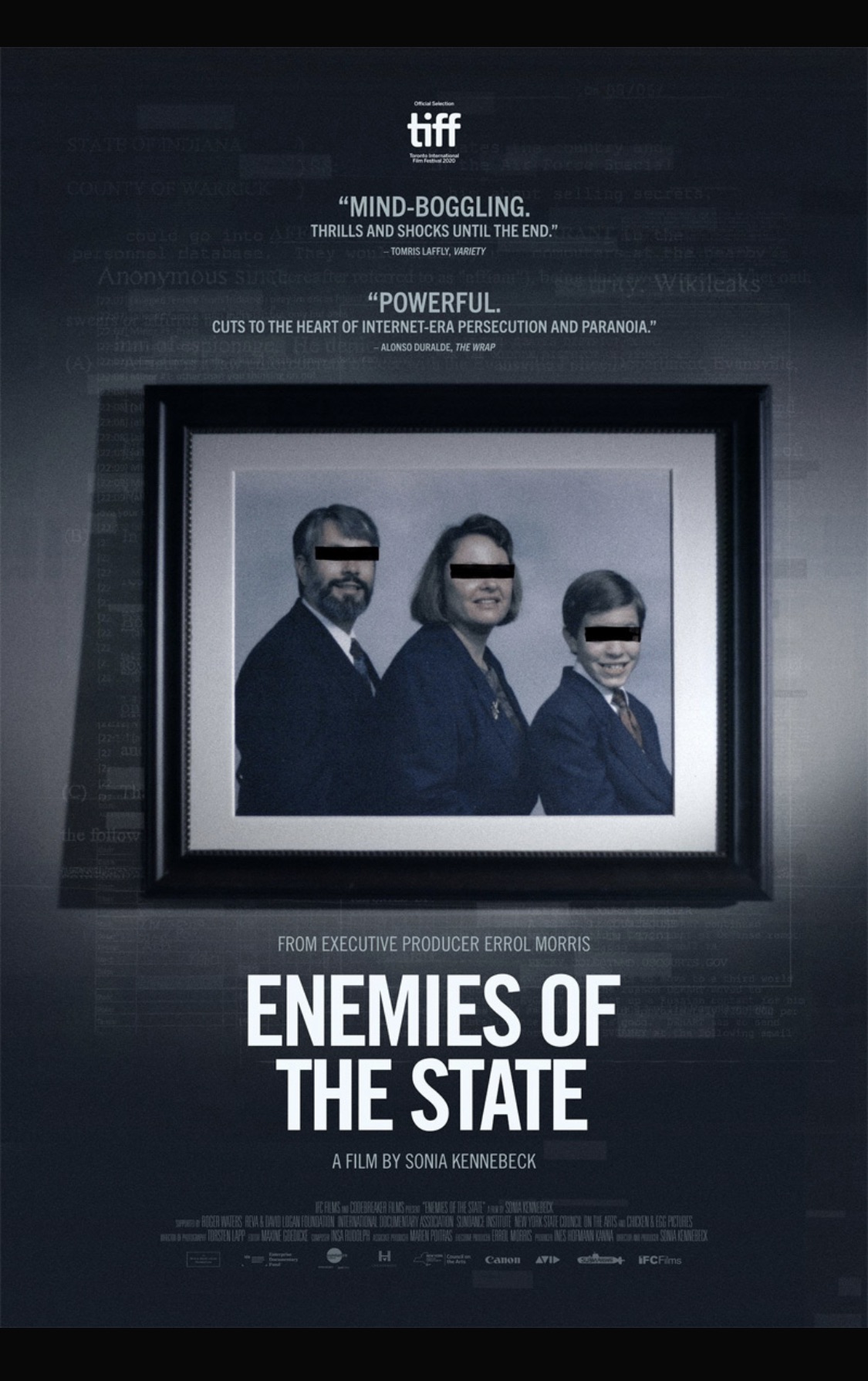
You may not know his name, but his story is fascinating and complex. Were it a fictionalized project, it would likely be less interesting. A computer whiz at an early age, Matt DeHart’s journey takes us from Indiana to Mexico to Washington DC to Canada, and to Tennessee and rural Kentucky. Since the FBI raided his home in 2010, Matt has been labeled: a hacker for Anonymous, a WikiLeaks contributor, an asylum seeker, a child pornographer, a whistleblower, and a hacktivist.

Kennebeck’s film plays like an investigative report, and we are there to assemble the puzzle pieces. The problem is that the pieces don’t actually fit. This is a duel between one young man (with the support of his parents, whose own story becomes more bizarre as time passes) and the US Government. When accused and charged with child pornography, DeHart fires back calling this a ruse by the Government, claiming he has proof documenting the CIA’s plot and involvement with the 2001 Anthrax attacks.

Matt’s parents, Paul and Leann, play a prominent role in his life and in the film. They are exceedingly protective of him and seem to carry none of the doubt that most everyone else involved in this does. Without ruining the chase for you, Matt administered a secret server for WikiLeaks and claims to have contacts with Anonymous and the Dark web. Kennebeck utilizes reenactments, archival footage, photographs, audio recordings, and interviews to take us through the research. Those interviewed include Matt’s parents, his immigration and defense attorneys, college professor Gabriella Coleman (an expert on Anonymous), and journalist Adrian Humphreys who covered Matt’s story for “The National Post” (the stories are available online).

Matt seeking asylum at the Russian Embassy and in Canada, adds to the complexity, even if one is leaning towards believing his claims of being targeted, and later tortured, by the government. The challenge here is that we never see the evidence – either of the child pornography or Matt’s documents exposing the CIA. Instead, we get the investigative research done on the case. Was he rightfully targeted by the government? Was he a spy? Did/does he have proof against the government? Was he just paranoid? Kennebeck’s project works best as an examination of human nature and exploration of the complexities of truth. Given what we’ve been through in recent years with U.S. politics, it’s easy to see how repeated untruths will sometimes come to be accepted as truth. Keep an open mind while watching this lunacy unfold, although it may prove difficult to come to a decision.

WATCH THE TRAILER