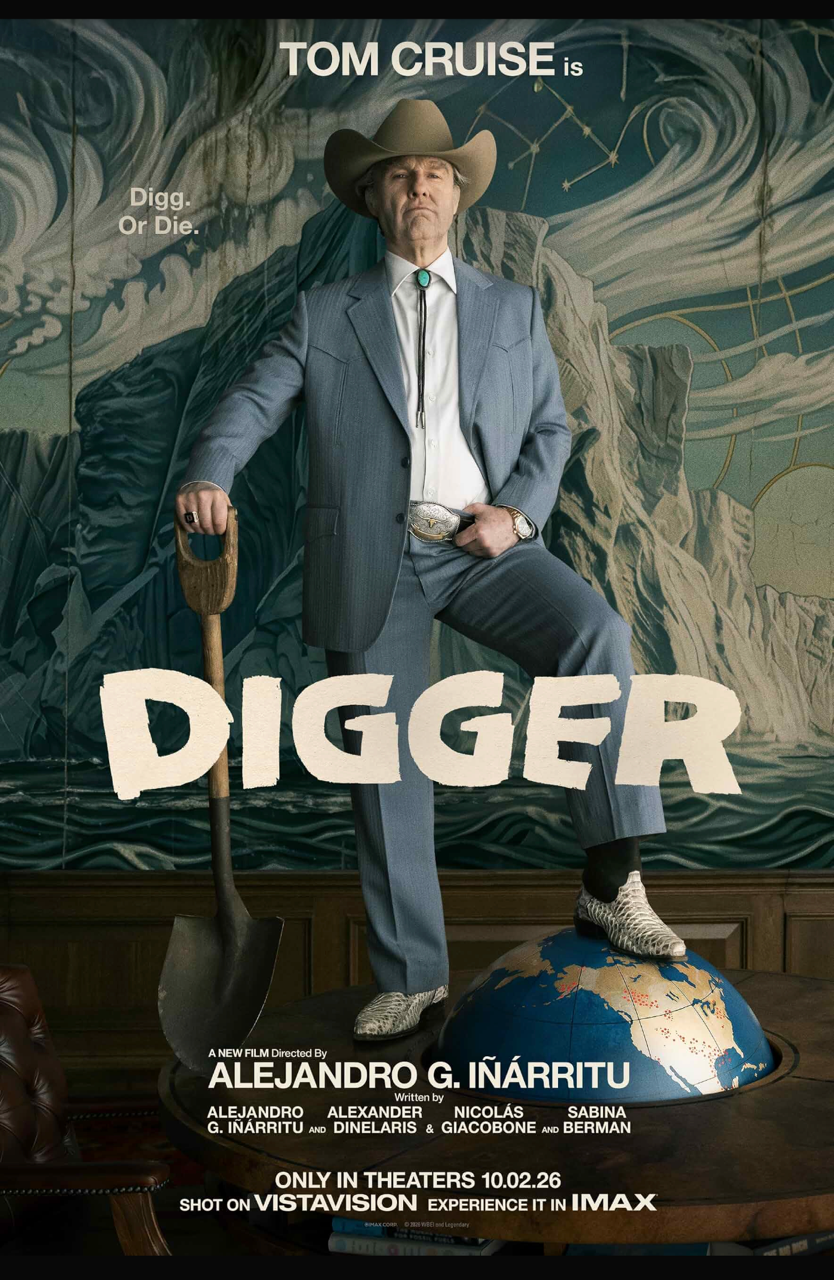
 Greetings again from the darkness. There will likely be a very distinct line of demarcation between those who ‘dig’ DIGGER and those who don’t. Director Alejandro Inarritu, who won Oscars for THE REVENANT (2015) and BIRDMAN (THE UNEXPTED VIRTUE OF IGNORANCE, 2014) and a list of five esteemed writers (Sabina Berman, Jez Butterworth, Alexander Dinelaris, Nicolas Giacobone, Inarritu) seemingly crafted a film that looks amazing, while intentionally angering or annoying or confusing a big chunk of movie goers. Not only will those who prefer traditional storytelling be frustrated, the politics involved will surely irritate many (and drive some nasty comments).
The studio has requested that no spoilers or hints be included in reviews, so I will tread extremely lightly here. An added reason is that the film is certainly best viewed ‘cold’ or with no preconceptions. If you’ve seen the video, you know immediately that this is a much different Tom Cruise character than the strutting, cocky, too-cool-for-school Ethan Hunt that he’s portrayed in numerous “Mission: Impossible” films. It’s his best non-action role since MAGNOLIA (1999), and also his most exuberant (some will say over-the-top). Under prosthetics that transform him into a man that looks his actual age, Cruise becomes Digger Rockwell, a man of enormous wealth, influence, and ego. Cruise has a couple of extended single takes, one of which is mesmerizing in the sheer amount of dialogue he recites and the physicality he displays.
As you would expect, many actors jump at the chance to work on an Inarritu film, and here the cast includes Oscar winner Riz Ahmed as Dr. Ganesh, John Goodman as President Compson, Michael Stuhlbarg as the Vice President, Sandra Huller (one of my 3 favorite actresses since TONI ERDMAN, 2016), Robert John Burke as Fitzgerald, and Jesse Plemons as Kenny. Ahmed is excellent in his role, while Goodman makes his mark with world class bellowing. Huller’s smaller role is a bit disappointing, but fortunately she has a starring role in Pawel Pawlikowski’s new film, FATHERLAND.
Even beyond the studio restrictions, I’m at a bit of a loss as how best to review this film. It’s likely meant to be satire as it takes on big issues like contemporary politics, global issues, ecological concerns, and socio-economic fallout. My view is that it’s a blend of Kubrick’s classic DOCTOR STRANGELOVE and some Coen Brothers films (minus the hilarity), topped off with editorial commentary on backroom politics and corporate greed. Controlling the narrative is a clear objective of these characters. The film takes one huge change of direction early on, and then another much later … the second being easier to foresee. These shifts will definitely challenge viewers, while also leaning into the creativity noted by those of us who find things to admire about the film.
Inarritu’s team is as superb as expected. Three-time Oscar winner Emmanuel Lubezki expertly handles the VistaVision cinematography, while Oscar winner Dennis Gassner awes us with Production Design. As an added bonus, the song playing over the closing credits is the excellent (and quite fitting) “Look What They’ve Done to My Song, Ma” by Melanie. But then, not everyone will stick around that long.
Opens in theaters on October 2, 2026


 Posted by David Ferguson
  Greetings again from the darkness. Many filmmakers mine their own lives for projects, making their work personal, revealing, and sometimes invasive. It’s easy to label these works as narcissistic, and by definition, that would be accurate. However, some of the finest films from our most interesting writer-directors fall into the autobiographical (or semi-autobiographical) category. Examples include Fellini’s 8 ½ (1963), Cameron Crowe’s ALMOST FAMOUS, and Woody Allen’s STARDUST MEMORIES. This time it’s Oscar winner Alejandro Inarritu looking inward. Inarritu won his Oscars for THE REVENANT (2015), and his previous nominations include BIRDMAN (2014) and BABEL (2006), and those are in addition to his other standouts: BIUTIFUL (2010), 21 GRAMS (2003), and AMORES PERROS (2000). He’s joined on this project by his BIUTIFUL and BIRDMAN co-writer, Nicolas Giacobone.
 Oak Cliff Film Festival 2021
