
PRAYERS FOR THE STOLEN (2021)

November 17, 2021

Greetings again from the darkness. This is Mexico’s official Oscar submission for 2021 Best International Feature Film. Written and directed by Tatiana Huezo (her first narrative feature), the story is adapted from the 2014 best-selling novel by Jennifer Clement. It’s an unusual film that lacks a traditional plot, and instead focuses on the daily lives within a small village in Mexico.

Young girls Ana, Paula, and Maria are good friends. They live in a poverty stricken area, and most of the males work in the quarry/mine or for the cartel, leaving women and children to make do scrounging for food and working in the poppy fields at harvest time. Rita (Mayra Batalla) is Ana’s mother. She’s a proud, hard-working woman who is very protective of her daughter. Why? Well the area is patrolled by the cartel, and neighbors regularly go ‘missing’ – especially young girls. When Ana shows up wearing lipstick, Rita doesn’t find it cute. Instead she serves up a harsh reprimand to the girl too young to understand the risk.

Our view is from Ana’s perspective, and there are two distinct halves. In the first, Ana and her friends are very young (likely between 7 and 9). When we flash forward, the girls are 13 or 14. As a youngster, Ana is played by Ana Cristina Ordonez Gonzales, and she cries when her mother chops off her long hair and styles it like a young boy. This is not done for punishment, but rather to make her less desirable to the cartel. Her friend Paula goes through the same ordeal, while Maria’s cleft palate is deemed to serve the same purpose. As a teenager, Ana is played by Marya Membreno, and the haircut no longer hides her femininity, though her friend Maria faces a tough decision when medical assistance becomes available.

Director Huezo and the actors do a superb job in conveying the ever-present aura of danger hovering over the village. Rita digs a grave-like hole as a hiding place for Ana, and their strategy is put to use. In one particularly tense scene in conflict with the cartel, what keeps Rita alive is that she works in the poppy field – so she is viewed as an asset. As if possible starvation or abduction aren’t enough to keep everyone worried, the poppy fields are sprayed with poison in an attempt to control the crops – only the poison gets dumped on the village instead, as the helicopter pilots have been bribed and threatened by the cartel.

This is a haunting film and we connect quickly with Rita and Ana. We feel the relentless pressure of living in an environment where the cloak of danger is always worn and constant fear is a part of daily life. School provides the girls with a glimmer of hope, although it’s fleeting. This is no place for childhood innocence, and the responsibilities of parenting are almost beyond anyone’s ability. Cinematographer Dariela Ludlow perfectly captures the images, the acting is terrific, and director Huezo has delivered a gem.

Available on Netflix beginning November 17, 2021

WATCH THE TRAILER


OBJECTS (2021, doc)

November 17, 2021

Greetings again from the darkness. Do you collect stuff?  Does your stuff have meaning to you? Are you obsessed about saving your stuff? Documentarian Vincent Liota looks at the psychological aspects of how we treasure our treasures. In the montage opening, President Jimmy Carter and the Pope tell us not to put value on material items, while others tell us our saved objects represent memories that take us to our happy place. Liota even includes the “Rosebud” clip from CITIZEN KANE.

Over the course of an hour, our attention is mostly on three individuals: NPR personality Robert Krulwich, designer Rick Rawlins, and author Heidi Julavits. They each have items to which they are emotionally attached. Robert is holding on to some decades old dried grass, Rick has a ‘sugar egg’ from a childhood birthday party, and Heidi has a sweater once owned by the late French actress Isabella Corey. Three very different people latching on to items with very little (or zero) intrinsic value, yet generating an emotional response that is clearly very real to them.

The film touches on those who stand opposed – those who save no objects simply out of emotional attachment. Included is a brief sequence featuring “Tidy Up with Kon Mari” for those whose lives get crowded or overrun by stuff. But those folks aren’t the focus here. Mr. Liota’s project could easily slide into the syllabus for a university level psychology class. It is personality types that we are studying. Why do rational, intelligent people find meaning and memories in what could/should be throwaway items? In fact, these objects seem to grow in importance over the years, with each having their own personal story associated.

There is an odd 3D Printer experiment included that doesn’t seem to work as a test on whether a replica worthless object can replace an actual worthless object, and still maintain the emotional appeal. In addition to Kane’s ‘Rosebud’, the floating bag from AMERICAN BEAUTY has its moment here, seemingly symbolizing the connection between an item and an emotion or memory. We are left with the impression that regardless of where we might fall on the “objects” scale, no effort should be expended in judging others. A pleasant memory might be just what someone needs at any moment. Who could possibly object to that object?

Premiering at DOC NYC 2021

*Couldn’t find a trailer


BELFAST (2021)

November 12, 2021

Greetings again from the darkness. Despite Irish ancestry, during my childhood, Ireland was vaguely described as a place to avoid due to the Northern Ireland Conflict (also known as The Troubles). In contrast, the childhood of writer-director Kenneth Branagh was smack dab in the middle of this political and religious mess. This autobiographical project is a sentimental look back at his youth and the connection to his career as a filmmaker. This is very attractive and appealing filmmaking, and one that acknowledges the violent atmosphere without dwelling on it.

An opening aerial view of present day Belfast shipyards in full color abruptly transitions back to black and white 1969. A young boy plays and skips cheerfully as he makes his way through the apparently idyllic neighborhood. The pleasantries are shattered and give way to the frenzied fear and havoc created by an approaching angry mob. The native Protestants’ goal is to push out all Catholics from the area. The happy young boy we first see is Buddy (played by newcomer Jude Hill), the stand-in for Branagh as a child. While watching, we must keep in mind that we are seeing things unfold through Buddy’s eyes – which are actually the eyes of a middle-aged director looking back on his upbringing. This explains the sentimentality and nostalgia, two aspects handled exceedingly well.

Buddy and his older brother Will (Lewis McAskie) live with their parents Ma (Caitriona Balfe, FORD V FERRARI, “Outlander”) and Pa (Jamie Dornan, “The Fall”), and are close with Granny (Oscar winner Judi Dench) and Pop (Ciaran Hinds, one of the finest supporting actors working today). Pa spends much of his time away in London working as a carpenter, leaving Ma parenting diligently to create normalcy for the boys during tumultuous times. An added stress is the financial woes Ma and Pa face over tax debt. Granny and Pop are an endearing elderly couple still very much in love, despite their constant needling and bickering. 

As things escalate, the division over religion becomes more prevalent. Although he attempts to stay out of the fracas, Pa is faced with the “either with us or against us” decision – something he avoids as long as possible. Ma is obsessed with keeping her boys on the straight and narrow, despite their naivety and the many forces pulling them away. The family finds its emotional escape at the local cinema, which treats us to clips of bikini-clad Raquel Welch in ONE MILLION YEARS BC; Grace Kelly and Gary Cooper facing off with a similar ‘stay or go’ dilemma in HIGH NOON; John Wayne, Jimmy Stewart and Lee Marvin in THE MAN WHO SHOT LIBERTY VALANCE; and Dick Van Dyke in his flying car from CHITTY CHITTY BANG BANG. The sense of awe and wonder is laid on a bit thick for effect, but it helps us connect young Buddy with present day Branagh.

It’s quite a family dilemma. How do you decide to pack up and leave the only town you’ve ever called home, and when do you make that decision? When does the danger and turmoil pose too much to risk for your kids? There is a fun scene that provides young Buddy a lesson on how to answer, “Are you Protestant or Catholic?” It plays comically but has a serious undertone. Speaking of Buddy, newcomer Jude Hall in his feature film debut, uses his sparkling eyes and an engaging smile to light up the screen. His adolescent pining for Catherine (Olive Tennant), the smart girl in his class, is worthy of the price of admission. All of the actors are terrific, and in addition to young Mr. Hall, it’s Caitriona Balfe (as Ma) whose performance really stands out. Award considerations should be in her future.

Filmmaker Branagh has assembled a crew of frequent collaborators, including cinematographer Haris Zambarloukos, who works wonders with the monochromatic scheme. The soundtrack is chock full of Van Morrison songs – it is Ireland, after all, and the overall feeling is that this is a film Branagh needed to make in order to deal with his childhood prior to his family relocating to England. By not avoiding The Troubles, yet not focusing on it, Branagh has told his story in a personal way that should be relatable to many. It’s a terrific film.

BELFAST opens in theaters on November 12, 2021

WATCH THE TRAILER


THE SOUVENIR: PART II (2021)

November 12, 2021

Greetings again from the darkness. We tend to think of ‘coming-of-age’ movies as centered on teenagers as they face the challenges of transitioning into adulthood. The reality is that folks come of age during different phases of life (and some seemingly never do). Filmmaker Joanna Hogg continues her autobiographical look back with the follow-up to her exceptional 2019 arthouse film. Is it a sequel? Technically, yes; but it’s more of a continuation, and the two parts actually function best as a single 4-hour story.

Starting off shortly after the first movie ended, part two finds Julie (Honor Swinton Byrne) in bed at her parents’ house. They try to comfort her as she grieves the death of Anthony (played so well in the first by Tom Burke). For those who have not seen the 2019 film, I’ll tread lightly as it should be seen prior to this one due to the continuing story line and numerous references. Despite her confusion and despondency, Julie heads back to film school. Using art to deal with her emotions, she starts all over with the script for her graduation film. The Film School committee of like-minded middle-aged men thrash her idea of dealing with her situation on film. Despite their harsh words, she persists.

For such a ‘quiet’ movie, it’s astonishing how many things are going on in Ms. Hogg’s film and in Julie’s world. The jealousies of film school students are noted, as are the discrepancies between overly confident young filmmakers (a brilliant Richard Ayoade) and those still trying to find their voice (Julie). Ayoade’s arrogant Patrick is recognizable to us as a big production filmmaker in the vein of many who have come before him. On the other hand, Julie stumbles over how best to convey the emotions for the actors in her film … a film that is so personal she’s dealing with memories even while setting up scenes.

Honor Swinton Byrne (Tilda Swinton’s daughter) excels at relaying a certain sadness in Julie as she pushes onward. Anthony’s ghost hovers everywhere for her. She bravely visits his parents. The confusion over Anthony’s story, and her shock at not having recognized the signs, are exemplified as she presents the common façade of appearing OK while struggling inside. Julie’s parents, played by (the always great) Tilda Swinton and James Spencer Ashworth walk on egg shells around her, while trying to offer support, despite their detachment – not just from the relationship, but from Julie’s life in general (other than lending her money in times of need).

Supporting work comes from Charlie Heaton, Harris Dickinson, and Ariane Labed, as student actors. In Julie’s film, Ms. Labed plays the role of Julie, which in reality, is the role of Ms. Hogg as a young aspiring filmmaker. Joe Alwyn has a terrific cameo as Julie’s editor in one of the most awkward and tender scenes. Ms. Hogg did not film the two parts simultaneously, but her style is so unique (as an example, songs cut off abruptly mid-scene) that it’s a challenge not to rave about the look and feel. Her talented collaborators include Film Editor Helle le Fevre, who serves up some creative transitions; Production Designer Stephane Collonge, whose sets are crucial in a film with minimal dialogue; and Cinematographer David Radeker whose lensing gives the film the perfect look for its time. Tilda Swinton stars in Ms. Hogg’s upcoming film, THE ETERNAL DAUGHTER; however, we will have to be patient to see if Honor Swinton Byrne continues to pursue acting, a profession to which she seems destined.

In theaters beginning November 12, 2021

WATCH THE TRAILER

*link to my review of THE SOUVENIR (2019)


BRUCE SPRINGSTEEN & THE E STREET BAND: THE LEGENDARY 1979 NO NUKES CONCERTS (2021, doc)

November 8, 2021

Greetings again from the darkness (on the edge of town). The old adage goes, “Music soothes the savage beast”. But what if it’s the savage beast playing the music? Let’s go back more than 40 years to 1979. In March, the Three Mile Island nuclear plant accident occurred, sending shockwaves through the U.S. An activist group of musicians led by Jackson Browne, Graham Nash, Bonnie Raitt and others founded MUSE (Musicians United for Safe Energy) and scheduled concerts for awareness. The concerts were better known as “No Nukes”, and were followed up by a best-selling album and videos. Performing at two of the Madison Square Garden concerts in September were Bruce Springsteen and E Street Band. All these years later, Springsteen has re-mastered the original footage and packaged it as a remarkable and breathtaking 90 minute concert film that is a must-see for any Bruce fans of yesterday or today.
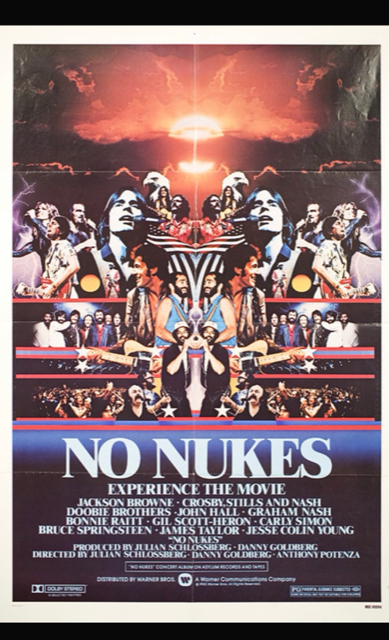
Lest you think I am an objective reviewer on this one, you should know that I caught Bruce and the E Street Band on December 7, 1978, near the end of their last tour prior to the No Nukes shows. That night in Austin remains the closest I’ve ever come to a religious experience – musically speaking. Those special memories came flooding back as I watched this 90 minute film. The raw power, sheer energy, and pure joy emanating from the stage is truly something to behold … oh, and the music was incredible.

This is much less a documentary than a concert film, but it’s certainly a different level than what we typically see in a concert film. The cinematographer, Haskell Wexler, had already won two Oscars for WHO’S AFRAID OF VIRGINIA WOOLF? (1966) and BOUND FOR GLORY (1976) and had been nominated for ONE FLEW OVER THE CUCKOO’S NEST (1975). I counted six cameras, but it’s possible fewer cameras were used and instead moved around between the two nights of shows that are blended here.

Keep in mind this was filmed two years before MTV was founded, so even his biggest fans hadn’t seen much film or video of Springsteen to this point. His reputation was built on legendary live performances, and his two most recent albums “Born To Run” and “Darkness on the Edge of Town”. This was also pre-Patty Scialfa and pre-Nils Lofgren. The music is straight-ahead, driving rock ‘n roll – five years before Bruce lapsed into “Dancing in the Dark” and became a global superstar, rather than a cult phenomenon. To this point, he had not been viewed as an activist, so his participation in the No Nukes concerts was a jackpot for the organizers, but also a turning point for Springsteen as a spokesperson on social issues (and politics).

Below is the 13 song playlist, and since this is a blend of the two nights, the easiest way to spot the difference is by Clarence’s outfit: one night he’s wearing a red suit, and the other night he’s wearing a white one. What you also notice is the athleticism and stamina of Bruce and Clarence as they bound around the stage – including the back amps to occasionally play for those seated behind the stage.

  1. Prove it All Night – (hard rock opener, setting the tone)
  2. Badlands – breakneck tempo (dedication to No Nukes volunteers)
  3. Promised Land – the third straight song from “Darkness”
  4. The River – (Bruce’s sister in the audience, written for her)
  5. Sherry Darling – (second song from “The River”, released a year later)
  6. Thunder Road – (this kicks off a string of fan favorites)
  7. Jungleland – (Roy, Steve, Clarence shine)
  8. Rosalita – (Bruce introduces the band)
  9. Born to Run – (the anthem)
  10. Stay – (Jackson Brown, Tom Petty, Rosemary Butler on stage)
  11. Detroit Medley – Devil with a Blue Dress, Good Golly Miss Molly, CC Rider, Jenny Jenny
  12. Quarter to 3 – (the Gary US Bonds hit)
  13. Rave On – the Buddy Holly cover plays over the credits

It was May of 1974 when music critic Jon Landau wrote, “I saw Rock and Roll’s future and its name is Bruce Springsteen”. Landau’s words proved prophetic (and he went on to become Bruce’s longtime manager). Very few performers have ever connected to a live audience the way Springsteen did in those days. Sure, there’s some comedic shtick on stage: “That’s all I can stand …”, before he screams, “I’m just a prisoner … of Rock n Roll”. The fact is, many of us were prisoners of Bruce Springsteen and E Street Band, and this film is the best opportunity for others to understand.  

AVAILABLE FOR DIGITAL PURCHASE ON NOVEMBER 16 AND DIGITAL RENTAL ON NOVEMBER 23


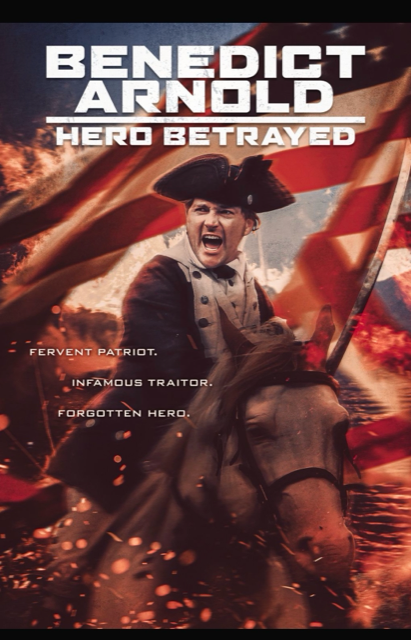
BENEDICT ARNOLD: HERO BETRAYED (2021, doc)

November 8, 2021

Greetings again from the darkness. His name has been derogatory punchline for as long as any of us can remember. Labeling someone ‘a Benedict Arnold’ meant they had been disloyal to their team, club, organization, or group of friends. But those of us who are not Revolutionary War historians actually know very little of his story – in fact, few know anything beyond his being a recognized traitor to the United States. Director Chris Stearns, using historian James Kirby Martin’s 1997 book, “Benedict Arnold, Revolutionary Hero: An American Warrior Reconsidered”, offers us a deeper and more comprehensive look at a man who was more complex than the epithet he was branded with.

When a film’s opening sequence is from the year 1780, you know that rather than being a traditional documentary, it’s also a blend of docudrama reenactments. And that’s exactly what this, while also working in a number of insightful interviews with historians and writers. Martin Sheen adds gravitas as the narrator who walks us through Arnold’s life. We go back to a childhood that featured a drunken father, whose destruction of the family’s good name prevented a recovery in social standing, despite Arnold’s tremendous success in business and trading.

There is little doubt that this well-researched information on Benedict Arnold will surprise those who watch. For three years, he fought the war with distinguished bravery and skilled leadership. Arnold even self-funded and led militia to fight Britain. He was an accomplished Naval officer and was a hero to the country for those early war years. So what changed him? That’s the part of the story that holds modern day relevance.

Arnold became ever more frustrated. He was not only physically injured while fighting for his country, but he became disenfranchised by endless power plays, political maneuverings, and cronyism of those above him. Lacking the political savvy necessary to self-promote, Arnold became the victim of self-serving officials looking to take credit for his work. As a Patriot, this was unbearable and led to his change in allegiance.

Director Stearns is thorough in his approach, knowing full well the skeptical eye with which most will watch the film. In just over 2 hours, he makes a strong case for the actions of a man who has been vilified for more than 200 years, and concludes that Benedict Arnold has been an American war hero until systemic corruption convinced him the country would be better off under British rule. Benedict Arnold betrayed America, but it seems clear from the facts that America also betrayed Benedict Arnold.

Benedict Arnold: Hero Betrayed will premiere on TVOD/EST including iTunes and Amazon on November 9. 2021.

WATCH THE TRAILER


THE BETA TEST (2021)

November 8, 2021

Greetings again from the darkness. Writer-director-editor-actor Jim Cummings’ 2018 film THUNDER ROAD was quite popular on the festival circuit, and Cummings is back with another story of a stressed out man … at a time when the world doesn’t much care about stressed out men, especially those who carry themselves with a heavy dose of self-importance. Cummings and co-writer, co-director, and co-star PJ McCabe have delivered a satire on traditional Hollywood in the shape of a whodunit with dark comedy that teeters into thriller territory.

Cummings stars as Jordan Hines, a high-octane Hollywood agent who talks as quickly and incessantly as he smiles, and neither are sincere. Jordan is an unlikable guy who belittles the support staff and mostly patronizes his fiancé Caroline (Virginia Newcomb, THE DEATH OF DICK LONG, 2019), while kissing the proverbial tushes of prospective clients. One day a mysterious elegant purple envelope shows up in Jordan’s mail. It’s an invitation to meet up with an admirer for anonymous, no-strings attached sex (as if that’s even possible when someone has targeted you). He initially trashes the envelope, before reconsidering.

After the encounter, Jordan’s personality becomes unhinged and his world begins to crumble. He wants to know who the woman was and why he was chosen. His desperate obsession with locating the mystery woman means his work suffers, as does his relationship with Caroline. Jordan’s fantasy has turned into a nightmare that causes him to see and hear things – and he’s unable to discern his visions from reality. This fast-talking agent teeters between viable and obsolete, and an “I’m so excited” montage fits perfectly into the persona of a man who lacks sincerity, doesn’t know himself, and is oblivious to the needs of others.

There are some comparisons here to Jeremy Piven’s character in “Entourage” and Patrick Bateman/Christian Bale in AMERICAN PSYCHO, but Cummings make the character his own. The comedy is dark and satirical, but the film never seems sure of itself as it bounds between erotic thriller (with very little eroticism), a ‘who is she’ mystery, and commentary on how a certain type of individual is no longer welcome in a post-Harvey proper society.

The opening sequence is no slow start, as it features a brutally violent murder – an incident that doesn’t find its place until near the end of the film. Also included here is cautionary tale on the dark web, and the dangers of social media and the internet, although this feels like an add-on, rather than a fully developed sub-plot.  Virginia Newcomb does get to deliver the film’s best line, “I’m not insulting you. I’m describing you”. Also giving the story a contemporary feel is the emphasis on packaging deals, which is a relevant topic in the ongoing discussions with industry unions. There is a lot tossed in here, and some parts work better than others.

WATCH THE TRAILER


HEART OF CHAMPIONS (2021)

October 31, 2021

Greetings again from the darkness. We’ve seen most of this before in a long list of inspirational sports stories where the beleaguered, tough as nails coach comes in and unites a rag-tag team while teaching life lessons. However, with (2-time Oscar nominee) Michael Shannon cast as the coach, we know there will be at least one performance worth watching. The screenplay is from Vojin Gjaja and it’s directed by Michael Mailer (son of 2-time Pulitzer Prize winning author, Norman Mailer).
The film opens in May 1999 as a crew team finishes last in the Collegiate Rowing Championships. Inner-team bickering and animosity exists thanks to domineering Team Captain Alex (Alexander Ludwig, “Vikings”). The following year, the team is introduced to their new coach, Coach Murphy (Shannon). He has a different approach and he’s focused on creating a team, rather than a few guys with oars. All we really learn about Murphy is that he’s an alum and former rower for this same college, and an Army and Vietnam veteran who lost friends in the war, and carries that burden with him every day.

Alex (Ludwig) is back for his senior year and his goal is to be chosen for the Olympics team … a goal his over-bearing father (David James Elliott, “JAG”) reminds him of every few minutes. The other two crew members who get significant screen time are John (Alex MacNicoll, ALL ROADS TO PEARLA, 2019) and newcomer Chris (Charles Melton, THE SUN IS ALSO A STAR, 2019). John is dating Alex’s ex-girlfriend Sara (Ash Santos), while transfer student Chris is dealing with a recent tragedy, and also attracted to Sara’s friend Nisha (Lilly Krug, EVERY BREATH YOU TAKE, 2021). And yes, at times the melodrama of these folks is just a bit too heavy-handed and soap opera-ish. Coach Murphy is clearly the most interesting character, yet the film spends the bulk of its time on the youngsters and their daily journey.

One of the plusses here is that the sport at the center is rowing, which at least veers from the typical sports fare. But then we learn very little about the sport, other than it blisters your hands and causes your lungs to burn … and there is “swing” which occurs when the team is in full sync. Mr. Shannon does as much with his underwritten role as possible; however, overall the movie is just a bit too generic with its final lesson of, “a loss is not the end.” Should you have an interest in a true life rowing story, allow me to recommend the 2013 book (my son recommended to me), “The Boys in the Boat: Nine Americans and Their Epic Quest for Gold at the 1936 Olympics” by Daniel James Brown

Opened October 29, 2021

WATCH THE TRAILER


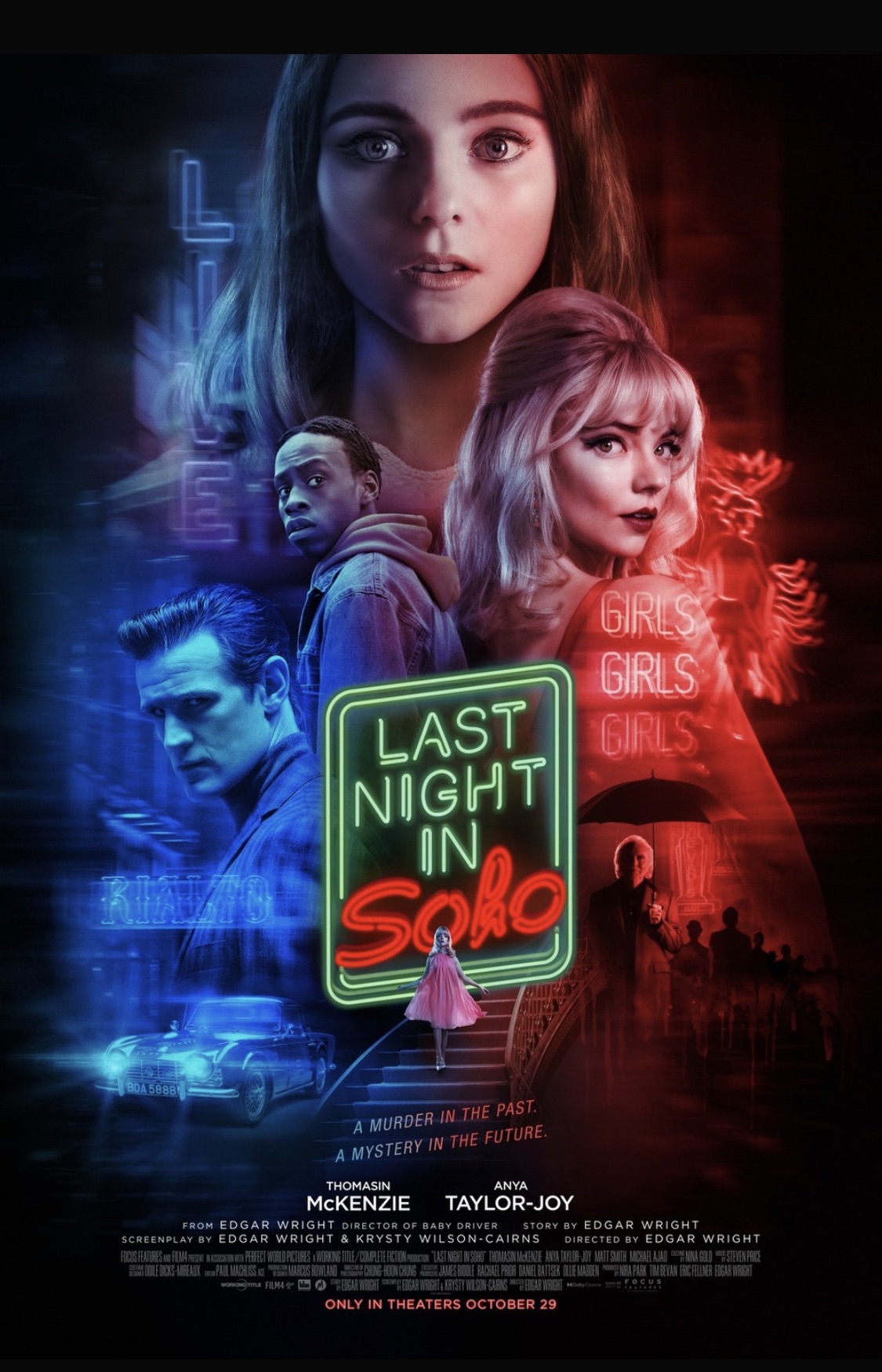
LAST NIGHT IN SOHO (2021)

October 28, 2021

Greetings again from the darkness. Every once in a while a movie captures that magic feeling of being swept away, and this wild film from writer-director Edgar Wright and co-writer Kristy Wilson-Cairns (1917) did just that for me. This is my kind of psychological-horror-thriller and with the exception of one sequence that went a bit too “slasher” for my tastes, I had a blast watching it. I’ll admit that, while also acknowledging more people will probably not enjoy this, than will. But for those who do, I feel confident they will share my enthusiasm.

Eloise (Thomasin McKenzie, JOJO RABBIT, 2019) opens the film by expressively dancing to Peter & Gordon’s “A World Without Love” while sporting a self-designed dress made of perfectly creased newspaper. Her room is filled with 1960’s colors and memorabilia and we soon learn she’s an orphan raised by her grandmother (Rita Tushingham, A TASTE OF HONEY, 1961). Eloise, or Ellie as she’s called, dreams of following her mother’s path to London, and is thrilled beyond measure when her acceptance letter arrives from the London School of Fashion. Ellie does carry the burden (and visions) of her mother’s mental illness, and her grandmother warns, “London can be a lot.”

Small town (Cornwall) Ellie with her timidity and wide-eyed innocence arrives in London and is immediately the target of ‘mean girl’ and fellow student Jocasta (Synnove Karlsen). Rather than subject herself to the abuse, Ellie sublets an attic room from an old lady landlord named Mrs. Collins (the last screen appearance for the great Diana Rigg). Ellie loves the room and her independence, but her dreams act as a portal back to those swinging 60’s of which she’s so fond. But that’s only the beginning. It’s here where she follows/becomes Sandie (Anya Taylor-Joy), and the mirror effects are truly other-worldly. Sandie is everything that Ellie wishes she was herself – confident, radiant, ambitious, and beautiful. This dream state allows Ellie to live vicariously through Sandie. At least initially.

The Ellie-Sandie sequences mess with your head in a wonderful way. Sandie seems to float across the club’s dance floor, and Ellie is mesmerized at first, before turning protective. The tone shifts when Sandie meets sleazy Jack (Matt Smith), a would-be agent who promises to get Sandie the shot at stardom she desires. This leads to ATJ’s amazing and breathy version of Petula Clark’s “Downtown”. It’s a standalone highlight of the film, and a moment that shifts the story yet again. If you are struggling to keep pace, you’re not alone.

Soho’s glamour is matched only by its grunge. The recurring dreams turn to nightmares, so that even Ellie’s waking hours are surreal. A mysterious elderly gent played by Terence Stamp may be the key to the mystery Ellie’s so busy trying to solve that she is oblivious to the romantic overtures by nice guy John (Michael Ajao). The nostalgia of the 60’s provides a visual treat with the Café de Paris, a massive theater marquee advertising James Bond’s THUNDERBALL, and Cilla Black’s “You’re My World”.

Filmmaker Wright gives us so much to discuss, but it’s crucial that the best parts not be spoiled. Just know that Oscar winner Steven Price (GRAVITY, 2013) provides an incredible mix of music, while Chung-Hoon Chung’s cinematography, Marcus Rowland’s Production Design, and Odile Dicks-Mireaux’s costumes all nearly steal the show. But of course, that can’t possibly happen thanks to the stupendous performances from Anya Taylor-Joy and (especially) Thomasin McKenzie. These are two of the finest young actors working today, and we will be fortunate to watch their careers develop.

Edgar Wright is having quite a year. He’s already delivered the terrific documentary, THE SPARKS BROTHERS, and now comes what is his best work yet. You may know his work on BABY DRIVER (2017) or the Three Flavours Cornetto trilogy that kicked off with SHAUN OF THE DEAD (2004). Here, he playfully bounces between genres serving up time travel, a murder mystery, the Soho history, a memorable soundtrack, surreal dream and ghost sequences, a touch of romance, and that previously mentioned ‘slasher’ scene. A final tip of the cap to Diana Rigg, whose career spanned her role as Emma Peel in “The Avengers” (from the 60’s), her time as a Bond girl in ON HER MAJESTY’S SECRET SERVICE (1969), and ultimately as Olenna Tyrell in “Game of Thrones”.

Opens in theaters on October 29, 2021

WATCH THE TRAILER


THE FRENCH DISPATCH (2021)

October 28, 2021

Greetings again from the darkness. Few things in the cinematic world are more instantly recognizable than a Wes Anderson movie. In fact, historically speaking, perhaps only Jacques Tati comes as close to having a signature style easily spotted by viewers (unless you want to count Tom Cruise sprinting or Julia Roberts cackling). This is Mr. Anderson’s 10th feature film in 25 years, and I now rate 5 of these very highly, though all 10 have a certain appeal. This latest, co-written by Anderson with frequent collaborators Roman Coppola, Hugo Guinness, and Jason Schwartzman, could be considered his most ambitious to date … and likely the most ‘Wes Anderson’ of all.

Billed as a love letter to journalists, it becomes crystal clear, that by this, Anderson means the esteemed stable of writers from the early days of “The New Yorker”. In fact, Anderson structures the film as if it were following the path of a magazine being published. We are informed upfront that this edition features “an obituary, a travel guide, and 3 feature articles”. An episodic format is not unusual for films, yet Anderson never does anything by the book. Each piece takes place in its own time period, and there appears to be little connection or crossover among key characters. Still, somehow he makes this work by ensuring each piece stands on its own and is filled with unusual characters and those patented, fabulous Anderson visuals.

The obituary is that of Arthur Howitzer Jr (a deadpan Bill Murray), the founder and publisher of “The French Dispatch” magazine, a spin-off from The Liberty Kansas Evening Sun … a move from a small town in Midwestern United States to a charming small town in France (hilariously and fittingly) named Ennui-sur-Blasé. Howitzer adores his writers, and the only guidance he offers them is, “Just try to make it sound like you wrote it that way on purpose”. He also has a “No Crying” sign posted in his office, likely as much as a reminder to himself as a rule for the staff.

Our travel guide section is fortunately quite brief since it involves Owen Wilson as a bicycle tour guide showing us around the town – the “Local Color”- of Ennui-sur-Blasé. This takes us to the first feature story, and the best of the lot. Tilda Swinton excels (doesn’t she always?) as a writer and art expert giving a colorful lecture entitled “The Concrete Masterpiece”. She tells the story of Moses Rosenthaler (Benecio del Toro), a genius modern artist serving a life sentence for murder, and as she lectures, we see it play out. While incarcerated, Moses continues to work and his muse is a prison guard named Simone, played exceptionally well by Lea Seydoux. Her nude posing for him leads to his signature modern art piece, which attracts the attention of an ambitious art dealer played by Adrien Brody.

“Revisions to a Manifesto” is the next feature, and it involves a young activist named Zeffirelli (Timothee Chalamet). He’s a chess expert, quite moody and has a questionable quest. He’s being covered by writer Lucinda Krementz (Frances McDormand), who is unable to maintain objectivity, and inserts herself right into the story, amongst other things. The segment pays tribute to the activism of the 1960’s and is filmed mostly in black and white.

The third feature, “The Private Dining Room of the Police Commissioner” involves writer Roebuck Wright (Jeffrey Wright) telling his story while a guest on Liev Schreiber’s Talk Show in the 1970’s. Roebuck is obviously inspired by James Baldwin, and he famously recalls every line he’s ever written. The story he recites involves a legendary chef played by Steve Park.

Actors mentioned so far are just the headliners, and Anderson has packed the film with his usual troupe, as well as dozens of others – some you’ll recognize, and some you won’t. There are at least seven Oscar winners involved: Christoph Waltz, Fisher Stevens, and Angelica Huston (as narrator), in addition to the aforementioned Swinton, McDormand, del Toro, and Brody. Numerous Oscar nominations and awards are included in the group of other familiar faces like Willem Dafoe, Saoirse Ronan, Edward Norton, Lois Smith, Henry Winkler Bob Balaban, Elisabeth Moss, and Mathieu Amalric.

Other frequent Anderson collaborators who deliver standout work include Production Designer Adam Stockhausen, Cinematographer Robert Yeoman, Editor Andrew Weisblum, and composer Alexandre Desplat. The film looks and sounds remarkable, and somehow it doesn’t feel like it’s moving fast – although we can barely keep pace. The film can be compared to ordering a flight at your local distillery. Each flavor is tasty, but they may not add up to a full drink.

Wes Anderson has delivered another stylish, fun film to watch, and one that is endlessly entertaining. It may not have as many moments of laughter as some of his previous films, yet there are still plenty of sight gags, insider references, and light-heartedness bathed in nostalgia – even if it’s not quite as whimsical. Shot in the French town of Angouleme, the visuals are as impressive as any you’ll find, serving up a collage of time, caricatures, color, and topics.

Opening nationwide in theaters on October 29, 2021

WATCH THE TRAILER