 My BEST OF 2021, including my personal TOP 10 … and a whole lot more … is now live!
Just click HERE
My BEST OF 2021, including my personal TOP 10 … and a whole lot more … is now live!
Just click HERE
 1 Comment |
  Articles | Tagged: Best of 2021 |
  Permalink
 Posted by David Ferguson
 Greetings again from the darkness. For those of us who enjoy the burst of adrenaline provided by thrillers, the premise of a blind person in peril is something we’ve seen a few other times, including WAIT UNTIL DARK (1967) with Audrey Hepburn, SEE NO EVIL (1971) with Mia Farrow, BLINK (1993), and the more recent DON’T BREATHE (2016, 2021) series with Stephen Lang. Director Randall Okita, working from a screenplay by Adam Yorke and Tommy Gushue, manages to use modern technology to provide a twist to a familiar set-up.
When we first see Sophie (the feature film debut of Skyler Davenport), she’s getting caught by her mom sneaking out of the house. Now this wouldn’t be that unusual were it not for the fact that Sophie is blind … a degenerative disease robbing her of her dream of making the Olympic ski team. She is independent to the point of stubborn, and has found a way to supplement her house/cat-sitting gigs with the help of her only friend Cam (Keaton Kaplan). Homeowner Debra (Laura Vandervoot) greets her at the sprawling, snow-covered remote mansion Sophie has been hired to ‘watch’.
Of course we know where this is headed, because who is more vulnerable than a blind girl alone in the house (with a cat)? The twist here is an app recommended by Sophie’s mom. It’s called “See For Me” and it’s a way for someone to assist a blind person by using the smart phone camera. Sophie is hooked up with Kelly (Jessica Parker Kennedy, “Black Sail”), a military veteran whose expertise at video game invasions will come in handy. Kelly is direct and efficient in her instructions to Sophie – from helping her jiggle open a sliding glass door to evading the three men who break into the house while she’s asleep.
The cat and mouse between Sophie and the intruders provides the necessary tension, and the main twists involve Kelly on the app and Sophie as a tough-to-like person. This is no angelic type that you’d like to hug and protect, in fact, she’s often abrasive to the point of rude. But most importantly, she’s tough and strong-minded. The interaction between Sophie and Kelly is the most interesting, and there’s also a sequence with a police officer that plays like a chain of events that could happen. Kim Coates adds a nice touch in his role … you might recall him as the drifter in WATERWORLD (1995).
By opening the film with “Introducing Skyler Davenport”, we know right away who the film belongs to. Skyler is a non-binary actor whose adult-onset vision impairment make the performance that much more impressive. Skyler is attempting to transition from a successful voice acting career into an on screen one, and this is a terrific start. We do wish the film had taken a few more risks, rather than sticking with some of the old stand-bys. The opportunities were there, but the punches weren’t thrown. Still, for a January thriller, director Okita’s film holds its own.
In select theaters and On Demand beginning January 7, 2022
Leave a Comment » | Thriller | Tagged: Adam Yorke, Jessica Parker Kennedy, Keaton Kaplan, Kim Coates, Laura Vandervoot, Randall Okita, Skyler Davenport, Tommy Gushue | Permalink
Posted by David Ferguson
 Greetings again from the darkness. Well we knew this day would come – an animated film that eclipses Pixar’s COCO (2017) in vibrant colors and stunning animation. The opening credits celebrate this as Disney’s official 60th animated feature film, and it’s truly prismatic and a glorious visual treat. The trio of directors include ZOOTOPIA (2016) collaborators Jared Bush and Byron Howard, as well as first time director Charise Castro Smith.
The story is set in Columbia, continuing the current trend of global trekking in animated films like LUCA, MOANA, RAYA AND THE LAST DRAGON, and the aforementioned COCO. It’s also in keeping with Disney’s feel-good approach to a kinder, gentler world where there are no real villains, and most of our protagonists discover their inner-strength. This story revolves around the Madrigal family, who live in a magical house that takes strength from a magical candle, and all of the family members possess their own special power. Well, all of them except for Mirabel (voiced exceptionally well by Stephanie Beatriz, “Brooklyn Nine-Nine”). Mirabel’s special night fell flat and she’s the only one in the family lacking a “gift” … and her judgmental Abuela Alma (voice by Maria Cecilia Botera, singing by Olga Merediz) never lets her forget. Of course what we notice, and no one else seems to, is that Mirabel is a caring, loving, soul, and we know a payoff is coming.
The songs are from the talented Lin-Manuel Miranda, and the bloodlines connected to his IN THE HEIGHTS movie are readily apparent. It’s likely a few of the songs will stick with kids, not the least of which is, “We Don’t Talk About Bruno”. What won’t be as popular with kids is a story over-crowded with characters and a backstory seemingly inserted to ensure the film slides into the modern day political climate. There are simply too many characters (and too many powers) for young kids to keep track of – not to mention the two factions within the family (Julieta’s side and Pepa’s side). There is a flashback to the family’s history and how they came to live in the magical house, and it’s a story that mirrors the journey of many immigrants.
The voice acting and singing are all superb, and mostly stay consistent to the Columbian story line. And Mirabel is certainly a character we expect kids to take a shine to. She’s kind and friendly and has a loving heart. Pixar tends to offer up stories that are perfectly structured, while Disney has always known how to tug on the heartstrings.
Now streaming on Disney+
Leave a Comment » | Animation, Fantasy | Tagged: Byron Howard, Charise Castro Smith, Jared Bush, Lin-Manuel Miranda, Maria Cecilia Botera, Olga Merediz, Stephanie Beatriz | Permalink
Posted by David Ferguson
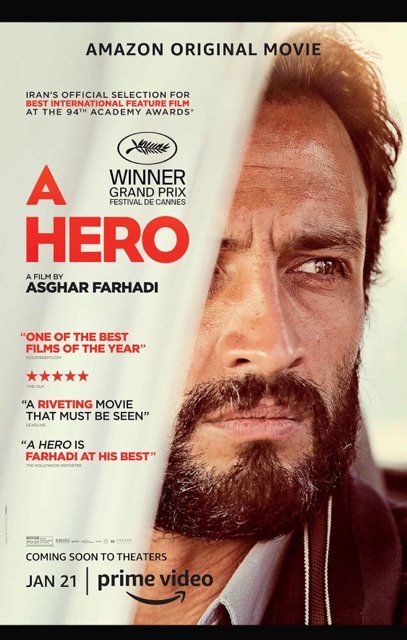 Greetings again from the darkness. “Oh, what a tangled web we weave, when first we practice to deceive.” That line from a Sir Walter Raleigh poem hit me early, and stuck with me through this latest superb film from Iranian writer-director Asghar Farhadi. Having won me over a decade ago with A SEPARATION (2011), and again 5 years ago with THE SALESMAN (2016), Farhadi excels at pushing our buttons on the complexities of human nature.
Rahim (Amir Jadidi) receives a two day leave from debtor’s prison, and has reason for optimism. He has a legitimate plan to make good on his debt and gain his release. A taxi drops him at the tomb of Xerxes where his sister’s brother Hossein (Alireza Jahandideh) is working on the preservation. Rahim, a low-key guy with an easy smile, asks Hossein for help in brokering a deal with Bahram (Mohsen Tanabandeh), the man who paid off the loan shark on Rahim’s behalf, and filed the complaint that sent him to jail.
The divorced Rahim meets up with his secret lover, Farkhondeh (Sahar Goldust), to cash out the 17 gold coins she recently found. Unfortunately, the exchange rate is less than expected, and worse than that for Rahim, Bahram refuses to accept the partial payment in conjunction with a promissory note. This leads to the aforementioned ‘tangled web’ and allows filmmaker Farhadi to do what he does best … cause us to question everything.
The web involves Rahim, Bahram, the jailer, and a local charity that gets involved for what is initially termed the actions of ‘a hero’. But that’s just the tip of who gets dragged in, and that includes Rahim’s son, who has a significant speech impediment. So what happens? Well, without giving anything away, we learn there’s a fine line between a lie and the truth, and between a heroic act and manipulation. In fact, Farhadi has us questioning what it means to be a hero. What impact does media attention have? Is it heroic to do the right thing? What if that thing also helps you? What role do the reasons for your actions play?
Rahim faces a steady stream of moral forks in the road. Which path to take at any given time has ramifications on him, his situation, and countless others. As the fibs pile up, soon others are lying to help you or telling stories to hurt you. There is so much grey area here, we can’t be certain whether black and white even exists. Farhadi’s film seems like a simple story about a simple man, but neither the story nor the man are simple. It’s not about the money, but the money reveals character. Reputation and integrity are on the line. We may first root for Rahim and jeer Bahram, but upon reflection, we likely shift our support. This is Iran’s submission to the Academy, and it’s a good one.
In theaters January 7, 2022 and streaming on Amazon Prime January 21, 2021
Leave a Comment » | Drama, World Cinema/Foreign | Tagged: Alireza Jahandideh, Amir Jadidi, Asghar Farhadi, Mohsen Tanabandeh, Sahar Goldust | Permalink
Posted by David Ferguson
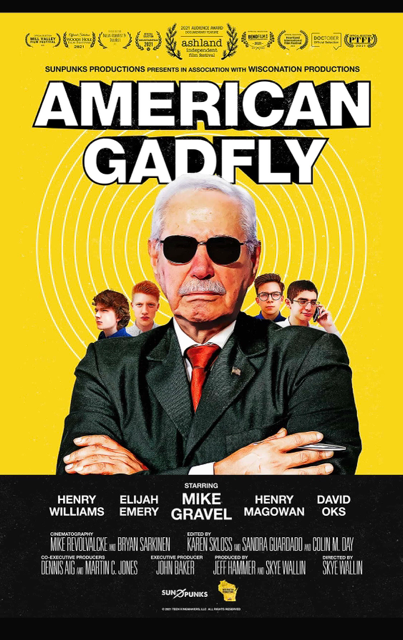 Greetings again from the darkness. Since I was unsure of the definition of “gadfly”, I was equally unsure of what I was getting into when I agreed to review the first feature-length documentary from Skye Wallin. It turns out, Wallin anticipated that particular uncertainty and kindly provided the definition in the opening for the film. A gadfly is one who provokes or annoys in regards to certain topics, and in this case those topics are political and societal in nature. The titular gadfly is not one person, but rather a few unusual collaborators: a group of smart and idealistic teenagers and an 89 year old former Senator.
Our ‘old-timer’ is Mike Gravel, who served as US Senator for Alaska from 1969 through 1981. He’s probably best remembered for reading the Pentagon Papers into the official record in 1971. The Pentagon Papers were the focus of Steven Spielberg’s Oscar nominated film THE POST (2017), but here they serve as background on Mr. Gravel, a lifelong fighter for ideals (think first edition Bernie Sanders). He ran a campaign for President in 2008, but had since lived a quiet life until contacted by a group of teenagers looking to raise awareness for the shared causes they believed in: anti-war, anti-corruption, etc.
The Gen Z activists convinced Gravel to run for President (the 2020 election) on a platform that mirrored his long-standing beliefs. Once Whitney, Gravel’s initially dubious wife, was on board, things clicked into overdrive. The smallest bit with the most impact was Gravel turning his Twitter account over to the youngsters. Make no mistake, this was a social media campaign fueled by the passion of a group of teenagers hoping to drive change. Mr. Gravel clearly admired (and shared) their passion, though he was not able to physically engage like he had early in his career.
Obviously these youngsters had no experience running a campaign, but their instincts were sharp as they drew in thousands of followers who shared their vision. Their goal of gaining an invitation for Gravel to one of the televised debates was both impressive and disappointing. A painful lesson about rules and a structured system led to a learning experience, rather than a successful mission.
Along the way, the group crossed paths with the likes of Andrew Yang, Tulsi Gabbard, Marianne Williamson, Rick Santorum, and yes, even Bernie Sanders … each candidate expressing their admiration for the group’s work, and some even offering valuable assistance. Throughout history, the passion of youth has generated waves of change. The impacts aren’t always immediately noticeable, but the desire for a better world should drive us all, regardless of age or political affiliation. Skye Wallin’s entertaining and informative film reminds us of this.
*Note: Mike Gravel passed away in June 2021
VOD on January 4, 2022
Leave a Comment » | Documentary | Tagged: Mike Gravel, Skye Wallin | Permalink
Posted by David Ferguson
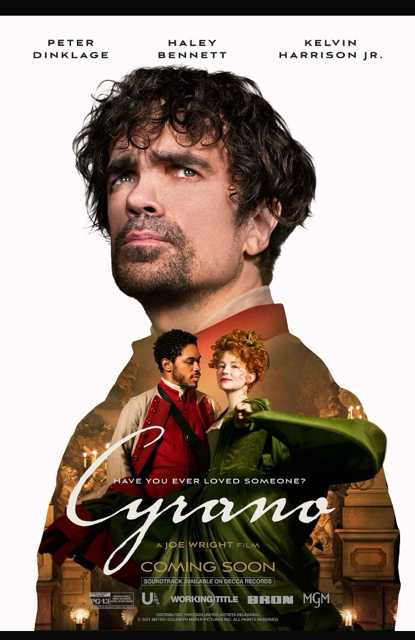 Greetings again from the darkness. Filmmaker Joe Wright has proven how adeptly he can re-make a classic love story. You’ll likely agree if you’ve seen his versions of ANNA KARENINA (2012) and/or PRIDE AND PREJUDICE (2005), which are in addition to his best film (also a love story), ATONEMENT (2007). Working from the terrific script Erica Schmidt adapted from Edmond Rostand’s 1897 play, Wright delivers a musical version of Cyrano de Bergerac that delivers all of the intended “panache” of the original tragic-romance.
Peter Dinklage (THE STATION AGENT, 2003) stars as Cyrano, a master swordsman and orator who entertains with words that cut like a surgeon’s scalpel … except when he’s weaponizing those words for love. Haley Bennett (SWALLOW, 2019) plays Roxanne, the secret object of Cyrano’s desire, though she views him as but a close friend and confidant. Instead, her gaze is upon the newly arrived Christian (Kelvin Harrison Jr), a virile and handsome man lacking the charisma and common sense required to court Roxanne. This dilemma lends itself to the melding of Cyrano’s word being delivered by the preferable packaging of Christian.
Rather than Cyrano’s oversized nose, the film uses Mr. Dinklage’s diminutive stature and feelings of unworthiness of Roxanne’s affections to create the division, and yet it’s the musical aspect that takes a bit of getting used to. Dinklage excels in the film’s best sequence, as early on he humiliates a poor stage actor, a rebellious act that ends in a duel … entertaining for the play’s audience as well as us as viewers. It’s the connection between Cyrano and Christian that leaves us missing the good stuff. It all happens quickly and efficiently, rather than a slow transition from foes to partners. The film is at its best when Cyrano’s loneliness is at the forefront … Dinklage excels in these scenes. In fact, Wright and the actors (Dinklage and Bennett) nail the ending which packs the punch Rostand intended.
Mr. Dinklage has long been married to the film’s screenwriter Erica Schmidt, and Ms. Bennett and director Wright have a daughter together. These ties may have contributed to the effectiveness of the best scenes, though we do wish Ben Mendelsohn (as De Guiche) had a bit more screen time. The three most well-known film versions are CYRANO DE BERGERAC (1950) starring Jose Ferrer, ROXANNE (1987) starring Steve Martin, and CYRANO DE BERGERAC (1990) starring Gerard Depardieu. Wright’s latest version is set apart with the musical aspect, and certainly the Dinklage performance ranks amongst the best. Edmond Rostand’s play was a fictionalized version of the life of Savinien de Cyrano de Bergerac (1619-1655), but the romance, ego, and self-doubt applies to all eras.
5 Comments | Drama, Musical | Tagged: Ben Mendelsohn, Edmond Rostand, Erica Schmidt, Haley Bennett, Joe Wright, Kelvin Harrison Jr, Peter Dinklage | Permalink
Posted by David Ferguson
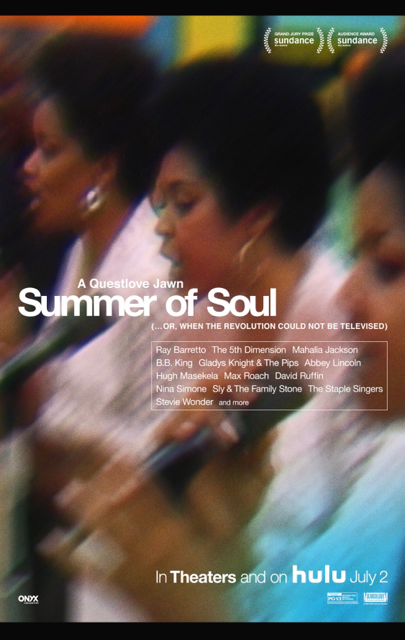 Greetings again from the darkness. Ahmir “Questlove” Thompson’s directorial debut is a history lesson wrapped in a concert film, and it’s just the blended spoonful we need. You might know Questlove best as the bandleader/drummer on “The Tonight Show with Jimmy Fallon”, and with this documentary, he has proven his skill in balancing the visuals with the message. The Harlem Cultural Festival was held over six weekends in the summer of 1969. Yep, the same summer as (and only 100 miles from) the infamous and celebrated Woodstock festival. A total of 300,000 people attended the free events held in Mt Morris Park in Harlem, and Questlove’s film brings back what has been forgotten.
TV director Hal Tulchin filmed each week’s concert in hopes that it would have market value as a broadcast event. When he was unable to market the footage, all 47 reels remained stashed in his basement for 50 years. Questlove weaves a magic carpet that injects interviews, statements, and news clips over the powerful music being performed on stage. We get interviews with festival attendees, musicians, NY Times reporter Charlayne Hunter-Gault, and historical perspective from news clips of Richard Nixon, the Vietnam War, and the assassinations of John Kennedy, Malcolm X, Bobby Kennedy, and Martin Luther King. The festival was organized to commemorate MLK’s death the previous year, and at a time when the black community felt much anger and unrest. The Black Panthers were brought in for security as drugs had spiraled out of control in Harlem.
It was never just about the music, but what music it was! Gospel, blues, soul, and R&B filled the air, as the crowd cheered, danced, and sang along. We learn Maxwell House coffee served as the key sponsor, and there is a segment on NYC Mayor Lindsay, who supported the festival and was well-respected in the Black community. Tony Lawrence, a lounge singer and radio DJ, served as the festival’s host and producer. He introduced each of the acts, and did so with quite a flair for fashion.
The performers aren’t necessarily shown in the same order as the festival, but that matters little. Stevie Wonder is at a decisive point in his career, and his drum solo (yes, drums) is energizing. We also get to see and hear such acts as BB King, the 5th Dimension, the Staples Singers, Mahalia Jackson, Gladys Knight and the Pips, and Nina Simone. There is an audio recording of Mavis Staples recalling how “unreal” it was for her to sing with Mahalia. Other highlights include David Ruffin hitting and holding a high note on “My Girl”, the Edwin Hawkins Singers performing “Oh, Happy Day”, Hugh Maskela jolting the crowd with “Grazing in the Grass”, and Sly and the Family Stone (and their “white drummer”) leading the audience through “Higher”. The late Nina Simone comes across as especially regal and powerful in her time on stage. There are clips of comedian Moms Mabley performing, as well as Jesse Jackson orating. Lin-Manuel Miranda discusses the music of Puerto Rico and Spanish Harlem, and one of the most touching segments finds Marilyn McCoo and Billy Davis Jr recalling the backstory of how The 5th Dimension came to record “Aquarius/Let the Sunshine in”.
Early marketing attempts re-branded the festival as “Black Woodstock”, but that didn’t change the fact that the market was limited at the time. Festival-attendee Musa Jackson is interviewed as he watches the film, and it’s clear that it’s an affirmation of the era. It’s also fascinating to hear Charlayne Hunter-Gault recount how she fought the NY Times over her preferred description of people as “Black” rather than the previously utilized “Negro”. Questlove’s film immediately becomes a historical time capsule and one that should be viewed by many.
Available on Hulu
2 Comments | Documentary | Tagged: Ahmir Questlove Thompson | Permalink
Posted by David Ferguson
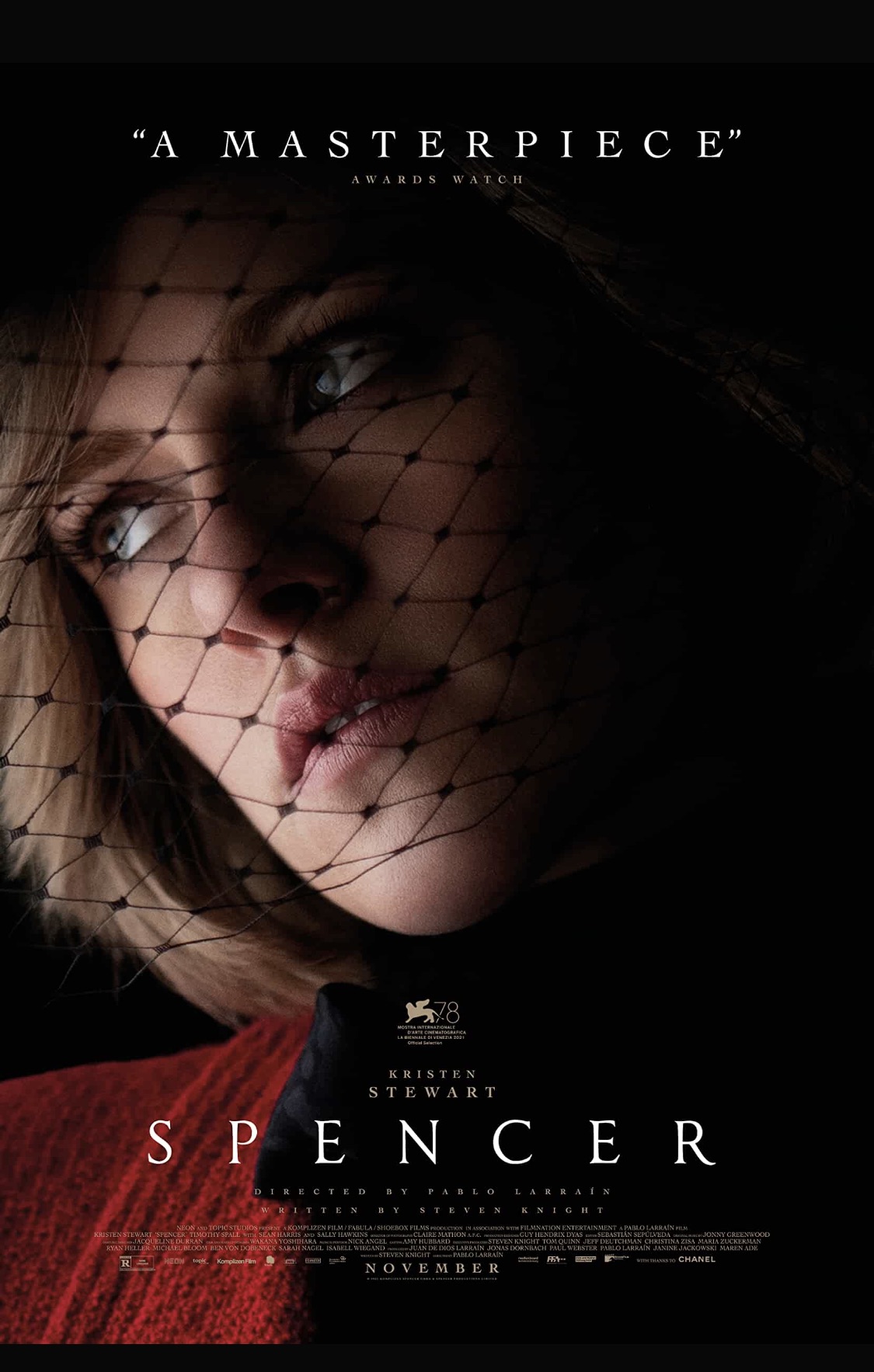 Greetings again from the darkness. “A fable of a true tragedy.” Such is the cautionary sub-heading that director Pablo Larrain begins his latest film. As in his 2016 film, JACKIE, the director turns his lens to an icon of which both too much and too little is known. The screenplay is written by Steven Knight (DIRTY PRETTY THINGS, 2002), and it takes place in the early 1990’s not long before the official marital break of the Prince and Princess of Wales. Much of this movie occurs in the muddled mind of Lady Diana through surreal dream sequences and imagined internal mental imagery.
You may find the holidays to be a stressful time, but what we see in Diana are the results of unrelenting pressures: media, royal family, a husband’s not-so-secret relationship with another woman, and yes, the somewhat absurd Christmas traditions of the institution into which she married. Kristen Stewart plays Diana, and we first see her lost on the back country roads trying to drive herself to Sandringham Estate, the site of the festivities. Arriving late (as she does throughout the 3 days covered here), Diana is confronted by Major Gregory (Timothy Spall), a military man hired by the royal family to keep the media at bay and to ‘spy’ and report on Diana’s every move … including the traditional holiday “weigh-in”, a particularly discomforting event for the Princess with an eating disorder.
It seems the only ones happy to see her are the kids: William (Jack Nielen) and Harry (Freddie Spry). Their relationship is much how we have imagined – lots of mommy time with some royal lessons thrown in for good measure. A book on her life leads to Diana’s encounters with the ghost of Anne Boleyn, the second wife of King Henry VIII, whose path is one Di would prefer to avoid. Her only confidant is her dresser Maggie (Sally Hawkins), the lone adult she can trust with actual thoughts and conversation. We quickly realize that, regardless of the size of the castle, Diana feels very much as if she has been caged by her situation.
Her emotional pain and anguish seems to multiply by the minute, right down to being forced to wear the pearl necklace – identical to the one Charles (Jack Farthing) also gave Camilla. Grasping for freedom, Diana tries to explore her nearby childhood home, now a relic of the past. The coat removed from a dilapidated scarecrow is yet another attempt for Diana to escape back to her simpler and happier life, and of course, we watch this knowing how her story ends.
The head chef, Darren McGrady (a terrific Sean Harris) is one of the few who holds a soft spot of empathy for the Princess, but her paranoia is only enhanced by such things as the sign in the kitchen that states, “They can hear you”, and a reminder from Maggie, “Everyone here hears everything.” Cinematographer Claire Methon complements the surreal feel with matching camera work, and Jonny Greenwood (PHANTOM THREAD, 2017) delivers one of his most unique and distinctive scores – both matching the oddity of the film and the captivating performance of Kristen Stewart. More psychodrama than biopic, director Larrain’s film is both interpretative and a bit sad.
available VOD (Amazon)
Leave a Comment » | Drama | Tagged: Claire Methon, Freddie Spry, Jack Farthing, Jack Nielen, Kristen Stewart, Pablo Larrain, Sally Hawkins, Sean Harris, Steven Knight, Timothy Spall | Permalink
Posted by David Ferguson
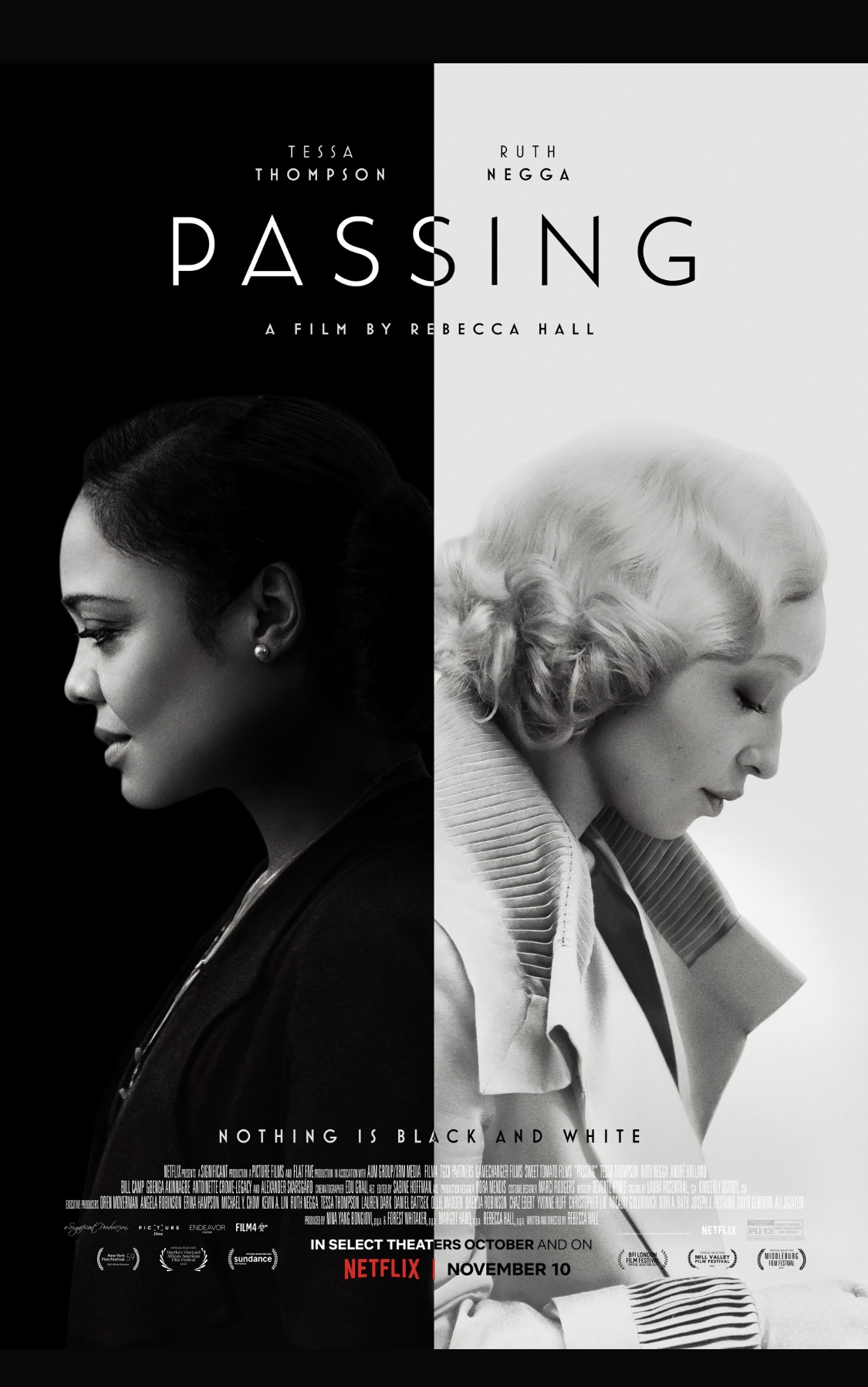 Greetings again from the darkness. “We’re all passing for something or other.” Irene (played by Tessa Thompson) speaks the line that cuts to the quick of Nella Larsen’s 1929 novel, adapted here by first time writer-director Rebecca Hall. We are familiar with Ms. Hall’s many film projects as an actor, and her debut as a director shows immense promise. Ms. Larsen’s novel was inspired by her own life as a mixed-race woman.
It’s Irene whom we first see as ‘passing’ as white as she visits a retail store and takes tea at a fancy restaurant that most assuredly would not serve her if her light complexion and drawn-down hat were not hiding her true self. Cinematographer Eduard Grau has the camera track Irene’s darting eyes that are trained to notice potential trouble. Her gaze stops on a woman seated alone. There is a familiarity between the two and soon, Clare (Ruth Negga) has joined her long-ago childhood friend, Irene, at her table. While Irene “passes” when it’s necessary, she clearly identifies and lives as an African-American – married to Harlem doctor Brian (Andre Holland). Clare, on the other hand, is living a lie. She has permanently “passed” as a white woman, marrying John (Alexander Skarsgard).
The film’s best scene occurs when Clare takes Irene home and introduces her to husband John. His vile, racist nature immediately shows, creating a tense moment filled with excruciating and subtle exchanges of knowing glances between Clare and Irene. It’s a dangerous moment and we aren’t sure where it’s headed. What is clear is that a childhood bond may exist between the two ladies, but there is now a void that can never be filled. But what happens is that Clare finagles her way into the lives of Irene and Brian (and their kids). What we see is that Clare finds the ‘honest’ life quite enticing. Allowing herself to be who she is … dropping the façade … energizes her. Racial identity and sexuality are at stake here, and so are class and culture.
Bill Camp plays a pompous writer named Hugh who always seems to be hanging around the same parties and events as Irene. One of the best lines of the film occurs after Bill asks someone why they are hanging around. The answer is brief and insightful, and cuts to the quick. It’s a strong debut film from director Hall. It has a dreamlike look and excellent performances from the two leading ladies. The grey area in life is teased, and we do wish the dive had been a bit deeper on Irene and Clare, but that ending is one that will stun you – even if you’re expecting it.
Streaming on Netflix
Leave a Comment » | Drama | Tagged: Alexander Skarsgard, Andre Holland, Bill Camp, Eduard Grau, Nella Larsen, Rebecca Hall, Ruth Negga, Tessa Thompson | Permalink
Posted by David Ferguson
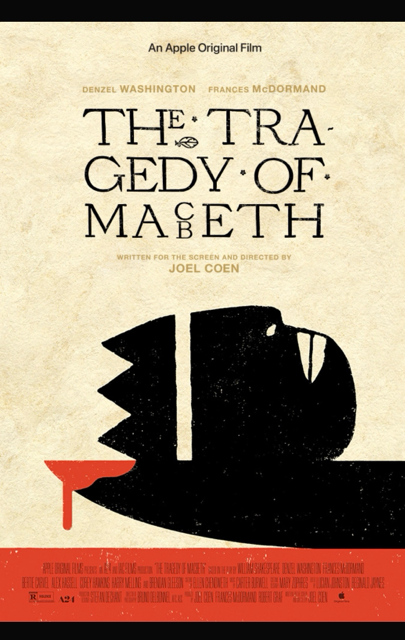 Greetings again from the darkness. The confounding part about screen adaptions of great and familiar literary works is that we have each already formed our mental images of characters and setting. Adapting Shakespeare’s 400 year old play is Joel Coen (4 time Oscar winner, NO COUNTRY FOR OLD MEN), and it’s also his first time to fly solo as director without his brother Ethan. Filmed in black and white on a sound stage, this production may lack the frills we’ve come to expect in modern times, yet while its stark sets recall German Expressionism, the film still manage to deliver memorable visuals.
Denzel Washington (2 time Oscar winner, TRAINING DAY, GLORY) stars as Macbeth, while Mr. Coen’s wife, Frances McDormand (4 time Oscar winner, NOMADLAND) is a perfect fit as the scheming Lady Macbeth. The absolute best and creepiest sequences are thanks to terrific work from stage actor Kathryn Hunter, who plays not one witch, but rather the trio (plus, in true Shakespearian fashion, a fourth character later). Ms. Hunter’s work is a highlight as she contorts her body and rings out prophecy with an exceedingly disturbing voice. She is fantastic. It’s the witches’ prophecy that Macbeth will become King of Scotland that sets into action a chain of events familiar to most of us.
The reasons this didn’t work as well for me as it did for others include Denzel’s extremely low-key performance in the first half, and more crucially, the film lacks that unbridled lust for power that so attracts me to this particular story. It struck me more as a story of a disgruntled couple than the timeless themes of corruption and lust for power that Shakespeare so expertly crafted. Denzel’s performance does come alive in the second half and he’s quite something to watch. However, it’s Ms. McDormand who nails the Lady Macbeth role and ensures our attention doesn’t drift. Although obvious, it must be noted that these two renowned actors are a bit old for the roles, but interesting enough, this elements adds a different perspective to the characters’ ambitions.
Supporting performances include Brendan Gleeson (is he ever not a standout?) as the ill-fated King Duncan, and Harry Melling as Malcolm and Matt Helm as Donalbain, Duncan’s two sons. Corey Hawkins plays Macduff, Bertie Carvel is Banquo, and Stephen Root is the scene-stealing (and comic relief) Porter. Cinematographer Bruno Delbonnel treats us to some creative shots and angles … and plenty of birds. But of course, it’s Denzel and McDormand who will make or break this for you.
Director Coen does include the familiar lines: “Something wicked this way comes” inspired writer Ray Bradbury, Lady Macbeth’s “out, damned spot” still packs a punch, while Macbeth’s “a tale full of sound and fury, signifying nothing” remains my personal favorite. With the stark sets, Coen serves up a shadowy presentation – or is it a presentation of shadows? It’s a blend of stage and screen, yet never fully both. Despite some of my displeasures and the long-lasting curse, overall it’s a welcome version of “the Scottish play” … although I still prefer reading The Bard’s prose.
Opening in theaters on December 25, 2021 and streaming on AppleTV+ on January 14, 2022
Leave a Comment » | Drama | Tagged: Bertie Carvel, Brendan Gleeson, Bruno Delbonnel, Corey Hawkins, Denzel Washington, Frances McDormand, Harry Melling, Joel Coen, Kathryn Hunter, Matt Helm, Stephen Root | Permalink
Posted by David Ferguson
 Movie Reviews from the Dark