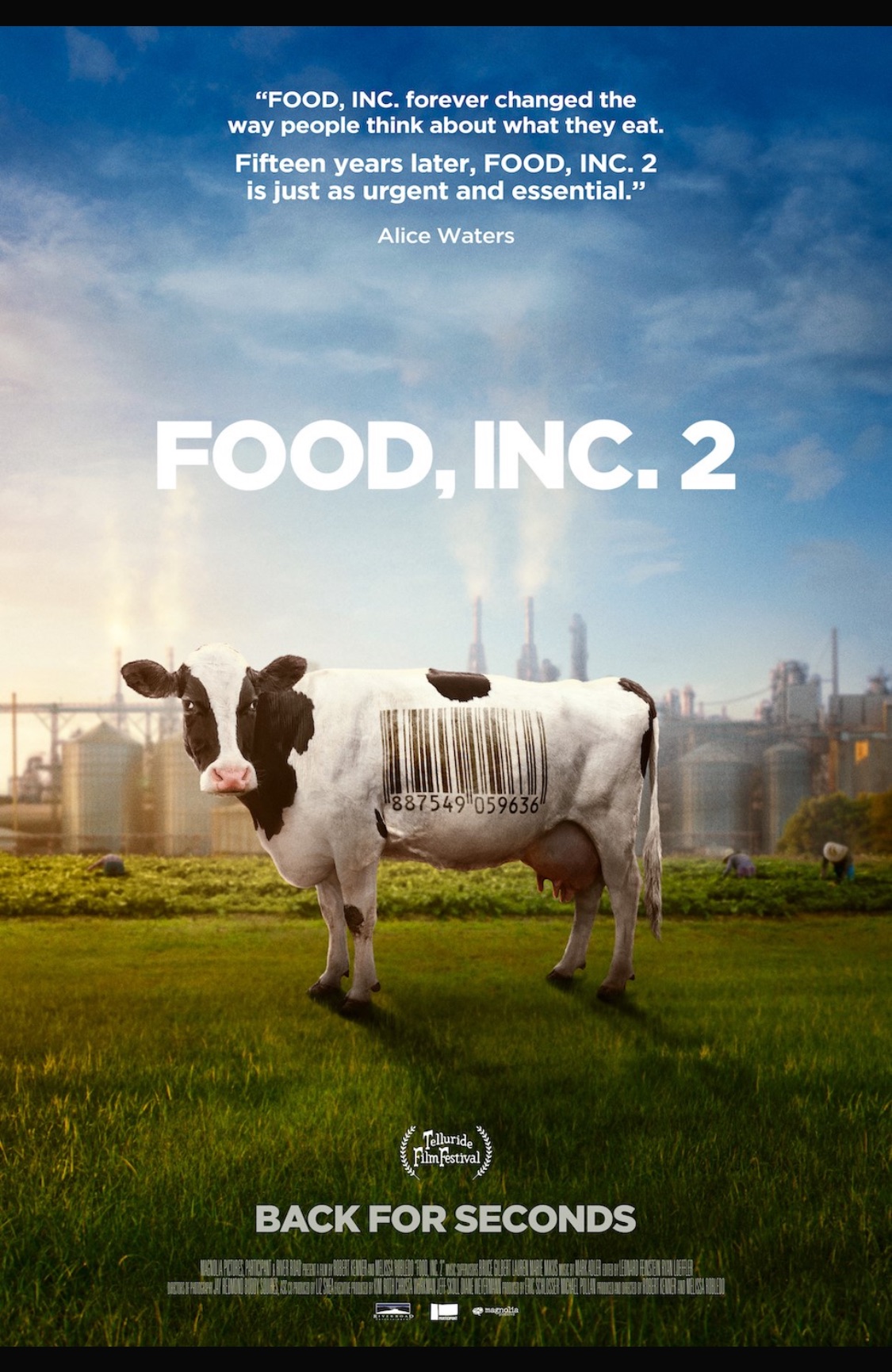
 Greetings again from the darkness. It’s likely director Robert Kenner and producer Melissa Robledo assumed their Oscar nominated documentary FOOD INC (2008) would generate change and improvement in what we eat and how our food supply works. To some extent they were correct, yet here we are 16 years later, and Kenner and Robledo are back with FOOD INC 2, this time as co-directors, to emphasize the dangers of having a few mega-corporations in control of what we eat.
That first documentary has been described as the beginning of “the food movement”, and it’s true that many people have improved their diet by focusing on more natural and organic food sources, and depending less on fast food and processed items. However, it’s also true that mergers and acquisitions have allowed food suppliers to get bigger and more powerful over those years … and the Pandemic contributed as well. That first film highlighted our overdependency on corn products, and has led to more local farmers markets and more organic offerings (although still at elevated prices).
This second film informs us that the pandemic exposed just how delicate (and wobbly) our system is. Supermarket shelves sat empty while farmers destroyed crops and animals. The filmmakers hope this film will be a catalyst for closer inspection on how the mega-food companies are controlling what we eat, with a focus on profits rather than nutrition. Author and journalist Michael Pollan and “Fast Food Nation” author Eric Schlosser are back to lend their knowledge and expertise and concerns. The concern regards monopolies within the various food segments.
Discussion is held regarding President Trump issuing a 2020 executive order citing the Defense Production Act to keep meat packer plants open despite COVID outbreaks. It’s reported here that most of the meat was shipped to China, but U.S. corporate greed and profits remained intact, although no concrete data is provided. Mostly they call for anti-trust laws to be enforced.
Specifics are provided in the various food segments. The filmmakers take us to Immokalee, Florida where mistreatment of migrant workers is the story; Iowa, where the Tyson plant COVID outbreaks are detailed; Wisconsin, where the dairy industry is mentioned; back to Iowa where crops and soil issues are identified; New Jersey, where US Senator Cory Booker of the Agriculture committee is interviewed; and Montana, where US Senator Jon Tester speaks from experience. The demise of family farms is a by-product of the mergers and trend toward bigger, and the most frightening aspect is in regards to “ultra-processed foods” … those with additives and artificial sweeteners. These are the driving force behind diabetes, obesity, and other diseases … and the changes in Brazil diets are especially telling on the last point.
The value in this documentary from Kenner and Robledo is in the information and details. We learn that the big companies are investing in alternative meat and food (such as Impossible Burger), while at the same time taking advantage of research and data focused on sweetness and calories. Foods from science labs may be our future, right along with innovation in “weird” farming sustainability (Stockcropper) and kelp fishing/harvesting in Connecticut. Farm-to-table school lunches in Camden, New Jersey provide us some hope, and we learn about the conflicts with the Fair Food Program and labor relations.
There are no easy answers when billions of people on the globe must be fed. What we must demand is that efforts in the field go towards nutrition and sustainability, and not just profits for a few mega-companies.
Here are some of the provided statistics:
Four companies have a stranglehold on 85% of beef processing.
Three companies dominate 83% of cold cereal.
Two companies control 70% of the carbonated soft drink market.
Two companies control 80% of the baby formula market.
Ultra-processed foods make up about 58% of US adults caloric intake.
Special theater screening on April 9, 2024 and on Digital beginning April 12, 2024


 Posted by David Ferguson
 Greetings again from the darkness. “This is more true than you’d think.” Director Thea Sharrock (ME BEFORE YOU, 2016) kicks off the film with this statement. The movie then proceeds to twist and stretch and outright change many of the details from the actual story and case outlined in the 2017 book, “The Littlehampton Libels: A Miscarriage of Justice and a Mystery about Words in 1920’s England” by Christopher Hilliard. However, from an entertainment perspective, the script from Jonny Sweet combined with the stellar British cast works pretty well as a glimpse of that era’s patriarchal society, as well as the need for attention from someone who has been stifled for far too long. And it even includes a few laughs along the way.
 Greetings again from the darkness. If you are one for whom hearing a particular song, no matter how many times over however many years, brings back vivid memories of a person close to you or a memorable event, then you will likely relate to Harriet, the lead character in this film from writer-director Ned Benson (THE DISAPPEARANCE OF ELEANOR RIGBY, 2014). Additionally, if you have tragically lost someone special to you and find yourself cloaked in unshakeable grief, then you will also likely find common ground with Harriet.

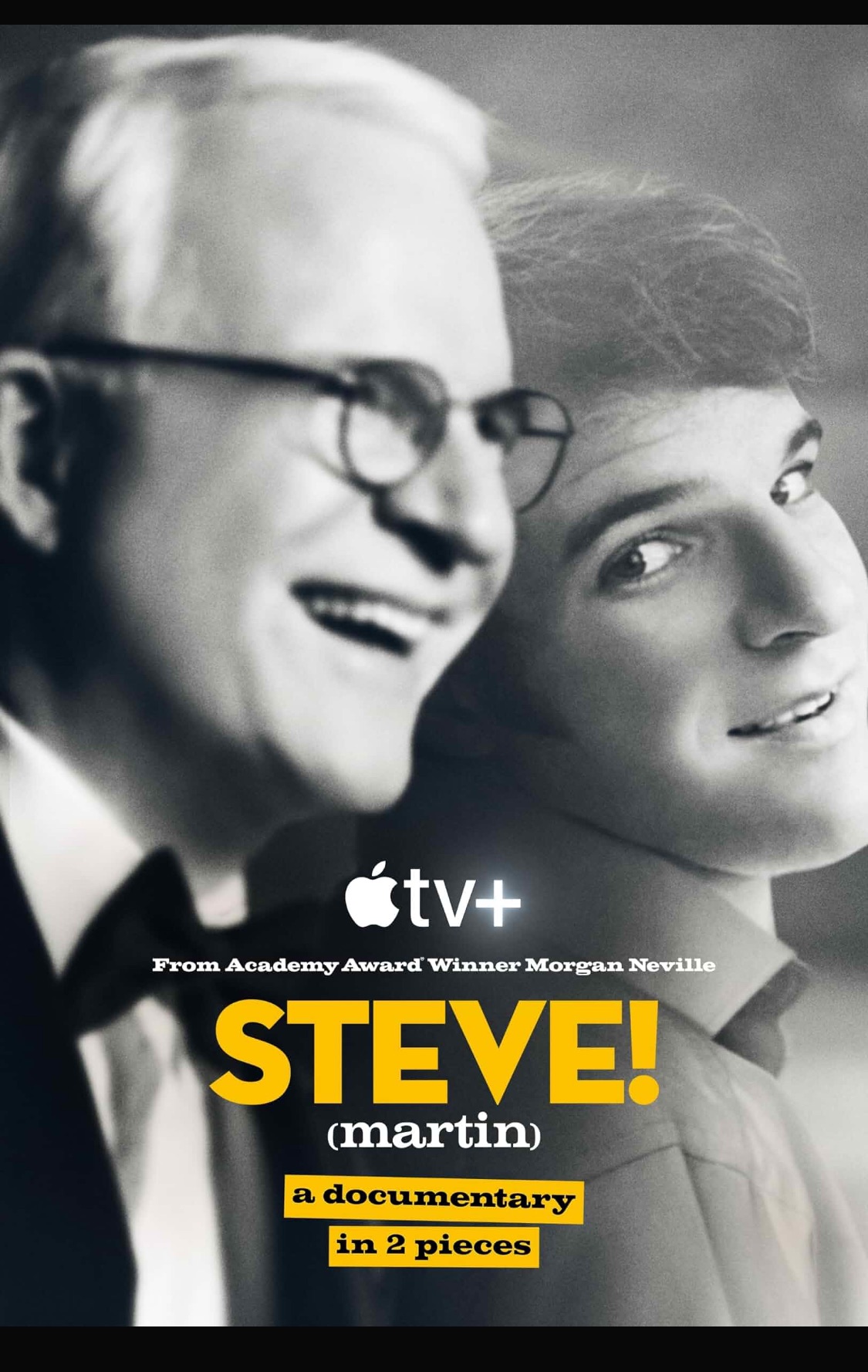 Greetings again from the darkness. We are now two full generations past the peak (and end) of Steve Martin’s superstardom as a stand-up comedian. Today, he is mostly known as a banjo player, a writer, or as one of the three co-stars of the hit show, “Only Murders in the Building”. That’s right. At almost 80 years of age, and removed from his two previous fame-inducing careers (comedian and movie star), he “only” has three remaining paths to fame, glory, and gobs of money. Regardless of the Steve Martin era studied, what stands out is his remarkable ability to entertain – something he says captured his fancy the very first time he saw a stage.
 Greetings again from the darkness. It’s easy to forget that Russell Crowe was once Oscar nominated three years in a row, winning Best Actor for Ridley Scott’s epic, GLADIATOR (2000), and has probably deserved two or three additional nominations. His reputation has not won him many industry friends over the years, but to his credit, he keeps plugging away – some minor roles in big films, and some lead roles in smaller films. Crowe can still command the screen with his presence, even when the material is slight (see THE POPE’S EXORCIST, 2023).
 Greetings again from the darkness. Co-directors Marlo McKenzie and Jonathan Parker have teamed up for one of the most ‘revealing’ documentaries you’ll ever watch. OK, all I can do is try my best to minimize the use of puns and double entendre as the review progresses. But that won’t be easy as the filmmakers strip away the excess and serve up a bouncy peek at one of the more influential figures driving cultural change in San Francisco during the 1960’s.
 The year of “Barbenheimer” concluded with one of the best and best-paced Oscars ceremonies in recent history. Of course, there were ups and downs … even an awkward Best Picture finale (which isn’t far off from becoming a tradition). Despite the bumps, the show served up plenty of entertainment for movie lovers and very few surprises for followers of the awards circuit.
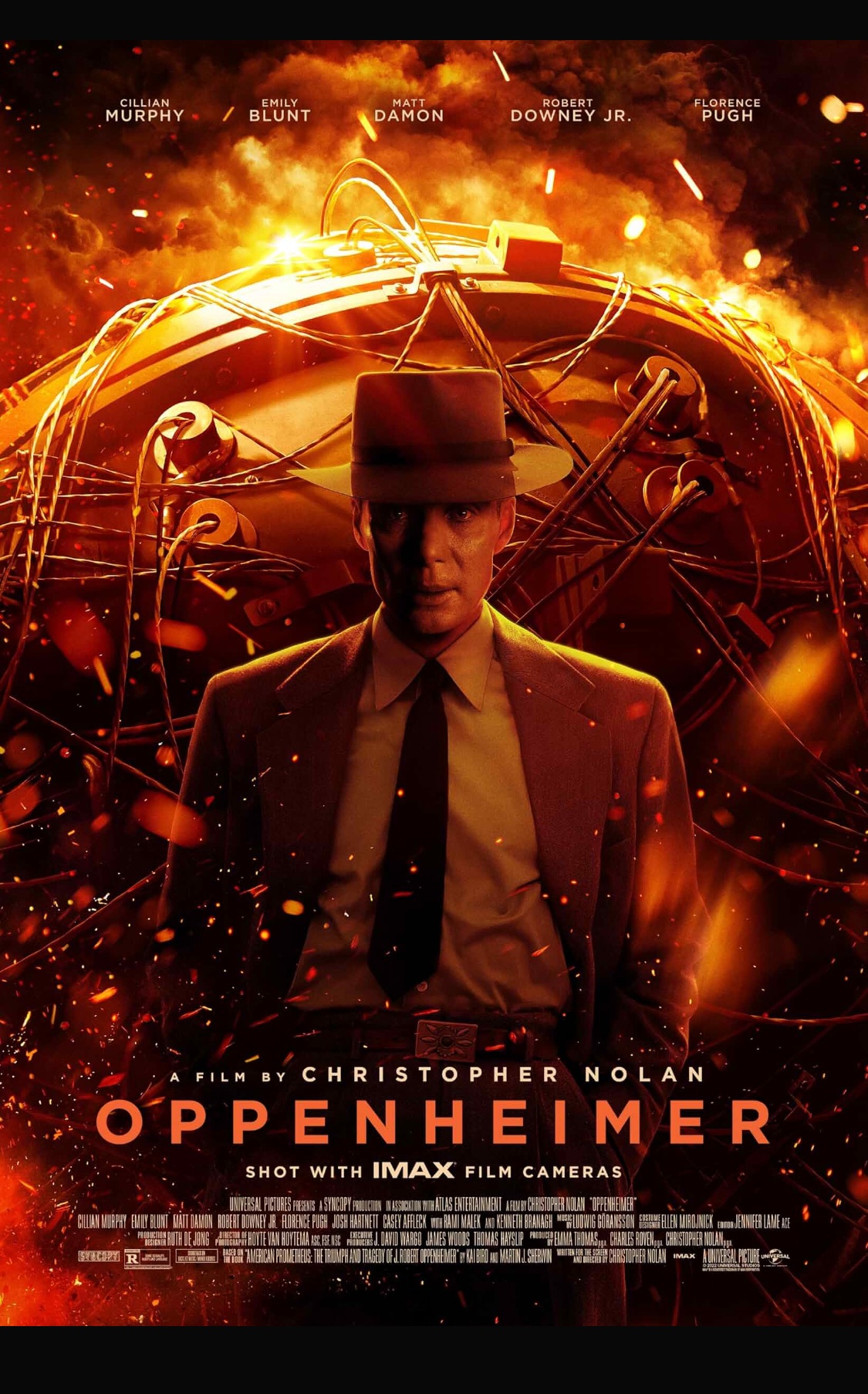 My favorite movie of the year, OPPENHEIMER, was the night’s big winner with 7 Oscars, including Best Picture. Christopher Nolan’s film is quite an achievement, juggling history, a deep roster of actors, and an era that now seems foreign to most people under 40. However, this film is only half of the “Barbenheimer” label, and the BARBIE faction delivered the showstopper thanks to sparkly pink suit attired Ryan Gosling and his rousing “I’m Just Ken”. It was the kind of spectacle and audience participation moment that will go down in Oscars lore.
 Greetings again from the darkness. The first feature film from writer-director Rose Glass was delayed almost two years due to COVID, but when SAINT MAUD hit in 2021, we knew immediately she was a filmmaker to watch. Along comes her second feature, co-written with Weronika Tofilska, and as a rare lesbian neo-noir, it’s sexy and violent and stylishly filmed … confirming Glass as one to follow.
 Greetings again from the darkness. Owning a home remains the American Dream, and being unrealistic about the topic makes one an American Dreamer. The first few scenes of the film make it obvious that American Dreamer is not just the title of Dr. Phil Loder’s in-progress novel, but also a term that describes him. This is Paul Dektor’s directorial debut, and the script is co-written by Theodore Melfi (HIDDEN FIGURES 2016, ST VINCENT 2014) and Christopher Wehner. It’s loosely based on a true story.

