FRAMING JOHN DELOREAN (2019, doc)

June 6, 2019

 Greetings again from the darkness. Hollywood is known for taking a real life person or event, embellishing the details, twisting the facts, and creating a fictionalized version meant to shock … or at least entertain. John DeLorean lived a life that made it almost too easy for Hollywood, yet numerous attempts at a biopic have stalled over the years. Co-directors Don Argott and Sheena M. Joyce were there to pick up the pieces and deliver a documentary with dramatized reenactments of actual (and hypothetical) moments. Co-writers Dan Greeney and Alexandra Orton assist with a cinematic version likely to cause those who recall actual events to marvel at the full story, and those too young to remember will likely find it difficult to believe … or perhaps, sadly, all too believable!

The film provides the backstory where John DeLorean was a talented engineer at General Motors and became a star on the rise within what at the time was the world’s largest corporation. Turning around GM’s flailing Pontiac division by introducing the GTO as a muscle car, DeLorean’s success was a mixture of technical knowledge, marketing savvy, risk-taking, swagger, and ambition. Despite his actions leading directly to higher profits and large executive bonus checks, the stodgy old school regime forced him out in 1973. DeLorean, seen as a swashbuckling rebel, started his own company, De Lorean Motor Company, with the unusual stated goal of mass producing exotic sports cars made of stainless steel.

The dramatizations and reenactments involve Alec Baldwin as DeLorean, Morena Baccarin as his (third) wife, supermodel Cristina Ferrare, and Josh Charles as Bill Collins, the chief engineer he ‘stole’ from GM. We even get a behind the scenes look as Baldwin discusses the role from the makeup chair, and Ms. Baccarin is interviewed on how she viewed Ms. Ferrare.  These dramatizations cover possible conversations between DeLorean and Collins, as well as home life with Ms. Ferrare and the kids, and are more distraction than help.

More effective than these “what if” segments, are the actual interviews with the real Bill Collins, as well as others who were involved at the time. Unfortunately, we only see the actual Ms. Ferrare in clips, as she understandably wouldn’t want to be relive this part of her life. However, their kids, Zach and Kathryn, are interviewed on camera. Both are quite forthcoming with their thoughts, recollections, and the impact of growing up as DeLoreans’ kids. Zach carries his hostility on his sleeve, while Kathryn offers a bit more reticence. Both reactions are understandable, and ‘the car vs the dad’ discussions are fascinating … and these interviews are the film’s high points.

Opening with FBI footage of DeLorean’s lie detector test administered in 1983, possibly the most interesting aspect from an overall perspective is the contrast between his trial for drug trafficking and his later trial for embezzlement. Despite his being a truly desperate man when he agreed to the drug deal, it seems quite obvious – as the jury found – that DeLorean was a victim of FBI entrapment (possibly the first time many of us had heard the word). In the aftermath of what was a media circus not dissimilar to OJ’s trial, we do hear from both defense attorney Howard Weitzman and prosecutor Robert Perry as to how each viewed the case. However, the shell company in Geneva and the aspects to his embezzlement lead us to believe DeLorean’s character was truly compromised – or possibly revealed.

From a business viewpoint, it was quite interesting to learn that DMC (De Lorean Motor Company) ended up being based in Belfast, Northern Ireland (a great trivia question) due to 30% unemployment and the large government subsidies meant to stimulate an economy in the dumps. The lack of infrastructure and a workforce with no automobile experience led to quality issues that were simply too great to overcome …especially when combined with other issues on Planet DeLorean.

John DeLorean led a flamboyant life and experienced a very public fall from grace. Screenwriter Bob Gale explains how the DeLorean car was chosen for the BACK TO THE FUTURE trilogy, and how a letter from DeLorean showed how much he still enjoyed the spotlight. Was DeLorean a renegade visionary or a con man? Was he a victim or a cut-throat businessman? Whatever your thoughts, he’s a textbook example of how the American Dream can come true, and still be followed by one’s worst nightmare. Sometimes there is no need to print the legend … fact will do just fine.

watch the trailer:


HALSTON (2019, doc)

June 6, 2019

 Greetings again from the darkness. My fashion of choice is jeans and an untucked shirt, but even a schlub like me recognizes the creative force that was Roy Halston Frowick. His impact as groundbreaking fashion designer Halston is beyond question. Jackie O’s pillbox hat?  Halston. The “hot pants” revolution in the 60’s? Halston. His innovations were first noted at Bergdorf Goodman, the iconic luxury department store on Fifth Avenue in Manhattan. Director Frederic Tcheng clearly understands the fashion world and was the right choice for this project. Mr. Tcheng’s previous documentaries include DIOR AND I (2014) and DIANA VREELAND: THE EYE HAS TO TRAVEL (2011). Here, he pays homage to Halston the designer, while also pulling back the curtain on Halston the man.

Despite the fascinating subject and an expert director, an odd choice was made for this documentary to feature a narrator – a fictional character narrator, “somebody working in the archives”. It seems to be a stretch in an attempt to make a more artistic film, but opening with a deep cut Elvis song, “Fame and Fortune”, any attempts to add interest to Halston’s story were unnecessary.

The film tracks Halston’s industry timeline and his 1968 break from Bergdorf to open his own salon. This led to his notoriety in the 70’s and put American fashion on the map – thanks in large part to his splash at the Versailles Fashion Show. Interviewees range from movie director Joel Schumacher (responsible for the less than artistic BATMAN & ROBIN, 1997), who partied hard with Halston; to model and actress Marisa Berenson, who walked the runway in his clothes and became a movie star; to Elsa Peretti, who created Halston fragrances and worked with him for years. There is also Liza Minelli who has worn Halston exclusively for decades. We get a glimpse at some of the Studio 54 parties, the Andy Warhol years, and Halston’s lavish lifestyle.

Much of the later years center around the impact of business dealings. In 1973, Norton-Simon acquired Halston and his brand, which is what drove the expansion into fragrances, shoes, furniture and more. We see his historic 1980 trip to China, and learn about his record-breaking $1 billion deal with JC Penney, a transaction outsiders described as he “moved from class to mass.” When Esmark (Playtex) purchased the brand and discovered that they owned the Halston brand name, Halston the man was booted from the company (1984). This allowed John David Ridge to become the designer of Halston.

We hear that Halston was a perfectionist – a demanding boss who was sometimes cruel to his staff and others. We’ve heard similar tales in regards to other artists. This is a man who designed for the world’s most fashion-conscious people, and for such diverse causes as The Olympics, the Girl Scouts, and Avis company uniforms. Having Esmark erase the Halston history may pale in comparison to the tragedy of having the designer die of AIDS in 1989 at age 57, but it’s unfortunate to say the least. By that time, he had disappeared from public life as his purpose and name were no longer his.

watch the trailer:


WOODSTOCK: THREE DAYS THAT DEFINED A GENERATION (2019, doc)

June 2, 2019

 Greetings again from the darkness. Michael Wadleigh’s 1970 film WOODSTOCK won the Oscar for Best Documentary, feature. The assistant director on the film was a 27 year old budding filmmaker named Martin Scorsese (three years before MEAN STREETS). The footage of the iconic bands, the groovy clothes, the heavy rain, and the mounds of trash fascinated those of us who wanted a taste of what the “peace and love” culture was all about. Co-directors Barak Goodman and Jamila Ephron take a different approach in honor of the festival’s 50th anniversary in this project for PBS’ “American Experience”.

Rather than focus on the extraordinary music, this film provides a glimpse into the arduous process of “how” to put on a huge event. Three years prior to the festival, a business meeting between four gentlemen: John Roberts, Joel Rosenman, Artie Kornfield and Michael Lang, began as a proposal to build a music studio in Woodstock, and instead evolved into a vision for an outdoor festival of music, art, and peace. This is the generation that fought in and protested the Vietnam War, saw their spokesperson Martin Luther King gun downed, and then had their savior Bobby Kennedy violently taken away. The youth of the counterculture were desperate for answers and hope.

Much of what we hear are recollections of those who were there. The memories and feelings of the time are presented as evidence of success. We also witness the behind-the-scenes obstacles and challenges faced by the event’s promoters. All of this comes courtesy of some never-before-seen footage and photographs.

With construction having begun (stage, fencing, etc), the town of Wallkill, NY had second thoughts about having 50,000 hippies descend on their town. That’s right. Initial estimates were off by about ten-fold to what actually happened. Five weeks prior to the festival, the town passed an ordinance prohibiting gatherings of more than 5000 people. This was a problem as acts were booked, tickets sold, and workers were being paid. Dairy farmer Max Yasgur offered up his 600 acre farm, and, frantically, the plan was revised and construction started anew. It was also very interesting to note that the word of the festival was spread through the alternative press. Of course, no social media existed at the time, so getting the word out to the country was especially challenging.

It can be argued whether the Woodstock festival held August 15-17, 1969 in Bethel, NY actually defined a generation, but there is no debating that pulling off such a peaceful event in the face of challenges like political backlash, bad weather, bad drugs, a food shortage, and a crush of humanity, was quite remarkable. No mention is made of the tragedy that unfolded a mere four months later at Altamont, but it’s quite a contrast to the crowd control provided by Wavy Gravy of Hog Farm, the “freak out” tents for bad drug trips, and a community of citizens who emptied their pantries in order to provide food and beverage for thousands in need.

And yes … we do get some samples of the music. We learn Richie Havens was the first act to go on stage simply because he was “there”. He then proceeded to create his iconic “Freedom” spontaneously in front of the audience. Day 2 attendance jumped by at least 100,000 to experience Sly and the Family Stone, and of course, The Who. We get a glimpse of the first ever live show from Crosby, Stills and Nash, and hear farmer Max Yasgur’s complimentary words to the crowd. Peace and Love indeed.

watch the trailer:


ROCKETMAN (2019)

May 30, 2019

 Greetings again from the darkness. It’s billed as a musical fantasy. If you are familiar with Elton John’s discography and history, you’ll want to keep that in mind as the film unfolds. The reward is a colorful spectacle worthy of one of pop music’s most successful songwriters and greatest showmen. Director Dexter Fletcher (EDDIE THE EAGLE, 2015) and writer Lee Hall (BILLY ELLIOT, 2000) make frequent use of Elton’s music within the fabric of the storytelling. It’s no traditional biopic, nor should it be, given the wild ride of the man whose story is being told.

Taron Egerton tears into playing Elton John like it’s the role of a lifetime. And he succeeds in a way that makes it seem that could be true. Most of us first recognized Taron’s talent as “Eggsy” in KINGSMAN: THE SECRET SERVICE (2014), though I’m not sure we expected such a dynamic step up so soon. This is not some actor merely mimicking the movements of a celebrity. This is an actor taking possession of a role. Without the costumes, Taron doesn’t look much like Elton John. He certainly doesn’t sound like Elton John … though his voice does justice to the classic songs. Despite those things, he is captivating on screen, both in the dramatic moments and the musical mania.

Elton’s childhood and the strained relationship he had with his parents (played here by Bryce Dallas Howard and Steven Macintosh) are given much attention, as is the support and love of his grandmother (Gemma Jones). With two self-centered parents wishing he didn’t exist, the child piano prodigy might never have attended the Royal Academy of Music if not for grandmother Ivy. Of course, the professional relationship that meant the most to Elton’s career was his songwriting collaboration with lyricist Bernie Taupin (Jamie Bell), and much of the film is devoted to this prolific partnership – in fact, one of the most spine-tingling moments occurs as Bernie hands Elton the words to “Your Song” and Elton proceeds to set it to music right in front of us and Bernie. Whether that’s historically accurate or not, it provides a thrilling moment on screen for the creative duo.

Elton John in rehab is used as a framing device for the film. This allows him to walk us through his life … after admitting to having issues with drugs, alcohol, sex, shopping and anger. In other words, one of the most successful musicians of all time was a mess. And we get to sit front row as he details his early sexual confusion, his desire to be loved, his early professional frustration, and finally a career that exploded – covering him with money, adoration, stress, and more frustration. We see the warts and all.

Supporting roles are filled by Richard Madden as John Reid, Elton’s lover and manager; Tate Donovan as Doug Weston, owner of Sunset Blvd’s Troubadour; Rachel Muldoon as Kiki Dee, Elton’s collaborator on  their big hit “Don’t Go Breaking My Heart”; and Stephen Graham as Dick James, the famous music publisher who first signed Elton.

As someone whose favorite Elton albums are “Tumbleweed Connection”, “Madman Across the Water”, and “Honky Chateau”, it’s easy for me to appreciate the time period covered here (roughly 1970-1983), and also to recognize the ‘artistic license’ taken with the timelines and events. His 1970 gig at Troubadour features a rowdy version of “Crocodile Rock”, which wasn’t even written yet … although the scene makes for great cinema. Many of the songs that advance the story are used out of sequence, but it’s quite effective to see and hear them in context. His marriage to Renate Blauel and the rehab stint featured both occurred after 1983, which we can assume is the story’s stopping point given the use of the “I’m Still Standing” video as a finale. Even the use of John Lennon over Long John Baldry doesn’t really matter since this is all about the spectacle, and for spectacle, you’ve likely never seen costumes (including eyeglasses and headdresses) used to such startling effect … and so frequently. The baseball “uniform” Elton wore during his 1975 Dodger Stadium gig has always made me a bit uncomfortable, but it’s recreated beautifully for the film.

Given that comparisons to the recent BOHEMIAN RHAPSODY are inevitable, it should be noted that director Dexter Fletcher rescued the final production of that film before finishing this one. Freddie Mercury and Elton John are two of the most fascinating figures in music history, and while both films are enjoyable, it’s ROCKETMAN that is willing to take the riskier path by highlighting the flaws of a creative genius. So criticize if you must, but you’ll probably still be singing in your seat.

watch the trailer:


THE SOUVENIR (2019)

May 30, 2019

 Greetings again from the darkness. Viewers of writer-director Joanna Hogg’s semi-autobiographical feature will likely be divided into two distinct groups: those who find it to be a beautifully artistic psychological study, and those who find it to be a painfully slow watch. Fortunately, most who would fall into the latter group will likely skip it altogether, and we can only hope those in the first group will seek it out and encourage similar-minded film fans to attend. Surely both groups can agree that it features a terrific breakout lead performance from Honor Swinton Byrne (daughter of Tilda Swinton).

Ms. Swinton-Byrne stars as Julie, a young London film school student. She’s soon drawn to Anthony (Tom Burke), an odd man who is somehow simultaneously laid back and condescending. Their relationship builds as he works some vague job at the Foreign Office, and giving every indication that something’s not quite right. Many moments of normal life are shown; however we soon learn that Anthony is a master manipulator, and his off-handed requests for ‘a tenner’ or sticking Julie with a restaurant tab go deeper than being a simple jerk. We know heartbreak is coming for her; we just don’t know how when or how hard.

Tilda Swinton (a long-time friend of director Hogg) appears in a few scenes as Julie’s mom, and as you would expect, she perfectly captures the mother-daughter dynamics. Of course Julie is a film student struggling to make ends meet, but with her frequent requests for ‘mom loans’ coinciding with the Anthony relationship, mother knows best. Jean-Honore Fragonard’s 18th century painting gives the film its title, and provides a terrific scene with Julie and Anthony.

Later, when Anthony tells Julie, “You’re inviting me to do this to you”, we recognize this is an abusive relationship similar to those many women have endured. Set in the 1980’s, a doomed relationship looks eerily similar regardless of the era. The film serves as an example of how we sit in judgment of the love lives of others, while often remaining blind (or is it hopelessly optimistic) to our own relationship issues.

Ms. Hogg shot on film and there are some memorable shots throughout – especially within Julie’s apartment. There is a recurring split-screen shot where a wall divides what we see in the kitchen with what’s happening in the living area – we see characters on each side. This is the anti-Marvel movie. No special effects. No superheroes. And the only worlds in peril are those of average, flawed people like us.

There is a segment involving an analysis of Hitchcock’s PSYCHO, and it’s clear director Hogg learned lessons about what not to show. There is also a reference to another Hitchcock classic with the tailored grey suit Tom buys for Julie and their trip to Venice. Alfonso Cuaron scored big with ROMA, a very intimate look at his personal life, and filmmaker Hogg’s film is in that same vein. It’s extremely well made and beautiful to look at, and is likely to be quite challenging for viewers. The payoff comes after much patience and effort and investment into figuring out these characters. It’s an arthouse film with improvised dialogue (bonus points for Joe Jackson’s “Is She Really Going Out with Him?”). This was a grand jury prize winner at Sundance, and the sequel is already in production … good news for some of us, while inexplicable to others.

watch the trailer:


ASK DR. RUTH (doc, 2019)

May 30, 2019

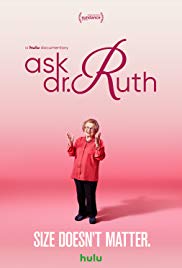
 Greetings again from the darkness. Your impression of Dr. Ruth Westheimer might be that of a little old lady who offers up entertaining segments on talk shows, or maybe even more extreme, that of a carnival-type sideshow meant to shock with its taboo topics. Director Ryan White (THE CASE AGAINST 8) profiles the now 90 year old (she turns 91 next week) icon and we are treated to a wonderful story of a fascinating self-made woman.

Karola Ruth Siegel was born in Germany and her parents shipped her to an orphanage in Switzerland at age 10 to protect her from the Nazis and the war. Though her parents did not survive the war, young Karola did and director White allows the adult woman, now known as Ruth Westheimer, to retrace the steps that resulted in her becoming a world renowned sex therapist, speaker, educator and author. Some of the filming takes place inside her Washington Heights, NY apartment … her home for the past 54 years.

Animation is used to fill in the gaps of her childhood, as a narrator reads passages from the young girl’s diary. Her own words connect two worlds – that of a lost child and those of today’s strong woman whose work has impacted so many. Sure, Dr. Ruth has her critics, but she was a solitary voice of help and knowledge at a time “Sexually Speaking” (the name of her first radio show) was still not done in public. This tiny (4’7”) woman with German-accented English spoke directly to her audience (many who chuckled or turned crimson with embarrassment) about matters that were causing much emotional turmoil – matters that were killing relationships. She was truly a life saver for many.

Educated at Columbia and Cornell, Ruth earned her Ph.D. and became a licensed sex therapist. It was her matter-of-fact delivery of facts and insight that made her so popular on radio and TV. Now, in her 90’s, she still teaches two classes, makes appearances as a guest lecturer, writes books (published more than 60), writes a regular newspaper column, and travels the globe entertaining and educating young and old alike. This is a busy, focused woman.

Dr. Ruth was a calm voice in the storm of the initial AIDS/HIV epidemic as she reserved judgment and dispensed facts, while encouraging care and empathy. We learn she has espoused speaking of politics in public and doesn’t much believe in “normal” as a description to be applied to anything. Pierre Lehu, her long-time Director of Communications admits they speak by phone 25-30 times per day. Most people half her age live daily lives much less busy.

Director White opens the film with Dr. Ruth asking Alexa if she’s going to get a boyfriend. Her playful side is still evident, but quickly shifts into all-business mode when required. We hear from her daughter and son, as well as her 3 grandkids. We learn of her 3 husbands, and the situation with each. Did you know she was trained as a sniper in the Jewish Underground Army? Well there’s a segment on that. She was a rare single mother in the U.S. in 1958 and transformed herself into “Grandma Freud”. By the end, we know this spirited woman would have survived and been successful in whatever path she chose. Many are thankful she still walks that path.

watch the trailer:


BOOKSMART (2019)

May 23, 2019

 Greetings again from the darkness. Every generation tends to get the high school movie (the movie about high school life) they deserve. Going back to James Dean in REBEL WITHOUT A CAUSE (1955) and Sidney Poitier in TO SIR WITH LOVE (1967), what followed were such memorable films as CARRIE (1976), GREASE (1978), FAST TIMES AT RIDGEMONT HIGH (1982), most every John Hughes movie from the 80’s, FERRIS BUELLER’S DAY OFF (1986), SAY ANYTHING (1989), DAZED AND CONFUSED (1993), CLUELESS (1995), 10 THINGS I HATE ABOUT YOU (1999), MEAN GIRLS (2004), HIGH SCHOOL MUSICAL (2006), JUNO (2007), and SUPERBAD (2007). It’s that last one on the list that this directorial debut from Olivia Wilde is likely to draw the most comparisons to.

Kaitlyn Dever (“Justified”) and Beanie Feldstein (LADY BIRD, and sister of Jonah Hill) star as Amy and Molly, two best friends and high school seniors who have sacrificed a social life (i.e. partying) for academics in order to position themselves for the best colleges. Amy has decided to take a gap year doing charity work in Botswana, while Molly wears her intelligence and class ranking on her sleeve and sits in judgement of her less disciplined classmates. She is headed to Yale with her ultimate life goal being an appointment to the Supreme Court (she has an RBG poster up in her room).

Imagine their shock when, the day before graduation, Amy and Molly discover that many of their less-disciplined (i.e. hard partying) classmates will also be attending elite schools. The besties immediately scheme to make up for 4 years of nose-to-the-grindstone by attending the biggest party of the year … and showing others how much fun they can be. Plus, the party affords each the opportunity to pursue their crush: skater-girl Ryan (Victoria Ruesga) for Amy, and athlete Nick (Mason Gooding) for Molly.

Although (full disclosure) I was never a high school girl, the one thing that stands out about the film is how the kids seem like real kids. That’s not to say most every aspect isn’t slightly exaggerated, because it is. The level of gayness in the Drama club is a bit difficult to take, and the teenage body is objectified in more than one shot; however, director Wilde has a knack for making high school look cinematic. Two sequences are particular standouts for the way they are filmed: the swimming pool scene with Amy underwater, and the house party as the characters weave in and out of rooms in the large house

Supporting roles add depth to the comedy thanks to Jason Sudeikis as the school Principal/Lyft driver; Billie Lourd (daughter of Carrie Fisher) as Gigi, who is always popping up and stealing scenes; Lisa Kudrow and Will Forte as Amy’s parents; Molly Gordon (“Animal Kingdom”) as the misunderstood ‘Triple A’; the aforementioned Victoria Ruesga and Mason Gooding; and star-in-the-making Diana Silvers as Hope – the aptly named rebel who clicks with Amy.

Co-written by Susanna Fogel, Emily Halpern, Sarah Haskins, and Katie Silberman, the film presents a realistic friendship between two teenage girls, and mines some common and recognizable personalities for comedy gold. Smart and funny female characters are interesting at any age, and “no one knows me” is the anthem of most every high school student since caveman days. The inevitable comparisons to SUPERBAD will likely be favorable to this film, and it will probably be the perfect fit for this generation – even if we hope most students avoid many of the happenings. With Will Ferrell and Adam McKay as producers, you should prepare for the harsh language high school kids are known for, as well as that ‘brazen, yet insecure’ blend so common to the age. Of course, we can’t help but find the timing of release quite interesting, given the recent college admissions scandal. It won’t replace AMERICAN GRAFFITI for me, but with Olivia Wilde having been known as an actress, we now recognize her as a legitimate director.

watch the trailer:


ASBURY PARK: RIOT, REDEMPTION, ROCK N ROLL (2019, doc)

May 23, 2019

 Greetings again from the darkness. Ask most people what they think of when you mention Asbury Park, New Jersey, and the vast majority would answer Bruce Springsteen. In today’s global music climate, it’s rare for a musician to be so closely associated with a city or geographic area. Perhaps only Elvis and Memphis eclipses The Boss and Jersey. However it’s important to note that this documentary from director Tom Jones (no, not that one) is not the story of Bruce, but rather a historic tale of a divided city whose music defined a generation.

New Jersey radio personality Big Joe Henry narrates the film, and we learn Asbury Park was founded in 1871, and became a town literally divided by railroad tracks (not the proverbial kind). The East side was populated with well-off citizens and tourists, while the West side was comprised of working class and minorities. Though only 1 square mile in size, the city’s division and segregation was clear and beyond question. Of course, the one aspect those tracks couldn’t stop was the music.

What happened in the 1960’s was a blend of jazz, soul, R&B, rock and blues. Music acted as a uniter in the evenings after the daytime maintained the line of demarcation. We hear the stories from the local musicians who thrived during the era: Steven Van Zandt, Southside Johnny Lyon, David Sancious, Max Weinberg, Garry Talent, Vini “Mad Dog” Lopez, and Edward Carter among others. To top it off, we get New Jersey’s own Bruce Springsteen casually lounging on a chair (well-lighted, mind you) within the walls of the infamous Upstage Club, deserted for more than 40 years, but looking pretty much the same as it did when a young Bruce and all of the previously named musicians played there.

July 4, 1970, changed everything for Asbury Park. Race riots, police, destruction, and fire. The city went through some dark times. Urban blight prevailed on the west side, and to this day it has not recovered. On the other side of the tracks, the east side has bounced back with music, the boardwalk and resorts leading the way. The Empress Hotel features The Paradise Club, a favorite establishment for the gay community … a community that has been behind much of the town’s resurgence.

It’s quite fascinating to have these local musicians recalling their own memories, and how the artistic freedom provided by The Upstage allowed their music to blossom. Asbury Park is described as “the Liverpool of America”, and through these passionate interviews, we get a taste of how. Not much actual music is included in the film, though near the end, we see clips of Springsteen joining Steve Van Zandt on stage with some young students from the local Lake House Music Academy. The film is co-sponsored by Jersey Mike’s and Halo X media, with much of the proceeds going to youth music programs. The only way this could have ended better would have been Bruce playing Ten Years After’s “I’m Going Home” … for 30 minutes.

watch the trailer:


ALADDIN (2019)

May 22, 2019

 Greetings again from the darkness. Aladdin … come on down!  You are the next participant in Disney’s ongoing mission for live-action remakes of their classic films. And rest easy fans, this time the mega-studio has done right by the original. Now that doesn’t mean there aren’t surprises. How about Guy Ritchie as director?  How about a cast of mostly unknowns? How about modernized songs and even a new one sung by Jasmine? And it probably goes without asking, but how about a lot of CGI?

Mena Massoud (“Tom Clancy’s Jack Ryan”) stars as Aladdin, and he gets to showboat early in the film and flash some parkour skills in the familiar and high-octane chase through the village. Aladdin, of course, is labeled a ‘street rat’ and ‘riff-raff’, but he’s also charming, handsome, talented as a thief, and quite warm-hearted. He and his pet monkey Abu – or more accurately, partner in crime – are streetwise and work quite well together, both for theft and love.

Naomi Scott (slated to star in the CHARLIE’S ANGELS movie coming out later this year) is a beautiful and ambitious Princess Jasmine, who wants to succeed her father as Sultan of Agrabah, but is instead forced to choose between a steady stream of suitors – each a Prince, as required by law. Ms. Scott has a terrific singing voice and really gets to cut loose on the new woman power song “Speechless”.

The blue Genie is played by Will Smith, and this is what has fans of the beloved 1992 animated film so flustered. No, Will Smith is not Robin Williams, and few if any, could match the late great comedian for his energy and comedic flair. But Mr. Smith does a marvelous job of staying true to the original, while also adding his own style … a style that works very well for comedy, music, and dramatic moments. He is not likely to disappoint anyone who has an open mind.

So let’s talk about the villain. Marwan Kenzari is Jafar, the man so dissatisfied with being number 2. Personally, I would have preferred a more intimidating bad guy, but given the tone of the film (more on that below), he’s a solid fit. His sidekick and smart-aleck parrot Iago is voiced by Alan Tudyk (it was the distinctive Gilbert Gottfried in the 1992 version). Two other key supporting roles include Nasim Padrad (“Saturday Night Live”) as Dalla, Jasmine’s handmaiden; and Navid Negahban (Abu Nazir in “Homeland”) as the Sultan and Jasmine’s father.

It’s been 27 years since Robin Williams’ Genie entertained so many, and the comparisons to that version are inevitable. It’s a relief that Disney opted to keep the film family friendly (Rated PG) and avoid the dark tone that had their recent projects aimed more at adults than kids, rather than the balance they’ve been known for more than 6 decades. Yes, this is the same director that made SNATCH (2000) and SHERLOCK HOLMES (2009), neither of which any decent parent would allow their young kids to watch. But, Mr. Ritchie has delivered a film which entertained (and didn’t overly frighten) kids as young as 5 in the screening I attended.

Director Ritchie co-wrote the script with John August, who is best known for his work with Tim Burton (BIG FISH, CHARLIE AND THE CHOCOLATE FACTORY, CORPSE BRIDE, DARK SHADOWS, FRANKENWEENIE). The film runs 2 hours and 8 minutes, 38 longer than the 1992 film … though it doesn’t feel too long. Gemma Jackson’s set design of Agrabah, the Palace, and the Cave of Wonders are all stunning, and then of course, there is the music. Alan Menken won an Oscar for ALADDIN (1992) and his music is back and modernized, and sounds wonderful … especially “A Whole New World” and Jasmine’s new song.

With a talented cast of Arab/Middle Eastern/Central Asian/Southern Asian actors, there should be no cries of “foul”, and there really is something special about a movie that can be thoroughly enjoyed by all ages. The Bollywood-type closing number provides a kaleidoscope of color, texture and dancing … and is a nice twist to “You’ve Never Had a Friend Like Me”. And I’ll leave you with this final offer: you can have the monkey, if I can have the magic carpet.

watch the trailer:


JOHN WICK 3: PARABELLUM (2019)

May 16, 2019

 Greetings again from the darkness. Worlds are colliding! No, no … not in the way of “The Avengers” movies, but it’s kind of hard not to smile when Keanu Reeves and Laurence Fishburne share a scene (or two) in a mini-reunion of THE MATRIX. Mr. Reeves and director Chad Stahelski are back for a third time, and somehow they manage to raise the bar yet again on the fight sequences. And let’s face it, the fighting and action are why so many are drawn to this franchise. This latest entry runs 2 hours and 10 minutes, and almost every bit is a frantic chase scene or violent fight … or both.

The film picks up mere moments after JOHN WICK: CHAPTER 2 ended. If you recall, John had killed a member of the High Table inside the Continental Hotel, an unforgivable break in the treasured rules. Winston (Ian McShane), the manager of the hotel, has given his friend a one hour head start prior to issuing the “excommunicado”. It’s that order (and the $14 million bounty) that sends every assassin on the planet on Wick’s trail.

No need to wait for the good stuff … the film’s first two fight sequences are extraordinary feats of stunt coordination, and consume the first 15-20 minutes. Here is what John Wick (and we viewers) are in for: Guns (many kinds), lots of knives, a hatchet, swords, a book, enough broken glass to fill a recycle center, horses, motorcycles, cars, every martial art known to man, highly trained dogs, a public library, a museum/collectibles display, a stable, and a ballet theatre complete with dancers. There is even a current NBA player, 7’3” Boban Marjonovic, who battles John Wick and ultimately learns books can be used for something other than reading.

John Wick’s background is revealed, and his general level of tiredness reaches exhaustion, which actually adds an element to a character who is quite efficient with his conversation. There are a few people who are called on to help Wick, in particular we have Laurence Fishburne as the Bowery King, Anjelica Huston as the Ballet Director, and Halle Berry as Sophia, a former assassin who now runs the Continental Hotel in Morocco. See, even an underworld crime syndicate promotes from within. The segment with Sophia is one of the most fun, and it’s not because of Ms. Berry. Rather her beautiful and highly-trained dogs are scene stealers who are devastating in their commitment to carry out orders.

Other characters of interest include Asia Kate Dillon (“Billions”) as the Adjudicator, one who enjoys doling out punishment; Mark Dacascos (Wo Fat in “Hawaii 5-0) as Zero, the ultimate Wick fanboy who wants nothing more than to be the one who kills him; Jerome Flynn (“Game of Thrones”) as Berrada, the senior official who doesn’t negotiate fairly; Said Taghmaoui as The Elder from the High Table, who listens to Wick’s proposal. Other supporting roles are filled admirably by Robin Lord Taylor, Jason Mantzoukas and Susan Blommaert.  Of course, some of the most fun occurs again at The Continental Hotel as Reeves’ Wick interacts with Lance Reddick and Ian McShane.

From the department of “Give ‘em what they want”, the film has a very similar look, feel and tone to the first two, but director Stahelski (a standout stunt coordinator) and writers Derek Kolstad, Shay Hatten, Chris Collins, and Mark Abrams keep it fresh with new characters, new props and some terrific set design. The early model computers are contrasted with the high tech gadgetry of the Continental, and with a body count likely higher than the first two films combined, this entry can best be described as brutally entertaining … is that even a thing?  The violence is vivid and excessive and non-stop, and if that’s not your style, you should at least know that the title is taken from the Latin “Si vis pacem, para bellum” – If you want peace, prepare for war.

watch the trailer: