KATIE SAYS GOODBYE (2017)

June 6, 2019

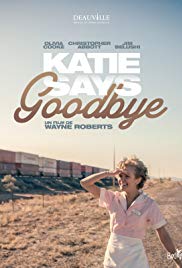
 Greetings again from the darkness. This little gem played at the 2017 Dallas International Film Festival, and at that time, I wrote about how writer/director Wayne Roberts was one of the new and most exciting filmmakers to burst on the scene. Now, more than two years later, the film is finally getting the distribution it deserves, and I still worry there will be those who decry another film exploiting women as a victim of society. I also still stand behind my case that there is another way to view the story of Katie, a good-hearted dreamer played beautifully by Olivia Cooke (“Bates Motel”, THOROUGHBREDS, READY PLAYER ONE).

Initially, Katie’s unflappable optimism seems unlikely, if not impossible. She walks miles to work along a dusty highway. She lives in a trailer park with her deadbeat mother (Mireille Enos), whom she supports both financially and emotionally. She works double-shifts as a waitress at a truck stop, where she’s known to toss in a couple extra bucks when a particularly frugal customer stiffs the other waitress. She also works a side job as a prostitute for locals and a regular trucker named Bear (Jim Belushi). Despite a life filled with *stuff*, Katie doggedly pursues her dream of saving enough money to move to San Francisco and become a hair stylist. Of course, since she’s cursed with a heart of gold, she has to save enough money for her own trip AND for her mother to live on. Her dream seems lofty, yet almost achievable.

When Katie falls for Bruno (Christopher Abbott), the new guy in town, she tries her best to fall in love and pull him into her dreams for a better life. It doesn’t take long before Bruno is made aware of Katie’s side job, and her fantasy world begins to crumble. On a daily basis, Katie happily (of course) drinks up the truck stop wisdom of diner owner Maybelle (Mary Steenburgen), who spouts such gems as “A man with a smile will hurt you”. Good intentions abound here, but we realize … even if Katie doesn’t … that the reality of people’s self-interest is the immovable object that so often tears down the dreamers of the world.

As with much of life, one’s enjoyment of the film is likely contingent upon the perspective you bring. A caustic, cynical view will have you waving off Katie’s lot in life as exploitive movie-making; while those who can share even a spoonful of Katie’s spirit, will find themselves rooting exuberantly for her dreams to come true … or at least to sustain her refreshing outlook on life and people. Director Roberts recently released his newest, THE PROFESSOR, starring Johnny Depp. He remains a filmmaker to follow.

watch the trailer:


ECHO IN THE CANYON (2019, doc)

June 6, 2019

 Greetings again from the darkness. “Go Where You Wanna Go”, a catchy pop song by The Mamas and the Papas, always seemed a quintessential 1960’s song, but now, thanks to an insightful interview with singer Michelle Phillips in this new documentary, it’s a reminder that even the era’s free love carried a price. Director Andrew Slater, the former President of Capital Records, combines the nostalgia associated with the California Sound with the contemporary staying power of the songs and the musicians.

Jakob Dylan of The Wallflowers (and Bob’s son) is really the face of the film. Not only does he conduct most of the (many) interviews, he’s also the driving force behind the 2015 concert at the Orpheum Theatre celebrating the 50th anniversary of The Byrds debut album … an album we are told kicked off the fusion of folk and rock. Dylan’s first interview is with the legendary Tom Petty (in one of his final interviews before suddenly passing away in 2017). The two are sitting in a guitar shop with Petty regaling the brilliance of a Rickenback, and how the music of 1965-67 influenced him as a songwriter and musician.

An aerial view of Laurel Canyon accompanies its description as the antithesis of the plastic TV world of the 1960’s. It was an area that attracted bohemians – musicians, artists, and actors – and collaboration and community were the calling.  Jackson Browne and Tom Petty both mention “cross-pollination” … the “borrowing” of ideas from each other, as it’s contrasted with outright theft.

The concert at the Orpheum acts a bit as a framing device, and Jakob Dylan takes the lead and performs with other modern day acts such as Regina Spektor, Beck, Jade, Fiona Apple, Cat Power and Norah Jones. We cut to modern versions of the 60’s classics after an interview with the original artist or clip of the original band is played. It’s a way to connect the dots and show how the music still stands today.

Those interviewed include: Jackson Browne, music producer Lou Adler, David Crosby, Roger McGuinn, Michelle Phillips, Eric Clapton, Graham Nash, Stephen Stills, John Sebastian, and Ringo Starr. Each of these musical luminaries serves up a story or two, and takes a stab at defining the era and its influence. Roger McGuinn tells us how The Beatles influenced The Byrds, how The Beach Boys “Pet Sounds” influenced “Sgt Pepper”, and how so many songs and bands are interlinked. Brian Wilson is compared to both Mozart and Bach, and Eric Clapton admits to taking a bit from Buffalo Springfield.

We see and hear Brian in the studio with Jakob, as well as Clapton riffing with Stills. It’s fascinating to listen as Brian explains 4 different local studios were used to cut “Good Vibrations” because of the various sounds needed. A bit of artistic lunacy?  Perhaps. But it makes for a great tale. It’s a bit odd to have clips of Jacques Demy’s MODEL SHOP, starring Gary Lockwood and Anouk Aimee, interspersed throughout, but Dylan explains how the film inspired the concert and film. Lastly, we can’t help but chuckle since even Jakob couldn’t coax his notoriously reclusive father into providing even a touch of recollection for the project. “Expecting to Fly” is offered as the end of the era.

watch the trailer:


LOOPERS: THE CADDIE’S LONG WALK (2019, doc)

June 6, 2019

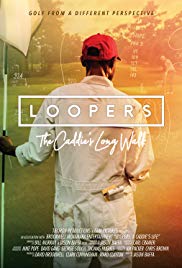
 Greetings again from the darkness. It’s a bit difficult, after watching this documentary, to not question the motives of director Jason Baffa. Was his mission really to explore the history that forged the bond between caddy and player, or was he actually after a fantasy trip to see the world’s most historic golf courses and interview some of the sport’s most iconic figures?  Either way, we can’t help but be a bit jealous!

Lest you think the jealousy might be exaggerated, you should know the film kicks off at Ballybunion Club in Ireland, and also includes visits to St. Andrews in Scotland, Canterbury Golf Club in Ohio, Carnoustie in Scotland, Bandon Dunes in Oregon, Augusta National in Georgia, and Pebble Beach in California. Director Baffa’s interviews include Tom Watson, Nick Faldo, Lee Trevino and Ben Crenshaw. And if that’s not enough, the narrator is none other than Bill Murray, himself a golf lover associated with the best “golf” comedy of all-time (the pond is good for him after a day of chasing gofers).

“Show up. Keep up. Shut up.” We learn that was the early creed for caddies as they were meant to only carry the bag for players, and occasionally help locate the misplaced shot. It didn’t take long, however, for players to recognize the value of local course knowledge, and caddying slowly evolved into a craft. It’s quite interesting to see the contrast between caddies hustling for a gig in the parking lots of clubs, to those who became rich and famous, often tied to the bag of a pro golfer for years. Examples shown include the heartfelt story of Bruce Edwards as a career caddy for Tom Watson; the first female caddy, Fanny Sunesson, working with Nick Faldo during his streak; and of course, Fluff Cowan and Steve Williams who both had runs with Tiger Woods.

Director Baffa and writer/editor Carl Cramer spend as much time talking to the history of golf as to how caddies fit in. They mention that 1474 is believed to be the first record of golf, but those in Scotland would argue it came about decades prior. A tale that ties golf to Mary Queen of Scots and the murder of her husband is told, and the true Cinderella Story of Greg Puga becoming the first caddy to tee it up at the Masters claims plenty of screen time.

Old Tom Morris’ legacy at St. Andrews is covered, as is the tie between the great Bobby Jones and Augusta National, and how the change in caddy policy affected so many African-American men. A trip to Oregon explains how Bandon Dunes is the closest thing the U.S. has to an actual links course, and most of us hear for the first time about the Evans Scholarship for caddies and George Solich’s Caddy and Leadership Academy. It turns out the CADDYSHACK really wasn’t a documentary, but it is true that the best caddies must be a blend of therapist, friend, and coach. It’s not job for the faint of heart, but caddies can certainly be the difference in a good round.

watch the trailer:


FRAMING JOHN DELOREAN (2019, doc)

June 6, 2019

 Greetings again from the darkness. Hollywood is known for taking a real life person or event, embellishing the details, twisting the facts, and creating a fictionalized version meant to shock … or at least entertain. John DeLorean lived a life that made it almost too easy for Hollywood, yet numerous attempts at a biopic have stalled over the years. Co-directors Don Argott and Sheena M. Joyce were there to pick up the pieces and deliver a documentary with dramatized reenactments of actual (and hypothetical) moments. Co-writers Dan Greeney and Alexandra Orton assist with a cinematic version likely to cause those who recall actual events to marvel at the full story, and those too young to remember will likely find it difficult to believe … or perhaps, sadly, all too believable!

The film provides the backstory where John DeLorean was a talented engineer at General Motors and became a star on the rise within what at the time was the world’s largest corporation. Turning around GM’s flailing Pontiac division by introducing the GTO as a muscle car, DeLorean’s success was a mixture of technical knowledge, marketing savvy, risk-taking, swagger, and ambition. Despite his actions leading directly to higher profits and large executive bonus checks, the stodgy old school regime forced him out in 1973. DeLorean, seen as a swashbuckling rebel, started his own company, De Lorean Motor Company, with the unusual stated goal of mass producing exotic sports cars made of stainless steel.

The dramatizations and reenactments involve Alec Baldwin as DeLorean, Morena Baccarin as his (third) wife, supermodel Cristina Ferrare, and Josh Charles as Bill Collins, the chief engineer he ‘stole’ from GM. We even get a behind the scenes look as Baldwin discusses the role from the makeup chair, and Ms. Baccarin is interviewed on how she viewed Ms. Ferrare.  These dramatizations cover possible conversations between DeLorean and Collins, as well as home life with Ms. Ferrare and the kids, and are more distraction than help.

More effective than these “what if” segments, are the actual interviews with the real Bill Collins, as well as others who were involved at the time. Unfortunately, we only see the actual Ms. Ferrare in clips, as she understandably wouldn’t want to be relive this part of her life. However, their kids, Zach and Kathryn, are interviewed on camera. Both are quite forthcoming with their thoughts, recollections, and the impact of growing up as DeLoreans’ kids. Zach carries his hostility on his sleeve, while Kathryn offers a bit more reticence. Both reactions are understandable, and ‘the car vs the dad’ discussions are fascinating … and these interviews are the film’s high points.

Opening with FBI footage of DeLorean’s lie detector test administered in 1983, possibly the most interesting aspect from an overall perspective is the contrast between his trial for drug trafficking and his later trial for embezzlement. Despite his being a truly desperate man when he agreed to the drug deal, it seems quite obvious – as the jury found – that DeLorean was a victim of FBI entrapment (possibly the first time many of us had heard the word). In the aftermath of what was a media circus not dissimilar to OJ’s trial, we do hear from both defense attorney Howard Weitzman and prosecutor Robert Perry as to how each viewed the case. However, the shell company in Geneva and the aspects to his embezzlement lead us to believe DeLorean’s character was truly compromised – or possibly revealed.

From a business viewpoint, it was quite interesting to learn that DMC (De Lorean Motor Company) ended up being based in Belfast, Northern Ireland (a great trivia question) due to 30% unemployment and the large government subsidies meant to stimulate an economy in the dumps. The lack of infrastructure and a workforce with no automobile experience led to quality issues that were simply too great to overcome …especially when combined with other issues on Planet DeLorean.

John DeLorean led a flamboyant life and experienced a very public fall from grace. Screenwriter Bob Gale explains how the DeLorean car was chosen for the BACK TO THE FUTURE trilogy, and how a letter from DeLorean showed how much he still enjoyed the spotlight. Was DeLorean a renegade visionary or a con man? Was he a victim or a cut-throat businessman? Whatever your thoughts, he’s a textbook example of how the American Dream can come true, and still be followed by one’s worst nightmare. Sometimes there is no need to print the legend … fact will do just fine.

watch the trailer:


HALSTON (2019, doc)

June 6, 2019

 Greetings again from the darkness. My fashion of choice is jeans and an untucked shirt, but even a schlub like me recognizes the creative force that was Roy Halston Frowick. His impact as groundbreaking fashion designer Halston is beyond question. Jackie O’s pillbox hat?  Halston. The “hot pants” revolution in the 60’s? Halston. His innovations were first noted at Bergdorf Goodman, the iconic luxury department store on Fifth Avenue in Manhattan. Director Frederic Tcheng clearly understands the fashion world and was the right choice for this project. Mr. Tcheng’s previous documentaries include DIOR AND I (2014) and DIANA VREELAND: THE EYE HAS TO TRAVEL (2011). Here, he pays homage to Halston the designer, while also pulling back the curtain on Halston the man.

Despite the fascinating subject and an expert director, an odd choice was made for this documentary to feature a narrator – a fictional character narrator, “somebody working in the archives”. It seems to be a stretch in an attempt to make a more artistic film, but opening with a deep cut Elvis song, “Fame and Fortune”, any attempts to add interest to Halston’s story were unnecessary.

The film tracks Halston’s industry timeline and his 1968 break from Bergdorf to open his own salon. This led to his notoriety in the 70’s and put American fashion on the map – thanks in large part to his splash at the Versailles Fashion Show. Interviewees range from movie director Joel Schumacher (responsible for the less than artistic BATMAN & ROBIN, 1997), who partied hard with Halston; to model and actress Marisa Berenson, who walked the runway in his clothes and became a movie star; to Elsa Peretti, who created Halston fragrances and worked with him for years. There is also Liza Minelli who has worn Halston exclusively for decades. We get a glimpse at some of the Studio 54 parties, the Andy Warhol years, and Halston’s lavish lifestyle.

Much of the later years center around the impact of business dealings. In 1973, Norton-Simon acquired Halston and his brand, which is what drove the expansion into fragrances, shoes, furniture and more. We see his historic 1980 trip to China, and learn about his record-breaking $1 billion deal with JC Penney, a transaction outsiders described as he “moved from class to mass.” When Esmark (Playtex) purchased the brand and discovered that they owned the Halston brand name, Halston the man was booted from the company (1984). This allowed John David Ridge to become the designer of Halston.

We hear that Halston was a perfectionist – a demanding boss who was sometimes cruel to his staff and others. We’ve heard similar tales in regards to other artists. This is a man who designed for the world’s most fashion-conscious people, and for such diverse causes as The Olympics, the Girl Scouts, and Avis company uniforms. Having Esmark erase the Halston history may pale in comparison to the tragedy of having the designer die of AIDS in 1989 at age 57, but it’s unfortunate to say the least. By that time, he had disappeared from public life as his purpose and name were no longer his.

watch the trailer:


WOODSTOCK: THREE DAYS THAT DEFINED A GENERATION (2019, doc)

June 2, 2019

 Greetings again from the darkness. Michael Wadleigh’s 1970 film WOODSTOCK won the Oscar for Best Documentary, feature. The assistant director on the film was a 27 year old budding filmmaker named Martin Scorsese (three years before MEAN STREETS). The footage of the iconic bands, the groovy clothes, the heavy rain, and the mounds of trash fascinated those of us who wanted a taste of what the “peace and love” culture was all about. Co-directors Barak Goodman and Jamila Ephron take a different approach in honor of the festival’s 50th anniversary in this project for PBS’ “American Experience”.

Rather than focus on the extraordinary music, this film provides a glimpse into the arduous process of “how” to put on a huge event. Three years prior to the festival, a business meeting between four gentlemen: John Roberts, Joel Rosenman, Artie Kornfield and Michael Lang, began as a proposal to build a music studio in Woodstock, and instead evolved into a vision for an outdoor festival of music, art, and peace. This is the generation that fought in and protested the Vietnam War, saw their spokesperson Martin Luther King gun downed, and then had their savior Bobby Kennedy violently taken away. The youth of the counterculture were desperate for answers and hope.

Much of what we hear are recollections of those who were there. The memories and feelings of the time are presented as evidence of success. We also witness the behind-the-scenes obstacles and challenges faced by the event’s promoters. All of this comes courtesy of some never-before-seen footage and photographs.

With construction having begun (stage, fencing, etc), the town of Wallkill, NY had second thoughts about having 50,000 hippies descend on their town. That’s right. Initial estimates were off by about ten-fold to what actually happened. Five weeks prior to the festival, the town passed an ordinance prohibiting gatherings of more than 5000 people. This was a problem as acts were booked, tickets sold, and workers were being paid. Dairy farmer Max Yasgur offered up his 600 acre farm, and, frantically, the plan was revised and construction started anew. It was also very interesting to note that the word of the festival was spread through the alternative press. Of course, no social media existed at the time, so getting the word out to the country was especially challenging.

It can be argued whether the Woodstock festival held August 15-17, 1969 in Bethel, NY actually defined a generation, but there is no debating that pulling off such a peaceful event in the face of challenges like political backlash, bad weather, bad drugs, a food shortage, and a crush of humanity, was quite remarkable. No mention is made of the tragedy that unfolded a mere four months later at Altamont, but it’s quite a contrast to the crowd control provided by Wavy Gravy of Hog Farm, the “freak out” tents for bad drug trips, and a community of citizens who emptied their pantries in order to provide food and beverage for thousands in need.

And yes … we do get some samples of the music. We learn Richie Havens was the first act to go on stage simply because he was “there”. He then proceeded to create his iconic “Freedom” spontaneously in front of the audience. Day 2 attendance jumped by at least 100,000 to experience Sly and the Family Stone, and of course, The Who. We get a glimpse of the first ever live show from Crosby, Stills and Nash, and hear farmer Max Yasgur’s complimentary words to the crowd. Peace and Love indeed.

watch the trailer:


ROCKETMAN (2019)

May 30, 2019

 Greetings again from the darkness. It’s billed as a musical fantasy. If you are familiar with Elton John’s discography and history, you’ll want to keep that in mind as the film unfolds. The reward is a colorful spectacle worthy of one of pop music’s most successful songwriters and greatest showmen. Director Dexter Fletcher (EDDIE THE EAGLE, 2015) and writer Lee Hall (BILLY ELLIOT, 2000) make frequent use of Elton’s music within the fabric of the storytelling. It’s no traditional biopic, nor should it be, given the wild ride of the man whose story is being told.

Taron Egerton tears into playing Elton John like it’s the role of a lifetime. And he succeeds in a way that makes it seem that could be true. Most of us first recognized Taron’s talent as “Eggsy” in KINGSMAN: THE SECRET SERVICE (2014), though I’m not sure we expected such a dynamic step up so soon. This is not some actor merely mimicking the movements of a celebrity. This is an actor taking possession of a role. Without the costumes, Taron doesn’t look much like Elton John. He certainly doesn’t sound like Elton John … though his voice does justice to the classic songs. Despite those things, he is captivating on screen, both in the dramatic moments and the musical mania.

Elton’s childhood and the strained relationship he had with his parents (played here by Bryce Dallas Howard and Steven Macintosh) are given much attention, as is the support and love of his grandmother (Gemma Jones). With two self-centered parents wishing he didn’t exist, the child piano prodigy might never have attended the Royal Academy of Music if not for grandmother Ivy. Of course, the professional relationship that meant the most to Elton’s career was his songwriting collaboration with lyricist Bernie Taupin (Jamie Bell), and much of the film is devoted to this prolific partnership – in fact, one of the most spine-tingling moments occurs as Bernie hands Elton the words to “Your Song” and Elton proceeds to set it to music right in front of us and Bernie. Whether that’s historically accurate or not, it provides a thrilling moment on screen for the creative duo.

Elton John in rehab is used as a framing device for the film. This allows him to walk us through his life … after admitting to having issues with drugs, alcohol, sex, shopping and anger. In other words, one of the most successful musicians of all time was a mess. And we get to sit front row as he details his early sexual confusion, his desire to be loved, his early professional frustration, and finally a career that exploded – covering him with money, adoration, stress, and more frustration. We see the warts and all.

Supporting roles are filled by Richard Madden as John Reid, Elton’s lover and manager; Tate Donovan as Doug Weston, owner of Sunset Blvd’s Troubadour; Rachel Muldoon as Kiki Dee, Elton’s collaborator on  their big hit “Don’t Go Breaking My Heart”; and Stephen Graham as Dick James, the famous music publisher who first signed Elton.

As someone whose favorite Elton albums are “Tumbleweed Connection”, “Madman Across the Water”, and “Honky Chateau”, it’s easy for me to appreciate the time period covered here (roughly 1970-1983), and also to recognize the ‘artistic license’ taken with the timelines and events. His 1970 gig at Troubadour features a rowdy version of “Crocodile Rock”, which wasn’t even written yet … although the scene makes for great cinema. Many of the songs that advance the story are used out of sequence, but it’s quite effective to see and hear them in context. His marriage to Renate Blauel and the rehab stint featured both occurred after 1983, which we can assume is the story’s stopping point given the use of the “I’m Still Standing” video as a finale. Even the use of John Lennon over Long John Baldry doesn’t really matter since this is all about the spectacle, and for spectacle, you’ve likely never seen costumes (including eyeglasses and headdresses) used to such startling effect … and so frequently. The baseball “uniform” Elton wore during his 1975 Dodger Stadium gig has always made me a bit uncomfortable, but it’s recreated beautifully for the film.

Given that comparisons to the recent BOHEMIAN RHAPSODY are inevitable, it should be noted that director Dexter Fletcher rescued the final production of that film before finishing this one. Freddie Mercury and Elton John are two of the most fascinating figures in music history, and while both films are enjoyable, it’s ROCKETMAN that is willing to take the riskier path by highlighting the flaws of a creative genius. So criticize if you must, but you’ll probably still be singing in your seat.

watch the trailer:


THE SOUVENIR (2019)

May 30, 2019

 Greetings again from the darkness. Viewers of writer-director Joanna Hogg’s semi-autobiographical feature will likely be divided into two distinct groups: those who find it to be a beautifully artistic psychological study, and those who find it to be a painfully slow watch. Fortunately, most who would fall into the latter group will likely skip it altogether, and we can only hope those in the first group will seek it out and encourage similar-minded film fans to attend. Surely both groups can agree that it features a terrific breakout lead performance from Honor Swinton Byrne (daughter of Tilda Swinton).

Ms. Swinton-Byrne stars as Julie, a young London film school student. She’s soon drawn to Anthony (Tom Burke), an odd man who is somehow simultaneously laid back and condescending. Their relationship builds as he works some vague job at the Foreign Office, and giving every indication that something’s not quite right. Many moments of normal life are shown; however we soon learn that Anthony is a master manipulator, and his off-handed requests for ‘a tenner’ or sticking Julie with a restaurant tab go deeper than being a simple jerk. We know heartbreak is coming for her; we just don’t know how when or how hard.

Tilda Swinton (a long-time friend of director Hogg) appears in a few scenes as Julie’s mom, and as you would expect, she perfectly captures the mother-daughter dynamics. Of course Julie is a film student struggling to make ends meet, but with her frequent requests for ‘mom loans’ coinciding with the Anthony relationship, mother knows best. Jean-Honore Fragonard’s 18th century painting gives the film its title, and provides a terrific scene with Julie and Anthony.

Later, when Anthony tells Julie, “You’re inviting me to do this to you”, we recognize this is an abusive relationship similar to those many women have endured. Set in the 1980’s, a doomed relationship looks eerily similar regardless of the era. The film serves as an example of how we sit in judgment of the love lives of others, while often remaining blind (or is it hopelessly optimistic) to our own relationship issues.

Ms. Hogg shot on film and there are some memorable shots throughout – especially within Julie’s apartment. There is a recurring split-screen shot where a wall divides what we see in the kitchen with what’s happening in the living area – we see characters on each side. This is the anti-Marvel movie. No special effects. No superheroes. And the only worlds in peril are those of average, flawed people like us.

There is a segment involving an analysis of Hitchcock’s PSYCHO, and it’s clear director Hogg learned lessons about what not to show. There is also a reference to another Hitchcock classic with the tailored grey suit Tom buys for Julie and their trip to Venice. Alfonso Cuaron scored big with ROMA, a very intimate look at his personal life, and filmmaker Hogg’s film is in that same vein. It’s extremely well made and beautiful to look at, and is likely to be quite challenging for viewers. The payoff comes after much patience and effort and investment into figuring out these characters. It’s an arthouse film with improvised dialogue (bonus points for Joe Jackson’s “Is She Really Going Out with Him?”). This was a grand jury prize winner at Sundance, and the sequel is already in production … good news for some of us, while inexplicable to others.

watch the trailer:


ASK DR. RUTH (doc, 2019)

May 30, 2019

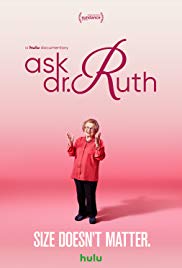
 Greetings again from the darkness. Your impression of Dr. Ruth Westheimer might be that of a little old lady who offers up entertaining segments on talk shows, or maybe even more extreme, that of a carnival-type sideshow meant to shock with its taboo topics. Director Ryan White (THE CASE AGAINST 8) profiles the now 90 year old (she turns 91 next week) icon and we are treated to a wonderful story of a fascinating self-made woman.

Karola Ruth Siegel was born in Germany and her parents shipped her to an orphanage in Switzerland at age 10 to protect her from the Nazis and the war. Though her parents did not survive the war, young Karola did and director White allows the adult woman, now known as Ruth Westheimer, to retrace the steps that resulted in her becoming a world renowned sex therapist, speaker, educator and author. Some of the filming takes place inside her Washington Heights, NY apartment … her home for the past 54 years.

Animation is used to fill in the gaps of her childhood, as a narrator reads passages from the young girl’s diary. Her own words connect two worlds – that of a lost child and those of today’s strong woman whose work has impacted so many. Sure, Dr. Ruth has her critics, but she was a solitary voice of help and knowledge at a time “Sexually Speaking” (the name of her first radio show) was still not done in public. This tiny (4’7”) woman with German-accented English spoke directly to her audience (many who chuckled or turned crimson with embarrassment) about matters that were causing much emotional turmoil – matters that were killing relationships. She was truly a life saver for many.

Educated at Columbia and Cornell, Ruth earned her Ph.D. and became a licensed sex therapist. It was her matter-of-fact delivery of facts and insight that made her so popular on radio and TV. Now, in her 90’s, she still teaches two classes, makes appearances as a guest lecturer, writes books (published more than 60), writes a regular newspaper column, and travels the globe entertaining and educating young and old alike. This is a busy, focused woman.

Dr. Ruth was a calm voice in the storm of the initial AIDS/HIV epidemic as she reserved judgment and dispensed facts, while encouraging care and empathy. We learn she has espoused speaking of politics in public and doesn’t much believe in “normal” as a description to be applied to anything. Pierre Lehu, her long-time Director of Communications admits they speak by phone 25-30 times per day. Most people half her age live daily lives much less busy.

Director White opens the film with Dr. Ruth asking Alexa if she’s going to get a boyfriend. Her playful side is still evident, but quickly shifts into all-business mode when required. We hear from her daughter and son, as well as her 3 grandkids. We learn of her 3 husbands, and the situation with each. Did you know she was trained as a sniper in the Jewish Underground Army? Well there’s a segment on that. She was a rare single mother in the U.S. in 1958 and transformed herself into “Grandma Freud”. By the end, we know this spirited woman would have survived and been successful in whatever path she chose. Many are thankful she still walks that path.

watch the trailer:


BOOKSMART (2019)

May 23, 2019

 Greetings again from the darkness. Every generation tends to get the high school movie (the movie about high school life) they deserve. Going back to James Dean in REBEL WITHOUT A CAUSE (1955) and Sidney Poitier in TO SIR WITH LOVE (1967), what followed were such memorable films as CARRIE (1976), GREASE (1978), FAST TIMES AT RIDGEMONT HIGH (1982), most every John Hughes movie from the 80’s, FERRIS BUELLER’S DAY OFF (1986), SAY ANYTHING (1989), DAZED AND CONFUSED (1993), CLUELESS (1995), 10 THINGS I HATE ABOUT YOU (1999), MEAN GIRLS (2004), HIGH SCHOOL MUSICAL (2006), JUNO (2007), and SUPERBAD (2007). It’s that last one on the list that this directorial debut from Olivia Wilde is likely to draw the most comparisons to.

Kaitlyn Dever (“Justified”) and Beanie Feldstein (LADY BIRD, and sister of Jonah Hill) star as Amy and Molly, two best friends and high school seniors who have sacrificed a social life (i.e. partying) for academics in order to position themselves for the best colleges. Amy has decided to take a gap year doing charity work in Botswana, while Molly wears her intelligence and class ranking on her sleeve and sits in judgement of her less disciplined classmates. She is headed to Yale with her ultimate life goal being an appointment to the Supreme Court (she has an RBG poster up in her room).

Imagine their shock when, the day before graduation, Amy and Molly discover that many of their less-disciplined (i.e. hard partying) classmates will also be attending elite schools. The besties immediately scheme to make up for 4 years of nose-to-the-grindstone by attending the biggest party of the year … and showing others how much fun they can be. Plus, the party affords each the opportunity to pursue their crush: skater-girl Ryan (Victoria Ruesga) for Amy, and athlete Nick (Mason Gooding) for Molly.

Although (full disclosure) I was never a high school girl, the one thing that stands out about the film is how the kids seem like real kids. That’s not to say most every aspect isn’t slightly exaggerated, because it is. The level of gayness in the Drama club is a bit difficult to take, and the teenage body is objectified in more than one shot; however, director Wilde has a knack for making high school look cinematic. Two sequences are particular standouts for the way they are filmed: the swimming pool scene with Amy underwater, and the house party as the characters weave in and out of rooms in the large house

Supporting roles add depth to the comedy thanks to Jason Sudeikis as the school Principal/Lyft driver; Billie Lourd (daughter of Carrie Fisher) as Gigi, who is always popping up and stealing scenes; Lisa Kudrow and Will Forte as Amy’s parents; Molly Gordon (“Animal Kingdom”) as the misunderstood ‘Triple A’; the aforementioned Victoria Ruesga and Mason Gooding; and star-in-the-making Diana Silvers as Hope – the aptly named rebel who clicks with Amy.

Co-written by Susanna Fogel, Emily Halpern, Sarah Haskins, and Katie Silberman, the film presents a realistic friendship between two teenage girls, and mines some common and recognizable personalities for comedy gold. Smart and funny female characters are interesting at any age, and “no one knows me” is the anthem of most every high school student since caveman days. The inevitable comparisons to SUPERBAD will likely be favorable to this film, and it will probably be the perfect fit for this generation – even if we hope most students avoid many of the happenings. With Will Ferrell and Adam McKay as producers, you should prepare for the harsh language high school kids are known for, as well as that ‘brazen, yet insecure’ blend so common to the age. Of course, we can’t help but find the timing of release quite interesting, given the recent college admissions scandal. It won’t replace AMERICAN GRAFFITI for me, but with Olivia Wilde having been known as an actress, we now recognize her as a legitimate director.

watch the trailer: