It’s Christmas Eve, and what better way to spend it than going through my BEST OF 2019 movie list and complaining about my choices and wondering why your favorites didn’t make it. The joy of movies is that everyone has their own tastes and preferences. I am fortunate in that I get to watch more movies throughout the year than most people, so I enjoy providing a bit of insight and perspective. Check out this year’s list and see if we agree on anything!
Greetings again from the darkness. More than 150 years have passed since Louisa May Alcott’s novel was published (volume 1 was published in 1868, volume 2 in 1869). By my count, there have been seven previous movie adaptations, dating back to the silent film era and through the more familiar George Cukor-Katharine Hepburn (1933), Mervyn Leroy-June Allyson (1949), and Gillian Armstrong-Wynona Ryder (1994) versions. One might think that sufficient, yet, after viewing this latest, you’ll likely join me in believing that director Greta Gerwig and Louisa May Alcott (and by natural extension Jo March) are kindred spirits … timeless storytellers of the moment.
Oscar nominated (writing and directing) for her standout LADY BIRD (2017), Ms. Gerwig remains true to the beloved source material while adding her own contemporary touch. She begins with the adult March sisters and then flashing back 7 years to the stage of living together and battling through the difficult and awkward transitional phase. The four sisters Jo (Saoirse Ronan), Meg (Emma Watson), Amy (Florence Pugh), and Beth (Eliza Scanlen) are exceptionally well cast, and we immediately recognize the familiar personality traits of each. Jo is the serious, determined writer who has an understanding of financial necessities. Meg is the warm facilitator beloved by all. Amy has ambitions (or is it dreams?) of being a great artist and living an exceptional life. Beth, the youngest, radiates a sweet nature and love for the piano.
Much of the story is told through the eyes of Jo. Her independent spirit and frustration with how the world is, boils over at times. She states her disappointment at being born a girl, and is described as having “a nature too noble to curb.” While viewing, one must keep in mind that this was the Civil War era (the girls’ father is a military Chaplain), and women had achieved very few rights in society. The contrast is never more evident than when comparing Marmee (Laura Dern), presented here as a near flesh-and-blood saint, with Aunt March (Meryl Streep), one quite at ease in thumbing her nose at societal norms for one reason … she is rich.
Fans of the novel will be pleased that Timothee Chalamet plays “Laurie Laurence”, who struggles every bit as much as the sisters in finding his way towards adulthood. His scenes with Jo are exceptional. Chris Cooper, not seen nearly enough in movies these days, perfectly captures the broken spirit of Mr. Laurence, a man never quite able to escape his own personal loss. Other key cast members include James Norton as tutor/teacher John Brooke, Louis Garrel as Friedrich (here a Frenchman), and Tracy Letts dropping some deadpan comedy as Jo’s publisher Mr Dashwood.
Ms. Gerwig (perhaps with a future as one of the greatest filmmakers) displays storytelling and cinematic craftsmanship at the highest level. She bounces between timelines (over at least 7 years) and different sisters’ stories, showing how each is so different … yet all interconnected. These spirited sisters, raised in the same modest home, have their own independent thoughts and ideas of how they want to live their lives. This delivers multiple comings-of-age and examines ‘a woman’s place’, whatever that means. In fact, the message is that a woman’s place is whatever she decides, and while her options are many (despite obstacles), her decisions are personal. None of the four sisters are played by American actors, and all four perform admirably. Pay particular attention to Florence Pugh (MIDSOMMAR) and her work as Amy. Also impressive is the Production Design by Jess Gonchor and the score by 2-time Oscar winner Alexandre Desplat. This one is all about the storytelling and characters, so take in the bunch known as the March sisters. As a side note, Greta Gerwig’s next movie is a live-action BARBIE movie, with Margot Robbie in the lead.
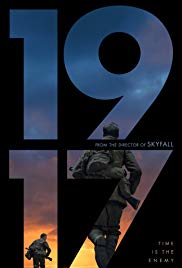
Greetings again from the darkness. It’s now been over 100 years since World War I ended. The Great War garners barely a mention in high school history books these days, and Hollywood has devoted much more time and energy to WWII. Filmmaker Peter Jackson did his part with last year’s stunning documentary THEY SHALL NOT GROW OLD, a video and photographic look at the actual people involved in the First World War. And now, Oscar winning director Sam Mendes (AMERICAN BEAUTY) delivers another glimpse … and another technical marvel.
Mr. Mendes, working with Oscar winning Cinematographer Roger Deakins (BLADE RUNNER 2049) and Oscar winning Film Editor Lee Smith (DUNKIRK), has shot and edited the film to give the look of one continuous take in real time. Although used previously in such films as Hitchcock’s ROPE and Inarritu’s BIRDMAN, the single take approach is certainly no gimmick here. We open on two young British soldiers lounging in a prairie as they are summoned to report to the commander. Their mission is described as critical, as a British battalion is preparing to walk into a deadly trap set by the Germans. More than 1600 lives are at stake and the phone lines are down. It’s up to Lance Corporal Blake and Lance Corporal Schofield to work their way across No Man’s Land to the front line and hand-deliver an order stopping the attack. Oh, and one more detail: Blake’s older brother is in the battalion he is tasked with warning.
The real time approach serves the purpose of allowing viewers to take on the urgency of Blake and Schofield. We experience the tension and horrors of war. Barbed wire, booby traps, slushy trenches, snipers, rats, dead bodies, dogfights (the aerial type) and towns under siege all play a part here as the men rush towards their goal of saving fellow soldiers lives, including a beloved family member. Dean-Charles Chapman (“Game of Thrones”) plays Blake, and George MacKay (CAPTAIN FANTASTIC) plays Schofield. We spot the personality differences between them. Blake is super focused and determined to save his brother, while Schofield doesn’t welcome the assignment, but is a dutiful soldier and loyal friend.
It’s really the Schofield character with whom the viewer mostly relates. He’s no super soldier or Jason Bourne-type, but rather a young man trying to stay alive and fulfill his orders. With the relentless pacing of the film, we feel the fear and admire the courage. There is an especially touching scene in a bombed-out town where paths are crossed with a French woman (Claire Duburcq) caring for an orphaned infant. It’s a reminder that humanity still exists, even within the bounds of war.
There is no clock ticking in the corner of the screen, but we know time is of the essence, and quite limited. The camera seems to be always moving forward, rarely allowing for us or the characters to exhale. As you might expect, running is done frequently – sometimes towards something, sometimes from it. Roger Deakins is in prime form here with his camera, and there are too many remarkable moments to mention them all; however, the river rapids and waterfall, and the town under siege at night, are two of the most incredible sequences I’ve seen on screen.
Along the journey, some familiar faces pop up as military men: Andrew Scott, Benedict Cumberbatch, Richard Madden, Mark Strong, and Colin Firth. Although each appears only briefly, it’s a testament to their acting prowess that each is memorable. The chaos and relentless terror of war is on display, more often than not. But this isn’t a film designed to create deep thoughts or serious debates on the merits of war. Instead, it’s meant to focus on one of the countless personal stories that occur during war. War is fought by people, not faceless countries, and each person has their own story.
Non-linear story telling has been a movie-thing since even before MEMENTO, but director Mendes (and co-writer Kristy Wilson-Cairns, “Penny Dreadful”) show us the true presentation of linear … in the moment and by the moment. GALLIPOLIand PATHS OF GLORY are about the closest comparisons I can come up with, and the weight of the film is felt physically and emotionally as we are drawn in. The exceptional score from Thomas Newman (14 time Oscar nominee) serves to accentuate the chaos and relentless terror. It’s a work of art and a unique viewing experience.
Greetings again from the darkness. It’s debatable whether this movie should be labeled an indie crime thriller or a ‘Scared Straight’ session for gambling addicts. Benny Safdie and Josh Safdie are filmmaking brothers who seem to specialize in adding a frenetic pace to the lives of characters who consistently make bad decisions. Their excellent 2017 film GOOD TIME (starring Robert Pattinson) set the tone for their latest, featuring an Adam Sandler performance unlike anything we’ve previously seen from him.
After a brief prologue at an Ethiopian mine, we are dropped right into Howard’s world. Well, more specifically, we find ourselves on the camera end of Howard Ratner’s colonoscopy, while also seeing the vibrant glow of the rare opal extracted from that opening mine. Remarkably, the colonoscopy may be Howard’s (and our) most relaxing moment of the movie. The character of Howard is based on a guy the Safdie brothers’ dad worked for in the Diamond District when they were growing up. He’s played here by Mr. Sandler, who delivers a performance so memorable that we now can’t imagine anyone else in the role.
Here is what we learn about Howard: he’s arrogant and foolish and energetic and hopeful. He lives life on the edge … or perhaps he’s already tipped. He’s a Jewish jeweler based in inner-city Manhattan, and as the film begins, he owes a lot of money to someone who has hired goons to collect. Howard has an irascible wife Dinah (Idina Menzel, Elsa’s voice in FROZEN) who is fed up with his antics … one of which is his employee/mistress Julia (newcomer Julia Fox). Howard has an insatiable gambling addiction and he’s always on the brink of a life-changing big score or a colossal failure that could cost him everything. He’s a hustler who has to move faster each day to prevent the collapse of his house of cards: sports bets, pawns, loans, lies, and empty promises.
So if you think you now have a feel for this, I can assure you that you are mistaken. The frenetic pace is relentless to watch. We kind of like Howard, but yet, we want nothing to do with him. His latest scheme involves the expectation that the rare opal will solve his many financial woes. In the meantime, his business associate Demany (LaKeith Stanfield) brings him a high profile client … NBA player Kevin Garnett. The film looks and feels like a gritty 1970’s flick, but it’s based during the 2012 Eastern Conference Finals, and Garnett plays himself (and quite well). Garnett borrows the opal for good luck and that’s when all ‘heck’ breaks loose. Also in play here is Howard’s rotten brother-in-law (Eric Begosian), to whom he also owes money. Adding even more NYC flavor are Judd Hirsch, John Amos, and sports radio host Mike Francesca, as Howard’s bookie.
Daniel Lopatin (aka Oneohtrix Point Never) provides an electronic score that helps ensure we are never comfortable watching what is unfolding, and cinematographer Darius Khondji (EVITA) keeps his camera in constant motion – just like the characters. Production Designer Sam Lisenco creates Howard’s world through the jewelry shop, the house, the apartment, and especially that back office. Set Decorator Kendall Anderson wins a place in my heart for the Pete Maravich poster.
The Safdie brothers co-wrote the script with their editor Ronald Bronstein (who also worked on GOOD TIME), and afterwards you’ll find yourself going back through all the poor choices made by most every character. The brilliantly sustained level of uneasiness includes a segment featuring The Weeknd, and one revolving around a school play for Howard’s daughter. The Safdie style is present throughout, and most conversations are loud and heated and threatening. If you are the type that needs at least one likable character, or a serene environment, or respectful adult conversation, you are out of luck here. Howard is an exhausting character in an exhausting story within an exhausting movie … just as it was intended.
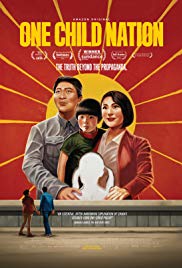
Greetings again from the darkness. Living in a free society means we get to make many of our own life decisions … big ones and small. Of course, those decisions are best if managed within generally accepted societal norms. Most of us can’t even imagine living under the rule of a government that controls something as personal as the number of kids we can have in our family. Well, in 1979 China imposed a “one child” policy. It stood for more than three decades, until 2015. Filmmakers Nanfu Wang and Jialing Zhang give us an insider’s glimpse of the effects of this policy by talking to the folks who lived through it.
Ms. Wang was born in China and moved to the U.S. Having recently had a baby, she decided to return to her birth country and explore the effects of the policy under which she was born. The social experiment and restrictive policy was instituted out of desperation for a country whose population was booming, yet the economy and food supply were a mess. She shows us the propaganda that was seemingly everywhere – from artwork on neighborhood walls to television shows. The approach was to make people think this was their patriotic duty, and that one child was the idyllic life.
What has never been discussed or studied was the dark side of what the policy meant. It was a system that encouraged boys and downgraded girls. To Ms. Wang’s credit, she interviews those on both sides of the policy – those who believe it was necessary and prevented over-population, and those who tell the horror stories of families torn apart, babies abandoned, and the secretive human trafficking that occurred. It’s quite devastating to hear these people discuss the personal impact.
The film is autobiographical in nature, in that Ms. Wang is our narrator, often appears on camera, and even interviews her own family members – both to personalize the story and to educate herself. Hearing the story of her grandfather stepping in to prevent sterilization of Nanfu’s mother is incredible. We learn she later had a son who became the favored child within the family. And yes, we get details … very specific details … on the forced sterilizations and abortions that occurred. One doctor takes credit for ‘tens of thousands’ of abortions and sterilizations, which Ms. Wang effectively contrasts with America’s ever-increasingly restrictive abortion policies. These are the two extremes in preventing women’s control of their own bodies.
No top government officials are interviewed, but the implications are quite clear. We even learn of the Utah organization Research-China.org that researches Asian children adopted during this era, often with the adoptive parents unaware of what was happening in China. We even learn of a set of twins who were separated at birth – one raised in the U.S., the other in China. They have never met. Ms. Wang is quite effective as a documentarian-journalist. Though the film lacks any attempt at style points, the details are astounding. She even shows how the Chinese government transitioned from ‘one child’ to marketing the benefits of a “two child” household, and how the propaganda machine kicked in. This film is all about impact, and it will deliver a gut-punch.
Greetings again from the darkness. With a title pulled from a line in George Eliot’s “Middlemarch”, enigmatic filmmaker Terrence Malick continues his deep probe into humanity and faith … recurring themes in most of his films, and especially the run that began with his excellent THE TREE OF LIFE (2012). This current film is easily his most accessible over that period as it focuses on the (mostly) true story of Austrian WWII conscientious objector Franz Jagerstatter.
The film opens with contrasting images: a black screen with sounds of nature fading to a bucolic Austrian Alps village versus dramatic historical clips of Hitler (I believe from Leni Reifenstahl’s 1935 Nazi propaganda film TRIUMPH OF THE WILL). The rural farming village we see is Sankt Radegund, the idyllic community where Franz Jagerstatter (played by August Diehl, INGLORIOUS BASTERDS) lives off the land with his wife Franziska “Fani” (played by Valerie Pachner) and their three young daughters. It’s a family bonded by love. The family and fellow villagers go about the rigors of daily life as the war spreads. In 1940, Franz is sent to Enns Military base for training, and is then returned to his village under a farming exemption.
What follows is a first half filled with dread as Franz struggles with his own beliefs in a new world order that has no room for individual thought. He refuses to swear an oath to Hitler, despite the rest of the villagers doing so. He knows what this means, as does his wife. As Franz refuses the “Heil Hitler”, he is described as being something worse than an enemy – a traitor. He holds firmly to his principles … vague to us, yet crystal clear to him. He becomes a pariah in his own village, as even the priest urges him to relent by stating he has “a duty to the fatherland.”
“Don’t they know evil when they see it?” Franz asks the question we have all been asking since Hitler came to power. When he is called to duty in 1943, Franz and Fani know the eventual outcome. Franz is asked by many, and in various ways, “What purpose does it serve?” No one can make sense of his stand. As he is imprisoned at Tegel Prison, solicitors played by Matthias Schoenaerts and Alexander Fehling both try to convince him to pledge loyalty and save his life. Franz’s response is, “I can’t do what I know is wrong.”
With the first half being filled with dread and anxiety, the second half is all about the suffering. Franz is locked away with very little access to the nature or family he holds so dear, while Fani is a village outcast, trying desperately to raise their daughters and put food in their mouths. They are each in their own prison – isolated from the life they love. From Tegel Prison in 1943, Franz writes many letters to Fani. The letters are philosophy mixed with hope and love, and provide the source of how his story was discovered many years ago.
Anyone familiar with Malick’s films know that each is a visual work of artistry. Instead of his usual cinematographer, 3-time Oscar winner Emmanuel Lubezki, this film features the camera work of Jorg Widmer (who assisted Lubezki on THE TREE OF LIFE). The film lives up to our expectations, especially in capturing the vitality and spirit of nature through lush landscapes, mountains, trees, grasses, gardens, streams, rivers, and a waterfall. The family is one with nature, which stands in stark contrast to Franz inside the cold prison walls. Composer James Newton Howard brilliantly uses a lone violin, as well as a mixture of classical music. This was the final film for two extraordinary actors who recently passed away. Michael Nyqvist plays the Bishop who tells Franz that if God gave us free will, then we are responsible for what we do and what we don’t do. Bruno Ganz plays the head judge on the committee that decides Franz’s fate.
We could describe the film as either a tragic love story or an ode to faith and principles. Both fit, and yet both fall short. Terrence Malick is a confounding and brilliant and artistic filmmaker. After his breakthrough film DAYS OF HEAVEN (1978), he took a 20 year hiatus before filming THE THIN RED LINE (his other WWII film). Recently he has proven much more productive, yet he remains a meticulous craftsman – taking three years to edit this film. His visual style is quite unique, yet he has the skill to make a messenger’s bicycle bell send chills. He was able to meet Franz’s surviving daughters (now in their 80’s) prior to filming, as they still live near this village. We are quite fortunate that this exquisite filmmaker is allowing us to tag along on his search for the meaning of life and his exploration of faith … just make sure you set aside 3 hours for the lesson.
Greetings again from the darkness. Movies based on true stories are increasingly popular these days. OK, not as popular as comic book films, but the appeal of tapping into ‘truth-is-stranger-than-fiction” is a natural, as viewers bring a sense of familiarity to the characters and/or events. On the flipside, this familiarity can create challenges for the filmmakers and actors as they must meet viewer expectations or risk being waved off as a flop. When tackling the story of Fox News CEO Roger Ailes and the sexual harassment scandal of 2016, the folks associated with this project faced the added burden of an internationally reported story with faces and personalities recognized around the globe.
For the most part, director Jay Roach (TRUMBO, MEET THE PARENTS, AUSTIN POWERS), screenwriter Charles Randolph (Oscar winner THE BIG SHORT), and a very talented cast succeed in taking us behind the scenes of this unsettling story, so that we might better understand how 20 years of despicable behavior continued unabated. The film picks up in 2015 as the Presidential campaigns are underway. Megyn Kelly (a spot-on performance from Oscar winner Charlize Theron) breaks the 4th wall and takes us on a tour of the Fox offices – even pointing out Roger Ailes’ private and secure sanctuary. We then see the memorable moment where Ms. Kelly publicly questioned candidate Donald Trump about his history with women. It was a moment that shook the network, and elevated Megyn Kelly to worldwide notoriety.
Early emphasis is on Gretchen Carlson (played by Oscar winner Nicole Kidman), and her declining role at the network as she is removed from the highly rated “Fox and Friends”, and placed on her own show in an unappealing time slot. Although her professional skills are presented in a way that has her appearing a bit amateurish, Ms. Carlson makes the case that she was unceremoniously removed due to her not going along with Ailes’ wishes behind closed doors. It’s Gretchen Carlson’s lawsuit against Ailes that kicks off the downfall of the network’s leader. She was the one courageous enough to be first.
Margot Robbie plays Kayla Pospisill, an ambitious producer who initially works for Carlson, and then moves on to “The O’Reilly Factor”. Kayla is a composite character written to represent many of the women who worked at the network. She is smart and working towards a shot at becoming an on-air personality. It’s that ambition that results in her sitting in Ailes’ office when he says “Stand up and give me a twirl.” His request (evidently not an uncommon one) is followed by his reasoning – “Television is a visual medium.” It’s Kayla’s interaction that allows us a glimpse at the systemic sexual harassment that became commonplace in the office. The toxic environment was not isolated to Ailes … as shown here, and proven later.
John Lithgow perfectly captures the elderly Ailes, who suffers from multiple physical ailments – none of which affect his ego or demented nature. He never sees the evil of his ways, as he’s been taking advantage of his power position for so long, the right comebacks and lead-ons have become second nature to him. What makes this even more frightening is that Ailes apparently used this harassment and manipulation as the first step in a form of mind control … to ensure the content of his network fit his ultra-conservative and closed-minded ideals. The message was clear: remain loyal to him or lose your career.
The ensemble cast is excellent, even if the leads dominate the story. Oscar winner Allison Janney portrays Ailes’ attorney Susan Esrcih, Connie Brittain plays his supportive wife Beth Ailes, Malcolm McDowell is Rupert Murdoch, and Kate McKinnon plays Kayla’s co-worker (and more) Jess Carr, who is forced to keep her private life in her desk drawer. Other supporting roles are filled by Liv Hewson, Brigette Lundy-Paine, Rob Delaney, Mark Duplass, Stephen Root, Robin Weigert, Anne Ramsay, and Richard Kind. Some of the real life names and faces include: Bill O’Reilly, Rudy Giuliani, Chris Wallace, Greta Van Susteren, Neil Cavuto, Geraldo Rivera, and Jeanine Pirro.
“This place is crazy.” I don’t remember which character said it, but it could have been any of them. The politics of the network (and Ailes himself) are always hovering over every scene. What caused Fox News to become such a toxic work environment? Having a despicable leader doesn’t seem like enough. Why were so many men treating it as a frat house, and so few women willing to speak up? The answer seems to be that these were talented and ambitious women who were determined not to lose what they had worked for. When one character states that women owe it to each other to speak up, it really brings into focus how much courage is required to do just that.
Showtime’s multiple-episode “The Loudest Voice” with Russell Crowe as Roger Ailes and Naomi Watts as Gretchen Carlson was able to go into greater depth with the longer run time, but director Roach tells this from the women’s viewpoint. Ms. Theron truly disappears into the role of Megyn Kelly, while Lithgow, Kidman and Robbie deliver in a way that we forget we are watching actors. Some of the best segments feature these women reacting in the moment … moments we hope are becoming extinct. By the way, I wonder how much a “Team Roger” t-shirt is going for these days – or if they can even give them away?
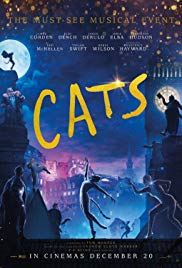
Greetings again from the darkness. Director Tom Hooper must really enjoy this process. In 2012 he brought mega-hit stage musical LES MISERABLES to the screen. It was nominated for 8 Oscars and won 3, including one for Anne Hathaway. This time, Mr. Hooper again turns his talents towards a colossally successful stage musical, and costumes, make-up, and visual effects are even more crucial. Whereas Les Mis was adapted from Victor Hugo’s novel, CATS was adapted by songwriter Andrew Lloyd Webber from a 1939 poetry collection of T.S. Elilot. Of course, Mr. Webber is also the genius behind other brilliant musicals, including THE PHANTOM OF THE OPERA (from the novel by Gaston Leroux).
Tom Hooper and Lee Hall have adapted the screenplay from the stage presentation, and the sung-through musical approach means there is minimal dialogue. Songs are used to tell the story and introduce the key characters. Choreographer Andy Blankenbuehler (a 3-time Tony winner, “Hamilton”) is the real star. Multiple dance styles are featured, including: classical ballet, contemporary, hip-hop, and traditional tap. The dancing is tremendous, and of course, a big part of that is Francesca Hayward, who plays new kitten on the block, Victoria. Ms. Hayward is a Principal Ballerina at The Royal Ballet. Numerous other skilled dancers are in the cast as well.
The story (such that it is) revolves around a tribe of Jellicle cats who have an annual ritual of selecting one to ascend to the Heaviside Layer and come back with a new Jellicle life. Sweet Victoria is unceremoniously dumped in the alley by her owner, and is quickly surrounded by this tribe of cats that basically aren’t very nice. It’s in this opening sequence where we realize these humans as cats actually look a bit creepy and take a while to get accustomed to. Given the structure, the story plods along through each successive song, with certain characters getting their moment to shine. These include Rebel Wilson as humorous and chunky Gumbie cat Jennyanydots, Rum Tum Tiger cat played by talented musician/singer/dancer Jason Derulo, Oscar winner Jennifer Hudson as outcast Grizabella, James Corden as the usually-hungry Bustopher Jones, and Oscar winner Judi Dench as Old Deuteronomy. Always hovering, is the mystical Macavity played by glowing-green-eyed Idris Elba, and making a later appearance is Taylor Swift as Bombalurina, singing the Macavity tribute song.
The two most memorable numbers come courtesy of Ian McKellan as Gus the Theatre Cat, and Ms. Hudson who belts out the most famous song of the production, “Memory”, in a vocal and emotional highlight of the film. Visually, it’s Mr. Mistofelees (Laurie Davidson) magic number that breaks us out of the muted palette. The other musical numbers mostly just fall flat and aren’t very entertaining or enjoyable.
It’s pure coincidence that the screening for this film was the same day as the new Star Wars movie. The franchise for the latter began in 1977, while “Cats” first hit the stage in 1981. That’s quite a legacy for both. As for this film version from director Hooper, I do wonder if enough viewers will respond to a musical where the story and songs are overshadowed by the dancing, and the sets and costumes offer no ‘wow’ factor. Many will find these characters hard to connect with … at least outside of that incredible Jennifer Hudson vocal. It seems these kitties should have remained on stage.
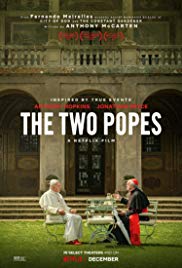
Greetings again from the darkness. Abba versus Classical. Perhaps nothing more clearly separates the two men than their musical tastes. Of course, it’s their widely disparate views of society and the role of Catholicism that matter most. Expert filmmaker Fernando Meirelles (CITY OF GOD, 2002) and screenwriter Anthony McCarten (BOHEMIAN RHAPSODY, THE THEORY OF EVERYTHING) have crafted a beautiful telling of the story of how these two men crossed paths, and they selected two preeminent actors to play the two Eminences.
Jonathan Pryce plays Cardinal Jorge Bergoglio, now known as Pope Francis, and Oscar winner Sir Anthony Hopkins plays Joseph Ratzinger, now known as Pope Benedict XVI. The story kicks off in 2005 with the announcement that Pope John Paul II has died. The proceedings for the election of the new pope provide us our first glimpse at the differences between ultra-conservative and traditional German Joseph Ratzinger and the progressive Jorge Bergoglio, so in touch with the people. It’s portrayed as a passive-aggressive rivalry, and an election between humility and ambition. Director Meirelles does a terrific job of establishing the pomp and tradition that goes with the election of a new pope … we see the quite amazing process in quick-cut form so that it doesn’t drag out.
There are flashbacks to Bergoglio’s early days in Buenos Aires, and Juan Minujin portrays him as a younger man making the all-important life decision. But of course the real fun here is the verbal sparring and intellectual chess match played out between the older men in 2012. Pope Benedict is dealing with church scandals involving financial fraud and sex-abuse cover-ups. He is, for lack of a better term, beaten down in his job. Bergoglio has requested permission to retire from his post, and he makes the trip to secure Benedict’s signature on the papers. Pope Benedict deftly avoids the papers and the topic as he engages Bergoglio in meaningful dialogue. Their conversation is at times combative, as their disparate philosophies become apparent. Bergoglio is a humble man of the people and understands the public perception of the Church. Benedict embraces the sanctity and power of his position and holds tightly to tradition.
As the two men philosophize on the Catholic religion and church, these two acting legends make every moment a pleasure to watch. Watching men of faith with differing ideals could have been either of two extremes: dry or over-the-top. Instead, we have meaningful dialogue on faith and the role of the church. Also, the set of the re-created Sistine Chapel is breathtaking and accurate. For those of us who have been inside the walls of the Chapel, we can’t help but recall the architectural and artistic details captured here. Cinematographer Cesar Charlone (Oscar nominated for CITY OF GOD) captures the beauty of the Chapel, as well as the immense size of Vatican City. As an added bonus, the aerial shots of Rome are not to be missed.
With more than one billion Catholics around the globe, it’s actually quite impressive that Pope Benedict was willing to step down and take the role of pope emeritus. For such a proud man to recognize that he was no longer the right man for the job is quite rare, but even more impressive is how he understood that his diametric opposite, Pope Francis, was the right man for the times. Fanta, futbol, Fitbit and Tango all surprisingly have their moments. The running gag with Fitbit provides levity when needed. The film might let Pope Benedict off a bit too easy as it showers Pope Francis with affection, but the real fun here is watching these two fine actors go at it.
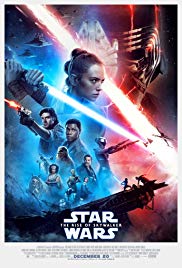
Greetings again from the darkness. Ending the final trilogy of trilogies that covers 42 years of storytelling, was never going to be easy. And, given the rabid fan base’s backlash from the penultimate episode, the ending was unlikely to appease all (or even most?). Keeping respectful of the sensitivity associated with this franchise, no spoilers are included here, certainly nothing that hasn’t already been dissected and debated after the trailers were released.
As I approached the theatre, it was impossible not to chuckle at the irony of seeing the life-sized marketing prop for KNIVES OUT in the lobby. Of course, that current release is directed by Rian Johnson, who caused such an uproar with the aforementioned STAR WARS: THE LAST JEDI (Episode VIII), a franchise entry that happens to be one of my personal favorites. But we are here for Episode IX, the wrap-up of George Lucas’ masterful vision. JJ Abrams (STAR WARS: EPISODE VII – THE FORCE AWAKENS) is back in the director’s chair, and knowing what a fanboy he is, it’s not surprising to see the familiarity and tributes to the franchise interjected throughout.
In fact, this finale leans heavily on nostalgia and humor, while tying up most loose ends – as well as some that weren’t even all that loose. Writers Derek Connolly, Colin Trevorrow (originally slated to direct), Chris Terrio, and Abrams seemed intent on giving each beloved character their moment, as a sign of appreciation for their contributions to a legacy that covers a period longer than the lifespan of some of the biggest Star Wars fans. As one who stood in line in 1977, it’s an approach that I respect and have no problems with – knowing full well that some will.
Any attempt to tie up previous threads must focus on the odd, mystical relationship between Kylo Ren (Adam Driver) and Rey (Daisy Ridley). Both are still conflicted and attempting to come to grips with who they are. Rey especially is struggling with her identity and roots. One of my favorite elements from The Last Jedi was inner-head conversations blended with cross-dimensional physical interactions between Kylo and Rey, and it’s used beautifully here.
So, the biggest complaint from me is that despite its nearly two-and-a-half hour run time, there is simply too much crammed in. Too much story and too many characters and too many things that get a glimpse or mention, but no real development. This movie is jam-packed, and ‘convoluted’ would not be too strong of a word to describe. There are times we aren’t sure where the characters are or what they are doing or why they are doing it. We do know that everything good is dependent on ‘this mission’, a mission that seems to change direction about every 12 minutes. In fact, the “new” players – Rey, Poe (Oscar Isaac) and Finn (John Boyega) – spend very little time together on screen. And really, Finn is given almost nothing to do except look worried most of the time. On the bright side for characters, Chewbacca (Joonas Suotamo) and C3PO both get their own sub-plots. Anthony Daniels (as C3PO) becomes the only actor to appear in all 9 episodes, although R2D2 joins C3PO as characters appearing in all.
There are many old familiar faces, both good and evil. Some of these play key roles, while others are brief cameos. Much has been speculated about how Carrie Fisher’s role as Leia will be handled. Archival footage, combined with special effects and camera angles, allows her to be present throughout, and yes, she gets the send-off she deserves. There are even some new characters/creatures introduced, including a cute new droid (never underestimate or under-market a droid) that is already for sale in Disney stores.
No matter one’s feelings or expectations, an area that surely will not disappoint is the visual effects. Somehow, this one is even more impressive and awe-inspiring than the others. In particular, a couple of scenes filmed in and around an angry sea left me dumbfounded, mouth-agape. However, what’s most amazing is the consistency of the visuals throughout. It’s just a stunning film to look at. Some of the story may be a bit confusing or cheesy, but some parts of the film are truly great. Cinematographer and Special Effects guru Dan Mindel deserves special mention, as do Production Designers Rick Carter and Kevin Jenkins. Of course the visual effects team is without peer – and take up about 5 minutes in the closing credits.
Lastly, composer John Williams gets to add his well-deserved personal stamp on this final chapter with new work added to the already iconic score. Very few moments compare to the opening notes blasting away on the theatre sound system as a Star Wars film begins. And as much as we’d like to treat this as the end, we all know Disney will find a way to keep us interested in a galaxy, far far away.



 Posted by David Ferguson