VITA & VIRGINIA (2019)

August 22, 2019

 Greetings again from the darkness. The historical landscape of relationships is littered with the remains of artist couples who began with a cosmic connection and ended with a sonic boom. Add in the socially toxic matter of same-sex attraction from a century ago, and you have a starting point for the romance-friendship-inspiration between writers Vita Sackville-West and Virginia Woolf. Director Chanya Button co-wrote the script with Eileen Atkins, and it’s adapted from Ms. Atkins play and the personal letters of Virginia and Vita … correspondence that covered many years and hundreds of letters.

Gemma Arterton (TAMARA DREWE, 2010 and QUANTUM OF SOLACE, 2008) stars as writer Vita Sackville-West, a successful poet, novelist, and columnist. Vita was also known for her free spirited ways, and sometimes scandalous behavior. Virginia Woolf is played by Elizabeth Debicki (“The Night Manager”, THE GREAT GATSBY), and she does really nice work capturing the troubled genius, and the glimmers of hope during her time with Vita. The two women were so very different in their approach to life and writing, although each faced their own challenges.

We see their first meeting, and the immediate enchantment that occurs as their eyes meet across the room. However, what makes their relationship interesting is the long and winding path to consummation. The interesting parts come as Vita toys with the fragile Virginia, though it’s clear their connection is quite strong. Though the connection was strong, the relationship was quite complex. Vita was a fan of Virginia’s talent. Virginia was an admirer of Vita’s strength and confidence. They seemed to push each other – sometimes for the better, other times for the worse.

The film opens as Ms. Woolf’s book “Jacob’s Room” is being typeset and printed. It’s quite an artistic way to show the mechanics of the process, and credit goes to Cinematographer Carlos De Carvalho for a segment that would typically be little more than filler. We learn about Vita’s secretly “open” marriage to diplomat Harold Nicholson (Rupert Penry-Jones) and her constant battle with her mother Lady Sackville (Isabella Rossellini) over scandals and the family reputation. Virginia’s husband Leonard (Peter Ferdinando) runs their printing business, and is seen as vital to his wife’s emotional stability, despite the void in other marital aspects. Virginia’s artist sister Vanessa Bell (Emerald Fennell) is quite an interesting character whose backstory (also a part of the Bloomsbury Group) is teased enough that she might deserve her own film.

The film features a couple of memorable lines of dialogue, both spoken by Vita. During a BBC radio program she boldly claims “Independence has no sex”, and in an early discussion with Virginia states “Popularity is no sign of genius”. Vita’s brazen step traveling as a man with her previous lover Violet Keppel is mentioned, but mostly this is focused on the class differences and the ‘snatched moments’ for Vita and Virginia. Vita’s exotic spirit and Virginia’s struggle with mental health are made clear (even using special effects for the latter). “Visions” of conversations bring the words on the letter pages to life, though it does seem that the filmmakers played things a bit too safe in order to capture a mainstream audience. The music of Isobel Waller-Bridge (Phoebe’s sister) brings a contemporary feel but it’s at times in contrast to the high gloss presentation. For the women who wrote and inspired the amazing novel “Orlando”, and led one of the more tumultuous historical lesbian affairs, it could be argued that they deserved a bit more risk taking on the big screen. Still, “X” marks the spot for Virginia’s writing room, and we do understand why discretion might be the right call.

watch the trailer:


AMERICAN FACTORY (doc, 2019)

August 22, 2019

 Greetings again from the darkness. In December 2008, General Motors shut down their truck plant in Dayton, Ohio, putting approximately 2000 employees out of work. Six years later, Chairman Cao Dewang, the founder of Fuyao Glass, invested millions to turn the shell of the plant into a retro-fitted factory and the first U.S. operation for his company – a company he claims owns 70% of the auto glass market. In doing so, the factory hired approximately 1000 locals, many of whom had not had consistent work since the GM plant closed years prior.

Co-directors Steven Bognar and Julie Reichert share an Oscar nomination (she has 3 total) for their 2009 documentary short, THE LAST TRUCK: CLOSING OF A GM PLANT. This time out, they have impressive access to a remarkable situation: a successful Chinese company opening a factory in the United States, and attempting to merge two distinctly different cultures. We hear much these days about globalization, and by the end of the film, you’ll likely be re-defining the word.

This unique business model came with good intentions on both sides. The differences that start out as kind of funny and well-intentioned turn into hurdles that are nearly impossible to manage. Fuyao ships many workers from China to Dayton for the training of U.S. workers. These ‘temporary’ transplants must spend two years away from their family as they try to make sense of an unfamiliar land far different from home. Workshops are held for the Chinese workers as they are lectured on what makes Americans different … they don’t work as hard, they don’t dress well, they talk too much on the job, they won’t work overtime, etc. The Chinese blatantly state that they are superior to American workers – a point that’s difficult to argue against when it comes to dedication, quality, and efficiency. We soon learn there is more to the picture.

U.S. labor and safety laws exist for a reason, and the Chinese company neither understands these, nor is very willing to abide by them. Additionally, since this is the ‘rust belt’, the shadow of unionization hovers from day one. While China’s Workers’ Union functions in sync with companies, U.S. labor unions are regularly in conflict with companies here. When the U.S. supervisors make a training and observation trip to China to see the Fuyao factory, the differences become even more obvious. The mostly overweight Americans show up casual – one even in a JAWS t-shirt – while the lean and fit Chinese are all in fine suits and ties. Morning shift routines are also contrasted to point out the gaps in discipline and attention to details.

What the filmmakers do best is allow us to see both sides of the issue. Surely the right thing to do is obvious when it comes to safety, and when Chairman Cao says the real purpose in life is one’s work, well, we realize these two cultures are farther apart than the 7000 miles that separate them. It’s a fair look at both sides, but for those who say U.S. companies are too focused on profit, they’ll likely be surprised to learn that Chinese factory workers typically get 1 or 2 days off from work each month!  As one of the dismissed American managers states, you can’t spell Fuyao with “fu”. The film seems to present a debate with lines drawn via citizenship and culture, and the contrast might be more relevant today than ever before.

watch the trailer:


READY OR NOT (2019)

August 21, 2019

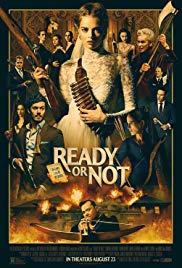
 Greetings again from the darkness. Rich people aren’t like you and me (unless you happen to be rich, in which case you fall into the first category). Their houses are different. Their vacations are different. Their family traditions are different. And that’s where this latest from co-directors Matt Bettinelli-Olpin and Tyler Gillet (known collectively with Producer Matt Villella as Radio Silence) really kicks in. Yes, the Le Domas estate is a maze of dark wood, music rooms, and hidden passages, but it’s the wedding day tradition of post nuptial game night that provides the thrills, chills, shocks and laughter for about an hour and a half.

Former foster child Grace (a star-making performance from Samara Weaving, THE BABYSITTER, THREE BILLBOARDS OUTSIDE EBBING MO), is nervous and excited just before her wedding ceremony begins. Her husband to be is Alex Le Domas (Mark O’Brien), the black sheep of an ultra-rich family, and the ceremony is being held within the lush garden and fountain grounds of the Le Domas mansion. Grace loves Alex and seems to have come to grips with his family: alcoholic brother Daniel (Adam Brody) who is always hitting on her, Daniel’s gold-digger wife Charity (Elyse Levesque), father and patriarch Tony (Henry Czerny) who is outspoken in his belief that Grace isn’t good enough for the family, mother and matriarch Becky (Andie MacDowell) who seems confused about her feelings towards Grace, crazy-eyed and wild-haired Aunt Helene (Nicky Guardagni) who seems to hate all living creatures, and coke-head sister Emilie (Melanie Scrofano) who, along with her douche-husband Fitch (Kristian Bruun) couldn’t even get to the ceremony on time.

The above lineup of players is crucial because of what happens next. For wedding day game night, Grace draws the “Hide and Seek” card, rather than the much preferred checkers or Old Maid. There is a nice set up for this tradition which includes a Faustian deal made by Great Grandfather Le Domas. It’s that deal that turns ‘hide and seek’ into ‘hunt and kill’. Oh yeah, Alex forgot to warn Grace about the stakes and it’s a blast to watch her transition as she figures it out. A torn wedding gown and yellow Chucks make up the visual of a bride fighting back against the antique weapons of crossbow, pocket pistol, elephant gun and battle-axe. You got it right – this family tradition is absolutely bonkers … and bloody … and deadly.

As has become the favorite pastime of Hollywood recently, the film torches the ultra-rich. But if you can overlook the political posturings, you’ll find a devilishly fun irreverent farcical zinger that offers some similarities to CLUE and SLEUTH, as well as many other games and movies. It has some of the look of SAW, but with significantly more tongue-in-cheek. In fact, dark comedy thriller might be a proper description, but you’ll likely find yourself laughing more often than jumping in your seat. It’s a wonderfully crafted and paced film that understands exactly what it is … an instant classic Midnight Movie (along with this year’s SATANIC PANIC from director Chelsea Stardust).

Co-writers Guy Busick and Ryan Murphy take full advantage of the ominous setting and the wicked set-up, however, a minor quibble would be that the dialogue could have been a bit wittier. Most of the laughs come courtesy of the moment or the actors, and the banter falls just a little short. The prologue provides a 30 year ago flashback that cautions us for the ride we are about to take, and even offers some insight into the characters as much younger versions of themselves. The opening credit sequence is a beautifully staged and filmed running shot of some classic board games, informing us of the industry closely associated with the Le Domas ‘dominion’.

It must be noted that a studio recently postponed the theatrical release of THE HUNT because of the political backlash to their premise – rich people hunting poor people. While the themes of these two films could be considered similar, only the most extreme hard-liners could view READY OR NOT as anything more than good demented fun. Much of the primary production was filmed on location at the Parkwood Estate in Ontario, and it’s the perfect setting for a family that chooses murder and fortune over all else. Two standouts on the soundtrack include “The Hide and Seek Song” by Headquarters Music and “Love Me Tender” by Stereo Jane (definitely not Elvis). For those who enjoy the twisted comedy approach to in-law jokes and violence, there are plenty of macabre moments that will deliver a smile … till death do us part.

***I’ve elected not to post the trailer here. If this is the type of movie you enjoy, it’s better that you allow the surprises and twists to sneak up on you. If you aren’t a fan of this type of movie, the trailer wouldn’t convince you to see it.


WHERE’D YOU GO BERNADETTE (2019)

August 15, 2019

 Greetings again from the darkness. Has she lost her way or lost her mind? The Bernadette Fox we meet is a misanthrope. She doesn’t much like her life. It’s a life with a loving husband, a workaholic tech genius. It’s a life with a crumbling, once majestic mansion that she is remodeling one spot at a time. It’s a life with a smart daughter who admires her mother. It’s a life that expects participation at a level Bernadette is unwilling to commit. And it’s a life that is not the one she envisioned for herself.

Two time Oscar winner Cate Blanchett plays Bernadette, and as with most of her roles, she embodies the character. It’s a role that more resembles that of her character in BLUE JASMINE than in CAROL. Bernadette is not really a likeable person and she clearly feels out of place in suburbia … yet we find her interesting – in a train wreck kind of way. She’s a bit reclusive and seems to best communicate with Manjula, her virtual assistant in India. The daily dictations come across as therapy as much as directives for such vitals as fishing vests.

Bernadette describes herself as a “creative problem solver with good taste” and as the self-proclaimed “Bitch Goddess of Architecture”. A mid-life crisis is pretty easy to recognize (unless it’s your own). It’s rarely about the person you sleep next to, and often about “finding one’s true self”. This syndrome is especially irksome for a parent, and is actually better described as selfish behavior. Bernadette was a rising star in the Los Angeles world of architecture, and when Microsoft bought her husband Elgie’s (Billy Crudup) software, the couple relocated to Seattle where he could continue his high-tech pursuits. Bernadette stopped designing and focused on being a mother to daughter (and the film’s narrator) Bee (Emma Nelson). In fact, it’s Bee’s request for a family trip to Antarctica that pushes Bernadette to the brink.

The supporting cast is brimming with talent. Kristen Wiig is Audrey, the neighbor and private school mom who manages to push every wrong button for Bernadette. Audrey is a victim of Bernadette’s mean streak in one of the more outrageous scenes in the film. Zoe Chao is Audrey’s friend and Elgie’s new Administrative Assistant. Laurence Fishburne appears as Bernadette’s mentor, and Judy Greer is underutilized in the role of psychologist. Others you’ll recognize include James Urbaniak, Claudia Doumit, and Megan Mullaly. But despite all of that talent, this is Cate Blanchett’s (and Bernadette’s) movie. Is it a powerful performance or an overpowering one?  I’m still not sure.

What is certain is that the Production Design of Bruce Curtis is exceptional. The old mansion is worthy of its own story, and provides a distinct contrast to Audrey’s spit-shined coziness next door. The scenes on the ships at sea are also well done, and Bernadette in the kayak makes for an absolute stunning visual.

Of course the film is based on the 2012 best-selling novel by Maria Semple, and director Richard Linklater co-wrote the script with his ME AND ORSON WELLES collaborators of Holly Gent and Vincent Palmo. We typically discuss how an actor might be miscast, but this time the debate could be in regards to the director. Mr. Linklater is a wonderful director with such diverse films as BOYHOOD (2014), BERNIE (2011), BEFORE SUNRISE (1995) and DAZED AND CONFUSED (1994). He’s a naturalistic story-teller with personalities we recognize. Bernadette looms so larger-than-life, with her grandiose gestures and over-dramatizing every moment that she’s almost cartoonish at times. At times, Linklater seems like everyone else … not sure what to make of Bernadette.

The film differs in many details from the novel, but the spirit remains. This plays like ‘Diary of a Mad-Disgruntled-Unfulfilled Housewife’, and it’s obvious to viewers that Bernadette’s near seclusion is actually her hiding from herself. Ms. Blanchett is a marvelous actress, one of the best of all-time. She is set to play the legendary Lucille Ball in Aaron Sorkin’s planned LUCY & DESI film. Ms. Blanchett commands our attention for Bernadette, whether it’s in the comedy segments or the more philosophical moments. Rarely will you see a film whose Act I and Act III are so tonally opposite. The first part plays like an old-fashioned Howard Hawks comedy, while the last part is Bernadette’s more somber search for artistic expression once she is freed from the constraints of family life. It’s the saddest comedy I can recall.

watch the trailer:


BLINDED BY THE LIGHT (2019)

August 14, 2019

 Greetings again from the darkness. Last year we had Queen via BOHEMIAN RHAPSODY, and so far this year we’ve had Elton John with ROCKETMAN and The Beatles with YESTERDAY. Thanks to writer-director Gurinder Chadha (BEND IT LIKE BECKHAM), our latest musical genius to receive the cinematic treatment is The Boss … New Jersey’s own Bruce Springsteen. While this one is not a biopic of Bruce, it is based on the memoir (“Greetings from Bury Park”) of British journalist Sarfraz Manzoor, who co-wrote the script with Ms. Chadha and Paul Mayeda Berges.

Viveik Kalra stars as Javed, a Pakistani Brit living in Luton during the economic downturn of Margaret Thatcher’s run as Prime Minister. It’s 1987 and Javed faces racism and the struggles of a first generation Pakistan family pursuing their American dreams. He is a wanna-be writer who creates recession-era poems and politically-charged song lyrics for his best friend’s pop-synth band. At home, his hyper-stressed father (Kulvinder Ghir) pushes to keep his ideals on track for the family – a vision which does not allow Javed to pursue a writing career.

Javed finds a supportive teacher in Ms. Clay (Hayley Atwell), and things really change for him thanks to his energetic Sikh buddy Roops (Aaron Phagura) who introduces him to the music of Springsteen. Viveik Kalra is a relative newcomer, having only previously appeared in the TV mini-series “Next of Kin”. He shines in this role, and never more than when he conveys the near-religious experience of being touched by music the first time. The more he listens to Springsteen, the more he relates. The music helps him find his voice as a writer, and equally importantly, his place in society.

Another relative newcomer to the big screen is the terrific Nell Williams, who plays activist and rebellious Eliza. She also happens to be the love interest for Javed, and the two are quite fun to watch together. It’s a bit of a shame that the roles weren’t expanded more for both Ms. Williams and Mr. Phagura. Both characters could have contributed more to the story. Dean Charles-Chapman plays Matt, Javed’s long-time musician friend, and Rob Brydon has a comical appearance as Matt’s dad – one who appreciates Springsteen as much as Javed.

The film weaves in the cultural challenges of Javed and his family, as well as some of the Pakistan traditions and the accompanying pressures. Filmmaker Chadha doesn’t deliver a musical per se, but there are definitely some musical moments, including full production numbers that have us singing along. A few too many Jewish Springsteen jokes are included, and some may find the film a bit too light-hearted, but it’s crafted for mass appeal while blasting some classics from the theatre speakers: Promised Land, Badlands, Thunder Road, Darkness on the Edge of Town, Born to Run, Because the Night, Prove it All Night, and yes, even “Hungry Heart”. These songs are the inspiration for the movie, just as they were for Mr. Manzoor. Sure, there are some silly moments, but mostly it’s an entertaining and inspirational message movie wrapped in BRUUUUUCE!

watch the trailer:


ZZ TOP: THAT LITTLE OL’ BAND FROM TEXAS (2019, doc)

August 14, 2019

 Greetings again from the darkness. The opening credits are still rolling when we hear the very familiar chords and vocal growls that kick off ZZ Top’s mega-hit “La Grange”. Director and music documentarian Sam Dunn delivers quite a celebratory tribute to this ‘little ol’ band’, and it’s likely that even their biggest fans will learn something new.

We first see the three band members as they drive a classic convertible right up to the front door of the historic Gruene Hall. Their subsequent jam session inside the rustic dance hall acts as a framing device throughout the film – proving they’ve still got “it”. Director Dunn introduces us to each band member separately in the beginning. Dusty Hill walks us through his man-cave and explains his appreciation of Elvis both today and as a kid growing up in Dallas, and recalls playing with his brother’s band The Warlocks. Frank Beard reminisces about playing regular gigs in Ft Worth and meeting up with Dusty first, and later with Billy. Billy Gibbons takes us through his early years in Houston, having some success with his band Moving Sidewalks, and opening for the Jimi Hendrix Experience.

The film moves takes a traditional timeline approach, but there is really nothing conventional about this band. Superfan Billy Bob Thornton describes ZZ Top as “unique and eccentric”, and other admiring interviews include Steve Miller and Josh Homme. Discussed throughout is the “mystique” of the band, which apparently stems from their spurning of Los Angeles and New York, while choosing instead to blend Texas with Nashville. In the early days, many critics and music executives tried to label them a blues band, but Mr. Gibbons said it best when he stated they were “interpreters of the blues.”

Director Dunn utilizes some animated sequences to fill in bits of the historical timeline, and that technique proves quite fitting when the band’s music videos for MTV are described as presenting the band members as ‘cartoon’ characters surrounded by cool cars and beautiful girls. The influences of their manager Bill Hamm, and video director Tim Newman are noted, which goes to the underlying theme here. These 3 guys, despite incredible career success, remain quite grounded and humble.

It’s been more than 40 years since I first saw ZZ Top in concert, yet I learned more about the band and these men during this film than over all these years. The origin of the band name and their commitment to experimenting with music and sound and stage shows are all details that stand out. It’s said, “No one else looked like them. No one else sounded like them.” The iconic beards were originally grown as disguises, but soon became trademarks … although, ironically, drummer Frank Beard is the one without a beard! ZZ Top has played halftime of a Super Bowl and been inducted to the Rock n Roll Hall of Fame, but having these guys tell their own stories confirms they realize how fortunate they are to have played with guys they want to play with for so long (they are the longest surviving rock lineup) … this little ol’ band has “legs”.

watch the trailer:


MANSON: MUSIC FROM AN UNSOUND MIND (2019, doc)

August 14, 2019

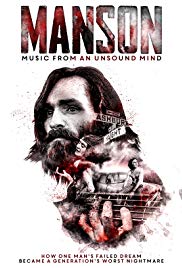
 Greetings again from the darkness. It’s been 50 years since the horrific and tragic Tate-LaBianca murders, and that has caused a renewed fascination with that era in general, and the Manson family specifically. History has rightly labeled Charles Manson as a monster and a madman and a demented cult leader, but it’s even more frightening to think of him as a human being … and that’s exactly what music documentarian Tom O’Dell does with his latest.

O’Dell examines Manson’s dream of becoming a rock star. If you’ve read anything about Manson, you are likely aware of his interest in music and quasi-affiliation with Dennis Wilson, Terry Melcher and other movers and shakers in the 1960’s music industry. But O’Dell digs deeper. We learn more of Manson’s childhood and early exposure to music. We learn of his dreams to become a songwriter and musician, and how many recognized his raw talent. And most amazingly, we hear clips from Manson’s actual recordings at Gold Star Recording Studio in 1967 … including the quite unique “Garbage Dump”.

O’Dell follows Manson’s journey after his release from prison. Attracted to communal nature and music scene, Manson made his way to Northern California. The Haight/Ashbury scene made famous by The Grateful Dead appealed to him very much, and it’s here where his charisma drew his first followers. Soon Manson and his followers headed to Southern California where the music scene was even more dynamic and offered even greater opportunity. He fell in with Dennis Wilson of The Beach Boys, and Wilson’s musical partner Gregg Jakobson provides some insight into what it was like to have Manson around.

Others interviewed include Rolling Stone magazine writers Anthony DeCurtis and David Felton, Dennis Wilson biographer Jon Stebbins, Manson biographer Simon Wells, and former ‘family’ member Dianne Lake. Ms. Lake was 14 years old at the time she was swept up by the family, and her recollections are quite chilling … though fortunately for her, she left before the murders took place. It’s through these interviews where we fully understand Manson’s broken dreams, his magnetism, and his delusional state.

After being rejected by Terry Melcher (son of Doris Day), the highly successful music producer of The Beach Boys, The Byrds, and Paul Revere and the Raiders, Manson seemed to slip from reality, which fully formed the historical figure of which we are most familiar. It’s quite interesting to note the effects on Dennis Wilson. The Beach Boys’ drummer had fully supported Manson as a songwriter – taking the song “Cease to Exist” and changing the title to “Never Learn to Love” and adjusting the lyrics so the group could record it as a “B” side. Manson was paid for his original song, but this connection likely pushed Wilson over the edge after the murders.

The influence of The Beatles White Album and “Helter Skelter” (a song about a fair ride) are discussed, and we hear stories from sound engineer Stephen Desper and Manson’s fellow ex-con Phil Kaufman about the recording and release of “Lie”, Manson’s only album. The story is filled with the best and worst of ‘Sex, Drugs, Rock ‘n Roll, Violence, and a Race War”. We leave with a better understanding of how a rejected Manson corrupted a community built on love and peace. It doesn’t soften the blow of the tragedy, but it does help explain. O’Dell’s film works for those who ‘know all about it’ and those who are interested in learning more.

watch the trailer:


TEACHER (2019)

August 14, 2019

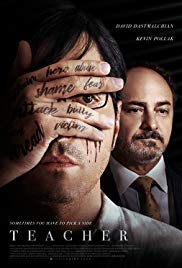
 Greetings again from the darkness. The first feature film from writer-director Adam Dick is actually a full length version of his own short film (same title) from a couple of years ago. In it, he covers many of today’s hot topics: bullying, racism, white privilege, and gun control. No one can argue against any film that takes on these issues, and the filmmaker gets many things right in this low budget presentation.

David Dastmalchian (whose crazed eyes we first noticed in THE DARK KNIGHT, 2008) stars as James Lewis, a devoted English teacher who cares about students despite his own personal issues. Those issues include a rough divorce, anger issues, alcoholism, and a less-than-ideal childhood. Having been bullied himself as a youngster, he recognizes what his mirror image student is going through. Preston (Matthew Garry) is a shy, sensitive, intelligent student who has a knack for photography. Preston is also the target of school bully Tim Cooper (a talented Curtis Edward Jackson), a star athlete and son of powerful local community businessman Bernard Cooper (the always excellent Kevin Pollak). When Preston befriends Daniela (Esme Perez), she also becomes a target – this time of cruel cyberbullying.

During Lewis’ class, Shakespeare’s “The Merchant of Venice” provides literary symmetry to the student experience, especially when the focus is on Shylock. This is the most creative portion of the film, and it’s a film that does a pretty nice job of capturing the helplessness of meek students, as well as the lack of power a school official often has in such situations. The film and characters are at their best in those moments of fear, frustration and desperation.

What doesn’t work so well is Mr. Lewis as a vigilante. At that point, it feels like a fantasy solution to a real world problem. Still, there are enough solid points and performances to keep us mostly engaged … especially when Kevin Pollak (he’s worked consistently and quite well since the mid-1980’s) spews forth with privileged rich guy righteousness. Sure, it’s all a bit obvious and over-the-top, but there is some underlying truth here as well.

watch the trailer:


DAVID CROSBY: REMEMBER MY NAME (2019, doc)

August 8, 2019

 Greetings again from the darkness. Headliners for the eternal Rock ‘n Roll question, “Is he still alive?” are Keith Richards and the subject of this documentary, David Crosby. The two men epitomize the ‘sex, drugs, and rock ‘n roll’ battle cry. Director A.J. Eaton and Producer Cameron Crowe team up to allow Crosby to tell his own story. It’s been 45 years since Crowe (whose story as an upstart reporter was the basis of ALMOST FAMOUS) first interviewed Crosby for Rolling Stone magazine, and this time Crosby is 75 years old and looking back on a life maybe not so well lived.

There is a mythology to the 1960’s and David Crosby WAS the 1960’s. He was a pop star who spoke his mind about politics and social issues … often to the detriment of his popularity or status within a band. The film states he has ‘been at the forefront of rock music for 5 decades”, and while it’s true he experienced tremendous success with The Byrds and Crosby, Stills and Nash, and later Crosby, Stills, Nash and Young (Crosby considers those two separate bands), he has also spent an inordinate amount of time on the sidelines – fired from bands, strung out on drugs, and even serving jail time.

Most of the interviews we see are clips from the past. This includes Graham Nash, Stephen Stills, Neil Young, Jackson Browne, and Chris Hillman. Roger McGuinn appears to be the only one who agreed to go on camera for the documentary. Crosby explains this by saying most everyone he created music with “hates” him and won’t talk to him … because he was an “a**hole”. Alienating 50 years of friends and collaborators is not an easy thing to own up to, but Crosby comes across as quite reflective during his time on camera speaking with Crowe.

Floyd Crosby, David’s father, was an Oscar winning cinematographer known for TABU: A STORY OF THE SOUTH SEAS (1931) and HIGH NOON (1952). The two were not close, but Crosby says his mother showed her love quite often. It’s fascinating to follow Crosby as he narrates the journey of his life: going sailing after being kicked out The Byrds, hanging with Mama Cass, discovering and loving Joni Mitchell, doing most every possible drug, and suffering health issues that include 8 stents in his heart, a liver transplant, and life as a diabetic. It’s mesmerizing to hear Crosby tell the story of Neil Young writing “Ohio” almost immediately after the Kent State massacre. We even meet Crosby’s wife Jan and see their lovely California home, replete with dogs and horses. Perhaps the most entertaining segment is when Crosby heads back to Laurel Canyon and visits “Our House” where Crosby, Stills and Nash were born with a 40 seconds take in the kitchen.

The only bit more amazing than Crosby still being alive is that stunningly pure voice has never failed him. It’s a voice that has appeared on so many records over the years, and now in this 70’s, Crosby has experienced a musical rebirth. The film would make a nice companion to the recently released documentary ECHO IN THE CANYON, but mostly it plays not like a story of redemption, but rather a farewell and apology letter. It’s quite possible that’s exactly the note Crosby wanted to hit.

watch the trailer:


THE KITCHEN (2019)

August 8, 2019

 Greetings again from the darkness. This is not a comedy. Ordinarily a movie review would not begin by telling you what the movie is not, but when the theatre marquee flashes “Starring Melissa McCarthy and Tiffany Haddish”, most anyone would assume they are in for a 2-hour laugh out loud romp with the promise of some outlandish one-liners to drop at the next party. Instead, the directorial debut from Andrea Berloff is a relatively violent mob movie. Ms. Berloff also adapted the screenplay from the Vertigo comic book series by Ollie Masters and Ming Doyle.

Kathy (Ms. McCarthy), Ruby (Ms. Haddish), and Claire (Elisabeth Moss) are left isolated when their mob-connected husbands are busted by the FBI, and sent to prison. Survival instincts kick in for the previously uninvolved ladies, and they quickly realize that a bit of strategy would allow them to not only run the business their husbands left behind, but also build it into something better. Of course the mobsters left behind are none-too-pleased with the women outperforming them, and so we get a good old fashioned ‘brains vs. brawn’ battle.

The setting is the Hell’s Kitchen section of Manhattan. The year is 1978, so the Irish community still has a stronghold on the area. This is basically the same timeframe and the same streets that serve as the setting for the classic TAXI DRIVER (1976). We see what happens when a woman’s touch is applied to gangster activities: bonds are built, services are rendered, and payments are made. The illusion of power draws the three women in deeper, and the movie has us believe they are good at it. The issue is, as viewers, we never really buy into these three seizing this power. We are just supposed to sit back and accept that Kathy is an expert community organizer, Ruby gets things done behind the scenes, and timid Claire evolves. Actually, Claire’s (Ms. Moss) transformation is the best part of the film. Seeing her discover new talents and her true persona is as exciting for us as it is for her. However, in total, the 3 characters are little more than caricatures.

In addition to the three stars, the cast is deep. The three husbands are played by Brian d’Arcy James, James Badge Dale, and Jeremy Bobb, and all three are criminals and bad husbands. Domhnall Gleeson resumes his chameleon ways in what could have been a more interesting role, Common plays a federal agent, Annabella Sciorra has a nice turn as a mobster’s wife, and the great Margo Martindale (with prop cane) and Bill Camp are both standouts (as they usually are) in their respective gangster roles.

The film does a nice job tying in historical elements of the era, including the construction plans for the Javitz Center. There are more than a few moments of violence, but the shots aren’t nearly as dramatic as we’ve come to expect in mob movies. It’s simply not as gritty as it pretends to be. There are some similarities to last year’s WIDOWS (directed by Steve McQueen and starring Viola Davis), but with this cast, Ms. Berloff might have considered approaching the tone of Jonathan Demme’s MARRIED TO THE MOB (1988). A raised eyebrow from the ultra-talented Ms. Haddish elicited laughter from the audience, rather than respect for her power. I expect it will be a crowd-pleaser for those along for the ride. Just remember – it’s not a comedy.

watch the trailer: