Greetings again from the darkness. Director Tom Hooper must really enjoy this process. In 2012 he brought mega-hit stage musical LES MISERABLES to the screen. It was nominated for 8 Oscars and won 3, including one for Anne Hathaway. This time, Mr. Hooper again turns his talents towards a colossally successful stage musical, and costumes, make-up, and visual effects are even more crucial. Whereas Les Mis was adapted from Victor Hugo’s novel, CATS was adapted by songwriter Andrew Lloyd Webber from a 1939 poetry collection of T.S. Elilot. Of course, Mr. Webber is also the genius behind other brilliant musicals, including THE PHANTOM OF THE OPERA (from the novel by Gaston Leroux).
Tom Hooper and Lee Hall have adapted the screenplay from the stage presentation, and the sung-through musical approach means there is minimal dialogue. Songs are used to tell the story and introduce the key characters. Choreographer Andy Blankenbuehler (a 3-time Tony winner, “Hamilton”) is the real star. Multiple dance styles are featured, including: classical ballet, contemporary, hip-hop, and traditional tap. The dancing is tremendous, and of course, a big part of that is Francesca Hayward, who plays new kitten on the block, Victoria. Ms. Hayward is a Principal Ballerina at The Royal Ballet. Numerous other skilled dancers are in the cast as well.
The story (such that it is) revolves around a tribe of Jellicle cats who have an annual ritual of selecting one to ascend to the Heaviside Layer and come back with a new Jellicle life. Sweet Victoria is unceremoniously dumped in the alley by her owner, and is quickly surrounded by this tribe of cats that basically aren’t very nice. It’s in this opening sequence where we realize these humans as cats actually look a bit creepy and take a while to get accustomed to. Given the structure, the story plods along through each successive song, with certain characters getting their moment to shine. These include Rebel Wilson as humorous and chunky Gumbie cat Jennyanydots, Rum Tum Tiger cat played by talented musician/singer/dancer Jason Derulo, Oscar winner Jennifer Hudson as outcast Grizabella, James Corden as the usually-hungry Bustopher Jones, and Oscar winner Judi Dench as Old Deuteronomy. Always hovering, is the mystical Macavity played by glowing-green-eyed Idris Elba, and making a later appearance is Taylor Swift as Bombalurina, singing the Macavity tribute song.
The two most memorable numbers come courtesy of Ian McKellan as Gus the Theatre Cat, and Ms. Hudson who belts out the most famous song of the production, “Memory”, in a vocal and emotional highlight of the film. Visually, it’s Mr. Mistofelees (Laurie Davidson) magic number that breaks us out of the muted palette. The other musical numbers mostly just fall flat and aren’t very entertaining or enjoyable.
It’s pure coincidence that the screening for this film was the same day as the new Star Wars movie. The franchise for the latter began in 1977, while “Cats” first hit the stage in 1981. That’s quite a legacy for both. As for this film version from director Hooper, I do wonder if enough viewers will respond to a musical where the story and songs are overshadowed by the dancing, and the sets and costumes offer no ‘wow’ factor. Many will find these characters hard to connect with … at least outside of that incredible Jennifer Hudson vocal. It seems these kitties should have remained on stage.
Greetings again from the darkness. Abba versus Classical. Perhaps nothing more clearly separates the two men than their musical tastes. Of course, it’s their widely disparate views of society and the role of Catholicism that matter most. Expert filmmaker Fernando Meirelles (CITY OF GOD, 2002) and screenwriter Anthony McCarten (BOHEMIAN RHAPSODY, THE THEORY OF EVERYTHING) have crafted a beautiful telling of the story of how these two men crossed paths, and they selected two preeminent actors to play the two Eminences.
Jonathan Pryce plays Cardinal Jorge Bergoglio, now known as Pope Francis, and Oscar winner Sir Anthony Hopkins plays Joseph Ratzinger, now known as Pope Benedict XVI. The story kicks off in 2005 with the announcement that Pope John Paul II has died. The proceedings for the election of the new pope provide us our first glimpse at the differences between ultra-conservative and traditional German Joseph Ratzinger and the progressive Jorge Bergoglio, so in touch with the people. It’s portrayed as a passive-aggressive rivalry, and an election between humility and ambition. Director Meirelles does a terrific job of establishing the pomp and tradition that goes with the election of a new pope … we see the quite amazing process in quick-cut form so that it doesn’t drag out.
There are flashbacks to Bergoglio’s early days in Buenos Aires, and Juan Minujin portrays him as a younger man making the all-important life decision. But of course the real fun here is the verbal sparring and intellectual chess match played out between the older men in 2012. Pope Benedict is dealing with church scandals involving financial fraud and sex-abuse cover-ups. He is, for lack of a better term, beaten down in his job. Bergoglio has requested permission to retire from his post, and he makes the trip to secure Benedict’s signature on the papers. Pope Benedict deftly avoids the papers and the topic as he engages Bergoglio in meaningful dialogue. Their conversation is at times combative, as their disparate philosophies become apparent. Bergoglio is a humble man of the people and understands the public perception of the Church. Benedict embraces the sanctity and power of his position and holds tightly to tradition.
As the two men philosophize on the Catholic religion and church, these two acting legends make every moment a pleasure to watch. Watching men of faith with differing ideals could have been either of two extremes: dry or over-the-top. Instead, we have meaningful dialogue on faith and the role of the church. Also, the set of the re-created Sistine Chapel is breathtaking and accurate. For those of us who have been inside the walls of the Chapel, we can’t help but recall the architectural and artistic details captured here. Cinematographer Cesar Charlone (Oscar nominated for CITY OF GOD) captures the beauty of the Chapel, as well as the immense size of Vatican City. As an added bonus, the aerial shots of Rome are not to be missed.
With more than one billion Catholics around the globe, it’s actually quite impressive that Pope Benedict was willing to step down and take the role of pope emeritus. For such a proud man to recognize that he was no longer the right man for the job is quite rare, but even more impressive is how he understood that his diametric opposite, Pope Francis, was the right man for the times. Fanta, futbol, Fitbit and Tango all surprisingly have their moments. The running gag with Fitbit provides levity when needed. The film might let Pope Benedict off a bit too easy as it showers Pope Francis with affection, but the real fun here is watching these two fine actors go at it.
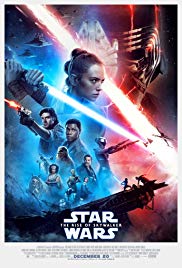
Greetings again from the darkness. Ending the final trilogy of trilogies that covers 42 years of storytelling, was never going to be easy. And, given the rabid fan base’s backlash from the penultimate episode, the ending was unlikely to appease all (or even most?). Keeping respectful of the sensitivity associated with this franchise, no spoilers are included here, certainly nothing that hasn’t already been dissected and debated after the trailers were released.
As I approached the theatre, it was impossible not to chuckle at the irony of seeing the life-sized marketing prop for KNIVES OUT in the lobby. Of course, that current release is directed by Rian Johnson, who caused such an uproar with the aforementioned STAR WARS: THE LAST JEDI (Episode VIII), a franchise entry that happens to be one of my personal favorites. But we are here for Episode IX, the wrap-up of George Lucas’ masterful vision. JJ Abrams (STAR WARS: EPISODE VII – THE FORCE AWAKENS) is back in the director’s chair, and knowing what a fanboy he is, it’s not surprising to see the familiarity and tributes to the franchise interjected throughout.
In fact, this finale leans heavily on nostalgia and humor, while tying up most loose ends – as well as some that weren’t even all that loose. Writers Derek Connolly, Colin Trevorrow (originally slated to direct), Chris Terrio, and Abrams seemed intent on giving each beloved character their moment, as a sign of appreciation for their contributions to a legacy that covers a period longer than the lifespan of some of the biggest Star Wars fans. As one who stood in line in 1977, it’s an approach that I respect and have no problems with – knowing full well that some will.
Any attempt to tie up previous threads must focus on the odd, mystical relationship between Kylo Ren (Adam Driver) and Rey (Daisy Ridley). Both are still conflicted and attempting to come to grips with who they are. Rey especially is struggling with her identity and roots. One of my favorite elements from The Last Jedi was inner-head conversations blended with cross-dimensional physical interactions between Kylo and Rey, and it’s used beautifully here.
So, the biggest complaint from me is that despite its nearly two-and-a-half hour run time, there is simply too much crammed in. Too much story and too many characters and too many things that get a glimpse or mention, but no real development. This movie is jam-packed, and ‘convoluted’ would not be too strong of a word to describe. There are times we aren’t sure where the characters are or what they are doing or why they are doing it. We do know that everything good is dependent on ‘this mission’, a mission that seems to change direction about every 12 minutes. In fact, the “new” players – Rey, Poe (Oscar Isaac) and Finn (John Boyega) – spend very little time together on screen. And really, Finn is given almost nothing to do except look worried most of the time. On the bright side for characters, Chewbacca (Joonas Suotamo) and C3PO both get their own sub-plots. Anthony Daniels (as C3PO) becomes the only actor to appear in all 9 episodes, although R2D2 joins C3PO as characters appearing in all.
There are many old familiar faces, both good and evil. Some of these play key roles, while others are brief cameos. Much has been speculated about how Carrie Fisher’s role as Leia will be handled. Archival footage, combined with special effects and camera angles, allows her to be present throughout, and yes, she gets the send-off she deserves. There are even some new characters/creatures introduced, including a cute new droid (never underestimate or under-market a droid) that is already for sale in Disney stores.
No matter one’s feelings or expectations, an area that surely will not disappoint is the visual effects. Somehow, this one is even more impressive and awe-inspiring than the others. In particular, a couple of scenes filmed in and around an angry sea left me dumbfounded, mouth-agape. However, what’s most amazing is the consistency of the visuals throughout. It’s just a stunning film to look at. Some of the story may be a bit confusing or cheesy, but some parts of the film are truly great. Cinematographer and Special Effects guru Dan Mindel deserves special mention, as do Production Designers Rick Carter and Kevin Jenkins. Of course the visual effects team is without peer – and take up about 5 minutes in the closing credits.
Lastly, composer John Williams gets to add his well-deserved personal stamp on this final chapter with new work added to the already iconic score. Very few moments compare to the opening notes blasting away on the theatre sound system as a Star Wars film begins. And as much as we’d like to treat this as the end, we all know Disney will find a way to keep us interested in a galaxy, far far away.
Greetings again from the darkness. Imagine you are being falsely accused of a terrorist act that killed and injured people. You are the FBI’s primary suspect. Your name and face are spread across every possible media outlet. Your belongings have been searched and seized as evidence – right down to your mom’s Tupperware. Cameras follow your every step of every day. Now imagine all of this occurs mere days after your actions actually saved lives and you were hailed as a hero across all of those same media outlets. Richard Jewell didn’t have to imagine this, as he lived this nightmare in 1996.
We first see Richard (played by Paul Walter Hauser in one of the year’s best performances) as a supply clerk at a law firm in 1986. His awkward ways and surprising efficiency catches the eye of attorney Watson Bryant (Oscar winner Sam Rockwell), a quasi-connection that comes into play a decade later. We then jump ahead those 10 years to find Richard being fired from his campus security job at a college due to his over-zealous focus on protocol. Fortunately for Richard, the Olympics are coming to Atlanta, so finding work as a security guard is pretty easy.
Atlanta’s Centennial Olympic Park is shown with crowds of people cheering at a Kenny Rogers and later dancing the Macarena. As one of the on-site security guards, Richard spots a suspicious backpack that turns out to be holding the bomb that detonates, creating tragedy for many. As the viewing audience, we know that Richard’s actions saved lives and he most definitely was not responsible for planting the bomb. And it’s that knowing that places us as close as possible to the Richard Jewell experience.
Four-time Oscar winner Clint Eastwood directs yet another story of a working-class hero. Only this time, he blatantly calls out what he sees as two evil forces: the U.S. Government (the FBI) and the media. Billy Ray (CAPTAIN PHILLIPS, SHATTERED GLASS) based his script on the 1997 Vanity Fair article “American Nightmare: The Ballad of Richard Jewell” by Marie Brenner (who also wrote the article that was the source for THE INSIDER, 1999). It can be argued that Eastwood comes down hard on the FBI and the media, but you might consider putting yourself in Richard Jewell’s shoes before crying foul.
Jon Hamm has perfected the role of cocksure FBI agent and here he plays Tom Shaw as the man totally focused on proving Richard Jewell was the perpetrator. Much has been made of Eastwood’s depiction of Atlanta Journal-Constitution reporter Kathy Scruggs (played by Olivia Wilde, who directed this year’s surprise hit BOOKSMART). It’s a bit curious that the uproar is over what some interpret as a reporter trading intimate relations for a scoop, yet Eastwood’s contempt seems focused more on the idea of trying a citizen’s case in public … while lacking any real evidence outside of a profile. The reporter (Ms. Scruggs passed away in 2001) is certainly portrayed as an ultra-aggressive reporter desperate for a headline story, but the implied consensual affair occurred after the inside information was provided – and the FBI agent was actually surprised… “Is this really going to happen?” Perhaps the viewer reaction to this is a sign of the times, but I’m guessing if any one of Eastwood’s critics were similarly falsely accused (as Jewell), the fictionalized version of the reporter would be less important than having the truth discovered. Of course, this could have been easily avoided had the name of the reporter been changed for the film.
Two key supporting roles come courtesy of Oscar winner Kathy Bates as Richard’s mother Bobi, and Nina Arianda as Watson Bryant’s paralegal. Ms. Bates starts out as a loving and simple mother to Richard, but her press conference captures the character in a new light. It’s a strong and heartfelt performance. Ms. Arianda brings some warmth sprinkled with welcome sarcasm to her role. Mr. Hauser is spot-on in every scene, and when these four are all together, it’s a pleasure to watch. Hauser and Rockwell are especially good in their scenes together as the ‘wronged man’ contrasted with the take-no-guff attorney.
Every time Richard says “I’m law enforcement too”, it’s heart-breaking to us and an opening for the FBI to manipulate him. The profile of a single white male living at home with his mom, carrying gung-ho dreams of a career in law enforcement, while collecting guns and knowledge on bombs and police procedure, made Richard Jewell seem like the kind of guy who would do something for attention. However, the film and the true story both emphasize the danger of prematurely persecuting individuals – especially in public. These days the race is always about who is first with a story, rather than who is right. A rush to judgment can be seen as an abuse of power, whether it’s by the media, a law enforcement agency, or folks on social media. At this stage of his career, director Eastwood seems more interested in telling stories than showing one. He offers up little visual artistry outside of the terrific performances, but this story … it’s a doozy.
Greetings again from the darkness. Nicole has already made her decision. The film opens with her and husband Charlie in a therapy session. They are listing traits they admire about the other person. Watching this, we are unsure if the therapist thinks this exercise might salvage a broken marriage, or if it’s some cruel way of highlighting what is being lost. This is writer-director Noah Baumbach’s most gut-wrenching film to date, and it’s based, at least partially, on his split from wife Jennifer Jason Leigh. Writing about personal experience is nothing new for Baumbach, as THE SQUID AND THE WHALE was inspired by his parents’ divorce.
Charlie (Adam Driver) is an up-and-coming theatre director in New York City, and wife Nicole (Scarlett Johansson) is the company’s lead actor. When Nicole informs Charlie that she wants a divorce, and is headed back home to Los Angeles to be with family and resume her TV acting career, he is stunned. She explains that her dreams and ambitions have been stifled by focusing on his career, and despite her numerous attempts to discuss this, he has never bothered to take her seriously. Oh, and she’s taking their young son Henry (Azhy Robertson) with her.
What follows is a masterclass in writing, acting, directing, editing, and human nature. We watch as Nicole builds the foundation of her new life, while Charlie is staggered – not so much in denial, as disbelief. Their initial course of an amicable split, equitable division of belongings, and shared/split custody of Henry is abruptly altered when Nicole takes counsel from powerhouse LA divorce attorney Nora Fanshaw (Laura Dern). Complicating matters is the bi-coastal nature of the divorce and California laws. This forces Charlie to meet with attorney Bert Spitz (a terrific Alan Alda), who may or may not be up to the task – his acumen varying from day to day.
Baumbach allows both sides to play out. These are basically normal, good people in a situation that brings out the worst traits in both. Unsparing pain arises at every turn. One particular argument between Charlie and Nicole is the axis on which the movie turns. It’s a spilling of guts and filled with devastating honesty. The scene is relentless and builds to a breakdown or breakthrough … any description leaves us spent. Just when we don’t believe we can handle any more emotional turmoil, up pops a moment of genuine tenderness that restores our faith – even if it’s only long enough for us to breathe again. There are even some surprisingly funny (dark humor) moments sprinkled throughout, just as there is in life.
Supporting roles are filled beautifully by Ray Liotta, Julie Hagerty, Merritt Weaver and Wallace Shawn. As Henry, Azhy Robertson avoids the “cute-kid” syndrome and delivers an actual nuanced performance by a child actor. Although it seems they are both everywhere these days, Ms. Johansson and Mr. Driver are truly outstanding in their roles here. Scarlet perfectly captures a woman moving on, while Adam singing Stephen Sondheim’s “Being Alive” at the bar in front of his theatre company is one of the most poignant on screen moments of the year.
There have been some amazing movies about marriage/divorce over the years. Bergman’s SCENES FROM A MARRIAGE (1974), Benton’s KRAMER VS KRAMER (1979), and Farhadi’s A SEPARATION (2011) come to mind. Baumbach’s latest belongs in that group. Even the “best” divorces – those where both sides end up better off – are a “loss” for both parties. At a minimum, it’s a loss of a once-in-time vision of life partnership. The division of assets is a cold term for the shredding of emotions. We are fine with whatever the adults decide as long as the priority for both is their young son who shouldn’t pay the price for their debacle … but certainly will, just as countless other children have. I’m only now able to write about this film after seeing it at the inaugural North Texas Film Festival (NTXFF). As a movie lover, I’m in awe of the acting and storytelling. As a human being, it temporarily destroyed me.
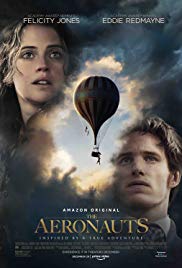
Greetings again from the darkness. ‘Up, up, and away, in my beautiful balloon.’ That song says nothing about a lack of oxygen (hypoxemia), a malfunctioning valve, or frost bite … all of which come into play in this story inspired by real life events of 1862 in London. Tom Harper directed the excellent WILD ROSE earlier this year, and for this one, he and his co-writer Jack Thorne (WONDER, 2017) base the story on both the real life record-breaking flight of scientist James Glaisher and balloon pilot Henry Coxwell, and Richard Holmes’ book “Falling Upwards: How We Took to the Air.’
Reuniting from THE THEORY OF EVERYTHING (2014) where they played Stephen Hawking and wife Jane, are Eddie Redmayne (as scientist-with-a-chip James Glaisher) and Felicity Jones (as fictional balloon pilot Amelia Wren/Rennes … yes, naming your female pilot Amelia is so very creative). Courageous real life balloon pilot Henry Coxwell gets nary a mention here, as new world cinema must require a female lead or co-lead for every filmmaker not named Martin Scorsese. So, to heck with history, Amelia Wren is now the hero of this adventure!
As it turns out, Ms. Jones’ character is the more interesting of the two. Amelia’s initial showmanship catches nerdy Glaisher off-guard, though in fact, both are over-compensating. He, for his inferiority complex and the ridicule he endures from his fellow brainiacs at the Royal Society of London, and she for the tragic loss of her beloved husband in a balloon mishap. The mismatched pair are on a mission to fly higher than any human has previously flown, and in the process, allow Glaisher to record all the atmospheric readings possible in order to prove to the skeptics that meteorology is legitimate, and the weather can be predicted (although almost 160 years later, most weather reporters still haven’t quite gotten the hang of it).
It’s a tricky thing filming two characters who spend most of the movie floating tens of thousands of feet above ground in a wicker basket. The banter between the two should be crisp and the connection or disconnect should add intrigue. Here, the two characters are dwarfed by the giant balloon and the challenges that brings. What begins as an adventure morphs into a tale of survival. Storms, frostbite and technical issues provide the conflict. We do have flashbacks to background on both Amelia and Glaisher. Himesh Patel (star of this year’s YESTERDAY) plays Glaisher’s best friend, while Tom Courtenay and Anne Reid are Glaisher’s parents. Vincent Perez appears as Amelia’s husband Pierre.
I was fortunate enough to see this in a theatre and the big screen allows for the balloon effects to have full impact. There is no doubt that streaming this on your TV will not be as impressive … although anyone suffering from acrophobia will likely still experience some discomfort. The scenes in the balloon are thrilling, and Amelia’s rescue mission up the ropes is stunning and beautifully filmed by cinematographer George Steel; however, the flashback scenes are quick to deflate the excitement. The upside here is that the English really did break the French record on the flight … even if the filmmaker had to bend history so Amelia could get credit.
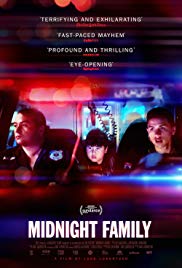
Greetings again from the darkness. It would be easy to question why a family would choose to run a private ambulance service in a city where they may or may not get paid. It’s only when we know one stunning statistic that their reasoning becomes clear. In Mexico City, the government operates only 45 ambulances for a population of nearly 9 million people. Director-cinematographer-editor-producer Luke Lorentzen takes us inside the ambulance with the Ochoas as they work the streets in the business they’ve run for almost 20 years … it’s a business that fills a necessary gap in emergency services.
Teenager Juan is the most talkative of the crew that includes his father, a younger brother and a friend of the family. We are never certain whether their service or vehicle is properly licensed, whether they are certified, or even if actual licenses and certifications exist. What we do know is that when a medical emergency occurs, a two-plus hour wait for a city ambulance makes the private services much more appealing … and, quite frankly, necessary.
Mr. Lorentzen serves up some terrific camera work, focusing mostly on the family rather than the patients they are providing service for. In the blink of an eye, the Ochoa family goes from utter boredom to a life-and-death situation where response time is crucial. Timing is important not just for medical reasons, but for competitive ones as well. Often there are two races occurring – the race to reach the patient, and the race against another ambulance. What is clear is that once on the scene, the Ochoas are very professional and caring … whether it’s a gunshot wound, a child that’s fallen four stories from a window, or a woman who has been physically assaulted by her boyfriend (and needs a hug, as well as an ambulance).
Corruption is everywhere in this cutthroat industry. From a government who refuses proper care for its citizens to a police force accepting bribes to private ambulance services on retainer from certain hospitals. For the Ochoas, the police scanner is as vital to their business as the medical supplies in the back where the youngest brother munches chips between calls. A loudspeaker is necessary as they race through the city streets admonishing cyclists and cab drivers to get out of the way for a medical emergency.
The Ochoas treat hundreds of patients each year, and when they aren’t responding to calls, they are scrubbing the blood from the vehicle or resting up for another stressful night. We hear their philosophy in providing care for those who might not otherwise get to the hospital on time, and we understand this family does care very much about their chosen profession … this in spite of the fact that so many refuse to pay them, or simply can’t afford to. It’s a constant hustle that keeps the family on the edge financially, although they can hold their head up high knowing they provide a valuable service. Lorentzen’s camera work ensures we feel the intensity and stress of each and every call.
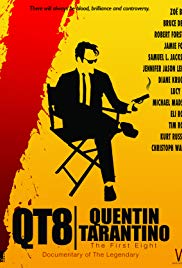
Greetings again from the darkness. Quentin Tarantino has been praised as the cinematic “voice of his generation.” His influence on other filmmakers is as obvious as those who have influenced him. This is a celebration of Tarantino the filmmaker, and also somewhat of a response to his critics. Tara Wood’s documentary never hides that she’s a fan, and to her credit, she hits head-on the 3 controversies associated with her subject: the use of the “N-word”, Uma Thurman’s stunt car accident while filming KILL BILL, and his friendship and business relationship with the despicable Harvey Weinstein.
Tarantino has publically stated that he will retire from filmmaking after directing his 10th film. Ms. Wood’s film covers his first eight, from RESERVOIR DOGS in 1992 to THE HATEFUL EIGHT in 2015. Because this documentary was tied up and delayed in the Miramax quagmire, there is also a brief mention of Tarantino’s 9th film ONCE UPON A TIME IN HOLLYWOOD, released this year. The film kicks off with some background information from Producer Stacey Sher, mentions of his writing for TRUE ROMANCE and NATURAL BORN KILLERS, and a fascinating tidbit involving how QT used his pay from appearing as an Elvis impersonator on “The Golden Girls” to initially fund his career in filmmaking.
Ms. Wood then divides her film into three chapters, thereby categorizing and providing insight on each. “Chapter 1 – The Revolution” includes RESERVOIR DOGS and PULP FICTION, both ground-breakers in their own way and they announced “an astonishing new voice” in movies. The best behind-the-scenes bit comes courtesy of actor and Tarantino regular Michael Madsen who initially objected to being Mr. Blonde, complaining “I didn’t want to get killed by Tim Roth.” Of course, it was PULP FICTION that elevated Tarantino to a new stratosphere – oh, and it also allowed for the stunning comeback of John Travolta.
“Chapter 2 – Badass Women and Genre Play” covers JACKIE BROWN, KILL BILL and DEATH PROOF. The first of those films, each which featured very strong women, was an ode to the Blaxploitation era, the second was influenced by Hong Kong cinema, and the third is described by Zoe Bell as Tarantino’s ‘thank you’ to industry stunt people. Perhaps the most important element of this chapter was that, despite the affirmations, he refused to serve up a repeat PULP FICTION … yet another thing that set him apart from other filmmakers.
“Chapter 3 – Justice” finishes up the catalog with INGLORIOUS BASTERDS, DJANGO UNCHAINED, and THE HATEFUL EIGHT. ‘Basterds’ is renowned for what may be the most fascinating opening sequence in any movie, ‘Django’ shows his love of westerns (especially Italian), and ‘Hateful 8’ stands as a ‘western RESERVOIR DOGS’. With his many references to earlier cinema, Tarantino shows no hesitancy in spinning or changing history to fit his story. While many disparaged the infamous Hitler scene in ‘Basterds’ (and subsequently the Manson killings in his latest), Tarantino firmly believes that viewers know they are watching a movie, and can easily separate this from real life and historical fact. It’s noted that this is what story telling is all about … asking ‘What if?”
Many of Tarantino’s collaborators offer insight and memories. Those appearing include: Samuel L Jackson, Christoph Waltz, Kurt Russell, Michael Madsen, Jennifer Jason Leigh, Diane Kruger, Lucy Liu, Bruce Dern, Jamie Foxx, the late Robert Forster, Tim Roth, Eli Roth, and Lawrence Bender. Most obvious in their absence are Uma Thurman, Pam Grier, Leonardo DiCaprio, John Travolta, and Tarantino himself. There is also a nice segment included as a tribute to the late Sally Menke, Tarantino’s long-time film editor.
Quentin Tarantino has been described as an overzealous geek with the talent to back it up. In reality, he’s a walking and (fast) talking encyclopedia of movie knowledge, trivia and history. He is also described as creating an exuberant infection with cinema, and his frequent scenes of ultra-violence are interpreted by Christoph Waltz as “opera”. It was October 5, 2017 when the Harvey Weinstein story broke, and immediately, since many films connect them, Tarantino was part of the story. It’s a blight on his record, just as it is for countless other actors, celebrities and film industry types who knew and chose to stay silent. But when it comes to making movies, few have ever done it better. There is an on-set clip where Tarantino says “One more take. Why? Because we love making movies!” It’s clear from the interviews here that QT reveres making movies. He also loves watching movies – so much so that he bought and renovated the New Beverly Cinema. He’s a proud film geek. Ms. Wood’s film is pure pleasure for QT fans and will explain a lot for those who aren’t so sure about his work.
Greetings again from the darkness. The Copacabana tracking shot in GOODFELLAS is etched not only in my brain, but in cinema lore. Filmmaker Martin Scorsese teases us with a similar shot as the opening sequence in his latest. The camera snakes through the dank halls and rooms of an assisted-living center before settling on the well-worn face of wheelchair-bound octogenarian Frank Sheeran (Robert DeNiro). Mr. Sheeran is the titular Irishman, and he narrates the story of his life, at least as he recalls it. His is a life story that connects the mob to history and politics in a no frills manner surely to provoke thought, skepticism, and a knot in the tummy.
Oscar winning writer Steve Zaillian (SCHINDLER’S LIST, also GANGS OF NEW YORK, THE FALCON AND THE SNOWMAN) adapted Charles Brandt’s book “I Heard You Paint Houses” for the film. Mr. Brandt was Sheeran’s attorney and worked with Sheeran on his memoir. The book title is highlighted by Scorsese at both the beginning and end of the film, as well as through a line of dialogue in the first phone conversation between Sheeran and Jimmy Hoffa. Mr. Sheeran was a WWII veteran turned truck driver turned mob hit man (and good soldier). He tells his story with little fanfare and in a way that we understand no glamour is associated with this lifestyle.
For those looking for the next GOODFELLAS or CASINO, you’ll likely be disappointed. This one is not as flashy or stylish as those two classics, and instead is a 3 and a half hour introspective look at the men who are efficiency experts in power. Violence is merely one of the tools in their box. The presentation is contemplative, not action-centric. The hits are abrupt and jerky and realistic, not the stylistic choreography of shootouts in films like JOHN WICK. There is a skewed theme of friendship and male bonding … even mentorship. It’s unlike what we’ve seen before from mob movies.
After a chance meeting over a timing belt on a delivery truck, Sheeran is taken under the wing of Philadelphia mob boss Russell Bufalino (Joe Pesci). This is Pesci’s first onscreen appearance since 2010, and he is absolutely brilliant in his portrayal of “the quiet Don.” His performance is 180 degrees from his comedy in LETHAL WEAPON (2.3.4) or HOME ALONE, and 180 degrees the opposite direction from his roles in GOODFELLAS and CASINO, where he was a bombastic man (not a clown) on the edge of violence at all times. Mr. Pesci has spent the last decade playing jazz under the name Joe Doggs. It’s such a joy to have him back on screen, especially as the father figure-friend-ruthless businessman. His Russell is always calm and calculating, whether plotting the next kill or putting up with his wife’s frequent smoke breaks on a road trip.
It’s Russell who directs Sheeran to connect with Jimmy Hoffa (Al Pacino), President of the International Brotherhood of Teamsters. Pacino flashes his blustery best as Hoffa in a couple of scenes, but is also terrific while spewing one of his countless “c***suckers”, or savoring one of his beloved ice cream sundaes – a simple pleasure in a complicated life. Sheeran and Hoffa develop an unusual friendship in their many years together, and Hoffa’s real life unsolved disappearance in 1975 is the basis for Sheeran’s recollections.
We learn that Sheeran’s time in WWII taught him to kill … there is a scene involving POW’s digging their own grave while his rifle is pointed at them. In fact, most of the story is told in flashbacks that bounce between different eras. Scorsese, as has been reported ad nauseam, has utilized the de-aging process from Industrial Light & Magic to show DeNiro, Pesci, Pacino and others over the years. The effect is a bit distracting at first, but the story and these characters are so intriguing that we simply roll with after the initial jolt. It’s also obvious how Scorsese worked to make DeNiro look like the hulking presence Sheeran was in real life (think Tom Cruise in the Jack Reacher movies). Camera angles, should pads, and shoe lifts are used to make us think DeNiro towers over the others the way Sheeran really did. DeNiro is excellent in portraying Sheeran as a good soldier, reserved in mannerisms – even flashing a slight stutter at times. He’s a proud man who simply looks at the mob work as his job.
In addition to the three stars who each excel in their roles, Scorsese has assembled a huge and talented cast. Harvey Keitel is chilling in a couple of scenes as Angelo Bruno, Ray Romano plays mob lawyer Bill Bufalino, Bobby Cannavale is steak-loving Skinny Razor, Jesse Plemons is Hoffa’s adopted son Chuckie O’Brien, Domenick Lombardozzi is Fat Tony Salerno, comedian Sebastian Maniscalco is “Crazy Joe” Gallo, Louis Cancelmi is bespectacled Sally Bugs, Jack Huston plays Attorney General Bobby Kennedy, and even Steven Van Zandt plays crooner Jerry Vale.
You are probably wondering, ‘Where are the women?’. While there is no Lorraine Bracco (GOODFELLAS) or Sharon Stone (CASINO), Scorsese makes the point that with Sheeran, and these other mobsters, it’s all business and real family relationships are nearly non-existent. Stephanie Kurtzuba plays Irene Sheeran (Frank’s second wife) and Katherine Narducci is Carrie Bufalino (Russell’s cig-loving wife). They have some brief but entertaining moments on the road trip, and Marin Ireland has an effective scene late in the movie as Carrie, one of Frank’s daughters, while Welker White plays Jo Hoffa. But it’s Sheeran’s daughter Peggy who is the quiet moral center of the story and his life. Played as a youngster by Lucy Gallina and later by Anna Paquin, Peggy is a mostly silent observer of her father, and whatever conscience he has, is impacted by her glances. Ms. Paquin is especially good with one question … “Why?”
Worthy of special mention is Stephen Graham who plays Anthony “Tony Pro” Provenzano, a friend-turned-rival of Hoffa. Graham and Pacino share two standout scenes – one in prison, while Hoffa scoops his sundae, and a later meeting where Hoffa takes offense to Tony Pro’s late arrival and casual attire. Both scenes are remarkable in that there is underlying humor balancing the surface anger. In fact, the film is filled with memorable scenes. Hoffa’s guidance on self-defense in guns vs. knives, and most every scene between DeNiro’s Sheeran and Pesci’s Russell. DeNiro and Pesci have a chemistry few actors share. It dates back to RAGING BULL (1980), and I believe this is their 7th film together.
The film reminds me of the 1970’s movies that fueled my movie obsession: THE GODFATHER I and II, THE CONVERSATION, THE FRENCH CONNECTION, CHINATOWN, and even THE LAST PICTURE SHOW. Sheeran may or may not be a reliable narrator, but these are real people – even if we don’t know the specifics on every hit. Captions are periodically included to inform of us how a particular mobster met his maker – again providing some dark humor. What is a bit surprising is the male bonding, even friendship, between guys in such a brutal profession. And watching how the story weaves in and out of history with the Bay of Pigs, Cuba casinos, and the Kennedy assassination -“If they can whack a President …” is a bit unsettling.
Cinematographer Rodrigo Prieto (SILENCE, BROKEBACK MOUNTAIN) is a good fit for Scorsese’s vision, and you can catch the varying camera styles for each character – and don’t miss the stunning shot of the illicit guns in the river. Composer Robbie Robertson (The Band) delivers Scorsese trademark musical riffs, and 3-time Oscar winner Thelma Schoonmacker is in peak form editing this epic. This is the 8th film collaboration for Scorsese and DeNiro, but the first in 25 years (CASINO).
I’m a little concerned. In fact, I’m a little more than concerned. This feels like the end of an era. It’s not the end of Scorsese films, but it’s the final chapter of his mob films. No other filmmaker comes close in this genre. With the bookends of Sheeran reminiscing in the assisted-living home, this is quite the holiday gift for cinephiles … and a lasting one (providing Netflix survives).
Greetings again from the darkness. Whether in sports or music or movies, watching talent blossom and grow is wondrous. For movie lovers, this describes young filmmaker Trey Edward Shults, whose first feature film KRISHA really grabbed me at a film festival in 2016. His follow-up was the critically acclaimed IT COMES AT NIGHT (2017), and now with only his third film, Mr. Shults has delivered an even more ambitious story with wide-reaching impact, yet he remains true to his intimate and personal approach. In fact, with WAVES, he basically delivers two brilliant films in one.
A terrific opening credits sequence takes us inside the life of a teenager. There is constant motion, laughter, the longing for independence, and signs of responsibility and structure. Tyler (Kelvin Harrison Jr,LUCE, 2019) is a high school student, talented athlete, pianist, son, brother, and boyfriend. He’s living an upper-middle class life in a beautiful home with his dad (a powerhouse Sterling K Brown), stepmom (Renee Elise Goldsberry), and younger sister Emily (breakout star Taylor Russell). His dad owns a construction company, and is tough and demanding as a parent, incessantly pushing his son to do and be more. His fatherly advice comes in the form of telling Tyler that black men have to work harder than white ones … never stopping to give praise or affection. He’s the type of father who challenges his son to arm wrestle while in a restaurant and critiques his wrestling match victory by telling him the lesser opponent should have been dispatched much quicker. The pressure is relentless, though offered with the best intentions … a college scholarship and a successful life.
Tyler’s stepmom is loving and supportive, and his sister Emily is very sweet and quiet, living in the shadows of big brother. Tyler and his girlfriend Alexis (Alexa Demie) seem to have a good relationship and Tyler appears to be dealing with the pressures. But then, as is common with life at this age, things go sideways quickly. A shoulder injury, self-medication, and Alexis’ late period bring this ideal world crashing down on Tyler. Just when it seems things can’t get worse, they do.
Shults’ film is really two love stories separated by a tragic line. Whereas the first half belongs to Tyler, the second half is owned by his sister Emily. Dealing with a situation and emotions that should be beyond her maturity level, Emily proves how strong she is, and how the heart can always respond to compassion and caring. She meets one of Tyler’s ex-teammates Luke (yet another brilliant Lucas Hedges performance). Luke is socially clumsy and 180 degrees from being a smooth-talker, but he’s smitten with Emily and offers her a lovely, if unlikely, companionship. First love is almost always awkward and watching these two navigate is quite charming and heart-warming. A road trip leads to bonding and a better understanding of each other.
As the film shifts in focus and tone, characters are pushed to emotional limits. The film offers snapshots of moments without disturbing the flow or Shults’ commitment to rich texture. The photography from cinematographer Drew Daniels is creative and varied, and adds much to the presentation. Music is also vital here. The score from Trent Reznor and Atticus Ross adds the perfect touch, and the soundtrack contrasts the tastes of today’s generation with what the parents relate to (Dinah Washington’s “What a Difference a Day Makes”), even forming a surprising connection at one point. For other fans of Shults’ film KRISHA, you will enjoy a quick scene with Krisha Fairchild as a high school teacher.
Proms, pregnancy, parties, pills, and parents are all common topics for films dealing with teens, but this one digs deeper than most. It’s based in south Florida and is quite the stylish and heartfelt drama, slicing open the traits that make us human. A lifetime of good decisions builds a foundation, and one or two bad choices can topple all the good ones. When Tyler and his teammates are pumping up before a match with chants of “I cannot be taken down!”, we all know that life can absolutely take you down. Tyler learns this lesson in the harshest of ways, while his sister Emily deals with the aftermath. Themes of acceptance and forgiveness give this the feeling of the work of a much more experienced filmmaker, but evidently Trey Edward Shults is just this talented.
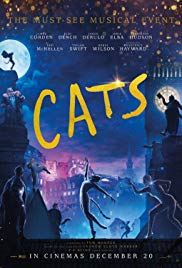 Greetings again from the darkness. Director Tom Hooper must really enjoy this process. In 2012 he brought mega-hit stage musical LES MISERABLES to the screen. It was nominated for 8 Oscars and won 3, including one for Anne Hathaway. This time, Mr. Hooper again turns his talents towards a colossally successful stage musical, and costumes, make-up, and visual effects are even more crucial. Whereas Les Mis was adapted from Victor Hugo’s novel, CATS was adapted by songwriter Andrew Lloyd Webber from a 1939 poetry collection of T.S. Elilot. Of course, Mr. Webber is also the genius behind other brilliant musicals, including THE PHANTOM OF THE OPERA (from the novel by Gaston Leroux).


 Posted by David Ferguson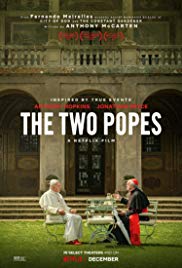




 Movie Reviews from the Dark