DOWNHILL (2020)

February 13, 2020

 Greetings again from the darkness. Overwhelming apprehension. That’s the feeling I had walking into the theatre for the Americanized re-make of one of my top 10 favorite movies from 2014 … FORCE MAJEURE. Sure, it’s common practice for U.S. filmmakers to farm international cinema for “new” projects, but when they mess with the really good ones, I can’t help but feel nervous to the point of dread. A sliver of hope existed since this new version was co-written (along with Jesse Armstrong, creator of “Succession”, and Oscar nominated for IN THE LOOP) and co-directed by Nat Faxon and Jim Rash, the creative forces behind THE WAY WAY BACK (2013).

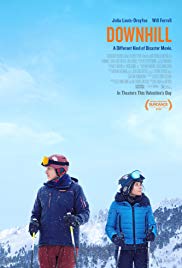
Julia Louis-Dreyfus and Will Ferrell star as married couple Billie and Pete. Along with their two teenage sons, they are on an Austrian ski trip meant to help Pete get through grieving his father’s death, and bring the family closer together. If you have seen the original or the trailer, you know what happens next. Pete’s reaction to a near catastrophic event creates a divide between him and the family … especially Billie, who is left shaken. This part is all quite similar to the original film, yet this version is different in so many ways.

Casting two brilliant comedic performers in the lead sends a strong signal that humor will play a role, and that the exceptional gravitas from filmmaker Ruben Ostlund’s FORCE MAJEURE will be softened somewhat. Both of those points hold true. However, surprisingly, this re-make manages to still generate some of the shaken-to-the-core emotions that come from having trust broken in such a startling manner. Ms. Louis-Dreyfus is especially strong here, and carries a much heavier load than Mr. Ferrell. As she is balancing her shock, frustration, and anger, while still attending to their equally shaken boys, Mr. Ferrell is relegated to spending much of the film wearing a wounded puppy look as he attempts to move on without addressing the issue.

Adding to the comedy elements are Zoe Chao (“The Comeback”) and Zach Woods (“The Office”) as Pete’s friends who get drawn into the fracas. Miranda Otto takes a break from her usually dramatic roles to play Charlotte, a wacky resort employee whose personality is a bit out of step with normalcy; although her zaniness succeeds in preventing the weight of the event from crushing Billie. Fans of the original will recognize Kristofer Hivju, who plays a resort security advisor this time. Another difference is that the kids (Julian Grey, Ammon Jacob Ford) play a bigger role in the family dynamics and fallout.

It’s clear that filmmakers Faxon and Rash set out to purposefully make a more mainstream, accessible movie than the Swedish version. The film remains effective at generating conversation about survival instinct and protecting one’s loved ones. It should be mentioned that this is not a typical Will Ferrell movie, and anyone expecting Frank the Tank, may only be pleased with one brief scene. Instead, this is about a man coming to grips with how his actions affected his family, and even his view of himself.

watch the trailer:


THE LODGE (2020)

February 13, 2020

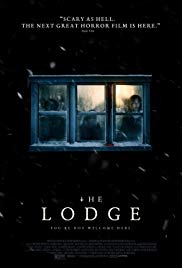
 Greetings again from the darkness. Should you ever get cast as the stepmother in a horror movie, just know things aren’t likely to go well for your character. That even holds true for the stepmom-to-be in this latest from the writer-director team of Severin Fiala and Veronika Franz who delivered GOODNIGHT MOMMY (2014). Their script comes from an idea by writer Sergio Casci, and it starts with a bang!

Richard (Richard Armitage) has planned a Christmas holiday trip to an isolated cabin in the woods so his two kids can get to know his fiancé Grace. Of course, his kids blame Grace for the break-up of their family, and the subsequent tragedy that befalls their mother. Aidan (Jaeden Martell, IT) and Mia (Lia McHugh) take advantage of Google to discover that Grace is the sole survivor of a cult’s mass suicide (similar to Marshall Applewhite’s Heaven’s Gate). As if that’s not enough, Richard gets called back to the city for work (what??) and then a massive snow storm hits the cabin just after the power and water are cut-off. Finally, Grace’s meds for sanity disappear, along with most of the clothes.

So we have a snow-covered cabin deep in the woods with two kids stranded with a quasi-stepmom that they don’t like. And yes, there’s a cute pet dog. We also have more religious images and ornamentation than anyone who is not the Pope should have in their home. On top of everything, there is a large dollhouse that often factors in to what we see on screen and to what the kids and Grace are going through. And it’s Christmas! In other words, there is no shortage of elements necessary for a quality horror film.

I much prefer creepy over slasher for horror films, and this one easily meets that standard. Rather than a slow burn, it’s a slow freeze. Unfortunately, the actions of the characters and the script just didn’t work for me. The tormenting that goes on was not believable, and I just never could get over the fact that dad left these people who didn’t even know each other, together in the middle of nowhere while he went back to work. As a rule of thumb (or red flag), when a character expresses their theory about unexplained occurrences in a horror movie, you can be fairly certain that the theory is incorrect, or at least misleading, even if it’s what you were already thinking.

On the bright side, Riley Keough (daughter of Elvis Presley’s daughter) gives a terrific performance as Grace. She is very effective in keeping us guessing as to her true colors – is she a creepy monster or is she being victimized? Also, the film has a very stylish look. The cinematographer is Thimios Bakatakis (THE LOBSTER), and the cabin and nature setting give him plenty to work with. Other bright spots include a very brief appearance from Alicia Silverstone, and the opening credits logo of the resurrected Hammer Films (a favorite of monster movie fans). I caught this at the inaugural North Texas Film Festival in 2019, and it will surely strike a chord with some horror movie lovers … even though it left me out in the cold.

watch the trailer:


THE LIGHTEST DARKNESS (Samaya svetlaya tma, Russia, 2019)

February 12, 2020

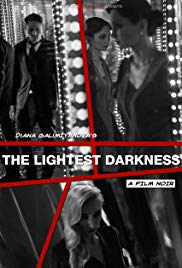
 Greetings again from the darkness. In the movie world, good things rarely happen on a train. In fact, whether it’s the train whistle, the train depot, or the passenger compartment, it’s a warning to viewers that this journey is troubled. So brace yourself. This may be the first feature film for Russian writer-director Diana Galimzyanova (known for video and documentary shorts), but her visual flair and nods to cinematic history are evident and welcome.

It’s billed as the first female directed Russian noir, and it’s clear Ms. Galimzyanova offers up a tip of the cap to Alfred Hitchcock (and others) in this homage to 1940’s Film Noir. Filmed in stark black and white for dramatic effect, the film features a very interesting story structure. Events move forward for the characters on the train, but their individual backstories are revealed in reverse chronological order via flashbacks and recollections. It’s both linear and reverse linear … requiring the viewer to pay attention and keep up!

So, who are these characters? We have Ruslan, the OCD private detective played by Rashid Aitouganov. The self-described “Crime Solver” has his frustrations at being unable to solve a case playing out with him compulsively wiping his hands. Next we have arrogant and judgmental concert pianist Elina played by Marina Voytuk. Elina boasts that her face is recognizable from the marketing posters for her concerts. Lastly we meet screenwriter Arina, played by Irina Gevorgyan. Arina claims she is researching for her computer game being written from the perspective of the murderer.

What murderer you ask? Well it turns out there is a serial killer nicknamed The Fruiterer, who is responsible for 6 murders over the last 6 months – all on the same train route that our 3 characters find themselves on. The nickname stems from the fresh strawberry the killer leaves by each body. If you enjoy the armchair detective work that goes along with murder mysteries, you’ll get a real kick out of this. Processing the interaction between the characters on the train, and blending in the details we pick up from the flashbacks leaves us filtering out what matters and what doesn’t. During the flashbacks we meet an unconventional therapist name Izolda (Kolya Neukolin) who seems to have a strange power over clients. Izolda is a key character, and also entertaining are the two knockout train conductors who have quite the side gig going on this route they refer to as “murder express.”

The opening of the film shows us a suitcase being packed with instruments of destruction. As with most mysteries, each clue must be taken with a grain of salt. Strangers, suitcases, secrets and strawberries all play a part in keeping us off balance. The film works thanks to the psychological uncertainty as we attempt to assess each character and what each tidbit means. When one of the characters says, “I can’t stand to talk to grieving people. They are so self-absorbed”, we understand each of these people has their flaws, but no one jumps out as the obvious killer.

The black and white photography, harsh lighting with shadows, and story structure add elements to the suspense and the surreal tone of the film. The camera angles and shots via mirrors, as well as the disconcerting score (often harpsichord) add intrigue to the bounty of clues and fake clues. It’s a fun movie to watch and a challenge to try and solve ahead of the reveal. For fans of murder mysteries and/or Film Noir, it’s a train ride worth taking.

watch the trailer:


OSCARS 2020 recap

February 10, 2020

Oscars 2020 recap

 It could be argued that the last 5 years of Best Picture announcements have each provided somewhat of a surprise as the title was announced. However, the noise level and affection directed towards the stage as those associated with PARASITE assembled, gave this year’s announcement a distinct and special feel. Filmmaker Bong Joon Ho has won over many in the industry during this awards season, and the historical significance of having the first non-English language winner shouldn’t be minimized. However, there was something else at play as the applause and whistles boomed throughout Hollywood’s Dolby Theatre. This was an auditorium filled with movie lovers who were celebrating a creative, unique, meaningful, and entertaining cinematic achievement … in other words, the things that movie making is meant to deliver. It was quite a moment.

While my predictions were correct on 20 of 24 categories this year, I can’t help but kick myself for not foreseeing this PARASITE juggernaut (it won 4 of its 6 Oscar nominations). Director Sam Mendes’ WWI visual masterpiece 1917 seemed to be on an unstoppable roll after winning Best Picture at BAFTA, Critics Choice, Directors’ Guild, and Producers’ Guild. But taking a step back and analyzing how the Oscars voting works – success is heavily dependent on how many ballots have a film in the first/favorite position – it becomes much easier to understand how this “upset” occurred. Ever since it won the Palme d’Or at Cannes, the number of crazed and vocal fans for PARASITE have been all over social media encouraging others to check it out. While almost everyone was wowed with the visual experience of 1917, it was the rabid fandom for the South Korean film that really stood out.

 So it was Bong Joon Ho’s film making Oscar history, and yet there are also other things to discuss. Choosing to go “host-less” for the second straight year, the very talented Janelle Monae opened the show by performing a take-off on Mister Rogers and then exploding into a high-octane song and dance featuring many of the nominated films, and a few that weren’t. Ms. Monae also infused the first political statement of the evening – one that would surely be followed by many more. Steve Martin and Chris Rock then took the stage, and though they apparently had not rehearsed their time together, there were a couple of good zingers … especially those aimed at Amazon’s Jeff Bezos … and more than a few that fell flat.

In his acceptance speech for Best Supporting Actor (ONCE UPON A TIME IN … HOLLYWOOD), Brad Pitt infused a bit of political commentary, as did Olaf, I mean Josh Gad, as he introduced Idina Menzel to sing the nominated song from FROZEN 2 (along with some talented international help). Diane Keaton did her best Warren Beatty/Faye Dunaway impression through incoherence and cluelessness (at the expense of good guy Keanu Reeves), and one of the best moments of the show was followed by one of the strangest. Lin-Manuel Miranda introduced a wonderful medley clip of film songs which played right into Eminem taking the stage to perform his Oscar winning “Lose Yourself.” Why is that strange?  Well, 8 MILE came out in 2002, and ‘18’ is rarely celebrated as a commemorative year (unless you are a 17 year old rejoicing in legal impendence). Eminem’s song is a favorite of many, but his inclusion here left us with one unanswered question … why?

Billie Eilish delivered a beautiful version of “Yesterday” as the annual In Memoriam slides played, but live performances from Randy Newman and Elton John (whose song won) paled in comparison to that of Cynthia Erivo. We were rewarded yet again by the brilliance of Olivia Colman, following up last year’s win with a turn as presenter. Her line, “Last year was the best night of my husband’s life” deserves to become part of Oscar lore alongside streakers, no-shows, and botched announcements. We were then subjected to two much-too-long ramblings from Acting winners Joaquin Phoenix and Renee Zellweger. Mr. Phoenix at least made some sense in his plea for justice for all (and a nice quote from his deceased brother River: “Run to the rescue with love, and peace will follow”), while Ms. Zellweger babbled “ums” and “you knows” about heroes, and proved why most actors should stick to a script.

As I’ve stated before, celebrities are welcome to their political opinions, which many share frequently and openly. My issue is that the Academy Awards ceremony was designed as a once a year opportunity to celebrate cinema and those who make it such an enticing and entertaining art form. Especially in this day of social media, I find the political outbursts to be in poor taste … similar to bringing McDonalds carry-out to a dinner party. It seems the proper approach would be to thank the Academy and those who helped the winner with their achievements, and then head backstage and tweet all the political opinions swirling about in their head. Having one’s own hair stylist, make-up artist, limo driver, and fashion designer, does not seemingly make one an expert on equality or geopolitics, so my personal preference would be for political opinions to be stifled for a few hours.

 All the best stories have memorable endings, and this year’s Academy Awards certainly delivered that. Political ramblings were forgotten as soon as Jane Fonda, after pausing for dramatic effect (and to ensure she had the correct envelope) announced PARASITE as Best Picture. Watching movie history unfold was exhilarating, and Bong Joon Ho’s promise to “drink till the morning” was well-deserved. He has announced his involvement with an HBO series based on this Oscar winning film, so we can expect to see his creativity on one screen or another for the next few years.

***NOTE: Tom Hanks announced during the ceremony that the long-awaited Academy Museum of Motion Pictures will open December 14, 2020 in Los Angeles’ Miracle Mile district.


CORPUS CHRISTI (Boze Cialo, 2019, Poland)

February 6, 2020

 Greetings again from the darkness. There are two camps of thought. You either believe people don’t change, or you believe that people can change. This feature film from Poland has been Oscar nominated for Best International Feature Film. In this film inspired by true events, director Jan Komasa and writer Mateusz Pacewicz will challenge your thoughts on people and change, as well as the role of Faith.

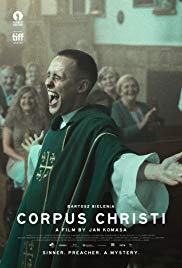
Twenty-year-old Daniel (a powerful and mesmerizing Bartosz Bielenia) is being paroled from the Juvenile Detention Center he’s been at since committing a violent crime. While incarcerated, Daniel has experienced a spiritual awakening, and is disappointed when Father Tomasz (Lukasz Simlat) informs him that his criminal record bars him from attending Seminary and becoming a priest. After a night of partying with his old buddies and attending to other releases not permitted at the center, Daniel eschews the provided job at a sawmill. He then stumbles into a temporary spot as a priest in a small community where the elder vicar’s (Zdzislaw Wardejn) health issues require him to take some time off.

Wearing a stolen priest collar, Daniel studies feverishly in order to lead mass and hear confessions. He falls back on what he has seen and heard from Father Tomasz, and even assumes that name for identity. Daniel has stepped into a community that is still reeling from a tragic car accident that took the lives of many locals. The widow (Barbara Kursai) of the “other” driver has been ostracized by the community, while mourners gather at the same site each day. Daniel befriends Marta (Eliza Rycembel), the sister of one of the victims, and he is assisted with his duties by Marta’s mother Lidia (Aleksandra Konieczna), who is suspicious of young Daniel, and still carrying much anger towards the man (and his widow) responsible for her son’s death.

Of course we know, even if Daniel sometimes forgets, that his past will eventually catch up with him. In the meantime, his enthusiasm and sincerity and youthful wisdom win over many in the community, and start the healing process among those who didn’t think it possible. These are people desperate for guidance, and they find themselves drawn to this young man so devoted to helping. Some of the most interesting scenes include the town mayor (Leszek Lichota), who also runs the sawmill. He’s a power broker for the town, and Daniel instantly recognizes his arrogance.

What is true Faith? Has Daniel turned a new leaf or is it an act? We know violence is in his make-up, but we also see that he is actually helping folks – he’s making a difference. There is a funeral procession that is quietly affecting, and the theme of forgiveness is crucial throughout. Mr. Komasa’s terrific film has been very well received at festivals, and it is sure to inspire many deep discussions. People are drawn to those who will assume the pulpit, and though the ending is brutal and crushing, we are reminded that no feeling compares to doing good for others … it’s addictive.

watch the trailer:


THE BAND’S VISIT (stage musical, 2020)

February 6, 2020

***NOTE: I don’t often post stage reviews, but since this one is adapted from a 2007 movie, I’m bending the rules

 “Nothing is as beautiful as something you don’t expect.” This memorable line works not only for the story, but also holds true as a review of the stage production. When we think of Tony Award winning musicals, we tend to think big and loud, with elaborate and ostentatious set design. Full disclosure: In 2008, I became a fan of writer-director Eran Kolirin’s film version, and in 2017 the stage musical version, with a script Itamar Moses adapted (from Kolirin’s screenplay) and music from David Yazbek moved to Broadway. It won 10 Tony Awards, including Best Musical, and then won a Grammy for Best Theatre Musical Album. So yes, that’s one of the beautiful things we didn’t expect.

When the lights first come up, it’s 1996 and we see the Alexandra Ceremonial Police Orchestra waiting apprehensively at the bus station for a ride that is apparently not coming. They have arrived in Israel from Egypt, after being invited to play at the Grand Opening of the Arab Cultural Center in Petah Tivka. Thanks to the language barrier, they instead find their way to Bet Hativka  … “with a B” instead of “with a P”. A tiny desert town in Israel offers up only confusing looks from the locals to go with welcome hospitality. Dina, the café owner, arranges a place for each of the band members to sleep that night, and her own personal guest is Tewfiq, the band’s dignified leader.

Janet Dacal has taken over the role of Dina from Katrina Lenk (Broadway) and Chilina Kennedy (first national tour). It’s a challenging character because Dina is a tough-talking local who still harbors hope of a fulfilling relationship. In other words, her hard shell protects the warm and open heart of a romantic. Additionally, Dina is responsible for bringing energy and spirit to the stage as most of her scenes are with Tewfiq, one of the more reserved stage characters you’ve seen. Sasson Gabay has reprised his excellent silver screen role as Tewfiq (played by Tony Shalhoub on Broadway), and he perfectly embodies a man weighted with an internal burden of grief, as well as the added responsibility of proudly representing his country.

Everything takes place over the course of one night. It’s not so much a story as it is a display of human connection. There is no real clash of cultures. No, these are simply people dealing with the situation. The mundane existence of the small town locals have varying reactions to the strangers wearing powder blue uniforms and toting instruments. Ah yes, the music. Rather than overblown showstoppers, the 12 songs and score coax us through the interactions. Dina’s “Omar Sharif” is not only a catchy tune, but one that bonds her with Tewfiq. “Papi Hears the Ocean” may be the most humorous of the songs, and it’s immediately followed by the touching “Haled’s Song About Love.” Themes of humor (including a running Chet Baker gag) and love run throughout, but keep in mind, this is mostly a subdued, intimate show featuring human moments between characters.

The circular, revolving stage works brilliantly for the simple sets of this simple town. The depth comes from the characters, and sometimes what is implied is more powerful than what is said. The production is from director David Cromer (also from the Broadway run), and the show runs a little more than 90 minutes with no intermission. We are informed twice that the band’s visit wasn’t important, and maybe they are right … this was “Something Different.” In contrast to the tone of the band’s overnight stay, it’s that finale concert that brings the crowd to their feet. We get to see the musicians do what they love. It’s quite a treat.

In Dallas at the Winspear Opera House, the show will have a two-week run with Dallas Summer Musicals (February 4-16, 2020), and then an additional week through AT&T Performing Arts Center (February 18-23, 2020)


STOLEN (Japan, 2020)

February 5, 2020

 Greetings again from the darkness. As the film opens, we are informed that since 1977, there have been 13 confirmed cases of Japanese citizens being abducted by the North Korean government. No reason is known, and countless other “disappearances” are suspected to fall under this same crime. Writer-director Taka Tsubota’s first film could be described as a political drama, a family drama, societal commentary, or international crime mystery. While it touches on each of these, the film, at its core, is a look at the turmoil and anxiety that strikes when a family member goes missing. Importantly, it’s inspired by real life events from within Japan.

The Hiiragi family is a mess. The youngest son, Tetsuya, has gone missing – presumed abducted by the North Koreans, given the history and that no ransom has been demanded. What we witness is the fallout: how each of the family members reacts, how the media treats the story, and how society as a whole leans toward victim-shaming. The father and mother are played by Takahiro Ono and Miwako Izumi, respectively. Dad has a background as a conservative journalist, and the couple experienced some bumpy marital times a few years prior. Both of these items come back to haunt them as the media pokes and prods for a story.

Kaede (played by Mizuki) is the daughter, a hard worker who gets fired from her job due to concerns for her employer’s image. Yuichi (Yuki Kawashima) is the oldest son, and we see him obsessed with boxing. His reasons are initially unclear, but become the heart of the film’s conclusion. Of course, the media (and others) interpret his focus on boxing as indifference towards his missing younger brother, adding fuel to the fire that this is some elaborate hoax meant to attract attention to the father’s political beliefs.

Guilt, confusion, and frustration are spread throughout the family as the media and society turn against them. Their lives are picked apart – past and present – and anything that can possibly be twisted as evidence is thrown at them. Is anything more disturbing than having personal family issues on public display? It’s fascinating to see the many reactions … especially those of the individual family members. Sometimes a family only has each other, and a reminder of this can arrive in many ways – some of which are emotionally draining. Although director Tsubota’s focus is on the Japanese culture, it’s very easy to see the similarities within American society. Victim-shaming is an easy sport in which to participate … just pray the full force is not aimed at you.

watch trailer:


THE RHYTHM SECTION (2020)

January 30, 2020

 Greetings again from the darkness. Kicking off a successful franchise that can sustain multiple sequels is the dream of most actors, writers, directors, and producers. When it clicks, a movie franchise can be a cash cow for many years. Unfortunately, it’s just not that easy to create characters that viewers will invest in, or story lines that will keep those viewers interested. Author Mark Burnell has already published four books in his Stephanie Patrick series, and director Reed Morano brings the first one to the big screen. By the time the end credits roll, we have little doubt that “franchise” was the goal.

An opening scene finds Stephanie Patrick (Blake Lively) pointing a gun at the head of a man who is unaware of her presence. A freeze frame shifts us to “8 months earlier.” Stephanie is a mess. She is supporting her heroin addiction through prostitution, all with the objective of numbing her pain. Three years earlier, her family was killed in a plane crash. It’s the kind of tragedy followed by a grief so devastating that Stephanie has basically given up on life.

Stephanie is jolted back to life when a journalist informs her that it was a bomb planted by a terrorist that brought down the plane her family was on. Now, Stephanie has a reason to exist … revenge. Clearly some suspension of disbelief is in order here. Actually everything about this story is a stretch from reality or even believability. Quick, name all of the heroin addicts who become world class assassins in 8 months. OK, that’s probably not a fair question since you likely don’t know many heroin addicts, and you hopefully don’t know many assassins. But you get the point.

The film plays like a brochure for a travel agent, as the story and Stephanie have stops in Tangier, England, Ireland, Madrid, New York, and Marseilles. Each stop is pretty brief – merely long enough for some killing. Of course most of the stops occur after former MI6 agent Ian Boyd (Jude Law) trains her on the finer points of being a contract killer. The training includes jogging uphill, a frigid lake swim, how to fight in the kitchen, how to get run off the road while driving, and the invaluable advice to shoot your victim twice (but your teacher only once). Oh yes, and she has to impersonate a presumed-dead assassin. Fortunately, Stephanie was top of her class at Oxford, so she is smart enough to make sense of all these things that make no sense to us.

And another thing … why do all these people have such perfect and complete files on their targets?  Photographs by Glamour Shots, map coordinates to hideouts, and an alphabetical list of known accomplices are all quite helpful when former MI6 and former CIA agents (Sterling K Brown) are trying to get a heroin addict to do their dirty work. Brown’s CIA agent turned ‘information broker’ is the oddest of many odd characters here. He lives in a stunning ultra-modern home and has no qualms about hitting on hot assassins that he knows only by reputation. Thanks to all those marvelously complete files, the only unknown here is the mysterious U17. Well, U17 seems to be mysterious to everyone except those watching the movie.

Blake Lively is a talented actress as evidenced by her work in THE TOWN, THE SHALLOWS, and A SIMPLE FAVOR. She is simply miscast here. Despite the “training” her Stephanie received from Ian, we never once believe she is ready to kill all the bad guys. This contributes heavily to the lack of believability presented by the film. It’s a serious story that is ultimately impossible to take seriously as a viewer.

There is a difference in believable and stylish, and director Reed Morano certainly serves up style. She is known mostly for her work as a cinematographer, though she did direct the first 3 episodes of “The Handmaid’s Tale.” Ms. Morano and cinematographer Sean Bobbitt hit us with some jarring camera work, and the musical inserts are just a tad too cutesy and obvious at their given time: “I’m Sorry”, “It’s Now or Never”, and “Where Did You Sleep Last Night?” (a cover by Sleigh Bells).

Having author Mark Burnell adapt his own novel may have been a mistake, as there are far too many plot holes and ridiculous moments for this to work as any type of thriller. Here are three examples: we never know why Stephanie didn’t get on the flight with her family; it makes little sense that the journalist tracked her down; and is that supposed to be a twist or not? Given the inclusion of Bond producers (and half-siblings) Barbara Broccoli and Michael G Wilson (stepson of Cubby Broccoli), we can safely assume that the vision was to turn Mr. Burnell’s books into a franchise along the lines of James Bond and Jason Bourne – right down to the fight scenes and international settings. This film certainly sets things up for round two, and if that happens, let’s hope more attention is paid to the script … a crucial element if viewers are expected to buy in.

watch the trailer:


MAKING APES: THE ARTISTS WHO CHANGED FILM (doc, 2020)

January 30, 2020

 Greetings again from the darkness. Movie make-up can be obvious and crucial to the character. Think about John Hurt in THE ELEPHANT MAN (1980) and Eric Stoltz in MASK (1985). It can also be subtle with quiet influence – think Grace Kelly in REAR WINDOW (1954), Julia Roberts in PRETTY WOMAN (1990), and Anne Hathaway in THE DEVIL WEARS PRADA (2006). Director William Conlin steps out of the world of Reality TV (“Animal Zone”) and into the world of make-up artists, whose job often consists of making the unreal look real. The power of movie make-up is described as magic.

As the title implies, the focus here is on director Franklin J Schaffner’s ground-breaking 1968 film PLANET OF THE APES. It is deservedly considered a turning point in movie make-up, as it proved if believable talking simians could be created, nothing was impossible. A “turning point” also means there was a ‘previous’ and a ‘since’, and Conlin’s documentary suffers from a lack of direction in those two segments. In his defense, a complete timeline of movie make-up would require much more than 90 minutes. Furthermore, additional time devoted to either the early years or the more recent years, and the importance of PLANET OF THE APES (POTA) would get lost. As you would expect, the doc is at its best when it focuses on the POTA make-up team and their process for those ‘darn’ dirty apes.

WWII Secret Agent Pierre Boulle’s 1963 science-fiction novel “La Planete des singes” (known as “Monkey Planet” in the UK) serves as the source material for the 1968 screenplay written by two legends: Rod Serling (“The Twilight Zone”) and 2 time Oscar winner Michael Wilson. Boulle also wrote the 1952 novel “The Bridge over the River Kwai”, which was renamed THE BRIDGE ON THE RIVER KWAI for the Oscar-winning film from director David Lean in 1957. 20th Century Fox was having financial troubles in the 1960’s, and it was acclaimed Oscar-winning actor Charleston Heston (BEN-HUR, 1959) who pushed to get a green light from the studio.

John Chambers had made a name for himself in both TV and movie make-up when he was hired for POTA. Chambers put together quite a staff, including Thomas R Burman, who spends a great deal of time on camera here recollecting Chambers and the backroom struggles and challenges faced by the crew. For the film to work, the apes needed not just to talk, but to emote; and even today … more than 50 years later … the make-up still looks great on screen. Mr. Chambers was awarded an Honorary Oscar for his work on POTA, as make-up did not become an official category until 1981.

Director Conlin opens the film with a history lesson – a lesson that actually feels too brief and incomplete. We hear about the work Lon Chaney and Jack P Pierce (FRANKENSTEIN, 1931) in those early Universal Studios monster movies, as well as the legendary Cecil Holland, who was behind the make-up on THE LOST WORLD (1925) and THE WIZARD OF OZ (1939). These early artists are held up as the inspirations for those who chose make-up as a career. Seven-time Oscar winner Rick Baker (AN AMERICAN WEREWOLF IN LONDON, 1982), four-time Oscar winner Greg Cannom (THE CURIOUS CASE OF BENJAMIN BUTTON, 2008), and four-time Oscar winner (now deceased) Stan Winston (TERMINATOR 2: JUDGMENT DAY, 1991) each speak highly (in recorded interviews) of their predecessors, and we also hear from directors who were inspired by their work: Guillermo del Toro (PAN’S LABRYNTH), Joe Dante (GREMLINS), Richard Donner (SUPERMAN), and John Landis (THE BLUES BROTHERS).

The modern day discussions address how the new generation is moving towards CGI and digital visual effects. Vincent Van Dyke speaks to today’s movie-making and how some of John Chambers’ early work is still used, and how digital effects are now commonplace not just in cinema, but also in TV work. He links the early POTA with the new generation of apes introduced in Tim Burton’s 2001 reboot, as well as the new Ape films that followed. Respect for the early masters is evident, but it’s easy to see how digital effects and traditional make-up are often at odds … leading us to believe a future documentary is likely to focus on this contrast.

PLANET OF THE APES premiered on March 28, 1968 and the backstories of those involved are quite entertaining. John Chambers is worshipped in the industry as both an artist (BLADE RUNNER, 1982) and as a crew leader with a temper. Conlin spends very little time (not enough in fact) on Chambers role with the CIA in the story told by the Oscar winning film ARGO. POTA director Franklin J Schaffner won an Oscar for directing PATTON (1970), and his resume also includes NICHOLAS AND ALEXANDRA (1971), PAPILLON (1973) and THE BOYS FROM BRAZIL (1978). He was also the TV adviser to John Kennedy during his campaign and presidency, and was the director of “A Tour of the White House with Mrs John F Kennedy” – a 1962 TV special broadcast to 80 million users. We also have actor Lou Wagner, who played Lucius in the original. Mr. Wagner and Mr. Burman (INVASION OF THE BODY SNATCHERS, 1978) are still regular speakers at the festivals and special screenings of their movie … the cult still thrives all these years later.

Despite the documentary sprinting through some important and interesting times, we walk away with a better understanding of how the artistry of make-up not only inspires actors, it can also help define the character for viewers. Make-up artists form a close-knit community, although one that may be fading due to digital effects. Standing as a legacy we have the 1968 PLANET OF THE APES, followed by its many sequels, TV series, and animated series. And you’ll just have to watch the documentary to find out how the great Edward G. Robinson played a role in the success of ‘Apes.’

watch the trailer:


INCITEMENT (Israel, 2019)

January 30, 2020

 Greetings again from the darkness. Since November 4, 1995, the day that Yigal Amir shot and killed Israel Prime Minister Yitzhak Rabin, speculation has existed that there could have been peace in the Middle East – if only the assassination had not occurred. The film opens on the first Oslo Peace Accord in 1994. Why was there a segment of the population concerned about possible peace? They were angry at the idea of surrendering their “promised land” to Palestinians and the Chairman of the PLO, Yasser Arafat.

Writer-director Yaron Zilberman and co-writers Yair Hizmi and Ron Leshem aren’t focused on what an end to the hostilities might look like today. Instead they offer up a psychological study of Yigal Amir (played by a forceful Yehuda Nahari Halevi) and what drove him to take the fateful action that changed the course of history. The film is presented as a slow-build thriller, and it mainly takes us through Yigal’s transformation from activist to assassin … a giant and significant step.

Yigal is a Law student at Bar-Ilan, and the college campus is filled with protests and tables dispensing information on all sides. Soon enough, Yigal is seeking counsel from rabbis who seem to be on board with revenge. When someone becomes obsessed, it’s not uncommon for them to ‘hear what they want to hear.’ Yigal sees Rabin fitting into the Jewish law of “pursuer/Rodif and Informer”, and he believes himself to be guided by Talmud and rabbis. The film is not about Yigal’s glory, but rather WHY he did it.

Alternatingly charming and frightening, intelligent and foolish, Yigal organizes a rebel movement for what he sees as a coming war. To him, there is no line between religion and politics. With archival footage of Netanyahu speaking out against Rabin and the peace project, it just pushes Yigal that much closer to action. There are three women who cross paths with Yigal and have varying impacts on him. His mother convinces him he is due for greatness (again, he interprets in his own way); Nava (Daniela Kertesz) is attracted to him, but can’t come to grips with his beliefs; and Margalit (Sivan Mast), who respects Yigal and understands how to lead him deeper down his chosen path.

There is a terrific scene between Yigal and his father, where the parent is emphasizing to the son he knows he’s losing that only the hand of God should determine Rabin’s fate … not an idealistic young man. The Oslo II accord from 1995 leads Yigal to conclude that Rabin is a traitor, and that it’s God’s will for Yigal to “let him go out like a tyrant.” This is all chilling to watch, and it helps us comprehend the vicious cycle of violence that plagues the Middle East. The film was Israel’s official submission for Academy Award consideration.

watch the trailer: