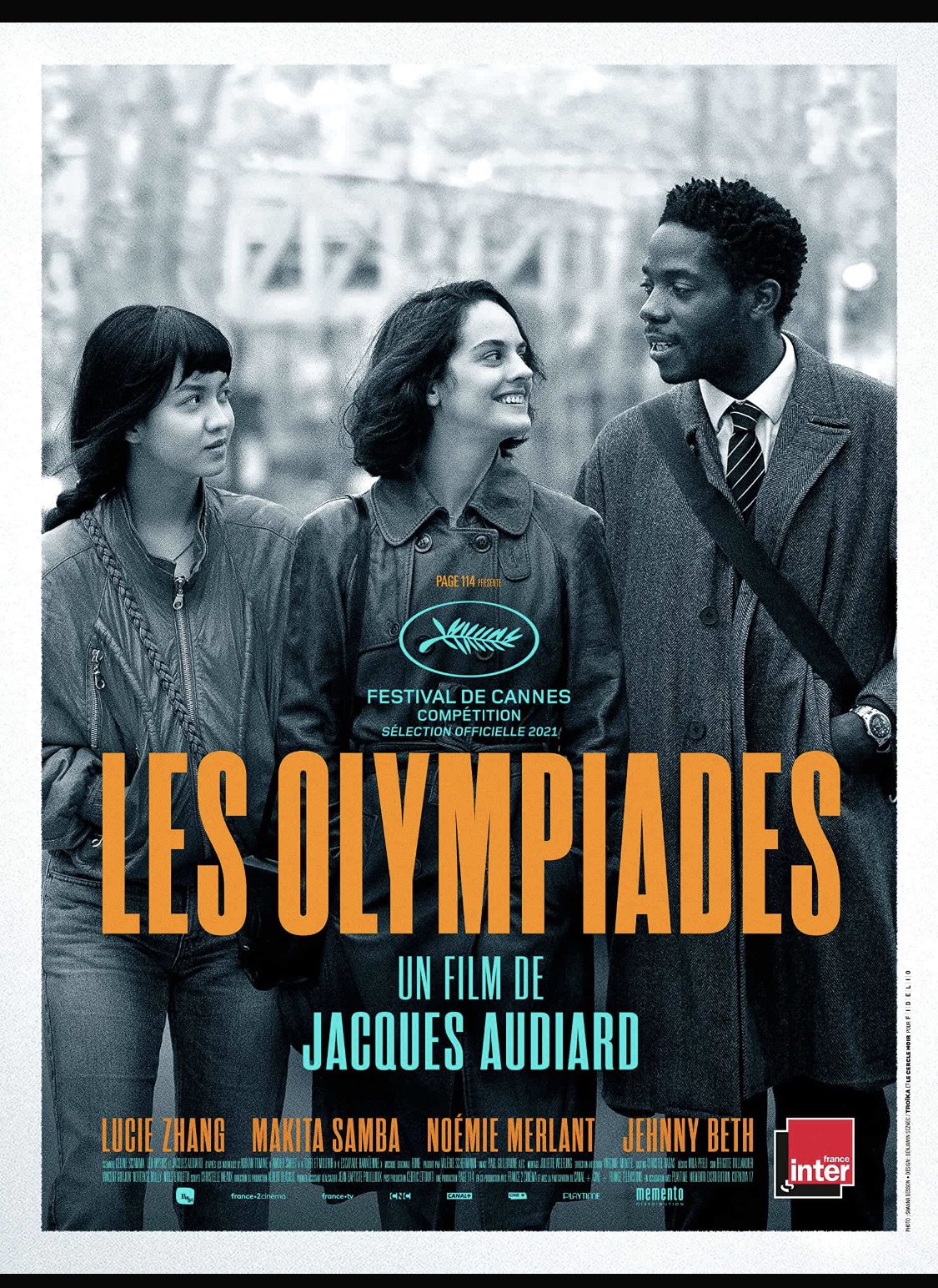
 Greetings again from the darkness. Jacques Audiard is one of the filmmakers who has won my cinematic loyalty through his consistently thought-provoking and entertaining films. His five features since 2005 have all been excellent: THE BEAT THAT MY HEART SKIPPED (2005), A PROPHET (2009), RUST AND BONE (2012), DEEPHAN (2015), THE SISTERS BROTHERS (2018). This latest is a different kind of story for Audiard, and it’s based on the stories from animator Adrian Tomine. Audiard adapted the screenplay with Nicholas Livecchi, Lea Mysius, and Celine Sciamma (writer and director of PORTRAIT OF A LADY ON FIRE, 2019). The result is a unique vision of modern-day love set in an area of Paris that is rarely featured in films.
Audiard gives us a REAR WINDOW-esque opening that lands on a couple evidently singing naked Karaoke. We are then informed, “It began like this.” Emilie (newcomer Lucie Zhang) is a tele-salesperson augmenting her income by renting out a room in her apartment … well, it’s her grandmother’s apartment, but she is confined to a nursing home suffering from Alzheimer’s. Emilie wants a female roommate and Camile is the first to schedule a showing. Only Camile (Makita Samba) isn’t female. Instead, he’s a handsome teacher working on his doctorate, and since there is a spark between he and Emilie, she agrees to let him move in. The attraction plays out as you would imagine, right up until Camile slams on the brakes and informs a frustrated Emilie that he has no intention of being a couple, and soon invites another lady friend over for an evening of intimacy. The micro-aggressions between Emilie and Camile escalate, and soon he moves out.
Next we meet thirty-something Nora (Noemie Merlant, PORTRAIT OF A LADY ON FIRE) who is excited (almost giddy) to be headed back to law school. It doesn’t take long for classmates to mistake her for a popular online sexy cam-girl named Amber Sweet. The mistaken identity and bullying cause Nora to drop out and return to her previous profession – real estate. It turns out the local office is being managed by Camile, who, disillusioned with teaching, is looking for a fresh start by helping out a friend. Nora sets the ground rules and the two maintain a professional relationship, right up to the point where they cross the line and become lovers.
Audiard shoots most of the film in black and white, which gives it the timeless feel of so many French romantic dramas over the years. The difference here stems from the sexual dynamics and interconnected stories and characters all within Paris’ 13th arrondissement. One of the terrific storylines has Nora cultivating a chat relationship with the same Amber Sweet (Jehnny Beth of the English rock band Savages) she was mistaken for. Personal grief plays a role with two of the main characters, while a dark family secret burdens another. This emphasizes how we each carry the past and it sticks with us regardless of the path we choose. The film also reinforces how there are invariably contradictions in how we see ourselves and our actual behavior. These characters may engage in casual sex, though by the end, it’s clear each wants more than they are willing to admit. Things wrap up pretty neatly in the end, but the road travelled is a bit rocky.


 Posted by David Ferguson
  Greetings again from the darkness. Every writer has a story about what inspired them to put words on the page. What we have here is Eva Husson directing a script from Alice Birch (LADY MACBETH, 2016) who has adapted the 2016 novella from British author Graham Swift. We follow Jane Fairchild through three stages, as her work as a maidservant allows her to become “an occupational observer of life.”
 Greetings again from the darkness. Ana Gasteyer’s “Saturday Night Live” parody of Celine Dion not-so-humbly announcing herself as “the greatest singer in the world” was brilliant sketch comedy and good for a hearty laugh. All these years later, filmmaker Valerie Lemercier cast herself as the lead in this unofficial biopic “inspired by” the story of Celine Dion. It’s a fictionalized account co-written with Brigitte Buc that sticks to the real story in some parts, while also being a bit creepy and serving up a quasi-horror film sensation in others. You might ask, “How can the story of Celine Dion” have anything to do with horror?”, and well the answer is that Ms. Lemercier (a woman in her 50’s), plays the fictionally named Aline Dieu at ALL ages (thanks to some CGI). Seeing that face on the young girl peering up at her family on stage is as creepy and discomforting as any screen image we will see this year.
 Greetings again from the darkness. “What made him do it?” That’s the question we always ask after a mass shooting. Rarely does any answer make much sense. Director Justin Kurzel and his TRUE HISTORY OF THE KELLY GANG (2019) screenwriter Shaun Grant join forces in collaboration again for a story based on the man responsible for the 1996 Port Arthur Massacre in Tasmania. It was the worst lone gunman mass shooting in Australian history with 35 killed and 23 injured. The filmmakers tread lightly here and never mention the shooter’s name, though the film’s title is a backwards hint. Their film is an attempt to answer that question we always ask.
 Greetings again from the darkness. Perhaps you are a normal movie lover and have never wondered what it might be like if director Terrence Malick delved into the horror genre. Well, the first feature film from writer-director Goran Stolevski gives every indication that he has spent entirely too much time with such thoughts. This arthouse folk horror film will likely frustrate many with its unconventional approach, odd narrative, and spiritual narration that hardly contributes to the characters in the story.
 Greetings again from the darkness. Writer-director Hany Abu-Assad has had two films nominated for the Best Foreign Language Oscar. OMAR (2013) and PARADISE NOW (2005) were both excellent and deserving of such regard. His latest in ‘based on true events’ from Bethlehem, West Bank in Occupied Palestine. He shows us the intimidating wall around the city and points out the vulnerability of local women.
 Greetings again from the darkness. As a kid in Glasgow, Alan McGee’s dream was the same as many others: he wanted to make it big in the music business. A TV appearance by The Sex Pistols lit the proverbial fire, and Alan became obsessed. However, as he states in the film, “I didn’t have any talent, which limited my opportunities.” What he did possess was ambition and commitment. The last few years have produced an abundance of music biopics, yet this one isn’t based on a great singer, songwriter, or guitar player. Instead, director Nick Moran and co-writers Dean Cavanagh and Irvine Welsh have adapted Alan McGee’s autobiography, “The Creation Records Story: Riots, Raves and Running a Label.”
 Greetings again from the darkness. It’s a bit embarrassing to admit, but prior to this movie, I was unfamiliar with Birthe Neumann. Most of her 50-year career has been spent in Denmark projects (film, TV, stage), but her screen presence here is such that I feel compelled to seek out some of her early work in order to catch up on what now feels like a gap in my movie watching. Ms. Neumann stars as writer Karen Blixen (pen name Isak Dinesen), who published her 1937 memoir, “Out of Africa”. The adapted book became a Best Picture Oscar winner starring Meryl Streep and Robert Redford. A couple of years later (1987) the film adapted from Blixen’s story “Babette’s Feast” won the Oscar for Best Foreign Language film.
 Greetings again from the darkness. It’s best not to take the film or its synopsis at face value. This bears no resemblance to a conventional film and the synopsis would have you thinking this is a traditional crime thriller. Iranian writer-director Abed Abest makes no effort to formulate an easy-to-follow story, and instead gives us a glimpse at war atrocities – here based during the Iran-Iraq War. Though it’s not a straightforward story to follow, the film is visually stunning and reminiscent (at times) of Jodorowsky and Kubrick.
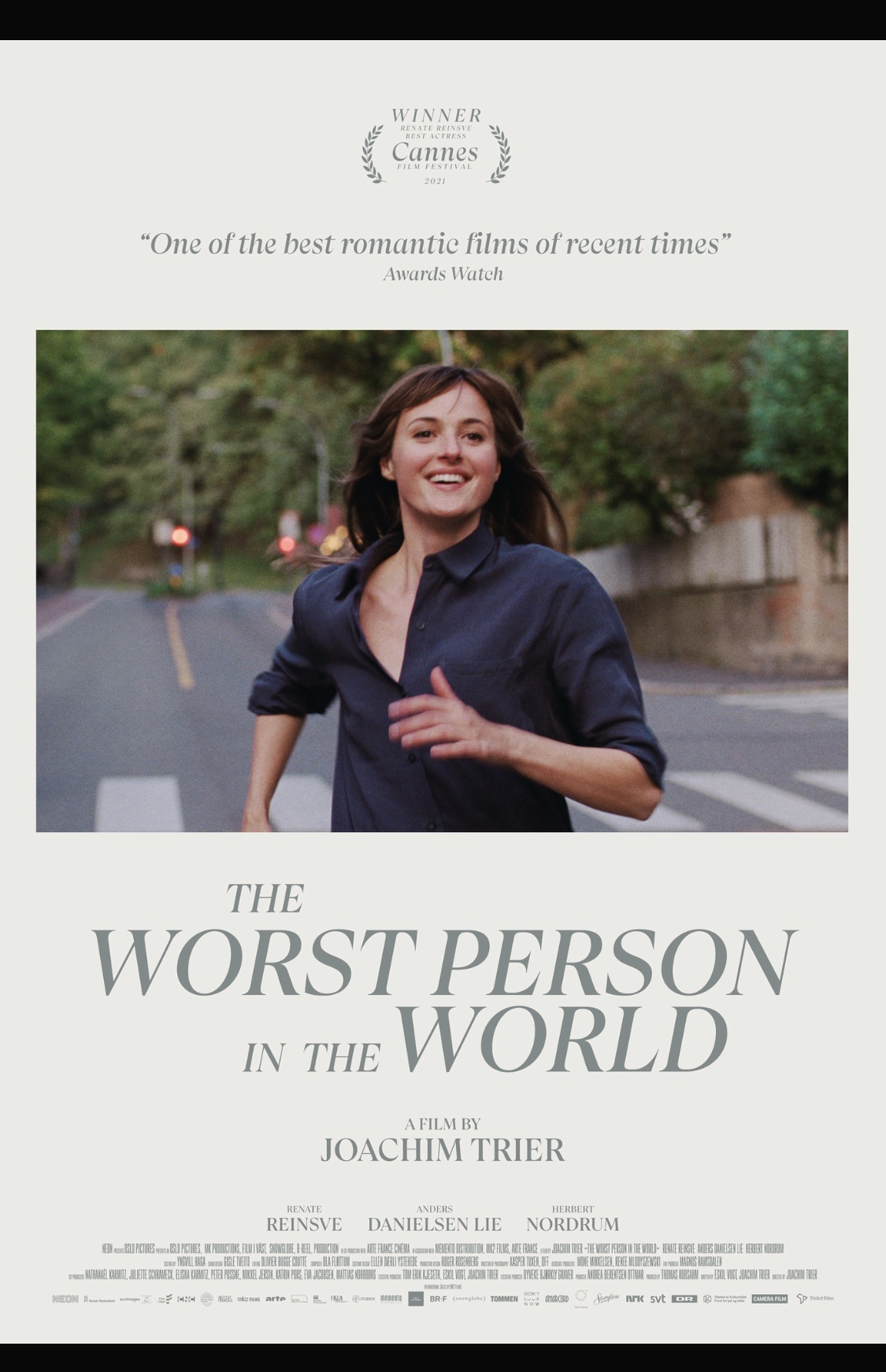 Greetings again from the darkness. It’s often fun when an innovative filmmaker turns a stodgy genre upside down and offers us a new take. And who better to flip over the frequently stale mode of romantic-comedies than Norwegian auteur Joachim Trier? Co-written with his frequent collaborator Eskil Vogt, the film could also be described as a dramady or a thirty-ish coming-of-age tale. Regardless of the label, it’s entertaining and thought-provoking, as well as being a bit dark in parts (some of these also being quite funny). This is being called the final film in Trier’s “Oslo Trilogy”, three loosely connected films including REPRISE (2006) and OSLO, AUGUST 31 (2011).
 Movie Reviews from the Dark