THE GUILTY (Den Skyldige, 2018, Denmark)

October 25, 2018

Dallas International Film Festival 2018
 Greetings again from the darkness. Some people prefer their movies to be light-hearted escapes from the real world – two hours of mindless entertainment that distract from real life responsibilities. Then there are the rest of us: the movie-goers who thrive on having our emotions and nerves mangled and twisted, leaving us drained and strained as we stumble from the theater after the closing credits. For those in the second group, meet Danish writer/director Gustav Moller.

It’s a remarkable first feature film, and Mr. Moller shares screenwriting credit with Emil Nygaard Albertsen, and it’s what we might call a one-room or confined-space thriller. Others in this claustrophobic category would include the classic 12 ANGRY MEN (1957) and more recent films like BURIED (2010), the underrated LOCKE (2013), and the Oscar nominated ROOM (2015). Most, if not all, of the action in these films takes place in a single setting, and the filmmakers creatively use that limited space in a way that elevates the story and tension.

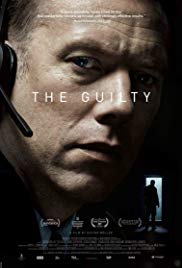
Jakob Cedergren is stunning as Asger Holm, an officer frustratingly on “desk duty” at the emergency dispatch center. Asger has been so assigned due to an unspecified internal investigation, and he takes out some of his irritation on callers he quickly judges to be responsible for their own situation – drunken brawlers and those looking to exchange commerce for companionship (wink-wink). However, a breathy call from a woman who claims to be kidnapped immediately ignites Asger’s instincts and street smarts.

Iben (the voice of Jessica Dinnage) informs Asger, through a series of yes-no questions that her ex-husband has kidnapped her, stranding her two young children home alone. Asger cleverly uncovers that Iben is being transported via white van on a major highway. It’s at this point that he remains calm and reassuring to Iben, while expertly juggling other phone calls for assistance: dispatch, highway patrol, even his somewhat intoxicated and disinterested former partner. Rather than route this call per protocol, Asger takes control with technology, experience and instincts as his only tools … likely sensing both the need for urgency and his shot at redemption.

The film is mostly just a series of phone conversations, yet somehow my stomach was tied up in knots! The isolation and desperation is evident on both ends of the line between Asger and Iben, and some outstanding sound design with ambient noise provides our only other link outside the barren walls of the call center. Cinematographer Jasper Spanning makes creative use of cameras to enhance the claustrophobic setting and story – often using tight shots and close-ups of Asger’s remarkable face. Every viewer is likely to jump to conclusions without having full details, emphasizing human nature’s quick trigger for assumptions. Still, in only 85 minutes, we experience a tension-packed, nerve-wracking, yet artistic presentation … one that leaves us in awe of Jakob Cedergren’s performance and Gustav Moller’s future.

watch the trailer:


BLACK 47 (2018)

September 27, 2018

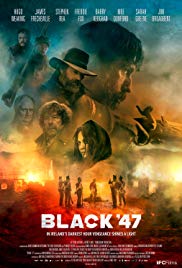
 Greetings again from the darkness. While filmmakers don’t tend to shy away from sad or even depressing characters or events, Ireland’s Great Famine has rarely been depicted on the big screen, for whatever reason. The film’s title refers to the worst year of the famine (1847). These were bleak times and folks were desperate – nearly without hope. More than one million people died, and between one million and two million emigrated from Ireland (depending on what time frame you exam). It all began with potato blight.

Director Lance Daly co-wrote the script with PJ Dillon, Eugene O’Brien, and Pierce Ryan, and have chosen to explain history through a personal story rather than an epic big picture one. Feeney (James Frecheville, ANIMAL KINGDOM, 2010) goes AWOL from the British Army in order to check on his family. The home he finds hardly resembles the one he left. His mother is dead from starvation and his brother was hanged. The rest of his family has been evicted and is soon dead as well. Apparently what he witnessed in war prepared Feeney for the horrors he discovers in his homeland. To complicate matters, he is not only viewed as a deserter by the British, but also a traitor within his own community (for fighting for the British).

Feeney becomes a renegade on a mission to avenge the deaths in his family. The film plays like one of those Charles Bronson movies, where a man of principle believes in doling out his own form of justice. A posse of 4 is assembled to track down Feeney. Captain Pope (Freddie Fox, THE THREE MUSKATEERS, 2011) is a despicable soul and by-the-book soldier who blindly follows orders and ignores the suffering of citizens he views as barely human. Young Hobson (Barry Keoghan, THE KILLING OF A SACRED DEER, 2017) is the Captain’s personal valet, while Conneely (Stephen Rea) is local added as a translator – and some much needed comic relief. The most interesting of the group is Hannah, a disgraced Inspector and Feeney’s former commanding officer.

Hugo Weaving (THE MATRIX) plays Hannah as a man driven to the edge by his war experience. One a hero, now slightly unstable in his actions, Hannah agrees to join the posse instead of spending his life in prison. His commitment to the cause is always in question, as we are led to believe there is much to the connection of Hannah and Feeney … a connection that plays out dramatically when they finally cross paths again. Mr. Weaving’s great face is contrasted nicely by Mr. Frecheville’s dead eyes (‘like a doll’s eyes’).

The revenge mission plays out with some violence, but director Daly never stoops to gratuitous gore. Instead, we typically see the aftermath … one of which brings a twist to the phrase “pig-headed”. Feeney’s time as a soldier has well prepared him for this mission. Even Crocodile Dundee would be proud of Feeney’s knife, and he does tend to make a statement with each of his killings.

Supporting work is provided by Jim Broadbent, Moe Dunford (“Vikings”), and Sarah Greene (“Penny Dreadful”). There are a couple of themes on display here: the politics (and power grab) of the time, and one man’s drive to knock down corruption and clean up his beloved country … while showing no mercy to those who have harmed his family. The contempt for the British is quite clear. Religion doesn’t escape commentary and judgment, with a sequence involving a Protestant minister, a Roman Catholic priest and a soup line with a catch.

Director of Photographer Declan Quinn (MONSOON WEDDING, IN AMERICA, LEAVING LAS VEGAS) does work capturing the contrast between beautiful vistas and incredible hardships. The stunning Connemara (western Australia) landscape is offset by immense suffering and cruelty … only the art design is a bit shaky, which is understandable given budgetary challenges. Though we’ve rarely, if ever, seen such a cinematic treatment of this era, it’s clear the guns misfired more often than this production.

watch the trailer:


MADRE (Spain, short film, 2018)

September 26, 2018

 Greetings again from the darkness. Filmmaker Rodrigo Sorogoyen begins his film with a long, slow pan shot across a deserted beach until we see the waves rhythmically rolling in and out. It appears to be a most peaceful setting, but instead it’s actually the set up for one of the most intense and emotionally shattering short films ever.

Marta Nieto and her mother Blanca Apilanez are hanging around the apartment on what’s a typical day for them. When Marta’s answers a call, an unimaginable horror unfolds via cell phone. On the other end is her 6 year old son. He’s on holiday with his father, Marta’s ex. Only her son tells her, as his cell phone battery is dying, that dad left him and now he’s alone on a beach … he thinks it’s France, but could be Spain.

Marta and her mother juggle cell phones as they try to track down the father, while keeping the young boy as calm as possible. It’s a captivating and stunning performance by Marta Nieto, and a brilliant piece of filmmaking from Mr. Sorogoyen. It may be the most unsettling 19 minutes of movie I’ve seen, and if it had gone any longer, it might have become truly unbearable.


ONE WILD MOMENT (2018)

September 26, 2018

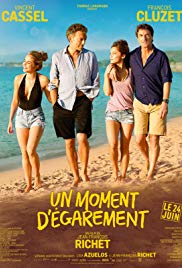
 Greetings again from the darkness. In 1977, French Producer-Writer-Director-Actor Claude Berri directed a film version of his own original screenplay entitled IN A WILD MOMENT. In 1984, director Stanley Donen’s (SINGIN’ IN THE RAIN) final feature film was an Americanized remake that inexplicably left Mr. Berri as uncredited. Perhaps that’s how Berri preferred it, since Donen’s BLAME IT ON RIO was atrocious and nearly unwatchable despite a cast that included Michael Caine and a 21 year old Demi Moore. This third iteration, directed by Jean-Francois Richet (who co-wrote the adapted screenplay with Lisa Azuelos) does credit Berri, and returns the material to France where it’s a better fit.

Best friends Antoine and Laurent take their teenage daughters Louna and Marie (who are also best friends) on holiday to Antoine’s childhood home in the Corsica countryside. The house is a bit rustic and neglected, has spotty (at best) internet, includes a family burial plot, and is miles from town. The only neighbor is an elderly gentleman and his roaming dog. The girls aren’t nearly as taken with the serenity as their dads seem to be.

Both dads are loving and protective of their daughters, though the usual teenager-parent squabbles occur regularly. Watching the interactions between the dads and daughters, between the two men, and between the two teenagers is quite entertaining and exceedingly believable. Of course, the core of the story is what happens in one “wild” moment when Laurent is simply being supportive of Antoine’s daughter Louna – and her teenage crush of the older man shifts into seduction. A late night naked frolic on the beach crosses the line that should never be crossed. Laurent instantly regrets the action, and Louna falls “in love” like only a teenager can.

The rest of the movie becomes an uneasy dance of lies, threats, insinuations and betrayals. Most of it is handled with a comedic intentions, and that compounds the feelings of queasiness and disgust that we have towards Laurent and his unacceptable and unforgivable (and illegal) actions. We see the two men frazzled for much different reasons. Though he doesn’t know the identity of the “older man” who took advantage of his daughter, Antoine is obsessed with tracking him down and making him pay. On the other hand, Laurent is desperate to keep the secret from his friend, and that forces him to play along with Louna’s taunting games.

Two of France’s biggest stars, Vincent Cassel (MESRINE) and Francois Cluzet (THE INTOUCHABLES, TELL NO ONE) play Laurent and Antoine, respectively, while Lola Le Lann (age 19 during filming) and Alice Isaaz are Louna and Marie. Mr. Cassel and Ms. Isaaz are especially effective – he in a no-win role, and she leaving us wanting even more characterization.

Though it was filmed more than 3 years ago, it’s now getting a second life. Original writer Claude Berri is probably best known for his stellar work on JEAN DE FLORETTE and MANON OF THE SPRING, and we can’t help but think his script would work better in contemporary times if the comedy turned much darker and made it abundantly clear that Laurent’s actions were entirely unacceptable – instead of leaving his response to young Louna’s come-on as understandable. The film is produced by Thomas Langmann, the son of Claude Berri, and kicks off with the beautiful and familiar version of “La Mer”, a 1946 song by Charles Trenet.

watch the trailer:


THE CAPTAIN (Der Hauptmann, 2018)

July 27, 2018

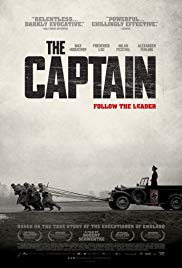
Greetings again from the darkness. It’s mind-boggling how many fascinating stories – both large and small – continue to come from World War II, even 75 years later. Writer/director Robert Schwentke (RED, FLIGHTPLAN) abruptly opens his latest with a single soldier desperately running from a posse of Nazi soldiers who appear to be hunting him down. The soldier manages to escape, kicking off an incredible journey that we are informed occurred during the final two weeks of the war (April 1945).

Max Hubacher stars as Willi Herold, the soldier we are to assume has deserted his military outfit and is now dirty, hungry and cold as he evades German patrols. Things change drastically for Herold when he stumbles on an abandoned suitcase neatly packed with a German Captain’s coat and full uniform. We are left to wonder what happened to the officer, but do get to watch Willi’s crazy next few days as he impersonates a German officer and assumes command of his situation.

Circumstances result in “Captain” Herold gaining followers, each of whom are as lost or unwilling to continue fighting as himself. The ragtag group ends up at prison camp Aschendorfermoor … a camp containing German deserters and looters. Herold has convinced those in charge that he has direct orders from Hitler to take command of the camp, and a horrific massacre of prisoners takes place over the next few days.

While this is a stunning story ripped from historical documents, the film works even better as a psychological character study. Herold first employs his newfound power as a survival strategy, but he is soon corrupted by the power of his assumed position. We witness as some blindly follow orders, and we watch (dumbfounded) as Herold’s thirst for power overtakes whatever integrity he might have had prior to the desperation injected by war.

The film moves at a meticulous pace and at times feels redundant. It could have been a stellar short film, but director Schwentke uses the slow pace to allow our shock to grow as Herold evolves into a coy monster (with a fine performance from Mr. Hubacher). Filmed in stark black and white, it offers some beautiful shots from cinematographer Florian Ballhaus (THE DEVIL WEARS PRADA), the son of famed cinematographer and 3 time Oscar nominee Michael Ballhaus (GANGS OF NEW YORK). The elder Ballhaus passed away in 2017, and the son continues to build his own legacy. Set in Germany during April 1945, this blend of docudrama and black comedy is a collaboration of German, Poland and France, and as a true story, packs quite a punch.

watch the trailer:


THE PASSION OF JOAN OF ARC (1928) revisited

June 20, 2018

Oak Cliff Film Festival 2018


 Greetings again from the darkness. It’s a rare treat to watch a 90 year old silent movie. Especially in a remastered format. Especially on the big screen. Especially at a historic theatre. Especially with a nearly packed house. And especially with a live score! The 7th annual Oak Cliff Film Festival, held at the Texas Theatre (opened 1931), afforded just such a treat with its Friday evening screening.

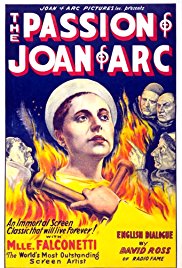
Most know the story of Joan of Arc (Jeanne d’Arc), a teenage heroine of France for her role in the Hundred Year War. She claimed that she received spiritual and religious guidance through voices and visions. Once she was captured by English allies, she was charged with heresy and burned at the stake in Rouen in 1431. A quarter century later, the Pope declared her a martyr and she became a symbol of France – canonized as a saint in 1920. Of course, here the story is as much about the film as it is the martyr and historical figure.

The eyes are what first grab our attention. The eyes of actress Maria Falconetti as Joan of Arc. It was Falconetti’s only screen appearance, and though she spent the rest of her career on stage, this role cemented her place in cinematic history. Without the benefit of sound and voice, the silent era performer had to emote through eyes, facial expression and body movement. Few ever did it better than Falconetti. It’s gut-wrenching to watch the church counsel attempt to break her resolve. Our minds hear the intensity of their voices though we only read the subtitles.

Renowned Danish filmmaker Carl Theodor Dreyer directs the script from writer Joseph Delteil (taken mostly from the transcripts of the trial), and the cinematography is through the eye of 5 time Oscar nominee Rudolph Mate’ (FOREIGN CORRESPONDENT, PRIDE OF THE YANKEES). It’s impossible not to notice a style so different from modern day filmmaking. The harsh lighting and almost exclusive use of close-ups and medium shots bring an immediacy of which we aren’t accustomed. The single piece set is quite unusual and provides a stage aura. Another thing that stands out is the editing style. Continuity of scene wasn’t important here. What mattered was the sense of frantic pacing and over-bearing stress brought on by the rapid-fire questioning. We share the claustrophobic feeling with Joan, though of course, we know where this is all headed.

As part of this special showing, the Oak Cliff Film Festival arranged for a live score performed by composer George Sarah, a 4 piece chamber orchestra, and a vocal group accompanying the music.

Perhaps this meant even more to me since I visited Rouen last year, and the lasting legacy (almost 600 years) of this courageous young woman is evident throughout much of France. The re-mastered film is stunning to look at, and even more historically important knowing that the film had long thought to be lost to a fire. The story and the film are quite something to experience.

watch the trailer:


SUMMER 1993 (2017, Spain)

May 31, 2018

 Greetings again from the darkness. In Sean Baker’s 2017 surprise indie hit THE FLORIDA PROJECT, we viewed a challenging family environment through the ever-optimistic eyes of a young girl intent on making the best of every day. On the opposite end of the spectrum is this autobiographical tale from writer/director Carla Simon in her first feature film. Co-written with Valentina Viso, this story is about one young girl’s struggle with grief and a cold-water splash into a new family.

Six year old Frida is left orphaned when her mother dies. She eavesdrops through half-closed doors as adults make arrangements for who will take care of her. Uncle Esteve (David Verdaguer) and Aunt Marga (Bruna Cusi) agree to raise her, requiring the young girl to relocate from Barcelona to a remote Catalonia village bordering a forest. It’s an idyllic setting for most young kids, however, paradise doesn’t exist for a young girl who has lost both parents.

Initially it seems to be simply ‘kids being kids’. As more oddities occur while Frida plays with her 3 year old cousin Anna, we begin to believe that Frida’s rebellious acts may actually be that of a disturbed young child incapable of dealing with nearly unbearable sorrow. Clearly Aunt Marga runs a more disciplined household than Frida’s (apparently) eccentric mother, though it’s quite obvious to any parent that Frida is vying for attention – literally competing with the younger Anna for the love of parents. It’s heartbreaking to watch.

We view most everything from the viewpoint and perspective of the kids. Even the camera angles are often eye-level for a 6 year old. This is a terrific approach by filmmaker Simon since Child Psychology is at the core of the story. As adults, we look to teach and protect, while sometimes overlooking the undeveloped emotional maturity in youngsters.

There is brilliance in the story-telling process here as adult viewers (it’s certainly not a movie for kids) will catch the hints and partial details that Frida can’t possibly process. The disease that killed her mother, though never stated, becomes clear. That cause also leads to unexpected reactions to Frida by others. The lack of sentimentality or over-dramatization is delivered through lazy summer days that lull us into complacency before awakening us to what could be. Two amazing child actresses, Laia Artigas (Frida) and Paula Robles (Anna) keep us captivated as director Simon unfolds her life onscreen.

watch the trailer:


ON CHESIL BEACH (2018)

May 30, 2018

 Greetings again from the darkness. This is one of those movies that has the look and feel that leaves me believing I should like it more than I do. Ian McEwan (the excellent ATONEMENT) adapted the screenplay from his own novel, and it’s by no means a cookie-cutter story. The feature film debut of director Dominic Cooke features one of today’s most talented leading ladies, a strong supporting cast, and some stunning outdoor scenery from a very beautiful part of the globe.

The story kicks off in 1962 England with a setting that could easily be a one-Act stage play. We are in a hotel room immediately after the ceremony of a newlywed couple. Awkward movements and forced conversation are interrupted by a formal dinner being served in the room by two waiters. The expected post-dinner gawkiness leads to a bedroom scene ravaged by emotional trauma that goes far beyond inexperience. It’s disastrous and leads to full disclosure along the shoreline of Chesil Beach, Dorsit.

Saoirse Ronan stars as Florence and Billy Howle is Edward. Through flashbacks we witness both their budding romance as eager youngsters, as well as pervious childhood moments that now seem to matter. We learn Florence is Mozart, while Edward is Chuck Berry. Maybe opposites do attract, however, the class differences become more obvious as we meet the respective parents. Florence’s mom (Emily Watson) and dad (Samuel West) are upper crust types who don’t take kindly to her infatuation with one not of their ilk. Edward’s dad (Adrian Scarborough) is a school teacher and his mother (a marvelous Anne-Marie Duff) is an eccentric artist, “brain-damaged” in a freak train accident.

Florence and Edward are victims of their time … a time of sexual repression, where such conversations simply did not occur. It’s not so much a story of rejection as it is of being not accepted, though it’s clear how childhood led each down their path. Had the film remained focused on this fascinating story line, it likely would have been better received by this particular viewer. Instead, we are subjected to an ending that crashes and burns as it attempts to provide resolution for characters that should have none. A flash forward to communal living in 1975 and a 2007 farewell concert at the beautiful and historic Wigmore Hall (opened in 1901), are little more than a show of disrespect to those viewers who invested in the unfortunate tale of Florence and Edward.

watch the trailer:


SWEET COUNTRY (2018)

April 21, 2018

 Greetings again from the darkness. For whatever reason, Australia and Westerns seem to go together quite well. Perhaps it’s the naturally beautiful vistas that seem to stretch forever. Maybe it’s the slower pace and the accent that provide the perfect blend of comfort and danger. What matters is that director Warwick Thornton has delivered another gem from the Outback genre.

That previously mentioned blend of slow pace and danger is evident in the opening scene. Fred Smith (Sam Neill) is napping in a rocking chair on his front porch until being startled awake by the snorting of a stranger’s horse only a few feet away. The new neighbor is Harry March (played by Ewen Leslie), an ornery war vet who drinks too much and is racist to his core.

The film is set in the 1920’s, although it doesn’t really matter when. It’s more about the what, the why and the who. The racism on display would be just as believable in contemporary times, though this Outback seems especially far out. Neighbors are rarely seen, and the town is so small, they watch silent movies (The Kelly Gang) and hold court outside on the dusty main street.

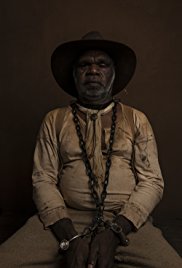
Co-writers Steven McGregor and David Tranter have created a story that likely has played out in real life, although hopefully not to this extreme. A series of events occurs: indigenous Australian Sam Kelly (played exceptionally well by non-actor Hamilton Morris) is coerced into helping March put up a fence, March crosses the line with Sam’s wife, a young boy Philomac (played by twins Tremayne and Trevon Doolan) is always stirring up trouble and pilfering things, and a drunk March accuses Sam of hiding the boy and violence erupts leaving the “white fella” dead and Sam and his wife on the run.

Sergeant Fletcher (Bryan Brown) is the local law – he even proclaims “I am the law” – and he forms a posse to track down Sam so he can stand trial. The posse includes March’s friend Kennedy (Thomas M Wright), Sam’s employer Fred Smith (Mr. Neill), and Archie (Gibson John), an indigenous Aussie employed by Kennedy.  Director Thornton uses this chase sequence to paint some extraordinary visions on screen. The natural land is beautiful, and then we come across a stunning and deadly desert in the salt flats. Mr. Thornton acts as co-cinematographer with Dylan River, and the result is a movie that’s a thing of beauty to look at.

Director Thornton uses an array of flashbacks and flash-forwards, sometimes in quick cut form. This approach keeps us on our toes, sometimes foreshadowing, sometimes filling gaps. Against the wishes of the locals, this is a developing country, and many of the locals feel it’s no longer their country – they are kept as laborers, and rarely treated as equals by the new inhabitants. In this world, for this man (Sam), doing the right and necessary thing places he and his family in instant peril. It’s better to run than surrender. The story is very good, though the dialogue is a bit lacking at times. The photography is world class. Though we would have preferred screen vets Bryan Brown and Sam Neill to have more scenes together, the panoramic majesty of Australia is certainly enough … with an added and fitting bonus of Johnny Cash singing “Peace in the Valley” over the closing credits.

watch the trailer:


BIG FISH & BEGONIA (Dayu haitang, China, 2018)

April 5, 2018

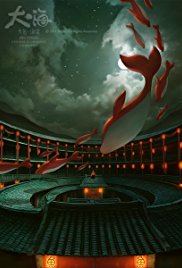
 Greetings again from the darkness. Animated films from Asia will likely always draw comparisons to the films of Oscar winner Hayao Miyazaki, the Japanese master storyteller behind Studio Ghibli and such animated classics as SPIRITED AWAY, PRINCESS MONOKE, and THE WIND RISES. Some may find it curious to mention Miyazaki when discussing a project from two first time Chinese filmmakers, but their work here is so impressive, the comparison is justified. Not only that, it’s quite clear Xuan Liang and Chun Zhang have studied the master’s work and are believers in his style.

As with any animated film, success can only be had when both the look and the story hold our attention. Supposedly the film took 12 years to complete, and with its intricate weaving of Chinese culture and tradition, and the dreamy visuals, we understand why. While I don’t begin to understand the many references to Chinese mythologies and legends, and most of the classic Chinese literary characters are new to me, the movie has a spellbinding effect that draws us in and leaves us fascinated.

On her 16th birthday, Chun partakes in a rite of passage that involves spending 7 days in the land of humans. See, Chun is from a magical parallel world where “the others” control the human world seasons and tides. And we all know that if one is going to have control over another world, it only makes sense to have a basic understanding of that world and its inhabitants!  Chun is transformed into a red dolphin and shoots through a portal into the land of humans. It’s there that she is saved by a boy, whose courageous act costs him his own life when he is caught in a vortex. Chun is determined to deliver his life back to him … remember, she is from a magical world.

The story really takes off from here and becomes an adventure filled with love and sacrifice. We are told “Some fish aren’t meant to be caged, because they are meant for the sky”, and it’s not until the conclusion that we fully understand. Chun’s mission has her crossing paths with both the Keeper of Good Souls who lives with more cats than anyone should, and a creepy Rat Lady who is the Keeper of less fortunate souls and commands an army of rats for her dirty work. This game of cat and mouse between the two factions of soul-keepers is but one of the many webs of intrigue presented in the story.

As you would expect, these two parallel worlds collide and Chun, her friend Qui, and the hero human who is resurrected as a small fish named Kun are all at the center. Chun must protect Kun for his soul to survive, and this puts her in conflict with her own family who prefer the tradition of keeping the two worlds separate.

“Without happiness, what’s the meaning of longevity?” This quote is at the heart of Chun’s passion, and in fact, also drives her friend Qui to go above and beyond. A debt to be paid sprinkled with love and attraction adds a personal touch to the otherwise fantastical proceedings. Though the visuals are splendid and enough to keep us engaged, it’s the convergence of sky and sea – and Begonia flower power – that move this from a fancy cartoon into a story with depth and meaning. Remarkably, it’s the first film for these two filmmakers, though I do hope we mustn’t wait a dozen years for their next.

watch the trailer: