Oscar Nominate Documentary Shorts 2019

February 22, 2019

Oscar Nominated Documentary Shorts 2019

By definition, films in this category pack a punch with a real life story into a run time of just a few minutes. It’s possible one or two could be transformed into a feature length documentary or narrative interpretation, and yet it’s remarkable how much information or emotion can be relayed with a short film. In an unusual twist, one of the nominated films offers only an edited clip of historical footage – yet it will likely stick with you. Below you will find the five films listed these in order of my preference. Just a reminder, these are not Oscar predictions, just personal opinion.


 PERIOD. END OF SENTENCE (USA) 26 minutes

‘It’s some type of illness that mostly affects girls.’ That’s paraphrasing the answer from a group of young Indian men when asked to define menstruation. Unfortunately, the women aren’t much better educated or informed, and the subject remains taboo in rural India. The Pad Project is designed to empower women by providing a machine that makes low cost pads, far superior and more hygienic than the “cloths” they have used for generations.

Director Rayka Zehtabchi introduces us to the man who invented the machine, but this story is about the women. Not only do the pads improve their life and health, but by marketing the pads, the women experience financial gains that dramatically impact their lifestyle. The film is surprisingly humorous and uplifting, and it’s refreshing to see such a wonderful solution to what’s referred to as “a girl problem”. The film will be available on Netflix beginning February 12.
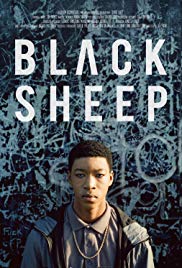
 

 BLACK SHEEP (UK), 21 minutes

When a young boy, not so dissimilar to her 10 year old Nicaraguan son, is killed on the streets of her London neighborhood, a mother takes steps she feels are necessary to protect her son. They relocate to Essex for safety, unaware that extreme racism exists. With the camera in close-up mode, a now adult Cornelius Walker re-tells his story as reenactments periodically accompany his words.

Director Ed Perkins captures the pain and intimacy of the decisions that led Cornelius to try and fit in … “make friends with monsters”, as he puts it. What a stark reminder of how strong our survival instincts are. We can rationalize actions that wouldn’t typically be considered, even if the long-term price paid for those decisions is to be forever haunted by losing our true self. The reenactments may cost it some votes in this category, but Mr. Walker’s story will stick with you.
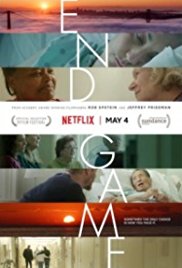
 

 END GAME (USA), 40 minutes

Though emotions run high in all 5 of the Doc Short nominees, none reach the tearjerker level and gut-punch of this look at palliative care by co-directors Rob Epstein and Jeffrey Friedman. Teams of medical professionals are committed to end of life care and helping patients and families deal with death.

Mr. Epstein is a two time Oscar winner for Doc Feature (THE TIMES OF HARVEY MILK, 1984; COMMON THREADS: STORIES FROM THE QUILTS, 1989) and he and Mr. Friedman previously collaborated on the 2014 doc AND THE OSCAR GOES TO … There is an interesting look at the San Francisco Zen Hospice Guest House, but there is a bit too much time spent on one patient/family and the film is very similar to the previously nominated EXTREMIS (2016).


 A NIGHT AT THE GARDEN (USA), 7 minutes

On February 20, 1939, a Nazi-American rally took place at Madison Square Garden in New York City. Perhaps you were aware of this or not, but either way, this brief 7 minute clip edited from archival footage will surely chill you to the bone.

The rally takes place shortly before WWII begins, and the pomp and circumstance, as well as the scope of the event, are startling. Standing at a podium in front of a giant George Washington portrait, Fritz Kuhn, leader of the German American Bund, spews vile hate-filled words and the crowd of 20,000 cheers.

Director Marshall Curry has been previously nominated twice for Documentary Feature, and his work here is wisely restricted to editing the footage. No commentary or interview is necessary. The name you will want to know after this 7 minutes is Isadore Greenbaum.

 

 LIFEBOAT (USA), 34 minutes

Thousands of refugees take to rafts and battered boats in the Mediterranean Sea in hopes of escaping an environment of poverty, torture and/or bombings. They realize it’s a life or death step, yet they believe those odds are better than staying put. This is director Skye Fitzgerald’s follow up to his 2015 doc short 50 FEET FROM SYRIA, and the second of what he plans will be a trilogy.

We follow Sea-Watch Captain Jon Castle as his crew, funded by a German non-profit dedicated to rescuing refugees, strives to save as many as possible before starvation, illness or drowning occurs. Sometimes they succeed. This one would make an interesting double-bill with last year’s winner THE WHITE HELMETS, which focused on rescues on land (after bombings). Captain Castle (who passed away last year) makes the point that the rescues are the right thing to do as humans, as it could easily be us in need of rescue sometime in the future. Director Fitzgerald pays little attention to political arguments, and presents this as a humanitarian issue.


Oscar Nominated Animated Shorts 2019

February 22, 2019

Oscar Nominated Animated Shorts 2019

The difference in production value is quite evident in the animated shorts category, as not all filmmakers are backed by the resources of Pixar or Disney. What really stands out here is the strength of the stories and how they play on our real life emotions and memories. Below you will find these listed in order of my preference. Just a reminder, these are not Oscar predictions, just personal opinion.


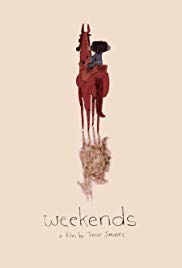
 WEEKENDS (USA) 16 minutes

Familiarity, in fact, all-too-familiar, may be the difference for this story from Trevor Jimenez. A young son gets bounced back and forth between the homes of his divorced parents. Initially the mother keeps things simple, with an emphasis on love. In contrast, trips to dad’s place include scary movies, video games, fast food and plenty of hands-on play time (with weapons and costumes!).

Fittingly, dad’s car radio is on an endless stream of Dire Straits’ “Money for Nothing”, while the other times are covered by the familiar and recognizable chords of Satie. The boy is caught between the two adults trying to put their own lives back together, and some amazing animation takes us through the boy’s imaginative dream and nightmare sequences.

While at Pixar, Mr. Jimenez worked on FINDING DORY and COCO, and this one seems to carry personal memories for him.


 ANIMAL BEHAVIOUR (Canada) 14 minutes

The husband and wife animation team of David Fine and Alison Snowden (two very real, not animated creators) won an Oscar in this category in 1995 for their short BOB’S BIRTHDAY, which was then turned into a TV series “Bob and Margaret”. It’s not a stretch to imagine that the animators have hopes for the same path for their latest.

We enter a group therapy session for an unusual collection of critters, including: a praying mantis, a leech, a bird, and a pig.  The session is led by a dog, and is soon crashed by a newcomer – a boisterous gorilla. The gag here – beyond the obvious – is that each of these critters is dealing with normal traits for their species, though they sound particularly bothersome when stated aloud. Kids are not the target market here given all the talk about sex (stay away from the praying mantis) and orifices. Creativity is on display here, and don’t be surprised if some mutation of this ends up on TV.


 ONE SMALL STEP (USA, China) 8 minutes

Former Disney animators Andrew Chesworth (animator on MOANA and FROZEN) and Bobby Pontillas co-direct a script co-written with Taiko Studios founder Shaofu Zhang. It’s a story of a single father and his Chinese-American daughter Luna, and takes us through her early childhood dreams of walking on the moon to her college years taking astrophysics classes.

The devoted father is there to encourage his young daughter’s dreams, and later to quietly support her with meals and shoe repair. It’s yet another reminder of how the efforts of parents sometimes go unappreciated, but the commitment never fades. The ending here is predictable, yet no less powerful and emotional.


 BAO – Pixar (USA) 8 minutes

It should come as no surprise that Pixar has a nomination in this category. The premier animation studio employees some immensely talented folks, including Domee Shi (previously a storyboard artist on INCREDIBLES 2), who becomes the first woman to direct a Pixar short film.

As with many Pixar projects, this one will likely resonate with parents as much, if not more, than with kids. Of course there are some exceptional visuals; however, it’s more poignantly a look at the stages of life … especially the trials and tribulations of parenthood (especially the overprotective type). This one is far and away the most viewed entry since it ran before theatrical showings of INCREDIBLES 2, which itself is Oscar nominated for Best Animated Feature.

Some may struggle a bit with the idea of a homemade dumpling coming to life and being raised as a growing kid, but the ending will likely hit home with most every parent.


 LATE AFTERNOON (Ireland) 10 minutes

Louise Bagnall previously worked as an animator on the Oscar nominated SONG OF THE SEA, but this one is all hers. These days there is no shortage of projects putting dementia front and center, and we quickly realize the elderly Emily (voiced by the great Fionnula Flanagan) suffers from this dreaded affliction.

The fantastical dreamlike sequences carry us away in Emily’s memories of life. These snippets of her childhood and adult life tell us much about the woman who now finds happiness in a biscuit with her tea. The past and present are often a jumbled mess for Emily, and although her caretaker’s identity is no real mystery, it is still a wonderful moment when it clicks for Emily … even if we know it’s only for a short while.


EVERYBODY KNOWS (2019, Todos lo saben)

February 21, 2019

 Greetings again from the darkness. Sometimes we just click with the work of a particular filmmaker, and such is the case with Iranian-born Asghar Farhadi. From ABOUT ELLY (2009) to his two Oscar wins for Foreign Language films, the instant classic A SEPARATION (2011) and THE SALESMAN (2016), Mr. Farhadi has proven himself to be a terrific and distinct story teller. As an added bonus in this latest film, he works with cinematographer (and frequent Pedro Almodovar collaborator) Jose Luis Alcaine to take his visuals to a new level.

There is a playful and warm and familiar set-up before the switch is flipped. Laura (Penelope Cruz) has been living in Argentina with her husband Alejandro, teenage daughter Irene (Carla Campra) and young son Diego (Ivan Chavero), and has returned to her hometown outside of Madrid for her younger sister Ana’s (Inma Cuesta, THE BRIDE) wedding. Laura’s husband Alejandro did not make the trip, and that plays a role deeper in the story. Hugs and kisses are exchanged amongst some of the most attractive people you’ll see on screen as family and friends are reunited … including Laura and local vineyard owner Paco (Javier Bardem), who share a romantic history from years ago. We quickly learn that Laura’s daughter Irene is a bit rebellious and free-spirited as she re-establishes her connection with Paco’s lovestruck nephew.

Slowly, we are introduced to other friends and family members, including Paco’s wife Bea (Barbara Lennie). These introductions are vital, not for the raucous and music filled wedding reception, but for what happens after. Having put her to bed earlier, Laura comes back to find daughter Irene missing and the only clues are newspaper clippings from a local child kidnapping years past. A most festive evening has been jolted into panic and dread. Soon Laura receives an untraceable text (I guess that’s how it’s done these days) asking for a huge ransom. It’s at this point, where secrets previously kept begin to surface.

The Farhadi trademark kicks in about this time. Although Laura is understandably distraught and disoriented, it’s clear the story is less about the crime and more about the interactions of the characters – resentments, the weight of long held grudges, and more of those dark secrets that begin to find the light. Everyone is a suspect, including Laura’s husband Alejandro (Ricardo Darin, THE SECRET IN THEIR EYES) who shows up convinced God will protect his daughter. The worst traits of human nature are on full display as quick assumptions are drawn. There are lots of pieces to this puzzle and it’s dizzying fun keeping track.

Trust within the family and amongst friends is at the core of the story, and Mr. Farhadi makes solving the crime secondary to the actions and reactions of these folks who have known each other for so long. Melodrama abounds (in a good way) and there are some wonderful visuals, including drone photography from the wedding reception, and an opening sequence featuring the church bell tower and clock. This is the 5th film collaboration between real life couple Cruz and Bardem (the most recent being the disappointing LOVING PABLO), and both are exceptional here. Ms. Cruz offers up a gut-wrenching performance and Mr. Bardem is a joy to watch as he struggles with emotions too complex to verbalize. This is Mr. Farhardi’s first Spanish language film, but it’s clear his subject matter and characters are universally recognized.

watch the trailer:


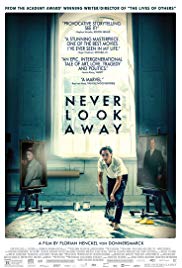
NEVER LOOK AWAY (2019, Germany)

February 13, 2019

 Greetings again from the darkness. As much as we pride ourselves on ‘artistic freedom’, the reality is that politics has long played a vital role – either as inadvertent inspiration for the work, or as organized suppressor or moderator. Rarely in history has the latter been more in effect than during the Nazi regime. This film begins at an art gallery in 1937 Dresden as a loving aunt takes her young nephew to an installation of “degenerate artists”. Nazi propaganda presented modern art by such artists as Picasso and Kandinsky as a blight on German culture, and proceeded to educate (or brainwash) the populace accordingly.

Writer-Director Florian Henckel von Donnersmarck was behind the extraordinary Best Foreign Language Oscar winner THE LIVES OF OTHERS (2006), as well as the all-but unwatchable THE TOURIST (2010). Fortunately, this latest is much closer to the level of the first one, and it has been rewarded by also being Oscar nominated. Miss May, the loving and free-spirited aunt of the opening sequence is played by the luminescent Saskia Rosendahl. As a student, a simple gesture of handing Hitler a bouquet of flowers destroys her psyche, which leads to even more dramatic ramifications. This was an era when being a free-spirit was treated harshly, which could mean mass sterilization or even being “relieved of a meaningless existence.”  Miss May crosses paths with Nazi gynecologist Professor Carl Seeband (Sebastian Koch), in a gut-wrenching scene that hovers over the entire film, and especially that beloved young nephew.

Tom Schilling (and his turquoise eyes) plays Kurt Barnert (the nephew at older age), one who possesses exceptional artistic talent. As Kurt begins making a name for himself (painting as directed), he meets and falls for design student Ellie Seeband (Paula Beer, FRANTZ). Yes, she is the daughter of the Professor who determined the fate of Kurt’s aunt, although Kurt is unaware. As the war escalates, Kurt and Ellie flee to West Germany, while the past haunts all involved.

Once accepted into the new art school, Kurt falls under the guidance of Professor van Verten (Oliver Masucci). It’s this Professor’s personal horror story that becomes a turning point for Kurt, and enables him to discover his own voice as an artist. During this time, Professor Carl Seeband has smoothly switched allegiances and become a communist to save his arrogant hide, though he is burdened with the knowledge that his war crimes past could catch up at any moment. This man is both family member and villain to Kurt and Ellie, tormenting and belittling at every opportunity. It’s fascinating to see how the couple perseveres through his psychological games and even medical malpractice – as if the war, Nazism and Communism weren’t enough of a daily challenge.

The film is loosely based on German artist Gerhard Richter, though mostly in the form of his earliest artwork. Mr. Richter is still alive today and still creating. Cinematographer Caleb Deschanel (father to Emily and Zooey) has produced a beautifully shot film, and the result is his 6th Oscar nomination. Brace yourself for a 3-plus hour run time, and the frustrations of how an artist can discover their voice despite an organized singular ideology that one is pressured to accept.

watch the trailer


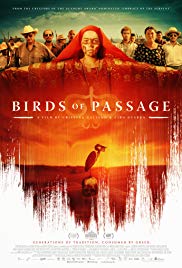
BIRDS OF PASSAGE (Pajaros de verano, 2019)

February 12, 2019

 Greetings again from the darkness. It’s not unusual for movies to “trick” us into embracing a drug dealer, and even kind of rooting for them – despite the near universal condemnation of such folks when we are outside of a dark theatre. Co-directors Cristina Gallego and Ciro Guerra were the producer and director behind the Oscar nominated EMBRACE OF THE SERPANT (2015) about an Amazon tribe striving to hold tight to their way of life despite outside interference. This time out, they focus on the rural Guajira territory of Columbia, with its desert conditions and villagers committed to their own traditions.

The film is based on a true story and covers the time period of 1960-1980, and is separated by chapter titles that include the year and a hint of what’s to follow. We first see Zaida (Natalia Reyes) as a girl in confinement as she prepares to be introduced as a woman to the villagers. This is one of the more elaborate rituals of the village, and it leads to Rapayet (Jose Acosta) asking for Zaida’s hand in marriage. Her mother Ursula (Carmina Martinez), a respected village elder, sets the dowry at what she believes in an unattainable level for Rapayet: 30 goats, 20 cows, and 5 necklaces. Ursula has unwittingly set off a chain of events that eventually brings the family money, power, and tragedy. How can a few goats and cows cause this? Well, when one is poor and needs to quickly assemble a large dowry, what better way than to enter the drug trade? And that’s exactly what Rapayet does.

Rapayet’s friend and partner in the coffee trading business, Moises (Jhon Narvaez), joins him in the transition of careers, and while Rapayet is content to build his empire quietly and under the radar, Moises runs amok with the power and money. Ursula is respected for her abilities as a dream reader, and she’s constantly dousing Rapayet’s business with the cold water of her visions … worried mostly about the safety of her daughter Zaida. By 1971, Rapayet’s business of peddling marijuana to gringos is booming, and by 1979 (in a chapter entitled “Prosperity”) we see the results: a mansion-fortress in the desert protected by guards with automatic weaponry (a sure sign that bad news is on the way).

What began as a look at peaceful remote villagers sticking to the traditional path of their ancestors, transforms into a drug war featuring cartel mobsters. Cinematographer David Gallego contrasts the beauty and simplicity of traditions with the danger and violence of new money and new world order. Leonardo Heiblum’s score is a terrific complement as well. The infancy of the Columbian drug trade presented here conveniently places blame on the free-spirited youngsters of the Peace Corps; while the story plays out like a Greek tragedy, replete with mixed messages on revenge, capitalism, tradition, greed, and family ties. It’s a rags-to-riches story that pulls no punches when it comes to the price paid for taking an illicit shortcut. It’s a path that can destroy lives and culture.

watch the trailer:


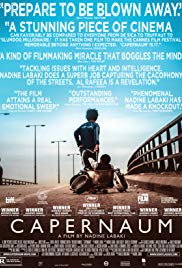
CAPERNAUM (2018, Lebanon)

January 31, 2019

 Greetings again from the darkness. Rare is the film that casts a kid in the lead role and then features him in most every scene … often with only him and a toddler on screen. It’s even rarer when that kid is a first time actor, and the film gets nominated for an Oscar (Best Foreign Language film). Each of these come to pass in the latest from writer-director Nadine Labaki (CARAMEL, 2007), with a script she co-wrote with four others: Jihad Hojelly, Michelle Keserwany, Georges Khabbaz, and Khaled Mouzanar (Ms. Labaki’s husband, who also produced the film’s music).

The film opens in a courtroom setting which acts as a framing device for a story that is told mostly through flashbacks. Zain (Zain Al Rafeea) is asked by the judge why he is suing his parents. His answer: “Because I was born.” Zain is an undernourished 12 year old Lebanese slum-dweller who lives with his parents and an indeterminate number of brothers and sisters. Zain is particularly close to his 11 year old sister Sahar (Cedra Izzam), and the two work odd jobs on the streets to bring home money and food for the family. When Sahar comes of age, Zain knows this spells change, as their parents view her as little more than an asset that can be traded for chickens. When this happens, an angry Zain runs away from home.

Zain’s adventure takes him from the slums to shantytown, where a kind-hearted, poverty stricken single mom takes pity on him. Rahil (Yordanos Shiferaw) is an undocumented Ethiopian who works multiple jobs while hiding her toddler Yonas (so freaking adorable). In exchange for food and shelter, Zain agrees to babysit Yonas while Rahil works. The two young boys become like brothers, and when Rahil doesn’t return home, Zain’s street smarts kick in. He reverts to the lessons of his previous life and begins literally scrapping for scraps. His ingenuity is inspiring, as is his full-blown survival mode … all while caring diligently for Yonas.

In the courtroom, director Labaki appears as Zain’s attorney, but it’s the young actor who carries the weight of the film. He is truly remarkable to watch, whether he’s interacting with other street hustlers, conversing with “Cockroach Man” on the bus, or in that final freeze-frame ending, Zain steals our heart. The film is not dissimilar to SHOPLIFTERS, the Japanese film also nominated for Best Foreign Language Oscar this year. The title means “chaos” and it begs the question, without paperwork, do we exist to society? Ms. Labaki manages to put a pretty face on a tragic environment, and offer up a rare matter-of-fact melodrama on the hardships for children in poverty.

watch the trailer:


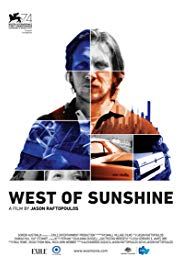
WEST OF SUNSHINE (2019, Australia)

January 24, 2019

 Greetings again from the darkness. Life’s eternal mysteries include the question, how can one be a father when not yet a man? The feature film debut of writer-director Jason Raftopoulos focuses on fatherhood and the price of self-destructive behavior, while finally gathering the strength to right one’s self.

Damien Hill stars as Jim, a blue collar courier with a gambling habit that likely cost him his marriage, his previous job, and a solid relationship with his son. Jim is basically a decent guy who can’t seem to overcome his weaknesses, which leaves us judging him as a hapless dude who can’t buy a clue. The story unfolds over a single day as Jim faces a deadline from the loan shark he owes thousands. Banos (Tony Nikolakopoulos) is a scary looking guy who, in loan shark circles, would be considered relatively patient … although he has reached the breaking point with Jim.

Of course, Jim has a stellar plan to pay back the money – a “sure thing” on a horse in today’s race #2. However, there’s a blip (at least one) in his plan. His estranged wife reminds him that today is his day to look after their son Alex (Ty Perham, real life stepson to Mr. Hill). So father and son, rocky relationship and all, take off on a road trip around Melbourne as Jim proves to be one of the city’s worst couriers, and a borderline incompetent father. When Jim’s horse does in fact pay off, he makes the all-too-familiar mistake of a gambling addict … rather than pay off the debt, he tries to win more. You can surely guess how that goes.

Desperate times call for desperate measures, and the father-son team go about tracking down Jim’s old contacts in hopes one might help him through this dilemma. It should be noted that Jim and Alex are traveling in style – Jim’s classic Ford Fairlane, with quite an impactful story of its own. Support work is provided by Arthur Angel (as Jim’s friend and co-worker), Kat Stewart (a former girlfriend who runs an illicit business out of her bakery), Fay Smythe (Jim’s wife), and Eliza D’Souza (a would-be girlfriend and yet another Jim lets down).

Being a role model for a kid is not easy for someone as self-destructive as Jim. The steady stream of “I promise” and “I’m sorry” make it clear where Jim’s priorities rest. Alex wants to look up to Jim, but spends more time looking down on him. It takes a near catastrophe for Jim to wake up … a wake up that only occurs when one grows weary of always racing against the clock. Leaving the past behind – both emotionally and with a symbolic sacrifice – is Jim’s only path to redemption. Fine, naturalistic performances make these characters relatable to us, and filmmaker Raftopoulos does a nice job with keeping the pace moving along, while never losing that sense of reality.

watch the trailer:


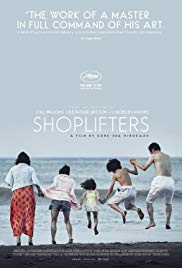
SHOPLIFTERS (2018, Manbiki kazoku, Japan)

January 3, 2019

 Greetings again from the darkness. We typically think of family as blood relatives, those affiliated by marriage or adoption, and those funky cousins (sometimes ‘removed’) that, according to the family tree, are supposedly related to us. Expert Japanese filmmaker Hirokazu Kore-eda (LIKE FATHER LIKE SON, 2013) presents a story that will have you questioning whether the strongest connection is blood, heart, or money.

We first witness ‘father’ Osamu Shibata (played by Lily Franky) and adolescent ‘son’ Shota (Jyo Kairi) in a well-coordinated shoplifting maneuver at the local grocery store. On the way home they stumble across a shivering child, maybe 4 or 5 years old, who has been seemingly abandoned by her parents. They take her home to warm her up and feed her, and it’s here we discover the multi-generational family living in a tiny apartment. This family also consists of ‘grandmother’ Hatsue (an excellent Kirin Kiki), ‘mother/wife’ Nobuyo (Sakura Ando), and teenage daughter Aki (rising star Mayu Matsuoka).

When the family discovers signs of abuse on the little girl Yuri (Miyu Sasaki), they decide to keep her – less an informal adoption than an admission to the club. See, this family lives in poverty, and finds comfort in working odd jobs and shoplifting. They do bad things out of necessity, in a kind of twisted ‘honor among thieves’. Each person, regardless of age is expected to contribute to the team. The eldest provides a steady income through her deceased ex-husband’s pension, and by scamming mercy money from his second family. Osamu and Nobuyo have regular part time jobs, while Aki works in a sexy chat room. Shota polishes his shoplifting skills and even tiny Yuri begins to learn by watching him. Everyone contributes in what can be described as a pyramid scheme of petty cons.

As the film progresses, we get to know each of the characters and begin to care about them … rooting for them to find success. Writer-Director Kore-eda draws us in with subtle scenes of interaction between the characters, each willing to sacrifice for the other. He raises the question on whether choosing one’s family might create a stronger bond than those blood ties. What really seems to matter is where we feel we belong, and where are accepted.

The film won the Palme d’Or at the 2018 Cannes Film Festival, and it’s likely due to the devastating and expert final act. In a dramatic shift in tone, true character is revealed – it’s a shocking revelation on some fronts, and fully expected on others. Each family member has a backstory that slowly unfolds through the first two acts, and then abruptly slaps us upside the head as the film nears conclusion. There are many social aspects to be discussed after this one, including how the child welfare system (seemingly regardless of country) sometimes works against a child’s best interest, even with the best intentions. This is one that will grab your heart and then stick with you for a while.

watch the trailer:

https://www.youtube.com/watch?v=9382rwoMiRc


COLD WAR (2018, Zimna wojna, Poland)

January 2, 2019

 Greetings again from the darkness. Who doesn’t enjoy a good love story? The wonderfully talented filmmaker Pawel Pawlikowski proves to us the massive difference between a story of ‘good love’ and a ‘good story’ of love. With two lead characters based (somewhat) on his own parents (and named after them), we witness how two people can be simultaneously meant for each other AND not meant to be together. It’s the story of a man and woman forever connected, yet painfully mismatched.

Director Pawlikowski’s extraordinary last film, IDA (2013) won the Oscar for Best Foreign Language film, and this time he starts us off with a curious montage of Polish folk musicians (including bagpipes and violins) performing their songs … each in stark and static close-ups. This strange opening only makes sense to us much later, as we realize what a key element music plays in the numerous shifts in tone – the chapters – of the story.

Former lovers Wiktor (Polish star Tomasz Kot) and Irena (Agata Kulesza, IDA) are co-directors of a Polish song and dance performance team, and as they are conducting auditions, Wiktor is immediately drawn to Zula (Joanna Kulig), one who has a pure singing voice but a questionable past to go with no previous dancing experience. Irena recognizes lust when she sees it, but Wiktor stands firm that he perceives Zula’s stage presence as something special. The film covers the period of 1949 through 1964, and in that time we watch as Wiktor and Irena are both proven right. Mr. Kot and especially Ms. Kulig deliver extraordinary performances … truly captivating.

Director Pawlikowski offers up a love story unlike anything we’ve ever seen on the big screen. Wiktor and Zula experience the most tumultuous and romantic ride through Poland (the company first performs in Warsaw), East Berlin, Paris, Yugoslavia, back to Paris, and back to Poland. There were likely some other stops along the way, but those are the ones I made note of. Sometimes they are together, other times they are separated. It’s 1952 East Berlin where they formulate a plan to defect … only Zula is a no show, and they don’t meet up again for a couple of years. In one Paris rendezvous a few years later, Zula explains to Wiktor that she married another man “for us”. Somehow this makes sense.

It’s best to know no other specifics of this relationship. Star-crossed lovers is not a phrase used much these days, and perhaps even that description falls short. What causes someone to sell their soul for another – or sacrifice so much? How can so much pain and humiliation be accompanied by so much longing and yearning? What’s fascinating is that the film’s music styles shift in tone right along with their relationship. Sometimes the music is political (with a Stalin poster) – as that is the wall between them, and then later Zula is dancing totally free to “Rock Around the Clock”.

There are no wasted words here. The black and white images of cinematographer Lukasz Zal complements each segment with the appropriate softness or harshness depending on the characters’ emotions of the moment. Certainly at the heart of this story is the role of memories … how snapshots in time can impact our feelings, at times causing us to be oblivious to rational thought. As viewers, we experience a constant feeling of impending doom – even during the good times for Wiktor and Zula. The unusual editing style of extended cuts to black signal shifts in time … the blackness held for an extra beat or two, allowing us to brace for the next chapter. Polish jazz pianist Marcin Masecki scored the film – a crucial element not just because our two main characters are musicians, but because the music guides us through the lives we see. The film recalls the crown jewel of mismatched lovers in CASABLANCA as two lovers apparently meant to be together, but real life circumstances prove too much. Yet another excellent film from Pawel Pawlikowski.

watch the trailer:


ROMA (2018)

December 23, 2018

 Greetings again from the darkness. It is possible for a filmmaker to be “too close” to the material when undertaking a story that is somewhat autobiographical. It’s also possible, in that situation, for them to catch lightning in a bottle and magic on the screen – and that’s exactly what writer/director Alfonso Cuaron has achieved with this look back at his childhood home life. In his follow-up to GRAVITY, for which he won the Best Director Oscar, Mr. Cuaron has dedicated the film to Libo, his family maid/nanny during his youth in Mexico City.

Balancing artistry and everyday humanity like few other films, it takes us inside the home of a well-off family: Antonio (Fernando Gredigaga), the father-husband-doctor; Sofia (Marina de Tavira, the only experienced actor in the main cast), the mother-wife; Teresa (Veronica Garcia), the grandmother; the four kids; and two live-in maids, Adela (Nancy Garcia Garcia) and Cleo (Yalitza Aparicio). There is no separating the human emotions from the near-poetic art form of Cuaron’s movie. It is unusually quiet, filmed mostly at midrange, and with no musical score. Yet, in the stillness and quiet, so much is happening.

The focus here is on Cleo. We hear many times how she is considered part of the family. Of course, she (and we) are reminded that’s only true to a certain extent as she is admonished for not cleaning up after the family dog or ‘wasting’ electricity in her living quarters by using the light in her tiny living quarters at night. First time actress Yalitza Aparicio brings a realism and accessibility to the role as the quiet, perpetually-in-motion maid/caregiver/nanny and she is mesmerizing to watch. Her duties include keeping the house clean, cooking meals, getting the kids up in the morning, getting the kids to/from school, and putting the kids to bed at night. What little scraps of time she has for a personal life are spent going on a date with the cousin of Adela’s boyfriend.  Fermin (Jorge Antonio Guerrero) is a martial arts fanatic and just prior to their intimacy, he demonstrates his skills to her with a shower rod and literally nothing else.

When Antonio and Sofia announce to the kids that dad will be attending a conference in Quebec “for a few weeks”, we as viewers understand what this means, even though the kids don’t. Spending time with his mistress means Sofia and Grandma Teresa must manage the house … but of course, as always, the bulk of the burden falls to Cleo. When Cleo finds out she’s pregnant, Fermin dumps her – leaving both Cleo and Sofia as abandoned by men. It’s fascinating to watch this unfold, and contrast how the two women react and cope. The dialogue is secondary to the situations in the film, but there is a great line of dialogue after the men leave: “We women are always alone.”

From a cinematic aspect, Cuaron’s film is a delight to watch – reminding at times of the classic Italian and French films of years past. Since his first film in 1995, Cuaron has frequently collaborated with (3 time Oscar winning) cinematographer Emmanuel Lubezki, but this time Cuaron wears multiple hats as writer/director/cinematographer/co-editor/producer. This is his movie – and his most personal one – from top to bottom. Working closely over the years with Lubezki has influenced Cuaron’s camera work … it’s stunning. He uses wide, initially static shots with slow pans – just the way we see in real life. And just like in real life, what he shows us is sometimes mundane and at other times various degrees of emotional. The remarkable opening credit scene could be quickly described as Cleo mopping the dog mess from the garage floor. But of course there is much more. We also see the reflection of planes flying overhead and hear only the sounds of everyday life. It sets the stage for the entire film.

This is 1970-71 Mexico City, so in addition to Cleo getting the kids to and from school, the street riots – some quite violent – play a role, as does the incessant sound of dogs barking in the background. Cleo’s trip to the delivery room is filmed with real doctors and nurses, while a later trip to the beach offers yet another gut punch … and both sequences maintain the overall feel of authenticity. Lest you think this is just another “small scale” indie, Cuaron goes big a few times – the street riot, a mass martial arts training session, and the beach trip. His film is a story of class and family, making it more than just a thing of celluloid beauty. It also brilliantly captures the essence of life’s emotions: the “bad” with two men who ignore their responsibilities, the “normal” with kids being kids, and the “good” with seeing Cleo become such a vital and beloved part of the family.

(Available on Netflix)

watch the trailer: