 Greetings again from the darkness. The thing about humans is that we are always looking towards the future to see how we can make things easier, better, or more exciting. This is often with an eye towards more fuel-efficient cars, smaller and more powerful computers, and more effective medical treatments. Writer-director Maria Schrader and co-writer Jan Schomburg have adapted the short story from Emma Braslavsky and turn the lens to relationships and love. Is it possible to advance inter-personal relations to the point of perfection? Would that even be desirable or preferable to the messiness that’s gone on since the beginning of time?
It’s actually the film’s premise that impresses most. Maren Eggert stars as Alma, an Anthropologist who has dedicated years of her life to leading a team documenting the earliest human use of poetry. Alma is a serious and determined woman, and one who bears the scars of a recent breakup. She’s drawn into an extraordinary experiment that blends high-tech with sociology. Advanced robots have been developed to become the “perfect” mate, and are programmed specifically for one person. Alma has agreed to the three-week trial, and her robot is Tom (played well by Dan Stevens, BEAUTY AND THE BEAST, 2017).
Their initial interactions are quite awkward as Alma is skeptical and Tom is programmed to constantly and quickly learn and evolve based on Alma’s reactions. Despite Alma’s hope for companionship and recognition of her own biological clock, she seems to catch herself anytime she begins to feel a bit of joy. She never imagined that her pursuit of happiness would be dependent on advanced robotics. To monitor the progress, the program’s director, played by Sandra Huller (TONI ERDMANN, 2016) periodically checks in. And yes, she holds her own secrets.
This is a clever film that delves a bit deeper into human emotions than we originally anticipate. It also contains quite a bit of humor – the initial dance club introductions are pretty funny, as is Tom’s facial expression each time he’s tweaking his algorithms. We do learn flirting is “difficult to program”, although in today’s society, that’s a treacherous path anyway. Of course, Alma slowly comes around to the idea of an artificial relationship – one that by definition can never be real. The film is not at the level of EX MACHINA (2014), although it’s less about technological advances and more about self-realization. Ms. Schrader’s film is plenty entertaining to watch and one that slyly points out many flaws of us human beings, while delivering an unexpected ending.
Available for streaming on multiple platforms


 Posted by David Ferguson
  Greetings again from the darkness. One could view being number four in a trilogy as similar to being the ‘third wheel’ on a date. Or one could view it as a new beginning, with a familiar foundation. Your way of viewing will likely depend on whether you choose the red pill or the blue one. This time out, it’s only writer-director Lana Wachowski, without her sister Lilly. Their groundbreaking first film in the series hit screens in 1999, and it’s been 18 years since the last. Lana co-wrote this script with David Mitchell and Aleksandar Hemon.
 Greetings again from the darkness. In a cinematic oddity, this is my second SWAN SONG film to review this year. The first was a SXSW starring vehicle for Udo Kier, and now we have the first feature film from writer-director Benjamin Cleary, who won an Oscar for his 2015 short film STUTTERER. It’s safe to say the two ‘Swan Songs’ share no similarities other than their title. Cleary presents a sci-fi drama that applies moral and ethical questions to advanced medical science, and our inherent desire to protect loved ones.
 Greetings again from the darkness. What would happen if human survival depended on the Griswolds (from the VACATION movies) battling the rogue robots programmed to take over the planet? Filmmakers Michael Rianda and Jeff Rowe answer to that scenario is hyper-active, frenetic, overly-busy visual chaos that attempts to blend apocalyptic science fiction, extreme action sequences, and dysfunctional family comedy-drama. It’s a lot to tackle, and for the most part, it works.
 Greetings again from the darkness. There is a reason musical acts like The Eagles, Jimmy Buffet, and The Rolling Stones continue to pack arenas. We love our nostalgia and prefer it familiar and easily recognizable. The fans don’t show up to hear the new songs, but rather those ‘oldies-but-goodies’ that bring back pleasant memories. Writer-director Jason Reitman and co-writer Gil Kenan fully understand this psychology as they deliver what amounts to a sequel of the original GHOSTBUSTERS movie released 37 years ago (and directed by Reitman’s father Ivan).
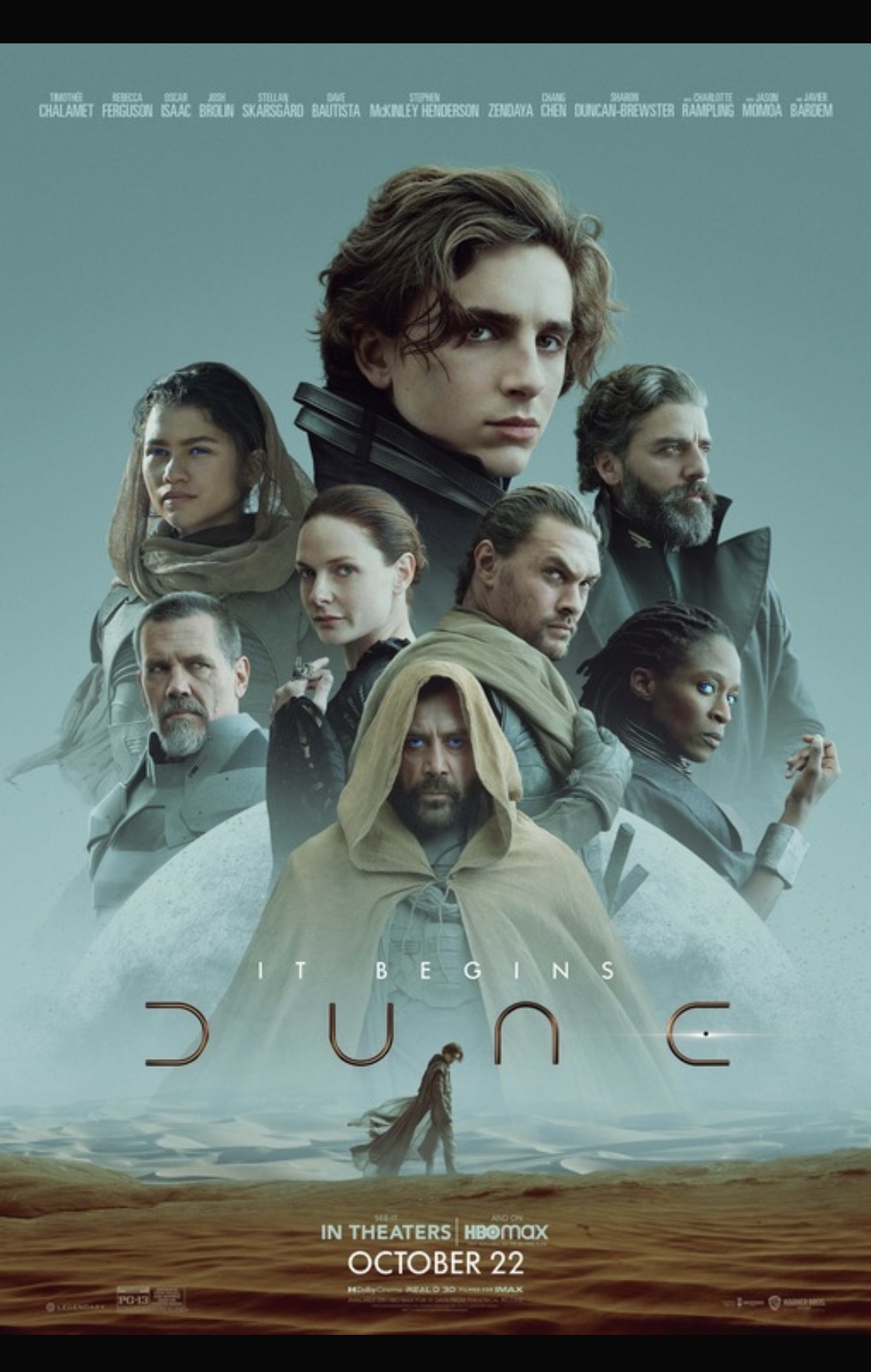 Greetings again from the darkness. It’s been nearly 40 years since David Lynch directed DUNE (1984). The film received an Oscar nomination for Best Sound, and has since been a cult favorite, though not one I’m particularly drawn to. All these years later, Frank Herbert’s 1965 novel (there are 5 sequel novels) has been re-made by acclaimed writer-director Denis Villeneuve (ARRIVAL, 2016) and his co-writers Eric Roth (Oscar winner, FORREST GUMP, 1994) and Joe Spaihts (PROMETHEUS, 2012). The new version looks absolutely fantastic, even if the story is a bit convoluted and the characters don’t always make the best, or even logical, decisions.
 Greetings again from the darkness. The meaning of Life is an ambitious topic to tackle for any filmmaker, but certainly as a first feature film. Japanese-Brazilian writer-director Edson Oda not only doesn’t shy away from existential questions, he has found a creative way of exploring these, leaving us with plenty to discuss after viewing. His approach is often bleak and slow-moving, yet his film excels in pushing us to examine our own attitude and appreciation for the gift of life.
 Greetings again from the darkness. In 2015, director Sean Baker’s use of an iPhone to film
 Greetings again from the darkness. There are some great time-travel movies, some great Science-Fiction movies, and some great alien-invasion action movies; however, there are very few that successfully blend all of the above. Director Chris McKay (
