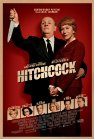
Greetings again from the darkness. Here goes: John J McLaughlin wrote this Hitchcock screenplay based on Stephen Rebello‘s book “Alfred Hitchcock and the Making of Psycho”, which was based on the filming of the Psycho screenplay from Joseph Stefano, which was loosely based on Robert Bloch’s book, which was based on the grizzly real life crimes of Ed Gein. Whew!
It’s kind of interesting that Alfred Hitchcock is hot again some 36 years after his final movie. His Vertigo recently displaced Citizen Kaneas the all-time greatest film. HBO is still running their recent production of The Girl, which is based on Hitchcock’s making of The Birdsand his unhealthy connection to Tippi Hedren. And now, we get this Hollywood production, supposedly based on the master of suspense. I say supposedly, because this film plays like it was written by the heirs of Alma Reville, Hitch’s long time wife and collaborator. We all knew she worked on his films and contributed ideas, but the film wants us to believe she was the real genius behind the public genius.
The movie is entitled “Hitchcock” and is based on the making of Psycho, but in fact, it’s more the story of Alma and her husband. While there is nothing wrong with that story … in fact, it is quite interesting and entertaining … it’s also a bit of false advertising.
Helen Mirren portrays Alma, and instead of the mousy woman who usually faded into the background, we see a fairly strong and talented woman who goes toe-to-toe with Hitch in her best scene. Sir Anthony Hopkins dons some facial appliances and a fat suit and does a solid job of capturing the odd, creepy, leering, disturbed, insecure genius we recognize as Alfred Hitchcock. He comes across as louder and more in-motion than what we have previously seen. And while director Sacha Gervasi makes it clear that Hitch is not a “normal” guy, he doesn’t dwell too much on the blond fixations.
The emphasis on the skills and importance of Alma would be fine were it not so exaggerated. Surely every great director and writer and artist has a muse and/or support system; and, there is no question Alma was a very talented lady, but her strength here bordered on distracting to the overall picture. Especially needless was the storyline of Alma being attracted to screenwriter Whitfield Cook (Danny Huston), who wrote Strangers on a Trainfor Hitchcock.
The Hitchcock humor is allowed to shine through (“call me Hitch, hold the cock”) and his battles with Paramount Studio head Barney Balaban (Richard Portnow) and the censorship board (Kurtwood Smith) are excellent. Hopkins finds the humanity under the fat suit and is especially good in his work with Scarlett Johansson (as Janet Leigh) and Jessica Biel (as Vera Miles). I also got a kick out of James D’Arcy as the affected Anthony Perkins and all his quirky mannerisms.
Though this barely qualifies as a story on the making of Psycho, it was chilling to watch the addition of Bernard Herrmann’s iconic score added to the shower scene. In fact, Danny Elfman does a nice job of subtly adding a Herrmann-type score to this film. I’m not sure if the film will play well with all Hitchcock aficionados, but if you can forgive the Alma slant, it’s actually quite interesting and entertaining and kind of a sweet film at its core.
SEE THIS MOVIE IF: you want to see what would happen if Alfred Hitchcock took personal advice from serial killer Ed Gein OR you want to see two great actors (Mirren, Hopkins) having a really good time OR you want to see Scarlett Johansson play Jamie Lee Curtis’ mother.
SKIP THIS MOVIE IF: you expect to learn much about the making of Psycho
Greetings again from the darkness. Every now and then we are reminded of just how stunning movies can be. Periodically a filmmaker proves to us that pushing the envelope of creativity still drives some auteurs. James Cameron brought us Avatar, which demonstrated that 3D technology could be beautiful and breath-taking. As beautiful and new as Cameron’s breakthrough was, it lacked a story worthy of it advancements. Now, we get director Ang Lee’s vision of Yann Martel’s worldwide bestseller, and we are left gasping at what happens when you combine a fantastical story with technological advances and perfection.
Ang Lee has provided us with a varied selection of films including Crouching Tiger, Hidden Dragon; Brokeback Mountain; and Sense and Sensibility. He refuses to be limited by genre and takes a global and philosophical view of filmmaking. He wants us to think and discuss and think some more. His Life of Pifilm purposefully leaves many scenes, events and thoughts open to interpretation. You can see as much or as little of humanity in this story as you like.
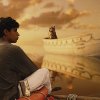
The brilliant opening depicts real animals in the real zoo located in Pondicherry, India. The colors, sights and sounds are dazzling and give us an immediate sense of the area and culture. We meet young Pi and his family. Pi is inquisitive and ingenious from an early age. His father imparts such wisdom as “If you believe in everything, you believe in nothing“. This comes as Pi is absorbing multiple religions and considers himself Hindu/Muslim/Christian. At an early age, he seeks answers and meaning. Events transpire and soon enough, Pi and his family take their most valued animals and board a ship to Canada to start a new life. Disaster strikes when a storm capsizes the ship and Pi (Suraj Sharma) is the lone human survivor. He finds himself in a small lifeboat with a hyena, an orangutan, and a huge Bengal tiger. Yes, that sounds like the first line of a bad joke, but here it’s the beginning of a remarkable journey.
The developments need not be discussed here, but rather the focus of the story is the spirit of survival that Pi possesses. His ingenious methods of learning to coexist with the ferocious tiger force us to consider what the human race has done to nature in our attempts to gain control. Pi’s religious spirit and insightful ways, coupled with a very fortuitous and specific survival guide, lead him to maneuver 227 days adrift in the Pacific. In the process, we are treated to some of the most spectacular visuals ever seen on screen. At times the sea, and its sea life and sky, are phosphorescent. The story (screenplay by David Magee, who also wrote the underrated Finding Neverland) is so amazing that we find ourselves not caring how much is real and how much is caused by Pi’s hunger and thirst. Some of the visual effects are tranquil, while others are quite violent. A sequence featuring flying silver fish is something to behold.
The structure of the story is such that an adult Pi (played by Irrfan Khan) is re-telling the tale of survival to a Canadian novelist (Rafe Spall). While this is a traditional story-telling device, it takes nothing away from the anything but traditional story of Pi and Richard Parker (the tiger’s name). We are told “This is a story that will make you believe in God“. Whether it does or it doesn’t, it certainly makes us believe in the magic of movies.
Some will compare to Castaway, while others will think of 127 Hours. My best advice is to let go and give yourself to the story and the film. There is always time afterwards for debate and discussion. Instead, enjoy the moment and be thankful that a movie like this can get made … it will lead the industry to even more creative productions down the road. So, just this once, forget what I have said many times, and go see this one in 3D. Allow it to take you away.
**NOTE: Suraj Sharma, who plays Pi on the lifeboat, is a remarkable first time actor. Irrfan Khan, who plays the adult Pi, is known for his excellent turns in Slumdog Millionaireand The Namesake.
SEE THIS MOVIE IF: you are interested in it or not OR you have doubted whether 3D technology can enhance the movie going experience
SKIP THIS MOVIE IF: you don’t care to see the year’s most remarkable combination of story and visual
Greetings again from the darkness. Ambitious and mesmerizing. Those are the two words that best describe my reaction to this stunning film based on the David Mitchell novel. Hopefully, you have not come here for answers to the many mysteries offered up by this most unique film experience. If you are the type that loves to think, analyze and discuss complex movies, you will be challenged and satisfied. If you prefer your stories clean, straightforward and gift-wrapped, you will be like some of those in my audience who walked out of the theatre at various stages -not to return.
While there are no easy explanations for what we see on screen, this is undoubtedly one of the more complex and multi-faceted and challenging movies to watch. There are six stories that span approximately 500 years (beginning in 1849 and going through 2346 or so). We see many actors playing multiple characters of various ages, crossing racial and gender lines depending on the specific story. We track the progression/regression of their souls through time. This will prove more challenging to you than it sounds on paper, as the make-up work is some of the most extreme ever seen on screen. Many will describe the film as messy or convoluted, but the argument can be made that those traits add to the fun. Certainly, this won’t be to the taste of most; however, if you thrive on life’s puzzles, the film will hit your sweet spot.
The six stories are co-written and directed by Tom Twyker (Run Lola Run) and The Wachowski’s (Lana and Andy, The Matrixtrilogy). These six segments are split evenly between the two director groups, yet then blend seamlessly thanks to the truly expert editing of Alexander Berner. You will recognize the influence and similarities of such films as Master and Commander, Cocoon, Silkwood and Blade Runner, as well as many others.
Filling the costumes, donning the make-up and spouting the dialogue in manners that you often won’t recognize are such disparate actors as Tom Hanks, Halle Berry, Jim Broadbent, Hugo Weaving, Jim Sturgess, Donna Bae, Ben Whishaw, Keith David, James D’Arcy, Xun Zhou, Susan Sarandon and Hugh Grant. Especially entertaining are Hugo Weaving as a sadistic female nurse and Hugh Grant as a violent tribesman. The best laughs in the film are courtesy of the great Mr. Broadbent whose facial expressions are near clown-like in elasticity.
As for the themes and points of the film, that is a topic for debate. A couple of lines of dialogue offer some clues. Hanks’ nasty ship doctor spouts “The weak are meat the strong do eat“, and we notice the recurring theme of the strong dominating the weak across all story lines. There is another line: “One can transcend any convention so long as one can conceive of doing so“, that provides the glimmer of hope in each story. Love and oppression are always present, but it’s clear to me that the human spirit remains strong and is capable of overcoming oppression in the past, present and future. You may disagree but our debates will be colorful … and may change after a second viewing!
SEE THIS MOVIE IF: you enjoy assembling the pieces of multiple storylines and numerous interconnected characters OR you just want to see Hugo Weaving play the toughest on screen nurse since Nurse Ratched
SKIP THIS MOVIE IF:you prefer movies to be short and sweet (this one is almost 3 hours and anything but sweet)
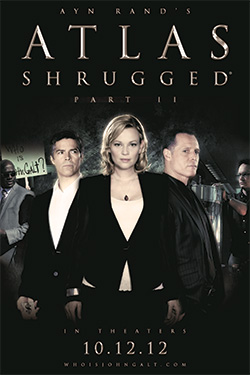
Greetings again from the darkness. A tip of the cap to the independent producers who promised to make Part II despite the financial failure of Part I last year. My deep admiration for Ayn Rand and her classic novel label me as a believer in objectivism; however, as a movie blogger, my comments here are based on the movie, rather than the must-read book. Fully understanding the need and desire to tell this story and make the points via film, I am most disappointed in the lack of quality associated with the filmmaking process … just as I was with Part I.
On the bright side, the level of acting is a step up from the first entry in this series of three. Samantha Mathis is believable as Dagny Taggart and Jason Berghe is an improvement over Grant Bowler for Hank Reardon. Esai Morales adds a touch of class as Francisco d’Anconia, and we get the familiar faces of Diedrich Bader (Quentin Daniels), Michael Gross, Arye Gross, and Richard T Jones. There is even a quick speaking part for the usually silent Teller (of Penn and Teller).
The key to the story and Ms. Rand’s philosophy is not to be judged by the film production quality, but instead of the actions of individuals. Value for value by mutual consent and for mutual benefit. This flies in direct contradiction to much of what we hear during this election year in the U.S. Instead we get thinly-veiled references to re-distribution of wealth and sharing with those in need for the greater good. In this Part II, we see more mysterious disappearances from the greatest minds and most creative people. These happen even as those responsible refuse to understand they are the cause.
Despite the barely TV-level production quality of Parts I and II, I would never discourage anyone from seeing the films. The message is too strong. I would, however, highly recommend reading the source material from Ms. Rand’s 1957 novel. It is a brilliant work of art, and though quite hefty, well worth the thought-provoking effort regardless of one’s political views.
Greetings again from the darkness. Being a huge fan of Tim Burton’s 1984 short of the same title, news of a feature length feature was very exciting. It’s obvious from both films that director Mr. Burton holds the story and project close to his heart. The obvious guess is that young Victor Frankenstein has much in common with the enigmatic director’s childhood experience … a social misfit who finds joy in less than popular outlets (science, sci-fi, filmmaking). Burton then adds the crucial elements of nostalgia and fun.
The story begins simply enough, Victor – a socially inept boy, whose only friend is his loyal dog Sparky, quickly connects with the new science teacher, Mr. Rzykroski (who bears a striking resemblance to the late, great Vincent Price). Victor’s parents try to get him more engaged and that leads to a tragic accident that kills Sparky. Victor is heart-broken but his scientific mind leads to a shocking development thanks to a local lightning storm. Soon enough, Sparky is back! Of course, the secret gets out and the Science Fair takes on quite a competitive nature.
Burton really treats the film as an homage to old monster, horror and sci-fi films. We get tributes to Frankenstein, The Mummy, Dracula (complete with Christopher Lee), Godzilla, Bride of Frankenstein, Gremlins, Jurrassic Park and others I certainly missed on first viewing. But this is so much more. Mr. Rzykroski gives a less than PC speech to the local townspeople, and though it is straight to the point, that point is lost on these fine folks. The importance of science and learning and accepting the differences of others is all touched upon, but not in a preachy way.
The voice work is stellar thanks to Catherine O’Hara, Martin Short, Winona Ryder, Charlie Tahan, Martin Landau and Atticus Shaffer (Brick on “The Middle”). The style and texture of the film is extraordinary. The shadows and lighting provide an atmosphere that adds just enough creepiness. The detail involved with the characters and setting is remarkable for stop-motion animation. Not just that, but how many movies have you seen recently that include a cat-bat, sea monkeys, and a giant turtle? The suburban setting is almost identical to the neighborhood seen in Burton’s Edward Scissorhands, just without the 1960’s color palette.
This is excellent movie entertainmentand FUN for adults and children alike. Unfortunately, the black and white presentation has meant a lack of interest from today’s kids. Sure it has some darkness to it, but the PG rating means nothing too heavy. This is Tim Burton at his finest … and without Johnny Depp or Helena Bonham Carter! Also, Danny Elfman’s score perfectly compliments the story and characters, and stay for the credits to hear a very odd Karen O song.
** NOTE: don’t miss the opportunity to compare the original short with this updated feature length version. The creative differences really show the technical advances over the past 28 years.
SEE THIS MOVIE IF: you enjoy fun movies and a tip of the cap to old horror films OR you want to see Tim Burton in peak form
SKIP THIS MOVIE IF: you refuse to believe a black & white animated film can provide any entertainment value
Greetings again from the darkness. When a writer/director sets a standard with a film like In Bruges, the anticipation for the follow-up is palpable, especially from those of us with the demented sense of humor necessary to watch that film over and over. Martin McDonagh is a writer firs (shorts, features and plays), and a self-taught filmmaker second. He again shows his talent for interesting characters in unusual situations, and an extraordinary blend of black comedy, violence and personal struggles with morality.
This film is a smart (but dark) comedy about characters who aren’t nearly as smart as they see themselves. It’s quite self-referential and at its best is a self-parody. Colin Farrell plays a writer who is blocked after creating the perfect title … “Seven Psychopaths”. Sam Rockwell plays his best friend who runs a crafty little dog-napping business and feeds Farrell possible story lines. He even goes as far as to run an ad asking real life psychopaths to come tell their story. Yep, this plan is just running smoothly until Rockwell kidnaps the dog of a local gangster played by Woody Harrelson.
What we quickly figure out is that we are watching Farrell’s writing process unfold on screen. The bigger challenge is trying to figure out which parts are really happening and which parts are fantasy or part of the creative process. The writing and acting are very skillful. Christopher Walken plays Rockwell’s partner and delivers what may be his best performance in years. It’s very offbeat and irregular … in other words, typical Walken. Though there are many excellent scenes, the best ones involve Walken.
The script pokes fun at the weak female characters – Abbie Cornish as Farrell’s girlfriend, and former Bond girl Olga Kurylenko as Harrelson’s less-than-loyal girlfriend. The film also features some of my favorite character actors. In addition to Walken, we get the great Tom Waits as a bunny loving psychopath, Harry Dean Stanton as a Quaker, ZeljkoIvanek as a henchman, and an opening scene with “Boardwalk Empire” alums Michael Pitt and Michael Stuhlbarg.
As wonderful a writer as McDonagh is, we can’t help notice the influences of Quentin Tarantino and the spaghetti westerns – especially The Good, The Bad and The Ugly. His comedic tendencies wrapped in violent sequences really challenge us as viewers. Trying to find the good in those who aren’t necessarily so good adds an element and complexity as the film throws violence in our face as the characters are confronting their deeper feelings on morality. Since Farrell’s character is a writer named Martin, we are probably safe in assuming that McDonagh is working through some of these same issues himself (especially the unnecessary violence and weak women characters). McDonagh proves again to be one of the most intriguing and talented filmmakers working, and even though this one is a tick below his last one, I anxiously await his next.
SEE THIS MOVIE IF: you saw In Brugesand appreciated the dark comedy and philosophical nature OR you don’t want to miss a classic Christopher Walken performance
SKIP THIS MOVIE IF: you prefer your comedy to be light-hearted in nature OR you can’t appreciate the character who brings a flare gun to the final shootout in the desert
Greetings again from the darkness. Writer/Director Rian Johnson (Brick) delivers a very entertaining, creative, thrilling and clever sci-fi film that features time travel, dark comedy, romance, metaphysics, and enough action to keep just about any viewer engaged … as long as you enjoy using your brain a bit. This one requires some assembly … and the ability to ignore the horribly distracting make-up/prosthetic/special effects used to make Joseph Gordon-Levitt look like a young Bruce Willis (he doesn’t).
Source Code, the recent film from Duncan Jones, used time travel in very limited segments. In 2074, time travel is perfected, but has been declared illegal. So, of course, only crime syndicates use it. When you think about it, sending your enemies back in time to be killed and disposed of is brilliant. It’s very difficult to solve a missing person case when the body has been incinerated 30 years prior. The future mob boss known as The Rainmaker hires “loopers” from 30 years past to handle the dirty work. When The Rainmaker begins “closing loops”, he does so by sending the loopers back in time to be killed by their younger selves. Yes, somehow this works.
Well it works until Seth (Paul Dano) chokes up and lets his future self escape. That doesn’t go over well with the modern day (sent from the future) crime boss (Jeff Daniels) who just can’t allow these future guys to be roaming free. Then, just like that, the same thing happens to Joe (Joseph Gordon-Levitt). His future self (Bruce Willis) appears, young Joe flubs the kill, and the next thing you know, Young Joe and Old Joe are seated in a booth at a remote diner ordering the same breakfast and staring into their own eyes. You may recall that Mr. Willis is an acting time travel expert thanks to his “trips” in Tweleve Monkeys and The Kid.
It’s impossible not to compare to some other time travel movies (there have been MANY). There are certainly similarities to The Terminator, but not so much to Hot Tub Time Machineor Bill and Ted’s Excellent Adventure. It’s a tricky topic because it involves the uncertainty of how things done today might impact what has already happened. Or something like that. It would have been interesting to get more flavor from the 2074 world, since all we see is the blissful (until it’s not) presence of Old Joe and his saviour bride. Also, you have to believe that if you came face to face with the future “you”, there might be at least a brief Q&A.
Plenty of fun stuff in this one, although, I had a tough time buying a blond Emily Blunt as a Kansas farmer. Her young son Cid, played very well by Pierce Gagnon, is one of the more interesting characters in the film. He is supposed to the young version of the future Rainmaker, and he possesses some unusual traits … with Blunt trying to supply sufficient motherly love to prevent him from spinning off track.
Director Johnson has a knack of tossing in some dark humor at just the right time. Some of the romance seemed a bit forced, but the criminal element and the Joe vs Old Joe stuff was really fascinating to keep up with. If you enjoy movies that are somewhat challenging, and you can suspend reality for the time travel elements, it’s one that you’ll probably find quite entertaining.
SEE THIS MOVIE IF: time travel and sci-fi tickle your fancy OR you want to see Hollywood’s best attempt to make Joseph Gordon-Levitt look like a young Bruce Wills
SKIP THIS MOVIE IF:Hot Tub Time Machineor Austin Powersare the level of seriousness you expect from time travel flicks
Greetings again from the darkness. Director Todd Solondz is the master of film uncomfortableness. If you have seen his Happiness or Welcome to the Dollhouse, you won’t debate whether that’s a real word or not. Mr. Solondz has a way of finding the worst in his characters and then taking it even darker and more negative. And yet, somehow, his latest (and maybe his simplest film to date) could be called a comedy.
We are first introduced to Abe (Jordan Gelber) and Miranda (Selma Blair) as they share a table at a wedding, though obviously aren’t remotely together. He is oblivious to her near silent attempts to nicely avoid providing her phone number to him. The film moves quickly to provide proof that Abe is the epitome of arrested development. A mid-thirties something who not only “works” for his dad, but still lives with his parents (Mia Farrow, Christopher Walken) in a bedroom decorated with action figures. It’s difficult to look at someone who takes up as much space as Abe and categorize them as a kid, so I believe the better term is “not an adult”. He stalks Miranda and doesn’t seem to mind/notice that she is a heavily medicated depressed individual who looks at him like he’s a circus act.
Abe’s work environment is no better than his personal life. He brings nothing of value to his dad’s company, yet somehow thinks he is always being mistreated. This carries over to his feelings toward his brother Richard (Justin Bartha), who is a doctor. Abe, who dropped out of college, believes the only difference is that Richard was the favorite son and received special privileges. It’s very easy to label Abe a “loser”, but somehow Solondz manages to maintain our interest with small sparks of hope (very small).
The hope quickly fades and Abe’s life heads on a fast downward spiral. There are some bizarre fantasy/dream sequences that involve the quiet, much older co-worker Marie (Donna Murphy), and a conversation in the car with his mother and brother that plays like something directly out of a Woody Allen movie (made even creepier with the presence of Mia Farrow), plus another odd sequence featuring Miranda’s ex (Aasif Mandvi) and the source of her Hep B.
There are some funny moments, but as Mr. Solondz would prefer, the laughs are tainted with guilt. We can’t help but wonder why we laugh at a guy for whom we have such little respect … actually bordering on disgust. I must admit to being pretty tired of Abe by the end of the movie, and couldn’t help wondering if it might have been more effective as a short film. Still, the acting was superb, and unfortunately Abe isn’t that much of a stretch from someone you probably know in real life.
SEE THIS MOVIE IF:you don’t mind a dose of guilt mixed with some humor
SKIP THIS MOVIE IF: you prefer to avoid the depressed and the losers amongst us.
Greetings again from the darkness. Well it took six years, but co-directors Jonathan Dayton and Valerie Faris finally deliver their follow-up to the smash hit Little Miss Sunshine. With a script from first time screenwriter Zoe Kazan (granddaughter of legendary director Elia Kazan), we get an odd mash-up of would-be Woody Allen, Charlie Kaufman, Stranger Than Fiction, and a “Twilight Zone” episode.
The story begins almost as a whimsical fantasy. Paul Dano plays Calvin, a blocked writer 10 years after writing the next great American novel, while he was still a teenager. The necessary comparisons to JD Salinger are made, and we witness Calvin as a socially-inept type who was never comfortable with his early success, and now can’t find a way to move on with life. Given a writing assignment by his shrink (Elliott Gould), Calvin discovers the true power of the written word is far beyond anything he had previously imagined.
After a dream of meeting a lovely girl in the park, Calvin’s fingers tear through his manual typewriter and develop a story around his literal dream girl. And literal means literal. He runs into her downstairs. His creation has become his creation. Once he realizes they aren’t going to lock him away for insanity, Calvin and Ruby (also Zoe Kazan) begin a real relationship. Well as real as it can be with a girl who is not really real and whose actions can be changed simply by typing words on a page. If you think this sounds like a male fantasy, then you are in agreement with Calvin’s brother (Chris Messina).
A trip to visit the brothers’ mothers (Annette Bening) and her boyfriend (Antonio Banderas) adds some humorous scenes while also signaling the beginning of trouble for Ruby and Calvin. It turns out that bringing your invented dream girl into the real world doesn’t always work so well. Who would have thought? There is much humor in the film including Steve Coogan as Calvin’s mentor. Deborah Ann Woll (“True Blood”) has a scene as Calvin’s ex-girlfriend and it is probably the best written scene in the film. Really good insight into how two people’s view of the same relationship can vary greatly.
The story can be looked at from different perspectives. It certainly serves as insight into how a writer’s mind can work. Many writers need a muse … but few get to create their own! More importantly, it makes a statement on how we (well, not me) often try to control and manipulate the other person in our relationships. This is a sterling reminder to be careful what you ask for … you just might get it.
**Note: on a side note, it is refreshing to see a love story between two actors who look rather “normal” rather than so perfectly beautiful they appear to be a genetic experiment
SEE THIS MOVIE IF: you enjoy off-beat, quirky humor with an underlying message
SKIP THIS MOVIE IF: the last thing you wish to do is crawl inside the head of a Hollywood writer
Greetings again from the darkness. If you are a fan of the series, this is a sensational ending to the Christopher Nolan Batman trilogy. Though replicating Heath Ledger’s Joker is not possible, every other piece of this finale worked for me … and worked exceptionally well. There are critics who are nit-picking, saying that the story is muddled, the villain a letdown, run time too long, the first half is slow or the second half is too traditional in action. My challenge to these critics … name a better comic book hero film. For me, this is an incredibly entertaining and ambitious film that sets the standard for the genre.
In addition to director Nolan, many of the familiar characters are back. Christian Bale as Bruce Wayne/Batman, Michael Caine as Alfred, Gary Oldman as Commissioner Gordon and Morgan Freeman as Lucius Fox. New to the series are Anne Hathaway as Selina Kyle/Catwoman, Joseph Gordon-Levitt as Officer Blake, Marion Cotillard as Miranda Tate, and best of all, Tom Hardy as Bane – the hulking masked monster wreaking havoc on Batman and Gotham.
I will not go into any of the plot points other than to say this is the first time we have seen a villain who is at least Batman’s match physically and mentally. Bane is a wrecking ball with a general’s strategic skills and voice that is begging to impersonated by intoxicated males of all ages for years to come. There are a couple of twists that add much fun for the fans of the first two films, including a return appearance by a key member of Batman Begins. Also, Michael Caine is given a couple of wonderful scenes to prove he is more than a driver and butler.
Since this is Batman, the action scenes have to be analyzed. It should be noted that Batman is not on screen very often, but when he is, it is quite thrilling. We have new toys and weapons, and quite a bit of fisticuffs with Bane and Catwoman that compete with any of the giant firepower scenes. One of the more fascinating sets is the prison based in a pit of despair that harkens back to Poe. This pit plays an important role in the past and present. For those who were worried that Catwoman’s presence might take away from the aura of the movie, fear not. Ms. Hathaway creates an interesting duality that proves very interesting.
Neither Mr. Nolan nor his DOP Wally Pfister are proponents of 3D (Thank Goodness!!), so instead we get treated to 50 minutes of actual 70mm IMAX footage. This means, if possible, you should catch this on an IMAX screen. I have seen it IMAX and XD, and while both are visually stunning, the IMAX is an overwhelming site at times.
The movie picks up 8 years after the ending of The Dark Knight. Harvey Dent is worshiped as a hero, and Bruce Wayne is a Howard Hughes type recluse – broken body and all. The initial aerial sequence is a fun start to a film that runs just under 3 hours. Of course, there is so much offered here that deserves comment, however, I believe the film is best watched with only the upfront primer of the first two films in the series. I will give nothing away here that might impact the joy of discovery during this gem. Contrary to some critics, I believe the story is fairly easy to follow and quite intense, thrilling and pure cinematic joy … including the thumping score from Hans Zimmer.
For those who claim there is a lack of humor … Exhibit #1: Hines Ward returning a kickoff for a TD. Come on, how long since he was fast enough for that??
Note: Though I haven’t addressed the Aurora shooting here, I did post a statement on the blog on July 20.