THE ONLY LIVING BOY IN NEW YORK (2017)

August 8, 2017

 Greetings again from the darkness. When a movie borrows its title from a great Simon and Garfunkel song, and then utilizes the song to emphasize a point during the story, we can’t help but have high expectations. This is often true even if it appears we are likely to be subjected to yet another movie featuring the all too familiar ground of New York intellectuals brewing and stewing their own problems. Director Marc Webb (500 DAYS OF SUMMER, GIFTED) delivers the type of film that critics tend to rip, and audiences like to watch.

Much of the story seems familiar, but the excellent cast prevents the clichés from being overly distracting. Callum Turner stars as Thomas, an aimless writer-wannabe and recent college graduate with daddy issues. Thomas spends his time dreaming about what he might be and pining for the beautiful, intelligent girl with whom he hangs out. It’s understandable why Mimi (Kiersey Clemons) has friend-zoned him, since she has ambitions and goals, while he mostly just talks and drifts through each day. One evening while enjoying their conversation over drinks, Thomas spots his dad getting beyond “friendly” with a beautiful young woman in a corner booth. This is upsetting because Thomas’ parents are still married, and his mother is at home working through clinical depression.

Ethan (Pierce Brosnan) is a well-known publisher and Judith (Cynthia Nixon) is an artist in a fragile state. As with most self-centered twenty-somethings, Thomas has just assumed the marriage was fine and their family fell into the “normal” range of dysfunction. It’s about this time when the movie assumes the tone of a Woody Allen movie. Thomas turns detective and begins following the mysterious beauty from the booth, and their first encounter is a bit awkward. He finds himself mesmerized by Johanna (Kate Beckinsale). She’s the stuff that dreams (and fantasies) are made of … for both fathers and sons.

Johanna is really the second spell that Thomas has fallen under. His neighbor W.F. has been providing sage advice on love and writing. It’s yet another terrific performance from Jeff Bridges, who plays the alcoholic mentor with secrets of his own. See, every character here carries the weight and burden of their own secrets and plays games in every relationship. In fact, much of the movie plays like group therapy – two characters at a time.

No superheroes exist in this world. There are no car chases or guns, and the only knife is used to slice strawberries in the kitchen. The movie could be described as a coming-of-age story; however, it’s not just Thomas that has growing up to do. A deeper message is on display for those who take notice. Every person and every family has secrets, and many people find an inability to be honest and open to be a much simpler way to go through life. We know that people aren’t always good – even when we really want them to be.

Of course, we do get the obligatory dinner party with a table full of New York intellectuals (including Wallace Shawn) reminiscing about what a great city it used to be. Actually, nostalgia is an underlying theme throughout. The dinner party does provide Thomas the opportunity to drop the best ‘Philadelphia’ line since W.C. Fields. The script provides some other quality lines, and though it’s certainly not at the level of Whit Stillman or Noah Baumbach, it marks a step up for writer Allan Loeb, who is renowned for such lackluster efforts as COLLATERAL BEAUTY, THE SPACE BETWEEN US and JUST GO WITH IT. He likely owes director Webb and cast a debt of gratitude.

watch the trailer:


COLUMBUS (2017)

August 3, 2017

 Greetings again from the darkness. The first feature film from Korean writer/director/editor Kogonada provides intimate and revealing slices of life that are somehow simultaneously familiar, thought-provoking, and enlightening. There is so much going in this seemingly quiet little story that we are left thinking that it could easily have been split into 2 or 3 movies.

Haley Lu Richardson stars as Casey, a local girl who works in the library and as a tour guide. She’s clearly smart, and readily admits to sacrificing her future for the responsibility of looking after her mother (Michelle Forbes) – a recovering addict to both meth and “s***heads”. Her exchanges with Gabriel (Rory Culkin) carry the weight of intellects-in-development, as well as strained attraction that is regularly shut down through sneakily awkward and uncomfortable moments. Their back-and-forth on reading, video games and attention spans is one of the best on-screen exchanges we will hear this year.

The film begins with an elderly man having some type of seizure, sending him to the hospital and canceling his scheduled architecture presentation. His son Jin (John Cho) arrives from out of town and the next morning has an initial inelegant crossing of paths with Casey. The lack of connection between the two transforms in a beautifully written and photographed scene the next day. Shot from the other side of the window glass with no audible dialogue, we witness the moment Casey lets down her guard and Jin becomes enamored. It’s a unique and wonderful scene – so quiet, yet it changes everything.

Columbus, Indiana is the other star of the film. Its famous modern architecture is featured prominently throughout as Casey guides Jin to her favorites. Their corresponding conversations, usually while puffing on cigarettes, gradually become more detailed and more revealing. Doorways, bridges, windows, and buildings become part of the conversation, and crucial to the look and feel created by cinematographer Elisha Christian.

Mr. Cho captures the stoic nature of a son inconvenienced by a Korean culture that requires him to be present should his father die. He is miffed by the need to ‘adequately grieve’ for the man who never put his own life on hold for his son. Ms. Richardson is the revelation here. Having seen her in SPLIT, THE EDGE OF SEVENTEEN, and THE BRONZE, it was obvious she had screen presence, but here she shows the depth and range that portends a long and varied acting career. Her slumped shoulders and panged expression are spot on for a 19 year old who is too smart for her situation, yet too young and unworldly to know how to forge ahead.

Kogonada proves himself a sly storyteller as well as a master of visual setting, utilizing language, architecture and above all, conversation. At one point, Jin asks Casey “Are we losing interest in everyday life?” This filmmaker is doing his part to keep us aware and interested.

watch the trailer:


FROM THE LAND OF THE MOON (Mal de pierres, France, 2017)

August 1, 2017

 Greetings again from the darkness. Director Nicole Garcia (The Adversary, 2002) takes the best-selling novel from Milena Agus and harkens back to good old-fashioned movie melodrama – with a French twist. Of course, most any project is elevated with the beautiful and talented Marion Cotillard in the lead role. Few can suffer on screen as expertly as Ms. Cotillard, and she conveys that disquiet through most of this story.

What is love? You’d best not look to Gabrielle (Cotillard) for clarification. As a young woman, her search for love and sexual fulfillment follows the fantasies of the novels she reads (Wuthering Heights). Her corresponding inappropriate behavior teeters between delusion and hysteria. It’s the 1950’s in rural France, so her actions and attitude are not much appreciated, and her parents bribe Jose (Alex Brendemuhl), a local bricklayer, to marry Gabrielle. She is then given the choice of (an “arranged”) marriage or a mental institution.

As a romantic dreamer whose blurred reality expects love to mirror those romance novels, Gabrielle’s self-centeredness and failure to grasp reality results in a loveless marriage – and easily one of the most uncomfortable lovemaking scenes in the history of French cinema. Beyond that, severe kidney stones make it impossible for her to bear children. In hopes of “the cure”, she is sent for treatment to a spa in the Alps (it’s the same spa from Paolo Sorrentino’s 2015 film YOUTH).

While at the spa, she meets handsome Andre (Louis Garrel), a gravely ill soldier from the Indochina War. Gabrielle imagines Andre to be everything she dreamt a lover should be (except for that whole sickness thing). The contrast between the two love-making sessions is startling, and it seems as though Gabrielle has found her bliss.

The years pass after her release from the spa, and Gabrielle makes one mistake after another … blind to what and who is right in front of her … while holding on to the dreamer’s dream. She is certainly not a likeable person, and is downright cruel to her loyal (and extremely quiet) husband Jose. However, Ms. Cotillard is such an accomplished actress that we somehow pull for Gabrielle to “snap out of it”.

The novel was adapted by Jacques Fieschi, Natalie Carter and director Garcia, and you’ll likely either be a fan or not, depending on your taste for old-fashioned melodrama. Despite numerous awkward moments, it’s beautifully photographed by cinematographer Christophe Beaucame. Additionally, the music plays a vital role here – both composer Daniel Pemberton’s use of the violin, and the duality of Tchaikovsky’s piano concerto that connects Gabrielle’s two worlds. You may say she’s a dreamer, but I hope she’s the only one.

watch the trailer:


ATOMIC BLONDE (2017)

July 30, 2017

 Greetings again from the darkness. David Leitch has taken the rare Hollywood career path of stuntman-to-director. His expertise in fight scenes is beyond reproach as evidenced by his limited work on JOHN WICK (2014), and in his helming this heavily promoted, style over substance summer action film masquerading as a spy thriller. Kurt Johnstad (300) adapted Antony Johnston and Sam Hart’s graphic novel “The Coldest City”, and in collaboration with director Leitch and the ultra-talented Charlize Theron, has created some of the most brutal, bone-crunching and violent fight scenes ever seen on screen.

Ms. Theron stars as Lorraine, an MI6 agent whose life-sustaining nourishment is apparently derived from Stoli on the rocks and an endless supply of cigarettes. The opening scene features a naked Lorraine submerged in an ice cube bath seeking relief for her bruised and battered body. She then heads to an official debriefing by her supervisor (Toby Jones) and a CIA officer (John Goodman); they want details on what went wrong with her most recent mission. Those details come through flashbacks of Lorraine’s trip to Berlin to investigate the murder of a fellow agent and the stolen list of all agents. It’s 1989, and the Cold War concern is that the list falls into the hands of the KGB, immediately placing all agents and missions in peril.

With the recurring backdrop of President Reagan exhorting Mr. Gorbachev to “tear down that wall”, the film in no way employs the clever clandestine strategies of the TV series “The Americans”, or even slightly resembles international espionage classics like TINKER TAILOR SOLDIER SPY or THREE DAYS OF THE CONDOR. Instead, whatever plot lines or MacGuffins exist have one sole purpose: generate another fight scene for Lorraine.

Stairwells, kitchen utensils, a skateboard, water hoses, car keys and a corkscrew all have their moments (no, it’s not a Jackie Chan movie), as do a couple of car chase sequences. Ms. Theron is a physical marvel (she performed most of her own stunts) as she takes on numerous adversaries in various locations all while sporting more fashionable black & white outfits (with coordinated stilettos) than we can count. She has proven many times (MAD MAX: FURY ROAD, NORTH COUNTRY, MONSTER) that she is much more than a pretty face, and this is her most grueling role to date.

This is undoubtedly Charlize’s show, and supporting work is provided by an underutilized James McAvoy (fresh off of SPLIT) as the rebellious Berlin station agent, Eddie Marsan as a German Stasi known as Spyglass, James Faulkner as MI6 Chief, Roland Moller as the Soviet Bremovych, the always-cool Til Schweiger as the watchmaker, and Bill Skarsgard (Pennywise in the upcoming IT remake). Sofia Boutella plays the wonderfully named Delphine LaSalle, a French agent who, like most of the human race, is attracted to Ms. Theron/Lorraine.

Though it’s understandable we don’t get to see much of Berlin, the soundtrack continually reminds us that we are in 1989 thanks to music from such varied artists as David Bowie, Public Enemy, Nena, The Clash, Depeche Mode and A Flock of Seagulls. There is even a throwback clip from MTV making a crack about the ethics of sampling, and Cinematographer Jonathan Sela’s background in music videos works perfectly for the flash cut action segments.

A more intricate and full-bodied story tied to the international espionage of the Cold War could have elevated the film to a more elite status; however, it immediately becomes one of the top female-led action films and features some of the most impressive and fun to watch cinematic fight scenes ever. Next up for director Leitch is Deadpool 2, so we will soon find out if he can inject humor into his expert action.

watch the trailer:


A GHOST STORY (2017)

July 20, 2017

 Greetings again from the darkness. We’ve not previously seen a movie like this latest from writer/director David Lowery. Detractors will likely roll their eyes and ask “and why would we?”, while those who find a connection here will pontificate endlessly on the existential meaning of life, love, loss and legacy. Polarized reactions to the film will lead to some colorful post-viewing discussions … exactly what would be expected from an artsy non-horror movie entitled A Ghost Story.

Yes, there is a ghost. However this ghost is neither friendly Casper nor angry spirit. Instead, for the vast majority of the run time, we see a white sheet covered Casey Affleck (at least we are told it’s him) standing in static melancholic repose. We do initially meet Affleck’s composer character in what appears to be a somewhat normal up-and-down relationship with his wife, played by Rooney Mara. In the midst of a passive-aggressive argument about whether to move from their somewhat dumpy suburban rental, Affleck’s character is killed in an automobile accident mere feet from their driveway. We next see him back in the house, draped in a bedsheet (one way to keep wardrobe costs under control), and watching his grief-stricken wife through blackened eye holes.

We come to understand that the ghost is confined to the home and time seems to bounce from present to future to past. The residents change, but the ghost doesn’t. Periodically the ghost flashes anger or some other act that disrupts the real world, but mostly he just stands and observes longingly.

A word of caution is in order. This is a deep cut, art house indie that features very little dialogue, almost no plot, and numerous extended fixed shots with no payoff for your anticipation. Oh, and it’s shot in the old fashioned almost square aspect ratio. There are no creepy clowns under the bed or in the storm drains, and there is an absence of cheap jump-scares (OK, there is one that is the director’s prank on the audience). This is more abstract experimental filmmaking than traditional horror, so choose your viewing partner accordingly.

Filmmaker Lowery previously collaborated with Affleck and Mara on the critically acclaimed 2013 Ain’t Then Bodies Saints, and this one was filmed in secret just after Lowery completed Pete’s Dragon. It takes a meditative approach to some of the issues we all ponder at times. Lines such as “We do what we can to endure”, and “You do what you can to make sure you’re still around after you’re gone” … these provide the clues when you begin to wonder what the film is trying to tell you. In fact, it isn’t telling you anything. It’s encouraging you to think. The film may lack a traditional narrative structure, but if taken with an open mind, it can generate some introspection that most movies wouldn’t even attempt to inspire.

In addition to Affleck and Mara, the small cast also includes Liz Cardenas Franke (the film’s producer) as the landlord, and singer-songwriter Will Oldham as a hipster philosopher/prognosticator who is given entirely too much screen time. Daniel Hart contributes an excellent use of music – especially considering the minimal dialogue and non-existent special effects. The film doesn’t solve the mysteries of the universe, but it does answer the question of whether Rooney Mara can eat an entire pie in one uninterrupted shot. Expect descriptions as disparate as: inexplicable, pretentious, boring, thought-provoking, and existential … whatever your reaction, you wouldn’t be wrong.

watch the trailer:


DUNKIRK (2017)

July 19, 2017

 Greetings again from the darkness. Even for us frequent movie-goers, a truly great film is a rare and emotional experience. Leave it to Christopher Nolan, one of the finest film makers working today, to deliver a World War II masterpiece centered on a remarkable and historic evacuation, rather than one of the epic battles that more directly led to an Allied victory. The result is a spectacular, stunning and relentlessly intense assault on our eyes, ears and emotions … it’s a horrific thing of artistic beauty.

Mr. Nolan chooses a triptych approach to tell the May/June 1940 Dunkirk story from three distinctly different perspectives: The Mole, The Sea, and The Air. The Mole (term for protective sea walls) is the “by land” segment, and it shows nearly 400,000 soldiers lined up on the beach – nervously waiting to be either rescued or massacred. The Sea puts us not on the deck of the Navy destroyers, but rather alongside the citizen volunteers who answered the call to ferry men off the beach with own pleasure vessels. The Air plops us inside the Spitfire cockpits of two Royal Air Force pilots battling low fuel as they attempt to protect their fellow soldiers below. This 3-part film harmony expertly captures the disorientation of war by shuffling between the three segments, and varying the timelines and sequence of each.

This all happened pretty early in the war, as Winston Churchill had only become Prime Minister a few weeks prior. It should be noted that Mr. Nolan purposefully avoids the usual war room blustery (we see neither Churchill nor Hitler, and there is little mention of the infamous Halt Order) and allows the action to tell the story. Instead, his focus on the (very) young men being sent to battle makes a clear political statement on the absurdity of war. One of “The Sea” volunteers (an excellent Mark Rylance) delivers the message when he states it’s the old men running the war, so he can’t be expected to just sit back as young sons are sent to fight and die.

Despite the epic look, feel and sound of the film and the massive scale of the event, this film is surprisingly at its best in the small moments of heroism and the dogged determination of individuals to survive. Minimal dialogue allows the horrors of war to take center screen. Danger and death are at every turn – bombings, torpedoes, drowning, gunfire, and most any imaginable peril is ever-present. We witness PTSD (shell-shock) in the form of Cillian Murphy’s shivering rescued soldier, and are reminded that every young man present will be either dead or scarred for life. No one escapes war unscathed.

The opening sequence finds young Fionn Whitehead and his squad being targeted with gunfire as German leaflets fall from the sky. The leaflets are maps outlining the hopelessness as German forces have them surrounded. The film is meticulously researched and historically based, though the few characters we get to know are fictionalized accounts. The practical effects throughout are breath-taking and much of it was filmed on location at the Dunkirk beach. There will likely be some complaints regarding the scarcity of female characters and those of color, but the technical aspects of the film are beyond reproach – although the French might have preferred their military receive a bit more attention. Hans Zimmer’s score is unique and searing as it perfectly captures the intensity of the film. His use of a ticking watch only perpetuates the constant feeling of running out of time. Cinematographer Hoyte Van Hoytema and Editor Lee Smith prove why they are among the best at their profession.

Given the spectacle of the action (if possible, see it in IMAX or 70mm), it’s remarkable how we still manage to get to know some of the characters. From The Mole segment, Fionn Whitehead, Aneurin Barnard and Harry Styles represent the young soldiers, while Kenneth Branagh and James D’Arcy play officers. Tom Hardy and Jack Lowden are piloting the Spitfires, while Mark Rylance, Barry Keoghan, Tom Glynn-Carney, and Cillian Murphy are aboard the rescue yacht. Nolan regular and good luck charm Michael Caine can be recognized as the voice on Air Force radio. There is a 1958 film with the same title, and it stars John Mills and Richard Attenborough. The connection (other than the Dunkirk title) is Sir Attenborough’s grandson Will appears in this current film.

The horrors and impact of World War II continue to be an abundant garden – ripe for the picking when it comes to movies. Over the past 70 years there have been numerous approaches to telling part of the story that redefined the world: Judgment at Nuremberg (legal aftermath), Casablanca (romance), I Was a Male War Bride (comedy), Tora! Tora! Tora! and From Here to Eternity (Pearl Harbor), Shoah (documentary), Schindler’s List and Son of Saul (holocaust), Downfall (Hitler), The Great Escape (entertainment), Patton (bio), The Pianist (personal), Saving Private Ryan (Normandy), Das Boot (U-boat), The Thin Red Line (Guadalcanal), and Letter From Iwo Jima (two opposing perspectives). Each of these, and many others, have their place in War movie history, and now Christopher Nolan’s film belongs among the best.

watch the trailer:


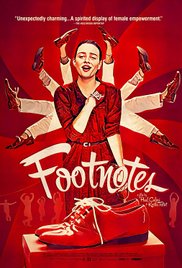
FOOTNOTES (Sur qued piel danser, France, 2017)

July 16, 2017

 Greetings again from the darkness. On the heels of success experienced by LA LA Land, and “inspired by the films of Jacques Demy and Stanley Donen”, co-writers and co-directors Paul Calori and Kostia Testut find the right fit with this whimsical musical-comedy that puts coming-of-age and social commentary on equal footing.

Pauline Etienne stars as Julie, an eager, hardworking young lady who flip-flops between odd jobs (McJobs) just trying to make ends meet in a tough French economy. When she secures a job as a stocker in a high-profile shoe (not footwear) factory, Julie is determined to buckle down, not step on toes, win over her stern supervisor (Clementine Yelnik), and finally get her life in order. Unfortunately, there are rumors of an upgrade, which in the world of corporate management double-speak means downsizing, or even closing the factory. Julie then spends most of the movie treading lightly between romance, a gruff boss, and her activist co-workers.

This is not the kind of musical where the singing voices, original songs or dancing will knock your socks off, but it all relates to the story and nothing seems forced. Feeling threatened, the factory ladies step up their game by singing “Let’s Fight Back” with some creative choreography that makes good use of the warehouse space. One of the delivery drivers (Olivier Chantreau) takes a shine to Julie, even though the boss assumes she is behind the workers’ strike and tries to boot her from the job.

Luic Corbery plays the smarmy CEO whose polished misleading statements are laced with charm as he attempts to re-buff the angry protests from the factory workers; all the while scheming to move operations to lower-cost China. With female solidarity and empowerment around her, Julie must decide if she will be the sole outlier, or if this is her chance to find her true self. It’s in these scenes where Ms. Etienne’s real-person screen presence spikes the story with the well-meaning persona that makes us care.

The working class dream of a better life is a constant throughout, though the ending is a bit disappointing given what we have watched Julie trudge through. The choreography is not flashy or polished, but rather low key and meaningful. There is a touch of the classic The Umbrellas of Cherbourg (including a song/dance featuring multi-colored umbrellas), and although it’s not at that level, it nonetheless is an admirable and enjoyable film. It should be noted that the original title Julie and the Shoe Factory does not quite take advantage of the wordplay offered by the English title.

watch the trailer:


MAUDIE (2017)

July 8, 2017

 Greetings again from the darkness. As the saying goes, “opposites attract”. It seems the bond between Canadian folk artist Maud Lewis and her reclusive employer/husband Everett Lewis prove this so – at least at first glance. However, digging deeper, as director Aisling Walsh and writer Sherry White do so expertly here, we discover an abundance of subtle similarities and life events that connect these two … showing yet again that real life is often stranger than fiction.

Sally Hawkins delivers her best performance to date (and a slam dunk Oscar nomination awaits) as Maud. She somehow manages to look even smaller on screen and capture the twisted, painful posture and movements of one stricken with severe arthritis. Ethan Hawke is Everett, the local fish peddler who lives like a hermit in his one-and-a-half room shack on the outskirts of town. Our first glimpse of Maude has her sneaking a cigarette on her Aunt’s porch while she listens to family members argue about who has to care for her. We first see Everett has he stomps into the general store demanding the shopkeeper write out and post his job opening for domestic help.

Filmed in Canada and Ireland, cinematographer Guy Godfree captures the harshness of the seasons and, more impressively, the claustrophobic and sparse living conditions of Maud and Everett’s tiny home (nothing like the HGTV segments). Maud’s sweetness and never-ending ability to find joy in the moment contrasts with Everett’s cantankerous and even initially cruel approach. These polar opposites are both societal outcasts, but eventually develop respect and yes, even love (though such a word would never be exchanged between the two). Hawkins and Hawke share two especially fabulous scenes – their initial meeting in his house, and a many-years-later emotional exchange on a bench. Hawke’s character is a bit challenging for the audience, but Hawkins captures our heart immediately.

Supporting work is minimal, yet effective, as Zachary Bennett plays Maud’s brother Charles, Gabrielle Rose is her Aunt Ida, and Kari Matchett is Sandra – the New Yorker with the fancy shoes who first spots Maud’s talent. Much of the story focuses on Everett’s pride and Maud’s joy/spirit, while slowly they both gain a bit of fame thanks to her artistic talent and their living arrangement.

Ms. Hawkins has long been an underrated actress (despite last year’s Oscar nomination), and her turn in Happy-Go-Lucky (2008) was proof she could carry the lead. Here, seeing her hoist such a real life character and story on her hunched back is a thing of beauty and is not to be missed. It’s an artful movie about an artist and making the best of life. The film’s music is perfectly understated and features acoustic guitar, violin and piano. It should be noted that the end of the film features a clip of the real Maud and Everett, and their house has been preserved and displayed at the Art Gallery of Nova Scotia.

watch the trailer:


THE BIG SICK (2017)

June 30, 2017

 Greetings again from the darkness. Those of us who tend to avoid Hollywood Romantic Comedies honestly have nothing against them in theory (no really, it’s true). The problems with the genre stem from (years of) cringe-inducing clichés, story structure re-treads, and inane dialogue – all of which is usually accompanied by acting that comes across as significantly short of believable. So when a rom-com (like this one) hits the silver screen and it provides emotionally dramatic moments, organically generated laughter, and multiple characters that we genuinely care about … expect the accolades to start flowing.

Real life husband and wife Kumail Nanjiani (“Silicon Valley”) and Emily Gordon have collaborated on the script; an autobiographical re-telling of the saga known as the beginning of their relationship. It’s a story that starts simply enough with a meet-cute in a Chicago comedy club where Pakistani-American Kumail is performing his stand-up routine (in between Uber-driving shifts), and Emily is in the audience firing off some mild heckling which progresses to flirting and then … well, activity that leads to both saying “this can’t happen again”.

Director Michael Showalter continues to prove that he doesn’t mind breaking the mold for relationship movies. Hello, My Name is Doris was one of last year’s more creative films in this genre, and now Showalter has taken another step forward with this true life script. Kumail plays himself, and rather than a larger-than-life presence, he comes across as exactly life size. Zoe Kazan (granddaughter of legendary director Elia Kazan) plays Emily. The two actors are believable together (and apart) and allow us to buy in to them as a couple – and as not a couple. Their relationship shines a spotlight on religious and cultural challenges, and family pressures that those from a traditional Muslim family carry. For some, moving to the U.S. doesn’t override religious and cultural traditions such as arranged marriages and preferred professions. The script addresses this beautifully and without pulling punches – although some humor does help.

The supporting cast is excellent and plays a substantial role in the story, especially as Emily (Kazan) lay quite ill in the hospital. Holly Hunter and Ray Romano play her parents, and deliver an emotional wallop, even while dealing with their own marital issues – one of which allows Romano and Kumail to bond a bit. Kumail’s parents are played by Anupam Kher and Zenobia Shroff, while his brother is played by Adeel Akhtar. They each capture the shock and disappointment that follows when Kumail seems to choose Emily over the family. Since this is a rare multi-dimensional script where characters can’t just be labeled “boyfriend” or “best friend”, Kumail’s cohorts at the comedy club are played by Bo Burnham, Aidy Bryant, Kurt Braunohler, and David Alan Grier – each bringing more depth to the story.

Expect the best giraffe and 9/11 jokes you’ve likely ever heard, but mostly rejoice in the graceful balance between life and death, comedy found in daily life, and the real relationship struggles. It’s not even the first coma-centric romantic-comedy (While You Were Sleeping, 1995), but here, the human feelings on screen remind us that most decisions in life are complex, and we all make mistakes of the heart. Kumail is caught in “no man’s land” between family obligations and his own identity. Hopefully life hasn’t stuck you in Kumail’s spot – hanging out in the hospital waiting room with the parents of your ex as she lay comatose down the hall as you slowly come to realize that she’s the girl of your dreams (and your parents’ nightmare). It may not sound like the makings of a traditional rom-com, but that’s what makes it so exceptional.

watch the trailer:


BABY DRIVER (2017)

June 29, 2017

 Greetings again from the darkness. If his movies are any indication, writer/director Edgar Wright would be fun to hang out with. He thrives on action and humor, and seems committed to making movies that are entertaining, rather than philosophical life statements. Many know his work from Three Flavours Cornetto trilogy (Shaun of the Dead, Hot Fuzz, The World’s End), while others are fans of Scott Pilgrim vs. the World. High concept, high energy and a creative use of music are identifiable traits within Mr. Wright’s films, all of which are crucial to the success of his latest.

Ansel Elgort (excellent in The Fault in Our Stars) stars as Baby, a freakishly talented getaway driver paying off a debt to a no-nonsense crime boss Doc played by Kevin Spacey. Baby has an unusual movie affliction – a childhood accident killed his parents and left him with tinnitus. He compensates for the constant ringing in his ear by listening to music through ear buds attached to one of his many iPods (depending on his mood). In fact, his insistence on finding just the right song for the moment adds a colorful element to each escape route.

The film opens with what may be its best car chase scene and the hyper-kinetic approach sets the stage for something a bit different than what we usually see. There are no car drops from airplanes or train-jumping (I’m looking at you Fast and Furious franchise). Instead these are old school chases in the mode of Bullitt, or more precisely, Walter Hill’s 1978 The Driver (Mr. Hill appears briefly here as a courtroom reporter). A heist-romance-chase film with a diverse and truly remarkable selection of songs, high energy, more than a few comedic moments (the Mike Myers mask sequence is brilliant) and a recurring Monsters, Inc quote requires a strong lead, and young Mr. Elgort aces the test. Baby is the DJ to his own life, and possesses a moral compass that others on his jobs can’t comprehend. It’s a heart of gold in a bad spot.

Spacey plays Doc with his chilling dead-eyed stare, and even has his own moment of action sporting an automatic weapon during a violent shootout. Spacey’s various crime teams (he varies the pairings) include psycho-lovebirds Buddy (Jon Hamm in his continuing effort to distance from Don Draper) and Darling (Eiza Gonzalez), Jon Bernthal, Flea, and an aptly named Bats (Jamie Foxx), who is not the clearest thinker of the bunch. Other supporting work comes courtesy of the rarely seen songwriter/actor Paul Williams, musician Sky Ferreira (as Baby’s beloved mother), young Brogan Hall as Doc’s talented nephew, and CJ Jones as Baby’s foster father. Mr. Jones is one of the few deaf movie actors and he adds much to Baby’s life outside of crime.

The crucial role of Baby’s love interest goes to the very talented and likable Lily James (Pride and Prejudice and Zombies) as singing waitress Debora, who introduces him to Carla Thomas’ “B-A-B-Y” song, while he plays “Debora” from T.Rex for her. She and Baby share the not overly ambitious life plan: “to head west in a car I can’t afford and a plan I don’t have”. They are good together and that helps make up for the always cringe-inducing red flag of “one last job” prior to the lovers running away together.

Buried in the Miscellaneous Crew is Choreographer Ryan Heffington, who deserves at least some of the credit for the most unique and creative aspect of the presentation. This appears to be a movie fit to the music, rather than music fit to the movie. There are some astounding sequences where the drum/bass beats are right on cue with the action – gunfire, driving, and character movements. “Harlem Shuffle” plays as Baby playfully dances past graffiti and sidewalk obstacles that perfectly match the beat and lyrics. We see what is likely the best ever movie use of “Bellbottoms”, and without question, the most creatively brilliant use of “Hocus Pocus” by Focus. At times exhilarating to the senses, the infusion of comedy shots and new love help offset the tension of crime jobs and the thrill of the chase.

watch the trailer: