PARASITE (2019, Korea)

November 7, 2019

 Greetings again from the darkness. At least once per year, a movie really hits a sweet spot … something that is fun to watch and not really like anything we’ve previously seen. Korean filmmaker Bong Joon Ho’s latest film is this year’s cinematic surprise. It’s filled with interesting characters, social commentary, a unique setting, a creative and twisty story, and enough tension that we are left stunned as the end credits roll. There have already been a few excellent movies this year, and this is surely to be a memorable addition to the best of 2019.

We first meet the Kims, a family in poverty living in near-squalor in a basement level apartment with one small window. That window is at street level and allows a bit of natural light to leak in, and also provides a too-clear view of drunks targeting the window as they relieve themselves. The family keeps the window open for free fumigation as the city sprayers drive past, in hopes that it will get rid of the pesky stink bug infestation (yes, there is symmetry to this later in the story). The Kim family consists of Dad (a terrific Kang-ho Song), Mother (Hye-jin Jang), teenage son Kevin/Ki-woo (Woo-sik Choi) and 20-something daughter Jessica/Ki-jung (So-dam Park), and they react strongly when they lose “free hi-fi” access from a neighbor’s system. The family seems to make just enough money for their next meal despite somehow underperforming at their family job of folding pizza boxes for a local vendor.

Fortunes begin to change for the Kims when one of Kevin’s friends ask him to take over tutoring a teenage girl for a wealthy family in town. This sets off an ingenious and sometimes quite funny chain of events that result in all four Kim family members working in some capacity for the Parks, the aforementioned wealthy family. The Park’s home was designed by a famous architect and it is a stunning modern hillside home with lush garden and a window that stands in stark contrast to that little window in the Kim’s city apartment. Mr. Park (Sun-kyun Lee) is a 1% tech titan married to a high-strung woman who is an eternally anxious and over-matched mom (a fantastic Yeo-jeong Jo). Their two kids are lustful teenage daughter Da-hye (Ji-so Jung) and hyperactive young son Da-song (Hyun-jun Jung).

It’s fascinating to watch how this family of schemers infiltrates this gullible and vulnerable upper class home, and how they so are easily trusted thanks to photoshop skills, Google, and a street-wise understanding of how to read people. The script, co-written by the director and Han Jin Won, explores the co-dependency as the rich depend on the poor for service work, and the poor depend on the rich for jobs and a living wage. Given the film’s title, we soon realize that a “host” may have more than one parasite at any time … something that plays out in what has to be the wildest film twist of the year, thanks to an all-out performance from Jeong-eun Lee as the Park’s long-time housekeeper.

The social and class commentaries are spread throughout, and in addition to the window comparisons, you’ll also notice that the walk is uphill to the Parks’ home and downhill (and flood-risky) to the Kim’s apartment. There are multiple layers within the stories and within the individual characters. What begins as a devastating social satire morphs into a wild and crazy time of violence … without losing its general theme. A comedy of familial con artists bursts into a violent class thriller – the price to pay for unearned comfort. The film is not just unpredictable, it smacks us with a jarring twist.

Bong Joon Ho has become a well-respected filmmaker for his previous work: THE HOST 2006, MOTHER 2009, SNOWPIERCER 2013, and OKJA 2017. This latest elevates him to a whole new level. The film is darkly humorous and unpredictable, with excellent performances throughout. It’s also quite something to look at. Cinematographer Kyung-pyo Hong works his magic, and it should be noted that the Park’s home is a complete set built solely for the film. I challenge you to notice this – I sure couldn’t tell. The film won the 2019 Palme d’Or at Cannes Film Festival, and it is likely headed for many more accolades.

watch the trailer:


JOJO RABBIT (2019)

October 31, 2019

 Greetings again from the darkness. Welcome to the most divisive movie of the year. Some will scoff at the idea and deride the filmmaker without ever even seeing the movie. Some will relay disgust after seeing the movie. A few won’t appreciate the style or structure, and will fail to find the humor. Ah yes, but some of us will embrace Taika Waititi’s wacky adaptation of Christine Leunens’ 2018 novel “Caging Skies” as one of the funniest and most heart-warming films of the year … fully acknowledging that many won’t see it our way.

One wouldn’t be off base in asking why a successful filmmaker would tackle such a risky project: a coming-of-age comedy-drama-fantasy about a 10 year old Nazi fanatic who has as his imaginary friend, not a 6 foot rabbit, but the Fuhrer himself, Adolph Hitler. After all, writer-director Waititi is coming off a couple of brilliant indies (2014’s WHAT WE DO IN THE SHADOWS, and 2016’s HUNT FOR THE WILDERPEOPLE) and a major score with Marvel money on THOR: RAGNAROK (2017), arguably the most entertaining superhero movie of the past few years. He certainly could have continued to cash in with ‘safer’ choices; however, Mr. Waititi sees the world differently than most of us. He finds humor in the drudgery, and humanity in malevolence. He’s also a bit goofy.

Playing over the opening credits is the German version of “I Want to Hold Your Hand”, as we see old clips of German citizens cheering for Adolph Hitler in a similar manner to how fans used to scream for The Beatles. World War II is nearing the end as we meet 10 year old Jojo Betzler (newcomer Roman Griffin Davis). Jojo is fervent in his fanaticism towards the Nazi way, and buys into the belief that Jews are monsters with horns on their head. He’s such a believer that his imaginary friend is actually Hitler, well at least a bumbling boisterous version played by the filmmaker himself – enacted to extreme comedy effect (recalling a bit of Chaplin in THE GREAT DICTATOR). Mel Brooks managed to play Hitler to a laughable extreme in “Springtime for Hitler” in THE PRODUCERS, but the only thing missing her from Waititi’s costume is an old timey dunce cap.

Jojo lives at home with his mother Rosie (Scarlett Johansson), while dad is off fighting on the front line. Ms. Johansson’s performance is terrific (despite limited screen time) as she creates a believably warm bond with her son during horrific times. Soon, Jojo is off to a Nazi camp designed to teach the boys how to fight (and burn books), as the girls learn the virtues of having babies. The camp leaders are Captain Klenzendorf (Sam Rockwell), who is a bit of a joke on the surface, but more interesting the deeper we dig; Fraulein Rahm (Rebel Wilson) who boasts of having 18 Aryan babies; and Finkel (Alfie Allen) a violent psychopath. At camp with Jojo is his best friend Yorki (newcomer and scene-stealer Archie Yates), and the two show what a genuine friendship can be as the movie progresses.

Things change quickly for Jojo when, by happenstance, he discovers a Jewish girl living in the walls of his home. Elsa (Thomasin McKenzie, LEAVE NO TRACE) shows none of the characteristics that Jojo has been brainwashed into believing all Jews possess. She has no horns, flashes a good sense of humor, and is actually very nice and knowledgeable. In other words, she’s no monster. As they get to know each other, Jojo realizes this “nice” Jewish girl contrasts starkly with his lunatic hero Adolph.

Waititi’s film is ingenious satire, and it likely won’t sit well with those who think not enough time has passed to justify making fun of Nazi atrocities. It’s funny and heavy, and deals with some thought-provoking matter in an unusual way. The “Heil Hitler” count approaches the ‘F-word’ frequency of most Tarantino movies, and there is a German Shepherd gag that caught the audience off-guard. Stephen Merchant’s Gestapo search of Jojo’s house is comedy at its weirdest. The movie messes with your head as it’s some odd blend of SCHINDLER’S LIST, “The Diary of Anne Frank”, and an extended Monty Python skit.

It’s rare for a film that borders on slapstick at times to have so many touching and emotional moments. The actors are really strong here, especially Ms. Johansson and Ms. McKenzie, who as gutsy Elsa, proves again she is quickly becoming a powerhouse young actor. Roman Griffin Davis carries a significant weight in the story despite being a first time actor, and I can’t emphasize enough how young Archie Yates will steal your heart while he’s stealing his scenes. Michael Giacchino’s score and Mihai Malaimaire Jr’s terrific cinematography work well with Waititi’s vision … a satirical vision that would never work outside of his unique filmmaking talent. The story is basically proof of the adage, ‘Kill ‘em with kindness’, when what we are really killing is hatred. At its core, this is a story of humanity and human nature, and how we grab hold of the wrong thing until the truth becomes evident. Now, please pass the unicorn.

watch the trailer:


MOTHERLESS BROOKLYN (2019)

October 31, 2019

 Greetings again from the darkness. Gumshoe film noir from the 1940’s and 1950’s is probably my favorite genre after suspense thrillers. Classics like THE MALTESE FALCON, KISS ME DEADLY, A LONELY PLACE, LAURA, and DOUBLE INDEMNITY draw me in with style, mood, and character flaws. Tough guys and clever women combined with secrets, empty clues, and false bunny trails can mesmerize me for hours. Evidently Edward Norton shares my affection for this genre, as he purposefully shifted the time frame of Jonathan Lethem’s novel from 1999 to 1957 for the big screen adaptation.

Norton dons 4 hats for his passion project that’s been brewing for almost a decade. He writes, directs (his second time at the helm), produces, and stars as Lionel Essog, the assistant to Private Investigator Frank Minna (played by Bruce Willis). Lionel, often referred to as “Brooklyn” or “Freak Show” suffers from Tourette’s syndrome, causing him many uncomfortable moments of awkward verbal outbursts and physical tics, while also blessing him with a photographic memory and world class attention to detail. The concern here was that Norton the actor would turn the character into a gumshoe “Rain Man”, but that never happens, as his affliction rarely overshadows a scene or the story.

One of the first things we notice is that the film looks beautiful. The costumes (Amy Roth) and set design (Beth Mickle, Kara Zeigon) and cinematography (2-time Oscar nominee Dick Pope) are all spot on and top notch. The classic cars are especially impressive, despite my pet peeve of each being perfectly washed and waxed in every scene. Daniel Pemberton’s retro score perfectly captures the neo-noir moments.

This era in New York included jazz clubs, corrupt politicians and power struggles for profiteering from the growth. Norton’s film delivers The King’s Rooster jazz club with the great Michael Kenneth Williams as the featured trumpet player … he looks like a natural on stage in the smoky club. We also, of course, have plenty of big time corruption and scheming. The main culprit being City Planner Moses Randolph, the epitome of corruption and racism. Alec Baldwin could play this role in his sleep, and he performs admirably in the not-so-subtle riff on the real life Robert Moses.

The film’s opening sequence leaves Lionel committed to solving the murder of Minna, his mentor and (only) friend. His co-workers played by Dallas Roberts, Bobby Cannavale, and Ethan Suplee come in and out of the story, contributing very little. Things are most interesting when Lionel crosses paths with brilliant city engineer Paul (Willem Dafoe in a less salty role than in THE LIGHTHOUSE) and activist Laura Rose (Gugu Mbatha-Raw), in a role that would have benefitted from some beefing up in the script. Other supporting roles are filled by Leslie Mann, Fisher Stevens, Cherry Jones, and Josh Pais.

The story follows a path not dissimilar to the all-time classic CHINATOWN, and it’s in that comparison where the weaknesses in Norton’s film are most evident. The dialogue never quite clicks like it should, and at times it comes across like the actors are simply playing dress up 1950’s-style, rather than actually experiencing the struggles of the story. Everything just seems too ‘clean’ for this genre, even the moments of violence. It’s the details that make the difference in this genre, and even Norton’s voiceover is mishandled. As narrator, his voice is low and gruff which is customary for noir; however, while in character, the voice is high-pitched and sporadic. Both voices are as they should be, but since it’s the same character, the contrast takes us out of the moment when the narrator chimes in. The Tourette’s Association of America gave its stamp of approval to the film, and we do walk away with sage advice: “Never lie to a woman who is smarter than you.”

watch the trailer:


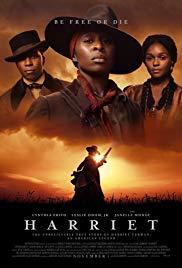
HARRIET (2019)

October 31, 2019

 Greetings again from the darkness. As far as I can tell, there has never before been a feature film profiling Harriet Tubman. Given her remarkable accomplishments and historic standing as an iconic American hero, we should all agree that it’s high time. The film plays as a passion project for writer-director Kasi Lemmons (EVE’S BAYOU, 1997) and her co-writer Gregory Allen Howard (REMEMBER THE TITANS, 2000). Cinematically speaking, it’s a fairly formulaic biopic; however, from a historical perspective, HARRIET is story that was due to be told.

Cynthia Erivo (WIDOWS, BAD TIMES AT THE EL ROYALE) stars as Araminta Ross, known as Minty. She was born into slavery, and the film picks up in 1849 Maryland when she is being sold ‘down south’ by her heartless owner Gideon Brodess (an understated Joe Alwyn, THE FAVOURITE). Rather than be separated from her family, Minty runs (she does a lot of running). She runs until cornered, and then leaps from a bridge into rushing water. It’s only after her treacherous 100 mile walk to Pennsylvania that she becomes a free woman and changes her name to Harriet Tubman – in honor of her mother and husband.

She receives help along the way. Reverend Samuel Green (Vondie Curtis Hall) plays a recurring role in her escape and later rescues. Once in Pennsylvania, she meets abolitionist William Still (Leslie Odom Jr, MURDER ON THE ORIENT EXPRESS, 2017), who runs the Pennsylvania Anti-Slavery Society and introduces her to fellow abolitionist Marie Buchanon (Janelle Monae). Ms. Buchanan is a free black woman, as elegant in her manner as she is dedicated to the cause … and she’s worthy of her own story.

Harriet decides she must go back and rescue her family. She is told the trip is foolish and too risky – which doesn’t stop her from making 13 trips and saving 70 slaves. We learn of her work with the Underground Railroad – not a train, but rather a secretive organization committed to helping slaves escape to freedom. After the Fugitive Slave Act of 1850, Harriet’s work becomes even more difficult, as she must guide the slaves all the way to Canada. Omar J Dorsey plays Bigger Long, an expert slave hunter – yes, that’s an actual occupation – hired by Harriet’s owner to capture her. When Harriet converts Walter the scout (Henry Hunter Hall), the colorful character becomes a valuable ally and strong believer.

As a young girl, Minty/Harriet had her skull cracked by a slave owner whilst standing in the wrong place at the wrong time. After that, she experienced episodes, “spells” that she claimed were visions from God. The film captures quite a few of these and treats Harriet as someone “touched”. Was this the prophecy or was Harriet an extraordinarily resourceful and tenacious woman? The message of God is present throughout, and it’s difficult to not view this as unintentionally taking a chip out of what Harriet accomplished.

Slave owners were baffled by the rescues conducted by this mythic figure they named “Moses”. Of course, they assumed it was a man, and once Harriet’s identity was exposed, her former owner was held accountable by other slave owners. It’s at that point where Gideon Brodess’ mother Eliza makes one of the most cold-hearted, racist speeches we’ve seen on film. Eliza is played by Jennifer Nettles, the singer for C&W band Sugarland. In 1858, Harriet crosses paths with abolitionists John Brown and Frederick Douglas, and delivers an impassioned speech of her own in the presence of Senator William Seward (one of Booth’s targets in the Lincoln assassination). Harriet assisted Brown with recruitment for his raid on Harpers Ferry. In 1863, Harriet led the Comahee River Raid, which resulted in 750 slaves being set free.

The film might be a bit slick, but the acting is top notch, and Harriet’s story is remarkable. Director Lemmons forgoes the brutality of 12 YEARS A SLAVE, and tries to cover Harriet’s time as a slave, her first escape off the bridge, and her continued work freeing other slaves. Harriet went on to become a Civil War spy for the Union, and later a respected elder who worked for women’s voting rights and to make latter life a bit easier for former slaves. It’s possible a movie was not the best format to tell Harriet’s story … a story that continued to develop until her death in 1913 at age 91 (or thereabouts). But it’s important to have her story documented in some way other than the textbooks kids likely won’t read. A film that tackles such a towering historical figure deserves a little slack.

watch the trailer:


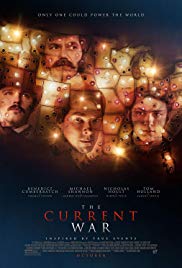
THE CURRENT WAR: DIRECTOR’S CUT (2019)

October 24, 2019

 Greetings again from the darkness. Electricity. Bringing light and power to the world. Other than dependable food sources and clean water and air, nothing is more vital to our way of life today. However, going back in time only 125 years finds the sun and candlelight as the only forms of illumination. Oh, but behind the doors of laboratories for Thomas Edison and George Westinghouse, skilled engineers were working diligently to discover the breakthrough that would deliver light to the dark world.

Normally the making of a movie is not a story worth telling. The final work should speak for itself. But the story of this film’s road to the screen is not normal. This was the film Harvey Weinstein was working on when his sex abuse scandal broke. Weinstein went ahead with the screening of the film at the 2017 Toronto Film Festival despite pleas from the director that the film was not ready to be shown. Once the scandal hit, director Alfonso Gomez-Rejon (the excellent ME AND EARL AND THE DYING GIRL, 2015) was helpless – he couldn’t access the film for reshoots and final edit. Now, after two years of legal wranglings, he is finally able to present his finished project.

On one hand, it’s a feel good story for the director. On the other hand, the film falls short of being a top notch historical drama … despite it being a real life drama that changed the world. Most would agree there isn’t much entertainment value in watching the daily trial and error of engineers in a lab, so it makes perfect sense that director Gomez-Rejon and writer Michael Mitnick would turn their focus on the personal and professional rivalry between Thomas Edison and George Westinghouse, as well as a portion of the story involving Serbian immigrant Nikola Tesla – perhaps the most brilliant of them all.

Benedict Cumberbatch plays Edison, a true celebrity and renowned inventor. We see how Edison’s family life with wife Mary (Tuppence Middleton) takes a back seat to his work at his Menlo Park lab; a trait that becomes more extreme after a personal tragedy. Michael Shannon plays George Westinghouse, developer of railway air brakes, in a stoic and focused manner, and with a close relationship with his wife Marguerite (Katherine Waterston). Nicholas Hoult portrays Nikola Tesla, he of brilliant mind contrasted with quirky and fastidious ways. The other two key players here are Matthew Macfadyen as JP Morgan, the banker who finances much of the work, and Tom Holland as Samuel Insull, Edison’s loyal assistant.

While difficult to imagine now, the big debate boiled down to what form of electricity was most practical for the masses. Edison believed it was direct current (DC), while Westinghouse and Tesla were all in for alternating current (AC), which they believed to be cheaper and more powerful. Edison, ever the media manipulator, created questions of public safety in regards to AC by pulling dramatic public stunts. An interesting note here is that despite Edison’s pledge to never invent military weapons or anything designed to take a life, it was his work that led to the use of the electric chair as a replacement for hangings in death penalty cases.

This rivalry between two titans of industry never seems to click, and sadly, Tesla’s story comes across as an add-on to the movie – though his work is worthy of its own movie. Westinghouse deals with his Civil War flashbacks, and Edison’s coarse nature is dulled somewhat here in an effort to make him a bit more appealing as a character. The 1893 Chicago World’s Fair provides the “finish line” for this competition, with the winner lighting up the Fair and setting the stage for the rest of the country. There are flickers of a great movie here, and the performances reach the expected levels for such a strong cast, but overall the movie comes across a bit disjointed and trying much too hard to be regarded as a prestigious film.

watch the trailer:


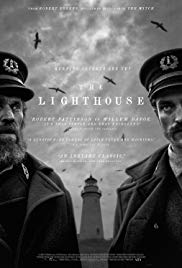
THE LIGHTHOUSE (2019)

October 17, 2019

 Greetings again from the darkness. The opening sequence plays like something from 1920’s era cinema. The chug-chug-chug of a boat slamming against the waves of an angry sea while birds flap and chirp alongside. We hear the wind and “feel” the severe ocean spray. Several minutes elapse before any word is spoken. Immediately noticeable is the nearly square aspect ratio … the rarely (these days) seen 1.19:1 frame, making the black and white images appear both surreal and ominous.

All of the above makes perfect sense when we realize this is writer-director Robert Eggers’ first feature film since his 2015 indie horror gem THE WITCH won dozens of festival awards. Mr. Eggers obviously has his own vision for projects, and his approach borders on experimental, eschewing conventional. He co-wrote this script with his brother Max, and evidently much was drawn from the actual journals of lighthouse keepers … something that is evident in the vocabulary and the effects of solitude.

4-time Oscar nominee Willem Dafoe stars alongside Robert Pattinson as the two men charged with a 4 week assignment of tending to a lighthouse. The film is set in 1890, and Dafoe plays Thomas Wake, the epitome of a salty old sea dog, replete with bad leg, hardcore Atlantic accent, and upside down pipe. Pattinson is Ephraim Winslow, the assistant Wickie, who faces non-stop demands from Wake, and initially maintains a quietness as he goes about his duties … what Wake calls the ‘doldrums.’ We learn little about either man’s past. For Wake, other than knowing his previous assistant went mad, the clue is when he mentions “13 Christmases spent at sea” costing him a family. For Ephraim, when Wake asks, “Tell me what’s a timberman want with being a Wickie?” we get some insight into Ephraim’s desired future.

Eggers has delivered the anti-buddy movie. It’s a bleak, slow-motion race to insanity caused by being isolated with only one other person … a person you aren’t fond of. Only this is not a director or a film content with showing two men stuck on a storm-battered rock, as they slip towards insanity. No, we viewers are forced to experience some of these same feelings – how much of what we see is actually happening? It’s mesmerizing and hypnotic, and the above-mentioned narrow screen aspect purposefully emphasizes the sense of confinement and claustrophobia.

With no color and only a couple of characters … OK, 3 if you count the mermaid …OK, 4 if you count the seagull … the film still manages to pound us with sensory overload. We can barely process all we are seeing, despite relatively minimal ‘typical’ action. The black and white images are mostly just various shades of gray, and sunshine is non-existent.  Cinematographer Jarin Blaschke (THE WITCH) embraces the dreariness by allowing the fog, lanterns, candles, wind, rain, and harsh elements to become characters unto themselves. However, nothing is in sync with our two leads. Composer Mark Korven fills the many lapses in dialogue with sounds and tones we haven’t heard before, yet they fit perfectly here. This is also quite likely the first film to utilize farts and foghorns in harmony.

Director Eggers filmed this on Cape Forchu in Nova Scotia, and the extreme weather and less-than-welcoming terrain create quite the visuals – as do the faces of our two lead actors. Dafoe may never have chewed scenery so delightfully as he does here, and Pattinson starts slowly before delivering his best work – including a ferocious rant that is fascinating to watch and contrast to his character’s first meal with Dafoe. Is this a horror film? A fantasy? Macabre comedy? There is simply no way to describe this other than bizarre. It’s truly miserable cinema, and I loved every minute of it.

watch the trailer:


PAIN & GLORY (2019)

October 17, 2019

 Greetings again from the darkness. This marks the 13th Pedro Almodovar movie I’ve seen over the last 33 years. There is no logical explanation for why I feel connected to his movies. It seems obvious I have very little in common with the provocative filmmaker from Spain who won an Oscar for his extraordinary 2002 film HABLA CON ELLA (TALK TO HER). Yet, his movies invariably strike an emotional chord with me – and none more so than his latest.

As with many of his previous films (and more than most), this one has a strong semi-autobiographical feel to it. Antonio Banderas stars as aging filmmaker Salvador Mallo. No other actor could have been cast in the role. This is, by my count, the eighth collaboration between actor and director … no actor has a better feel for Almodovar over the past three decades. It must be noted that Banderas does not stoop to impersonation or mimicry. OK, he has similar spiked hair, beard, fancy clothes and a museum-quality house … but the performance is all Banderas, and it’s a thing of beauty. Salvador is an aged man who looks defeated despite numerous career achievements. His physical pains are many – chronic back pain, migraines, sporadic choking – but it’s his emotional isolation and solitude that stands out. Salvador is a lonely man with signs of depression.

The film bounces between two time periods: Salvador as an older man with the above listed struggles, and young Salvador (Asier Flores) growing up in poverty with his mother Jacinta (Penelope Cruz) and dreaming of a better life. The elder Salvador is reflecting on the life journey that brought him to this point, while the younger Salvador is filled with youthful hope for the future, even as his core being is taking shape.

Cinemateque has remastered Salvador’s first big movie “Sabor” and have invited him to attend the screening and participate in the Q&A. He sees this as a chance to re-connect with the film’s star (and his long ago friend) Alberto Crespo (played by Asier Etxeandia). The two haven’t spoken in over 30 years due to bad blood and artistic differences during the filming of “Sabor”. Now understanding Alberto’s approach to the role, Salvador is told by an actress that ‘the movie hasn’t changed, but the eyes you see it through have’. Salvador visits Alberto and soon the actor is sharing his heroin stash with his director. Salvador continues “chasing the dragon” as a form of relief from his physical pain, and as an escape from his solitude. It seems to work much better than his cocktail of prescription drugs.

Rather than a film of drug addiction, this is a film of reflection. Fellini’s 81/2 (1963) is surely the most famous and iconic of the autobiographical films by a director, and though Fellini may have the advantage of esoteric artistry, Almodovar’s signature style is ever-present through primary colors (especially red) and memorable sets. Deserving of special mention are frequent Almodovar collaborators Antxion Gomez (Production Design), Maria Clara Notari (Art Direction), Paola Torres (Costume Design), and cinematographer Jose Luis Alcaine. The music is provided by 3-time Oscar nominee Alberto Iglesias.

There are some intimate and touching scenes in the film, as well as a couple of lines of dialogue that hit pretty hard. Circumstances are such that Salvador reunites with Federico (Leonardo Sbaraglia), the love of his life. It’s a tender reunion that lasts only a short time, but allows for needed closure for both men. There is also a sequence where Salvador is having a heartfelt and intimate conversation with his elderly mother (Julieta Serrano). She tells him he was not a good son. This conversation between adult son and mother is an example of things that should be said, but rarely are. Ms. Serrano previously played Mr. Banderas’ mother in WOMEN ON THE VERGE OF A NERVOUS BREAKDOWN and MATADOR.

Almodovar’s movie premiered at Cannes, and it examines our expectations for life and how they contrast to our later recollections. The two timelines show one looking forward as the stage is set, and the other looking back at both the good times and bad. For an artist, it’s the life that molds their influences for their art/craft. Salvador’s memories even play like short movies. There may be no real plot to the film, and instead it focuses on reflection, introspection and perspective. “Love can’t cure the ones we love” is a gut-punch of a line, and one that can’t be comprehended until late in life. For an Almodovar film, this one is restrained and tempered – even tender at times. And yet despite this, it will stick with me for awhile.

watch the trailer:


GEMINI MAN (2019)

October 10, 2019

 Greetings again from the darkness. Usually after watching a movie, I spend some time thinking about the story, the performances, the visual effects, the music, the sets, the costumes, and any other piece of the puzzle that makes up that particular movie going experience. However, Oscar winning director Ang Lee’s (BROKEBACK MOUNTAIN, LIFE OF PI) new film creates a challenge. In addition to those previously mentioned factors, the ground-breaking new technology must also be addressed – both separately and in conjunction with how it works in the movie.

If you’ve seen the trailer, or even the poster, you know that there is an “old” Will Smith and a “young” Will Smith. The basic story is that Henry Brogan (old Will Smith) is a retiring DIA (Defense Intelligence Agency) assassin who is being hunted by his own government. The one doing the hunting is Junior, a “young” clone of Henry Brogan. What you may not know is that this is not accomplished through the typical de-aging process that has become so popular in Hollywood. Nope, this Junior is actually digital animation from Weta Digital in New Zealand. It’s not even really Will Smith – it’s a digital creation that looks almost identical to the Will Smith from “The Fresh Prince of Bel-Air” (1990-96), minus the wide grin and funky clothes. It’s very impressive technology, but not yet to the point where it can replace living, breathing, emoting actors. However, it’s pretty obvious that day is coming.

What’s also obvious is that this script is a mess, and despite the new generation of technology, this film seems dated … well at least the story seems that way. Darren Lemke (SHAZAM!) first published the screenplay in the mid-1990’s and it has “almost” made it to production on a few occasions. Writers David Benioff (THE KITE RUNNER) and Billy Ray (CAPTAIN PHILLIPS) are credited on this final, mostly disappointing version. The dialogue is lame and character development is non-existent. We are never provided a reason to give a hoot about old Henry. Junior is never more than a video game creation. And DIA Agent Danny Zakarweski (Mary Elizabeth Winstead) seems to be an afterthought when someone realized the film needed a female presence. Clive Owen plays Clay Verris, the mastermind/mad scientist with little more than a scowl, though Benedict Wong brings a jolt of life to his Baron role as a pilot friend of Henry.

We do get to see some of the world. The initial sequence takes us on Henry’s final mission. It’s his 72nd kill, and it occurs from a grassy knoll in Belgium through a window on a bullet train going 228 mph. Henry heads back to his isolated lake cabin in Buttermilk Sound, Georgia where his peaceful retirement lasts about 3 scenes. Soon, we are headed to Columbia for a crazy motorcycle chase, and then on to the catacombs in Budapest – an idea that provides a welcome dose of inspiration.

High-speed parkour, blurry close-up fight scenes, rooftop shootouts, and a hyper motorcycle chase through town all have an air of familiarity, which is something this type of film should strive to avoid. Rian Johnson’s LOOPER toyed with us using a young and old version of the same character, and though that was time travel and not cloning, the ideas are too similar for this one to come across as unique. Oscar winning cinematographer Dion Beebe (MEMORIES OF A GEISHA) delivers the shots – down to the crystal clear logos on beer and soda – but we never really experience the thrill that new technology should deliver. It should also be noted that no theatre in America is equipped to show this in the way Ang Lee filmed it: 4K 3D 120fps HFR format … leaving us wondering, what’s the point?

watch the trailer:


LUCY IN THE SKY (2019)

October 10, 2019

 Greetings again from the darkness. ‘Space – the final frontier.’ Well, that wasn’t the case for real life astronaut Lisa Nowak. In 2007, Nowak made the national news for her cross-country, diaper-wearing road trip that ended with her being arrested in Orlando for attempted kidnapping. Nowak had been a Navy pilot and conducted spacewalks as an astronaut. She had been married and divorced from a NASA contractor, and the purpose of her long drive to Orlando was to kidnap the astronaut she had an affair with and the astronaut that she had been dumped for by that astronaut (the other one she was kidnapping). Noah Hawley’s feature film directorial debut is “inspired by true events”, and about the only thing missing is those diapers.

OK, that’s not the only thing. Also missing are a coherent story, believable dialogue, a realistic Texas accent, a competent psychologist, and an inspiring story of girl power. Natalie Portman plays Lucy Cola, and the film opens with her being filled with awe during a spacewalk that will forever make life on Earth seem small … even while her dreadful accent (with San Angelo gun joke) tortures the ears of every viewer. Jon Hamm co-stars as astronaut Mark Goodwin, the “action-figure” prize in the eyes of Lucy. This despite Lucy’s cheery, stable and very grounded husband Drew (Dan Stevens), who works in NASA Public Relations. Playing the 4th wheel in what should have been two separate two-wheelers is astronaut Erin Eccles (an underutilized Zazie Beetz). Thankfully, Ellen Burstyn is around to inject some raunchy old woman humor and life lessons as Lucy’s Nana. For no apparent reason, other than possibly in hopes of attracting a younger audience, Pearl Amanda Dixon plays Iris, Lucy’s teenage niece. Iris spends most of the movie casting confused looks at her famous aunt, wondering why Nana told her to take any advice from Lucy.

Noah Hawley is best known for his excellent TV work with “Fargo”, and here is credited as co-writer with Brian C Brown and Elliott DiGuiseppi. It’s the first feature film for all three and it shows. There are some interesting ideas and approaches, but most of the stylistic attempts are just too much: the non-stop shifting of aspect ratios, the by design blurring (out of focus) images, and the Malick-type edits early on, are all more distracting than artistic.

There are some intriguing bits to Lucy’s character. She’s a woman in a field dominated by Type A men, and she matches or exceeds all in determination, grit and expertise. It’s only after she is “star struck” that she begins her descent into mental and emotional instability. As she loses herself, there is a scene where Hamm’s Goodwin is watching the Space Shuttle Challenger tragedy over and over. That scene probably offers more insight into being an astronaut than most anything we see from Lucy. As for the finale, it’s a rain-soaked mess, and perhaps drives home the point that the filmmakers were handcuffed by a true life story that was simply too bizarre to work as a movie … especially since they left out the diapers.

watch the trailer:


THE LAUNDROMAT (2019)

October 10, 2019

North Texas Film Festival (NTXFF) 2019

 Greetings again from the darkness. The meek may inherit the earth, but if this Steven Soderbergh movie based on Jake Bernstein’s book (screenplay by Scott Z Burns) is correct, they aren’t likely to get the money too. To put it more bluntly, the first of the film’s 5 rules of creating and protecting wealth is, “the meek are screwed.” In order to follow this film that is “based on true secrets”, it helps to have a basic knowledge of the Panama Papers … a 2016 anonymous leak of more than 11 million documents exposing how the rich skirt the laws when it comes to protecting their money. Offshore entities had previously been a mainstream punchline, but these documents from Mossack Fonseca, a law firm in Panama, clearly outlined just how widespread the practice had become.

Rather than traditional narrative form, the information is presented through multiple vignettes featuring an impressive roster of well-known actors: Meryl Streep, Jeffrey Wright, Sharon Stone, Melissa Rauch, David Schwimmer, James Cromwell, Matthias Schoenaerts, Robert Patrick, Nonso Anozie, and Rosalind Chao, plus a few others you’ll recognize. In the role of tongue-in-cheek emcees are Gary Oldman and Antonio Banderas, as Jurgen Mossack and Ramon Fonseca, respectively. Their coordinating flamboyant outfits correspond to these caricatures of the real men behind this web of fraudulent activity. They are meant to add humor to the situation, but also tell “their side of the story.”

We are caught off-guard when Meryl Streep’s story and her character are not the main focus. Her slow unraveling of insurance fraud after her husband’s death is but one segment of the lesson that will likely confuse most people. The easy comparison is Adam McKay’s THE BIG SHORT (2015), which used some of this style in explaining the mortgage backed securities market. Whereas Mr. McKay won an Oscar for his screenplay, that’s highly unlikely for this one. Scott Z Burns is a talented writer, but this was simply too complex of a subject to tackle in 95 minutes. Mr. Soderbergh, as is tendency, not only directs the film, but is also the cinematographer, editor and producer.

This is a Netflix production that I caught at the inaugural North Texas Film Festival, and thanks to the presence of Ms. Streep, will likely have at least a limited theatrical release. Unfortunately, neither big screen nor small will solve the inherent issues here. There are some nuggets such as Delaware, despite its population of less than one million, being king of corporation filings (thanks to its business-friendly tax laws). Understanding shell companies, tax evasion, and other illicit financial activities among the world’s ultra-rich requires more than a talented cast, but perhaps there is enough here to motivate some to dig a little deeper with their own research. That is, if the film’s finale – a lecture on reform – doesn’t turn you off completely. Many of us appreciate being informed, but rebel against the preaching.

watch the trailer: