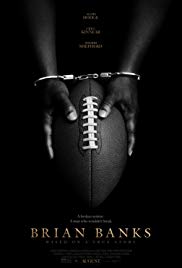
Greetings again from the darkness. With the momentum of the #MeToo movement, and the attention being paid to harassment and discrimination in all walks of life, there really is no better time for a film that tells the story of Brian Banks. We are counseled to believe women as they recount their heart-breaking and life-altering stories, and it’s Mr. Banks’ story that reminds us what should matter in all situations … truth and justice.
Brian was a 16 year old football star at Polytechnic High School in Long Beach, California when Wanetta Gibson (renamed Kennisha Rice in the movie) accused him of rape on school grounds. Banks was expelled from school, lost his athletic scholarship to USC, and poor legal advice led him to a plea bargain that resulted in his serving a 5 year prison sentence and another 5 years on restrictive probation. From day one, Brian Banks never wavered in the proclamation of his innocence.
In his situation, the only way for Brian to get some semblance of his life back was exoneration by the judge; and the only way that could happen would be new evidence or a recant of testimony by the accuser. Justin Brooks (played here by Greg Kinnear), the founder of the California Innocence Project, was touched by Brian’s story, but just couldn’t find a way to help. Surely the film offers some dramatization of actual events, but Brian Banks and his story are fascinating on many levels … and it makes for a though-provoking and inspirational 99 minutes.
Banks was a convicted man whose own conviction of his innocence is proof of just how strong the human spirit can be. Director Tom Shadyac (PATCH ADAMS 1998, ACE VENTURA: PET DETECTIVE 1994) had his own life-altering event, and it’s partly why this is his first narrative feature in more than a decade. It’s likely the “second chance at life” hit home, and the script from Doug Atchison (AKEELA AND THE BEE, 2006) manages to hit the high and low points experienced by Banks and his single mom (played by Sherri Shepherd), who never lost faith.
Aldis Hodge (“City on a Hill”) is outstanding as Brian Banks. He perfectly conveys the multitude of feelings of a man so confounded by a life gone wrong – yet so dedicated to staying on the right path despite all obstacles. In addition to the aforementioned Greg Kinnear and Sherri Shepherd, Melanie Liburd shines as Karina – Brian’s new romantic interest (who shares her own story of past sexual abuse), and Xosha Roquemore performs admirably and memorably in the thankless role of Kennisha Rice. It should also be noted that Morgan Freeman has a cameo as a prison counselor who makes an impact on Brian.
The film begins with Brian explaining that he never really knew what “freedom” meant until it was taken from him, and then he re-gained it. That’s a powerful statement, and it nicely corresponds to another lesson the film provides: “All you can control in life is how you respond to life.” The film may be a bit glossy at times, but its message and its central character are inspirational … and a source for further important discussions.
Greetings again from the darkness. The opening scene features an adolescent child spellbound by the bedtime story being told by a father. The story is an enhanced and personalized version of Noah’s Ark, and the scene goes on for at least 10 minutes … the camera never leaving their faces. What appears to be a simple campout turns curious, if not a bit ominous, as the father is next shown taking down a rigged security system and hiding certain personal items. This is the narrative feature directorial debut for Casey Affleck, who also wrote the story, produced the film, and is the lead actor (the father noted above).
As the daily rituals of these two characters unfold, the pieces of the puzzle come together and we learn there has been what is described as QTB – a female plague – that has killed off most of the females on the planet. As if a world of only men isn’t frightening enough, the father’s traveling companion is soon revealed to be a young girl disguised as a boy. This creates the ominous tone and explains the ever-present danger for these two, as rumor has it that the few remaining women are being held captive in camps to prevent the entire species from being eliminated. This is the story of one man’s efforts to protect his precious daughter from a society gone awry.
Anna Pniowsky establishes herself as a young actress to keep an eye on, as she is terrific as Rag, the daughter in disguise. Wise beyond her years, and though she has a general understanding of the constant threat, she is also quite curious about herself, her mother, and this bizarre world she is traversing with the only person in the world she can trust. Elisabeth Moss appears as the mother during flashbacks for Affleck’s character. This previous home life was a peaceful and loving environment, but the mother was stricken by the plague not long after giving birth to the daughter.
In contrast to the motherly environment, this father-daughter bond and existence requires constant preparation for escape. They must always be ready to “go” at a moment’s notice. Their red alerts and back-up plans are discussed and repeated. Their life in hiding means they never know who they can trust, and their solution is to distrust everyone – even though the father explains not all men are the enemy. His low key sense of calmness masks the constant stress they face.
Mr. Affleck is an Oscar winning actor (MANCHESTER BY THE SEA), and he shows some promise as a filmmaker (after his previous experiment with Joaquin Phoenix in I’M STILL HERE). Expert cinematography is provided by Emmy winner Adam Arkapaw (“True Detective” season one). At its core, the film is a story of the bond between father and daughter; however, it’s wrapped in a survival story. They strive to survive the next hour, the next day, and the next night. The film is a blend of CHILDREN OF MEN (2006), THE ROAD(2009) and LEAVE NO TRACE (2018), yet it brings a different tone and an emphasis to just how far a parent will go to protect their child. It’s a dystopian tale with a splash of gender identity questions, and a bond between father and daughter best surmised with their own words, “I love you to the sun and back.”
Greetings again from the darkness. You might be familiar with the disease “narcolepsy”, but unless you or someone close to you suffers from it, you’re likely unfamiliar with “cataplexy” – a symptom of narcolepsy that causes sudden and extreme muscle weakness typically brought on by severe emotions such as sadness, anger or excitement. For Charlie (played by Martin Freeman, THE HOBBIT), the trigger is happiness, so he has learned to (mostly) cope by avoiding his triggers: puppies, weddings, random acts of kindness, kids playing, and relationships. What he couldn’t avoid was being a groomsman in his sister’s wedding, which is how director Jason Winer and co-writers Max Werner and Chris Higgins choose to begin the film. We see the full effects and fallout (no pun intended) of Charlie’s disease.
Charlie listens to Wagner’s “Funeral March” on his commute to a calm job (out of necessity) at the public library, and his co-workers have mastered the art of assisting in keeping Charlie thinking non-happy thoughts. As tends to happen in life, love finds a way. Charlie crosses paths with Francesca (Morena Baccarin), a spirited woman who appears to be Charlie’s opposite in most every way … making the attraction even stronger. At a first date to a community theatre where a one-man show titled “Great Depression” is playing, we get the full effect of the challenges Charlie faces.
Cooper (Jake Lacy), Charlie’s younger brother, has been his main support system for most of his life – which is even more remarkable when we get the story of how Cooper got his name. When things fizzle between Francesca and Charlie, Cooper swoops in to date her and they set up Charlie with Bethany (a brilliantly funny Melissa Rauch). Bethany’s own quirks seem to be a good fit, even if Charlie’s torch for Francesca still flickers. Surely you’ve never seen an oboe sing-a-long to the Cranberries “Zombie”, and if somehow you have, it likely pales in comparison to the one Ms. Rauch performs.
The laughs are many, yet the script and Freeman’s performance remain respectful to the disease and those who suffer from it. Jane Curtin appears as Francesca’s Aunt who is cancer-stricken, and no, the purpose wasn’t to show a disease worse than cataplexy, but rather to show we all have challenges in life – and how we deal determines the type of person we are. The story was inspired by a segment on Chicago TV’s “This American Life”. It’s a delightful (if you can get over the use of a genetic disease as comedy fodder) little gem that I caught at the 2019 Dallas International Film Festival, and hopefully it will find an audience.
Greetings again from the darkness. With only her second feature film, Jennifer Kent (THE BABADOOK) has created a near cinematic masterpiece. The only thing holding it back is the historical subject matter and the no-holds-barred approach that will surely limit its audience. From an emotional aspect, the film is extraordinarily uncomfortable and disturbing to watch; however, from a filmmaking perspective, it’s a thing of beauty. The two sides of my brain were at war the entire time.
Set in 1825 Tasmania, the opening scenes are ominous and cloaked in dread – even though nothing has happened (yet). We just feel it in our bones … things are about to go wrong. And oh my, do they ever go wrong. Now you are likely similar to me in that your knowledge of 1825 Tasmanian history is quite limited. This was the era of “The Black War”. The British were in the midst of colonizing the country. Violence was prevalent towards women, native Aboriginals, and even the land and existing culture.
Clare (Aisling Franciosi, “The Fall”) is a young Irish woman, recently married with a newborn. She has served her 7 year sentence for theft (likely food for survival) and is now an improperly indentured servant to the ambitious and quietly despicable Lieutenant Hawkins (Sam Claflin, THE HUNGER GAMES). Clare is headstrong, but wise enough to understand her place. Her husband Aidan (Michael Sheasby, HACKSAW RIDGE) lacks the same judgement and his foolish attempts to deal directly with Hawkins results in the atrocity that leads to the core of the story.
When her pleas for justice fall on the deaf ears of the British military, Clare’s need for vengeance transforms her into a woman-obsessed. Due to the harsh elements of the Tasmanian forest, Clare reluctantly agrees to hire an equally reluctant Aboriginal tracker/guide. Billy (Baykali Ganambarr) takes the job, and the two have little respect for each other as the trek begins. As a female Irish convict, Clare was treated poorly by the British, yet she somehow views herself as superior to Billy. On the other hand, Billy lumps all white people into the category of those to hate and distrust. This pair make quite a statement on racism, classism and pre-judging others. Of course, as their journey continues, their similar backgrounds and commonalities are revealed, bringing these two broken people closer together and building mutual respect.
This is a part of history that Australia understandably doesn’t work to keep in the forefront. But the atrocities were very real and Ms. Kent’s film never shies away from the gut-punch of a moment. And though it takes place during this dark period with numerous appalling characters, the core element to the Clare’s story is determining the consequences and price of seeking vengeance. How does one hold on to compassion and humanity while trapped in an environment that is barely survivable? Does violence truly beget violence? Is there another way? One of the most striking elements of the story is the contrast of mindless slaughter against the intimacy of vengeance. The British soldiers seem to pay little mind to their victims, while Clare is an emotional wreck when violence is required. It’s quite a thought-provoking debate.
This is the first leading role for Aisling Franciosi and she is a marvel. Clare is quite a complex character and Ms. Franciosi is remarkable … as is her singing voice. Also impressive is the performance of Baykali Ganambarr as Billy. Known as a stage performer, this is Mr. Ganambarr’s first film role and he is terrific and believable as a young man looking to move on from a life that hasn’t been kind or fair. Other key supporting roles include Damon Herriman (“Justified”) as Hawkins’ right hand man, and Charlie Shotwell (CAPTAIN FANTASTIC) as young Eddie. All performances are strong, and filmmaker Kent was obviously attuned to presenting the authenticity of the period, even down to the spoken language. The costumes never look like something out of a Hollywood warehouse and cinematographer Radek Ladczuk captures the harshness of the land and brutality of the people. It’s a gripping tale focused on the reaction to the deepest of personal loss. The reward is there for those brave enough to give it a watch.
Greetings again from the darkness. A twenty-something New York City millennial is having an other-side of-the-globe phone conversation with her Chinese grandmother. It’s immediately clear that, despite the geographic gap, these two share a close bond. We also witness the stream of lies each of them cheerfully spouts off within a few minutes. This is the opening scene to writer-director Lulu Wang’s semi-autobiographical film … a film we are warned is “based on an actual lie.”
The millennial is China born and New York raised Billi (Awkwafina). When her parents (Tzi Ma and Diana Lin) tell her that her Grandmother (affectionately known as Nai Nai) has been diagnosed with Stage 4 cancer and has only months to live, Billi is stunned. More shock follows when Billi learns that the family has decided not to inform the family matriarch that she’s dying, and even more shock when Billi’s parents inform her that they are going to China for a final visit, but Billie is not invited, given her American tendency to wear her emotions on her sleeve.
To tell or not to tell? That is the question. If you were terminal, would you want to know? Well evidently in China, that’s a question the family can answer on your behalf. Philosophically speaking, is this a cultural or personal question? Your background likely determines your answer. Billi is experiencing a true Yin-Yang ordeal. Is it selfish on her part to want to be able to say goodbye to Nai Nai, or is it selfish on the part of the family to avoid that pressure? We are informed that in China, each person is a part of the whole – the family and the community.
Since all of that sounds so ominous and depressing, you should know that the film does a marvelous job of balancing the dramatic with the comical. Laughs are aplenty. The comedy comes from both old and young characters. It’s fascinating to see how director Wang explores Chinese family dynamics while also exploring cultural differences – never offering judgment on right and wrong. She often has multiple people in her shots – the frame is typically filled with many faces, making it a challenge for viewers to take in all of the nuances and reactions.
With so many characters, it’s crucial that we quickly understand the make up of each. That said, the ensemble cast is deep and terrific. The most surprising comes from the hilarious, touching and grounded performance of Shuzhen Zhau as Nai Nai, in what apparently is her first ever on screen appearance. She can be the warm grandmother poking fun at her granddaughter’s independent life, or the fully-in-charge woman demanding satisfaction from a local vendor. Her scenes with Billi are the true heart and soul of the film. Awkwafina (also a rapper) was fun in CRAZY RICH ASIANS, but here she flashes talent that no one saw coming. It’s a textured performance worthy of awards consideration.
Despite how personal the story and the characters are to Ms. Wang, her film never dips into sentimental overload or cultural preaching. She also avoids the farcical nature of a film such as DEATH AT A FUNERAL. Instead, she maintains a nice balance between drama and comedy, grief and guilt, and love and respect for tradition. The clichés are lacking, but heart is prevalent. Little wonder this was an Audience Award winner at Sundance. It’s a film that’s going to touch many.
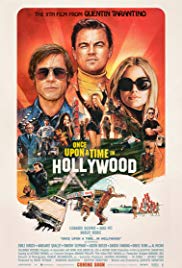
Greetings again from the darkness. Hippies, westerns, short skirts, pompadours, catchy pop songs … all have (mostly) disappeared from our world. Back to save the day and the memories, and twist a little history, is Quentin Tarantino, the ultimate film geek. His latest reminds us of a bygone era of movie stars and old school filmmaking … a once beloved industry which has been described as being on life support. There have been plenty of big screen love letters to Hollywood, but few if any, were filmed with so many personal touches and call-backs to the director’s own films.
In keeping with the request from Mr. Tarantino, this review will not include any spoilers or details that might negatively impact anyone’s initial viewing of the film. It’s a reasonable request since the film is so unique and literally packed with nostalgia, sight gags, and historical bits and pieces – some accurate, some not so much. There is a lot to take in and process, and the full impact of the initial viewing might result in awe, shock or disgust … and maybe even all of the above. So this will be a pretty simple overview peppered with some insight that should enhance rather than spoil the experience.
The film covers about 6 months in 1969, but in reality, it all takes place (at least what we see on screen) in 3 days. Leonardo DiCaprio (possibly his best ever performance) plays Rick Dalton, an actor who had a hit (fictional) TV western series in the 50’s and 60’s entitled “Bounty Law”. Since the show ended, Rick has been unable to make the successful transition to movies. For comparison, think of Clint Eastwood, Steve McQueen and Burt Reynolds – all actors in TV westerns who found greater career success in movies. Brad Pitt (the epitome of cool) stars as Cliff Booth, Rick’s stunt double, friend, driver, handyman, etc. While Rick is desperate to find the next stage of his career and fend off being forgotten, Cliff, a Vietnam vet, is accepting of his lot in life. Rick lives in a swanky Hollywood Hills home next door to hotshot director Roman Polanski and his starlet wife Sharon Tate; and Cliff lives in a trailer behind the Van Nuys Drive-In with his well-trained Pit Bull Brandy.
There are multiple parallel stories to follow, and a key one involves the aforementioned Sharon Tate. Margot Robbie nails the role and bounces about town with the energy and sweet aura that we imagine she possessed. All 3 of the lead actors – DiCaprio, Pitt, Robbie – have knockout scenes that I’d love to be able to discuss, but I’m not sure how without giving away too much. What I can say is that each of these three talented actors prove that movie stars still exist.
This is Tarantino’s 9th film as a director (he counts the 2-part KILL BILL as one film), and he claims he will stop making films after number 10. There are multiple features we can count on in a QT film, and a ridiculously deep supporting cast is one. Going through each of the characters played by actors you will recognize would take a page and a half, so I’ll cover only a few here. Margaret Qualley is a scene stealer as Pussycat, one of the Manson family girls. You likely remember her from the recent “Fosse/Verdon” or “The Leftovers”, and here she fully embraces the hippie look and spirit. Emile Hirsch plays hairdresser Jay Sebring, one of those in the house with Ms. Tate on that fateful night, and Mike Moh plays Bruce Lee so convincingly that I was momentarily confused when he took off his sunglasses. Also making appearances are some Tarantino regulars: Kurt Russell (as a stunt coordinator and narrator), Michael Madsen (as an actor), and Bruce Dern as George Spahn (a late replacement after Burt Reynolds passed away). Others of note include Maya Hawke (Uma Thurman’s daughter), Austin Butler (recently cast in the title role of Baz Luhrmann’s Elvis biopic) as Tex Watson, Rumer Willis (Bruce’s daughter) as actress Joanna Pettet, Damian Lewis as Steve McQueen, Al Pacino as agent Marvin Schwarzs, Dakota Fanning as Squeaky Fromme, and the late Luke Perry as actor Wayne Maunder (“Lancer”). 90 year old Clu Gulager (“The Virginian”, THE LAST PICTURE SHOW) makes an appearance, and Nicholas Hammond (Friedrich from THE SOUND OF MUSIC) tears into his role with gusto as director Sam Wanamaker. There is even a TV Guide cover featuring the late great character actor Andrew Duggan (“Lancer”). Some of these, and many more, are like cameos, but it’s still fascinating to see the faces.
1969 was 50 years ago, and Tarantino does a remarkable job of recreating the look of Sunset Boulevard, Hollywood Boulevard, Cielo Drive, and studio backlots. Much credit goes to Production Designer Barbara Ling and Set Decorator Nancy Haigh (frequent Coen Brothers collaborator and an Oscar winner for BUGSY). Arianne Phillips does a tremendous job with the costumes that look natural for the time period, and not like something right off the wardrobe racks. Three-time Oscar winning Cinematographer Robert Richardson (HUGO, THE AVIATOR, JFK) is back for his 6th Tarantino film, and he captures the look and feel and vibe of a time that is so personal to the director.
It’s been three and a half years since THE HATEFUL EIGHT, Tarantino’s most recent film, and probably his worst received. This one is clearly personal as it captures the time and place that he fell in love with movies. The dichotomy of rising starlet and fading cowboy as neighbors is a brilliant way to make a point about times changing. This was a time of transition in the United States – a new culture was upon us, and whatever innocence remained, was surely snuffed out on a hot August night in 1969. As usual, his use of music serves a purpose. We are treated to Roy Head, The Royal Guardsmen, and Paul Revere and the Raiders, among others. QT also shows us plenty of bare feet (another trademark). What is unusual is that the film lacks the trademark mass dialogue. This one kind of meanders … right up until it doesn’t.
Quentin Tarantino is a living, breathing film geek (that’s a compliment) who has earned the right to make the movies he wants to make. This one took him a lifetime to live, 5 years to write, and it will take you 161 minutes to watch. It was warmly received at Cannes, but no one can expect to “catch” everything Mr. Tarantino has served up in one viewing. That said, one viewing will likely be one too many for quite a few folks (especially many under 40 who have no recollection of this Hollywood). Some will categorize this as an overindulgent nostalgia trip for movie nerds. And they are likely correct. But for those of us who complain that too many movies are remakes, re-treads and comic books, there is no denying Tarantino delivers a unique and creative viewing experience – and it’s not meant for everyone.
Greetings again from the darkness. This special screening included a simulcast of the Red Carpet arrivals at the Brooklyn Alamo Drafthouse hosted by Eric Davis of Fandango, and the broadcast went to many cities around the U.S. What immediately struck me from the interviews with writer-director Riley Stearns and co-stars Jesse Eisenberg and Alessandro Nivola was how carefully they chose their words in describing the story and their characters. It was clear what we were about to watch was not just another acting gig, and certainly not some mainstream mush. According to those involved, this was something altogether different.
Casey Davies (Eisenberg) is a corporate accountant. He’s a meek guy. Casey is an outsider at work, and has no social life beyond his TV and devoted dachshund (because a poodle would be too obvious). To put it bluntly, he’s a lonely guy. One evening, whilst walking back from the grocery store to buy dog food, Casey is mugged and brutally attacked by a motorcycle gang. This leaves Casey not only alone and battered, but also afraid. His decision to buy a gun gets sidetracked when a local dojo catches his eye. He’s drawn to the whispered guidance of the Sensei (Nivola), and the confidence and power derived from the self-defense skills being taught.
Filmmaker Stearns takes on toxic masculinity in a subversive and satirical manner. His dark comedy is played straight by the participants, putting viewers in a state of awkward laughter and uncertain reactions to what we are witnessing. It’s both exaggerated and nuanced, as there are informative subtleties in both the dialogue and the mannerisms of the characters. Imogen Poots plays Anna, perhaps the most interesting character in the film. She’s a talented brown belt frustrated by her Sensei’s unwillingness to award her with a much-deserved black belt. Instead, she is relegated to teaching kids’ classes, and only gets to shine in the mysterious night classes. It’s a shame this role wasn’t expanded to take advantage of Ms. Poots’ talent.
Ah yes, the night classes. Participants must be personally invited by Sensei, and it’s here where Casey finally begins to understand the dark forces at work. Henry, played by David Zellner (co-producer with his brother Nathan) is so desperate for Sensei’s stamp of approval that he makes the tragic mistake of attending night class without being invited. The violence in the film elevates quickly.
We witness the changes in Casey as he gains confidence, and the many transitions in his life take the form of shifting colors, foreign language and music. Misogyny and toxic masculinity were also addressed in the recent action-comedy STUBER, but here, Mr. Stearns’ voice challenges us to analyze what we are laughing at. Nivola’s Sensei is simultaneously funny and frightening, and demented and enlightened. The insecurities that accompany the male ego are contrasted with the extra hurdles women must clear to be accepted as equals. These people could possibly be caricatures, but possibly not. There is much confusion over how to be a man in today’s world – what it means, how to act, how to control sparks of aggression, how to prevent the misuse of power. We watch as Casey becomes so similar to those he so despised. We also learn that the Alpha male may not be male after all. These are some serious topics buried within the lesson of “kick with your hands and punch with your feet.” It’s an offbeat film presented in a way that makes us sit up and take note.
Greetings again from the darkness. For us baseball fans, seeing the sport on the big screen can be bliss (THE SANDLOT, 1993) or extreme torture (ED, 1996). Actually, with any sports movie, the pressure is on the filmmakers and cast to be respectful to the talent and athleticism required to play that game. When they succeed, it can be a wonderful blend of movie and sport. When they fail, it can be maddening … a cinematic version of fingernails on a chalkboard.
Director Raymond De Felitta delivered an excellent (and underappreciated) little gem in 2009 entitled CITY ISLAND. This time out he’s working from a script by Robert Bruzio (his first feature film screenplay). It begins with Sonny Stano (played by Joseph Manganiello) being released from Sing Sing Prison. He has served nearly two decades (since 1999) after accidentally killing someone just after signing a big contract with the New York Yankees right out of his Bronx high school … in the shadow of historic Yankee Stadium. See, Sonny was a baseball legend in the area – a “sure thing” to become the next Yankees legend. He even has a Mickey Mantle jersey mounted on the wall of his childhood apartment, alongside numerous pennants, trophies and sport photographs.
All those years ago, Sonny left behind not only baseball, but his high school sweetheart Angela (Sofia Vergara), who is now a single mom raising her young daughter. Of course, once Sonny and Angela bump into each other at the market, we know where this is headed. Just like we know where it’s headed when Sonny’s old Coach Hannis (Michael Rispoli) invites him to help out with the local Yankees minor league affiliate … in particular, a young hot shot player who is mouthy and uncoachable. Along the way, we also see Sonny’s Parole Officer (Denis O’Hare, in a “True Blood” reunion with Manganiello) and Angela’s less-than-welcoming cop/brother (Yancey Arias). They don’t call them stereotypes for nothing. It is nice to see Burt Young appear as a grizzled baseball scout, and fortunately Brian Cashman and Bernie Williams are the only Yankees who make a cameo appearance (awkwardly with no dialogue).
The idea is strong enough to work as an inspirational, second-chance-in-life sports movie; however, it all falls apart once Sonny hits the diamond. He moves like a weightlifter, not a ballplayer. His swing, supposedly capable of mashing pitches into the stratosphere, looks no different with a bat than with the sledge hammer he uses in one scene. The throwing motion is even more cringe-inducing. Still, we have been known to overlook such things in movies if there is a real life lesson. Unfortunately, despite his scenes reconnecting with Angela, we never find Sonny very likeable or easy to root for. Reading “King Rat” (James Clavell’s debut novel about his time as a POW) and wanting to take a business class is not enough to overcome the fact that he immediately quits the job that his friend gave him … the same friend who helped him get paroled. Plus, Sonny wears a constant scowl and tries to lecture, rather than lead, the prodigy he’s been assigned.
The fictional Staten Island Empires are a joke to watch, and it’s ludicrous to believe Sonny would catch the Yankees’ attention while taking BP for them. The scenes that do work are the quiet moments between real life husband and wife Mr. Manganiello and Ms. Vergara. Their scenes, while a nice reprieve from the clumsy baseball ones, are simply not enough to inspire us or give us reason to cheer the obvious and easy-to-predict developments. And another thing … why is it always the Yankees?
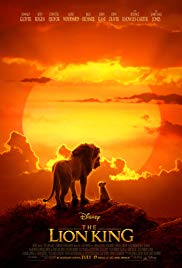
Greetings again from the darkness. If you have come here to read yet another take on how this next-gen remake of a beloved film doesn’t bring anything new to the story, you’ve come to the wrong place. I love cinema as an art form, and when analyzing a movie, I typically look for the good and enjoyable, rather than focusing on every element I might be able to criticize … never forgetting that the on screen presentation is the culmination of work performed by many dedicated people so that I might sit back in a comfy seat within the confines of an air-conditioned theatre and be entertained for a couple of hours. And entertained I was.
It only takes a few moments for the awe to set in. The look is at times so realistic that kids may actually believe animals can talk. More than once the fur of an animal or the splash of the river reminded of a National Geographic program with ultra-High Definition photography. So let’s clear up something right now. This has been labeled as a “live action” remake of the animated classic from 1994. You should know, even if your eyes tell you otherwise, that there is nothing “live” in the film. Instead, everything you see on screen is computer-animated/generated. No, the lions and elephants aren’t real and neither are the trees or distant mountains. The look of the film is as revolutionary as when the first TOY STORY stunned us in 1995. We had never seen animation like that then, and we’ve never before seen computer effects like this. What is familiar are two early songs, “The Circle of Life” and “I Just Can’t Wait to be King”.
Of course, neo-realism can be admired only as a technical achievement when we are discussing a movie in which lions talk and warthogs sing. So while we marvel at the technical achievement, let’s not lose sight of the story … what made the original so popular and beloved 25 years ago. Although it’s approximately a half-hour longer than the original, this one is exceedingly close to a scene-for-scene remake. Only minor tweaks will be noticed, mostly in the demeanor of Scar and the banter between Pumbaa and Timon – each actually improving on the first film. What remains is the coming-of-age story that will now touch many new hearts and minds.
Kids will be immediately entranced with the cubs, Simba and Nala, voiced by JD McCrary and Shahadi Wright Joseph (the daughter in Jordan Peele’s US), and with Zazu (voiced by John Oliver), the goofy and comical bird tasked with keeping an eye on the two adventurous youngsters as they get themselves into trouble. James Earl Jones (now 88 years old) reprises his iconic voice role as the wise Mufasa, and Alfre Woodard voices Sarabi, the pride’s leading female. Chiwetel Ejiofor is excellent as the bitter Shakespearian villain Scar, but I couldn’t help but wish Jeremy Irons had returned for this interpretation of the jealous and power-hungry brother of Mufasa.
The energy level jumps once Simba meets Pumbaa the warthog and Timba the meerkat. Seth Rogen and Billy Eichner take the comedy routine to a new place, and we can only assume much of their banter is off-script. Kids may not get every joke, but they are sure to respond to this odd couple. Donald Glover and Beyonce voice the grown Simba and Nala, and both are outstanding – especially with their singing (no surprise there). Nala’s role is expanded a bit … as expected when you cast Queen Bey. Her original song “Spirit” is included but it’s her duet with Glover on “Can You Feel the Love Tonight?” that is a real musical standout.
Director Jon Favreau has been in the chair for such hits as IRON MAN 2 (2010), IRON MAN (2008), and ELF (2003), and he was also behind Disney’s live-action remake of THE JUNGLE BOOK (2016). The writing credits belong to Jeff Nathansan (CATCH ME IF YOU CAN, 2002) for the screenplay, Oscar winner Brenda Chapman (BRAVE, 2012) for the story, and Irene Mecchi, Jonathan Roberts, and Linda Woolverton for the characters. The latter three were among the 28 writers credited for the 1994 version. Also back is composer Hans Zimmer, who won an Oscar for his 1994 score, and songwriters Elton John and Tim Rice, also Oscar winners for their 1994 song, “Can You Feel the Love Tonight?”.
The beloved 1994 version didn’t win the Oscar for Best Animated Feature film because the award didn’t exist until 2002; however, it did spawn the 1997 Broadway smash musical. This more realistic version is rightly rated PG rather than G, as some of the scenes are likely to be a bit intense for younger viewers. And it’s important to remember that this version is meant to bring Simba’s story to a whole new generation – it’s not meant to replace the 1994 version for those who were kids when it came out so many years ago. The story and characters, while familiar to those age 30 and up, will be a whole new viewing experience for today’s kids. So while we may prefer the 1994 animated version, kids today will likely be enthralled by this updated look. And we all better get used to it, because Disney has 18 more “live action” remakes in the works (some of which will actually be “live” action).
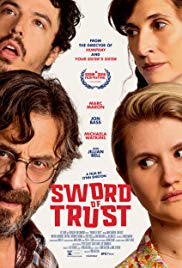
Greetings again from the darkness. Lynn Shelton has put together a very successful career that began with her contributions to the early days of mumblecore (Andrew Bujalski, the Duplass brothers, et al). Along with her filmmaking, she has mixed in some fine TV work, including multiple episodes of “GLOW”, “Fresh Off the Boat”, and “New Girl”. This time out, with a script she co-wrote with Mike O’Brien, she stays true to her offbeat roots and love of characters with character.
There is a story here, and in fact, it was the synopsis that contributed to me agreeing to review this one … well that, and the previous work of Ms. Shelton. Cynthia (Jillian Bell) and her partner Mary (Michaela Watkins) have returned to Alabama with the expectation of inheriting Cynthia’s grandfather’s house. Instead of the house, Cynthia instead walks away with an antique sword, whose accompanying drawing and handwritten letter supposedly prove that the South won the Civil War.
A visit to Mel’s Pawn Shop begins the process of finding a buyer for the sword. Cranky Mel is played by Marc Maron, best known for his stand-up comedy. As a shop owner, he seems constantly annoyed by his dim bulb employee Nathaniel (Jon Bass). The two couldn’t be more different, as Nathaniel spends his work days plugged into conspiracy podcasts (including one run by the film’s co-writer Mike O’Brien in a quick cameo). However, it’s Nathaniel that discovers the “truthers” who believe the ‘South won the war’, and are the best possible fit as buyers for Cynthia’s sword.
Director Shelton makes an appearance as Deirdre, Mel’s former lover. As a couple, their rocky history includes significant drug use and little contribution to society. Also appearing is Toby Huss as Hog Jaws, the oddball middleman involved with the sword transaction. “Seinfeld” fans will recall Mr. Huss as “The Wiz” from that popular show.
This is a deep cut indie, and the humor will either appeal to you or you’ll find it absolutely absurd (or maybe both). The entertainment is derived from the ‘little’ moments and the manner in which the characters interact. It appears many scenes were improvised, a trait of early Shelton projects, and with such talented comedy actors, it’s no wonder. The offbeat story simply exists to give these actors a reason to be funny … something they do quite well.
 Greetings again from the darkness. With the momentum of the #MeToo movement, and the attention being paid to harassment and discrimination in all walks of life, there really is no better time for a film that tells the story of Brian Banks. We are counseled to believe women as they recount their heart-breaking and life-altering stories, and it’s Mr. Banks’ story that reminds us what should matter in all situations … truth and justice.


 Posted by David Ferguson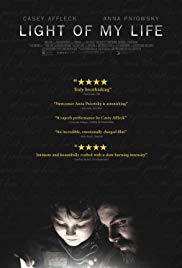




 Movie Reviews from the Dark