GREED (2020)

March 5, 2020

 Greetings again from the darkness. “Greed for lack of a better word, is good. Greed is right. Greed works.” Those words were part of the iconic speech from Gordon Gekko (an Oscar winning role for Michael Douglas) in Oliver Stone’s 1987 film WALL STREET. Here we are 3 decades later, and there may not be a more tarnished word, attitude, or approach than ‘greed’, and filmmaker Michael Winterbottom re-teams with his “The Trip” collaborator Steve Coogan to deliver satire on today’s ultra-rich.

The always entertaining Mr. Coogan stars as Sir Richard McReadie, also known in the media by numerous other names like: Greedy McReadie, McGreedy, The King of High Street, and The Monet of Money (a label he seemingly applied to himself). Sir Richard is apparently modeled after fashion mogul Sir Philip Green (owner of Top Shop), and with his fake tan and blinding white teeth caps, makes a pretty easy target for Winterbottom’s bashing of the too-rich.

A loose structure to the film is provided by the contrast of the coordination and excess going into planning McReadie’s upcoming 60th birthday toga bash on the Greek isle of Mykonos, and the official inquiry by Parliament into his questionable business practices. Scenes from the committee hearings are interspersed throughout the film, along with some flashbacks to young McReadie (played by Jamie Blackley) honing his negotiation skills. There is also McReadie’s hired biographer Nick (played by David Mitchell), a spineless freelancer thrilled to have the job, despite his initial obliviousness to what McReadie is all about. Although Nick does uncover some of the cruel labor practices, the character seems to be a way for Winterbottom to poke at journalists simultaneously to his scalding the rich. Celebrities for hire also take shot to the bow.

Isla Fisher plays Samantha, McReadie’s ex-wife, whose Monaco residence helps hide the family/ex-family fortune. The relationship between these two is not just creepy on the balance sheet, but plays out in ways apparently acceptable to the lifestyles of the wealthy. Asa Butterfield plays their overlooked and underappreciate son Finn, and the always fabulous Shirley Henderson plays Irish mother Margaret in such a way that we wish more of the movie was about her. McReadie’s daughter Lily (Sophia Cookson) is pretty funny as she films her Reality TV show in the midst of her father’s party preparation … which includes Bulgarian workers building a replica of a Roman amphitheater to act as the site of a GLADIATOR reenactment – replete with a live lion (not a tiger)!

Sarah Solemani and Dinita Gohil play two of McReadie’s key assistants, and provide us a glimpse of how real people struggle to work amidst such waste and ego and unrealistic expectations. McReadie kinda quotes Shakespeare, but we feel certain he’s not a well-read man. Instead his talents are in bending a system and forcing others to acquiesce to his demands. The tabletop shell game he mastered as a parlor trick is really just a miniaturized version of his business empire … trading one highly-leveraged enterprise for the next, while cashing in on the process.

Winterbottom’s approach is often confusing and sometimes drifts towards mockumentary for flashbacks and interviews. It’s an uneven comedy that works at times, and doesn’t at others – not uncommon for satire. Coogan makes McReadie always fun (in a disturbing way) to watch, though the film never clicks better than the Keith Richards moment near the end. The anger-based acidic comedy satirizes what’s happening in the real world, and tries to further expose how the mega-rich take advantage of the rest of us. Some well executed bits make this one worth watching, but really offers little in the form of insight or solutions. Instead it’s just infuriating … at least in the parts where we aren’t laughing. We certainly don’t laugh over the closing credits as real world statistics are provided regarding inequality and third world labor.

watch the trailer:


THE BANKER (2020)

March 5, 2020

 Greetings again from the darkness. The ‘long con’ usually doesn’t work for movies since the story must be told within a 2 hour window. However, writer-director George Nolfi and co-writers Brad Kane, Niceole R Levy, David Lewis Smith and Stan Younger deliver a story inspired by the true actions and events of men who found a clever way to circumvent a system designed to prevent people of color from succeeding in business.

Anthony Mackie puts on glasses and a few sharp suits to play Bernard Garrett. We see young Bernard as a shoeshine boy in Willis, Texas in 1939, eavesdropping on the businessmen as they chat about high finance, and then taking notes on subjects such as return on investment and calculating property value. Young Bernard grows into a math whiz adult … one whose ambition is hampered only by the color of his skin. He has a chip on his shoulder and is intent on proving the world wrong. His supportive wife Eunice (Nia Long) introduces him to Los Angeles entrepreneur Joe Morris (Samuel L Jackson), whose enterprising approach and bold lifestyle both complements and contrasts with Bernard’s ambition and straight-laced personality.

Bernard realized early on that in order to build the real estate portfolio he envisioned … one that could provide opportunity for others in the black community … he needed the face of a white man to handle the negotiations. Initially that white face belonged to Patrick Barker (Colm Meaney), and the business grew quickly. Things really take off for the Garrett – Morris partnership when they begin training Matt Steiner (Nicholas Hoult) how to be the face of the company. Bernard’s shrewd business and financial sense flies over Steiner’s head, but with practice, he learns to “act” the part. Steiner’s training involves everything from golf to math to dinner table etiquette.

It was the late 1950’s and early 1960’s … racism was rampant. The Garrett – Morris story plays like an underground rebellion, and one that is surprisingly fun to watch unfold on screen. While the two men built their personal wealth, their actions also helped fight against racism and inequality. They ended up owning 177 buildings, and things might have continued on had Garrett not, against Morris’ better judgment, decided they were strong enough to change things back in his hometown of Willis, Texas. Morris labeled Garrett’s plan as “social activism” rather than business. Their real estate venture morphed into banking so that blacks could have access to business and personal loans. What seemed like a minor misstep from Steiner, blew the wheels off and created a worst case scenario for Garrett and Morris.

Mackie, Hoult and Jackson are all fun to watch here, with Mr. Jackson offering up many of his patented reaction shots and laughs. If anything, the filmmakers play things a bit too safe with the story-telling. It’s all a bit too slick and glossy, given the times. Sure, it’s a pleasure to see what amounts to a classic car show on the street, but it’s difficult to imagine things went quite this smoothly right up until they didn’t. This is an Apple TV production, and its release was delayed due to controversy surrounding Garrett’s second wife (not depicted in the film) and his son, who was originally listed as a Producer. An “Inspired by true events” banner to open a film typically means some dramatic license was taken, which we can assume was the case here. Regardless, the story of Bernard Garrett and Joe Morris and Matt Steiner is fascinating, and worthy of being told.

watch the trailer:


GO BACK TO CHINA (2020)

March 5, 2020

 Greetings again from the darkness. Seeing Chinese films reach mainstream status is a nice development in a cinematic industry that too often segments by nationality. Jon M Chu’s CRAZY RICH ASIANS was a huge hit in 2018, and then last year Lulu Wang’s brilliant THE FAREWELL was a favorite. Now comes a semi-autobiographical tale from writer-director-producer Emily Ting. All three films revolve around Americanized young adults revisiting their Chinese roots, though each for different reasons.

Anna Akana stars as Sasha Li, a twenty-something one year removed from fashion school. We first see her on her birthday botching a job interview and running up a monster bar tab with her posse of friends at the club that night. Having ignored calls from her father in China, she is shocked and humiliated when she discovers her dad has cut her off from the trust fund she has been blowing through living the high life in Los Angeles. As viewers, we are immediately turned off by Sasha’s immaturity and spoiled self. When her dad offers her a deal … come back to China and work in his toy factory for a year in order to get her trust fund back, we (and her friends) see it as a no-brainer. But it’s not until she gets an eviction notice and discovers her mother (Kelly Hu) is also being cut off, that she makes the decision to head back to the homeland.

Once Sasha is back in China, all of the pieces to the puzzle are present. It’s a dysfunctional family headed by the father Teddy (Richard Ng) who seems dedicated to being a successful businessman, while proclaiming he’s doing it all for the family … a family that consists of multiple offspring from multiple women. His oldest daughter Carol (Lynn Chen) is Sasha’s half-sister, though they barely know each other. Carol has been a dutiful loyal soldier to dad’s toy company, and a bit envious of Sasha’s free-wheeling lifestyle. Carol believes she has paid her dues, and it’s now time for Sasha to pay hers. Sasha also meets two younger half-siblings, as well as a particularly young Lulu (Kendy Cheung), whose role Teddy describes as “she takes care of me.” Yuck.

What happens next is relatively predictable. Sasha’s fashion design skills prove valuable to dad’s stale line of toys, so her ideas bring new life to the company and the employees. The latter are impacted by Sasha’s insistence on better working conditions. Of course, Sasha being Sasha, her lack of business savvy leads to problems and a fallout. The film’s wrap up is a bit too clean for the real world, but Ms. Akana has managed to win us over by this point, so we are apt to overlook the script and story issues.

Richard Ng seems a bit too old for his role as Teddy, but he excels in the business scenes where frustrations boil over. Teddy fails miserably as a father or relationship partner, but his instincts with Sasha seem sincere. Filmmaker Ting includes some commentary on social and cultural issues in China, including the ‘One Child Policy’, and the labor practices and family pressures. The film is part ‘coming of age’, part ‘coming home’, and part ‘coming to grips’. The life lessons for Sasha are quite clear as she transitions from spoiled princess to reality-based citizen. Her family may still be packed with dysfunction, but then, whose isn’t? Part of maturity is learning to deal with it, and understand that family does matter.

watch the trailer:


EMMA. (2020)

February 27, 2020

 Greetings again from the darkness. Choosing Jane Austen’s beloved 1815 novel for one’s feature film directorial debut is an ambitious decision, and one for which photographer Autumn de Wilde proves she is up to the challenge. Ms. de Wilde and screenwriter Eleanor Catton may have added a period to the title to distinguish this version from the 1996 film starring Gwyneth Paltrow, or perhaps it was a personal stamp proclaiming this to be the definitive version. Regardless, coming on the heels of Greta Gerwig’s superb LITTLE WOMEN, both films blend a timeless literary classic with contemporary talent and attitude. Additionally, viewers may note some tonal similarities to this and the 2018 hit THE FAVOURITE (for which Oliva Colman won an Oscar).

It’s one of the finest crafted and most famous opening lines in the history of literature: “Emma Woodhouse, handsome, clever, and rich, with a comfortable home and happy disposition, seemed to unite some of the blessings of existence; and had lived nearly twenty-one years in the world with very little to distress or vex her.” The decision to cast mega-talented rising star Anya Taylor-Joy (THOROUGHBREDS, THE WITCH) as Emma provides a level of deliciously wicked entertainment that we can only hope Ms. Austen envisioned. Emma is spoiled and not really very likable, and though she sees herself as an all-knowing matchmaker, her family wealth and social status do little to override the quite common level of immaturity and faux-wisdom associated with her age.

For those unfamiliar with the novel, you may experience a slow build-up to connection with the characters … of which there are many who appear early on and with little introduction. Emma lives in her “comfortable” home Hartfield with her father (an offbeat and slyly comical Bill Nighy). Days are spent visiting and being visited by a community of folks who seem to have little to worry about in life other than who might marry whom. When young Harriet Smith (a terrific Mia Goth, A CURE FOR WELLNESS, 2017) comes to live with Emma, Harriet’s naivety causes her to easily fall under Emma’s matchmaking spell – resulting in some awkward moments and regretful decisions.

Interesting characters are everywhere we turn. Mr. Elton (an energetic and riotous Josh O’Connor) is the local vicar who is both amusing (“Inn-O-cence”) and a bit difficult to read, as Emma misinterprets his intentions causing one of the more startling developments. Frank Churchill (a stout and smirking Callum Turner) is initially one of the community’s more mysterious characters, and his looks and future holdings make him a desirable catch. Jane Fairfax (Amber Anderson) carries on a nuanced rivalry with Emma, and brings a new dynamic when she visits her chatty and ‘’try-so-hard” aunt, Miss Bates (a marvelous turn from Miranda Hart). As viewers we find Miss Bates to be at least as entertaining as Emma herself. Later in the film, Mr. Elton takes a bride (Tanya Reynolds), and her character provides a welcome and unsettling spark at just the right time.

Of course, it’s Mr. Knightley (played by musician Johnny Flynn, BEAST, 2017) who provides the moral backbone of the story. He seems to be the only one (other than her father) who recognizes the shred of goodness buried within Emma. Mr. Flynn gives a soulful performance, and is responsible for the single most touching scene in the film – a simple gesture of asking for a dance. Beyond that, his verbal sparring with Emma is usually morality based, or at straddling the line between politeness and rudeness. Ms. Taylor-Joy and Mr. Flynn and Ms. Hart are stand-outs in a superb cast that delivers the goods in each and every scene.

What makes the Austen novel, and the film, so captivating are the issues of romance, marriage, age, and social status woven into each moment – each dramatic turn laced with comedic undertones. Subtext abounds in every conversation and interaction, and words spoken do not always carry the same message as body language or a glance. To top things off, the film is beautiful to look at. The dreary lighting often associated with period pieces is non-existent, and the costumes and set design are extraordinary. The score from Isobel Waller-Bridge and David Schweitzer is a perfect fit, and allows us to recall that for the 1996 EMMA, composer Rachel Portman won the Oscar … the last female to win until this year when Hildur Guonadottir won for JOKER. It should also be noted that the 1995 film CLUELESS with Alicia Silverstone was a modern-day take on the Austen novel, and regardless of the format (or whether there is a period in the title), Emma continues to be “handsome, clever, and rich.”

watch the trailer:


BURDEN (2020)

February 27, 2020

 Greetings again from the darkness. For someone to truly change their core being, they must have a reason. “Because it’s the right thing to do” is usually not enough … it must be something much deeper like self-preservation or love. For Mike Burden, self-preservation was what kept him loyal to the Ku Klux Klan, while love is what drove him to walk away. The film is based on a true story from 1996 in Laurens, South Carolina, and it’s the feature film directorial debut of Andrew Heckler (who also wrote the screenplay).

Garrett Hedlund plays Mike Burden, a war veteran and dedicated Klan soldier who helped open the Redneck KKK Museum. The leader of the local KKK chapter is Tom Griffin, played by Tom Wilkinson. Griffin is a despicable man and a father figure to Mike. The great Forest Whitaker (Oscar winner for THE LAST KING OF SCOTLAND, 2006) plays local Reverend Kennedy, who preaches love and forgiveness while leading his congregation in protest of the new museum.

Poverty permeates the town of Laurens every bit as much as racism. Mike is employed by Griffin in his repo business, and drives around town in a truck advertising ‘Plantation Concrete’, a business name obviously selected for effect. These poor southern whites take out their frustrations on the only group they view as lower than themselves – local black folks.

Mike’s job has him crossing paths with Judy (the always excellent Andrea Riseborough), a single mom just trying to survive and raise her son the right way. Sparks fly between Mike and Judy, and she delivers an ultimatum. His choice to walk away from the Klan for love means his life, and Judy’s, gets immediately much tougher. An extraordinary act of kindness from Reverend Kennedy has its own ramifications, and the complexity of racism begins to show.

Supporting characters are played by Tess Harper (Tom’s wife), musician Usher Raymond (Judy’s friend), Crystal Fox (Reverend Kennedy’s wife), and Dexter Darden (Reverend Kennedy’s teenage son). Each of these characters offers a glimpse at how hatred evolves and perpetuates, especially in a poverty-stricken small southern town. Unfortunately, two hours is simply not enough to dig deep or make sense of systemic racism. However, personalizing the feelings can shine some light on the topic.

Director Heckler met with Reverend Kennedy in the late 1990’s and was able to write the story based on the conversations. As the film ends, we see actual clips of interviews with Reverend Kennedy, Judy, and Mike Burden … leaving us to wonder if a stellar documentary might be buried in the video vault. The film was an audience winner at Sundance in 2018, and it appears 8-10 minutes have been edited out, leaving a better paced film. The hand-held camera work works against the natural drama and tension of most scenes, although the film does provide some insight into how a person might go about rehabilitating their own poisoned thoughts. And that’s certainly worth a look.

watch the trailer:


STANDING UP, FALLING DOWN (2020)

February 20, 2020

 Greetings again from the darkness. Billy Crystal hasn’t starred in a film since 2012’s PARENTAL GUIDANCE. Sure, he’s had some appearances in movies and TV shows, and done some voice acting, but that’s a lot of years between top-lining gigs. It seems writer Peter Hoare (KILLING HASSELHOFF, 2017) and director Matt Ratner (his first feature film) know exactly what to do with the now 71 year old legendary comedian, and it makes perfect sense that Mr. Crystal chose this role to end his drought.

Scott Rollins (Ben Schwartz, “Parks and Recreation”) is a 34 year old struggling/failed stand-up comic who moves back home after a four year stint trying to make it in the Los Angeles comedy scene. His eternally-chirpy mother (Debra Monk) is thrilled to have him back in his room, but his business owner dad (Kevin Dunn) stays put in his recliner, his 30 year old sister (Grace Gummer, daughter of Meryl Streep) immediately starts jabbing him for failing (after all, she manages a pretzel stand at the mall), his friends have moved on with their own wives and kids, and Becky (Eloise Mumford), the dream girl ex that he deserted to pursue his dreams, has married another guy. Welcome to adulting Scott.

One of the most awkward ‘meet-cutes’ occurs when an inebriated Marty bumps into Scott on his way to urinate in the local pub’s restroom sink. Soon Marty, who doubles as town-drunk and a dermatologist, is treating Scott’s stress rash. The two strike up an odd friendship and the elder Marty is heard doling out life philosophy like, “Regret is the only thing that’s real”, and “Nobody has their life figured out.” Weed is also involved as the two similarly lost souls, separated by generations, find common ground in coming to grips with their individual missteps.

We glimpse more similarities as the backstories are unfolded for Marty and Scott. The elder man’s two wives and two kids have resulted in loneliness and pain for the once successful (we can tell by his house) medical professional. His son Adam (Nate Corddry) angrily blames Marty for his mother’s death, and daughter Taylor (Caitlin McGee), is mostly too busy for her old man. The younger Scott, previously broke off a solid relationship with Becky to pursue his dream. There was no conversation, just the actions of a younger man’s whims. It’s only now that he’s questioning what matters in life.

Many clichés are leaned on and some quite familiar ground (do new friends really take the podium at funerals?) is covered, but it’s enjoyable to watch an old pro like Mr. Crystal do what he does best. And the life lessons may be simple and obvious, but they are also ones that so many fail to learn until late in life. Some of the humor is offered with a twist. For instance 1986 is featured via HOWARD THE DUCK and Clemens versus Strawberry. Mostly the comedy plays the role of masking loneliness, and it seems when combined with friendship, that’s a more effective salve than alcohol. Writer Hoare (whose face is on the giant photo at the wake), leaves us with: “Lightning never strikes twice, but it can strike again.” Just like Billy Crystal.

watch the trailer:


DOWNHILL (2020)

February 13, 2020

 Greetings again from the darkness. Overwhelming apprehension. That’s the feeling I had walking into the theatre for the Americanized re-make of one of my top 10 favorite movies from 2014 … FORCE MAJEURE. Sure, it’s common practice for U.S. filmmakers to farm international cinema for “new” projects, but when they mess with the really good ones, I can’t help but feel nervous to the point of dread. A sliver of hope existed since this new version was co-written (along with Jesse Armstrong, creator of “Succession”, and Oscar nominated for IN THE LOOP) and co-directed by Nat Faxon and Jim Rash, the creative forces behind THE WAY WAY BACK (2013).

Julia Louis-Dreyfus and Will Ferrell star as married couple Billie and Pete. Along with their two teenage sons, they are on an Austrian ski trip meant to help Pete get through grieving his father’s death, and bring the family closer together. If you have seen the original or the trailer, you know what happens next. Pete’s reaction to a near catastrophic event creates a divide between him and the family … especially Billie, who is left shaken. This part is all quite similar to the original film, yet this version is different in so many ways.

Casting two brilliant comedic performers in the lead sends a strong signal that humor will play a role, and that the exceptional gravitas from filmmaker Ruben Ostlund’s FORCE MAJEURE will be softened somewhat. Both of those points hold true. However, surprisingly, this re-make manages to still generate some of the shaken-to-the-core emotions that come from having trust broken in such a startling manner. Ms. Louis-Dreyfus is especially strong here, and carries a much heavier load than Mr. Ferrell. As she is balancing her shock, frustration, and anger, while still attending to their equally shaken boys, Mr. Ferrell is relegated to spending much of the film wearing a wounded puppy look as he attempts to move on without addressing the issue.

Adding to the comedy elements are Zoe Chao (“The Comeback”) and Zach Woods (“The Office”) as Pete’s friends who get drawn into the fracas. Miranda Otto takes a break from her usually dramatic roles to play Charlotte, a wacky resort employee whose personality is a bit out of step with normalcy; although her zaniness succeeds in preventing the weight of the event from crushing Billie. Fans of the original will recognize Kristofer Hivju, who plays a resort security advisor this time. Another difference is that the kids (Julian Grey, Ammon Jacob Ford) play a bigger role in the family dynamics and fallout.

It’s clear that filmmakers Faxon and Rash set out to purposefully make a more mainstream, accessible movie than the Swedish version. The film remains effective at generating conversation about survival instinct and protecting one’s loved ones. It should be mentioned that this is not a typical Will Ferrell movie, and anyone expecting Frank the Tank, may only be pleased with one brief scene. Instead, this is about a man coming to grips with how his actions affected his family, and even his view of himself.

watch the trailer:


THE LIGHTEST DARKNESS (Samaya svetlaya tma, Russia, 2019)

February 12, 2020

 Greetings again from the darkness. In the movie world, good things rarely happen on a train. In fact, whether it’s the train whistle, the train depot, or the passenger compartment, it’s a warning to viewers that this journey is troubled. So brace yourself. This may be the first feature film for Russian writer-director Diana Galimzyanova (known for video and documentary shorts), but her visual flair and nods to cinematic history are evident and welcome.

It’s billed as the first female directed Russian noir, and it’s clear Ms. Galimzyanova offers up a tip of the cap to Alfred Hitchcock (and others) in this homage to 1940’s Film Noir. Filmed in stark black and white for dramatic effect, the film features a very interesting story structure. Events move forward for the characters on the train, but their individual backstories are revealed in reverse chronological order via flashbacks and recollections. It’s both linear and reverse linear … requiring the viewer to pay attention and keep up!

So, who are these characters? We have Ruslan, the OCD private detective played by Rashid Aitouganov. The self-described “Crime Solver” has his frustrations at being unable to solve a case playing out with him compulsively wiping his hands. Next we have arrogant and judgmental concert pianist Elina played by Marina Voytuk. Elina boasts that her face is recognizable from the marketing posters for her concerts. Lastly we meet screenwriter Arina, played by Irina Gevorgyan. Arina claims she is researching for her computer game being written from the perspective of the murderer.

What murderer you ask? Well it turns out there is a serial killer nicknamed The Fruiterer, who is responsible for 6 murders over the last 6 months – all on the same train route that our 3 characters find themselves on. The nickname stems from the fresh strawberry the killer leaves by each body. If you enjoy the armchair detective work that goes along with murder mysteries, you’ll get a real kick out of this. Processing the interaction between the characters on the train, and blending in the details we pick up from the flashbacks leaves us filtering out what matters and what doesn’t. During the flashbacks we meet an unconventional therapist name Izolda (Kolya Neukolin) who seems to have a strange power over clients. Izolda is a key character, and also entertaining are the two knockout train conductors who have quite the side gig going on this route they refer to as “murder express.”

The opening of the film shows us a suitcase being packed with instruments of destruction. As with most mysteries, each clue must be taken with a grain of salt. Strangers, suitcases, secrets and strawberries all play a part in keeping us off balance. The film works thanks to the psychological uncertainty as we attempt to assess each character and what each tidbit means. When one of the characters says, “I can’t stand to talk to grieving people. They are so self-absorbed”, we understand each of these people has their flaws, but no one jumps out as the obvious killer.

The black and white photography, harsh lighting with shadows, and story structure add elements to the suspense and the surreal tone of the film. The camera angles and shots via mirrors, as well as the disconcerting score (often harpsichord) add intrigue to the bounty of clues and fake clues. It’s a fun movie to watch and a challenge to try and solve ahead of the reveal. For fans of murder mysteries and/or Film Noir, it’s a train ride worth taking.

watch the trailer:


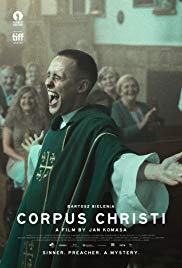
CORPUS CHRISTI (Boze Cialo, 2019, Poland)

February 6, 2020

 Greetings again from the darkness. There are two camps of thought. You either believe people don’t change, or you believe that people can change. This feature film from Poland has been Oscar nominated for Best International Feature Film. In this film inspired by true events, director Jan Komasa and writer Mateusz Pacewicz will challenge your thoughts on people and change, as well as the role of Faith.

Twenty-year-old Daniel (a powerful and mesmerizing Bartosz Bielenia) is being paroled from the Juvenile Detention Center he’s been at since committing a violent crime. While incarcerated, Daniel has experienced a spiritual awakening, and is disappointed when Father Tomasz (Lukasz Simlat) informs him that his criminal record bars him from attending Seminary and becoming a priest. After a night of partying with his old buddies and attending to other releases not permitted at the center, Daniel eschews the provided job at a sawmill. He then stumbles into a temporary spot as a priest in a small community where the elder vicar’s (Zdzislaw Wardejn) health issues require him to take some time off.

Wearing a stolen priest collar, Daniel studies feverishly in order to lead mass and hear confessions. He falls back on what he has seen and heard from Father Tomasz, and even assumes that name for identity. Daniel has stepped into a community that is still reeling from a tragic car accident that took the lives of many locals. The widow (Barbara Kursai) of the “other” driver has been ostracized by the community, while mourners gather at the same site each day. Daniel befriends Marta (Eliza Rycembel), the sister of one of the victims, and he is assisted with his duties by Marta’s mother Lidia (Aleksandra Konieczna), who is suspicious of young Daniel, and still carrying much anger towards the man (and his widow) responsible for her son’s death.

Of course we know, even if Daniel sometimes forgets, that his past will eventually catch up with him. In the meantime, his enthusiasm and sincerity and youthful wisdom win over many in the community, and start the healing process among those who didn’t think it possible. These are people desperate for guidance, and they find themselves drawn to this young man so devoted to helping. Some of the most interesting scenes include the town mayor (Leszek Lichota), who also runs the sawmill. He’s a power broker for the town, and Daniel instantly recognizes his arrogance.

What is true Faith? Has Daniel turned a new leaf or is it an act? We know violence is in his make-up, but we also see that he is actually helping folks – he’s making a difference. There is a funeral procession that is quietly affecting, and the theme of forgiveness is crucial throughout. Mr. Komasa’s terrific film has been very well received at festivals, and it is sure to inspire many deep discussions. People are drawn to those who will assume the pulpit, and though the ending is brutal and crushing, we are reminded that no feeling compares to doing good for others … it’s addictive.

watch the trailer:


STOLEN (Japan, 2020)

February 5, 2020

 Greetings again from the darkness. As the film opens, we are informed that since 1977, there have been 13 confirmed cases of Japanese citizens being abducted by the North Korean government. No reason is known, and countless other “disappearances” are suspected to fall under this same crime. Writer-director Taka Tsubota’s first film could be described as a political drama, a family drama, societal commentary, or international crime mystery. While it touches on each of these, the film, at its core, is a look at the turmoil and anxiety that strikes when a family member goes missing. Importantly, it’s inspired by real life events from within Japan.

The Hiiragi family is a mess. The youngest son, Tetsuya, has gone missing – presumed abducted by the North Koreans, given the history and that no ransom has been demanded. What we witness is the fallout: how each of the family members reacts, how the media treats the story, and how society as a whole leans toward victim-shaming. The father and mother are played by Takahiro Ono and Miwako Izumi, respectively. Dad has a background as a conservative journalist, and the couple experienced some bumpy marital times a few years prior. Both of these items come back to haunt them as the media pokes and prods for a story.

Kaede (played by Mizuki) is the daughter, a hard worker who gets fired from her job due to concerns for her employer’s image. Yuichi (Yuki Kawashima) is the oldest son, and we see him obsessed with boxing. His reasons are initially unclear, but become the heart of the film’s conclusion. Of course, the media (and others) interpret his focus on boxing as indifference towards his missing younger brother, adding fuel to the fire that this is some elaborate hoax meant to attract attention to the father’s political beliefs.

Guilt, confusion, and frustration are spread throughout the family as the media and society turn against them. Their lives are picked apart – past and present – and anything that can possibly be twisted as evidence is thrown at them. Is anything more disturbing than having personal family issues on public display? It’s fascinating to see the many reactions … especially those of the individual family members. Sometimes a family only has each other, and a reminder of this can arrive in many ways – some of which are emotionally draining. Although director Tsubota’s focus is on the Japanese culture, it’s very easy to see the similarities within American society. Victim-shaming is an easy sport in which to participate … just pray the full force is not aimed at you.

watch trailer: